

 |
市場調查報告書
商品編碼
2154755
散熱材料:市場佔有率分析、產業趨勢與統計、成長預測(2026-2031)Heat Dissipation Materials - Market Share Analysis, Industry Trends & Statistics, Growth Forecasts (2026 - 2031) |
||||||

※ 本網頁內容可能與最新版本有所差異。詳細情況請與我們聯繫。
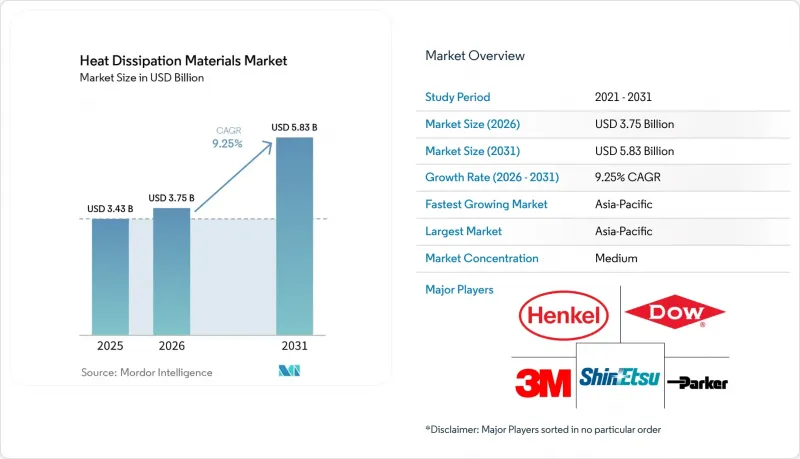
據 Mordor Intelligence 稱,2025 年散熱材料市場價值為 34.3 億美元,預計到 2031 年將從 2026 年的 37.5 億美元成長至 58.3 億美元,預測期(2026-2031 年)的複合年成長率為 9.25%。
全球散熱材料市場趨勢及洞察
人工智慧和高效能運算的功率密度
人工智慧 (AI) 工作負載的不斷成長,使得散熱介面材料的選擇成為伺服器開發中系統級設計的重要要求。 NVIDIA 的 Blackwell 圖形處理器 (GPU) 模組的總圖形功耗超過 575 W,因此持續散熱成為封裝設計的關鍵問題。未來的千瓦級加速器在設計時已考慮到液冷散熱,這對晶片、蓋板、冷板和冷卻迴路之間的可靠介面提出了更高的要求。在厚度小於 50 µm 的鍵合線上,以焊錫為基礎的散熱界面材料的總熱阻為 0.02 K·cm²/W 至 0.08 K·cm²/W,而鎵基液態金屬的界面熱阻則低於 0.05 K·cm²/W。在大型圖形處理器 (GPU) 封裝中,可能會出現 100 µm 至 300 µm 的翹曲,這可能超過材料的標稱厚度,因此對鍵合線進行持續控制至關重要。金屬和液態金屬配方的加入取代了幾個性能較低的聚合物基界面,提高了散熱材料市場中每個機架的價值。
電動汽車電池和電力電子設備的電氣化
電動車平台的電氣化正在改變散熱材料的需求格局,而不僅僅體現在單位用量的增加。在電池組和電池底盤的設計中,間隙填充材料和相變材料直接放置在電池單元之間,而不是作為可更換的維修零件。一旦電池系統通過認證並進入生產階段,材料選擇就成為結構設計決策的一部分。阿爾託大學的研究表明,1毫米至3毫米厚的相變材料屏障可以抑制鋰離子電池模組中電池單元間熱失控的傳播。 2026年5月,漢高公司推出了用於這些結構的無矽間隙填充材料「Bergquist TGF 2030APS」和導熱黏合劑「Loctite TLB 9270APS」。隨著開關頻率和快速充電帶來的熱負載的增加,逆變器、車載充電器和直流-直流轉換器也需要導電灌封材料。隨著經過認證的間隙填充材料在電池平台的整個生命週期中不斷被採用,散熱材料市場的需求變得更加可預測。
填料和特殊金屬的成本波動
特種填料和金屬的價格波動仍然是散熱材料製造商盈利面臨的一大限制因素。氮化硼填料具有良好的電絕緣性和高導電性,但其複雜的合成過程使其價格遠高於標準氧化鋁替代品。這種成本結構降低了中端產品的利潤率,並限制了通用配方中氮化硼的使用量。預計到2025年,中國對鎵的出口限制將使國內鎵的價格上漲至每公斤420美元,將使金屬基配方面臨政策引發的供應中斷風險。銦和銀的成本也會影響焊接用導熱界面材料的性價比。當供應商必須透過熱循環測試來維持材料的覆蓋率和抗翹曲性能時,這種影響尤其顯著。重疊的出口限制使採購、避險、合約談判和庫存策略變得更加複雜。持續的成本壓力可能會限制中小型特種配方製造商的研發能力,並削弱其毛利率的韌性。
細分市場分析
2025年,導熱界面材料的需求佔比達到36.67%,這反映了其在多種電子應用中作為矽元件與散熱器接觸點的用途。此領域涵蓋家用電子電器、資料中心和汽車電力電子等產業,這些產業都需要控制各自組件中接觸面的熱傳遞。 2025年10月,漢高股份公司(Henkel AG & Co. KGaA)將用於800G和1.6T光收發器的「樂泰TCF 14001」產品商業化。本產品的導熱係數為14.5 W/(m·K),矽基揮發性氣體的排放量低於100 ppm。儘管伺服器機架和消費性電子產品對散熱器的需求依然強勁,但在一些超大規模資料中心採用液冷板後,每個機架的散熱器需求有所下降。導熱膠帶用於不適合機械緊固的家用電子電器組裝中,而無矽、光學潔淨的膠帶則在主動式光纜應用中開闢了更多專業用途。
預計到2031年,相變材料將以9.89%的複合年成長率成長。這一成長與電動車架構密切相關,電動車架構需要在電池組件中整合導熱材料,以控制瞬態熱量,避免造成永久性溫度升高。阿爾託大學的報告指出,石蠟膨脹石墨複合相變材料能夠兼顧提升熱性能和可擴展電池模組的使用,其1毫米至3毫米厚的隔離層能夠抑制熱失控的蔓延。其他材料包括導熱黏合劑、灌封膠和封裝材料,用於功率模組、逆變器和馬達驅動器,這些應用需要同時實現結構黏合和熱控制。散熱材料產業正日益將結構、光學、介電和熱性能整合到單一配方中,這增加了認證設計的成本。
區域分析
預計到2025年,亞太地區將佔全球市場需求的42.18%,並在2031年之前以9.93%的複合年成長率持續成長,這主要得益於電子製造、半導體組裝和電動車生產的推動。在中國,電池製造以及智慧型手機和筆記型電腦供應鏈中對導熱材料的消耗,使得國內電動車製造商能夠採用「電芯到電池組」的設計,利用高密度導熱緩衝層實現快速充電。日本和韓國供應先進的半導體封裝、顯示面板製造和汽車電子產品,這些產品需要在裝置堆疊的多個環節中使用高規格的溫度控管材料。印度的「生產連結獎勵計畫計畫(PLI)」支持了該國新興的半導體和電子製造生態系統,鼓勵國際化合物製造商建立在地化的工程和分銷能力。在越南、泰國和馬來西亞,隨著OEM製造商供應鏈多元化,電子組裝的擴張擴大了導熱材料市場的區域基礎。
在北美,市場需求呈現不同的趨勢,主要受美國人工智慧(AI)資料中心和高階汽車應用的驅動。在《晶片法案》(CHIPS Act)的支持下,半導體製造領域的投資正在擴大國內先進封裝產能,隨著相關設施達到量產規模,預計本地對溫度控管材料的消耗量將會增加。政府和國防相關的採購項目也推動了對關鍵電子供應鏈中使用的國產認證材料的需求。在歐洲,由於對永續性和化學品法規的重視(與其他地區的要求有所不同),市場更傾向於選擇不含矽、低鹵素且可回收的散熱材料。德國的汽車電子產業、北歐國家高密度的資料中心以及英國和法國的國防和航太應用都支撐了對高溫穩定化合物材料的需求。
南美洲和中東及非洲的需求規模相對小規模。在巴西,汽車組裝和電動車推廣計畫支撐了需求,一些在地採購需求也促進了國內分銷網路的建立。沙烏地阿拉伯為實現其「2030願景」而對資料中心和數位基礎設施的投資,推動了企業對溫度控管相關產品的需求,使其成為區域需求中心。南非憑藉其成熟的汽車製造地做出貢獻,而全球電子品牌的多區域採購也在其主要生產基地之外創造了相關機會。因此,對散熱材料的需求正在向亞太地區以外的地區擴展,而亞太地區則是主要的製造地。
其他好處:
- Excel格式的市場預測(ME)表
- 3個月的分析師支持
目錄
第1章:引言
- 研究假設和市場定義
- 調查範圍
第2章:調查方法
第3章執行摘要
第4章 市場狀況
- 市場概覽
- 市場促進因素
- 人工智慧和高效能運算的功率密度
- 透過電池和電力電子設備實現電動車的電氣化
- 先進的半導體封裝和晶片架構
- 5G、6G 以及光學模組的引入
- 高頻電子設備中熱效應和電磁干擾的協同設計
- 市場限制因素
- 填料和特殊金屬的成本波動
- 認證週期和較窄的流程窗口
- 與鍵合線小型化相關的可靠性權衡
- 價值鏈分析
- 波特五力分析
第5章 市場規模與成長預測
- 材料類型
- 熱界面材料
- 散熱器
- 導熱膠帶
- 相變材料
- 其他材料類型
- 透過使用
- 家用電子產品
- 車
- 電訊
- 衛生保健
- 其他用途
- 按地區
- 亞太地區
- 中國
- 印度
- 日本
- 韓國
- 東南亞國協
- 其他亞太國家
- 北美洲
- 美國
- 加拿大
- 墨西哥
- 歐洲
- 德國
- 英國
- 法國
- 義大利
- 北歐國家
- 俄羅斯
- 其他歐洲國家
- 南美洲
- 巴西
- 阿根廷
- 其他南美國家
- 中東和非洲
- 沙烏地阿拉伯
- 南非
- 其他中東和非洲國家
- 亞太地區
第6章 競爭情勢
- 市場集中度
- 策略趨勢
- 市佔率和排名分析
- 公司簡介
- 3M
- Boyd
- Dow
- DuPont
- Electrolube
- Fujipoly America, Inc.
- Henkel AG & Co. KGaA
- Honeywell International Inc.
- Indium Corporation
- Momentive
- PARKER HANNIFIN CORP
- Shin-Etsu Chemical Co., Ltd.
- Wacker Chemie AG
- Wakefield Thermal, Inc.
第7章 市場機會與未來展望
According to Mordor Intelligence, the heat dissipation materials market size was valued at USD 3.43 billion in 2025 and is estimated to grow from USD 3.75 billion in 2026 to reach USD 5.83 billion by 2031, at a CAGR of 9.25% during the forecast period (2026-2031).
Global Heat Dissipation Materials Market Trends and Insights
AI and High-Performance Computing Power Density
Artificial intelligence workloads have made thermal interface material selection a system-level design requirement in server development. NVIDIA Blackwell graphics processing unit modules exceeded 575 W of total graphics power, placing sustained heat removal at the center of package design. Future kilowatt-class accelerators are designed for liquid cooling, which increases the need for reliable interfaces between the die, lid, cold plate, and cooling loop. Solder thermal interface materials achieved total thermal resistance from 0.02 K*cm2/W to 0.08 K*cm2/W below 50 µm bond lines, while gallium-based liquid metals achieved interface resistance below 0.05 K*cm2/W. Large graphics processing unit packages can experience 100 µm to 300 µm warpage, which can exceed nominal material thickness and make consistent bond-line control essential. The heat dissipation materials market gains value per rack when metal and liquid-metal formulations replace several lower-performance polymer interface solutions.
Electric Vehicle Battery and Power-Electronics Electrification
Electric vehicle platform electrification is changing the demand profile for heat dissipation materials beyond a simple rise in unit volumes. Cell-to-pack and cell-to-chassis designs place gap fillers and phase change materials directly between cells, rather than using them as replaceable service components. Material choice becomes a structural design commitment once a battery system has passed qualification and entered production. A review from Aalto University found that 1 mm to 3 mm phase change material barriers can limit cell-to-cell thermal-runaway propagation in lithium-ion battery modules. Henkel AG & Co. KGaA introduced the Bergquist TGF 2030APS silicone-free gap filler and Loctite TLB 9270APS thermally conductive adhesive for these architectures in May 2026. Inverters, on-board chargers, and direct current-to-direct current converters also need conductive potting materials as switching frequencies and fast-charging thermal loads increase. The heat dissipation materials market gains more predictable demand when qualified gap fillers remain embedded within a battery platform for its production life.
Filler and Specialty-Metal Cost Volatility
Specialty filler and metal price changes remain an immediate profitability constraint for heat dissipation materials manufacturers. Boron nitride fillers support electrical insulation and high conductivity, but their complex synthesis makes them materially more expensive than standard alumina alternatives. This cost structure reduces margins for mid-specification products and limits boron nitride loading in commodity formulations. China's gallium export controls pushed domestic Chinese gallium prices to USD 420 per kilogram in 2025, exposing metal formulations to policy-driven supply disruptions. Indium and silver costs also change the price-performance balance of solder thermal interface materials, especially when suppliers must maintain coverage and warpage performance through thermal cycling. Overlapping export-control rules complicate purchasing, hedging, contract negotiations, and inventory strategies. Sustained cost pressure can limit research and development capacity and weaken gross-margin resilience for smaller specialty formulators.
Other drivers and restraints analyzed in the detailed report include:
- Advanced Semiconductor Packaging and Chiplet Architectures
- 5G, 6G, and Optical-Module Deployment
- Qualification Cycles and Narrow Process Windows
For complete list of drivers and restraints, kindly check the Table Of Contents.
Segment Analysis
Thermal interface materials held 36.67% of demand in 2025, reflecting their use between silicon devices and heat sinks across several electronics applications. The segment served consumer electronics, data centers, and automotive power electronics, where each assembly needed controlled heat transfer at a contact surface. Henkel AG & Co. KGaA commercialized Loctite TCF 14001 in October 2025 for 800G and 1.6T optical transceivers, with 14.5 W/(m*K) thermal conductivity and less than 100 ppm silicone volatile outgassing. Heat sinks also retained demand in server racks and consumer devices, although liquid cold plates are reducing heat-sink demand per rack in some hyperscale data centers. Thermal tapes served consumer-electronics assembly, where mechanical fastening was unsuitable, while silicone-free and optically clean tape created a more specialized use case in active optical cable applications.
Phase change materials are projected to advance at a 9.89% CAGR through 2031. Their growth is tied to electric vehicle architectures that embed thermal materials within battery assemblies and require them to manage transient heat without permanent temperature elevation. Aalto University reported that paraffin-expanded graphite composite phase change materials can balance thermal enhancement with scalable battery-module use, and 1 mm to 3 mm barriers can limit thermal-runaway propagation. Other materials include thermally conductive adhesives, potting compounds, and encapsulants for power modules, inverters, and motor drives where structural bonding and heat control are required together. The heat dissipation materials industry is increasingly combining structural, optical, dielectric, and thermal performance in one formulation, which raises switching costs for qualified designs.
Complete Report Scope:
- By Material Type
- Thermal Interface Materials
- Heat Sinks
- Thermal Tapes
- Phase Change Materials
- Other Material Types
- By Application
- Consumer Electronics
- Automotive
- Telecommunications
- Healthcare
- Other Applications
- By Geography
- Asia-Pacific
- China
- India
- Japan
- South Korea
- ASEAN Countries
- Rest of Asia-Pacific
- North America
- United States
- Canada
- Mexico
- Europe
- Germany
- United Kingdom
- France
- Italy
- NORDIC Countries
- Russia
- Rest of Europe
- South America
- Brazil
- Argentina
- Rest of South America
- Middle-East and Africa
- Saudi Arabia
- South Africa
- Rest of Middle-East and Africa
- Asia-Pacific
Geography Analysis
Asia-Pacific held 42.18% of the market demand in 2025 and is projected to advance at a 9.93% CAGR through 2031, supported by electronics manufacturing, semiconductor assembly, and electric vehicle production. China combined battery-cell manufacturing with thermal-material consumption from smartphone and laptop supply chains, while domestic electric vehicle producers adopted cell-to-pack designs that used dense thermal layers for fast-charging thermal buffering. Japan and South Korea supplied advanced semiconductor packaging, display-panel manufacturing, and automotive electronics that required high-specification thermal-management materials at several points in the device stack. India's Production-Linked Incentive (PLI) scheme supported its emerging semiconductor and electronics manufacturing ecosystem and encouraged international formulators to develop local engineering and distribution capabilities. Vietnam, Thailand, and Malaysia expanded electronics assembly as original equipment manufacturers diversified supply chains, broadening the regional base of the heat dissipation materials market.
North America had a different demand profile centered on artificial intelligence data centers in the United States and high-specification automotive applications. Semiconductor fabrication investments supported by the CHIPS Act are expanding domestic advanced-packaging capacity and are expected to increase local thermal-material consumption as facilities reach production scale. Government and defense procurement programs also supported demand for domestically qualified materials used in critical electronics supply chains. Europe favored silicone-free, halogen-reduced, and recyclability-documented thermal materials under sustainability and chemical-compliance priorities that differed from regional requirements elsewhere. Germany's automotive electronics base, Nordic data-center density, and defense and aerospace applications in the United Kingdom and France supported demand for high-temperature stable formulations.
South America, and Middle-East and Africa represented smaller demand areas. Brazil supported demand through automotive assembly and electric vehicle adoption programs, while some local-content requirements encouraged development of domestic distribution networks. Saudi Arabia's Vision 2030-related data-center and digital-infrastructure investments are supporting enterprise thermal-management procurement and positioning the Kingdom as a regional demand center. South Africa contributes through its established automotive manufacturing base, while multi-region sourcing by global electronics brands creates related opportunities beyond core production locations. These conditions broaden demand in the heat dissipation materials market beyond the dominant Asia-Pacific manufacturing base.
- 3M
- Boyd
- Dow
- DuPont
- Electrolube
- Fujipoly America, Inc.
- Henkel AG & Co. KGaA
- Honeywell International Inc.
- Indium Corporation
- Momentive
- PARKER HANNIFIN CORP
- Shin-Etsu Chemical Co., Ltd.
- Wacker Chemie AG
- Wakefield Thermal, Inc.
Additional Benefits:
- The market estimate (ME) sheet in Excel format
- 3 months of analyst support
TABLE OF CONTENTS
1 Introduction
- 1.1 Study Assumptions and Market Definition
- 1.2 Scope of the Study
2 Research Methodology
3 Executive Summary
4 Market Landscape
- 4.1 Market Overview
- 4.2 Market Drivers
- 4.2.1 AI and High-Performance Computing Power Density
- 4.2.2 Electric Vehicle Battery and Power-Electronics Electrification
- 4.2.3 Advanced Semiconductor Packaging and Chiplet Architectures
- 4.2.4 5G, 6G, and Optical-Module Deployment
- 4.2.5 Thermal-EMI Co-Design in High-Frequency Electronics
- 4.3 Market Restraints
- 4.3.1 Filler and Specialty-Metal Cost Volatility
- 4.3.2 Qualification Cycles and Narrow Process Windows
- 4.3.3 Reliability Trade-Offs at Thinner Bond Lines
- 4.4 Value Chain Analysis
- 4.5 Porter's Five Forces Analysis
- 4.5.1 Bargaining Power of Suppliers
- 4.5.2 Bargaining Power of Buyers
- 4.5.3 Threat of New Entrants
- 4.5.4 Threat of Substitutes
- 4.5.5 Competitive Rivalry
5 Market Size and Growth Forecasts (Value)
- 5.1 By Material Type
- 5.1.1 Thermal Interface Materials
- 5.1.2 Heat Sinks
- 5.1.3 Thermal Tapes
- 5.1.4 Phase Change Materials
- 5.1.5 Other Material Types
- 5.2 By Application
- 5.2.1 Consumer Electronics
- 5.2.2 Automotive
- 5.2.3 Telecommunications
- 5.2.4 Healthcare
- 5.2.5 Other Applications
- 5.3 By Geography
- 5.3.1 Asia-Pacific
- 5.3.1.1 China
- 5.3.1.2 India
- 5.3.1.3 Japan
- 5.3.1.4 South Korea
- 5.3.1.5 ASEAN Countries
- 5.3.1.6 Rest of Asia-Pacific
- 5.3.2 North America
- 5.3.2.1 United States
- 5.3.2.2 Canada
- 5.3.2.3 Mexico
- 5.3.3 Europe
- 5.3.3.1 Germany
- 5.3.3.2 United Kingdom
- 5.3.3.3 France
- 5.3.3.4 Italy
- 5.3.3.5 NORDIC Countries
- 5.3.3.6 Russia
- 5.3.3.7 Rest of Europe
- 5.3.4 South America
- 5.3.4.1 Brazil
- 5.3.4.2 Argentina
- 5.3.4.3 Rest of South America
- 5.3.5 Middle-East and Africa
- 5.3.5.1 Saudi Arabia
- 5.3.5.2 South Africa
- 5.3.5.3 Rest of Middle-East and Africa
- 5.3.1 Asia-Pacific
6 Competitive Landscape
- 6.1 Market Concentration
- 6.2 Strategic Moves
- 6.3 Market Share (%)/Ranking Analysis
- 6.4 Company Profiles (includes Global Overview, Market Overview, Core Segments, Financials as available, Strategic Information, Products and Services, and Recent Developments)
- 6.4.1 3M
- 6.4.2 Boyd
- 6.4.3 Dow
- 6.4.4 DuPont
- 6.4.5 Electrolube
- 6.4.6 Fujipoly America, Inc.
- 6.4.7 Henkel AG & Co. KGaA
- 6.4.8 Honeywell International Inc.
- 6.4.9 Indium Corporation
- 6.4.10 Momentive
- 6.4.11 PARKER HANNIFIN CORP
- 6.4.12 Shin-Etsu Chemical Co., Ltd.
- 6.4.13 Wacker Chemie AG
- 6.4.14 Wakefield Thermal, Inc.
7 Market Opportunities and Future Outlook
- 7.1 White-Space and Unmet-Need Assessment

 超低溫空冷模組市場:全球市場預測(2026-2032年)斯特林低溫冷卻器市場:全球市場預測,2026-2032年精密銅散熱器市場:全球市場預測,2026-2032年
 半導體散熱器市場報告:至2035年的趨勢、預測與競爭分析液冷散熱器市場報告:至2035年的趨勢、預測與競爭分析空間低溫冷卻設備市場報告:趨勢、預測與競爭分析(至2035年)
 全球蒸汽室市場預測(至2034年)-按類型、材料、應用、最終用戶和地區分類的分析散熱器市場預測至2034年-按產品類型、材質、製造流程、冷卻技術、應用和地區分類的全球分析
 散熱器:市場佔有率分析、產業趨勢與統計、成長預測(2026-2031)
 熱導板:全球市場