


 |
市場調查報告書
商品編碼
2107342
非小細胞肺癌市場:按癌症類型、分子類型、藥物分類、療法、治療類型、給藥途徑、最終用戶、分銷管道、地區和主要參與者分類的趨勢和預測(至 2035 年)Non-Small Cell Lung Cancer Market by Type of Cancer, Type of Molecule, Drug Class, Therapy, Type of Treatment, Route of Administration, End User, Distribution Channel, Geographical Regions and Leading Players - Trends and Forecast Till 2035 |
||||||

非小細胞肺癌市場概覽
據估計,全球非小細胞肺癌市場規模將從今年的 264 億美元成長到 2035 年的 560 億美元,在整個預測期內複合年成長率為 8.7%。
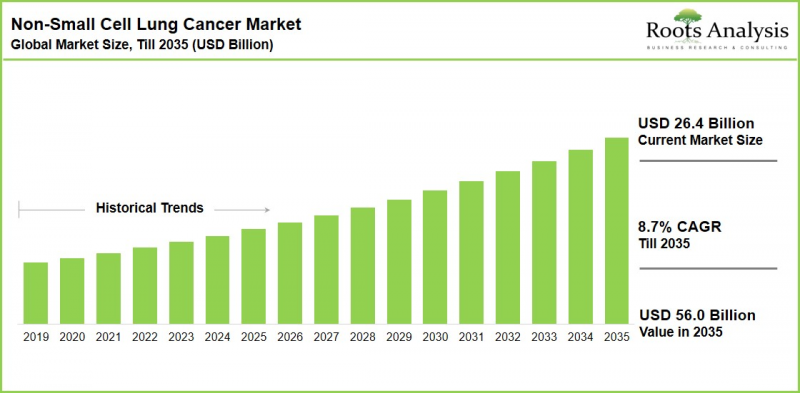
非小細胞肺癌市場:成長與趨勢
非小細胞肺癌(NLC)佔全球肺癌診斷病例的絕大多數。隨著生物製藥公司不斷改進基於生物標記的治療方法和聯合治療的疾病管理策略,NLC的治療格局正在快速發展。由於吸菸、空氣污染和全球人口老化等因素導致的NLC發生率上升,合格治療條件的患者群體也不斷擴大。同時,標靶治療和免疫療法的法規核准正在重塑整個治療線的標準治療路徑。
液態生物檢體技術的進步使得疾病的早期診斷和更精準的即時監測成為可能。這進一步加速了基於生物標記選擇治療方案的廣泛轉變。此外,製藥公司也越來越重視將查核點抑制劑與標靶治療治療或化療相結合的聯合治療,以提高緩解率並應對新的抗藥性機制。
在整個預測期內,競爭格局預計將保持活躍。這種穩定成長歸功於強大的後期臨床試驗管線,預計到2026年將有多個新核准,以及大型製藥企業為加強其腫瘤產品併購和許可活動。隨著基於生物標記的患者細分成為標準做法,非小細胞肺癌市場預計將在整個預測期內保持持續的長期成長。
成長要素:支持市場擴張的因素
非小細胞肺癌市場的發展主要受全球肺癌發生率上升的驅動,而肺癌發生率上升又歸因於生活方式的改變和環境因素的影響。此外,對早期診斷和有效治療監測的需求不斷成長,也進一步推動了市場發展。研發人員正日益致力於基於生物標記的精準治療方法,包括EGFR和ALK抑制劑,以及免疫查核點抑制劑等先進的免疫療法,以提供更具標靶性和療效的藥物。
大量處於後期臨床試驗階段的藥物預計將在2026年下半年獲得批准,進一步拓寬可用的治療選擇範圍。此外,細胞療法和異體移植的持續進步,以及政府對癌症研究的持續投入,都進一步鞏固了市場的長期成長動能。
市場挑戰:阻礙進展的主要障礙
儘管市場成長前景良好,但仍面臨許多挑戰,可能阻礙其擴張。標靶治療和免疫療法的高成本持續限制著部分地區患者的用藥,而對完善的生物標記檢測基礎設施的需求也增加了啟動治療的複雜性和成本。現有標靶治療的抗藥性機制,以及嚴格且不斷變化的區域監管要求,都進一步延長了研發週期並增加了研發成本。
此外,隨著部分第一代標靶治療的專利到期,研發公司面臨來自學名藥和生物相似藥日益激烈的競爭,導致某些細分市場的價格壓力增加。對於希望在該領域最大限度地掌握商業性機會的相關人員而言,應對這些准入、監管和競爭方面的挑戰至關重要。
非小細胞肺癌市場:關鍵洞察
本報告詳細分析了非小細胞肺癌市場的現狀,並指出了分銷合作夥伴、通路仲介業者和服務整合商的潛在成長機會。主要發現包括:
- 從單一治療標準療法轉向雙標靶治療:非小細胞肺癌 (NSCLC) 的治療格局正從蛋白酪氨酸激酶抑制劑 (TKI) 單藥治療轉向雙標靶治療聯合治療模式。楊森公司批准 RYBREVANT®(阿米凡他單抗)+ LAZCLUZE™(拉沙替尼)作為 EGFR 突變陽性 NSCLC 的一線治療方案,這清楚地表明了這種向多通路阻斷療法轉變的趨勢,旨在延緩抗藥性的產生。
- 能夠克服抗藥性的資產獲得高額併購溢價:大型製藥企業正大力投資於能夠針對繼發性抗藥性突變的後期精準藥物。一個關鍵指標是葛蘭素史克(GSK)以106億美元收購其子公司Nuvalent(該公司獲得了後期ROS1抑制劑didesamtinib和ALK抑制劑neradalquib)。
- 專業經銷商和低溫運輸物流:在非小細胞肺癌領域,隨著複雜生物製藥、雙特異性抗體和抗體藥物複合體(ADC) 的擴展,專業經銷商需要加強其低溫低溫運輸追蹤系統和生物處理工作流程,以防止產品在運輸到分散的輸液中心的過程中劣化。
近期交易趨勢顯示投資者情緒高漲。
- 6月:葛蘭素史克宣布將以106億美元收購Nuvalent。這將為該公司的腫瘤產品線增加兩項處於後期研發階段的資產:didesamtinib和neradalquib,目前正在接受FDA對非小細胞肺癌(NSCLC)的審查。
- 5 月:默克公司憑藉其 KRAS G12C 抑制劑 calderasib (MK-1084) 與Pembrolizumab聯合治療療法,作為進行性或轉移性非小細胞肺癌 (NSCLC) 的一線治療方案,獲得了 FDA 的突破性療法認定。
- 5 月:Nuvation Bio 宣布,FDA 已接受其關於 taretrectinib 用於進行性ROS1 陽性非小細胞肺癌的新藥認證申請。
- 二月:FDA 加速核准勃林格殷格翰的 songertinib(Hernexeos)用於治療攜帶 HER2 突變的不可切除或轉移性非鱗狀非小細胞肺癌 (NSCLC) 成年患者。
- 1 月:Summit Therapeutics 宣布,其用於化療先前接受 TKI 治療的 EGFR 突變非小細胞肺癌患者的生技藥品聯合治療化療方案的申請已獲得 FDA 批准。
非小細胞肺癌的市場區隔
市場規模和機會分析是根據以下參數進行細分的:
按類型分類的癌症
- 鱗狀細胞癌
- 腺癌
- 大細胞神經內分泌腫瘤
- 大細胞癌
依分子類型
- 低分子化合物
- 生物製藥
按藥物分類
- 烷化劑
- 抗代謝物
- EGFR抑制劑
- 有絲分裂抑制劑
- 多激酶抑制劑
- 其他
治療類型
- 單藥治療
- 聯合治療
治療類型
- 化療
- 放射線治療
- 標靶治療
- 免疫療法
- 其他
透過行政途徑
- 腸外
- 口服
- 其他
最終用戶
- 醫院
- 居家醫療
- 專科診所
- 其他
透過分銷管道
- 醫院藥房
- 製藥公司和零售藥局
- 網路藥房
按地區
- 北美洲
- 歐洲
- 亞太地區
- 中東和北非
- 拉丁美洲
目錄
第1章:序言
第2章:調查方法
第3章 市場動態
第4章 宏觀經濟指標
第5章執行摘要
第6章:引言
第7章 市場狀況
第8章:公司簡介
- 章節概要
- Amgen
- BeiGene
- Genentech
- Roche
第9章 專利分析
第10章 市場影響分析
第11章 大趨勢分析
第12章:全球非小細胞肺癌市場
第13章 非小細胞肺癌市場(依癌症類型分類)
第14章 非小細胞肺癌市場(依分子類型分類)
第15章 非小細胞肺癌市場(依藥物類型分類)
第16章 非小細胞肺癌市場(依治療方法分類)
第17章 非小細胞肺癌市場(依治療類型分類)
第18章 非小細胞肺癌市場(依給藥途徑分類)
第19章 非小細胞肺癌市場(依最終用戶分類)
第20章:非小細胞肺癌市場(依通路分類)
第21章 非小細胞肺癌市場(依地區分類)
第22章 結論
第23章附錄一:表格形式數據
第24章 附錄二:公司與組織列表
NON-SMALL CELL LUNG CANCER MARKET: OVERVIEW
As per Roots Analysis, the global non-small cell lung cancer market is estimated to grow from USD 26.4 billion in the current year to USD 56.0 billion by 2035, registering a CAGR of 8.7% across the forecast period.
Non-Small Cell Lung Cancer Market: Growth and Trends
Non-small cell lung cancer accounts for the majority of all diagnosed lung cancers worldwide. The treatment landscape of non-small cell lung cancer continues to evolve rapidly as biopharmaceutical developers refine biomarker-driven and combination-based approaches to disease management. Rising incidence linked to smoking, air pollution and an ageing global population continues to expand the eligible patient pool. Meanwhile, a steady stream of regulatory approvals for targeted therapies and immunotherapies is reshaping standard-of-care pathways across treatment lines.
Advances in liquid biopsy technology are enabling earlier diagnosis and more precise real-time monitoring of disease progression. This further supports a broader shift toward biomarker-matched treatment selection. Additionally, the drug developers are increasingly prioritizing combination regimens, pairing checkpoint inhibitors with targeted agents or chemotherapy, to improve response rates and address emerging resistance mechanisms.
The competitive landscape remains progressive throughout the forecast period. This steady growth is potentially due to the dense late-stage pipeline anticipated to deliver multiple new approvals through 2026, alongside continued mergers and acquisitions, and licensing activity as large pharmaceutical companies seek to reinforce their oncology portfolios. As biomarker-defined patient segmentation becomes standard practice, the non-small cell lung cancer market is positioned for sustained, long-term growth through the forecast period.
Growth Drivers: Factors Fueling Market Expansion
The non-small cell lung cancer market is being propelled by the rising global incidence of lung cancer that occurs due to changing lifestyles and environmental exposure. Further, the growing demand for early diagnosis and effective treatment monitoring has further fueled the market growth. Developers are increasingly pursuing precise, biomarker-guided treatment approaches, including EGFR and ALK inhibitors, as well as advanced immunotherapies such as immune checkpoint inhibitors, to deliver more targeted and effective medications.
A rich late-stage pipeline is expected to yield multiple approvals in late 2026, further widening the available treatment options. Additionally, ongoing advances in cell therapies and allogeneic treatment modalities, together with sustained government funding for cancer research, continue to reinforce the long-term growth trajectory of the market.
Market Challenges: Critical Barriers Hindering Progress
Despite favourable growth prospects, the market faces several challenges that could impede its expansion. The high cost of targeted therapies and immunotherapies continues to limit patient access in several geographies, while the need for robust biomarker testing infrastructure adds complexity and cost to treatment initiation. Resistance mechanisms to existing targeted agents, combined with stringent and evolving regulatory requirements across geographies, further add time and cost to development programs.
Additionally, as several first-generation targeted therapies approach patent are about to expire developers face intensifying generic and biosimilar competition, creating pricing pressure across select segments. Addressing these access, regulatory and competitive challenges will be critical for stakeholders seeking to capture the full commercial opportunity within this space.
Non-Small Cell Lung Cancer Market: Key Insights
The report delves into the current state of the Non-Small Cell Lung Cancer market and identifies potential growth opportunities for distribution partners, channel intermediaries, and service integrators. Some key findings include:
- Transition from Monotherapy Standard-of-Care to Dual-Targeted Approaches: The NSCLC landscape is shifting away from single-agent tyrosine kinase inhibitors (TKIs) toward dual-targeted and combination paradigms. Janssen's approval of RYBREVANT(R) (amivantamab) + LAZCLUZE(TM) (lazertinib) for first-line EGFR-mutated NSCLC exemplifies this pivot toward multi-pathway blockade to delay resistance onset.
- Heavy M&A Premium on Resistance-Conquering Assets: Big Pharma companies are making significant investments in late-stage precision drugs that are capable of targeting secondary resistance mutations. A key indicator is GSK's $10.6 billion acquisition of Nuvalent (acquiring late-stage ROS1 inhibitor zidesamtinib and ALK inhibitor neladalkib).
- Specialty Distributors & Cold-Chain Logistics: As complex biologics, bispecific antibodies, and antibody-drug conjugates (ADCs) expand within NSCLC, specialty distributors must upgrade ultra-cold chain tracking and bio-handling workflows to prevent product degradation during transit to decentralized infusion centers.
Recent Deal Activity Signalling Investor Momentum
- In June: GSK announced a USD 10.6 billion acquisition of Nuvalent, adding two late-stage non-small cell lung cancer assets, zidesamtinib and neladalkib, currently under FDA review, to its oncology pipeline.
- In May: Merck received FDA Breakthrough Therapy designation for calderasib (MK-1084), a KRAS G12C inhibitor, in combination with pembrolizumab for first-line treatment of advanced or metastatic NSCLC.
- In May: Nuvation Bio announced FDA acceptance of a supplemental New Drug Application for taletrectinib in advanced ROS1-positive NSCLC.
- In February: The FDA granted accelerated approval to Boehringer Ingelheim's zongertinib (Hernexeos) for adults with unresectable or metastatic non-squamous NSCLC harboring HER2 mutations.
- In January: Summit Therapeutics announced FDA acceptance of its Biologics License Application for ivonescimab combined with chemotherapy in EGFR-mutated NSCLC patients following prior TKI therapy.
Non-Small Cell Lung Cancer Market Segments
The market sizing and opportunity analysis has been segmented across the following parameters:
By Type of Cancer
- Squamous Cell Carcinoma
- Adenocarcinoma
- Large Cell Neuroendocrine Tumors
- Large-Cell Carcinoma
By Type of Molecule
- Small Molecules
- Biologics
By Type of Drug Class
- Alkylating Agents
- Antimetabolites
- EGFR Inhibitors
- Mitotic Inhibitors
- Multi-kinase Inhibitors
- Others
By Type of Therapy
- Monotherapies
- Combination Therapies
By Type of Treatment
- Chemotherapy
- Radiation Therapy
- Targeted Therapy
- Immunotherapy
- Other Treatments
By Route of Administration
- Parenteral
- Oral
- Other Routes of Administration
By End User
- Hospitals
- Homecare
- Specialty Clinics
- Other End Users
By Distribution Channel
- Hospital Pharmacies
- Drugs and Retail Pharmacies
- Online Pharmacies
By Geographical Regions
- North America
- Europe
- Asia-Pacific
- Middle East and North Africa
- Latin America
Non-Small Cell Lung Cancer Market: Key Segments
Adenocarcinoma Leads the Market
Based on Roots Analysis market assessment, the adenocarcinoma segment currently secures highest share of overall market revenue. This leading share reflects the rising incidence of adenocarcinoma among smokers and non-smokers alike, along with strong adoption of biomarker-driven targeted therapies and precision medicine approaches.
On the other hand, squamous cell carcinoma segment is expected to register a comparatively higher CAGR through the forecast period. This lucrative growth is supported by a growing late-stage pipeline focused specifically on this subtype.
Small Molecules Dominate the Market
According to the proprietary market analysis, small molecules currently account for the highest market share. This highest share is driven by their central role in combination regimens that pair targeted small-molecule agents with chemotherapy.
In the long run, the biologics segment is likely to register the fastest CAGR during the forecast period. This unprecedented growth is propelled by the increasing shift toward oncology precision medicines for the treatment of non-small cell lung cancer.
EGFR Leads the Drug Class
Based on the Roots Analysis market report, EGFR inhibitors hold the largest share among drug classes. Notably, this segment will continue to maintain its dominance in the future and also register higher CAGR during the forecast period. This highest share is underpinned by their demonstrated ability to slow cancerous cell proliferation via the epidermal growth factor receptor pathway. In addition, the growing development of next-generation, and biomarker-matched inhibitors to overcome these escape mechanisms, allowing biopharma developers to capture high-value second- and third-line treatment settings.
Targeted Therapy Leads the Market and Immunotherapy Grow at Higher CAGR
Based on the Roots Analysis market report, targeted therapy currently accounts for the largest share of the overall market. This highest share reflects strong demand for tailored, biomarker-matched drugs with lower off-target effects to treat non-small cell lung cancer.
However, the immunotherapy segment is projected to grow at a higher CAGR during the forecast period. This growth is likely to be the result of expanding use of immune checkpoint inhibitors and immunocytokines across earlier lines of treatment.
North America Dominates the Market and Asia-Pacific Registers Higher CAGR
North America currently holds the highest overall market share. This highest share is supported by advanced healthcare infrastructure, high adoption of innovative oncology therapies, and a strong concentration of leading pharmaceutical and biotechnology companies.
On the other hand, Asia-Pacific is likely to grow at a relatively higher CAGR during the forecast period. This lucrative growth is driven by rising smoking-linked incidence, expanding healthcare access, and growing diagnosed patient population.
Hospital Pharmacies Hold the Highest Market Share
Hospital pharmacies currently capture more than 65% of the overall market. This dominance reflects their role as the primary dispensing channel for complex, high-cost oncology therapies including immunotherapies and targeted agents.
Meanwhile, drug and retail pharmacies are expected to grow at a higher CAGR during the forecast period. This growth is due to the expanding roster of FDA-approved therapies that are becoming available through broader retail channels.
Example Players in Non-Small Cell Lung Cancer Market
- Amgen
- AstraZeneca
- Bayer
- BeiGene
- Boehringer Ingelheim
- Eli Lilly
- Genentech (Roche)
- GSK
- Johnson & Johnson
- Merck
- Novartis
- Pfizer
NON-SMALL CELL LUNG CANCER MARKET: RESEARCH COVERAGE
- Market Landscape: A comprehensive analysis of active non-small cell lung cancer drug developers, featuring information on year of establishment, company size, location of headquarters, type of molecule, drug class, therapy type, route of administration, line of treatment, target indication, and dosing frequency.
- Company Profiles: In-depth profiles of prominent players engaged in non-small cell lung cancer drug development, covering company overview, product portfolio, and recent initiatives.
- Patent Analysis: A detailed analysis of patents filed / granted in this domain, based on parameters such as publication year, type of patent, type of applicant, application year, patent jurisdiction, patent age, and leading industry and non-industry players, along with patent benchmarking and valuation analysis.
- Market Impact Analysis: An assessment of the key drivers, restraints, opportunities and challenges influencing the evolution of the non-small cell lung cancer market.
- Mega Trend Analysis: An evaluation of the broader industry and macro-level trends likely to shape the near- to long-term trajectory of the non-small cell lung cancer market.
- Market Sizing and Opportunity Analysis: An in-depth analysis of the market focusing on key segments, including type of cancer, type of molecule, type of drug class, type of therapy, type of treatment, route of administration, end user, distribution channel, and geographical regions.
Key Questions Answered in this Report
- Which are the leading companies developing drugs for non-small cell lung cancer?
- Which region dominates the non-small cell lung cancer market, and which region is growing the fastest?
- What are the key trends observed in the non-small cell lung cancer market?
- What factors are likely to influence the evolution of this market through 2035?
- What is the current and future size of the non-small cell lung cancer market?
- What is the CAGR of the non-small cell lung cancer market through 2035?
- How is the current and future market opportunity distributed across type of cancer, molecule, drug class, therapy, treatment, route of administration, end user, distribution channel and geography?
- What opportunities exist for distribution partners and channel intermediaries entering the oncology supply chain?
- What are the primary challenges faced by non-small cell lung cancer drug developers?
Reasons to Buy this Report
This report is designed to give drug developers, distribution partners and investors a decisive analytical edge in a fast-evolving oncology market. Its core differentiators include:
- Scenario-Based Forecasting: Market estimates are built across conservative, base and optimistic scenarios to account for future uncertainty in key parameters, enhancing the robustness and decision-readiness of the forecast.
- Nine-Parameter Segmentation: Granular segmentation across type of cancer, molecule, drug class, therapy, treatment, route of administration, end user, distribution channel and geography enables precise opportunity sizing for any go-to-market or investment thesis.
- Integrated Patent and Competitive Benchmarking: A dedicated patent analysis chapter, covering jurisdiction, applicant type and patent age, is combined with company-level benchmarking to give a fuller picture of competitive positioning than conventional market-sizing reports.
- 253+ Pages Across 24 Chapters: Comprehensive coverage spanning market sizing, competitive landscape, patent analysis, company profiling, and regional opportunity mapping across five geographies.
- Primary Research-Backed Insights: Findings are validated through direct interviews with thoracic oncologists, medical oncologists and commercial leaders, ensuring insights reflect real-world clinical and commercial dynamics rather than desk research alone.
Additional Benefits
- Complementary PPT Insights Pack
- Complementary Excel Data Packs for all Analytical Modules in the Report
- 15% Free Content Customization
- Detailed Report Walkthrough Session with Research Team
- Free Updated report if the report is 6-12 months old or older
TABLE OF CONTENTS
1. PREFACE
- 1.1. Introduction
- 1.2. Market Share Insights
- 1.3. Key Market Insights
- 1.4. Report Coverage
- 1.5. Key Questions Answered
- 1.6. Chapter Outlines
2. RESEARCH METHODOLOGY
- 2.1. Chapter Overview
- 2.2. Research Assumptions
- 2.2.1. Market Landscape and Market Trends
- 2.2.2. Market Forecast and Opportunity Analysis
- 2.2.3. Comparative Analysis
- 2.3. Database Building
- 2.3.1. Data Collection
- 2.3.2. Data Validation
- 2.3.3. Data Analysis
- 2.4. Project Methodology
- 2.4.1. Secondary Research
- 2.4.1.1. Annual Reports
- 2.4.1.2. Academic Research Papers
- 2.4.1.3. Company Websites
- 2.4.1.4. Investor Presentations
- 2.4.1.5. Regulatory Filings
- 2.4.1.6. White Papers
- 2.4.1.7. Industry Publications
- 2.4.1.8. Conferences and Seminars
- 2.4.1.9. Government Portals
- 2.4.1.10. Media and Press Releases
- 2.4.1.11. Newsletters
- 2.4.1.12. Industry Databases
- 2.4.1.13. Roots Proprietary Databases
- 2.4.1.14. Paid Databases and Sources
- 2.4.1.15. Social Media Portals
- 2.4.1.16. Other Secondary Sources
- 2.4.2. Primary Research
- 2.4.2.1. Types of Primary Research
- 2.4.2.1.1. Qualitative Research
- 2.4.2.1.2. Quantitative Research
- 2.4.2.1.3. Hybrid Approach
- 2.4.2.2. Advantages of Primary Research
- 2.4.2.3. Techniques for Primary Research
- 2.4.2.3.1. Interviews
- 2.4.2.3.2. Surveys
- 2.4.2.3.3. Focus Groups
- 2.4.2.3.4. Observational Research
- 2.4.2.3.5. Social Media Interactions
- 2.4.2.4. Key Opinion Leaders Considered in Primary Research
- 2.4.2.4.1. Company Executives (CXOs)
- 2.4.2.4.2. Board of Directors
- 2.4.2.4.3. Company Presidents and Vice Presidents
- 2.4.2.4.4. Research and Development Heads
- 2.4.2.4.5. Technical Experts
- 2.4.2.4.6. Subject Matter Experts
- 2.4.2.4.7. Scientists
- 2.4.2.4.8. Doctors and Other Healthcare Providers
- 2.4.2.5. Ethics and Integrity
- 2.4.2.5.1. Research Ethics
- 2.4.2.5.2. Data Integrity
- 2.4.2.1. Types of Primary Research
- 2.4.3. Analytical Tools and Databases
- 2.4.1. Secondary Research
- 2.5. Robust Quality Control
3. MARKET DYNAMICS
- 3.1. Chapter Overview
- 3.2. Forecast Methodology
- 3.2.1. Top-down Approach
- 3.2.2. Bottom-up Approach
- 3.2.3. Hybrid Approach
- 3.3. Market Assessment Framework
- 3.3.1. Total Addressable Market (TAM)
- 3.3.2. Serviceable Addressable Market (SAM)
- 3.3.3. Serviceable Obtainable Market (SOM)
- 3.3.4. Currently Acquired Market (CAM)
- 3.4. Forecasting Tools and Techniques
- 3.4.1. Qualitative Forecasting
- 3.4.2. Correlation
- 3.4.3. Regression
- 3.4.4. Extrapolation
- 3.4.5. Convergence
- 3.4.6. Sensitivity Analysis
- 3.4.7. Scenario Planning
- 3.4.8. Data Visualization
- 3.4.9. Time Series Analysis
- 3.4.10. Forecast Error Analysis
- 3.5. Key Considerations
- 3.5.1. Demographics
- 3.5.2. Government Regulations
- 3.5.3. Reimbursement Scenarios
- 3.5.4. Market Access
- 3.5.5. Supply Chain
- 3.5.6. Industry Consolidation
- 3.5.7. Pandemic / Unforeseen Disruptions Impact
- 3.6. Limitations
4. MACRO-ECONOMIC INDICATORS
- 4.1. Chapter Overview
- 4.2. Market Dynamics
- 4.2.1. Time Period
- 4.2.1.1. Historical Trends
- 4.2.1.2. Current and Forecasted Estimates
- 4.2.2. Currency Coverage
- 4.2.2.1. Major Currencies Affecting the Market
- 4.2.2.2. Factors Affecting Currency Fluctuations
- 4.2.2.3. Impact of Currency Fluctuations on the Industry
- 4.2.3. Foreign Currency Exchange Rate
- 4.2.3.1. Impact of Foreign Exchange Rate Volatility on the Market
- 4.2.3.2. Strategies for Mitigating Foreign Exchange Risk
- 4.2.4. Recession
- 4.2.4.1. Assessment of Current Economic Conditions and Potential Impact on the Market
- 4.2.4.2. Historical Analysis of Past Recessions and Lessons Learnt
- 4.2.5. Inflation
- 4.2.5.1. Measurement and Analysis of Inflationary Pressures in the Economy
- 4.2.5.2. Potential Impact of Inflation on the Market Evolution
- 4.2.6. Interest Rates
- 4.2.6.1. Interest Rates and Their Impact on the Market
- 4.2.6.2. Strategies for Managing Interest Rate Risk
- 4.2.7. Commodity Flow Analysis
- 4.2.7.1. Type of Commodity
- 4.2.7.2. Origins and Destinations
- 4.2.7.3. Values and Weights
- 4.2.7.4. Modes of Transportation
- 4.2.8. Global Trade Dynamics
- 4.2.8.1. Import Scenario
- 4.2.8.2. Export Scenario
- 4.2.8.3. Trade Policies
- 4.2.8.4. Strategies for Mitigating the Risks Associated with Trade Barriers
- 4.2.8.5. Impact of Trade Barriers on the Market
- 4.2.9. War Impact Analysis
- 4.2.9.1. Russian-Ukraine War
- 4.2.9.2. Israel-Hamas War
- 4.2.10. COVID Impact / Related Factors
- 4.2.10.1. Global Economic Impact
- 4.2.10.2. Industry-specific Impact
- 4.2.10.3. Government Response and Stimulus Measures
- 4.2.10.4. Future Outlook and Adaptation Strategies
- 4.2.11. Other Indicators
- 4.2.11.1. Fiscal Policy
- 4.2.11.2. Consumer Spending
- 4.2.11.3. Gross Domestic Product
- 4.2.11.4. Employment
- 4.2.11.5. Taxes
- 4.2.11.6. Stock Market Performance
- 4.2.11.7. Cross Border Dynamics
- 4.2.1. Time Period
- 4.3. Conclusion
5. EXECUTIVE SUMMARY
6. INTRODUCTION
- 6.1. Chapter Overview
- 6.2. Overview of Non-Small Cell Lung Cancer
- 6.3. Types of Non-Small Cell Lung Cancer
- 6.4. Future Perspectives
7. MARKET LANDSCAPE
- 7.1. Chapter Overview
- 7.2. Non-Small Cell Lung Cancer Drug Developers: Overall Market Landscape
- 7.2.1. Analysis by Year of Establishment
- 7.2.2. Analysis by Company Size
- 7.2.3. Analysis by Location of Headquarters
- 7.2.4. Analysis by Company Size and Location of Headquarters
- 7.2.5. Analysis by Type of Molecule
- 7.2.6. Analysis by Drug Class
- 7.2.7. Analysis by Type of Therapy
- 7.2.8. Analysis by Combination Drug
- 7.2.9. Analysis by Route of Administration
- 7.2.10. Analysis by Line of Treatment
- 7.2.11. Analysis by Target Indication
- 7.2.12. Analysis by Dosing Frequency
8. COMPANY PROFILES
- 8.1. Chapter Overview
- 8.2. Amgen
- 8.2.1. Company Overview
- 8.2.2. Product Portfolio
- 8.2.3. Recent Initiatives
- Similar details are presented for other companies mentioned below (based on information in the public domain)
- 8.3. BeiGene
- 8.4. Genentech
- 8.5. Roche
9. PATENT ANALYSIS
- 9.1. Chapter Overview
- 9.2. Scope and Methodology
- 9.3. Non-Small Cell Lung Cancer Market: Patent Analysis
- 9.3.1. Analysis by Publication Year
- 9.3.2. Analysis by Type of Patent
- 9.3.3. Analysis by Type of Patent and Publication Year
- 9.3.4. Analysis by Type of Applicant
- 9.3.5. Analysis by Application Year
- 9.3.6. Analysis by Patent Jurisdiction (Region)
- 9.3.7. Analysis by Patent Jurisdiction (Country)
- 9.3.8. Analysis by Patent Age
- 9.3.9. Leading Industry Players: Analysis by Number of Patents
- 9.3.10. Leading Non-Industry Players: Analysis by Number of Patents
- 9.3.11. Leading Individual Assignees: Analysis by Number of Patents
- 9.3.12. Analysis by CPC Symbols
- 9.4. Non-Small Cell Lung Cancer: Patent Benchmarking Analysis
- 9.5. Patent Valuation Analysis
10. MARKET IMPACT ANALYSIS
- 10.1. Chapter Overview
- 10.2. Market Drivers
- 10.3. Market Restraints
- 10.4. Market Opportunities
- 10.5. Market Challenges
- 10.6. Conclusion
11. MEGA TREND ANALYSIS
12. GLOBAL NON-SMALL CELL LUNG CANCER MARKET
- 12.1. Chapter Overview
- 12.2. Assumptions and Methodology
- 12.3. Global Non-Small Cell Lung Cancer Market, Forecasted Estimates (till 2035)
- 12.4. Roots Analysis Perspective on Market Growth
- 12.5. Scenario Analysis
- 12.5.1. Conservative Scenario
- 12.5.2. Optimistic Scenario
- 12.6. Key Market Segmentations
13. NON-SMALL CELL LUNG CANCER MARKET, BY TYPE OF CANCER
- 13.1. Chapter Overview
- 13.2. Key Assumptions and Methodology
- 13.3. Non-Small Cell Lung Cancer Market: Distribution by Type of Cancer
- 13.3.1. Non-Small Cell Lung Cancer Market for Squamous Cell Carcinoma, Forecasted Estimates (till 2035)
- 13.3.2. Non-Small Cell Lung Cancer Market for Adenocarcinoma, Forecasted Estimates (till 2035)
- 13.3.3. Non-Small Cell Lung Cancer Market for Large Cell Neuroendocrine Tumors, Forecasted Estimates (till 2035)
- 13.3.4. Non-Small Cell Lung Cancer Market for Large-Cell Carcinoma, Forecasted Estimates (till 2035)
- 13.4. Data Triangulation and Validation
14. NON-SMALL CELL LUNG CANCER MARKET, BY TYPE OF MOLECULE
- 14.1. Chapter Overview
- 14.2. Key Assumptions and Methodology
- 14.3. Non-Small Cell Lung Cancer Market: Distribution by Type of Molecule
- 14.3.1. Non-Small Cell Lung Cancer Market for Small Molecules, Forecasted Estimates (till 2035)
- 14.3.2. Non-Small Cell Lung Cancer Market for Biologics, Forecasted Estimates (till 2035)
- 14.4. Data Triangulation and Validation
15. NON-SMALL CELL LUNG CANCER MARKET, BY TYPE OF DRUG CLASS
- 15.1. Chapter Overview
- 15.2. Key Assumptions and Methodology
- 15.3. Non-Small Cell Lung Cancer Market: Distribution by Type of Drug Class
- 15.3.1. Non-Small Cell Lung Cancer Market for Alkylating Agents, Forecasted Estimates (till 2035)
- 15.3.2. Non-Small Cell Lung Cancer Market for Antimetabolites, Forecasted Estimates (till 2035)
- 15.3.3. Non-Small Cell Lung Cancer Market for EGFR Inhibitors, Forecasted Estimates (till 2035)
- 15.3.4. Non-Small Cell Lung Cancer Market for Mitotic Inhibitors, Forecasted Estimates (till 2035)
- 15.3.5. Non-Small Cell Lung Cancer Market for Multi-kinase Inhibitors, Forecasted Estimates (till 2035)
- 15.3.6. Non-Small Cell Lung Cancer Market for Others, Forecasted Estimates (till 2035)
- 15.4. Data Triangulation and Validation
16. NON-SMALL CELL LUNG CANCER MARKET, BY TYPE OF THERAPY
- 16.1. Chapter Overview
- 16.2. Key Assumptions and Methodology
- 16.3. Non-Small Cell Lung Cancer Market: Distribution by Type of Therapy
- 16.3.1. Non-Small Cell Lung Cancer Market for Monotherapies, Forecasted Estimates (till 2035)
- 16.3.2. Non-Small Cell Lung Cancer Market for Combination Therapies, Forecasted Estimates (till 2035)
- 16.4. Data Triangulation and Validation
17. NON-SMALL CELL LUNG CANCER MARKET, BY TYPE OF TREATMENT
- 17.1. Chapter Overview
- 17.2. Key Assumptions and Methodology
- 17.3. Non-Small Cell Lung Cancer Market: Distribution by Type of Treatment
- 17.3.1. Non-Small Cell Lung Cancer Market for Chemotherapy, Forecasted Estimates (till 2035)
- 17.3.2. Non-Small Cell Lung Cancer Market for Radiation Therapy, Forecasted Estimates (till 2035)
- 17.3.3. Non-Small Cell Lung Cancer Market for Targeted Therapy, Forecasted Estimates (till 2035)
- 17.3.4. Non-Small Cell Lung Cancer Market for Immunotherapy, Forecasted Estimates (till 2035)
- 17.3.5. Non-Small Cell Lung Cancer Market for Other Treatments, Forecasted Estimates (till 2035)
- 17.4. Data Triangulation and Validation
18. NON-SMALL CELL LUNG CANCER MARKET, BY ROUTE OF ADMINISTRATION
- 18.1. Chapter Overview
- 18.2. Key Assumptions and Methodology
- 18.3. Non-Small Cell Lung Cancer Market: Distribution by Route of Administration
- 18.3.1. Non-Small Cell Lung Cancer Market for Parenteral, Forecasted Estimates (till 2035)
- 18.3.2. Non-Small Cell Lung Cancer Market for Oral, Forecasted Estimates (till 2035)
- 18.3.3. Non-Small Cell Lung Cancer Market for Other Route of Administration, Forecasted Estimates (till 2035)
- 18.4. Data Triangulation and Validation
19. NON-SMALL CELL LUNG CANCER MARKET, BY END USER
- 19.1. Chapter Overview
- 19.2. Key Assumptions and Methodology
- 19.3. Non-Small Cell Lung Cancer Market: Distribution by End User
- 19.3.1. Non-Small Cell Lung Cancer Market for Hospitals, Forecasted Estimates (till 2035)
- 19.3.2. Non-Small Cell Lung Cancer Market for Homecare, Forecasted Estimates (till 2035)
- 19.3.3. Non-Small Cell Lung Cancer Market for Specialty Clinics, Forecasted Estimates (till 2035)
- 19.3.4. Non-Small Cell Lung Cancer Market for Other End Users, Forecasted Estimates (till 2035)
- 19.4. Data Triangulation and Validation
20. NON-SMALL CELL LUNG CANCER MARKET, BY DISTRIBUTION CHANNEL
- 20.1. Chapter Overview
- 20.2. Key Assumptions and Methodology
- 20.3. Non-Small Cell Lung Cancer Market: Distribution by Distribution Channel
- 20.3.1. Non-Small Cell Lung Cancer Market for Hospital Pharmacies, Forecasted Estimates (till 2035)
- 20.3.2. Non-Small Cell Lung Cancer Market for Drugs and Retail Pharmacies, Forecasted Estimates (till 2035)
- 20.3.3. Non-Small Cell Lung Cancer Market for Online Pharmacies, Forecasted Estimates (till 2035)
- 20.4. Data Triangulation and Validation
21. NON-SMALL CELL LUNG CANCER MARKET, BY GEOGRAPHICAL REGIONS
- 21.1. Chapter Overview
- 21.2. Key Assumptions and Methodology
- 21.3. Non-Small Cell Lung Cancer Market: Distribution by Geographical Regions
- 21.3.1. Non-Small Cell Lung Cancer Market in North America: Forecasted Estimates (till 2035)
- 21.3.2. Non-Small Cell Lung Cancer Market in Europe: Forecasted Estimates (till 2035)
- 21.3.3. Non-Small Cell Lung Cancer Market in Asia-Pacific: Forecasted Estimates (till 2035)
- 21.3.4. Non-Small Cell Lung Cancer Market in Middle East and North Africa: Forecasted Estimates (till 2035)
- 21.3.5. Non-Small Cell Lung Cancer Market in Latin America: Forecasted Estimates (till 2035)
- 21.4. Market Dynamics Assessment
- 21.4.1. Penetration-Growth (P-G) Matrix
- 21.5. Data Triangulation and Validation
22. CONCLUDING REMARKS
23. APPENDIX I: TABULATED DATA
24. APPENDIX II: LIST OF COMPANIES AND ORGANIZATIONS

 非小細胞肺癌治療市場:依療法、治療階段、生物標記表達、最終用戶和分銷管道分類-2026-2032年全球市場預測
 非小細胞肺癌治療市場規模、佔有率和成長分析:按治療方法、癌症類型、給藥途徑、分銷管道、最終用戶和地區分類-2026-2033年產業預測
 非小細胞肺癌市場規模、佔有率和成長分析:按治療方法、癌症類型、生物標記、分銷管道和地區分類-2026-2033年產業預測
 非小細胞肺癌(NSCLC):市場展望、流行病學、競爭格局、市場預測報告(2025-2035年)
 非小細胞肺癌市場:按類型、治療方法、最終用戶和地區分類非小細胞肺癌(NSCLC):新療法、未滿足的需求和TPP洞察報告,2026年
 非小細胞肺癌 (NSCLC) 市場分析及預測(至 2035 年):按類型、產品類型、技術、應用、最終用戶、疾病分期、設備、解決方案和流程分類
 非小細胞肺癌市場 - 全球產業規模、佔有率、趨勢、機會及預測(按類型、療法、藥物類別、最終用戶、地區和競爭格局分類,2021-2031年)非小細胞肺癌:全球市場展望、流行病學、競爭格局和市場預測報告(32個主要市場),2025-2035年
 非小細胞肺癌市場機會、成長動力、產業趨勢分析及2025-2034年預測