


 |
市場調查報告書
商品編碼
2106280
小分子原料藥生產市場趨勢及預測(至2035年):依生產商、原料藥類型、原料藥效價、企業規模、地區及主要公司分類Small Molecule API Manufacturing Market by Type of Manufacturer, Type of API, API Potency, Scale of Operation, Geographical Regions and Key Players - Trends and Forecast, Till 2035 |
||||||

小分子原料藥生產市場概覽
根據 Roots Analysis 的研究,預計到 2035 年,全球小分子 API 生產的市場規模將以 3.0% 的複合年成長率成長,從今年的 2,040 億美元成長到 2,660 億美元。
小分子原料藥生產市場:成長與趨勢
小分子化合物是現代治療藥物的基礎,佔全球口服和注射藥物的絕大多數。與單株抗體和重組蛋白等生物製藥不同,小分子藥物活性原料藥(API)主要透過複雜的有機化學合成製程生產。這些製程最佳化了複雜的多步驟反應路徑,以最大限度地提高產量,確保產品純度,並滿足嚴格的安全標準。
生產過程通常始於選擇和開發最高效的合成路線,隨後進行縮合、環化和其他化學轉化反應以產生關鍵中間體。之後,進行過濾、層析法和結晶等純化工藝,以獲得極高的純度(通常超過99.9%)並最佳化晶體性質,從而提高藥物的溶解度、穩定性和生物有效性。此外,乾燥、研磨和粒度控制等最終加工步驟確保原料藥符合指定的品質標準和性能要求。同時,也需解決放大生產過程中遇到的挑戰,例如溫度控管和製程一致性。
小分子原料藥經合成和純化後,在嚴格的品質保證和法規遵從框架下,以藥用級原料藥)的形式生產。這些原料藥隨後供應給製劑生產商,由其加工成片劑、膠囊和注射劑等成品劑型。隨著製藥業不斷優先考慮高品質、可擴展且經濟高效的藥物生產,API生產商正增加對先進生產能力的投資,以滿足不斷變化的市場需求。
在此背景下,受全球藥品需求不斷成長、新藥認證管線強勁以及醫療需求日益擴大的推動,小分子原料藥生產市場預計將持續成長。人工智慧整合、用於製程最佳化的數位孿生技術以及連續生產平台等技術進步有望提高營運效率、降低生產成本並增強生產擴充性。此外,對個人化醫療的日益重視以及對更短研發週期的需求,正在推動客製化原料藥生產服務的普及,為未來幾年市場參與企業創造巨大的成長機會。
小分子量原料藥生產市場的細分
市場規模和機會分析是根據以下參數進行分類的:
按製造商類型
- 內部製造
- 契約製造
按 API 類型
- 領先的 API
- 非專利API
API效力
- 低滴度原料藥
- 高效價原料藥
透過製造規模
- 臨床前/臨床規模
- 商業規模
按地區
- 北美洲
- 美國
- 加拿大
- 歐洲
- 德國
- 英國
- 法國
- 義大利
- 西班牙
- 其他
- 亞太地區
- 中國
- 日本
- 印度
- 韓國
- 澳洲
- 其他
- 中東和北非
- 沙烏地阿拉伯
- 埃及
- 其他
- 拉丁美洲
- 巴西
- 阿根廷
- 其他
小分子原料藥生產市場:關鍵細分市場
原廠藥原料藥持續推動小分子原料藥生產市場的發展。
市場預測顯示,2026年,原廠藥(API)將佔API類型中最大的市佔率,佔總銷售額的50%以上。這一主導地位得益於市場對創新取得專利的療法的持續需求以及品牌藥強大的市場佔有率。同時,受多種重磅藥物專利到期,非專利學名藥市場預計在預測期內將實現3.8%的複合年成長率。
低效價原料藥是最大的生產環節。
就原料藥效力而言,低效價原料藥目前佔主導地位,約佔市場佔有率的90%。其在各種治療應用中的廣泛採用以及成熟的生產流程,持續鞏固主導地位。同時,高效價原料藥(HPAPI)市場預計在預測期內將以10.7%的顯著複合年成長率成長。這一成長主要得益於癌症和慢性病標靶治療的不斷發展,其中高效價化合物在改善治療效果方面發揮著至關重要的作用。
歐洲保持主導地位
歐洲在全球小分子原料藥生產市場中佔最大佔有率,預計將佔總收入的35%以上。該地區的領先地位得益於其在生產高價值、複雜原料藥方面的雄厚實力,以及德國、瑞士和英國成熟的製藥製造地。此外,歐洲藥品管理局(EMA)監管的健全法律規範以及對藥物研發的大量投資進一步增強了該地區的競爭力。總部位於歐洲的主要公司包括阿斯特捷利康、葛蘭素史克、龍沙、諾華和山德士。
預計到2035年,亞太地區將成為最大的市場。
預計到2035年,亞太地區將成為小分子原料藥生產的最大市場,預測期內複合年成長率(CAGR)將達到4.9%。推動該地區成長的主要因素包括:成本效益高的生產能力、不斷完善的製藥生產基礎設施、政府的支持政策以及對醫療保健和生命科學領域投資的增加。此外,大規模原料藥生產商的存在以及全球外包活動的擴展預計將進一步鞏固該地區的市場地位。亞太地區的主要生產商包括Apitoria Pharma、Divi's Laboratories、MSN Laboratories和Sun Pharma。
小分子原料藥生產市場的主要參與者
- Apitoria Pharma
- Aurobindo Pharma
- Catalent
- Emcure Pharmaceuticals
- Hetero
- Ipca Laboratories
- MSN Laboratories
- Qilu Pharmaceutical
- Sun Pharma
- Novartis
- Sandoz
- Viatris
- Viyash
本報告考察了全球小分子原料藥生產市場,提供了概述、背景、市場影響因素分析、市場規模趨勢和預測、按各個細分市場和地區/主要國家進行的詳細分析、競爭格局以及主要公司的概況。
目錄
第1章 背景
第2章:調查方法
第3章 市場動態
第4章 宏觀經濟指標
第5章摘要整理
- 市場狀況和趨勢
- 市場預測與機會分析
第6章:引言
- 小分子原料藥生產商概覽
- 小分子與大分子的比較
- API生產的關鍵流程
- 小分子原料藥的優勢
- 小分子原料藥生產面臨的挑戰
- 下一代小分子原料藥生產策略
第7章 現有小分子原料藥生產商:市場概覽
- 章節概要
- 現有小分子原料藥生產商:市場現狀
第8章 現有小分子原料藥生產者:企業競爭分析
- 調查方法和關鍵參數
- 評分標準
- Peer Group
- Peer Group概覽
- 企業競爭力分析:總部位於北美的公司(Peer GroupI)
- 企業競爭力分析:歐洲公司(Peer GroupII)
- 企業競爭力分析:總部位於亞太地區的公司(Peer GroupIII)
第9章:生產能力分析
- 關鍵假設和調查方法
- 能力評估模型
- 小分子原料藥生產:全球產能
第10章 市場影響分析
- 章節概要
- 市場促進因素
- 市場限制因素
- 市場機遇
- 市場挑戰
第11章:全球小分子原料藥生產市場
- 章節概要
- 關鍵假設和調查方法
- 全球小分子原料藥生產市場:歷史趨勢與預測
- 主要市場區隔
第12章:小分子量原料藥生產市場:依生產者類型分類
- 章節概要
- 小分子原料藥生產市場:依生產商類型分類
- 內部生產:過往趨勢與預測
- 契約製造:過去趨勢與預測
第13章:小分子量原料藥生產市場:依原料藥類型分類
- 章節概要
- 小分子原料藥生產市場:依原料藥類型分類
- 領先的API:過往趨勢與預測
- 非專利API:歷史趨勢與預測
第14章:小分子原料藥生產市場:以原料藥效價分類
- 章節概要
- 小分子原料藥生產市場:以原料藥效價分類
- 低滴度原料藥:過去趨勢與預測
- 高效價原料藥:過往趨勢與預測
第15章 小分子原料藥生產市場:依企業規模分類
- 章節概要
- 小分子原料藥生產市場:依企業規模分類
- 臨床前和臨床規模:過去趨勢和預測
- 商業規模:過往趨勢與預測
第16章 小分子原料藥生產市場:依地區分類
- 章節概要
- 小分子原料藥生產市場:依地區分類
- 北美:歷史趨勢與預測
- 歐洲:過往趨勢與預測
- 亞太地區:歷史趨勢與預測
- 中東和北非:歷史趨勢與預測
- 拉丁美洲:過去趨勢與預測
- 市場動態評估
- 收入轉移分析
- 滲透成長(PG)矩陣
第17章:小分子原料藥生產市場:北美
- 按製造商類型
- 按 API 類型
- API效力
- 按企業規模
第18章:小分子原料藥生產市場:歐洲
- 按製造商類型
- 按 API 類型
- API效力
- 按企業規模
第19章:小分子原料藥生產市場:亞太地區
- 按製造商類型
- 按 API 類型
- API效力
- 按企業規模
第20章:小分子原料藥生產市場:中東與北非
- 按製造商類型
- 按 API 類型
- API效力
- 按企業規模
第21章:小分子原料藥生產市場:拉丁美洲
- 按製造商類型
- 按 API 類型
- API效力
- 按企業規模
第22章 小分子原料藥生產市場:主要公司概覽
第23章 結論
第24章 高階主管洞察
第25章附錄1:表格形式數據
第26章 附錄2:公司與組織列表
SMALL MOLECULE API MANUFACTURING MARKET: OVERVIEW
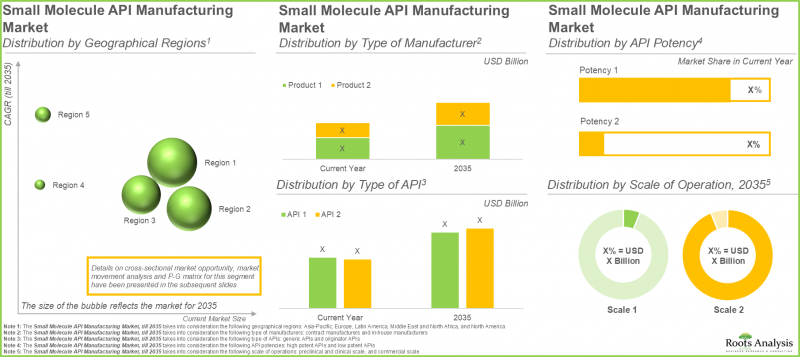
As per Roots Analysis, the global small molecule API manufacturing market is estimated to grow from USD 204 billion in the current year to USD 266 billion by 2035, at a CAGR of 3.0% during the forecast period, till 2035.
SMALL MOLECULE API MANUFACTURING MARKET: GROWTH AND TRENDS
Small molecules remain the foundation of modern therapeutics, accounting for the majority of oral and injectable pharmaceutical products worldwide. In contrast to biologics, such as monoclonal antibodies and recombinant proteins, small molecule active pharmaceutical ingredients (APIs) are predominantly manufactured through advanced organic chemical synthesis processes. These involve the optimization of complex multi-step reaction pathways to maximize yield, ensure product purity, and maintain compliance with stringent safety standards.
The manufacturing process typically begins with the selection and development of the most efficient synthetic route, followed by key chemical reactions such as condensation, cyclization, and other transformation steps to generate critical intermediates. Subsequent purification processes, including filtration, chromatography, and crystallization, are employed to achieve exceptionally high purity levels (often exceeding 99.9%) while optimizing crystal properties to improve drug solubility, stability, and bioavailability. Final processing steps, including drying, milling, and particle-size engineering, ensure the API meets the required quality specifications and performance criteria, while addressing scale-up challenges such as thermal management and process consistency.
Following synthesis and purification, small molecule APIs are produced as pharmaceutical-grade drug substances under rigorous quality assurance and regulatory compliance frameworks. These drug substances are subsequently supplied to formulation manufacturers, where they are converted into finished dosage forms, including tablets, capsules, and injectable products. As the pharmaceutical industry continues to prioritize high-quality, scalable, and cost-efficient drug production, API manufacturers are increasingly investing in advanced manufacturing capabilities to meet evolving market requirements.
Against this backdrop, the small molecule API manufacturing market is poised for sustained growth, driven by rising global pharmaceutical demand, a robust pipeline of new drug approvals, and expanding healthcare needs. Technological advancements, including the integration of artificial intelligence, digital twin technologies for process optimization, and continuous manufacturing platforms, are expected to enhance operational efficiency, reduce production costs, and improve manufacturing scalability. Furthermore, the growing adoption of custom API manufacturing services, fueled by the increasing focus on personalized medicine and the need to accelerate development timelines, is anticipated to create significant growth opportunities for market participants over the coming years.
Growth Drivers: Strategic Enablers of Market Expansion
The small molecule API manufacturing market is witnessing robust growth, driven by the convergence of rising global healthcare needs, an expanding drug development pipeline, and continuous technological innovation. The increasing prevalence of chronic diseases, including cancer, diabetes, cardiovascular disorders, and other long-term health conditions is generating sustained demand for cost-effective and widely accessible small molecule therapies. As healthcare systems worldwide focus on improving treatment accessibility for growing and aging patient populations, pharmaceutical companies are increasing production volumes and securing long-term supply agreements, creating significant opportunities for API manufacturers.
This demand is further reinforced by a strong and expanding small molecule drug pipeline. With more than 9,000 small molecule candidates currently under development and over 3,000 approved therapies already available for the treatment of various chronic conditions, the market benefits from a steady flow of new product development and commercialization activities. The large number of late-stage clinical candidates is expected to translate into increased API manufacturing requirements, strengthening long-term market prospects. Additionally, the growing adoption of advanced manufacturing technologies, including continuous manufacturing, automation, and digital process control systems, is enhancing operational efficiency, product traceability, and real-time quality assurance. These technological advancements not only reduce production costs and improve scalability but also enable manufacturers to efficiently produce increasingly complex therapeutic molecules, further accelerating market growth.
Market Challenges: Critical Barriers Impeding Progress
The small molecule API manufacturing market faces several challenges, primarily driven by stringent regulatory requirements and increasing compliance costs associated with maintaining global quality standards. Manufacturers continue to face margin pressures stemming from intense competition within the generic API segment and persistent pricing erosion. In addition, fluctuations in raw material costs, supply chain disruptions, and geopolitical uncertainties can negatively impact production efficiency and profitability. The growing complexity of novel small molecule therapies further increases manufacturing and process development challenges, requiring significant investments in advanced technologies and specialized infrastructure. As a result, balancing regulatory compliance, operational efficiency, and cost competitiveness remains a key challenge for industry participants.
SMALL MOLECULE API MANUFACTURING MARKET: KEY INSIGHTS
The report delves into the current state of the small molecule API manufacturing market and identifies potential growth opportunities within industry. Some key findings from the report include:
1. Owing to the rising prevalence of chronic diseases, growing demand for cost effective drugs, and advances in drug development technologies, the small molecule API manufacturing market is experiencing substantial growth.
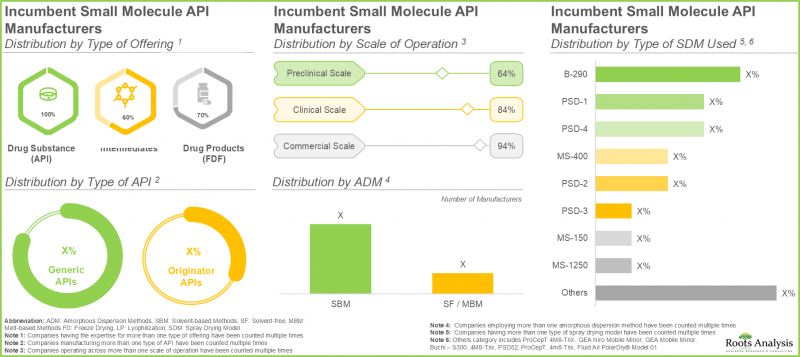
2. The current market landscape features the presence of ~155 incumbent players that are engaged in the manufacturing of small molecule APIs; ~80% of these players are headquartered in the Asia-Pacific region.
3. More than 85% of the companies are engaged in manufacturing generic APIs; notably, close to 95% of incumbent players operate at commercial scale of operation.
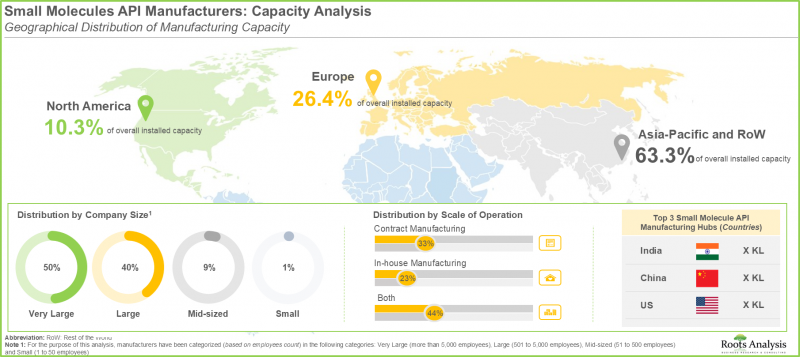
4. The global small molecule API manufacturing capacity is well distributed across different facilities worldwide; notably, majority (>60%) of the capacity is available with the players headquartered in Asia-Pacific.
5. India, China, and the United States account for the largest small-molecule API production capacities, positioning them as the top three competitors in the global manufacturing landscape.
6. Given the escalating burden of chronic diseases, growing pipeline of small molecules, and enhanced adoption of advanced technologies, the market is anticipated to witness a steady growth in the foreseen future.
7. Currently, majority of the small molecule API manufacturing market share is captured by Europe; this can be attributed to a mature, high value added pharmaceutical base with strong regulatory oversight.
8. North America is expected to capture more than 25% share of the global small molecule API manufacturing market; within North America, the US dominates the market.
9. The US market is expected to grow in the near future; this is due to the increasing demand for cost effective APIs, consequently fueling the need for advanced manufacturing capabilities.
Small Molecule API Manufacturing Market Segments
The market sizing and opportunity analysis has been segmented across the following parameters:
By Type of Manufacturer
- In-house Manufacturers
- Contract Manufacturers
By Type of API
- Originator APIs
- Generic APIs
By API Potency
- Low Potent APIs
- High Potent APIs
By Scale of Operation
- Preclinical and Clinical Scale
- Commercial Scale
By Geographical Regions
- North America
- US
- Canada
- Europe
- Germany
- UK
- France
- Italy
- Spain
- Rest of Europe
- Asia-Pacific
- China
- Japan
- India
- South Korea
- Australia
- Rest of Asia-Pacific
- Middle East and North Africa
- Saudi Arabia
- Egypt
- Rest of Middle East and North Africa
- Latin America
- Brazil
- Argentina
- Rest of Latin America
SMALL MOLECULE API MANUFACTURING MARKET: KEY SEGMENTS
Originator APIs Continue to Lead the Small Molecule API Manufacturing Market
According to market forecasts, the originator API segment is expected to account for the largest share of the small molecule API manufacturing market, representing over 50% of total revenues in 2026. This dominance is supported by the continued demand for innovative, patented therapeutics and the strong commercial presence of branded pharmaceutical products. However, the generic API segment is projected to witness a higher CAGR of 3.8% during the forecast period, driven by the expiration of patents for several blockbuster drugs, lower manufacturing costs, and increasing opportunities for market entry by generic drug manufacturers.
Low-Potency APIs Represent the Largest Manufacturing Segment
Low-potency APIs currently dominate the small molecule API manufacturing landscape, accounting for approximately 90% of the market. Their widespread use across a broad range of therapeutic applications and established manufacturing processes continue to support market leadership. Nevertheless, the high-potency API (HPAPI) segment is anticipated to expand at a significantly higher CAGR of 10.7% over the forecast period. This growth is primarily attributed to the increasing development of targeted therapies for oncology and chronic diseases, where highly potent compounds play a critical role in improving therapeutic outcomes.
Europe Maintains Its Leadership Position
Europe is expected to hold the largest share of the global small molecule API manufacturing market, accounting for more than 35% of total revenues. The region's leadership is underpinned by its strong expertise in the production of high-value and complex APIs, supported by well-established pharmaceutical manufacturing hubs in Germany, Switzerland, and the United Kingdom. Furthermore, a robust regulatory framework governed by the European Medicines Agency (EMA), coupled with substantial investments in pharmaceutical research and development, continues to strengthen the region's competitive position. Key industry participants headquartered in Europe include AstraZeneca, GSK, Lonza, Novartis, and Sandoz.
Asia-Pacific Poised to Become the Largest Market by 2035
The Asia-Pacific region is projected to emerge as the leading market for small molecule API manufacturing by 2035, expanding at a CAGR of 4.9% during the forecast period. Growth in the region is being driven by cost-efficient manufacturing capabilities, expanding pharmaceutical production infrastructure, supportive government policies, and increasing investments in healthcare and life sciences. Additionally, the presence of large-scale API manufacturers and growing global outsourcing activities are expected to further strengthen the region's market position. Prominent Asia-Pacific-based manufacturers include Apitoria Pharma, Divi's Laboratories, MSN Laboratories, and Sun Pharma.
Example Players in Small Molecule API Manufacturing Market
- Apitoria Pharma
- Aurobindo Pharma
- Catalent
- Emcure Pharmaceuticals
- Hetero
- Ipca Laboratories
- MSN Laboratories
- Qilu Pharmaceutical
- Sun Pharma
- Novartis
- Sandoz
- Viatris
- Viyash
Primary Research Overview
The opinions and insights presented in this study were influenced by discussions conducted with multiple stakeholders. The research report features detailed transcripts of interviews held with the following industry stakeholders:
- President and Chief Executive Officer, Corporate Strategy and Business Development, Mid-sized Company, US
- Digitalization and Artificial Intelligence Manager, Large Company, Switzerland
- Former Director, Pharmaceuticals Marketing, Large Company, France
- Former Director, Commercial Development, Cell Therapy, Mid-sized Company, Switzerland
- Former Director of Business Development, Large Company, US
- Former Vice President Business Development, Marketing, and IP, Mid-sized Company, Israel
In addition, the market report includes transcripts of the following other third-party discussions:
- Technical Director, Mid-sized Organization, UK
SMALL MOLECULE API MANUFACTURING MARKET: RESEARCH COVERAGE
- Market Sizing and Opportunity Analysis: The report features an in-depth analysis of the small molecule API manufacturing market, focusing on key market segments, including [A] type of manufacturer, [B] type of API, [C] API potency, [D] scale of operation, [E] geographical regions [F] key players.
- Incumbent Small Molecule API Manufacturers Market Landscape: A comprehensive evaluation of small molecule API manufacturers, considering various parameters, such as [A] year of establishment, [B] company size, [C] location of headquarters, [D] type of manufacturer, [E] location of manufacturing facility, [F] type of offering, [G] type of API, [H] scale of operation, [I] amorphous dispersion method, and [J] type of solid dispersion method used.
- Company Competitiveness Analysis: A comprehensive competitive analysis of incumbent small molecule API manufacturers, examining factors, such as company strength and portfolio strength.
- Capacity Analysis: An estimate of the overall installed capacity for the manufacturing of biopharmaceuticals, highlighting the distribution of the available capacity, based on [A] size of manufacturer, [B] type of expression system used and [C] geography.
- Market Impact Analysis: The report analyzes various factors such as drivers, restraints, opportunities, and challenges affecting market growth.
KEY QUESTIONS ANSWERED IN THIS REPORT
- Which are the leading companies in the small molecule API manufacturing market?
- Which region dominates the small molecule API manufacturing market?
- What are the key trends observed in the small molecule API manufacturing market?
- What factors are likely to influence the evolution of this market?
- What are the primary challenges faced by small molecule API manufacturers?
- What is the current and future market size?
- What is the CAGR of this market?
- How is the current and future market opportunity likely to be distributed across key market segments?
REASONS TO BUY THIS REPORT
- The report provides a comprehensive market analysis, offering detailed revenue projections of the overall market and its specific sub-segments. This information is valuable to both established market leaders and emerging entrants.
- The report offers stakeholders a comprehensive overview of the market, including key drivers, barriers, opportunities, and challenges. This information empowers stakeholders to stay abreast of market trends and make data-driven decisions to capitalize on growth prospects.
- The report can aid businesses in identifying future opportunities in any sector. It also helps in understanding if those opportunities are worth pursuing.
- The report helps in identifying customer demand by understanding the needs, preferences, and behavior of the target audience in order to tailor products or services effectively.
- The report equips new entrants with requisite information regarding a particular market to help them build successful business strategies.
- The report allows for more effective communication with the audience and in building strong business relations.
ADDITIONAL BENEFITS
- Complementary Excel Data Packs for all Analytical Modules in the Report
- 15% Free Content Customization
- Detailed Report Walkthrough Session with Research Team
- Free Updated report if the report is 6-12 months old or older
TABLE OF CONTENTS
1. BACKGROUND
- 1.1. Context
- 1.2. Project Objectives
2. RESEARCH METHODOLOGY
- 2.1. Chapter Overview
- 2.2. Research Assumptions
- 2.2.1. Market Landscape and Market Trends
- 2.2.2. Market Forecast and Opportunity Analysis
- 2.2.3. Comparative Analysis
- 2.3. Database Building
- 2.3.1. Data Collection
- 2.3.2. Data Validation
- 2.3.3. Data Analysis
- 2.4. Project Methodology
- 2.4.1. Secondary Research
- 2.4.1.1. Annual Reports
- 2.4.1.2. Academic Research Papers
- 2.4.1.3. Company Websites
- 2.4.1.4. Investor Presentations
- 2.4.1.5. Regulatory Filings
- 2.4.1.6. White Papers
- 2.4.1.7. Industry Publications
- 2.4.1.8. Conferences and Seminars
- 2.4.1.9. Government Portals
- 2.4.1.10. Media and Press Releases
- 2.4.1.11. Newsletters
- 2.4.1.12. Industry Databases
- 2.4.1.13. Roots Proprietary Databases
- 2.4.1.14. Paid Databases and Sources
- 2.4.1.15. Social Media Portals
- 2.4.1.16. Other Secondary Sources
- 2.4.2. Primary Research
- 2.4.2.1. Types of Primary Research
- 2.4.2.1.1. Qualitative Research
- 2.4.2.1.2. Quantitative Research
- 2.4.2.1.3. Hybrid Approach
- 2.4.2.2. Advantages of Primary Research
- 2.4.2.3. Techniques for Primary Research
- 2.4.2.3.1. Interviews
- 2.4.2.3.2. Surveys
- 2.4.2.3.3. Focus Groups
- 2.4.2.3.4. Observational Research
- 2.4.2.3.5. Social Media Interactions
- 2.4.2.4. Key Opinion Leaders Considered in Primary Research
- 2.4.2.4.1. Company Executives (CXOs)
- 2.4.2.4.2. Board of Directors
- 2.4.2.4.3. Company Presidents and Vice Presidents
- 2.4.2.4.4. Research and Development Heads
- 2.4.2.4.5. Technical Experts
- 2.4.2.4.6. Subject Matter Experts
- 2.4.2.4.7. Scientists
- 2.4.2.4.8. Doctors and Other Healthcare Providers
- 2.4.2.5. Ethics and Integrity
- 2.4.2.5.1. Research Ethics
- 2.4.2.5.2. Data Integrity
- 2.4.2.1. Types of Primary Research
- 2.4.3. Analytical Tools and Databases
- 2.4.1. Secondary Research
- 2.5. Robust Quality Control
3. MARKET DYNAMICS
- 3.1. Chapter Overview
- 3.2. Forecast Methodology
- 3.2.1. Top-down Approach
- 3.2.2. Bottom-up Approach
- 3.2.3. Hybrid Approach
- 3.3. Market Assessment Framework
- 3.3.1. Total Addressable Market (TAM)
- 3.3.2. Serviceable Addressable Market (SAM)
- 3.3.3. Serviceable Obtainable Market (SOM)
- 3.3.4. Currently Acquired Market (CAM)
- 3.4. Forecasting Tools and Techniques
- 3.4.1. Qualitative Forecasting
- 3.4.2. Correlation
- 3.4.3. Regression
- 3.4.4. Extrapolation
- 3.4.5. Convergence
- 3.4.6. Sensitivity Analysis
- 3.4.7. Scenario Planning
- 3.4.8. Data Visualization
- 3.4.9. Time Series Analysis
- 3.4.10. Forecast Error Analysis
- 3.5. Key Considerations
- 3.5.1. Demographics
- 3.5.2. Government Regulations
- 3.5.3. Reimbursement Scenarios
- 3.5.4. Market Access
- 3.5.5. Supply Chain
- 3.5.6. Industry Consolidation
- 3.5.7. Pandemic / Unforeseen Disruptions Impact
- 3.6. Limitations
4. MACRO-ECONOMIC INDICATORS
- 4.1. Chapter Overview
- 4.2. Market Dynamics
- 4.2.1. Time Period
- 4.2.1.1. Historical Trends
- 4.2.1.2. Current and Forecasted Estimates
- 4.2.2. Currency Coverage
- 4.2.2.1. Major Currencies Affecting the Market
- 4.2.2.2. Factors Affecting Currency Fluctuations
- 4.2.2.3. Impact of Currency Fluctuations on the Industry
- 4.2.3. Foreign Currency Exchange Rate
- 4.2.3.1. Impact of Foreign Exchange Rate Volatility on the Market
- 4.2.3.2. Strategies for Mitigating Foreign Exchange Risk
- 4.2.4. Recession
- 4.2.4.1. Assessment of Current Economic Conditions and Potential Impact on the Market
- 4.2.4.2. Historical Analysis of Past Recessions and Lessons Learnt
- 4.2.5. Inflation
- 4.2.5.1. Measurement and Analysis of Inflationary Pressures in the Economy
- 4.2.5.2. Potential Impact of Inflation on the Market Evolution
- 4.2.6. Interest Rates
- 4.2.6.1. Interest Rates and Their Impact on the Market
- 4.2.6.2. Strategies for Managing Interest Rate Risk
- 4.2.7. Commodity Flow Analysis
- 4.2.7.1. Type of Commodity
- 4.2.7.2. Origins and Destinations
- 4.2.7.3. Values and Weights
- 4.2.7.4. Modes of Transportation
- 4.2.8. Global Trade Dynamics
- 4.2.8.1. Import Scenario
- 4.2.8.2. Export Scenario
- 4.2.8.3. Trade Policies
- 4.2.8.4. Strategies for Mitigating the Risks Associated with Trade Barriers
- 4.2.8.5. Impact of Trade Barriers on the Market
- 4.2.9. War Impact Analysis
- 4.2.9.1. Russian-Ukraine War
- 4.2.9.2. Israel-Hamas War
- 4.2.10. COVID Impact / Related Factors
- 4.2.10.1. Global Economic Impact
- 4.2.10.2. Industry-specific Impact
- 4.2.10.3. Government Response and Stimulus Measures
- 4.2.10.4. Future Outlook and Adaptation Strategies
- 4.2.11. Other Indicators
- 4.2.11.1. Fiscal Policy
- 4.2.11.2. Consumer Spending
- 4.2.11.3. Gross Domestic Product (GDP)
- 4.2.11.4. Employment
- 4.2.11.5. Taxes
- 4.2.11.6. Stock Market Performance
- 4.2.11.7. Cross-Border Dynamics
- 4.2.1. Time Period
- 4.3. Conclusion
5. EXECUTIVE SUMMARY
- 5.1. Executive Summary: Market Landscape and Trends
- 5.2. Executive Summary: Market Forecast and Opportunity Analysis
6. INTRODUCTION
- 6.1. Overview of Small Molecule API Manufacturers
- 6.2. Comparison between Small Molecules and Large Molecules
- 6.3. Key Steps Involved in Manufacturing API
- 6.4. Advantages associated with Small Molecule APIs
- 6.5. Challenges associated with Manufacturing Small Molecule APIs
- 6.6. Next-Generation Strategies for Small-Molecule API Manufacturing
7. INCUMBENT SMALL MOLECULE API MANUFACTURERS: MARKET LANDSCAPE
- 7.1. Chapter Overview
- 7.2. Incumbent Small Molecule API Manufacturers: Market Landscape
- 7.2.1. Analysis by Year of Establishment
- 7.2.2. Analysis by Company Size
- 7.2.3. Analysis by Location of Headquarters
- 7.2.4. Analysis by Company Size and Location of Headquarters
- 7.2.5. Analysis by Type of Manufacturer
- 7.2.6. Analysis by Location of Manufacturing Facility
- 7.2.7. Analysis by Type of Offering
- 7.2.8. Analysis by Type of API
- 7.2.9. Analysis by Scale of Operation
- 7.2.10. Analysis by Amorphous Dispersion Method
- 7.2.11. Analysis by Type of Solid Dispersion Method Used
8. INCUMBENT SMALL MOLECULE API MANUFACTURERS: COMPANY COMPETITIVENESS ANALYSIS
- 8.1. Methodology and Key Parameters
- 8.2. Scoring Criteria
- 8.3. Peer Groups
- 8.4. Overview of Peer Groups
- 8.5. Company Competitiveness Analysis: Players based in North America (Peer Group I)
- 8.6. Company Competitiveness Analysis: Players based in Europe (Peer Group II)
- 8.7. Company Competitiveness Analysis: Players based in Asia-Pacific (Peer Group III)
9. CAPACITY ANALYSIS
- 9.1. Key Assumptions and Methodology
- 9.2. Capacity Assessment Model
- 9.3. Small Molecule API Manufacturing: Global Installed Capacity
- 9.3.1. Distribution by Company Size
- 9.3.2. Distribution by Regional Strength
- 9.3.3. Distribution by Scale of Operation
10. MARKET IMPACT ANALYSIS
- 10.1. Chapter Overview
- 10.2. Market Drivers
- 10.3. Market Restraints
- 10.4. Market Opportunities
- 10.5. Market Challenges
11. GLOBAL SMALL MOLECULE API MANUFACTURING MARKET
- 11.1. Chapter Overview
- 11.2. Key Assumptions and Methodology
- 11.3. Global Small Molecule API Manufacturing Market, Historical Trends (Since 2023) and Forecasted Estimates (Till 2035)
- 11.3.1. Scenario Analysis
- 11.3.1.1. Conservative Scenario
- 11.3.1.2. Optimistic Scenario
- 11.3.1. Scenario Analysis
- 11.4. Key Market Segmentations
12. SMALL MOLECULE API MANUFACTURING MARKET, BY TYPE OF MANUFACTURER
- 12.1. Chapter Overview
- 12.2. Small Molecule API Manufacturing Market: Distribution by Type of Manufacturer
- 12.2.1. Small Molecule API Manufacturing Market for In-house Manufacturers, Historical Trends (Since 2023) and Forecasted Estimates (Till 2035)
- 12.2.2. Small Molecule API Manufacturing Market for Contract Manufacturers, Historical Trends (Since 2023) and Forecasted Estimates (Till 2035)
13. SMALL MOLECULE API MANUFACTURING MARKET, BY TYPE OF API
- 13.1. Chapter Overview
- 13.2. Small Molecule API Manufacturing Market: Distribution by Type of API
- 13.2.1. Small Molecule API Manufacturing Market for Originator APIs, Historical Trends (Since 2023) and Forecasted Estimates (Till 2035)
- 13.2.2. Small Molecule API Manufacturing Market for Generic APIs, Historical Trends (Since 2023) and Forecasted Estimates (Till 2035)
14. SMALL MOLECULE API MANUFACTURING MARKET, BY API POTENCY
- 14.1. Chapter Overview
- 14.2. Small Molecule API Manufacturing Market: Distribution by API Potency
- 14.2.1. Small Molecule API Manufacturing Market for Low Potent APIs, Historical Trends (Since 2023) and Forecasted Estimates (Till 2035)
- 14.2.2. Small Molecule API Manufacturing Market for High Potent APIs, Historical Trends (Since 2023) and Forecasted Estimates (Till 2035)
15. SMALL MOLECULE API MANUFACTURING MARKET, BY SCALE OF OPERATION
- 15.1. Chapter Overview
- 15.2. Small Molecule API Manufacturing Market: Distribution by Scale of Operation
- 15.2.1. Small Molecule API Manufacturing Market for Preclinical and Clinical Scale, Historical Trends (Since 2023) and Forecasted Estimates (Till 2035)
- 15.2.2. Small Molecule API Manufacturing Market for Commercial Scale, Historical Trends (Since 2023) and Forecasted Estimates (Till 2035)
16. SMALL MOLECULE API MANUFACTURING MARKET, BY GEOGRAPHICAL REGIONS
- 16.1. Chapter Overview
- 16.2. Small Molecule API Manufacturing Market: Distribution by Geographical Regions
- 16.2.1. Small Molecule API Manufacturing Market in North America, Historical Trends (Since 2023) and Forecasted Estimates (Till 2035)
- 16.2.1.1. Small Molecule API Manufacturing Market in the US, Historical Trends (Since 2023) and Forecasted Estimates (Till 2035)
- 16.2.1.2. Small Molecule API Manufacturing Market in Canada, Historical Trends (Since 2023) and Forecasted Estimates (Till 2035)
- 16.2.2. Small Molecule API Manufacturing Market in Europe, Historical Trends (Since 2023) and Forecasted Estimates (Till 2035)
- 16.2.2.1. Small Molecule API Manufacturing Market in Germany, Historical Trends (Since 2023) and Forecasted Estimates (Till 2035)
- 16.2.2.2. Small Molecule API Manufacturing Market in the UK, Historical Trends (Since 2023) and Forecasted Estimates (Till 2035)
- 16.2.2.3. Small Molecule API Manufacturing Market in France, Historical Trends (Since 2023) and Forecasted Estimates (Till 2035)
- 16.2.2.4. Small Molecule API Manufacturing Market in Italy, Historical Trends (Since 2023) and Forecasted Estimates (Till 2035)
- 16.2.2.5. Small Molecule API Manufacturing Market in Spain, Historical Trends (Since 2023) and Forecasted Estimates (Till 2035)
- 16.2.2.6. Small Molecule API Manufacturing Market in Rest of Europe, Historical Trends (Since 2023) and Forecasted Estimates (Till 2035)
- 16.2.3. Small Molecule API Manufacturing Market in Asia-Pacific, Historical Trends (Since 2023) and Forecasted Estimates (Till 2035)
- 16.2.3.1. Small Molecule API Manufacturing Market in China, Historical Trends (Since 2023) and Forecasted Estimates (Till 2035)
- 16.2.3.2. Small Molecule API Manufacturing Market in Japan, Historical Trends (Since 2023) and Forecasted Estimates (Till 2035)
- 16.2.3.3. Small Molecule API Manufacturing Market in India, Historical Trends (Since 2023) and Forecasted Estimates (Till 2035)
- 16.2.3.4. Small Molecule API Manufacturing Market in South Korea, Historical Trends (Since 2023) and Forecasted Estimates (Till 2035)
- 16.2.3.5. Small Molecule API Manufacturing Market in Australia, Historical Trends (Since 2023) and Forecasted Estimates (Till 2035)
- 16.2.3.6. Small Molecule API Manufacturing Market in Rest of Asia-Pacific, Historical Trends (Since 2023) and Forecasted Estimates (Till 2035)
- 16.2.4. Small Molecule API Manufacturing Market in Middle East and North Africa, Historical Trends (Since 2023) and Forecasted Estimates (Till 2035)
- 16.2.4.1. Small Molecule API Manufacturing Market in Saudi Arabia, Historical Trends (Since 2023) and Forecasted Estimates (Till 2035)
- 16.2.4.2. Small Molecule API Manufacturing Market in Egypt, Historical Trends (Since 2023) and Forecasted Estimates (Till 2035)
- 16.2.4.3. Small Molecule API Manufacturing Market in Rest of Middle East and North Africa, Historical Trends (Since 2023) and Forecasted Estimates (Till 2035)
- 16.2.5. Small Molecule API Manufacturing Market in Latin America, Historical Trends (Since 2023) and Forecasted Estimates (Till 2035)
- 16.2.5.1. Small Molecule API Manufacturing Market in Brazil, Historical Trends (Since 2023) and Forecasted Estimates (Till 2035)
- 16.2.5.2. Small Molecule API Manufacturing Market in Argentina, Historical Trends (Since 2023) and Forecasted Estimates (Till 2035)
- 16.2.5.3. Small Molecule API Manufacturing Market in Rest of Latin America, Historical Trends (Since 2023) and Forecasted Estimates (Till 2035)
- 16.2.1. Small Molecule API Manufacturing Market in North America, Historical Trends (Since 2023) and Forecasted Estimates (Till 2035)
- 16.3. Market Dynamics Assessment
- 16.3.1. Revenue Shift Analysis
- 16.3.2. Penetration Growth (P-G) Matrix
17. SMALL MOLECULE API MANUFACTURING MARKET: NORTH AMERICA
- 17.1. Small Molecule API Manufacturing Market in North America: Distribution by Type of Manufacturer
- 17.1.1. Small Molecule API Manufacturing Market in North America for In-house Manufacturers, Historical Trends (Since 2023) and Forecasted Estimates (Till 2035)
- 17.1.2. Small Molecule API Manufacturing Market in North America for Contract Manufacturers, Historical Trends (Since 2023) and Forecasted Estimates (Till 2035)
- 17.2. Small Molecule API Manufacturing Market in North America: Distribution by Type of API
- 17.2.1. Small Molecule API Manufacturing Market in North America for Originator APIs, Historical Trends (Since 2023) and Forecasted Estimates (Till 2035)
- 17.2.2. Small Molecule API Manufacturing Market in North America for Generic APIs, Historical Trends (Since 2023) and Forecasted Estimates (Till 2035)
- 17.3. Small Molecule API Manufacturing Market in North America: Distribution by API Potency
- 17.3.1. Small Molecule API Manufacturing Market in North America for Low Potent APIs, Historical Trends (Since 2023) and Forecasted Estimates (Till 2035)
- 17.3.2. Small Molecule API Manufacturing Market in North America for High Potent APIs, Historical Trends (Since 2023) and Forecasted Estimates (Till 2035)
- 17.4. Small Molecule API Manufacturing Market in North America: Distribution by Scale of Operation
- 17.4.1. Small Molecule API Manufacturing Market in North America for Preclinical and Clinical Scale, Historical Trends (Since 2023) and Forecasted Estimates (Till 2035)
- 17.4.2. Small Molecule API Manufacturing Market in North America for Commercial Scale, Historical Trends (Since 2023) and Forecasted Estimates (Till 2035)
18. SMALL MOLECULE API MANUFACTURING MARKET: EUROPE
- 18.1. Small Molecule API Manufacturing Market in Europe: Distribution by Type of Manufacturer
- 18.1.1. Small Molecule API Manufacturing Market in Europe for In-house Manufacturers, Historical Trends (Since 2023) and Forecasted Estimates (Till 2035)
- 18.1.2. Small Molecule API Manufacturing Market in Europe for Contract Manufacturers, Historical Trends (Since 2023) and Forecasted Estimates (Till 2035)
- 18.2. Small Molecule API Manufacturing Market in Europe: Distribution by Type of API
- 18.2.1. Small Molecule API Manufacturing Market in Europe for Originator APIs, Historical Trends (Since 2023) and Forecasted Estimates (Till 2035)
- 18.2.2. Small Molecule API Manufacturing Market in Europe for Generic APIs, Historical Trends (Since 2023) and Forecasted Estimates (Till 2035)
- 18.3. Small Molecule API Manufacturing Market in Europe: Distribution by API Potency
- 18.3.1. Small Molecule API Manufacturing Market in Europe for Low Potent APIs, Historical Trends (Since 2023) and Forecasted Estimates (Till 2035)
- 18.3.2. Small Molecule API Manufacturing Market in Europe for High Potent APIs, Historical Trends (Since 2023) and Forecasted Estimates (Till 2035)
- 18.4. Small Molecule API Manufacturing Market in Europe: Distribution by Scale of Operation
- 18.4.1. Small Molecule API Manufacturing Market in Europe for Preclinical and Clinical Scale, Historical Trends (Since 2023) and Forecasted Estimates (Till 2035)
- 18.4.2. Small Molecule API Manufacturing Market in Europe for Commercial Scale, Historical Trends (Since 2023) and Forecasted Estimates (Till 2035)
19. SMALL MOLECULE API MANUFACTURING MARKET: ASIA-PACIFIC
- 19.1. Small Molecule API Manufacturing Market in Asia-Pacific: Distribution by Type of Manufacturer
- 19.1.1. Small Molecule API Manufacturing Market in Asia-Pacific for In-house Manufacturers, Historical Trends (Since 2023) and Forecasted Estimates (Till 2035)
- 19.1.2. Small Molecule API Manufacturing Market in Asia-Pacific for Contract Manufacturers, Historical Trends (Since 2023) and Forecasted Estimates (Till 2035)
- 19.2. Small Molecule API Manufacturing Market in Asia-Pacific: Distribution by Type of API
- 19.2.1. Small Molecule API Manufacturing Market in Asia-Pacific for Originator APIs, Historical Trends (Since 2023) and Forecasted Estimates (Till 2035)
- 19.2.2. Small Molecule API Manufacturing Market in Asia-Pacific for Generic APIs, Historical Trends (Since 2023) and Forecasted Estimates (Till 2035)
- 19.3. Small Molecule API Manufacturing Market in Asia-Pacific: Distribution by API Potency
- 19.3.1. Small Molecule API Manufacturing Market in Asia-Pacific for Low Potent APIs, Historical Trends (Since 2023) and Forecasted Estimates (Till 2035)
- 19.3.2. Small Molecule API Manufacturing Market in Asia-Pacific for High Potent APIs, Historical Trends (Since 2023) and Forecasted Estimates (Till 2035)
- 19.4. Small Molecule API Manufacturing Market in Asia-Pacific: Distribution by Scale of Operation
- 19.4.1. Small Molecule API Manufacturing Market in Asia-Pacific for Preclinical and Clinical Scale, Historical Trends (Since 2023) and Forecasted Estimates (Till 2035)
- 19.4.2. Small Molecule API Manufacturing Market in Asia-Pacific for Commercial Scale, Historical Trends (Since 2023) and Forecasted Estimates (Till 2035)
20. SMALL MOLECULE API MANUFACTURING MARKET: MIDDLE EAST AND NORTH AFRICA
- 20.1. Small Molecule API Manufacturing Market in Middle East and North Africa: Distribution by Type of Manufacturer
- 20.1.1. Small Molecule API Manufacturing Market in Middle East and North Africa for In-house Manufacturers, Historical Trends (Since 2023) and Forecasted Estimates (Till 2035)
- 20.1.2. Small Molecule API Manufacturing Market in Middle East and North Africa for Contract Manufacturers, Historical Trends (Since 2023) and Forecasted Estimates (Till 2035)
- 20.2. Small Molecule API Manufacturing Market in Middle East and North Africa: Distribution by Type of API
- 20.2.1. Small Molecule API Manufacturing Market in Middle East and North Africa for Originator APIs, Historical Trends (Since 2023) and Forecasted Estimates (Till 2035)
- 20.2.2. Small Molecule API Manufacturing Market in Middle East and North Africa for Generic APIs, Historical Trends (Since 2023) and Forecasted Estimates (Till 2035)
- 20.3. Small Molecule API Manufacturing Market in Middle East and North Africa: Distribution by API Potency
- 20.3.1. Small Molecule API Manufacturing Market in Middle East and North Africa for Low Potent APIs, Historical Trends (Since 2023) and Forecasted Estimates (Till 2035)
- 20.3.2. Small Molecule API Manufacturing Market in Middle East and North Africa for High Potent APIs, Historical Trends (Since 2023) and Forecasted Estimates (Till 2035)
- 20.4. Small Molecule API Manufacturing Market in Middle East and North Africa: Distribution by Scale of Operation
- 20.4.1. Small Molecule API Manufacturing Market in Middle East and North Africa for Preclinical and Clinical Scale, Historical Trends (Since 2023) and Forecasted Estimates (Till 2035)
- 20.4.2. Small Molecule API Manufacturing Market in Middle East and North Africa for Commercial Scale, Historical Trends (Since 2023) and Forecasted Estimates (Till 2035)
21. SMALL MOLECULE API MANUFACTURING MARKET: LATIN AMERICA
- 21.1. Small Molecule API Manufacturing Market in Latin America: Distribution by Type of Manufacturer
- 21.1.1. Small Molecule API Manufacturing Market in Latin America for In-house Manufacturers, Historical Trends (Since 2023) and Forecasted Estimates (Till 2035)
- 21.1.2. Small Molecule API Manufacturing Market in Latin America for Contract Manufacturers, Historical Trends (Since 2023) and Forecasted Estimates (Till 2035)
- 21.2. Small Molecule API Manufacturing Market in Latin America: Distribution by Type of API
- 21.2.1. Small Molecule API Manufacturing Market in Latin America for Originator APIs, Historical Trends (Since 2023) and Forecasted Estimates (Till 2035)
- 21.2.2. Small Molecule API Manufacturing Market in Latin America for Generic APIs, Historical Trends (Since 2023) and Forecasted Estimates (Till 2035)
- 21.3. Small Molecule API Manufacturing Market in Latin America: Distribution by API Potency
- 21.3.1. Small Molecule API Manufacturing Market in Latin America for Low Potent APIs, Historical Trends (Since 2023) and Forecasted Estimates (Till 2035)
- 21.3.2. Small Molecule API Manufacturing Market in Latin America for High Potent APIs, Historical Trends (Since 2023) and Forecasted Estimates (Till 2035)
- 21.4. Small Molecule API Manufacturing Market in Latin America: Distribution by Scale of Operation
- 21.4.1. Small Molecule API Manufacturing Market in Latin America for Preclinical and Clinical Scale, Historical Trends (Since 2023) and Forecasted Estimates (Till 2035)
- 21.4.2. Small Molecule API Manufacturing Market in Latin America for Commercial Scale, Historical Trends (Since 2023) and Forecasted Estimates (Till 2035)
- *Detailed information on Chapters 17 to 21 is available in the Excel Data Packs shared along with the report**
22. SMALL MOLECULE API MANUFACTURING MARKET, BY KEY PLAYERS
23. CONCLUDING REMARKS
24. EXECUTIVE INSIGHTS
- 24.1. Chapter Overview
- 24.2. Company A
- 24.2.1. Company Snapshot
- 24.2.2. Interview Transcript: President and Chief Executive Officer, Corporate Strategy and Business Development
- 24.3. Company B
- 24.3.1. Company Snapshot
- 24.3.2. Interview Transcript: Digitalization and Artificial Intelligence Manager
- 24.4. Company C
- 24.4.1. Company Snapshot
- 24.4.2. Interview Transcript: Former Director, Pharmaceuticals Marketing
- 24.5. Company D
- 24.5.1. Company Snapshot
- 24.5.2. Interview Transcript: Former Director, Commercial Development, Cell Therapy
- 24.6. Company E
- 24.6.1. Company Snapshot
- 24.6.2. Interview Transcript: Former Director of Business Development
- 24.7. Company F
- 24.7.1. Company Snapshot
- 24.7.2. Interview Transcript: Former Vice President Business Development, Marketing, and IP
- 24.8. Company G
- 24.8.1. Company Snapshot
- 24.8.2. Interview Transcript: Technical Director
25. APPENDIX 1: TABULATED DATA
26. APPENDIX 2: LIST OF COMPANIES AND ORGANIZATIONS
List of Tables
- Table 6.1 Comparison between Small Molecules and Large Molecules
- Table 7.1 Incumbent Small Molecule API Manufacturers: Information on Year of Establishment, Company Size, Headquarters, Manufacturing Facilities and Type of Manufacturer
- Table 7.2 Incumbent Small Molecule API Manufacturers: Information on Type of Offering, Type of API, Scale of Operation, Reactor Capacity, Amorphous Dispersion Methods and Type of Spray Drying Model Used
- Table 9.1 Capacity Analysis: Sample Dataset (Information on Manufacturers' Installed Capacity)
- Table 9.2 Capacity Analysis: Average Capacity per Facility, by Company Size (Sample Dataset)
- Table 25.1 Incumbent Small Molecule API Manufacturers: Distribution by Year of Establishment
- Table 25.2 Incumbent Small Molecule API Manufacturers: Distribution by Company Size
- Table 25.3 Incumbent Small Molecule API Manufacturers: Distribution by Location of Headquarters
- Table 25.4 Incumbent Small Molecule API Manufacturers: Distribution by Company Size and Location of Headquarters
- Table 25.5 Incumbent Small Molecule API Manufacturers: Distribution by Type of Manufacturer
- Table 25.6 Incumbent Small Molecule API Manufacturers: Distribution by Location of Manufacturing Facility
- Table 25.7 Incumbent Small Molecule API Manufacturers: Distribution by Type of Offering
- Table 25.8 Incumbent Small Molecule API Manufacturers: Distribution by Type of API
- Table 25.9 Incumbent Small Molecule API Manufacturers: Distribution by Scale of Operation
- Table 25.10 Incumbent Small Molecule API Manufacturers: Distribution by Amorphous Dispersion Method
- Table 25.11 Incumbent Small Molecule API Manufacturers: Distribution by Type of Spray Drying Model Used
- Table 25.12 Global Capacity of Small Molecule API Manufacturers (in KL): Distribution by Company Size
- Table 25.13 Global Capacity of Small Molecule API Manufacturers (in KL): Distribution by Regional Strength
- Table 25.14 Global Capacity of Small Molecule API Manufacturers (in KL): Distribution by Scale of Operation
- Table 25.15 Small Molecule API Manufacturing Market: Historical Trends (Since 2023) and Forecasted Estimates (Till 2035), Base Scenario (USD Billion)
- Table 25.16 Small Molecule API Manufacturing Market: Forecasted Estimates (Till 2035), Conservative Scenario (USD Billion)
- Table 25.17 Small Molecule API Manufacturing Market: Forecasted Estimates (Till 2035), Optimistic Scenario (USD Billion)
- Table 25.18 Small Molecule API Manufacturing Market: Distribution by Type of Manufacturer
- Table 25.19 Small Molecule API Manufacturing Market for In-house Manufacturers, Historical Trends (Since 2023) and Forecasted Estimates (Till 2035) (USD Billion)
- Table 25.20 Small Molecule API Manufacturing Market for Contract Manufacturers, Historical Trends (Since 2023) and Forecasted Estimates (Till 2035) (USD Billion)
- Table 25.21 Small Molecule API Manufacturing Market: Distribution by Type of API
- Table 25.22 Small Molecule API Manufacturing Market for Originator APIs, Historical Trends (Since 2023) and Forecasted Estimates (Till 2035) (USD Billion)
- Table 25.23 Small Molecule API Manufacturing Market for Generic APIs, Historical Trends (Since 2023) and Forecasted Estimates (Till 2035) (USD Billion)
- Table 25.24 Small Molecule API Manufacturing Market: Distribution by API Potency
- Table 25.25 Small Molecule API Manufacturing Market for Low Potent APIs, Historical Trends (Since 2023) and Forecasted Estimates (Till 2035) (USD Billion)
- Table 25.26 Small Molecule API Manufacturing Market for High Potent APIs, Historical Trends (Since 2023) and Forecasted Estimates (Till 2035) (USD Billion)
- Table 25.27 Small Molecule API Manufacturing Market: Distribution by Scale of Operation
- Table 25.28 Small Molecule API Manufacturing Market for Preclinical and Clinical Scale, Historical Trends (Since 2023) and Forecasted Estimates (Till 2035) (USD Billion)
- Table 25.29 Small Molecule API Manufacturing Market for Commercial Scale, Historical Trends (Since 2023) and Forecasted Estimates (Till 2035) (USD Billion)
- Table 25.30 Small Molecule API Manufacturing Market: Distribution by Geographical Regions
- Table 25.31 Small Molecule API Manufacturing Market in North America: Historical Trends (Since 2023) and Forecasted Estimates (Till 2035) (USD Billion)
- Table 25.32 Small Molecule API Manufacturing Market in the US: Historical Trends (Since 2023) and Forecasted Estimates (Till 2035) (USD Billion)
- Table 25.33 Small Molecule API Manufacturing Market in Canada: Historical Trends (Since 2023) and Forecasted Estimates (Till 2035) (USD Billion))
- Table 25.34 Small Molecule API Manufacturing Market in Europe: Historical Trends (Since 2023) and Forecasted Estimates (Till 2035) (USD Billion)
- Table 25.35 Small Molecule API Manufacturing Market in Germany: Historical Trends (Since 2023) and Forecasted Estimates (Till 2035) (USD Billion)
- Table 25.36 Small Molecule API Manufacturing Market in the UK: Historical Trends (Since 2023) and Forecasted Estimates (Till 2035) (USD Billion)
- Table 25.37 Small Molecule API Manufacturing Market in France: Historical Trends (Since 2023) and Forecasted Estimates (Till 2035) (USD Billion)
- Table 25.38 Small Molecule API Manufacturing Market in Italy: Historical Trends (Since 2023) and Forecasted Estimates (Till 2035) (USD Billion)
- Table 25.39 Small Molecule API Manufacturing Market in Spain: Historical Trends (Since 2023) and Forecasted Estimates (Till 2035) (USD Billion)
- Table 25.40 Small Molecule API Manufacturing Market in Rest of Europe: Historical Trends (Since 2023) and Forecasted Estimates (Till 2035) (USD Billion)
- Table 25.41 Small Molecule API Manufacturing Market in Asia-Pacific, Historical Trends (Since 2023) and Forecasted Estimates (Till 2035) (USD Billion)
- Table 25.42 Small Molecule API Manufacturing Market in China, Historical Trends (Since 2023) and Forecasted Estimates (Till 2035) (USD Billion)
- Table 25.43 Small Molecule API Manufacturing Market in Japan, Historical Trends (Since 2023) and Forecasted Estimates (Till 2035) (USD Billion)
- Table 25.44 Small Molecule API Manufacturing Market in India, Historical Trends (Since 2023) and Forecasted Estimates (Till 2035) (USD Billion)
- Table 25.45 Small Molecule API Manufacturing Market in South Korea, Historical Trends (Since 2023) and Forecasted Estimates (Till 2035) (USD Billion)
- Table 25.46 Small Molecule API Manufacturing Market in Australia, Historical Trends (Since 2023) and Forecasted Estimates (Till 2035) (USD Billion)
- Table 25.47 Small Molecule API Manufacturing Market in Rest of Asia-Pacific, Historical Trends (Since 2023) and Forecasted Estimates (Till 2035) (USD Billion)
- Table 25.48 Small Molecule API Manufacturing Market in Middle East and North Africa, Historical Trends (Since 2023) and Forecasted Estimates (Till 2035) (USD Billion)
- Table 25.49 Small Molecule API Manufacturing Market in Saudi Arabia, Historical Trends (Since 2023) and Forecasted Estimates (Till 2035) (USD Billion)
- Table 25.50 Small Molecule API Manufacturing Market in Egypt, Historical Trends (Since 2023) and Forecasted Estimates (Till 2035) (USD Billion)
- Table 25.51 Small Molecule API Manufacturing Market in Rest of Middle East and North Africa, Historical Trends (Since 2023) and Forecasted Estimates (Till 2035) (USD Billion)
- Table 25.52 Small Molecule API Manufacturing Market in Latin America, Historical Trends (Since 2023) and Forecasted Estimates (Till 2035) (USD Billion)
- Table 25.53 Small Molecule API Manufacturing Market in Brazil, Historical Trends (Since 2023) and Forecasted Estimates (Till 2035) (USD Billion)
- Table 25.54 Small Molecule API Manufacturing Market in Argentina, Historical Trends (Since 2023) and Forecasted Estimates (Till 2035) (USD Billion)
- Table 25.55 Small Molecule API Manufacturing Market in Rest of Latin America, Historical Trends (Since 2023) and Forecasted Estimates (Till 2035) (USD Billion)
- Table 25.56 Small Molecule API Manufacturing Market: Distribution by Key Players (Capacity in KL)
List of Figures
- Figure 2.1 Research Methodology: Project Methodology
- Figure 2.2 Research Methodology: Data Sources for Secondary Research
- Figure 2.3 Research Methodology: Robust Quality Control
- Figure 3.1 Market Dynamics: Forecast Methodology
- Figure 3.2 Market Dynamics: Market Assessment Framework
- Figure 4.1 Lessons Learnt from Past Recessions
- Figure 5.1 Executive Summary: Market Landscape and Trends
- Figure 5.2 Executive Summary: Market Sizing and Opportunity Analysis
- Figure 6.1 Key Steps Involved in Manufacturing API
- Figure 6.2 Advantages associated with Small Molecule APIs
- Figure 6.3 Challenges associated with Manufacturing Small Molecule APIs
- Figure 6.4 Next-Generation Strategies for Small-Molecule API Manufacturing
- Figure 7.1 Incumbent Small Molecule API Manufacturers: Distribution by Year of Establishment
- Figure 7.2 Incumbent Small Molecule API Manufacturers: Distribution by Company Size
- Figure 7.3 Incumbent Small Molecule API Manufacturers: Distribution by Location of Headquarters
- Figure 7.4 Incumbent Small Molecule API Manufacturers: Distribution by Company Size and Location of Headquarters
- Figure 7.5 Incumbent Small Molecule API Manufacturers: Distribution by Type of Manufacturer
- Figure 7.6 Incumbent Small Molecule API Manufacturers: Distribution by Location of Manufacturing Facility
- Figure 7.7 Incumbent Small Molecule API Manufacturers: Distribution by Type of Offering
- Figure 7.8 Incumbent Small Molecule API Manufacturers: Distribution by Type of API
- Figure 7.9 Incumbent Small Molecule API Manufacturers: Distribution by Scale of Operation
- Figure 7.10 Incumbent Small Molecule API Manufacturers: Distribution by Amorphous Dispersion Method
- Figure 7.11 Incumbent Small Molecule API Manufacturers: Distribution by Type of Spray Drying Model Used
- Figure 8.1 Company Competitiveness Analysis of Developers based in North America
- Figure 8.2 Company Competitiveness Analysis of Developers based in Europe
- Figure 8.3 Company Competitiveness Analysis of Developers based in Asia-Pacific
- Figure 9.1 Global Capacity of Small Molecule API Manufacturers (in KL): Distribution by Company Size
- Figure 9.2 Global Capacity of Small Molecule API Manufacturers (in KL): Distribution by Regional Strength
- Figure 9.3 Global Capacity of Small Molecule API Manufacturers (in KL): Distribution by Scale of Operation
- Figure 10.1 Drivers v/s Restraints
- Figure 10.2 Opportunities v/s Challenges
- Figure 10.3 Market Drivers
- Figure 10.4 Market Restraints
- Figure 10.5 Market Opportunities
- Figure 10.6 Market Challenges
- Figure 11.1 Small Molecule API Manufacturing Market: Historical Trends (Since 2023) and Forecasted Estimates (Till 2035), Base Scenario (USD Billion)
- Figure 11.2 Small Molecule API Manufacturing Market: Forecasted Estimates (Till 2035), Conservative Scenario (USD Billion)
- Figure 11.3 Small Molecule API Manufacturing Market: Forecasted Estimates (Till 2035), Optimistic Scenario (USD Billion)
- Figure 12.1 Small Molecule API Manufacturing Market: Distribution by Type of Manufacturer
- Figure 12.2 Small Molecule API Manufacturing Market for In-house Manufacturers, Historical Trends (Since 2023) and Forecasted Estimates (Till 2035) (USD Billion)
- Figure 12.3 Small Molecule API Manufacturing Market for Contract Manufacturers, Historical Trends (Since 2023) and Forecasted Estimates (Till 2035) (USD Billion)
- Figure 13.1 Small Molecule API Manufacturing Market: Distribution by Type of API
- Figure 13.2 Small Molecule API Manufacturing Market for Originator APIs, Historical Trends (Since 2023) and Forecasted Estimates (Till 2035) (USD Billion)
- Figure 13.3 Small Molecule API Manufacturing Market for Generic APIs, Historical Trends (Since 2023) and Forecasted Estimates (Till 2035) (USD Billion)
- Figure 14.1 Small Molecule API Manufacturing Market: Distribution by API Potency
- Figure 14.2 Small Molecule API Manufacturing Market for Low Potent APIs, Historical Trends (Since 2023) and Forecasted Estimates (Till 2035) (USD Billion)
- Figure 14.3 Small Molecule API Manufacturing Market for High Potent APIs, Historical Trends (Since 2023) and Forecasted Estimates (Till 2035) (USD Billion)
- Figure 15.1 Small Molecule API Manufacturing Market: Distribution by Scale of Operation
- Figure 15.2 Small Molecule API Manufacturing Market for Preclinical and Clinical Scale, Historical Trends (Since 2023) and Forecasted Estimates (Till 2035) (USD Billion)
- Figure 15.3 Small Molecule API Manufacturing Market for Commercial Scale, Historical Trends (Since 2023) and Forecasted Estimates (Till 2035) (USD Billion)
- Figure 16.1 Small Molecule API Manufacturing Market: Distribution by Geographical Regions
- Figure 16.2 Small Molecule API Manufacturing Market in North America: Historical Trends (Since 2023) and Forecasted Estimates (Till 2035) (USD Billion)
- Figure 16.3 Small Molecule API Manufacturing Market in the US: Historical Trends (Since 2023) and Forecasted Estimates (Till 2035) (USD Billion)
- Figure 16.4 Small Molecule API Manufacturing Market in Canada: Historical Trends (Since 2023) and Forecasted Estimates (Till 2035) (USD Billion)
- Figure 16.5 Small Molecule API Manufacturing Market in Europe: Historical Trends (Since 2023) and Forecasted Estimates (Till 2035) (USD Billion)
- Figure 16.6 Small Molecule API Manufacturing Market in Germany: Historical Trends (Since 2023) and Forecasted Estimates (Till 2035) (USD Billion)
- Figure 16.7 Small Molecule API Manufacturing Market in the UK: Historical Trends (Since 2023) and Forecasted Estimates (Till 2035) (USD Billion)
- Figure 16.8 Small Molecule API Manufacturing Market in France: Historical Trends (Since 2023) and Forecasted Estimates (Till 2035) (USD Billion)
- Figure 16.9 Small Molecule API Manufacturing Market in Italy: Historical Trends (Since 2023) and Forecasted Estimates (Till 2035) (USD Billion)
- Figure 16.10 Small Molecule API Manufacturing Market in Spain: Historical Trends (Since 2023) and Forecasted Estimates (Till 2035) (USD Billion)
- Figure 16.11 Small Molecule API Manufacturing Market in Rest of Europe: Historical Trends (Since 2023) and Forecasted Estimates (Till 2035) (USD Billion)
- Figure 16.12 Small Molecule API Manufacturing Market in Asia-Pacific, Historical Trends (Since 2023) and Forecasted Estimates (Till 2035) (USD Billion)
- Figure 16.13 Small Molecule API Manufacturing Market in China, Historical Trends (Since 2023) and Forecasted Estimates (Till 2035) (USD Billion)
- Figure 16.14 Small Molecule API Manufacturing Market in Japan, Historical Trends (Since 2023) and Forecasted Estimates (Till 2035) (USD Billion)
- Figure 16.15 Small Molecule API Manufacturing Market in India, Historical Trends (Since 2023) and Forecasted Estimates (Till 2035) (USD Billion)
- Figure 16.16 Small Molecule API Manufacturing Market in South Korea, Historical Trends (Since 2023) and Forecasted Estimates (Till 2035) (USD Billion)
- Figure 16.17 Small Molecule API Manufacturing Market in Australia, Historical Trends (Since 2023) and Forecasted Estimates (Till 2035) (USD Billion)
- Figure 16.18 Small Molecule API Manufacturing Market in Rest of Asia-Pacific, Historical Trends (Since 2023) and Forecasted Estimates (Till 2035) (USD Billion)
- Figure 16.19 Small Molecule API Manufacturing Market in Middle East and North Africa, Historical Trends (Since 2023) and Forecasted Estimates (Till 2035) (USD Billion)
- Figure 16.20 Small Molecule API Manufacturing Market in Saudi Arabia, Historical Trends (Since 2023) and Forecasted Estimates (Till 2035) (USD Billion)
- Figure 16.21 Small Molecule API Manufacturing Market in Egypt, Historical Trends (Since 2023) and Forecasted Estimates (Till 2035) (USD Billion)
- Figure 16.22 Small Molecule API Manufacturing Market in Rest of Middle East and North Africa, Historical Trends (Since 2023) and Forecasted Estimates (Till 2035) (USD Billion)
- Figure 16.23 Small Molecule API Manufacturing Market in Latin America, Historical Trends (Since 2023) and Forecasted Estimates (Till 2035) (USD Billion)
- Figure 16.24 Small Molecule API Manufacturing Market in Brazil, Historical Trends (Since 2023) and Forecasted Estimates (Till 2035) (USD Billion)
- Figure 16.25 Small Molecule API Manufacturing Market in Argentina, Historical Trends (Since 2023) and Forecasted Estimates (Till 2035) (USD Billion)
- Figure 16.26 Small Molecule API Manufacturing Market in Rest of Latin America, Historical Trends (Since 2023) and Forecasted Estimates (Till 2035) (USD Billion)
- Figure 16.27 Revenue Shift Analysis
- Figure 16.28 Penetration-Growth (P-G) Matrix
- Figure 22.1 Small Molecule API Manufacturing Market: Distribution by Key Players (Capacity in KL)

 合成小分子量原料藥市場規模、佔有率和成長分析:按產品類型、生產流程分析、活性成分濃度、治療應用、劑型適用性和地區分類-2026-2033年產業預測
 小分子原料藥市場規模、佔有率、成長及全球產業分析:按類型和應用、區域洞察及2026-2034年預測
 神經病學領域小分子原料藥市場規模、佔有率和成長分析:按治療適應症、生產形式、原料藥類別、最終用戶和地區分類-2026-2033年產業預測
 風濕病小分子原料藥市場規模、佔有率和成長分析:按藥物類別、生產來源、治療適應症、最終用戶和地區分類-2026年至2033年產業預測全球合成小分子藥物原料藥市場規模、佔有率、趨勢和成長分析報告(2026-2034年)
 小分子原料藥市場:依原料藥類型、應用與地區分類
 小分子原料藥連續生產市場-全球產業規模、佔有率、趨勢、機會及預測(按設備、單元操作、類型、最終用途、地區和競爭格局分類,2021-2031年)
 小分子原料藥市場規模、佔有率及成長分析(按類型、製造商、應用及地區分類)-2026-2033年產業預測
 小分子 API 市場機會、成長動力、產業趨勢分析及 2025 - 2034 年預測
 合成小分子 API 市場規模、佔有率、趨勢分析報告:按製造商、應用、地區、細分市場預測,2025-2030 年