


 |
市場調查報告書
商品編碼
2052134
全球飛機電機市場(至2035年):按電機類型、飛機類型、功率、應用和地區分類-產業趨勢和市場預測Aircraft Electric Motors Market, Till 2035: Distribution by Type of Motor, Type of Aircraft, Type of Output Power, Type of Application, and Geographical Regions: Industry Trends and Global Forecasts |
||||||

飛機電機市場展望
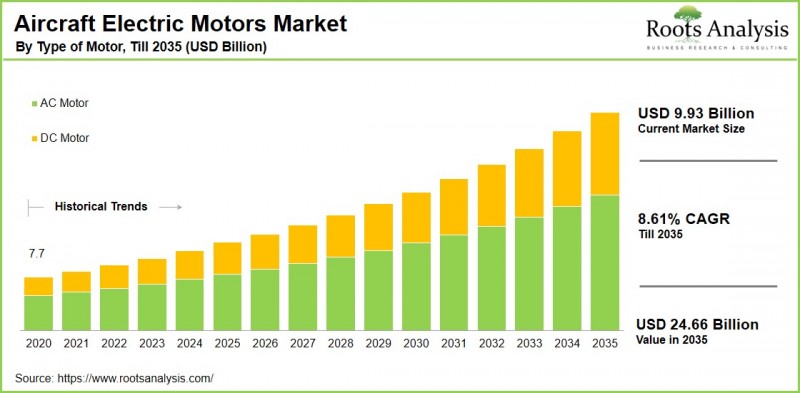
預計到 2035 年,全球飛機用電動馬達市場規模將以 8.61% 的年複合成長率成長,從目前的 99.3 億美元成長到 246.6 億美元。
飛機電動馬達代表了航空技術的一項重大進步,它利用電池或其他電源供電。這些系統基於電磁原理運行,將電能轉化為機械能,驅動飛機部件並提供推力。電動機的主要優勢在於其卓越的效率。與內燃機僅35%相比,電動驅動系統的效率可超過90%。此外,電動馬達適用於多種應用,包括旨在最佳化整體性能以提高運行可靠性和安全性的混合動力推進系統。因此,預計全球飛機電動機市場在預測期內將顯著成長。
此外,隨著航空業向更永續、更有效率的飛行解決方案轉型,電力推進系統的重要性日益凸顯。近年來,飛機用電動馬達的創新發展包括:與傳統的噴射機燃料引擎相比,碳排放更低、噪音更小、運作效率更高。隨著這些技術的不斷發展,電力推進系統有望改變未來的航空旅行,並最終實現零排放的商業航空。
飛機電機市場成長的關鍵市場促進因素
飛機用電動馬達市場的主要驅動力是日益成長的環境永續關注。更嚴格的飛機排放氣體法規以及政府為促進二氧化碳排放而採取的支持措施也推動了市場成長。此外,短途旅行需求的成長和新型城市空中運輸解決方案的出現正在加速市場對電動馬達的接受度。與傳統技術相比,電動推進系統具有更低的營運成本和更少的維護需求等經濟優勢,進一步促進了這一轉變。
飛機電機產業領導者所採取的競爭策略
航空航太馬達市場競爭激烈,市場動態瞬息萬變,既有老牌跨國公司參與其中,也有新興企業。目前,大型企業憑藉其規模、技術實力和全球佈局,佔據市場主導地位。同時,中小企業正透過瞄準細分市場,提供針對特定應用的客製化解決方案,不斷鞏固自身地位。整個產業都在積極推行各種競爭策略,例如推動創新技術、建立策略聯盟和夥伴關係關係、拓展產品系列和地理覆蓋範圍。此外,他們還投資於新產品的研發和功能改進,以完善產品線並保持競爭優勢。
電動航空監管環境的變化
在確保安全的同時促進電動航空領域的創新,飛機馬達市場的監管和政策框架正在快速發展。美國聯邦航空管理局(FAA)和歐洲航空安全局(EASA)等航空監管機構正在積極制定電動和混合動力飛機的認證流程。近期,FAA推出了專門針對動力漂移飛機的法律規範,對飛行員培訓、運行標準和適航認證提出了要求。這為電動航空的商業運作奠定了基礎。
此外,包括美國聯邦航空管理局(FAA)和歐洲航空安全局(EASA)在內的國際監管機構之間的合作正在推進,這有望加速全球標準化進程並縮短產品上市時間。總體而言,監管環境正變得更加規範和有利,但認證的複雜性和不斷變化的安全要求仍然是參與企業市場時面臨的重大挑戰。
飛機馬達市場的新趨勢
受飛機電氣化和永續性的快速推進,飛機電機市場正呈現出若干新趨勢。其中最顯著的趨勢之一是混合動力和純電動飛機的日益普及,這得益於對下一代推進技術投資的不斷增加。此外,電池能量密度的提升和高功率密度馬達的研發也提高了飛機的性能並拓展了其飛行能力。
另一個重要趨勢是輕量化材料和先進溫度控管系統的整合,這提高了整體效率並減輕了系統重量。模組化馬達架構和分散式推進系統的興起進一步提升了運作效率,尤其是在電動垂直起降(eVTOL)飛機和城市空中運輸(UAM)平台領域。
此外,全電動飛機架構的轉型正在加速,飛行控制、起落架和飛行系統中用電動馬達取代傳統液壓和氣壓系統的趨勢日益明顯。這些趨勢共同表明,航空業正朝著更乾淨、更安靜、更有效率的解決方案邁進。
北美在飛機電動機市場佔最大佔有率。
今年,北美在全球飛機用電動馬達市場佔最大佔有率。這一主導地位歸功於主要廠商的存在、對先進飛機日益成長的需求以及向電氣化航空系統的持續轉型。此外,該地區也受惠於電動機設計和效率的不斷提升,以及政府支持政策和法律規範對推廣永續航空技術的支持。
飛機電機市場面臨的主要挑戰
儘管預計電動馬達市場將保持強勁成長,但它仍面臨許多重大挑戰。首要問題是,與傳統航空燃料相比,目前電池技術的能量密度相對較低,這限制了航程和飛行時間。此外,飛機嚴格的重量限制使得在重量和功率密度之間實現最佳平衡變得極具挑戰性。另外,基礎設施的限制,特別是機場充電設施的不足,也嚴重阻礙了電動馬達無縫融入現有的航空生態系統。
飛機電機市場:主要市場細分
依馬達類型
- AC馬達
- DC馬達
按飛機類型
- 先進空中運輸
- 固定翼飛機
- 旋翼飛機
- 無人機
依輸出類型
- 10~200 kW
- 超過200千瓦
- 小於10千瓦
透過使用
- 商務及通用航空
- 商業航空
- 軍事航空
按地區
- 北美洲
- 美國
- 加拿大
- 墨西哥
- 其他北美國家
- 歐洲
- 奧地利
- 比利時
- 丹麥
- 法國
- 德國
- 愛爾蘭
- 義大利
- 荷蘭
- 挪威
- 俄羅斯
- 西班牙
- 瑞典
- 瑞士
- 英國
- 其他歐洲國家
- 亞洲
- 中國
- 印度
- 日本
- 新加坡
- 韓國
- 其他亞洲國家
- 拉丁美洲
- 巴西
- 智利
- 哥倫比亞
- 委內瑞拉
- 其他拉丁美洲國家
- 中東和北非
- 埃及
- 伊朗
- 伊拉克
- 以色列
- 科威特
- 沙烏地阿拉伯
- 阿拉伯聯合大公國
- 其他中東和北非國家
- 世界其他地區
- 澳洲
- 紐西蘭
- 其他
本報告檢視了全球飛機用電動機市場,提供了市場概述、背景、市場影響因素分析、市場規模趨勢和預測、各個細分市場的詳細分析、競爭格局以及主要公司的概況。
目錄
第一部分:報告概述
第1章:序言
第2章:調查方法
第3章 市場動態
第4章 宏觀經濟指標
第二部分:定性考量
第5章執行摘要
第6章:引言
第7章 監管情景
第三部分:市場概覽
第8章:主要公司綜合資料庫
第9章 競爭情勢
第10章:閒置頻段分析
第11章:企業競爭力分析
第12章:飛機電機市場的創業生態系統
第四部分:公司簡介
第13章:公司簡介
- 章節概要
- Allied Motion Technologies
- Ametek
- Collins Aerospace
- H3X Technologies
- Honeywell International
- Magni X
- Maxon
- Moog
- Pipistrel
- Raytheon Technologies
- Rolls-Royce
- Safran
- Siemens
- Windings
- Woodward
第五部分:市場趨勢
第14章:分析大趨勢
第15章:未滿足需求的分析
第16章 專利分析
第17章 近期趨勢
第六部分:市場機會分析
第18章:全球飛機電動機市場
第19章 按電機類型分類的市場機會
第20章 按飛機類型分類的市場機會
第21章 依產量水準分類的市場機會
第22章 按應用分類的市場機會
第23章 北美飛機電動機的市場機遇
第24章 歐洲飛機電動機的市場機遇
第25章 亞洲飛機電動機的市場機遇
第26章 中東和北非地區飛機電動機的市場機遇
第27章 拉丁美洲飛機電動機的市場機遇
第28章 世界其他地區飛機電動機的市場機遇
第29章 市場集中度分析:主要公司的分佈
第30章:鄰近市場分析
第七部分:戰略工具
第31章:制勝的關鍵策略
第32章:波特五力分析
第33章 SWOT分析
第34章 價值鏈分析
第35章:ROOTS的策略建議
第八部分:其他獨家見解
第36章 來自初步調查的見解
第37章:報告結論
第9章:附錄
第38章:表格形式數據
第39章 公司與組織列表
第40章:客製化的機會
第41章:ROOTS訂閱服務
第42章 作者信息
Aircraft Electric Motors Market Outlook
As per Roots Analysis, the global aircraft electric motors market size is estimated to grow from USD 9.93 billion in the current year to USD 24.66 billion by 2035, at a CAGR of 8.61% during the forecast period, till 2035.
Aircraft electric motors represent a notable advancement in aviation technology, characterized by their reliance on electricity, typically sourced from batteries, to generate power. These systems operate through electromagnetic principles, converting electrical energy into mechanical energy to drive aircraft components or provide propulsion. A key advantage of electric motors lies in their superior efficiency, with electric drivetrains achieving efficiencies exceeding 90%, compared to 35 internal combustion engines. In addition, electric motors enhance operational reliability and safety, making them well-suited for diverse applications, including hybrid propulsion systems designed to optimize overall performance. Consequently, the global aircraft electric motors market is anticipated to witness substantial growth over the forecast period.
Furthermore, electric propulsion systems are gaining importance as the aviation sector transitions towards more sustainable and efficient flight solutions. Recent innovations in aircraft electric motors include reduced carbon emissions, lower noise levels, and improved operational efficiency compared to traditional jet fuel-based engines. As these technologies continue to evolve, electric propulsion systems are poised to transform the future of air travel, enabling the development of zero-emission commercial aviation.
Strategic Insights for Senior Leaders
Key Drivers Propelling Growth of Aircraft Electric Motors Market
The aircraft electric motors market is primarily driven by an increasing emphasis on environmental sustainability, reinforced by stringent government regulations on aviation emissions and supportive incentives aimed at reducing carbon footprints. Additionally, the growing demand for short-haul travel and emerging urban air mobility solutions is accelerating market adoption. This shift is further supported by the economic advantages associated with electric propulsion systems, including lower operational costs and reduced maintenance requirements compared to conventional technologies.
Key Competitive Strategies Adopted by Players in the Aircraft Electric Motors Industry
The aircraft electric motors market is characterized by intense competition and evolving dynamics, driven by the presence of both established multinational corporations and emerging players. Large enterprises currently dominate in terms of market share, leveraging their scale, technological capabilities, and global reach. Meanwhile, smaller companies are strengthening their positions by targeting niche segments and offering specialized solutions tailored to specific applications. Across the industry, companies are actively pursuing competitive strategies such as advancing innovative technologies, forming strategic alliances and partnerships to broaden their portfolios and geographic presence. Additionally, they are investing in new product developments and feature enhancements to improve their offerings and maintain a competitive advantage.
Evolving Regulatory Landscape for Electric Aviation
The regulatory and policy framework for the aircraft electric motors market is evolving rapidly, driven by the need to ensure safety while enabling innovation in electric aviation. Aviation authorities such as the Federal Aviation Administration (FAA) and European Union Aviation Safety Agency are actively developing certification pathways for electric and hybrid-electric aircraft. Recently, the FAA introduced a dedicated regulatory framework for powered-lift aircraft, outlining requirements for pilot training, operational standards, and airworthiness certification, thereby establishing a foundation for commercial electric aviation operations.
Additionally, increasing collaboration between global regulators, including FAA-EASA alignment efforts, is facilitating harmonized standards and accelerating market readiness for electric aircraft. Overall, the regulatory landscape is transitioning toward a more structured and supportive environment, although certification complexity and evolving safety requirements remain key considerations for market participants.
Emerging Trends in Aircraft Electric Motors Market
The aircraft electric motors market is witnessing several emerging trends driven by rapid advancements in aviation electrification and sustainability initiatives. One of the most prominent trends is the increasing adoption of hybrid-electric and fully electric aircraft, supported by growing investments in next-generation propulsion technologies. Additionally, advancements in battery energy density and the development of high-power-density motors are enabling improved performance and extended flight capabilities.
Another key trend is the integration of lightweight materials and advanced thermal management systems, which enhance overall efficiency and reduce system weight. The rise of modular motor architecture and distributed propulsion systems, particularly in electric vertical take-off and landing (eVTOL) and urban air mobility platforms, is further transforming operational efficiency.
Moreover, the transition toward fully electric aircraft architecture is accelerating, with electric motors increasingly replacing conventional hydraulic and pneumatic systems in flight control, landing gear, and onboard systems. These trends collectively indicate a strong movement towards cleaner, quieter, and more efficient aviation solutions.
North America Holding the Largest Share in the Aircraft Electric Motors Market
According to our analysis, in the current year, North America captures the highest share of the global aircraft electric motors market. This dominance is driven by the presence of leading aviation companies, rising demand for advanced aircraft, and an increasing transition toward electrified aviation systems. Additionally, the region benefits from supportive government policies and regulatory frameworks that encourage the adoption of sustainable aviation technologies, alongside continuous advancements in electric motor design and efficiency.
Key Challenges in the Aircraft Electric Motors Market
Despite strong growth projections, the aircraft electric motors market faces several notable challenges. A primary concern is the relatively low energy density of current battery technologies compared to conventional aviation fuels, which restrict operational range and endurance. Additionally, achieving an optimal balance between weight and power density remains complex due to stringent aviation weight constraints. Furthermore, infrastructure limitations, particularly the lack of adequate charging facilities at airports, pose significant barriers to seamless integration within the existing aviation ecosystem.
Aircraft Electric Motors Market: Key Market Segmentation
By Type of Motor
- AC Motor
- DC Motor
By Type of Aircraft
- Advanced Air Mobility
- Fixed Wing
- Rotary Wing
- Unmanned Aerial Vehicles
By Type of Output Power
- 10-200 kW
- Above 200 kW
- Up to 10 kW
By Type of Application
- Business and General Aviation
- Commercial Aviation
- Military Aviation
By Geographical Regions
- North America
- US
- Canada
- Mexico
- Other North American countries
- Europe
- Austria
- Belgium
- Denmark
- France
- Germany
- Ireland
- Italy
- Netherlands
- Norway
- Russia
- Spain
- Sweden
- Switzerland
- UK
- Other European countries
- Asia
- China
- India
- Japan
- Singapore
- South Korea
- Other Asian countries
- Latin America
- Brazil
- Chile
- Colombia
- Venezuela
- Other Latin American countries
- Middle East and North Africa
- Egypt
- Iran
- Iraq
- Israel
- Kuwait
- Saudi Arabia
- UAE
- Other MENA countries
- Rest of the World
- Australia
- New Zealand
- Other countries
Example Players in Aircraft Electric Motors Market
- Allied Motion Technologies
- Ametek
- Collins Aerospace
- H3X Technologies
- Honeywell International
- Magni X
- Maxon
- Moog
- Pipistrel
- Raytheon Technologies
- Rolls-Royce
- Safran
- Siemens
- Windings
- Woodward
aircraft Electric Motors Market: Report Coverage
The report on the aircraft electric motors market features insights on various sections, including:
- Market Sizing and Opportunity Analysis: An in-depth analysis of the aircraft electric motors market, focusing on key market segments, including [A] type of motor, [B] type of aircraft, [C] type of output power, [D] type of application, and [E] geographical regions.
- Competitive Landscape: A comprehensive analysis of the companies engaged in the aircraft electric motors market, based on several relevant parameters, such as [A] year of establishment, [B] company size, [C] location of headquarters and [D] ownership structure.
- Company Profiles: Elaborate profiles of prominent players engaged in the aircraft electric motors market, providing details on [A] location of headquarters, [B] company size, [C] company mission, [D] company footprint, [E] management team, [F] contact details, [G] financial information, [H] operating business segments, [I] product / technology portfolio, [J] recent developments, and an informed future outlook.
- Megatrends: An evaluation of ongoing megatrends in the aircraft electric motors industry.
- Patent Analysis: An insightful analysis of patents filed / granted in the aircraft electric motors domain, based on relevant parameters, including [A] type of patent, [B] patent publication year, [C] patent age and [D] leading players.
- Recent Developments: An overview of the recent developments made in the aircraft electric motors market, along with analysis based on relevant parameters, including [A] year of initiative, [B] type of initiative, [C] geographical distribution and [D] most active players.
- Porter's Five Forces Analysis: An analysis of five competitive forces prevailing in the aircraft electric motors market, including threats of new entrants, bargaining power of buyers, bargaining power of suppliers, threats of substitute products and rivalry among existing competitors.
- SWOT Analysis: An insightful SWOT framework, highlighting the strengths, weaknesses, opportunities and threats in the domain. Additionally, it provides Harvey ball analysis, highlighting the relative impact of each SWOT parameter.
Key Questions Answered in this Report
- What is the current and future market size?
- Who are the leading companies in this market?
- What are the growth drivers that are likely to influence the evolution of this market?
- What are the key partnership and funding trends shaping this industry?
- Which region is likely to grow at higher CAGR till 2035?
- How is the current and future market opportunity likely to be distributed across key market segments?
Reasons to Buy this Report
- Detailed Market Analysis: The report provides a comprehensive market analysis, offering detailed revenue projections of the overall market and its specific sub-segments. This information is valuable to both established market leaders and emerging entrants.
- In-depth Analysis of Trends: Stakeholders can leverage the report to gain a deeper understanding of the competitive dynamics within the market. Each report maps ecosystem activity across partnerships, funding, and patent landscapes to reveal growth hotspots and white spaces in the industry.
- Opinion of Industry Experts: The report features extensive interviews and surveys with key opinion leaders and industry experts to validate market trends mentioned in the report.
- Decision-ready Deliverables: The report offers stakeholders with strategic frameworks (Porter's Five Forces, value chain, SWOT), and complimentary Excel / slide packs with customization support.
Additional Benefits
- Complimentary Dynamic Excel Dashboards for Analytical Modules
- Exclusive 15% Free Content Customization
- Personalized Interactive Report Walkthrough with Our Expert Research Team
- Free Report Updates for Versions Older than 6-12 Months
TABLE OF CONTENTS
SECTION I: REPORT OVERVIEW
1. PREFACE
- 1.1. Introduction
- 1.2. Market Share Insights
- 1.3. Key Market Insights
- 1.4. Report Coverage
- 1.5. Key Questions Answered
- 1.6. Chapter Outlines
2. RESEARCH METHODOLOGY
- 2.1. Chapter Overview
- 2.2. Research Assumptions
- 2.3. Database Building
- 2.3.1. Data Collection
- 2.3.2. Data Validation
- 2.3.3. Data Analysis
- 2.4. Project Methodology
- 2.4.1. Secondary Research
- 2.4.1.1. Annual Reports
- 2.4.1.2. Academic Research Papers
- 2.4.1.3. Company Websites
- 2.4.1.4. Investor Presentations
- 2.4.1.5. Regulatory Filings
- 2.4.1.6. White Papers
- 2.4.1.7. Industry Publications
- 2.4.1.8. Conferences and Seminars
- 2.4.1.9. Government Portals
- 2.4.1.10. Media and Press Releases
- 2.4.1.11. Newsletters
- 2.4.1.12. Industry Databases
- 2.4.1.13. Roots Proprietary Databases
- 2.4.1.14. Paid Databases and Sources
- 2.4.1.15. Social Media Portals
- 2.4.1.16. Other Secondary Sources
- 2.4.2. Primary Research
- 2.4.2.1. Introduction
- 2.4.2.2. Types
- 2.4.2.2.1. Qualitative
- 2.4.2.2.2. Quantitative
- 2.4.2.3. Advantages
- 2.4.2.4. Techniques
- 2.4.2.4.1. Interviews
- 2.4.2.4.2. Surveys
- 2.4.2.4.3. Focus Groups
- 2.4.2.4.4. Observational Research
- 2.4.2.4.5. Social Media Interactions
- 2.4.2.5. Stakeholders
- 2.4.2.5.1. Company Executives (CXOs)
- 2.4.2.5.2. Board of Directors
- 2.4.2.5.3. Company Presidents and Vice Presidents
- 2.4.2.5.4. Key Opinion Leaders
- 2.4.2.5.5. Research and Development Heads
- 2.4.2.5.6. Technical Experts
- 2.4.2.5.7. Subject Matter Experts
- 2.4.2.5.8. Scientists
- 2.4.2.5.9. Doctors and Other Healthcare Providers
- 2.4.2.6. Ethics and Integrity
- 2.4.2.6.1. Research Ethics
- 2.4.2.6.2. Data Integrity
- 2.4.3. Analytical Tools and Databases
- 2.4.1. Secondary Research
3. MARKET DYNAMICS
- 3.1. Forecast Methodology
- 3.1.1. Top-Down Approach
- 3.1.2. Bottom-Up Approach
- 3.1.3. Hybrid Approach
- 3.2. Market Assessment Framework
- 3.2.1. Total Addressable Market (TAM)
- 3.2.2. Serviceable Addressable Market (SAM)
- 3.2.3. Serviceable Obtainable Market (SOM)
- 3.2.4. Currently Acquired Market (CAM)
- 3.3. Forecasting Tools and Techniques
- 3.3.1. Qualitative Forecasting
- 3.3.2. Correlation
- 3.3.3. Regression
- 3.3.4. Time Series Analysis
- 3.3.5. Extrapolation
- 3.3.6. Convergence
- 3.3.7. Forecast Error Analysis
- 3.3.8. Data Visualization
- 3.3.9. Scenario Planning
- 3.3.10. Sensitivity Analysis
- 3.4. Key Considerations
- 3.4.1. Demographics
- 3.4.2. Market Access
- 3.4.3. Reimbursement Scenarios
- 3.4.4. Industry Consolidation
- 3.5. Robust Quality Control
- 3.6. Key Market Segmentations
- 3.7. Limitations
4. MACRO-ECONOMIC INDICATORS
- 4.1. Chapter Overview
- 4.2. Market Dynamics
- 4.2.1. Time Period
- 4.2.1.1. Historical Trends
- 4.2.1.2. Current and Forecasted Estimates
- 4.2.2. Currency Coverage
- 4.2.2.1. Overview of Major Currencies Affecting the Market
- 4.2.2.2. Impact of Currency Fluctuations on the Industry
- 4.2.3. Foreign Exchange Impact
- 4.2.3.1. Evaluation of Foreign Exchange Rates and Their Impact on Market
- 4.2.3.2. Strategies for Mitigating Foreign Exchange Risk
- 4.2.4. Recession
- 4.2.4.1. Historical Analysis of Past Recessions and Lessons Learnt
- 4.2.4.2. Assessment of Current Economic Conditions and Potential Impact on the Market
- 4.2.5. Inflation
- 4.2.5.1. Measurement and Analysis of Inflationary Pressures in the Economy
- 4.2.5.2. Potential Impact of Inflation on the Market Evolution
- 4.2.6. Interest Rates
- 4.2.6.1. Overview of Interest Rates and Their Impact on the Market
- 4.2.6.2. Strategies for Managing Interest Rate Risk
- 4.2.7. Commodity Flow Analysis
- 4.2.7.1. Type of Commodity
- 4.2.7.2. Origins and Destinations
- 4.2.7.3. Values and Weights
- 4.2.7.4. Modes of Transportation
- 4.2.8. Global Trade Dynamics
- 4.2.8.1. Import Scenario
- 4.2.8.2. Export Scenario
- 4.2.9. War Impact Analysis
- 4.2.9.1. Russian-Ukraine War
- 4.2.9.2. Israel-Hamas War
- 4.2.10. COVID Impact / Related Factors
- 4.2.10.1. Global Economic Impact
- 4.2.10.2. Industry-specific Impact
- 4.2.10.3. Government Response and Stimulus Measures
- 4.2.10.4. Future Outlook and Adaptation Strategies
- 4.2.11. Other Indicators
- 4.2.11.1. Fiscal Policy
- 4.2.11.2. Consumer Spending
- 4.2.11.3. Gross Domestic Product (GDP)
- 4.2.11.4. Employment
- 4.2.11.5. Taxes
- 4.2.11.6. R&D Innovation
- 4.2.11.7. Stock Market Performance
- 4.2.11.8. Supply Chain
- 4.2.11.9. Cross-Border Dynamics
- 4.2.1. Time Period
SECTION II: QUALITATIVE INSIGHTS
5. EXECUTIVE SUMMARY
6. INTRODUCTION
- 6.1. Chapter Overview
- 6.2. Overview of Aircraft Electric Motors Market
- 6.2.1. Type of Motor
- 6.2.2. Type of Aircraft
- 6.2.3. Type of Output Power
- 6.2.4. Type of Applications
- 6.3. Future Perspective
7. REGULATORY SCENARIO
SECTION III: MARKET OVERVIEW
8. COMPREHENSIVE DATABASE OF LEADING PLAYERS
9. COMPETITIVE LANDSCAPE
- 9.1. Chapter Overview
- 9.2. Aircraft Electric Motors: Overall Market Landscape
- 9.2.1. Analysis by Year of Establishment
- 9.2.2. Analysis by Company Size
- 9.2.3. Analysis by Location of Headquarters
- 9.2.4. Analysis by Ownership Structure
10. WHITE SPACE ANALYSIS
11. COMPANY COMPETITIVENESS ANALYSIS
12. STARTUP ECOSYSTEM IN THE AIRCRAFT ELECTRIC MOTORS MARKET
- 12.1. Aircraft Electric Motors Market: Market Landscape of Startups
- 12.1.1. Analysis by Year of Establishment
- 12.1.2. Analysis by Company Size
- 12.1.3. Analysis by Company Size and Year of Establishment
- 12.1.4. Analysis by Location of Headquarters
- 12.1.5. Analysis by Company Size and Location of Headquarters
- 12.1.6. Analysis by Ownership Structure
- 12.2. Key Findings
SECTION IV: COMPANY PROFILES
13. COMPANY PROFILES
- 13.1. Chapter Overview
- 13.2. Allied Motion Technologies*
- 13.2.1. Company Overview
- 13.2.2. Company Mission
- 13.2.3. Company Footprint
- 13.2.4. Management Team
- 13.2.5. Contact Details
- 13.2.6. Financial Performance
- 13.2.7. Operating Business Segments
- 13.2.8. Service / Product Portfolio (project specific)
- 13.2.9. MOAT Analysis
- 13.2.10. Recent Developments and Future Outlook
- 13.3. Ametek
- 13.4. Collins Aerospace
- 13.5. H3X Technologies
- 13.6. Honeywell International
- 13.7. Magni X
- 13.8. Maxon
- 13.9. Moog
- 13.10. Pipistrel
- 13.11. Raytheon Technologies
- 13.12. Rolls-Royce
- 13.13. Safran
- 13.14. Siemens
- 13.15. Windings
- 13.16. Woodward
SECTION V: MARKET TRENDS
14. MEGA TRENDS ANALYSIS
15. UNMET NEED ANALYSIS
16. PATENT ANALYSIS
17. RECENT DEVELOPMENTS
- 17.1. Chapter Overview
- 17.2. Recent Funding
- 17.3. Recent Partnerships
- 17.4. Other Recent Initiatives
SECTION VI: MARKET OPPORTUNITY ANALYSIS
18. GLOBAL AIRCRAFT ELECTRIC MOTORS MARKET
- 18.1. Chapter Overview
- 18.2. Key Assumptions and Methodology
- 18.3. Trends Disruption Impacting Market
- 18.4. Demand Side Trends
- 18.5. Supply Side Trends
- 18.6. Global Aircraft Electric Motors Market, Historical Trends (Since 2020) and Forecasted Estimates (Till 2035)
- 18.7. Multivariate Scenario Analysis
- 18.7.1. Conservative Scenario
- 18.7.2. Optimistic Scenario
- 18.8. Investment Feasibility Index
- 18.9. Key Market Segmentations
19. MARKET OPPORTUNITIES BASED ON TYPE OF MOTOR
- 19.1. Chapter Overview
- 19.2. Key Assumptions and Methodology
- 19.3. Revenue Shift Analysis
- 19.4. Market Movement Analysis
- 19.5. Penetration-Growth (P-G) Matrix
- 19.6. Aircraft Electric Motors Market for AC Motor: Historical Trends (Since 2020) and Forecasted Estimates (Till 2035)
- 19.7. Aircraft Electric Motors Market for DC Motor: Historical Trends (Since 2020) and Forecasted Estimates (Till 2035)
- 19.8. Data Triangulation and Validation
- 19.8.1. Secondary Sources
- 19.8.2. Primary Sources
- 19.8.3. Statistical Modeling
20. MARKET OPPORTUNITIES BASED ON TYPE OF AIRCRAFT
- 20.1. Chapter Overview
- 20.2. Key Assumptions and Methodology
- 20.3. Revenue Shift Analysis
- 20.4. Market Movement Analysis
- 20.5. Penetration-Growth (P-G) Matrix
- 20.6. Aircraft Electric Motors Market for Advanced Air Mobility: Historical Trends (Since 2020) and Forecasted Estimates (Till 2035)
- 20.7. Aircraft Electric Motors Market for Fixed Wing: Historical Trends (Since 2020) and Forecasted Estimates (Till 2035)
- 20.8. Aircraft Electric Motors Market for Rotary Wing: Historical Trends (Since 2020) and Forecasted Estimates (Till 2035)
- 20.9. Aircraft Electric Motors Market for Unmanned Aerial Vehicles: Historical Trends (Since 2020) and Forecasted Estimates (Till 2035)
- 20.10. Data Triangulation and Validation
- 20.10.1. Secondary Sources
- 20.10.2. Primary Sources
- 20.10.3. Statistical Modeling
21. MARKET OPPORTUNITIES BASED ON TYPE OF OUTPUT POWER
- 21.1. Chapter Overview
- 21.2. Key Assumptions and Methodology
- 21.3. Revenue Shift Analysis
- 21.4. Market Movement Analysis
- 21.5. Penetration-Growth (P-G) Matrix
- 21.6. Aircraft Electric Motors Market for 10-200 kW: Historical Trends (Since 2020) and Forecasted Estimates (Till 2035)
- 21.7. Aircraft Electric Motors Market for Above 200 kW: Historical Trends (Since 2020) and Forecasted Estimates (Till 2035)
- 21.8. Aircraft Electric Motors Market for Up to 10 kW: Historical Trends (Since 2020) and Forecasted Estimates (Till 2035)
- 21.9. Data Triangulation and Validation
- 21.9.1. Secondary Sources
- 21.9.2. Primary Sources
- 21.9.3. Statistical Modeling
22. MARKET OPPORTUNITIES BASED ON TYPE OF APPLICATION
- 22.1. Chapter Overview
- 22.2. Key Assumptions and Methodology
- 22.3. Revenue Shift Analysis
- 22.4. Market Movement Analysis
- 22.5. Penetration-Growth (P-G) Matrix
- 22.6. Aircraft Electric Motors Market for Business and General Aviation: Historical Trends (Since 2020) and Forecasted Estimates (Till 2035)
- 22.7. Aircraft Electric Motors Market for Emergency Commercial Aviation: Historical Trends (Since 2020) and Forecasted Estimates (Till 2035)
- 22.8. Aircraft Electric Motors Market for Main Military Aviation: Historical Trends (Since 2020) and Forecasted Estimates (Till 2035)
- 22.9. Data Triangulation and Validation
- 22.9.1. Secondary Sources
- 22.9.2. Primary Sources
- 22.9.3. Statistical Modeling
23. MARKET OPPORTUNITIES FOR AIRCRAFT ELECTRIC MOTORS IN NORTH AMERICA
- 23.1. Chapter Overview
- 23.2. Key Assumptions and Methodology
- 23.3. Revenue Shift Analysis
- 23.4. Market Movement Analysis
- 23.5. Penetration-Growth (P-G) Matrix
- 23.6. Aircraft Electric Motors Market in North America: Historical Trends (Since 2020) and Forecasted Estimates (Till 2035)
- 23.6.1. Aircraft Electric Motors Market in the US: Historical Trends (Since 2020) and Forecasted Estimates (Till 2035)
- 23.6.2. Aircraft Electric Motors Market in Canada: Historical Trends (Since 2020) and Forecasted Estimates (Till 2035)
- 23.6.3. Aircraft Electric Motors Market in Mexico: Historical Trends (Since 2020) and Forecasted Estimates (Till 2035)
- 23.6.4. Aircraft Electric Motors Market in Other North American Countries: Historical Trends (Since 2020) and Forecasted Estimates (Till 2035)
- 23.7. Data Triangulation and Validation
24. MARKET OPPORTUNITIES FOR AIRCRAFT ELECTRIC MOTORS IN EUROPE
- 24.1. Chapter Overview
- 24.2. Key Assumptions and Methodology
- 24.3. Revenue Shift Analysis
- 24.4. Market Movement Analysis
- 24.5. Penetration-Growth (P-G) Matrix
- 24.6. Aircraft Electric Motors Market in Europe: Historical Trends (Since 2020) and Forecasted Estimates (Till 2035)
- 24.6.1. Aircraft Electric Motors Market in Austria: Historical Trends (Since 2020) and Forecasted Estimates (Till 2035)
- 24.6.2. Aircraft Electric Motors Market in Belgium: Historical Trends (Since 2020) and Forecasted Estimates (Till 2035)
- 24.6.3. Aircraft Electric Motors Market in Denmark: Historical Trends (Since 2020) and Forecasted Estimates (Till 2035)
- 24.6.4. Aircraft Electric Motors Market in France: Historical Trends (Since 2020) and Forecasted Estimates (Till 2035)
- 24.6.5. Aircraft Electric Motors Market in Germany: Historical Trends (Since 2020) and Forecasted Estimates (Till 2035)
- 24.6.6. Aircraft Electric Motors Market in Ireland: Historical Trends (Since 2020) and Forecasted Estimates (Till 2035)
- 24.6.7. Aircraft Electric Motors Market in Italy: Historical Trends (Since 2020) and Forecasted Estimates (Till 2035)
- 24.6.8. Aircraft Electric Motors Market in Netherlands: Historical Trends (Since 2020) and Forecasted Estimates (Till 2035)
- 24.6.9. Aircraft Electric Motors Market in Norway: Historical Trends (Since 2020) and Forecasted Estimates (Till 2035)
- 24.6.10. Aircraft Electric Motors Market in Russia: Historical Trends (Since 2020) and Forecasted Estimates (Till 2035)
- 24.6.11. Aircraft Electric Motors Market in Spain: Historical Trends (Since 2020) and Forecasted Estimates (Till 2035)
- 24.6.12. Aircraft Electric Motors Market in Sweden: Historical Trends (Since 2020) and Forecasted Estimates (Till 2035)
- 24.6.13. Aircraft Electric Motors Market in Switzerland: Historical Trends (Since 2020) and Forecasted Estimates (Till 2035)
- 24.6.14. Aircraft Electric Motors Market in the UK: Historical Trends (Since 2020) and Forecasted Estimates (Till 2035)
- 24.6.15. Aircraft Electric Motors Market in Other European Countries: Historical Trends (Since 2020) and Forecasted Estimates (Till 2035)
- 24.7. Data Triangulation and Validation
25. MARKET OPPORTUNITIES FOR AIRCRAFT ELECTRIC MOTORS IN ASIA
- 25.1. Chapter Overview
- 25.2. Key Assumptions and Methodology
- 25.3. Revenue Shift Analysis
- 25.4. Market Movement Analysis
- 25.5. Penetration-Growth (P-G) Matrix
- 25.6. Aircraft Electric Motors Market in Asia: Historical Trends (Since 2020) and Forecasted Estimates (Till 2035)
- 25.6.1. Aircraft Electric Motors Market in China: Historical Trends (Since 2020) and Forecasted Estimates (Till 2035)
- 25.6.2. Aircraft Electric Motors Market in India: Historical Trends (Since 2020) and Forecasted Estimates (Till 2035)
- 25.6.3. Aircraft Electric Motors Market in Japan: Historical Trends (Since 2020) and Forecasted Estimates (Till 2035)
- 25.6.4. Aircraft Electric Motors Market in Singapore: Historical Trends (Since 2020) and Forecasted Estimates (Till 2035)
- 25.6.5. Aircraft Electric Motors Market in South Korea: Historical Trends (Since 2020) and Forecasted Estimates (Till 2035)
- 25.6.6. Aircraft Electric Motors Market in Other Asian Countries: Historical Trends (Since 2020) and Forecasted Estimates (Till 2035)
- 25.7. Data Triangulation and Validation
26. MARKET OPPORTUNITIES FOR AIRCRAFT ELECTRIC MOTORS IN MIDDLE EAST AND NORTH AFRICA (MENA)
- 26.1. Chapter Overview
- 26.2. Key Assumptions and Methodology
- 26.3. Revenue Shift Analysis
- 26.4. Market Movement Analysis
- 26.5. Penetration-Growth (P-G) Matrix
- 26.6. Aircraft Electric Motors Market in Middle East and North Africa (MENA): Historical Trends (Since 2020) and Forecasted Estimates (Till 2035)
- 26.6.1. Aircraft Electric Motors Market in Egypt: Historical Trends (Since 2020) and Forecasted Estimates (Till 205)
- 26.6.2. Aircraft Electric Motors Market in Iran: Historical Trends (Since 2020) and Forecasted Estimates (Till 2035)
- 26.6.3. Aircraft Electric Motors Market in Iraq: Historical Trends (Since 2020) and Forecasted Estimates (Till 2035)
- 26.6.4. Aircraft Electric Motors Market in Israel: Historical Trends (Since 2020) and Forecasted Estimates (Till 2035)
- 26.6.5. Aircraft Electric Motors Market in Kuwait: Historical Trends (Since 2020) and Forecasted Estimates (Till 2035)
- 26.6.6. Aircraft Electric Motors Market in Saudi Arabia: Historical Trends (Since 2020) and Forecasted Estimates (Till 2035)
- 26.6.7. Aircraft Electric Motors Market in United Arab Emirates (UAE): Historical Trends (Since 2020) and Forecasted Estimates (Till 2035)
- 26.6.8. Aircraft Electric Motors Market in Other MENA Countries: Historical Trends (Since 2020) and Forecasted Estimates (Till 2035)
- 26.7. Data Triangulation and Validation
27. MARKET OPPORTUNITIES FOR AIRCRAFT ELECTRIC MOTORS IN LATIN AMERICA
- 27.1. Chapter Overview
- 27.2. Key Assumptions and Methodology
- 27.3. Revenue Shift Analysis
- 27.4. Market Movement Analysis
- 27.5. Penetration-Growth (P-G) Matrix
- 27.6. Aircraft Electric Motors Market in Latin America: Historical Trends (Since 2020) and Forecasted Estimates (Till 2035)
- 27.6.1. Aircraft Electric Motors Market in Argentina: Historical Trends (Since 2020) and Forecasted Estimates (Till 2035)
- 27.6.2. Aircraft Electric Motors Market in Brazil: Historical Trends (Since 2020) and Forecasted Estimates (Till 2035)
- 27.6.3. Aircraft Electric Motors Market in Chile: Historical Trends (Since 2020) and Forecasted Estimates (Till 2035)
- 27.6.4. Aircraft Electric Motors Market in Colombia Historical Trends (Since 2020) and Forecasted Estimates (Till 2035)
- 27.6.5. Aircraft Electric Motors Market in Venezuela: Historical Trends (Since 2020) and Forecasted Estimates (Till 2035)
- 27.6.6. Aircraft Electric Motors Market in Other Latin American Countries: Historical Trends (Since 2020) and Forecasted Estimates (Till 2035)
- 27.7. Data Triangulation and Validation
28. MARKET OPPORTUNITIES FOR AIRCRAFT ELECTRIC MOTORS IN REST OF THE WORLD
- 28.1. Chapter Overview
- 28.2. Key Assumptions and Methodology
- 28.3. Revenue Shift Analysis
- 28.4. Market Movement Analysis
- 28.5. Penetration-Growth (P-G) Matrix
- 28.6. Aircraft Electric Motors Market in Rest of the World: Historical Trends (Since 2020) and Forecasted Estimates (Till 2035)
- 28.6.1. Aircraft Electric Motors Market in Australia: Historical Trends (Since 2020) and Forecasted Estimates (Till 2035)
- 28.6.2. Aircraft Electric Motors Market in New Zealand: Historical Trends (Since 2020) and Forecasted Estimates (Till 2035)
- 28.6.3. Aircraft Electric Motors Market in Other Countries
- 28.7. Data Triangulation and Validation
29. MARKET CONCENTRATION ANALYSIS: DISTRIBUTION BY LEADING PLAYERS
30. ADJACENT MARKET ANALYSIS
SECTION VII: STRATEGIC TOOLS
31. KEY WINNING STRATEGIES
32. PORTER'S FIVE FORCES ANALYSIS
33. SWOT ANALYSIS
34. VALUE CHAIN ANALYSIS
35. ROOTS STRATEGIC RECOMMENDATIONS
- 35.1. Chapter Overview
- 35.2. Key Business-related Strategies
- 35.2.1. Research & Development
- 35.2.2. Product Manufacturing
- 35.2.3. Commercialization / Go-to-Market
- 35.2.4. Sales and Marketing
- 35.3. Key Operations-related Strategies
- 35.3.1. Risk Management
- 35.3.2. Workforce
- 35.3.3. Finance
- 35.3.4. Others
SECTION VIII: OTHER EXCLUSIVE INSIGHTS
36. INSIGHTS FROM PRIMARY RESEARCH
37. REPORT CONCLUSION
SECTION IX: APPENDIX
38. TABULATED DATA
39. LIST OF COMPANIES AND ORGANIZATIONS
40. CUSTOMIZATION OPPORTUNITIES
41. ROOTS SUBSCRIPTION SERVICES
42. AUTHOR DETAILS

 飛機馬達市場:依馬達類型、功率、飛機類型、組件、應用領域和最終用戶分類-2026-2032年全球市場預測
 2026年全球航空高速馬達市場報告2026年全球飛機電機市場報告
 全球飛機電機市場規模、佔有率、趨勢和成長分析報告(2026-2034)
 飛機電機市場-全球產業規模、佔有率、趨勢、機會、預測:按類型、應用、地區和競爭格局分類,2021-2031年
 飛機馬達市場規模、佔有率和成長分析(按類型、型號、產量和地區分類):產業預測(2026-2033 年)商用飛機電動馬達市場-全球產業規模、佔有率、趨勢、機會和預測,按類型、應用、產量、地區和競爭格局分類,2020-2030年預測
 飛機用電動馬達的全球市場的評估:各類型,各用途,各輸出功率,各飛機類型,各地區,機會,預測(2018年~2032年)
 飛機電動機市場機會、成長動力、產業趨勢分析及 2025 - 2034 年預測全球航空馬達市場:2033 年前的機會與策略