


 |
市場調查報告書
商品編碼
1958442
環保食品包裝市場規模(至 2035 年):依材料類型、包裝類型、產品類型、技術、策略細分、應用領域、最終用戶、公司、地區、產業趨勢和預測Eco-friendly Food Packaging Market Till 2035: Distribution by Type of Material, Type of Packaging, Product, Technique, Layer, Areas of Application, End-User, Enterprise, and Geographical Regions: Industry Trends & Global Forecasts |
||||||

環保食品包裝市場概況
全球環保食品包裝市場預計將從目前的 2,435.4 億美元成長至 2035 年的 5,225.5 億美元,2035 年前的複合年增長率 (CAGR) 為 7.9%。
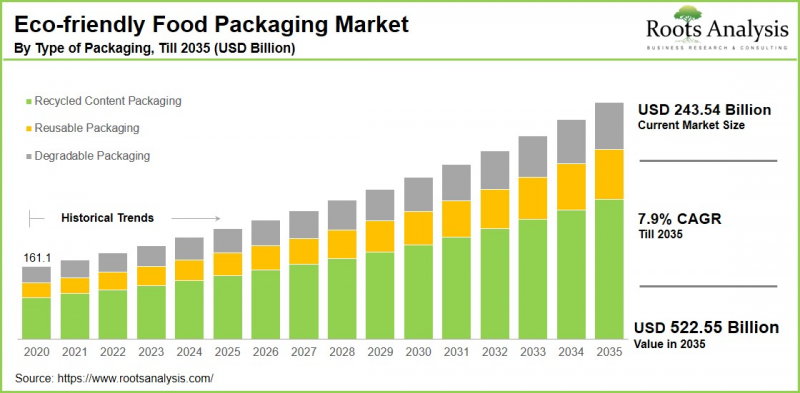
環保食品包裝市場:成長與趨勢
環保食品包裝是指使用環境安全且天然的材料包裝。 可降解材料。這些材料必須能夠保護食品免受物理、化學和生物威脅造成的篡改和污染。目前,活性包裝是確保食品安全的首選包裝類型。
受消費者偏好變化和嚴格的環境法規的推動,環保食品包裝市場正呈現顯著成長。塑造該市場的關鍵趨勢之一是可生物降解和可堆肥包裝材料的日益普及。這些材料由植物纖維和生物聚合物等可再生資源製成,因其能夠自然分解而備受關注,有助於減少垃圾掩埋場的廢物和環境污染。
此外,各公司正致力於開發符合永續發展目標的創新包裝解決方案,包括水性塗層和可回收阻隔技術。對零浪費和無塑膠包裝替代品的需求不斷增長,以及材料科學的進步,正在加速向環保食品包裝的轉變。循環經濟倡議日益重要,以及消費者期望企業在其營運中優先考慮永續性,也推動了這一趨勢。 考慮到這些因素,預計環保食品包裝市場在預測期內將顯著成長。
本報告分析了全球環保食品包裝市場,提供了市場規模估算、機會分析、競爭格局和公司概況。
目錄
第一部分:報告概述
第一章:引言
第二章:研究方法
第三章:市場動態
第四章:宏觀經濟指標
第二部分:質性研究結果
第五章:摘要整理
第六章:引言
第七章:監理環境
第三部分:市場概覽
第八章:關鍵指標綜合資料庫
第九章:競爭格局
第十章:市場空白分析
第十一章:競爭分析
第十二章:環保食品包裝市場的新創企業生態系
第四部分:公司簡介
第十三章:公司簡介
- 章節概述
- 安姆科
- 波爾公司
- 巴斯夫
- 生物質
- 加拿大紙業
- 杜邦
- 生態產品
- 常青
- 福建青山
- 喬治亞-太平洋地區
- 綠包
- 克拉賓
- 蒙迪
- 北歐紙業
- SCG 包裝
- 永續包裝
- 利樂
- TIPA
- 特種東海紙
- 蔬菜
- 西石
- 溫帕克
第 5 部分:市場趨勢
第 14 章:大趨勢分析
第 15 章:未滿足的需求分析
第 16 章:專利分析
章節第 17 章:最新進展
第 6 節:市場機會分析
第 18 章:全球環保食品包裝市場
第 19 章:依材料類型劃分的市場機會
第 20 章:依包裝類型劃分的市場機會
第 21 章:依產品類型劃分的市場機會
第 22 章:依技術類型劃分的市場機會
第 23 章:以層類型劃分的市場機會
第 24 章:依應用領域劃分的市場機會
第 25 章:依最終使用者劃分的市場機會
第26章:依公司類型劃分的市場機會
第27章:北美環保食品包裝市場的市場機會
第28章:歐洲環保食品包裝市場的市場機會
第29章:亞洲環保食品包裝市場的市場機會
第30章:中東和北非(MENA)環保食品包裝市場的市場機會
第31章:拉丁美洲環保食品包裝市場的市場機會
第32章:其他地區環保食品包裝市場的市場機會
第33章:主要參與者的市場集中度分析
第32章:鄰近市場分析
第7節:策略工具
第33章:關鍵成功策略
第34章:波特五力分析
第35章:SWOT分析
第36章:價值鏈分析
第37章:對Roots的策略建議
第8節:其他獨家發現
第38章:主要研究發現
第39章:報告結論
第九節:附錄
Eco-Friendly Food Packaging Market Overview
As per Roots Analysis, the global eco-friendly food packaging market size is estimated to grow from USD 243.54 billion in the current year USD 522.55 billion by 2035, at a CAGR of 7.9% during the forecast period, till 2035.
The opportunity for eco-friendly food packaging market has been distributed across the following segments:
Type of Material
- Glass
- Metal
- Paper & Paperboard
- Plastic
- Scratch-Based Materials
Type of Packaging
- Degradable Packaging
- Recycled Content Packaging
- Reusable Packaging
Type of Product
- Bags
- Bottles and Jars
- Boxes
- Cans
- Containers
- Films
- Pouches and Sachets
- Trays
- Tubes
- Other products
Type of Technique
- Active Packaging
- Alternate Fiber Packaging
- Molded Packaging
- Multipurpose Packaging
- Other techniques
Type of Layer
- Primary Packaging
- Secondary Packaging
- Tertiary Packaging
Areas of Application
- Beverages
- Food
Type of End-user
- Foodservice
- Food Processing
- Retail
Type of Enterprise
- Large Enterprises
- Small and Medium Enterprises
Geographical Regions
- North America
- US
- Canada
- Mexico
- Other North American countries
- Europe
- Austria
- Belgium
- Denmark
- France
- Germany
- Ireland
- Italy
- Netherlands
- Norway
- Russia
- Spain
- Sweden
- Switzerland
- UK
- Other European countries
- Asia
- China
- India
- Japan
- Singapore
- South Korea
- Other Asian countries
- Latin America
- Brazil
- Chile
- Colombia
- Venezuela
- Other Latin American countries
- Middle East and North Africa
- Egypt
- Iran
- Iraq
- Israel
- Kuwait
- Saudi Arabia
- UAE
- Other MENA countries
- Rest of the World
- Australia
- New Zealand
- Other countries
Eco-Friendly Food Packaging Market: Growth and Trends
Eco-friendly food packaging involves using materials that are environmentally safe and capable of breaking down naturally. Such materials must ensure protection against tampering or contamination from any physical, chemical, or biological threats; currently, the most favored type of packaging used for food safety is active packaging.
The market for eco-friendly food packaging is witnessing significant growth, driven by shifts in consumer preferences and stringent environmental regulations. A key trend shaping this market is the increasing adoption of biodegradable and compostable packaging materials. Made from renewable sources such as plant-based fibers and biopolymers, these materials are gaining traction because of their ability to decompose naturally, which helps reduce landfill waste and environmental pollution.
Further, the companies are focusing on developing innovative packaging solutions that align with sustainability goals, which includes water-based coatings and recyclable barrier technologies. The rising demand for zero-waste and plastic-free packaging alternatives, combined with advancements in material science, is accelerating the shift toward eco-friendly food packaging. This movement is also backed by an increased emphasis on circular economy initiatives and consumer expectations for companies that prioritize sustainability in their practices. Overall, considering the above mentioned factors, the eco-friendly food packaging market is expected to grow significantly during the forecast period.
Eco-Friendly Food Packaging Market: Key Segments
Market Share by Type of Material
Based on type of material, the global eco-friendly food packaging market is segmented into glass, metal, paper & paperboard, plastic, scratch-based materials. According to our estimates, currently, the paper & paperboard sub-segment captures the majority of the market share. This is due to its broad availability, recyclability, and versatility. Paper-based materials are economical, lightweight, and easily customizable, which makes them a favored option for food packaging across different sectors.
Conversely, the scratch-based materials segment is expected to experience rapid growth throughout the forecast period. This is driven by the increasing demand for innovative, biodegradable, and compostable packaging solutions. Scratch-based materials fit well within the circular economy model, providing a sustainable alternative to conventional plastics.
Market Share by Type of Packaging
Based on type of packaging, the global eco-friendly food packaging market is segmented into degradable packaging, recycled content packaging and reusable packaging. According to our estimates, currently, the recycled content packaging segment captures the majority of the market share. This is due to the increasing focus on circular economy initiatives and the rising demand for sustainable packaging made from materials that are either post-consumer or post-industrial waste.
However, the reusable packaging segment is expected to grow at a higher CAGR during the forecast period. This growth is fueled by the growing awareness of the need to minimize single-use packaging waste and the transition towards more durable and long-lasting packaging options.
Market Share by Type of Product
Based on type of product, the global eco-friendly food packaging market is segmented into bags, bottles and jars, boxes, cans, containers, films, pouches and sachets, trays, tubes and other products. According to our estimates, currently, the containers segment captures the majority of the market share. This growth is primarily due to its widespread usage in various applications like food storage and takeout services. Containers crafted from biodegradable materials such as cardboard, paper, and bioplastics are increasingly preferred for their capacity to reduce environmental impact while maintaining food quality.
However, the bags segment is expected to grow at a higher CAGR during the forecast period. The expansion of this segment is fueled by growing consumer demand for convenient and lightweight packaging options. Eco-friendly bags, frequently constructed from materials such as recycled paper or compostable plastics, are becoming more popular due to their versatility in transporting food items and their alignment with sustainability objectives.
Market Share by Type of Technique
Based on type of technique, the global eco-friendly food packaging market is segmented into active packaging, alternate fiber packaging, molded packaging, multipurpose packaging, and other techniques. According to our estimates, currently, the active packaging segment captures the majority of the market share. This growth is primarily due to its capability to enhance food safety and quality while decreasing waste, making it a popular option among manufacturers and consumers looking for sustainable choices.
However, the molded packaging segment is expected to grow at a higher CAGR during the forecast period. Molded packaging, which encompasses products like trays and containers made from biodegradable materials, is gaining popularity due to its flexibility and effectiveness in safeguarding food products. Moreover, the rising demand for lightweight yet resilient packaging solutions that also reduce environmental impact is propelling market growth.
Market Share by Type of Layer
Based on type of layer, the global eco-friendly food packaging market is segmented into primary packaging, secondary packaging, and tertiary packaging. According to our estimates, currently, the primary packaging segment captures the majority of the market share. Primary containers refer to items that directly hold food products, such as bags, bottles, and containers. This segment is experiencing growth due to heightened consumer awareness and regulatory demands for reducing plastic usage.
However, the secondary packaging segment is expected to grow at a higher CAGR during the forecast period. The increasing focus on sustainability and environmental consciousness among consumers is boosting the demand for secondary packaging solutions that are both functional and compatible with ecological objectives.
Market Share by Areas of Application
Based on areas of application, the global eco-friendly food packaging market is segmented into beverages and food. According to our estimates, currently, the food segment captures the majority of the market share. This segment benefits from the widespread adoption of sustainable packaging solutions across different food categories, such as bakery items, dairy products, meat, fruits, and vegetables. The growth of this segment is being driven by the increasing consumer demand for fresh and minimally processed foods, along with a heightened awareness of environmental concerns.
However, the beverages segment is expected to grow at a higher CAGR during the forecast period. This growth is attributed to the rising consumer inclination toward sustainable packaging options in beverage products, which include both alcoholic and non-alcoholic varieties.
Market Share by Type of End-User
Based on type of end-user, the global eco-friendly food packaging market is segmented into foodservice, food processing and retail. According to our estimates, currently, the foodservice segment captures the majority of the market share. This growth is primarily due to the rising focus on sustainability and environmental accountability among restaurants and catering firms, which are progressively adopting eco-friendly packaging solutions to satisfy consumer demand for greener packaging options.
However, the food processing segment is expected to grow at a higher CAGR during the forecast period. This growth is propelled by an increasing emphasis on sustainable practices in food manufacturing, as processors aim to lessen their environmental impact.
Market Share by Type of Enterprise
Based on type of enterprise, the global eco-friendly food packaging market is segmented into large and small and medium enterprises. According to our estimates, currently, the large enterprise segment captures the majority of the market share. This can be attributed to their flexibility, innovative approaches, emphasis on specialized markets, and capability to adjust to evolving customer preferences and market dynamics.
Market Share by Geographical Regions
Based on geographical regions, the eco-friendly food packaging market is segmented into North America, Europe, Asia, Latin America, Middle East and North Africa, and the rest of the world. According to our estimates, currently Europe captures the majority share of the market. This increase is largely fueled by the restrictions on single-use plastics enforced by government regulations within the European Union. The European Directive has set forth guidelines for the circular economy and sustainability standards that are being adopted by businesses across Europe.
Example Players in Eco-Friendly Food Packaging Market
- Amcor
- Ball Corporation
- BASF
- Be Green
- Berry Global
- Billerudkorsnas
- Biomass
- Biopak
- Canfor
- Crown Holdings
- CTI Paper
- Daio Paper Construction
- DS Smith
- DuPont
- Gascogne Papier
- Genpak
- Genus Paper and Boards
- International Paper
- Karl Knauer
- Klabin
- Oji Holdings
- PacknWood
- Paperfoam
- Printpak
- SCG PACKAGING
- Sealed Air
- Segezha
- Sulapac
- Sustainable Packaging
- Swedbrand
- Tetra Pak
- TIPA
- Tokushu Tokai Paper
- Vegware
- WestRock
- Winpak
Eco-Friendly Food Packaging Market: Research Coverage
The report on the eco-friendly food packaging market features insights on various sections, including:
- Market Sizing and Opportunity Analysis: An in-depth analysis of the eco-friendly food packaging market, focusing on key market segments, including [A] type of material, [B] type of packaging, [C] type of product, [D] type of technique, [E] type of layer, [F] areas of application, [G] type of end-user, [H] type of enterprise, and [I] geographical regions.
- Competitive Landscape: A comprehensive analysis of the companies engaged in the eco-friendly food packaging market, based on several relevant parameters, such as [A] year of establishment, [B] company size, [C] location of headquarters and [D] ownership structure.
- Company Profiles: Elaborate profiles of prominent players engaged in the eco-friendly food packaging market, providing details on [A] location of headquarters, [B] company size, [C] company mission, [D] company footprint, [E] management team, [F] contact details, [G] financial information, [H] operating business segments, [I] portfolio, [J] moat analysis, [K] recent developments, and an informed future outlook.
- Megatrends: An evaluation of ongoing megatrends in the eco-friendly food packaging industry.
- Patent Analysis: An insightful analysis of patents filed / granted in the eco-friendly food packaging domain, based on relevant parameters, including [A] type of patent, [B] patent publication year, [C] patent age and [D] leading players.
- Recent Developments: An overview of the recent developments made in the eco-friendly food packaging market, along with analysis based on relevant parameters, including [A] year of initiative, [B] type of initiative, [C] geographical distribution and [D] most active players.
- Porter's Five Forces Analysis: An analysis of five competitive forces prevailing in the eco-friendly food packaging market, including threats of new entrants, bargaining power of buyers, bargaining power of suppliers, threats of substitute products and rivalry among existing competitors.
- SWOT Analysis: An insightful SWOT framework, highlighting the strengths, weaknesses, opportunities and threats in the domain. Additionally, it provides Harvey ball analysis, highlighting the relative impact of each SWOT parameter.
- Value Chain Analysis: A comprehensive analysis of the value chain, providing information on the different phases and stakeholders involved in the eco-friendly food packaging market.
Key Questions Answered in this Report
- How many companies are currently engaged in eco-friendly food packaging market?
- Which are the leading companies in this market?
- What factors are likely to influence the evolution of this market?
- What is the current and future market size?
- What is the CAGR of this market?
- How is the current and future market opportunity likely to be distributed across key market segments?
Reasons to Buy this Report
- The report provides a comprehensive market analysis, offering detailed revenue projections of the overall market and its specific sub-segments. This information is valuable to both established market leaders and emerging entrants.
- Stakeholders can leverage the report to gain a deeper understanding of the competitive dynamics within the market. By analyzing the competitive landscape, businesses can make informed decisions to optimize their market positioning and develop effective go-to-market strategies.
- The report offers stakeholders a comprehensive overview of the market, including key drivers, barriers, opportunities, and challenges. This information empowers stakeholders to stay abreast of market trends and make data-driven decisions to capitalize on growth prospects.
Additional Benefits
- Complimentary Excel Data Packs for all Analytical Modules in the Report
- 15% Free Content Customization
- Detailed Report Walkthrough Session with Research Team
- Free Updated report if the report is 6-12 months old or older
TABLE OF CONTENTS
SECTION I: REPORT OVERVIEW
1. PREFACE
- 1.1. Introduction
- 1.2. Market Share Insights
- 1.3. Key Market Insights
- 1.4. Report Coverage
- 1.5. Key Questions Answered
- 1.6. Chapter Outlines
2. RESEARCH METHODOLOGY
- 2.1. Chapter Overview
- 2.2. Research Assumptions
- 2.3. Database Building
- 2.3.1. Data Collection
- 2.3.2. Data Validation
- 2.3.3. Data Analysis
- 2.4. Project Methodology
- 2.4.1. Secondary Research
- 2.4.1.1. Annual Reports
- 2.4.1.2. Academic Research Papers
- 2.4.1.3. Company Websites
- 2.4.1.4. Investor Presentations
- 2.4.1.5. Regulatory Filings
- 2.4.1.6. White Papers
- 2.4.1.7. Industry Publications
- 2.4.1.8. Conferences and Seminars
- 2.4.1.9. Government Portals
- 2.4.1.10. Media and Press Releases
- 2.4.1.11. Newsletters
- 2.4.1.12. Industry Databases
- 2.4.1.13. Roots Proprietary Databases
- 2.4.1.14. Paid Databases and Sources
- 2.4.1.15. Social Media Portals
- 2.4.1.16. Other Secondary Sources
- 2.4.2. Primary Research
- 2.4.2.1. Introduction
- 2.4.2.2. Types
- 2.4.2.2.1. Qualitative
- 2.4.2.2.2. Quantitative
- 2.4.2.3. Advantages
- 2.4.2.4. Techniques
- 2.4.2.4.1. Interviews
- 2.4.2.4.2. Surveys
- 2.4.2.4.3. Focus Groups
- 2.4.2.4.4. Observational Research
- 2.4.2.4.5. Social Media Interactions
- 2.4.2.5. Stakeholders
- 2.4.2.5.1. Company Executives (CXOs)
- 2.4.2.5.2. Board of Directors
- 2.4.2.5.3. Company Presidents and Vice Presidents
- 2.4.2.5.4. Key Opinion Leaders
- 2.4.2.5.5. Research and Development Heads
- 2.4.2.5.6. Technical Experts
- 2.4.2.5.7. Subject Matter Experts
- 2.4.2.5.8. Scientists
- 2.4.2.5.9. Doctors and Other Healthcare Providers
- 2.4.2.6. Ethics and Integrity
- 2.4.2.6.1. Research Ethics
- 2.4.2.6.2. Data Integrity
- 2.4.3. Analytical Tools and Databases
- 2.4.1. Secondary Research
3. MARKET DYNAMICS
- 3.1. Forecast Methodology
- 3.1.1. Top-Down Approach
- 3.1.2. Bottom-Up Approach
- 3.1.3. Hybrid Approach
- 3.2. Market Assessment Framework
- 3.2.1. Total Addressable Market (TAM)
- 3.2.2. Serviceable Addressable Market (SAM)
- 3.2.3. Serviceable Obtainable Market (SOM)
- 3.2.4. Currently Acquired Market (CAM)
- 3.3. Forecasting Tools and Techniques
- 3.3.1. Qualitative Forecasting
- 3.3.2. Correlation
- 3.3.3. Regression
- 3.3.4. Time Series Analysis
- 3.3.5. Extrapolation
- 3.3.6. Convergence
- 3.3.7. Forecast Error Analysis
- 3.3.8. Data Visualization
- 3.3.9. Scenario Planning
- 3.3.10. Sensitivity Analysis
- 3.4. Key Considerations
- 3.4.1. Demographics
- 3.4.2. Market Access
- 3.4.3. Reimbursement Scenarios
- 3.4.4. Industry Consolidation
- 3.5. Robust Quality Control
- 3.6. Key Market Segmentations
- 3.7. Limitations
4. MACRO-ECONOMIC INDICATORS
- 4.1. Chapter Overview
- 4.2. Market Dynamics
- 4.2.1. Time Period
- 4.2.1.1. Historical Trends
- 4.2.1.2. Current and Forecasted Estimates
- 4.2.2. Currency Coverage
- 4.2.2.1. Overview of Major Currencies Affecting the Market
- 4.2.2.2. Impact of Currency Fluctuations on the Industry
- 4.2.3. Foreign Exchange Impact
- 4.2.3.1. Evaluation of Foreign Exchange Rates and Their Impact on Market
- 4.2.3.2. Strategies for Mitigating Foreign Exchange Risk
- 4.2.4. Recession
- 4.2.4.1. Historical Analysis of Past Recessions and Lessons Learnt
- 4.2.4.2. Assessment of Current Economic Conditions and Potential Impact on the Market
- 4.2.5. Inflation
- 4.2.5.1. Measurement and Analysis of Inflationary Pressures in the Economy
- 4.2.5.2. Potential Impact of Inflation on the Market Evolution
- 4.2.6. Interest Rates
- 4.2.6.1. Overview of Interest Rates and Their Impact on the Market
- 4.2.6.2. Strategies for Managing Interest Rate Risk
- 4.2.7. Commodity Flow Analysis
- 4.2.7.1. Type of Commodity
- 4.2.7.2. Origins and Destinations
- 4.2.7.3. Values and Weights
- 4.2.7.4. Modes of Transportation
- 4.2.8. Global Trade Dynamics
- 4.2.8.1. Import Scenario
- 4.2.8.2. Export Scenario
- 4.2.9. War Impact Analysis
- 4.2.9.1. Russian-Ukraine War
- 4.2.9.2. Israel-Hamas War
- 4.2.10. COVID Impact / Related Factors
- 4.2.10.1. Global Economic Impact
- 4.2.10.2. Industry-specific Impact
- 4.2.10.3. Government Response and Stimulus Measures
- 4.2.10.4. Future Outlook and Adaptation Strategies
- 4.2.11. Other Indicators
- 4.2.11.1. Fiscal Policy
- 4.2.11.2. Consumer Spending
- 4.2.11.3. Gross Domestic Product (GDP)
- 4.2.11.4. Employment
- 4.2.11.5. Taxes
- 4.2.11.6. R&D Innovation
- 4.2.11.7. Stock Market Performance
- 4.2.11.8. Supply Chain
- 4.2.11.9. Cross-Border Dynamics
- 4.2.1. Time Period
SECTION II: QUALITATIVE INSIGHTS
5. EXECUTIVE SUMMARY
6. INTRODUCTION
- 6.1. Chapter Overview
- 6.2. Overview of Eco-friendly Food Packaging Market
- 6.2.1. Type of Material
- 6.2.2. Type of Packaging
- 6.2.3. Type of Product
- 6.2.4. Type of Technique
- 6.2.5. Type of Layer
- 6.2.6. Areas of Application
- 6.2.7. By End-Users
- 6.3. Future Perspective
7. REGULATORY SCENARIO
SECTION III: MARKET OVERVIEW
8. COMPREHENSIVE DATABASE OF LEADING PLAYERS
9. COMPETITIVE LANDSCAPE
- 9.1. Chapter Overview
- 9.2. Eco-friendly Food Packaging Market: Overall Market Landscape
- 9.2.1. Analysis by Year of Establishment
- 9.2.2. Analysis by Company Size
- 9.2.3. Analysis by Location of Headquarters
- 9.2.4. Analysis by Ownership Structure
10. WHITE SPACE ANALYSIS
11. COMPANY COMPETITIVENESS ANALYSIS
12. STARTUP ECOSYSTEM IN THE ECO-FRIENDLY FOOD PACKAGING MARKET
- 12.1. Eco-friendly Food Packaging Market: Market Landscape of Startups
- 12.1.1. Analysis by Year of Establishment
- 12.1.2. Analysis by Company Size
- 12.1.3. Analysis by Company Size and Year of Establishment
- 12.1.4. Analysis by Location of Headquarters
- 12.1.5. Analysis by Company Size and Location of Headquarters
- 12.1.6. Analysis by Ownership Structure
- 12.2. Key Findings
SECTION IV: COMPANY PROFILES
13. COMPANY PROFILES
- 13.1. Chapter Overview
- 13.2. Amcor*
- 13.2.1. Company Overview
- 13.2.2. Company Mission
- 13.2.3. Company Footprint
- 13.2.4. Management Team
- 13.2.5. Contact Details
- 13.2.6. Financial Performance
- 13.2.7. Operating Business Segments
- 13.2.8. Service / Product Portfolio (project specific)
- 13.2.9. MOAT Analysis
- 13.2.10. Recent Developments and Future Outlook
- 13.3. Ball Corporation
- 13.4. BASF
- 13.5. Biomass
- 13.6. Canadian Paper
- 13.7. DuPont
- 13.8. Eco Products
- 13.9. Evergreen
- 13.10. Fujian Qingshan
- 13.11. Georgia-Pacific
- 13.12. Green Pack
- 13.13. Klabin
- 13.14. Mondi
- 13.15. Nordic Paper
- 13.16. SCG PACKAGING
- 13.17. Sustainable Packaging
- 13.18. Tetra Pak
- 13.19. TIPA
- 13.20. Tokushu Tokai Paper
- 13.21. Vegware
- 13.22. WestRock
- 13.23. Winpak
SECTION V: MARKET TRENDS
14. MEGA TRENDS ANALYSIS
15. UNMET NEED ANALYSIS
16. PATENT ANALYSIS
17. RECENT DEVELOPMENTS
- 17.1. Chapter Overview
- 17.2. Recent Funding
- 17.3. Recent Partnerships
- 17.4. Other Recent Initiatives
SECTION VI: MARKET OPPORTUNITY ANALYSIS
18. GLOBAL ECO-FRIENDLY FOOD PACKAGING MARKET
- 18.1. Chapter Overview
- 18.2. Key Assumptions and Methodology
- 18.3. Trends Disruption Impacting Market
- 18.4. Demand Side Trends
- 18.5. Supply Side Trends
- 18.6. Global Eco-friendly Food Packaging Market, Historical Trends (Since 2020) and Forecasted Estimates (Till 2035)
- 18.7. Multivariate Scenario Analysis
- 18.7.1. Conservative Scenario
- 18.7.2. Optimistic Scenario
- 18.8. Investment Feasibility Index
- 18.9. Key Market Segmentations
19. MARKET OPPORTUNITIES BASED ON TYPE OF MATERIAL
- 19.1. Chapter Overview
- 19.2. Key Assumptions and Methodology
- 19.3. Revenue Shift Analysis
- 19.4. Market Movement Analysis
- 19.5. Penetration-Growth (P-G) Matrix
- 19.6. Eco-friendly Food Packaging Market for Glass: Historical Trends (Since 2020) and Forecasted Estimates (Till 2035)
- 19.7. Eco-friendly Food Packaging Market for Metal: Historical Trends (Since 2020) and Forecasted Estimates (Till 2035)
- 19.8. Eco-friendly Food Packaging Market for Paper and Paperboard: Historical Trends (Since 2020) and Forecasted Estimates (Till 2035)
- 19.9. Eco-friendly Food Packaging Market for Plastic: Historical Trends (Since 2020) and Forecasted Estimates (Till 2035)
- 19.10. Eco-friendly Food Packaging Market for Scratch-Based Materials: Historical Trends (Since 2020) and Forecasted Estimates (Till 2035)
- 19.11. Data Triangulation and Validation
- 19.11.1. Secondary Sources
- 19.11.2. Primary Sources
- 19.11.3. Statistical Modeling
20. MARKET OPPORTUNITIES BASED ON TYPE OF PACKAGING
- 20.1. Chapter Overview
- 20.2. Key Assumptions and Methodology
- 20.3. Revenue Shift Analysis
- 20.4. Market Movement Analysis
- 20.5. Penetration-Growth (P-G) Matrix
- 20.6. Eco-friendly Food Packaging Market for Degradable Packaging: Historical Trends (Since 2020) and Forecasted Estimates (Till 2035)
- 20.7. Eco-friendly Food Packaging Market for Recycled Content Packaging: Historical Trends (Since 2020) and Forecasted Estimates (Till 2035)
- 20.8. Eco-friendly Food Packaging Market for Reusable Packaging: Historical Trends (Since 2020) and Forecasted Estimates (Till 2035)
- 20.9. Data Triangulation and Validation
- 20.9.1. Secondary Sources
- 20.9.2. Primary Sources
- 20.9.3. Statistical Modeling
21. MARKET OPPORTUNITIES BASED ON TYPE OF PRODUCT
- 21.1. Chapter Overview
- 21.2. Key Assumptions and Methodology
- 21.3. Revenue Shift Analysis
- 21.4. Market Movement Analysis
- 21.5. Penetration-Growth (P-G) Matrix
- 21.6. Eco-friendly Food Packaging Market for Bags: Historical Trends (Since 2020) and Forecasted Estimates (Till 2035)
- 21.7. Eco-friendly Food Packaging Market for Bottles and Jars: Historical Trends (Since 2020) and Forecasted Estimates (Till 2035)
- 21.8. Eco-friendly Food Packaging Market for Boxes: Historical Trends (Since 2020) and Forecasted Estimates (Till 2035)
- 21.9. Eco-friendly Food Packaging Market for Cans: Historical Trends (Since 2020) and Forecasted Estimates (Till 2035)
- 21.10. Eco-friendly Food Packaging Market for Containers: Historical Trends (Since 2020) and Forecasted Estimates (Till 2035)
- 21.11. Eco-friendly Food Packaging Market for Films: Historical Trends (Since 2020) and Forecasted Estimates (Till 2035)
- 21.12. Eco-friendly Food Packaging Market for Pouches and Sachets: Historical Trends (Since 2020) and Forecasted Estimates (Till 2035)
- 21.13. Eco-friendly Food Packaging Market for Trays: Historical Trends (Since 2020) and Forecasted Estimates (Till 2035)
- 21.14. Eco-friendly Food Packaging Market for Tubes: Historical Trends (Since 2020) and Forecasted Estimates (Till 2035)
- 21.15. Eco-friendly Food Packaging Market for Other products: Historical Trends (Since 2020) and Forecasted Estimates (Till 2035)
- 21.16. Data Triangulation and Validation
- 21.16.1. Secondary Sources
- 21.16.2. Primary Sources
- 21.16.3. Statistical Modeling
22. MARKET OPPORTUNITIES BASED ON TYPE OF TECHNIQUE
- 22.1. Chapter Overview
- 22.2. Key Assumptions and Methodology
- 22.3. Revenue Shift Analysis
- 22.4. Market Movement Analysis
- 22.5. Penetration-Growth (P-G) Matrix
- 22.6. Eco-friendly Food Packaging Market for Active Packaging: Historical Trends (Since 2020) and Forecasted Estimates (Till 2035)
- 22.7. Eco-friendly Food Packaging Market for Alternate Fiber Packaging: Historical Trends (Since 2020) and Forecasted Estimates (Till 2035)
- 22.8. Eco-friendly Food Packaging Market for Molded Packaging: Historical Trends (Since 2020) and Forecasted Estimates (Till 2035)
- 22.9. Eco-friendly Food Packaging Market for Multipurpose Packaging: Historical Trends (Since 2020) and Forecasted Estimates (Till 2035)
- 22.10. Eco-friendly Food Packaging Market for Other techniques: Historical Trends (Since 2020) and Forecasted Estimates (Till 2035)
- 22.11. Data Triangulation and Validation
- 22.11.1. Secondary Sources
- 22.11.2. Primary Sources
- 22.11.3. Statistical Modeling
23. MARKET OPPORTUNITIES BASED ON TYPE OF LAYER
- 23.1. Chapter Overview
- 23.2. Key Assumptions and Methodology
- 23.3. Revenue Shift Analysis
- 23.4. Market Movement Analysis
- 23.5. Penetration-Growth (P-G) Matrix
- 23.6. Eco-friendly Food Packaging Market for Primary Packaging: Historical Trends (Since 2020) and Forecasted Estimates (Till 2035)
- 23.7. Eco-friendly Food Packaging Market for Secondary Packaging: Historical Trends (Since 2020) and Forecasted Estimates (Till 2035)
- 23.8. Eco-friendly Food Packaging Market for Tertiary Packaging: Historical Trends (Since 2020) and Forecasted Estimates (Till 2035)
- 23.9. Data Triangulation and Validation
- 23.9.1. Secondary Sources
- 23.9.2. Primary Sources
- 23.9.3. Statistical Modeling
24. MARKET OPPORTUNITIES BASED ON AREAS OF APPLICATION
- 24.1. Chapter Overview
- 24.2. Key Assumptions and Methodology
- 24.3. Revenue Shift Analysis
- 24.4. Market Movement Analysis
- 24.5. Penetration-Growth (P-G) Matrix
- 24.6. Eco-friendly Food Packaging Market for Beverages: Historical Trends (Since 2020) and Forecasted Estimates (Till 2035)
- 24.7. Eco-friendly Food Packaging Market for Food: Historical Trends (Since 2020) and Forecasted Estimates (Till 2035)
- 24.8. Data Triangulation and Validation
- 24.8.1. Secondary Sources
- 24.8.2. Primary Sources
- 24.8.3. Statistical Modeling
25. MARKET OPPORTUNITIES BASED ON TYPE OF END-USER
- 25.1. Chapter Overview
- 25.2. Key Assumptions and Methodology
- 25.3. Revenue Shift Analysis
- 25.4. Market Movement Analysis
- 25.5. Penetration-Growth (P-G) Matrix
- 25.6. Eco-friendly Food Packaging Market for Foodservice: Historical Trends (Since 2020) and Forecasted Estimates (Till 2035)
- 25.7. Eco-friendly Food Packaging Market for Food Processing: Historical Trends (Since 2020) and Forecasted Estimates (Till 2035)
- 25.8. Eco-friendly Food Packaging Market for Retail: Historical Trends (Since 2020) and Forecasted Estimates (Till 2035)
- 25.9. Data Triangulation and Validation
- 25.9.1. Secondary Sources
- 25.9.2. Primary Sources
- 25.9.3. Statistical Modeling
26. MARKET OPPORTUNITIES BASED ON TYPE OF ENTERPRISE
- 26.1. Chapter Overview
- 26.2. Key Assumptions and Methodology
- 26.3. Revenue Shift Analysis
- 26.4. Market Movement Analysis
- 26.5. Penetration-Growth (P-G) Matrix
- 26.6. Eco-friendly Food Packaging Market for Large Enterprise: Historical Trends (Since 2020) and Forecasted Estimates (Till 2035)
- 26.7. Eco-friendly Food Packaging Market for Small and Medium Enterprise (SME): Historical Trends (Since 2020) and Forecasted Estimates (Till 2035)
- 26.8. Data Triangulation and Validation
- 26.8.1. Secondary Sources
- 26.8.2. Primary Sources
- 26.8.3. Statistical Modeling
27. MARKET OPPORTUNITIES FOR ECO-FRIENDLY FOOD PACKAGING MARKET IN NORTH AMERICA
- 27.1. Chapter Overview
- 27.2. Key Assumptions and Methodology
- 27.3. Revenue Shift Analysis
- 27.4. Market Movement Analysis
- 27.5. Penetration-Growth (P-G) Matrix
- 27.6. Eco-friendly Food Packaging Market in North America: Historical Trends (Since 2020) and Forecasted Estimates (Till 2035)
- 27.6.1. Eco-friendly Food Packaging Market in the US: Historical Trends (Since 2020) and Forecasted Estimates (Till 2035)
- 27.6.2. Eco-friendly Food Packaging Market in Canada: Historical Trends (Since 2020) and Forecasted Estimates (Till 2035)
- 27.6.3. Eco-friendly Food Packaging Market in Mexico: Historical Trends (Since 2020) and Forecasted Estimates (Till 2035)
- 27.6.4. Eco-friendly Food Packaging Market in Other North American Countries: Historical Trends (Since 2020) and Forecasted Estimates (Till 2035)
- 27.7. Data Triangulation and Validation
28. MARKET OPPORTUNITIES FOR ECO-FRIENDLY FOOD PACKAGING MARKET IN EUROPE
- 28.1. Chapter Overview
- 28.2. Key Assumptions and Methodology
- 28.3. Revenue Shift Analysis
- 28.4. Market Movement Analysis
- 28.5. Penetration-Growth (P-G) Matrix
- 28.6. Eco-friendly Food Packaging Market in Europe: Historical Trends (Since 2020) and Forecasted Estimates (Till 2035)
- 28.6.1. Eco-friendly Food Packaging Market in Austria: Historical Trends (Since 2020) and Forecasted Estimates (Till 2035)
- 28.6.2. Eco-friendly Food Packaging Market in Belgium: Historical Trends (Since 2020) and Forecasted Estimates (Till 2035)
- 28.6.3. Eco-friendly Food Packaging Market in Denmark: Historical Trends (Since 2020) and Forecasted Estimates (Till 2035)
- 28.6.4. Eco-friendly Food Packaging Market in France: Historical Trends (Since 2020) and Forecasted Estimates (Till 2035)
- 28.6.5. Eco-friendly Food Packaging Market in Germany: Historical Trends (Since 2020) and Forecasted Estimates (Till 2035)
- 28.6.6. Eco-friendly Food Packaging Market in Ireland: Historical Trends (Since 2020) and Forecasted Estimates (Till 2035)
- 28.6.7. Eco-friendly Food Packaging Market in Italy: Historical Trends (Since 2020) and Forecasted Estimates (Till 2035)
- 28.6.8. Eco-friendly Food Packaging Market in Netherlands: Historical Trends (Since 2020) and Forecasted Estimates (Till 2035)
- 28.6.9. Eco-friendly Food Packaging Market in Norway: Historical Trends (Since 2020) and Forecasted Estimates (Till 2035)
- 28.6.10. Eco-friendly Food Packaging Market in Russia: Historical Trends (Since 2020) and Forecasted Estimates (Till 2035)
- 28.6.11. Eco-friendly Food Packaging Market in Spain: Historical Trends (Since 2020) and Forecasted Estimates (Till 2035)
- 28.6.12. Eco-friendly Food Packaging Market in Sweden: Historical Trends (Since 2020) and Forecasted Estimates (Till 2035)
- 28.6.13. Eco-friendly Food Packaging Market in Switzerland: Historical Trends (Since 2020) and Forecasted Estimates (Till 2035)
- 28.6.14. Eco-friendly Food Packaging Market in the UK: Historical Trends (Since 2020) and Forecasted Estimates (Till 2035)
- 28.6.15. Eco-friendly Food Packaging Market in Other European Countries: Historical Trends (Since 2020) and Forecasted Estimates (Till 2035)
- 28.7. Data Triangulation and Validation
29. MARKET OPPORTUNITIES FOR ECO-FRIENDLY FOOD PACKAGING MARKET IN ASIA
- 29.1. Chapter Overview
- 29.2. Key Assumptions and Methodology
- 29.3. Revenue Shift Analysis
- 29.4. Market Movement Analysis
- 29.5. Penetration-Growth (P-G) Matrix
- 29.6. Eco-friendly Food Packaging Market in Asia: Historical Trends (Since 2020) and Forecasted Estimates (Till 2035)
- 29.6.1. Eco-friendly Food Packaging Market in China: Historical Trends (Since 2020) and Forecasted Estimates (Till 2035)
- 29.6.2. Eco-friendly Food Packaging Market in India: Historical Trends (Since 2020) and Forecasted Estimates (Till 2035)
- 29.6.3. Eco-friendly Food Packaging Market in Japan: Historical Trends (Since 2020) and Forecasted Estimates (Till 2035)
- 29.6.4. Eco-friendly Food Packaging Market in Singapore: Historical Trends (Since 2020) and Forecasted Estimates (Till 2035)
- 29.6.5. Eco-friendly Food Packaging Market in South Korea: Historical Trends (Since 2020) and Forecasted Estimates (Till 2035)
- 29.6.6. Eco-friendly Food Packaging Market in Other Asian Countries: Historical Trends (Since 2020) and Forecasted Estimates (Till 2035)
- 29.7. Data Triangulation and Validation
30. MARKET OPPORTUNITIES FOR ECO-FRIENDLY FOOD PACKAGING MARKET IN MIDDLE EAST AND NORTH AFRICA (MENA)
- 30.1. Chapter Overview
- 30.2. Key Assumptions and Methodology
- 30.3. Revenue Shift Analysis
- 30.4. Market Movement Analysis
- 30.5. Penetration-Growth (P-G) Matrix
- 30.6. Eco-friendly Food Packaging Market in Middle East and North Africa (MENA): Historical Trends (Since 2020) and Forecasted Estimates (Till 2035)
- 30.6.1. Eco-friendly Food Packaging Market in Egypt: Historical Trends (Since 2020) and Forecasted Estimates (Till 205)
- 30.6.2. Eco-friendly Food Packaging Market in Iran: Historical Trends (Since 2020) and Forecasted Estimates (Till 2035)
- 30.6.3. Eco-friendly Food Packaging Market in Iraq: Historical Trends (Since 2020) and Forecasted Estimates (Till 2035)
- 30.6.4. Eco-friendly Food Packaging Market in Israel: Historical Trends (Since 2020) and Forecasted Estimates (Till 2035)
- 30.6.5. Eco-friendly Food Packaging Market in Kuwait: Historical Trends (Since 2020) and Forecasted Estimates (Till 2035)
- 30.6.6. Eco-friendly Food Packaging Market in Saudi Arabia: Historical Trends (Since 2020) and Forecasted Estimates (Till 2035)
- 30.6.7. Eco-friendly Food Packaging Market in United Arab Emirates (UAE): Historical Trends (Since 2020) and Forecasted Estimates (Till 2035)
- 30.6.8. Eco-friendly Food Packaging Market in Other MENA Countries: Historical Trends (Since 2020) and Forecasted Estimates (Till 2035)
- 30.7. Data Triangulation and Validation
31. MARKET OPPORTUNITIES FOR ECO-FRIENDLY FOOD PACKAGING MARKET IN LATIN AMERICA
- 31.1. Chapter Overview
- 31.2. Key Assumptions and Methodology
- 31.3. Revenue Shift Analysis
- 31.4. Market Movement Analysis
- 31.5. Penetration-Growth (P-G) Matrix
- 31.6. Eco-friendly Food Packaging Market in Latin America: Historical Trends (Since 2020) and Forecasted Estimates (Till 2035)
- 31.6.1. Eco-friendly Food Packaging Market in Argentina: Historical Trends (Since 2020) and Forecasted Estimates (Till 2035)
- 31.6.2. Eco-friendly Food Packaging Market in Brazil: Historical Trends (Since 2020) and Forecasted Estimates (Till 2035)
- 31.6.3. Eco-friendly Food Packaging Market in Chile: Historical Trends (Since 2020) and Forecasted Estimates (Till 2035)
- 31.6.4. Eco-friendly Food Packaging Market in Colombia Historical Trends (Since 2020) and Forecasted Estimates (Till 2035)
- 31.6.5. Eco-friendly Food Packaging Market in Venezuela: Historical Trends (Since 2020) and Forecasted Estimates (Till 2035)
- 31.6.6. Eco-friendly Food Packaging Market in Other Latin American Countries: Historical Trends (Since 2020) and Forecasted Estimates (Till 2035)
- 31.7. Data Triangulation and Validation
32. MARKET OPPORTUNITIES FOR ECO-FRIENDLY FOOD PACKAGING MARKET IN REST OF THE WORLD
- 32.1. Chapter Overview
- 32.2. Key Assumptions and Methodology
- 32.3. Revenue Shift Analysis
- 32.4. Market Movement Analysis
- 32.5. Penetration-Growth (P-G) Matrix
- 32.6. Eco-friendly Food Packaging Market in Rest of the World: Historical Trends (Since 2020) and Forecasted Estimates (Till 2035)
- 32.6.1. Eco-friendly Food Packaging Market in Australia: Historical Trends (Since 2020) and Forecasted Estimates (Till 2035)
- 32.6.2. Eco-friendly Food Packaging Market in New Zealand: Historical Trends (Since 2020) and Forecasted Estimates (Till 2035)
- 32.6.3. Eco-friendly Food Packaging Market in Other Countries
- 32.7. Data Triangulation and Validation
33. MARKET CONCENTRATION ANALYSIS: DISTRIBUTION BY LEADING PLAYERS
32. ADJACENT MARKET ANALYSIS
SECTION VII: STRATEGIC TOOLS
33. KEY WINNING STRATEGIES
34. PORTER'S FIVE FORCES ANALYSIS
35. SWOT ANALYSIS
36. VALUE CHAIN ANALYSIS
37. ROOTS STRATEGIC RECOMMENDATIONS
- 37.1. Chapter Overview
- 37.2. Key Business-related Strategies
- 37.2.1. Research & Development
- 37.2.2. Product Manufacturing
- 37.2.3. Commercialization / Go-to-Market
- 37.2.4. Sales and Marketing
- 37.3. Key Operations-related Strategies
- 37.3.1. Risk Management
- 37.3.2. Workforce
- 37.3.3. Finance
- 37.3.4. Others
SECTION VIII: OTHER EXCLUSIVE INSIGHTS
38. INSIGHTS FROM PRIMARY RESEARCH
39. REPORT CONCLUSION
SECTION IX: APPENDIX
40. TABULATED DATA
41. LIST OF COMPANIES AND ORGANIZATIONS
42. CUSTOMIZATION OPPORTUNITIES
43. ROOTS SUBSCRIPTION SERVICES
44. AUTHOR DETAILS

 全球無 PFAS 食品包裝市場規模、佔有率、趨勢和成長分析報告(2026-2034 年)
 2026 年至 2035 年 PFAS 不含食品包裝市場的成長機會、成長要素、產業趨勢與預測。
 2034 年可生物分解和可堆肥包裝替代品市場預測-按材料、包裝形式、分解類型、應用、分銷管道和地區進行全球分析。環保黏合劑市場預測至2034年-全球分析(按類型、原料、技術、配方、性能、終端應用產業、通路和地區分類)環保食品包裝市場機會、成長要素、產業趨勢分析及2026-2035年預測
 環保食品包裝市場分析及預測(至2035年):類型、產品類型、材料類型、應用、技術、最終用戶、組件、製程、實施方案、解決方案全球甘蔗容器市場規模、佔有率、趨勢和成長分析報告(2026-2034年)環保食品包裝市場規模、佔有率、成長及全球產業分析:按類型和應用分類,區域的洞察,2026-2034年預測
 2026年全球環保食品包裝市場報告永續包裝和環保食品解決方案市場預測至2032年:按包裝材料、產品類型、技術、分銷管道、最終用戶和地區分類的全球分析