


 |
市場調查報告書
商品編碼
2163643
認知測驗與評估:市場佔有率分析、產業趨勢與統計、成長預測(2026-2031)Cognitive Test and Assessment - Market Share Analysis, Industry Trends & Statistics, Growth Forecasts (2026 - 2031) |
||||||

※ 本網頁內容可能與最新版本有所差異。詳細情況請與我們聯繫。
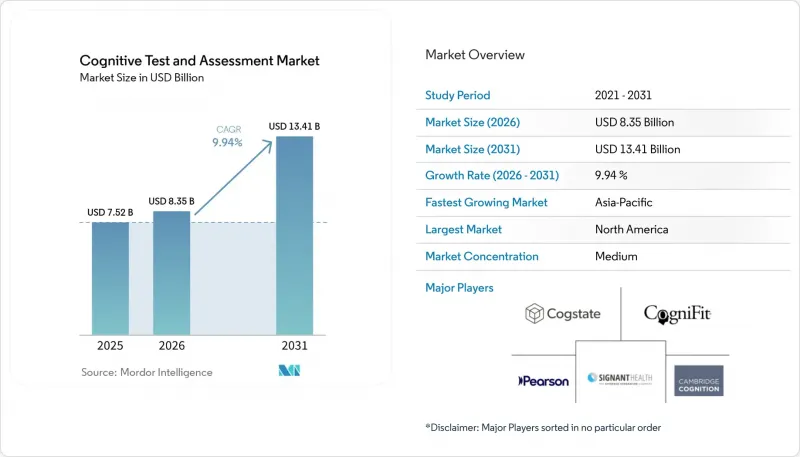
根據 Mordor Intelligence 預測,全球認知測試和評估市場預計將從 2025 年的 75.2 億美元成長到 2026 年的 83.5 億美元,到 2031 年達到 134.1 億美元,複合年成長率為 9.94%。
全球認知功能測驗與評估市場趨勢及洞察
失智症和神經退化性疾病的疾病負擔日益加重
認知功能測試和評估市場持續受益於大規模且不斷成長的疾病負擔。目前全球失智症患者人數已達5500萬,每年新增病例近1000萬,因此在診斷、分期和後續觀察的各個階段,對測試的需求都十分旺盛。一項發表於2025年的同儕審查研究也指出,患者群體規模將進一步大規模,長期患病人數也將持續成長。研究預測,隨著人口老化,到2050年,全球失智症患者人數將達到1.53億人。這對認知功能測試和評估市場具有重大意義,因為每位患者通常需要在治療的多個階段進行重複評估,而不僅僅是一次性測試。 2025年5月,美國食品藥物管理局(FDA)批准了Fujiri Bio公司的「Lumipulse」血液檢測,這將進一步強化這一趨勢。該檢測將使更多患者能夠在疾病早期階段接受系統性的認知功能評估。
中樞神經系統(CNS)臨床試驗去中心化進展
認知功能測試和評估市場的發展也受到中樞神經系統 (CNS) 臨床試驗中遠端和數位化優先試驗設計的明顯轉變的推動。申辦方擴大使用數位化認知終點,因為這些終點可以減輕研究中心的負擔,提高受試者招募的柔軟性,並能夠在更長的試驗週期內產生更高頻率的數據。 Cogstate 報告稱,截至 2025 年 12 月 31 日,其投資組合中共有 133 項正在進行的臨床試驗。這比去年同期成長了 34%,直接顯示申辦方對數位化評估基礎設施的需求日益成長。該報告還指出,2026 會計年度上半年將啟動 42 項新試驗,超過去年同期的 25 項,表明其應用範圍已超越了傳統上僅限於阿茲海默症研究的範疇。向情緒障礙、睡眠障礙和其他神經系統疾病計畫的多元化發展正在降低對特定治療領域或臨床試驗結果的依賴,從而使認知功能測試和評估市場中與臨床試驗相關的需求更具永續性。
超出既定治療路徑的報銷範圍有限。
在認知功能測試和評估市場中,除少數成熟的醫療機構外,其他機構的保險報銷仍存在不平等現象。在美國,醫療保險和醫療補助服務中心 (CMS) 透過 CPT 代碼 99483 支持認知功能評估和護理計劃。然而,該框架適用於固定的護理療程,而非許多遠距平台所依賴的更短、更頻繁的數位互動。因此,許多供應商被迫平衡兩種不同的需求來源:與保險報銷相關的需求和取決於自付費用、雇主資助或機構預算的需求。這種差距意義重大,因為認知功能測試和評估市場的可行性往往更多地取決於是否存在支付管道,而非其臨床價值。此外,各國報銷條件的顯著差異以及新型數位化評估模式的緩慢普及也使得國際業務拓展舉步維艱。
細分市場分析
到2025年,數位化和電腦化評估將佔據認知功能測試和評估市場48.5%的佔有率,成為調查期間最大的市場佔有率來源。這一趨勢反映了認知功能測試和評估市場從紙本測試向檢驗的數位化工作流程的長期轉變,這一轉變涵蓋臨床護理、調查以及出版商主導的測試平台。 Pearson於2025年9月推出的全數位化D-KEFS Advanced表明,領先的供應商不再只是將紙本表格數位化,而是重新設計測試方案,使其能夠直接在平板電腦上使用,並收集更詳細的回饋。數位化測驗能夠加快評分速度,提高測驗管理的一致性,並提升資料收集的準確性,這在醫療機構和多中心試驗中尤其重要。此外,它還為認知功能測試和評估市場的供應商提供了更大的柔軟性,使其能夠將測試結果與縱向文件、遠端工作流程和生物標記驅動的監測模型相結合。
紙本評估的持續盛行源於許多臨床醫生對長期既定規範、熟悉的解釋框架以及基於傳統測試工具的心理測量學歷史的堅持。在認知評估產業的某些領域,這種既有基礎阻礙了轉型,因為醫療保健提供者希望確保數位格式在不同年齡層、語言和設備類型下的等效性。遠端/線上評估是成長最快的方法,預計到2031年將以10.4%的複合年成長率成長,這表明需求正在超越僅限於診所的模式。劍橋認知公司(Cambridge Cognition)一項於2026年開展的與Oura系統相關的腦健康研究也指出了認知檢驗和評估市場的發展方向,該研究顯示,經過驗證的任務與連續睡眠和生理數據在互聯的數位生態系統中正日益融合。隨著遠距評估方式的成熟,其價值提案正從單純的便利性轉向持續的縱向監測,這使得供應商的地位比僅僅提供一次性篩檢更具吸引力。
到2025年,醫療保健機構將佔據32.5%的市場佔有率,成為認知測試和評估市場中最大的終端使用者群體。醫院、診所、神經科和復健機構將繼續發揮核心作用,因為正式診斷、治療分期和保險涵蓋的認知護理計劃仍將主要在醫療保健機構主導的管道內進行。學術和教育機構透過標準化測試集持續支撐著穩定的需求。同時,研究機構仍是中樞神經系統研究領域檢驗工具的重要基本客群。政府和國防機構也對用於作戰環境的專業人員準備和績效評估工具保持需求。企業買家也變得越來越重要,尤其是那些尋求擴充性基準來評估依賴注意力、適應性和資訊處理能力的職位的雇主。
個人消費者是成長最快的終端用戶群體,預計到2031年將以11.8%的複合年成長率成長,這標誌著認知測試和評估市場的准入方式發生了重大轉變。這一趨勢的驅動力來自直接面對消費者(DTT)的平台、基於應用程式的產品,以及大眾對長期腦健康追蹤(而不僅僅是基於症狀的評估)日益成長的興趣。劍橋認知(Cambridge Cognition)與印度Ivory的合作就是一個典型的例子,該合作同時面向專業醫療管道和麵向消費者的醫療保健管道,並支持多種印度語言以擴大覆蓋範圍。該公司類似的揭露凸顯了印度老年人群體中存在的巨大診斷缺口,強調了認知功能測試和評估市場中以消費者為主導的模式如何在正式就醫前覆蓋到那些診斷不足的人群。雖然這並不能取代臨床管道,但它拓寬了進入管道的入口,引導更多人在疾病和健康管理週期的早期階段進行監測。
區域分析
到2025年,北美將佔據認知功能測試和評估市場38.3%的佔有率,成為最大的區域市場。該地區受益於成熟的臨床基礎設施、活躍的生物製藥臨床試驗活動、對數位化工具的廣泛親和性,以及聯邦醫療保險(Medicare)對認知功能評估和護理計劃(CPT代碼99483)的現有支持。此外,美國在藥物研發領域對數位健康技術的監管政策日益明確,也推動了北美認知功能測試和評估市場的發展。這使得供應商和申辦者更容易採用檢驗的認知功能終點指標,同時降低了不不確定性。另一個結構性利多因素是,美國食品藥物管理局(FDA)將於2025年5月批准首個基於血液檢測的阿茲海默症診斷輔助工具,因為更早的生物學確診將增加進入縱向評估流程的患者數量。儘管北美地區的成長率低於亞太地區,但北美認知功能測試和評估市場仍然具有重要的戰略意義,因為許多新產品模型在推廣到其他地區之前,仍然需要美國的檢驗、報銷邏輯或贊助商支持。
亞太地區是成長最快的區域,預計到2031年將以11.9%的複合年成長率成長,並將成為認知功能測試和評估市場未來需求成長的核心。日本就是一個典型的例子,日本國立老年醫學與老年學中心計畫於2026年4月在19個市町村啟動「J-MINT腦健康計畫」的區域性試點,這顯示政府正在大力支持一項系統性的認知功能預防計畫。印度也蘊藏著巨大的成長機遇,劍橋認知公司與Ivory公司於2026年2月達成的合作,展示如何將多語言數位評估應用於醫療專業人員和消費者管道,以服務大規模未被充分診斷的人群。菲律賓則為該地區增添了新的維度。菲律賓科技部-衛生研究與發展委員會(DOST-PCHRD)已為NEUROMAP PH計畫提供6000萬菲律賓披索(約100萬美元)的資金,旨在加強當地的早期檢測和神經影像能力。
預計到2031年,歐洲市場將以6.0%的複合年成長率成長。雖然低於全球平均水平,但穩定的機構需求和完善的臨床基礎設施為其成長提供了支撐。 2025年12月,英國政府與培生教育有限公司簽署協議,採購線上教育心理學評估軟體及180份許可證,顯示公共部門採購仍是歐洲認知測驗與評估市場的重要管道。劍橋認知公司2026年4月的收益報告也顯示,臨床研究、學術研究、專業醫療以及消費者健康和保健領域均出現復甦和擴張,預計2026年銷售額將達到1240萬美元(950萬英鎊)。這表明專業供應商正在低滲透率的細分市場中尋找成長點。南美洲以及中東和非洲的認知評估市場規模仍然小規模。然而,即使在專業基礎設施不完善的地區,數位化分銷也是在這些地區擴大業務規模的切實可行的途徑。在這些市場中,行動和遠端評估模型可能比傳統的、依賴現場的評估形式更重要,因為它們減少了准入門檻,並且更適合供應商分佈不均的情況。
其他好處:
- Excel格式的市場預測(ME)表
- 3個月的分析師支持
目錄
第1章:引言
- 研究假設和市場定義
- 調查範圍
第2章:調查方法
第3章執行摘要
第4章 市場狀況
- 市場概覽
- 市場促進因素
- 失智症和神經退化性疾病負擔日益加重
- 擴大分散式中樞神經系統臨床試驗
- 遠端醫療和行動認知功能測試的普及
- 在雇主和教育機構中使用可擴展的認知能力基準
- 由於阿茲海默症治療途徑的不斷發展,重新分期的需求也日益增加。
- 基於語音的數位生物標記物可以減輕監測的負擔。
- 市場限制因素
- 既定治療路徑以外的報銷限制
- 神經資料隱私與網路安全風險
- 人工智慧存在偏見,且在不同人口群體中檢驗不足。
- 設備和語言之間的等效性差距
- 價值供應鏈分析
- 監理情勢
- 技術展望
- 波特五力模型
第5章 市場規模與成長預測
- 以規定形式
- 紙本評估
- 數位化和電腦化評估
- 遠距/線上評估
- 最終用戶
- 醫療服務提供者(醫院、診所、復健中心)
- 學術和教育機構
- 公司
- 研究機構
- 政府和國防機構
- 個人消費者
- 透過使用
- 臨床診斷和監測
- 教育與學習評估
- 對公司和員工團隊的評估
- 研究和臨床試驗
- 運動表現管理
- 一般消費者的腦健康與福祉
- 按評估類型
- 神經心理學評估
- 智力、記憶力和認知能力測試
- 注意力和執行功能評估
- 語言、行為和情緒評估
- 能力傾向和技能評估
- 其他
- 按地區
- 北美洲
- 美國
- 加拿大
- 墨西哥
- 南美洲
- 巴西
- 秘魯
- 智利
- 阿根廷
- 其他南美國家
- 歐洲
- 英國
- 德國
- 法國
- 西班牙
- 義大利
- 比荷盧經濟聯盟(比利時、荷蘭、盧森堡)
- 北歐國家(丹麥、芬蘭、冰島、挪威、瑞典)
- 其他歐洲國家
- 亞太地區
- 印度
- 中國
- 日本
- 澳洲
- 韓國
- 東南亞(新加坡、馬來西亞、泰國、印尼、越南、菲律賓)
- 其他亞太國家
- 中東和非洲
- 阿拉伯聯合大公國
- 沙烏地阿拉伯
- 南非
- 奈及利亞
- 其他中東和非洲國家
- 北美洲
第6章 競爭情勢
- 市場集中度
- 策略趨勢
- 市佔率分析
- 公司簡介
- Pearson PLC
- Cambridge Cognition Ltd
- Cogstate Ltd
- Signant Health
- CogniFit Inc
- BrainCheck Inc
- Posit Science Corp(BrainHQ)
- CNS Vital Signs, LLC
- ImPACT Applications Inc
- Linus Health Inc
- Cognivue Inc
- MoCA Test Inc
- Quest Diagnostics Incorporated
- PAR Inc
- Multi-Health Systems(MHS)
- Cognetivity Neurosciences Ltd
- AnthroTronix Inc
- Lumos Labs Inc(Lumosity)
- VeraSci LLC
- Winterlight Labs
第7章 市場機會與未來展望
According to Mordor Intelligence, the global cognitive test and assessment market size stood at USD 8.35 billion in 2026, up from USD 7.52 billion in 2025, and is projected to reach USD 13.41 billion by 2031, with a 9.94% CAGR.
Global Cognitive Test and Assessment Market Trends and Insights
Rising Dementia and Neurodegenerative Disease Burden
The cognitive test and assessment market is benefiting from a large, still-rising disease burden. Global dementia prevalence already stands at 55 million people, and the annual incidence remains close to 10 million new cases, which sustains recurring testing demand across diagnosis, staging, and follow-up care. A 2025 peer-reviewed burden study also pointed to a much larger long-term patient base, with global dementia cases projected to reach 153 million by 2050 as populations age further. This matters for the cognitive test and assessment market because each patient typically requires repeated evaluations at multiple treatment points rather than a single one-time test. Earlier biological confirmation is reinforcing that pattern, as the FDA clearance of Fujirebio's Lumipulse blood test in May 2025 is bringing more patients into structured cognitive evaluation at earlier stages of disease progression.
Growth of Decentralized CNS Clinical Trials
The cognitive test and assessment market is also supported by a clear shift in central nervous system trials toward remote, digital-first study designs. Sponsors are increasingly using digital cognitive endpoints because they reduce site burden, improve recruitment flexibility, and generate higher-frequency data over long study periods. Cogstate reported 133 active clinical trials in its portfolio as of December 31, 2025, which was a 34% year-on-year increase and a direct sign of growing sponsor demand for digital assessment infrastructure. The same disclosure showed 42 new trial starts in the first half of fiscal 2026, versus 25 in the prior comparable period, indicating broader adoption beyond a narrow group of legacy Alzheimer's studies. Diversification into mood, sleep, and other neurological programs makes trial-related demand in the cognitive test and assessment market more durable by reducing dependence on any single therapeutic area or trial outcome.
Limited Reimbursement Beyond Established Care Pathways
The cognitive test and assessment market still faces uneven reimbursement outside a limited number of established care settings. In the United States, CMS supports cognitive assessment and care planning through CPT code 99483. Still, that framework applies to a defined episode of care rather than the shorter, more frequent digital interactions many remote platforms depend on. That leaves many vendors balancing two distinct demand pools: one tied to reimbursement and another to self-pay, employer funding, or institutional budgets. The gap matters because adoption decisions in the cognitive test and assessment market often depend less on clinical value and more on whether a payer pathway already exists. It also makes international expansion harder, since reimbursement conditions vary widely across countries and often lag behind new digital assessment formats.
Other drivers and restraints analyzed in the detailed report include:
- Telehealth and Mobile Cognitive Testing Adoption
- Alzheimer's Therapy Pathways Increase Repeat Staging Needs
- AI Bias and Weak Cross-Demographic Validation
For complete list of drivers and restraints, kindly check the Table Of Contents.
Segment Analysis
Digital & computer-based assessment held 48.5% of the cognitive test and assessment market share in 2025, making it the largest delivery modality during the period under review. That position reflects a longer transition in the cognitive test and assessment market from paper administration toward validated digital workflows across clinical care, research studies, and publisher-led testing platforms. Pearson's launch of the all-digital D-KEFS Advanced in September 2025 showed how leading suppliers are no longer just digitizing paper forms, but are redesigning batteries for native tablet use and richer response capture. Digital testing supports faster scoring, more consistent administration, and better data capture, which is especially valuable in high-throughput care settings and multi-site trials. It also gives vendors in the cognitive test and assessment market more flexibility to link results with longitudinal records, remote workflows, and biomarker-led monitoring models.
Paper-based assessment still retains meaningful volume because many clinicians remain anchored to long-standing norms, familiar interpretive frameworks, and psychometric histories that were built around legacy instruments. In parts of the cognitive assessment industry, that installed base still slows migration because providers want confidence that digital formats preserve equivalence across age groups, languages, and device conditions. Remote/Online Assessment is the fastest-growing modality and is forecast to expand at a 10.4% CAGR through 2031, indicating that demand is moving beyond clinic-bound delivery models. Cambridge Cognition's 2026 Oura-linked brain health study also illustrates where the cognitive test and assessment market is headed, with validated tasks increasingly paired with continuous sleep and physiological data inside connected digital ecosystems. As remote formats mature, the value proposition shifts from simple convenience to sustained longitudinal monitoring, which is a more defensible position for vendors than one-time screening alone.
Healthcare providers held 32.5% of the market in 2025, making them the largest end-user group in the cognitive test and assessment market. Hospitals, clinics, neurology practices, and rehabilitation settings remain central because formal diagnosis, treatment staging, and reimbursed cognitive care planning still occur mainly within provider-led channels. Academic and educational institutions continue to support a steady volume through standardized testing batteries. At the same time, research organizations remain an important customer base for validated tools used in central nervous system studies. Government and defense agencies also maintain demand for specialized readiness and performance tools in operational settings. Corporate buyers are becoming more relevant as well, especially where employers want scalable benchmarking for roles that depend on attention, adaptability, and information processing.
Individual consumers are the fastest-growing end-user group and are forecast to grow at a 11.8% CAGR through 2031, marking a meaningful shift in how the cognitive test and assessment market is accessed. The move is being supported by direct-to-consumer platforms, app-based delivery, and growing public interest in longitudinal brain health tracking rather than only symptom-driven evaluation. Cambridge Cognition's partnership with Ivory in India is a strong example, since it targets both professional healthcare and consumer health channels and supports multiple Indian languages to broaden reach. The same company disclosure highlighted a major diagnostic gap among older adults in India, underscoring how consumer-led models in the cognitive test and assessment market can extend reach to underdiagnosed populations before a formal clinical visit. This does not replace the clinical channel, but it expands the funnel's front end and brings more people into monitoring earlier in the disease or wellness cycle.
Complete Report Scope:
- By Delivery Modality
- Paper-Based Assessment
- Digital & Computer-Based Assessment
- Remote/Online Assessment
- By End User
- Healthcare Providers (Hospitals, Clinics & Rehabilitation Centers)
- Academic & Educational Institutions
- Corporate Enterprises
- Research Organizations
- Government & Defense Agencies
- Individual Consumers
- By Application
- Clinical Diagnosis & Monitoring
- Education & Learning Assessment
- Corporate & Workforce Assessment
- Research & Clinical Trials
- Sports & Performance Management
- Consumer Brain Health & Wellness
- By Assessment Type
- Neuropsychological Assessments
- Intelligence, Memory & Cognitive Ability Tests
- Attention & Executive Function Assessments
- Language, Behavioral & Emotional Assessments
- Aptitude & Skills Assessments
- Others
- By Geography
- North America
- United States
- Canada
- Mexico
- South America
- Brazil
- Peru
- Chile
- Argentina
- Rest of South America
- Europe
- United Kingdom
- Germany
- France
- Spain
- Italy
- BENELUX (Belgium, Netherlands, and Luxembourg)
- NORDICS (Denmark, Finland, Iceland, Norway, and Sweden)
- Rest of Europe
- Asia-Pacific
- India
- China
- Japan
- Australia
- South Korea
- South East Asia (Singapore, Malaysia, Thailand, Indonesia, Vietnam, and Philippines)
- Rest of Asia-Pacific
- Middle East And Africa
- United Arab Emirates
- Saudi Arabia
- South Africa
- Nigeria
- Rest of Middle East And Africa
- North America
Geography Analysis
North America held 38.3% of the cognitive test and assessment market share in 2025, which made it the largest regional market. The region benefits from mature clinical infrastructure, dense biopharma trial activity, broad familiarity with digital tools, and established Medicare support for cognitive assessment and care planning under CPT code 99483. The cognitive test and assessment market in North America is also being strengthened by U.S. regulatory clarity around digital health technologies in drug development, which helps vendors and sponsors adopt validated cognitive endpoints with less uncertainty. The FDA clearance of the first blood-based Alzheimer's diagnostic aid in May 2025 is another structural tailwind, because earlier biological confirmation increases the number of patients entering longitudinal assessment pathways. Even with a lower regional growth rate than Asia-Pacific, the North American cognitive test and assessment market remains strategically important because many new product models still need U.S. validation, reimbursement logic, or sponsor traction before scaling elsewhere.
Asia-Pacific is the fastest-growing region and is forecast to expand at a 11.9% CAGR through 2031, positioning it at the center of future demand growth in the cognitive test and assessment market. Japan is a key example, with the National Center for Geriatrics and Gerontology launching the community J-MINT Brain Health Program trial across 19 municipalities beginning in April 2026, pointing to government-backed deployment of structured cognitive prevention activities at scale. India also represents a major growth opportunity, and Cambridge Cognition's February 2026 partnership with Ivory shows how multilingual digital assessment can be positioned across both professional healthcare and consumer channels in a large underdiagnosed population. The Philippines adds another layer to the regional picture, as DOST-PCHRD funded the NEUROMAP PH project at PHP 60 million, or USD 1.0 million, to strengthen localized early detection and neuroimaging capability.
Europe is forecast to grow at a 6.0% CAGR through 2031, below the global average but supported by stable institutional demand and established clinical infrastructure. The UK government's December 2025 contract for Pearson Education Limited to provide online educational psychology assessment software and 180 licenses confirms that public-sector procurement remains an active channel for the cognitive test and assessment market in Europe. Cambridge Cognition's April 2026 result statement also showed recovery and expansion across clinical studies, academic research, professional healthcare, and consumer health and wellness, with 2026 expected revenue of USD 12.4 million (GBP 9.5 million), which indicates that specialist vendors are finding growth in underpenetrated segments. South America, the Middle East, and Africa remain smaller markets for cognitive assessment. Still, digital delivery gives both regions a practical route to scale where specialist infrastructure is less dense. In those markets, mobile and remote assessment models are likely to matter more than traditional, site-heavy formats because they reduce access barriers and better fit uneven provider distribution.
- Pearson PLC
- Cambridge Cognition Ltd
- Cogstate Ltd
- Signant Health
- CogniFit Inc
- BrainCheck Inc
- Posit Science Corp (BrainHQ)
- CNS Vital Signs, LLC
- ImPACT Applications Inc
- Linus Health Inc
- Cognivue Inc
- MoCA Test Inc
- Quest Diagnostics Incorporated
- PAR Inc
- Multi-Health Systems (MHS)
- Cognetivity Neurosciences Ltd
- AnthroTronix Inc
- Lumos Labs Inc (Lumosity)
- VeraSci LLC
- Winterlight Labs
Additional Benefits:
- The market estimate (ME) sheet in Excel format
- 3 months of analyst support
TABLE OF CONTENTS
1 Introduction
- 1.1 Study Assumptions & Market Definition
- 1.2 Scope of the Study
2 Research Methodology
3 Executive Summary
4 Market Landscape
- 4.1 Market Overview
- 4.2 Market Drivers
- 4.2.1 Rising dementia and neurodegenerative disease burden
- 4.2.2 Growth of decentralized CNS clinical trials
- 4.2.3 Telehealth and mobile cognitive testing adoption
- 4.2.4 Employer and education use of scalable cognitive benchmarking
- 4.2.5 Alzheimer's therapy pathways increase repeat staging needs
- 4.2.6 Speech-based digital biomarkers enable low-burden monitoring
- 4.3 Market Restraints
- 4.3.1 Limited reimbursement beyond established care pathways
- 4.3.2 Neurodata privacy and cybersecurity exposure
- 4.3.3 AI bias and weak cross-demographic validation
- 4.3.4 Cross-device and language equivalence gaps
- 4.4 Value / Supply-Chain Analysis
- 4.5 Regulatory Landscape
- 4.6 Technological Outlook
- 4.7 Porter's Five Forces
- 4.7.1 Threat of New Entrants
- 4.7.2 Bargaining Power of Buyers
- 4.7.3 Bargaining Power of Suppliers
- 4.7.4 Threat of Substitutes
- 4.7.5 Industry Rivalry
5 Market Size & Growth Forecasts (Value)
- 5.1 By Delivery Modality
- 5.1.1 Paper-Based Assessment
- 5.1.2 Digital & Computer-Based Assessment
- 5.1.3 Remote/Online Assessment
- 5.2 By End User
- 5.2.1 Healthcare Providers (Hospitals, Clinics & Rehabilitation Centers)
- 5.2.2 Academic & Educational Institutions
- 5.2.3 Corporate Enterprises
- 5.2.4 Research Organizations
- 5.2.5 Government & Defense Agencies
- 5.2.6 Individual Consumers
- 5.3 By Application
- 5.3.1 Clinical Diagnosis & Monitoring
- 5.3.2 Education & Learning Assessment
- 5.3.3 Corporate & Workforce Assessment
- 5.3.4 Research & Clinical Trials
- 5.3.5 Sports & Performance Management
- 5.3.6 Consumer Brain Health & Wellness
- 5.4 By Assessment Type
- 5.4.1 Neuropsychological Assessments
- 5.4.2 Intelligence, Memory & Cognitive Ability Tests
- 5.4.3 Attention & Executive Function Assessments
- 5.4.4 Language, Behavioral & Emotional Assessments
- 5.4.5 Aptitude & Skills Assessments
- 5.4.6 Others
- 5.5 By Geography
- 5.5.1 North America
- 5.5.1.1 United States
- 5.5.1.2 Canada
- 5.5.1.3 Mexico
- 5.5.2 South America
- 5.5.2.1 Brazil
- 5.5.2.2 Peru
- 5.5.2.3 Chile
- 5.5.2.4 Argentina
- 5.5.2.5 Rest of South America
- 5.5.3 Europe
- 5.5.3.1 United Kingdom
- 5.5.3.2 Germany
- 5.5.3.3 France
- 5.5.3.4 Spain
- 5.5.3.5 Italy
- 5.5.3.6 BENELUX (Belgium, Netherlands, and Luxembourg)
- 5.5.3.7 NORDICS (Denmark, Finland, Iceland, Norway, and Sweden)
- 5.5.3.8 Rest of Europe
- 5.5.4 Asia-Pacific
- 5.5.4.1 India
- 5.5.4.2 China
- 5.5.4.3 Japan
- 5.5.4.4 Australia
- 5.5.4.5 South Korea
- 5.5.4.6 South East Asia (Singapore, Malaysia, Thailand, Indonesia, Vietnam, and Philippines)
- 5.5.4.7 Rest of Asia-Pacific
- 5.5.5 Middle East And Africa
- 5.5.5.1 United Arab Emirates
- 5.5.5.2 Saudi Arabia
- 5.5.5.3 South Africa
- 5.5.5.4 Nigeria
- 5.5.5.5 Rest of Middle East And Africa
- 5.5.1 North America
6 Competitive Landscape
- 6.1 Market Concentration
- 6.2 Strategic Moves
- 6.3 Market Share Analysis
- 6.4 Company Profiles {(includes Global level Overview, Market level overview, Core Segments, Financials as available, Strategic Information, Market Rank/Share for key companies, Products & Services, and Recent Developments)}
- 6.4.1 Pearson PLC
- 6.4.2 Cambridge Cognition Ltd
- 6.4.3 Cogstate Ltd
- 6.4.4 Signant Health
- 6.4.5 CogniFit Inc
- 6.4.6 BrainCheck Inc
- 6.4.7 Posit Science Corp (BrainHQ)
- 6.4.8 CNS Vital Signs, LLC
- 6.4.9 ImPACT Applications Inc
- 6.4.10 Linus Health Inc
- 6.4.11 Cognivue Inc
- 6.4.12 MoCA Test Inc
- 6.4.13 Quest Diagnostics Incorporated
- 6.4.14 PAR Inc
- 6.4.15 Multi-Health Systems (MHS)
- 6.4.16 Cognetivity Neurosciences Ltd
- 6.4.17 AnthroTronix Inc
- 6.4.18 Lumos Labs Inc (Lumosity)
- 6.4.19 VeraSci LLC
- 6.4.20 Winterlight Labs
7 Market Opportunities & Future Outlook
- 7.1 White-space & unmet-need assessment
- 7.2 Future Outlook

 神經多樣性認知評估軟體市場:全球市場預測,2026-2032年
 神經多樣性診斷和評估工具市場預測至2034年—按評估方法、技術、應用、最終用戶和地區分類的全球分析認知功能評估軟體市場:預測至 2034 年 - 按認知領域、評估方法、評分模型、評估工作流程、最終用戶和地區分類的全球分析
 全球認知功能評估與訓練市場規模、佔有率、趨勢及成長分析報告(2026-2034)全球認知功能評估與訓練市場規模、佔有率、趨勢及成長分析報告(2026-2034年)認知功能評估與訓練市場:2026-2032年全球市場預測(按組件、評估類型、交付方式、組織規模、應用和產業分類)
 醫療保健領域的認知評估與訓練:市場佔有率分析、產業趨勢與統計數據及成長預測(2026-2031 年)醫療保健領域認知功能評估與訓練市場:2034 年預測-按組成部分、評估方法、應用、最終用戶和地區分類的全球分析
 認知功能評估與訓練市場報告:按評估類型、組成部分、應用、最終用戶行業和地區分類(2026-2034 年)兒童神經發育評估平台市場預測至2034年:按評估類型、組件、技術、應用、最終用戶和地區分類的全球分析