


 |
市場調查報告書
商品編碼
2072639
醫療保健領域的認知評估與訓練:市場佔有率分析、產業趨勢與統計數據及成長預測(2026-2031 年)Cognitive Assessment and Training In Healthcare - Market Share Analysis, Industry Trends & Statistics, Growth Forecasts (2026 - 2031) |
||||||

※ 本網頁內容可能與最新版本有所差異。詳細情況請與我們聯繫。
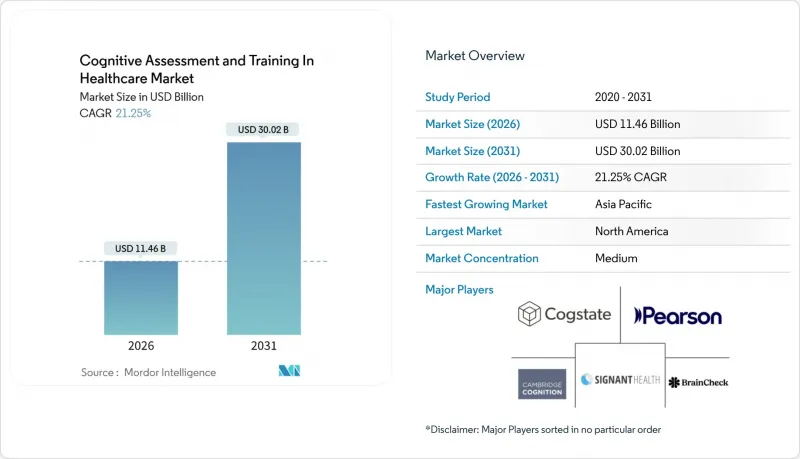
據 Mordor Intelligence 稱,2026 年醫療保健領域認知評估和訓練的市場規模估計為 114.6 億美元,預計在預測期(2026-2031 年)內將以 21.25% 的複合年成長率成長,到 2031 年達到 300.2 億美元。
本報告按組件(解決方案、服務)、評估類型(篩檢/診斷、臨床試驗等)、交付方式(電腦輔助等)、應用領域(失智症/阿茲海默症、創傷性腦損傷等)、最終用戶(醫療保健提供者、保險公司等)和地區(北美等)進行細分。市場預測以價值(美元)表示。
全球醫療保健認知評估與訓練市場趨勢及洞察
神經退化性疾病盛行率增加
預計到2024年,全球將有5,500萬人患有失智症,到2030年,全球整體患者人數預計將達到7,800萬,到2050年將達到1.39億人。因此,醫療保健系統正轉向在基層醫療機構進行預防性認知篩檢。到2025年,透過數位篩檢進行早期發現,平均可將失智症發展為中度失智症的時間延後18個月,並使每位患者的長期照護費用降低5萬美元。製藥公司正在將這些工具應用於阿茲海默症的II期臨床試驗,以捕捉療效的細微徵兆,並將研發週期縮短至多9個月。到2024年,失智症造成的經濟負擔將超過1.3兆美元,促使保險公司活性化對大規模評估計畫的支持力度,以延緩昂貴的機構照護。因此,醫療保健領域的認知評估和培訓市場將繼續受益於臨床的迫切需求和經濟獎勵。
數位醫療和行動醫療平台的快速普及
2024年1月至2025年12月期間,共有12款用於認知功能測試的數位裝置獲得FDA批准,其中5款可在智慧型手機上完全運作。根據Medicare在2025年的規定變更,遠距神經心理學諮商納入了CPT代碼96132的報銷範圍,減輕了居住在農村地區的患者的就醫負擔。英國藥品和保健產品監管局(MHRA)現在允許基於演算法等效性而非完整的臨床試驗,將軟體即服務(SaaS)認知功能評估工具作為醫療設備進行核准,前提是存在領先。每週一次的居家測試能夠捕捉到單次就診無法檢測到的個體內部差異,從而實現對治療方案的即時調整。這項功能在Biogen於2024年提交recanemab的申請時發揮了關鍵作用,因為數位終點比紙本測量提前四個月揭示了治療效果。
資料隱私和 HIPAA/GDPR 合規負擔
到2024年,醫療保健產業資料外洩的平均成本將達到1,090萬美元,而按時間順序排列的認知資料集是勒索軟體的理想目標。根據GDPR,認知資料被視為“特殊類別資訊”,供應商必須實施加密並接受第三方審計。 2024年,一家供應商因違反HIPAA而被罰款480萬美元,此前調查人員發現其門禁控制有缺陷,這導致創業融資放緩。小規模D2C(直接面對消費者)平台選擇退出歐盟,而不是承擔GDPR合規託管額外40%至60%的成本。
細分市場分析
預計到2031年,服務業務的收入將以22.25%的複合年成長率成長,縮小與解決方案業務的差距(解決方案業務在2025年佔據61.55%的市場佔有率)。醫院網路正面臨神經心理學家和資料科學家短缺的問題,這推動了外包合約的簽訂,這些合約涵蓋軟體、解讀和電子健康記錄(EHR)整合等服務。儘管開放原始碼替代方案對「解決方案」業務的利潤率構成壓力,「服務」業務則透過提供可操作的洞察,確立了其溢價地位。隨著基於價值的醫療保健模式越來越重視時間序列追蹤,以「服務」業務為代表的醫療保健領域認知評估和培訓市場規模預計到2031年將超過140億美元。
領先的管理服務供應商正在採用品質保證儀錶板,即時發出異常評分警報。這項功能目前已被製藥贊助商列為三大採購標準之一。責任醫療組織 (ACO) 正在將每週的認知功能更新整合到失智症治療路徑中,從而實現個人化干預,同時避免造成臨床醫生工作瓶頸。隨著支付方品質指標的不斷演變,在醫療保健領域的認知評估和訓練市場,結合平台和專家解讀的混合型供應商預計將超越純軟體供應商。
臨床試驗正以22.15%的複合年成長率穩步推進,反映出監管機構對基於智慧型手機的認知功能終點指標的認可。篩檢和診斷領域仍佔據最大佔有率,但與臨床試驗的需求相比,報銷限制預計將減緩其成長速度。申辦方在單次測試費用上投入大量預算以縮短受試者招募期,使供應商能夠維持超過65%的利潤率。到2031年,與臨床試驗相關的醫療保健領域認知評估和訓練的市場佔有率可能接近25%。
標準化創造了網路效應。隨著越來越多的申辦者採用相同的數位化測試方案,監管機構對其心理測量特性也更加熟悉,進一步提升了其可信度。合約研究組織(CRO)正在將認知功能測試模組整合到承包解決方案中,使數位化終點成為標準組件,而不僅僅是附加功能。學術聯盟也在人群研究中採用這些工具,進一步推動了市場上的良性循環。
區域分析
預計到2025年,北美將佔全球銷售額的38.45%,這主要得益於聯邦醫療保險(Medicare)對遠距醫療的承保以及退伍軍人事務部衛生部門對900萬受益人實施的強制性基準篩檢。加拿大安大略省已累計1.5億加元,計劃在2027年前實現失智症檢測的數位化,但法規核准的延遲阻礙了短期成果的取得。墨西哥的2025年失智症計畫優先考慮篩檢,但農村地區智慧型手機普及率低,減緩了篩檢的初期推廣。現有公司利用其保險公司網路和數十年來累積的檢驗數據,為北美醫療保健認知評估和培訓市場的新參與企業設置了很高的進入門檻。
預計到2031年,亞太地區的複合年成長率將達到22.22%,位居全球之首。在中國,65歲及以上成年人(約1.9億人)必須每年接受認知功能測試。印度計畫在2028年透過基層醫療中心進行5,000萬次篩檢。在日本,人口老化和300億日圓的數位健康基金正在推動居家監測的普及。在澳大利亞,記憶診所的普及率已達42%,但病例總數仍不多。韓國的國家失智症計畫旨在2030年實現80%的覆蓋率,這將催生一個能夠每年處理1500萬次評估的平台。
歐洲、中東和非洲以及南美洲的情況各不相同。在德國,較低的保險報銷率和預先核准障礙阻礙了基層醫療機構對數位化檢測的採用。在英國,一項數位化檢測試點計畫正在50家診所開展,但預算限制減緩了全國推廣的速度。法國已撥款4億歐元,在2029年前開發早期檢測基礎設施,包括電腦化工具。阿拉伯聯合大公國和沙烏地阿拉伯已將認知功能測試納入其數位健康藍圖,但其有限的人口基數限制了其潛在收入。在巴西,財政緊縮措施阻礙了公部門對認知功能檢測的採用,而南非私立醫院的採用率與歐洲相當。這些差異意味著,歐洲、中東和非洲以及南美洲「醫療保健認知評估和培訓」市場的綜合成長率預計將低於全球平均水平。
其他好處:
- Excel格式的市場預測(ME)表
- 3個月的分析師支持
目錄
第1章:引言
- 研究假設和市場定義
- 調查範圍
第2章:調查方法
第3章執行摘要
第4章 市場狀況
- 市場概覽
- 市場促進因素
- 神經退化性疾病盛行率增加
- 數位醫療和行動醫療平台的快速普及
- 電腦化認知工具的法規核准
- 增加針對認知功能終點的中樞神經系統(CNS)臨床試驗支出
- 與穿戴式神經生物標記生態系的整合
- 雇主提供的促進大腦健康的福利
- 市場限制因素
- 資料隱私和 HIPAA/GDPR 合規負擔
- 還款方式有限
- 人工智慧演算法中的文化和語言偏見
- 缺乏統一的臨床檢驗標準
- 監理情勢
- 技術展望
- 波特五力模型
第5章 市場規模與成長預測
- 按組件
- 解決方案
- 服務
- 按評估類型
- 篩檢和診斷
- 臨床試驗
- 學術和研究
- 根據配送方式而定
- 電腦化測試
- 行動/應用測試
- 書寫類型
- 透過使用
- 失智症和阿茲海默症
- 創傷性腦損傷
- 學習障礙
- 心理健康篩檢
- 最終用戶
- 醫療服務提供方
- 付款人
- 製藥和生物技術
- 居家照護和患者
- 按地區
- 北美洲
- 美國
- 加拿大
- 墨西哥
- 歐洲
- 德國
- 英國
- 法國
- 義大利
- 西班牙
- 其他歐洲國家
- 亞太地區
- 中國
- 印度
- 日本
- 澳洲
- 韓國
- 其他亞太國家
- 中東和非洲
- GCC
- 南非
- 其他中東和非洲國家
- 南美洲
- 巴西
- 阿根廷
- 其他南美國家
- 北美洲
第6章 競爭情勢
- 市場集中度
- 市佔率分析
- 公司簡介
- AnthroTronix
- BrainCheck
- BrainHQ
- Cambridge Cognition
- CogniFit
- Cogstate
- LearningRx
- Lumos Labs
- MedAvante-ProPhase
- Neurotrack
- NovaTech
- Oxford University Press(CANTAB)
- Pearson PLC
- Posit Science
- Savonix
- Signant Health
- VeraSci
- WCG Clinical
第7章 市場機會與未來展望
According to Mordor Intelligence, the cognitive assessment and training in healthcare market size is estimated at USD 11.46 billion in 2026, and is expected to reach USD 30.02 billion by 2031, at a CAGR of 21.25% during the forecast period (2026-2031).
This report is Segmented by Component (Solutions, Services), Assessment Type (Screening & Diagnostics, Clinical Trials, and More), Delivery Mode (Computer-Based and More), Application (Dementia & Alzheimer's, Traumatic Brain Injury, and More), End-User (Healthcare Providers, Payers and More), and Geography (North America and More). Market Forecasts are Provided in Terms of Value (USD).
Global Cognitive Assessment and Training In Healthcare Market Trends and Insights
Growing Prevalence of Neuro-Degenerative Disorders
Fifty-five million people were living with dementia in 2024, and the global tally is expected to climb to 78 million by 2030 and 139 million by 2050. Health systems are therefore shifting toward proactive cognitive screening at primary-care touchpoints. Early detection through digital tests slowed progression to moderate dementia by 18 months on average in 2025, saving USD 50,000 per patient in long-term care outlays. Pharmaceutical sponsors embed these tools in Phase II Alzheimer's trials to capture subtle efficacy signals and shorten timelines by up to nine months. The economic burden of dementia exceeded USD 1.3 trillion in 2024, galvanizing payer support for large-scale assessment programs that can defer costly institutional care. As a result, the Cognitive Assessment and Training in Healthcare market continues to benefit from both clinical urgency and economic incentives.
Rapid Adoption of Digital Health & mHealth Platforms
Twelve digital devices for cognitive testing cleared the FDA between January 2024 and December 2025, five of which run entirely on smartphones. Tele-neuropsychology sessions are reimbursed under CPT 96132 following Medicare's 2025 rule change, removing travel friction for patients in rural areas. The United Kingdom's MHRA now permits software-as-a-medical-device cognitive tools to rely on algorithmic equivalence rather than full clinical trials when predicates exist. Weekly at-home tests capture intra-individual variability that one-off clinic visits miss, enabling real-time therapy adjustments. This capability was pivotal in Biogen's 2024 lecanemab filing, where digital endpoints revealed treatment effects four months earlier than paper scales.
Data-Privacy & HIPAA / GDPR Compliance Burden
Average breach costs in healthcare reached USD 10.9 million in 2024, making longitudinal cognitive datasets an attractive ransomware target. GDPR treats cognitive data as special-category information, forcing vendors to adopt encryption and third-party audits. A vendor paid USD 4.8 million in HIPAA fines in 2024 after investigators uncovered lax access controls, damping venture funding for startups without mature compliance infrastructures. Smaller direct-to-consumer platforms often exit the European Union rather than absorb the 40-60% premium for GDPR-compliant hosting.
Other drivers and restraints analyzed in the detailed report include:
- Regulatory Endorsement of Computerized Cognitive Tools
- Rising CNS Clinical-Trial Spend for Cognitive End-Points
- Limited Reimbursement Pathways
For complete list of drivers and restraints, kindly check the Table Of Contents.
Segment Analysis
Services revenue is projected to climb at 22.25% CAGR through 2031, closing the gap with Solutions, which held 61.55% share in 2025. Hospital networks cite shortages of neuropsychologists and data scientists, prompting outsourced contracts that bundle software, interpretation, and EHR integration. Solutions face margin compression from open-source alternatives, while Services command premium rates for actionable insights. The Cognitive Assessment and Training in Healthcare market size captured by Services is expected to surpass USD 14 billion by 2031 as value-based care models reward longitudinal tracking.
Managed-service leaders employ quality-assurance dashboards that flag anomalous scores in real time, a feature pharmaceutical sponsors now list as a top-three procurement criterion. Accountable care organizations integrate weekly cognitive updates into dementia pathways, triggering personalized interventions without clinician bottlenecks. As payer quality metrics evolve, hybrid vendors that combine platforms with expert interpretation will outpace pure-play software providers in the Cognitive Assessment and Training in Healthcare market.
Clinical Trials are on pace for a 22.15% CAGR, reflecting regulators' acceptance of smartphone-based cognitive endpoints. Screening & Diagnostics still commands the largest slice, yet reimbursement constraints will slow growth relative to trial demand. Sponsors budget generous per-test fees to cut enrollment timelines, allowing vendors to sustain margins above 65%. The Cognitive Assessment and Training in Healthcare market share attached to Clinical Trials could approach 25% by 2031.
Standardization delivers network effects: as more sponsors adopt the same digital battery, regulators become familiar with its psychometrics, further boosting credibility. CROs embed cognitive testing modules into turnkey offerings, making digital endpoints a default rather than an add-on. Academic consortia also adopt these tools for population studies, reinforcing the market flywheel.
Complete Report Scope:
- By Component
- Solutions
- Services
- By Assessment Type
- Screening & Diagnostics
- Clinical Trials
- Academic & Research
- By Delivery Mode
- Computer-based Testing
- Mobile / App-based Testing
- Pen-and-Paper
- By Application
- Dementia & Alzheimer's
- Traumatic Brain Injury
- Learning Disabilities
- Mental Health Screening
- By End-User
- Healthcare Providers
- Payers
- Pharmaceutical & Biotech
- Home-care & Patients
- By Geography
- North America
- United States
- Canada
- Mexico
- Europe
- Germany
- United Kingdom
- France
- Italy
- Spain
- Rest of Europe
- Asia-Pacific
- China
- India
- Japan
- Australia
- South Korea
- Rest of Asia-Pacific
- Middle East and Africa
- GCC
- South Africa
- Rest of Middle East and Africa
- South America
- Brazil
- Argentina
- Rest of South America
- North America
Geography Analysis
North America accounted for 38.45% of 2025 revenue, anchored by Medicare's remote-testing coverage and the Veterans Health Administration's compulsory baseline screening for 9 million beneficiaries. Canada's Ontario province budgeted CAD 150 million through 2027 to digitize dementia testing, yet slower regulatory clearance tempers short-term gains. Mexico's 2025 dementia plan prioritizes screening, but limited smartphone penetration in rural districts curbs early uptake. Incumbents leverage payer networks and decades of validation data, presenting high entry barriers for newcomers in the North American Cognitive Assessment and Training in Healthcare market.
Asia-Pacific will deliver the fastest 22.22% CAGR to 2031. China mandates annual cognitive tests for adults aged 65+, a cohort of 190 million. India targets 50 million screenings by 2028 via primary-care health centers. Japan's aging demographics and JPY 30 billion digital health fund fuel home-based monitoring adoption. Australia boasts 42% penetration among memory clinics, but absolute volumes remain modest. South Korea's national dementia plan aims for 80% coverage by 2030, creating demand for platforms that handle 15 million annual assessments.
Europe, the Middle East, Africa, and South America form a heterogeneous landscape. Germany's low reimbursement and prior-authorization hurdles deter primary-care adoption. The U.K. has piloted digital testing across 50 clinics, yet budget constraints delay national rollout. France allocates EUR 400 million through 2029 for early detection infrastructure, including computerized tools. The UAE and Saudi Arabia include cognitive testing in digital health roadmaps, but limited population bases cap revenue potential. Brazil's public-sector rollout is stalled by fiscal austerity, while South Africa's private hospitals mirror European adoption rates. These disparities will keep EMEA and South America's combined Cognitive Assessment and Training in Healthcare market growth below the global average.
- AnthroTronix
- BrainCheck
- BrainHQ
- Cambridge Cognition
- CogniFit
- Cogstate
- LearningRx
- Lumos Labs
- MedAvante-ProPhase
- Neurotrack
- NovaTech
- Oxford University Press (CANTAB)
- Pearson PLC
- Posit Science
- Savonix
- Signant Health
- VeraSci
- WCG Clinical
Additional Benefits:
- The market estimate (ME) sheet in Excel format
- 3 months of analyst support
TABLE OF CONTENTS
1 Introduction
- 1.1 Study Assumptions & Market Definition
- 1.2 Scope of the Study
2 Research Methodology
3 Executive Summary
4 Market Landscape
- 4.1 Market Overview
- 4.2 Market Drivers
- 4.2.1 Growing prevalence of neuro-degenerative disorders
- 4.2.2 Rapid adoption of digital health & mHealth platforms
- 4.2.3 Regulatory endorsement of computerized cognitive tools
- 4.2.4 Rising CNS clinical-trial spend for cognitive end-points
- 4.2.5 Integration with wearable neuro-biomarker ecosystems
- 4.2.6 Employer-sponsored brain-wellness benefits
- 4.3 Market Restraints
- 4.3.1 Data-privacy & HIPAA / GDPR compliance burden
- 4.3.2 Limited reimbursement pathways
- 4.3.3 Cultural / linguistic bias in AI algorithms
- 4.3.4 Lack of harmonised clinical-validation standards
- 4.4 Regulatory Landscape
- 4.5 Technological Outlook
- 4.6 Porter's Five Forces
- 4.6.1 Supplier Power
- 4.6.2 Buyer Power
- 4.6.3 Threat of New Entrants
- 4.6.4 Threat of Substitutes
- 4.6.5 Competitive Rivalry
5 Market Size & Growth Forecasts (Value, USD)
- 5.1 By Component
- 5.1.1 Solutions
- 5.1.2 Services
- 5.2 By Assessment Type
- 5.2.1 Screening & Diagnostics
- 5.2.2 Clinical Trials
- 5.2.3 Academic & Research
- 5.3 By Delivery Mode
- 5.3.1 Computer-based Testing
- 5.3.2 Mobile / App-based Testing
- 5.3.3 Pen-and-Paper
- 5.4 By Application
- 5.4.1 Dementia & Alzheimer's
- 5.4.2 Traumatic Brain Injury
- 5.4.3 Learning Disabilities
- 5.4.4 Mental Health Screening
- 5.5 By End-User
- 5.5.1 Healthcare Providers
- 5.5.2 Payers
- 5.5.3 Pharmaceutical & Biotech
- 5.5.4 Home-care & Patients
- 5.6 By Geography
- 5.6.1 North America
- 5.6.1.1 United States
- 5.6.1.2 Canada
- 5.6.1.3 Mexico
- 5.6.2 Europe
- 5.6.2.1 Germany
- 5.6.2.2 United Kingdom
- 5.6.2.3 France
- 5.6.2.4 Italy
- 5.6.2.5 Spain
- 5.6.2.6 Rest of Europe
- 5.6.3 Asia-Pacific
- 5.6.3.1 China
- 5.6.3.2 India
- 5.6.3.3 Japan
- 5.6.3.4 Australia
- 5.6.3.5 South Korea
- 5.6.3.6 Rest of Asia-Pacific
- 5.6.4 Middle East and Africa
- 5.6.4.1 GCC
- 5.6.4.2 South Africa
- 5.6.4.3 Rest of Middle East and Africa
- 5.6.5 South America
- 5.6.5.1 Brazil
- 5.6.5.2 Argentina
- 5.6.5.3 Rest of South America
- 5.6.1 North America
6 Competitive Landscape
- 6.1 Market Concentration
- 6.2 Market Share Analysis
- 6.3 Company Profiles (includes Global level Overview, Market level overview, Core Segments, Financials as available, Strategic Information, Market Rank/Share for key companies, Products & Services, and Recent Developments)
- 6.3.1 AnthroTronix
- 6.3.2 BrainCheck
- 6.3.3 BrainHQ
- 6.3.4 Cambridge Cognition
- 6.3.5 CogniFit
- 6.3.6 Cogstate
- 6.3.7 LearningRx
- 6.3.8 Lumos Labs
- 6.3.9 MedAvante-ProPhase
- 6.3.10 Neurotrack
- 6.3.11 NovaTech
- 6.3.12 Oxford University Press (CANTAB)
- 6.3.13 Pearson PLC
- 6.3.14 Posit Science
- 6.3.15 Savonix
- 6.3.16 Signant Health
- 6.3.17 VeraSci
- 6.3.18 WCG Clinical
7 Market Opportunities & Future Outlook
- 7.1 White-space & Unmet-Need Assessment

 醫療保健領域認知功能評估與訓練市場:2026-2032年全球市場預測(按組件、評估類型、測量的認知功能、技術、年齡層、部署方法、應用和最終用戶分類)
 神經行為評估平台市場預測至2034年-按解決方案類型、技術、評估類型、最終用戶和地區分類的全球分析評估軟體市場預測至2034年-按組件、評估類型、部署模式、組織規模、最終用戶和地區分類的全球分析認知準備度評估市場預測至2034年—按評估類型、交付方式、技術、應用、最終用戶和地區分類的全球分析認知功能評估與訓練市場:2026-2032年全球市場預測(按組件、評估類型、交付方式、組織規模、應用和產業分類)互動式遠距培訓市場預測至2034年-按培訓類型、部署模式、技術、應用、最終用戶和地區分類的全球分析
 全球認知評估與訓練市場:機會與策略展望(至2035年)2026年全球衣殼偏好篩檢平台市場報告兒童神經發育評估技術市場預測至2034年—按評估類型、組成部分、技術、應用、最終用戶和地區分類的全球分析醫療保健領域認知功能評估與訓練市場:2034 年預測-按組成部分、評估方法、應用、最終用戶和地區分類的全球分析