


 |
市場調查報告書
商品編碼
2163607
伺服:市場佔有率分析、產業趨勢與統計資料、成長預測(2026-2031)Servo Presses - Market Share Analysis, Industry Trends & Statistics, Growth Forecasts (2026 - 2031) |
||||||

※ 本網頁內容可能與最新版本有所差異。詳細情況請與我們聯繫。
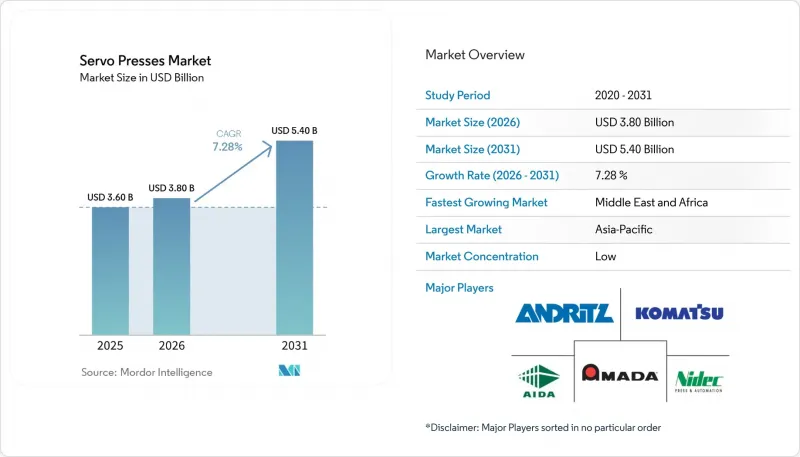
據 Mordor Intelligence 稱,伺服壓力機市場在 2025 年的價值為 36 億美元,預計到 2031 年將達到 54 億美元,而 2026 年為 38 億美元,預測期(2026-2031 年)的複合年成長率為 7.28%。
全球伺服壓力機市場趨勢及洞察
提高能源效率並降低總擁有成本 (TCO)
到2025年,隨著工業用電成本的上漲和碳排放報告要求的日益嚴格,能源效率將成為採購決策中更關鍵的因素。伺服系統僅在成型週期內消耗電力,避免了液壓系統固有的持續泵浦損耗。據Tolomatic公司稱,在其評估的應用中,電子機械執行器所需的能量比液壓執行器少4.4倍。 2026年1月,安德里茨舒勒公司推出了「HFA plus+」精密沖裁系統,該系統採用伺服控制液壓泵驅動裝置,能源效率提高了兩個數量級。預計這些營運成本的降低將縮短運作生產線的投資回收期,並進一步加速伺服壓力機的市場普及。
汽車電氣化和輕量化零件製造
電動車的生產需要與傳統動力傳動系統不同的零件。電池外殼、鋁製外殼和高抗張強度鋼結構需要特定的運動曲線,以便精確控制回彈和成形性。一項針對大型 25,000 kN伺服壓力機的研究發現,在汽車門板的生產過程中,校準後的扭矩預測誤差從 7.6% 降低至 1.4%。與傳統的液壓成型相比,伺服壓力機生產線還能降低 30% 至 45% 的電力消耗。 2026 年 1 月,AIDA Engineering 在墨西哥錫勞的 Wiegel 工廠安裝了一台 300 噸直驅伺服壓力機,用於生產電動車匯流排、端子、導線架和連接器。這些需求正推動伺服壓力機市場的發展,使其不再侷限於簡單的替換需求。
高昂的初始投資成本
由於伺服壓力機採用高精度馬達、編碼器、再生驅動裝置和多軸控制器,其價格高於同類傳統壓力機。這種價格差異對資金預算有限的中小型製造商來說是一大障礙。在某些情況下,安全相關的硬體、認證和整合工作也會增加購置成本。 ISO 16092-2:2025 標準規定了機械壓力機(包括伺服驅動系統)的安全要求。伺服壓力機市場的發展取決於供應商能否透過降低整個生命週期的營運成本來證明其高昂的初始成本是合理的。
細分市場分析
截至2025年,直邊式或H型框架壓力機將佔據伺服壓力機市場45%的佔有率,預計到2031年將以8.50%的複合年成長率成長。其堅固的結構能夠抑制偏心載重下的角位移,這對於使用多點模具的汽車車體面板和厚板壓制至關重要。預計到2031年,該細分市場也將是框架類型中成長最快的。工作台尺寸的增加和同步串聯生產線的引入正在推動汽車生產對這種配置的需求。
C型或間隙式壓力機仍廣泛應用於電子組裝、家電成型和中噸位精密加工。立柱式和柱式壓力機則較適用於航太、粉末成型和工業機械等特定應用領域。中小型設備製造商可以利用這一市場需求,為醫療和電子行業的客戶提供服務。然而,在高強度、高精度應用領域,直邊式壓力機仍佔據伺服壓力機市場的主導地位。機架的選擇與生產線的載重模式和模具密切相關。直邊式壓力機適用於需要長工作台、大型模具和穩定導軌的作業。因此,它們適用於大規模單件汽車沖壓成型和串聯生產線升級改造。 C型設備便於操作人員操作,並可實現小規模精密加工的自動化。當優先考慮特定成型條件而非大批量生產時,立柱式和柱式設計則較為合適。
截至2025年,伺服機械式金屬成型壓力機佔伺服壓力機市場總量的48%。這類壓力機已在汽車和家用電器等高速沖壓領域佔據穩固地位。它們的普及反映了大生產過程中對可靠產能的需求。伺服液壓壓力機在深拉延和其他高強度加工中繼續發揮至關重要的作用。安德里茨舒勒的HFA plus+系統展示了伺服控制液壓幫浦驅動如何提高此類加工的效率。混合式伺服壓力機將伺服驅動的主驅動裝置與液壓模墊結合,以處理難以加工的汽車鋼材。伺服壓力機市場正日益細分為高強度生產系統和精密組裝系統。隨著製造商實施可控連接工藝和確保可追溯性的生產過程,組裝設備的擴張速度正在進一步加快。
預計到2031年,電子機械或電動伺服組裝壓力機的市場將以11.6%的複合年成長率成長。電池模組連接、導線架成型、醫療設備組裝和連接器插入等應用是推動此快速成長的主要因素。此外,該技術不僅體現在噸位上,也體現在生產環境上。高速沖壓生產線需要穩定的循環性能以及與級進模的整合。組裝線需要精確的力道控制,以防止在連接過程中損壞精密零件。在需要液壓特性以進行深拉延或加工高要求材料的場合,伺服液壓系統仍然非常實用。當需要控制主行程和模具緩衝支撐時,混合系統則提供了更大的柔軟性。如此豐富的選擇使供應商能夠同時服務現有的沖壓設備工廠和新建的精密組裝單元。當客戶希望將新壓平機與其現有的物料輸送和模具系統整合時,這種選擇尤其重要。
區域分析
到2025年,亞太地區將佔據伺服壓力機市場52.48%的佔有率。在中國,汽車製造、電子製造和半導體生產能力的投資支撐了市場需求。日本仍然是重要的市場,因為多家伺服壓力機OEM廠商的總部都設在日本。在韓國和台灣,半導體、顯示器和精密電子供應鏈的需求也為市場貢獻了力量。日本電產驅動技術公司(Nidec Drive Technology)將於2026年4月15日在滋賀縣利東市開設一家新的壓平機組裝廠,屆時其國內產能將從每年60台加倍至120台,最大機型噸位也將從150噸擴大到330噸。隨著汽車和電子供應鏈的擴張,印度、泰國、越南和印尼等國的需求也推動著區域市場的發展。
2025年,歐洲在銷售領域佔據重要地位,主要得益於德國汽車工業和一級供應商的強勁成長。義大利的精密機械產業和法國的航太製造地也推動了該地區的需求。歐盟機械法規將於2027年1月20日強制執行,將促使企業進行設備現代化改造。安德里茨舒勒公司於2026年1月開始提供HFA plus+精密沖裁產品。法戈爾·阿拉薩特公司和Funditec公司於2026年3月成立了Primus Robotics公司,致力於開發用於精密製造的工業人形機器人。在波蘭、捷克和匈牙利,隨著汽車零件供應商實現生產在地化,市場需求不斷成長。
2025年,北美市場需求維持穩定,這主要得益於美國中西部地區汽車沖壓機的生產、生產回流以及電子組裝的成長。墨西哥透過新增零件生產,在電動車和電動出行供應鏈中的重要性日益提升。預計到2031年,中東和非洲地區的複合年成長率將達到9%,是本研究涵蓋地區中成長率最高的。沙烏地阿拉伯的產業多元化、阿拉伯聯合大公國的先進製造業項目以及南非的汽車組裝業都為此成長前景提供了支撐。在南美,巴西的汽車產業基礎支撐了市場需求,但高利率抑制了2025年的資本投資。伺服沖壓機市場的區域策略需要根據當地情況進行調整,包括設備產能、服務範圍和自動化需求。
其他好處:
- Excel格式的市場預測(ME)表
- 3個月的分析師支持
目錄
第1章:引言
- 研究假設和市場定義
- 調查範圍
第2章:調查方法
第3章執行摘要
第4章 市場狀況
- 市場概覽
- 市場促進因素
- 提高能源效率並降低總擁有成本
- 汽車電氣化和輕量化零件製造
- 高精度金屬成形的需求日益成長
- 透過工業4.0整合和可追溯性實現品管
- 電子和精密零件製造業的成長
- 現有印刷設備的翻新和現代化改造
- 市場限制因素
- 初始資本成本高
- 編程、試運行和技術純熟勞工要求
- 現有機械和液壓壓力機的更換週期過長
- 超高噸位應用中的限制
- 價值供應鏈分析
- 伺服馬達、驅動器和控制組件
- 壓力機機架、機械零件和液壓零件
- 伺服壓力機的製造和系統整合
- 模具、工具、自動化與機器人生態系統
- 配送、安裝和試運行
- 售後市場、軟體、改裝與服務生態系統
- 監理情勢
- 機械和壓平機的安全標準
- 功能安全和操作人員保護的要求
- 能源效率和環境法規
- 特定產業的品質和認證要求
- 技術展望
- 先進的伺服機構與直接驅動技術
- 電子機械精密壓力機技術
- 伺服液壓和混合壓力機技術
- 利用封閉回路型進行力、位置和運動控制
- 數位連接與工業物聯網的融合
- 人工智慧驅動的流程最佳化和預測性維護
- 能源回收再利用技術
- 工業和製造業趨勢
- 擴大靈活的多產品生產
- 自動化和整合式沖壓生產線
- 可追溯性和高精度沖壓加工的需求日益成長。
- 永續性和能源效率趨勢
- 永續性和能源效率
- 地緣政治趨勢對市場的影響
第5章 市場規模與成長預測
- 框架/結構配置
- C型/間隙型伺服壓力機
- 直邊/H型伺服壓力機
- 柱式/立柱式伺服壓力機
- 其他伺服壓力機配置
- 伺服壓力機技術/按系統型
- 伺服機械金屬成型壓力機
- 電子機械/電動伺服組裝壓力機
- 伺服液壓機
- 混合伺服壓力機
- 按壓開關/按產能
- 10噸或以下
- 10噸至100噸以上
- 100至500噸或更多
- 500至1000噸以上
- 超過1000噸
- 透過使用
- 壓制、沖壓、沖孔
- 深拉延和鈑金成形
- 鍛造和冷成型
- 組裝、壓入配合、連接
- 粉末成型
- 其他精密及特殊沖壓加工應用
- 最終用戶
- 汽車和運輸業
- 電氣和電子設備
- 航太/國防
- 醫療和精密設備
- 工業機械及一般製造業
- 家用電器耐用消費品
- 其他終端用戶產業
- 按地區
- 北美洲
- 美國
- 加拿大
- 墨西哥
- 南美洲
- 巴西
- 阿根廷
- 其他南美國家
- 歐洲
- 德國
- 義大利
- 法國
- 英國
- 俄羅斯
- 西班牙
- 其他歐洲國家
- 亞太地區
- 中國
- 日本
- 印度
- 韓國
- 台灣
- 東協(新加坡、馬來西亞、印尼、泰國、越南、菲律賓、緬甸、柬埔寨、寮國、汶萊)
- 其他亞太國家
- 中東和非洲
- 沙烏地阿拉伯
- 阿拉伯聯合大公國
- 土耳其
- 南非
- 埃及
- 奈及利亞
- 其他中東和非洲國家
- 北美洲
第6章 競爭情勢
- 市場集中度
- 策略趨勢
- 市佔率分析
- 公司簡介
- AIDA Engineering, Ltd.
- ANDRITZ Metals Forming/ANDRITZ Schuler
- Komatsu Industries Corp.
- Nidec Press & Automation(including Minster and ARISA)
- AMADA Group-AMADA PRESS SYSTEM/H&F Corporation
- Fagor Arrasate S. Coop.
- JIER Machine-Tool Group Co., Ltd.
- STAMTEC, Inc.
- SEYI/Shieh Yih Machinery Industry Co., Ltd.
- Chin Fong Machine Industrial Co., Ltd.
- SIMPAC Inc.
- Yangli Group
- Yamada Dobby Co., Ltd.
- Hoden Seimitsu Kako Kenkyusho Co., Ltd.
- Sutherland Presses
- AP&T Group
- ZANI SpA
- TOX PRESSOTECHNIK GmbH & Co. KG
- Promess, Inc.
- Kistler Group
- Janome Corporation-Industrial Equipment
- SCHMIDT Technology GmbH
- Sanyo Machine Works, Ltd.
- ESTIC Corporation
- Dai-ichi Dentsu Ltd.
- CORETEC Inc.
第7章 市場機會與未來展望
According to Mordor Intelligence, the servo presses market size was valued at USD 3.60 billion in 2025 and is estimated to grow from USD 3.80 billion in 2026 to reach USD 5.40 billion by 2031, at a CAGR of 7.28% during the forecast period (2026-2031).
Global Servo Presses Market Trends and Insights
Energy Efficiency and Lower Total Cost of Ownership
Energy efficiency became a stronger purchase factor in 2025 as industrial electricity costs and carbon reporting requirements increased. Servo systems use power during active forming cycles and can avoid the constant pump losses associated with hydraulic equipment. Tolomatic reported that electromechanical actuators required 4.4 times less energy than hydraulic counterparts in the applications it assessed. In January 2026, ANDRITZ Schuler introduced HFA plus+ fineblanking systems with servo-controlled hydraulic pump drives and double-digit energy efficiency improvements. These operating savings can shorten the payback period for high-use lines and support wider servo presses market adoption.
Automotive Electrification and Lightweight Component Manufacturing
Electric vehicle production requires parts that differ from those used in conventional powertrains. Battery enclosures, aluminum closures, and ultra-high-strength steel structures need motion profiles that can manage spring back and formability. A 25,000 kN heavy-duty servo press study found that post-calibration torque prediction error fell from 7.6% to 1.4% in automotive door-panel production. Servo press lines also reduce power use by 30-45% compared with conventional hydraulic stamping. AIDA Engineering installed a 300 metric ton direct-drive servo press at Wiegel's Silao, Mexico, facility in January 2026 for EV busbars, terminals, lead frames, and connectors. These requirements extend the servo presses market beyond replacement demand.
Higher Upfront Capital Cost
Servo presses cost more than comparable conventional systems because they use precision motors, encoders, regenerative drives, and multi-axis controllers. This difference is a material obstacle for small and medium-sized manufacturers with limited capital budgets. Safety hardware, certification, and integration work add to the purchase cost for some installations. ISO 16092-2:2025 sets safety requirements for mechanical presses, including servo-drive systems. The servo presses market will depend on suppliers proving that lower lifetime operating costs justify the initial premium.
Other drivers and restraints analyzed in the detailed report include:
- Rising Demand for High-Precision Metal Forming
- Industry 4.0 Integration and Traceable Quality Control
- Programming, Commissioning, and Skilled-Labor Requirements
For complete list of drivers and restraints, kindly check the Table Of Contents.
Segment Analysis
Straight-side or H-frame presses held 45% of the servo presses market share in 2025 and are also forecast to grow at an 8.50% CAGR through 2031. Their rigid construction limits angular deflection under eccentric loading. This is important for automotive body panels and heavy-gauge stampings that use multi-point tooling. The segment also recorded the highest projected growth among frame types through 2031. Larger bed sizes and synchronized tandem lines reinforce demand for this configuration in vehicle production.
C-frame or gap-frame presses continue to serve electronics assembly, appliance forming, and medium-tonnage precision work. Column and post-type systems support narrower uses in aerospace, powder compaction, and industrial machinery. Smaller equipment providers can use this demand to address medical and electronics customers. Straight-side systems nevertheless remain the core of the servo presses market size for high-force, high-accuracy applications. Frame selection is closely linked to the loading pattern and the tooling used on a production line. Straight-side systems are suited to work where a long bed, a large die, and stable guidance are needed. This makes them relevant to larger single-piece automotive stampings and tandem-line upgrades. C-frame equipment offers easier access for operators and automation in smaller precision applications. Column and post designs remain suitable where specialized forming conditions take priority over broad production volume.
Servo-mechanical metal forming presses held 48% of the servo presses market in 2025. They are established in high-speed automotive and appliance stamping. Their installed position reflects the need for reliable output in high-volume operations. Servo-hydraulic presses remain relevant for deep drawing and other high-force work. ANDRITZ Schuler's HFA plus+ systems show how servo-controlled hydraulic pump drives can improve efficiency in this category. Hybrid servo presses combine a servo primary drive with hydraulic die cushions for difficult automotive steel grades. The servo presses market industry is separating into high-force production systems and precision assembly systems. Assembly equipment is expanding more quickly as manufacturers add controlled joining and traceable production steps.
Electromechanical or electric servo assembly presses are forecast to grow at 11.6% CAGR through 2031. Battery-module joining, lead-frame forming, medical-device assembly, and connector insertion support this faster growth. Technology also reflects the production environment rather than tonnage alone. High-speed stamping lines require consistent cycle performance and integration with progressive dies. Assembly lines need precise force control so that sensitive components are not damaged during joining. Servo-hydraulic equipment remains valuable where deep drawing and demanding materials require hydraulic force characteristics. Hybrid equipment provides flexibility where a controlled primary stroke and die-cushion support are both needed. This range of choices lets suppliers serve both established stamping plants and newer precision assembly cells. The choice is particularly important when customers want to combine a new press with existing material handling and tooling.
Complete Report Scope:
- By Frame / Structural Configuration
- C-Frame / Gap-Frame Servo Presses
- Straight-Side / H-Frame Servo Presses
- Column / Post-Type Servo Presses
- Other Servo Press Configurations
- By Servo Press Technology / System Type
- Servo-Mechanical Metal Forming Presses
- Electromechanical / Electric Servo Assembly Presses
- Servo-Hydraulic Presses
- Hybrid Servo Presses
- By Press Force / Capacity
- Up to 10 Tons
- Above 10-100 Tons
- Above 100-500 Tons
- Above 500-1,000 Tons
- Above 1,000 Tons
- By Application
- Stamping, Blanking and Punching
- Deep Drawing and Sheet Forming
- Forging and Cold Forming
- Assembly, Press-Fitting and Joining
- Powder Compaction
- Other Precision and Specialized Pressing Applications
- By End User
- Automotive and Transportation
- Electrical and Electronics
- Aerospace and Defense
- Medical and Precision Devices
- Industrial Machinery and General Manufacturing
- Appliances and Consumer Durables
- Other End-Use Industries
- By Geography
- North America
- United States
- Canada
- Mexico
- South America
- Brazil
- Argentina
- Rest of South America
- Europe
- Germany
- Italy
- France
- United Kingdom
- Russia
- Spain
- Rest of Europe
- Asia-Pacific
- China
- Japan
- India
- South Korea
- Taiwan
- ASEAN (Singapore, Malaysia, Indonesia, Thailand, Vietnam, Philippines, Myanmar, Cambodia, Laos, and Brunei)
- Rest of Asia-Pacific
- Middle East and Africa
- Saudi Arabia
- United Arab Emirates
- Turkiye
- South Africa
- Egypt
- Nigeria
- Rest of Middle East and Africa
- North America
Geography Analysis
Asia-Pacific held 52.48% of the servo presses market in 2025. China supports demand through automotive production, electronics manufacturing, and investment in semiconductor capacity. Japan remains important because several servo press OEMs are headquartered there. South Korea and Taiwan add demand from semiconductor, display, and precision-electronics supply chains. Nidec Drive Technology opened a new press-machine assembly factory in Ritto, Shiga Prefecture, on April 15, 2026, doubling domestic capacity from 60 to 120 presses annually and extending maximum machine size from 150 to 330 tons. India, Thailand, Vietnam, and Indonesia also support regional demand as automotive and electronics supply chains expand.
Europe held a significant revenue position in 2025, led by Germany's automotive and Tier 1 supplier base. Italy's precision-mechanics sector and France's aerospace manufacturing base add to regional demand. The EU Machinery Regulation becomes mandatory on January 20, 2027, and supports equipment modernization decisions. ANDRITZ Schuler advanced its HFA plus+ fineblanking offering in January 2026. Fagor Arrasate and Funditec formed Primus Robotics in March 2026 to develop industrial humanoid robots for precision manufacturing. Poland, the Czech Republic, and Hungary add demand as automotive suppliers localize production.
North America recorded consistent demand in 2025, with the United States supported by Midwest automotive stamping, reshoring activity, and electronics assembly. Mexico gained importance in EV and e-mobility supply chains through new component production. The Middle East and Africa are forecast to grow at a 9% CAGR through 2031, the highest regional rate in the supplied research. Saudi industrial diversification, UAE advanced-manufacturing programs, and South African automotive assembly support this outlook. South America maintains demand through Brazil's automotive base, although high interest rates constrained capital spending in 2025. Regional strategies in the servo presses market must match equipment capacity, service coverage, and automation needs to local conditions.
- AIDA Engineering, Ltd.
- ANDRITZ Metals Forming / ANDRITZ Schuler
- Komatsu Industries Corp.
- Nidec Press & Automation (including Minster and ARISA)
- AMADA Group - AMADA PRESS SYSTEM / H&F Corporation
- Fagor Arrasate S. Coop.
- JIER Machine-Tool Group Co., Ltd.
- STAMTEC, Inc.
- SEYI / Shieh Yih Machinery Industry Co., Ltd.
- Chin Fong Machine Industrial Co., Ltd.
- SIMPAC Inc.
- Yangli Group
- Yamada Dobby Co., Ltd.
- Hoden Seimitsu Kako Kenkyusho Co., Ltd.
- Sutherland Presses
- AP&T Group
- ZANI S.p.A.
- TOX PRESSOTECHNIK GmbH & Co. KG
- Promess, Inc.
- Kistler Group
- Janome Corporation - Industrial Equipment
- SCHMIDT Technology GmbH
- Sanyo Machine Works, Ltd.
- ESTIC Corporation
- Dai-ichi Dentsu Ltd.
- CORETEC Inc.
Additional Benefits:
- The market estimate (ME) sheet in Excel format
- 3 months of analyst support
TABLE OF CONTENTS
1 INTRODUCTION
- 1.1 Study Assumptions and Market Definition
- 1.2 Scope of the Study
2 RESEARCH METHODOLOGY
3 EXECUTIVE SUMMARY
4 MARKET LANDSCAPE
- 4.1 Market Overview
- 4.2 Market Drivers
- 4.2.1 Energy Efficiency and Lower Total Cost of Ownership
- 4.2.2 Automotive Electrification and Lightweight Component Manufacturing
- 4.2.3 Rising Demand for High-Precision Metal Forming
- 4.2.4 Industry 4.0 Integration and Traceable Quality Control
- 4.2.5 Growth in Electronics and Precision Component Manufacturing
- 4.2.6 Replacement and Modernization of Conventional Press Installed Base
- 4.3 Market Restraints
- 4.3.1 Higher Upfront Capital Cost
- 4.3.2 Programming, Commissioning, and Skilled-Labor Requirements
- 4.3.3 Long Replacement Cycles for Existing Mechanical and Hydraulic Presses
- 4.3.4 Limitations in Ultra-High-Tonnage Applications
- 4.4 Value / Supply-Chain Analysis
- 4.4.1 Servo Motors, Drives and Control Components
- 4.4.2 Press Frames, Mechanical and Hydraulic Components
- 4.4.3 Servo Press Manufacturing and System Integration
- 4.4.4 Dies, Tooling, Automation, and Robotics Ecosystem
- 4.4.5 Distribution, Installation and Commissioning
- 4.4.6 Aftermarket, Software, Retrofit and Service Ecosystem
- 4.5 Regulatory Landscape
- 4.5.1 Machinery and Press Safety Standards
- 4.5.2 Functional Safety and Operator Protection Requirements
- 4.5.3 Energy Efficiency and Environmental Regulations
- 4.5.4 Industry-Specific Quality and Certification Requirements
- 4.6 Technological Outlook
- 4.6.1 Advanced Servo-Mechanical and Direct-Drive Technologies
- 4.6.2 Electromechanical Precision Press Technologies
- 4.6.3 Servo-Hydraulic and Hybrid Press Technologies
- 4.6.4 Closed-Loop Force, Position and Motion Control
- 4.6.5 Digital Connectivity and IIoT Integration
- 4.6.6 AI-Enabled Process Optimization and Predictive Maintenance
- 4.6.7 Energy Recovery and Regenerative Technologies
- 4.7 Industry and Manufacturing Trends
- 4.7.1 Growth of Flexible and High-Mix Manufacturing
- 4.7.2 Automation and Integrated Press Lines
- 4.7.3 Increasing Demand for Traceable and Precision Pressing
- 4.7.4 Sustainability and Energy-Efficiency Trends
- 4.8 Sustainability and Energy Efficiency
- 4.9 Impact of Geopolitical Developments on the Market
5 MARKET SIZE AND GROWTH FORECASTS
- 5.1 By Frame / Structural Configuration
- 5.1.1 C-Frame / Gap-Frame Servo Presses
- 5.1.2 Straight-Side / H-Frame Servo Presses
- 5.1.3 Column / Post-Type Servo Presses
- 5.1.4 Other Servo Press Configurations
- 5.2 By Servo Press Technology / System Type
- 5.2.1 Servo-Mechanical Metal Forming Presses
- 5.2.2 Electromechanical / Electric Servo Assembly Presses
- 5.2.3 Servo-Hydraulic Presses
- 5.2.4 Hybrid Servo Presses
- 5.3 By Press Force / Capacity
- 5.3.1 Up to 10 Tons
- 5.3.2 Above 10-100 Tons
- 5.3.3 Above 100-500 Tons
- 5.3.4 Above 500-1,000 Tons
- 5.3.5 Above 1,000 Tons
- 5.4 By Application
- 5.4.1 Stamping, Blanking and Punching
- 5.4.2 Deep Drawing and Sheet Forming
- 5.4.3 Forging and Cold Forming
- 5.4.4 Assembly, Press-Fitting and Joining
- 5.4.5 Powder Compaction
- 5.4.6 Other Precision and Specialized Pressing Applications
- 5.5 By End User
- 5.5.1 Automotive and Transportation
- 5.5.2 Electrical and Electronics
- 5.5.3 Aerospace and Defense
- 5.5.4 Medical and Precision Devices
- 5.5.5 Industrial Machinery and General Manufacturing
- 5.5.6 Appliances and Consumer Durables
- 5.5.7 Other End-Use Industries
- 5.6 By Geography
- 5.6.1 North America
- 5.6.1.1 United States
- 5.6.1.2 Canada
- 5.6.1.3 Mexico
- 5.6.2 South America
- 5.6.2.1 Brazil
- 5.6.2.2 Argentina
- 5.6.2.3 Rest of South America
- 5.6.3 Europe
- 5.6.3.1 Germany
- 5.6.3.2 Italy
- 5.6.3.3 France
- 5.6.3.4 United Kingdom
- 5.6.3.5 Russia
- 5.6.3.6 Spain
- 5.6.3.7 Rest of Europe
- 5.6.4 Asia-Pacific
- 5.6.4.1 China
- 5.6.4.2 Japan
- 5.6.4.3 India
- 5.6.4.4 South Korea
- 5.6.4.5 Taiwan
- 5.6.4.6 ASEAN (Singapore, Malaysia, Indonesia, Thailand, Vietnam, Philippines, Myanmar, Cambodia, Laos, and Brunei)
- 5.6.4.7 Rest of Asia-Pacific
- 5.6.5 Middle East and Africa
- 5.6.5.1 Saudi Arabia
- 5.6.5.2 United Arab Emirates
- 5.6.5.3 Turkiye
- 5.6.5.4 South Africa
- 5.6.5.5 Egypt
- 5.6.5.6 Nigeria
- 5.6.5.7 Rest of Middle East and Africa
- 5.6.1 North America
6 COMPETITIVE LANDSCAPE
- 6.1 Market Concentration
- 6.2 Strategic Moves
- 6.3 Market Share Analysis
- 6.4 Company Profiles (includes Global Level Overview, Market Level Overview, Core Segments, Financials as available, Strategic Information, Products and Services, Recent Developments)
- 6.4.1 AIDA Engineering, Ltd.
- 6.4.2 ANDRITZ Metals Forming / ANDRITZ Schuler
- 6.4.3 Komatsu Industries Corp.
- 6.4.4 Nidec Press & Automation (including Minster and ARISA)
- 6.4.5 AMADA Group - AMADA PRESS SYSTEM / H&F Corporation
- 6.4.6 Fagor Arrasate S. Coop.
- 6.4.7 JIER Machine-Tool Group Co., Ltd.
- 6.4.8 STAMTEC, Inc.
- 6.4.9 SEYI / Shieh Yih Machinery Industry Co., Ltd.
- 6.4.10 Chin Fong Machine Industrial Co., Ltd.
- 6.4.11 SIMPAC Inc.
- 6.4.12 Yangli Group
- 6.4.13 Yamada Dobby Co., Ltd.
- 6.4.14 Hoden Seimitsu Kako Kenkyusho Co., Ltd.
- 6.4.15 Sutherland Presses
- 6.4.16 AP&T Group
- 6.4.17 ZANI S.p.A.
- 6.4.18 TOX PRESSOTECHNIK GmbH & Co. KG
- 6.4.19 Promess, Inc.
- 6.4.20 Kistler Group
- 6.4.21 Janome Corporation - Industrial Equipment
- 6.4.22 SCHMIDT Technology GmbH
- 6.4.23 Sanyo Machine Works, Ltd.
- 6.4.24 ESTIC Corporation
- 6.4.25 Dai-ichi Dentsu Ltd.
- 6.4.26 CORETEC Inc.
7 MARKET OPPORTUNITIES AND FUTURE OUTLOOK
- 7.1 White-Space and Unmet-Need Assessment
- 7.1.1 High-Mix, Low-Volume Programmable Pressing Solutions
- 7.1.2 Precision Assembly and Joining Solutions
- 7.1.3 Digital Retrofit and Energy-Management Solutions
- 7.1.4 Higher-Force Servo and Hybrid Press Solutions
- 7.2 Future Outlook
- 7.2.1 Growing Adoption of Servo-Based Forming and Assembly Systems
- 7.2.2 Rising Demand from EV, Electronics and Precision Manufacturing
- 7.2.3 Increasing Automation and Connected Press Integration
- 7.2.4 Expansion of Servo-Hydraulic and Hybrid Press Technologies

 伺服液壓機市場:全球市場預測,2026-2032年
 全球數位伺服壓力機市場規模、佔有率、趨勢和成長分析報告(2026-2034)數位伺服壓力機市場:依力範圍、馬達類型、設計、終端用戶產業、應用與銷售管道分類-2026-2032年全球市場預測
 電子機械連接伺服壓力機市場分析及預測(至2035年):按類型、產品類型、技術、應用、零件、最終用戶、功能、製程、安裝類型、設備分類
 2026年全球數位伺服壓力機市場報告
 數位伺服壓力機市場規模、佔有率和成長分析(按力容量、應用、最終用戶產業和地區分類)—2026-2033年產業預測
 數位伺服壓力機:市場佔有率分析、產業趨勢與統計、成長預測(2025-2030 年)伺服壓力機的全球市場規模:各產品,各用途,各地區,範圍及預測