


 |
市場調查報告書
商品編碼
2163605
中國銑床切割機:市場佔有率分析、產業趨勢與統計及成長預測(2026-2031年)China Milling Machines - Market Share Analysis, Industry Trends & Statistics, Growth Forecasts (2026 - 2031) |
||||||

※ 本網頁內容可能與最新版本有所差異。詳細情況請與我們聯繫。
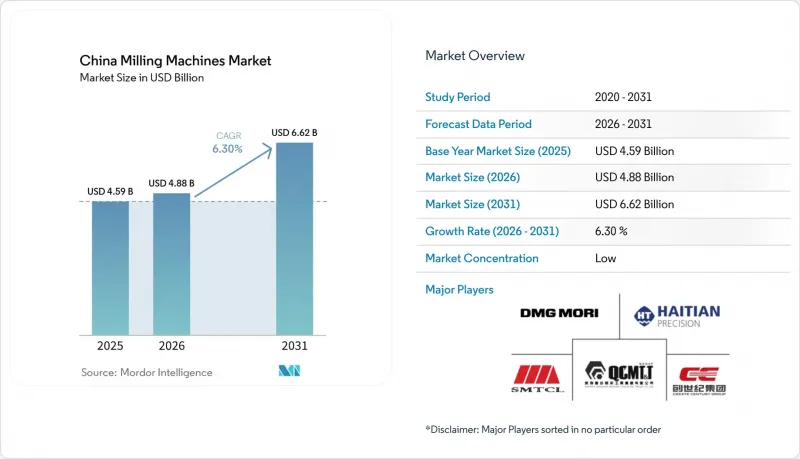
根據 Mordor Intelligence 預測,中國銑床市場規模將從 2025 年的 45.9 億美元成長到 2026 年的 48.8 億美元,然後在 2031 年達到 66.2 億美元,2026 年至 2031 年的複合年成長率為 6.30%。
中國銑床市場趨勢與洞察
大規模製造地滿足了對銑床的廣泛需求。
中國佔全球製造業產出的29%,對銑床設備的需求遍及各個工業領域。 2025年,規模以上機械企業的增加價值產出成長了8.2%。金屬切削工具機產量在2025年達到86.82萬台,比2024年成長9.7%。新訂單成長了9.3%,累積訂單也成長了7.9%。這一趨勢支撐了中國銑床市場的發展,因為需求不僅來自設備擴建,也來自常規升級。廣泛的終端用戶群減輕了特定製造業低迷對設備需求的影響。這種多樣性使機械供應商能夠在整個生產週期中獲得更廣泛的訂單基礎。
電動車和汽車產業產能的擴張正在推動對精密加工的需求。
預計到2025年,中國將生產約1,600萬輛電動車,佔全球電動車產量的近75%。電動車預計將佔中國汽車出口總額的35%以上,高於2024年的20%。馬達殼體、電驅動橋殼體、轉子孔和電池托盤結構等零件的精密銑削加工對供應商至關重要。此外,預計到2025年,中國將生產超過40萬輛電動卡車,超過2020年至2024年的累積產量。更嚴格的公差要求促使零件供應商用更先進的CNC工具工具機替換舊設備。隨著汽車生產及相關零件產能的擴張,中國銑床市場需求持續成長。能夠滿足汽車產業精度和產能要求的供應商將在多個零件類別中受益。
國內激烈的競爭給銑床的價格和利潤率帶來了壓力。
2025年,金屬切割工具機產量成長9.7%,新訂單成長9.3%。這顯示市場需求強勁,同時也暗示國內供應基礎龐大。國家性能標準設定了最低品質標準,但並未限制中低階價位段的競爭者數量。 2025年,工具機及刀具產業的固定資產投資有所下降。價格競爭可能會對中小型製造商的研發投入帶來壓力。這種壓力可能會減緩部分中國銑床市場參與企業向高附加價值領域擴張的速度。對於資源有限的製造商而言,將資金投入長期產品研發可能會變得更加困難。
細分市場分析
預計到2025年,立式銑床將佔中國銑床市場銷售額的49.5%。這一地位反映了立式銑床在通用機械加工車間、模具製造廠和汽車零件生產中的廣泛應用。直立式主軸配置易於操作人員理解,並可簡化許多標準零件的編程。此外,它還滿足了大型、小規模和中型加工中心的需求,這些加工中心將立式加工中心作為核心生產設備。此細分市場的裝機量支撐著對替換設備和相關升級的持續需求。因此,立式加工中心是中國銑床市場銷售的主力軍。
預計到2031年,臥式銑床的年複合成長率將達到7.3%。汽車OEM廠商和一級供應商正在採用這些系統,因為這些系統對吞吐量、剛性和多托盤自動化至關重要。水平佈局允許自動化製造單元進行更長的無人值守生產週期。龍門銑床和大型加工中心正被應用於風力發電機外殼、航太結構和能源設備零件的製造。在2026年CCMT展會上,海天精密發表了三款五軸加工中心,用於加工中大型複雜幾何形狀零件、實現高效生產和曲面加工。此舉表明,供應商正在拓展其產品線,不再局限於標準的垂直平台。
2025年,三軸銑床將佔中國銑床市場規模的53.5%。它們廣泛應用於汽車鑄件、工具機機殼、模腔和通用零件的加工。其具成本效益和廣泛的適用性使其適用於眾多中端市場。儘管裝機量龐大,但在成熟產品類型中,價格壓力依然存在。四軸銑床則是過渡選擇,適用於加工更複雜的輪廓和某些汽車零件。因此,三軸系統仍是中國銑床市場的主要收入來源。
預計到2031年,五軸及以上工具機的年複合成長率將達到10.5%。航太整體葉盤、渦輪葉片、半導體設備機殼以及複雜新能源汽車(NEV)傳動系統零件等應用都需要多軸聯動加工。這類工具機的售價是同類三軸平台平均價格的三到五倍。近年來,中國供應商在高階CNC工具機市場佔了超過8%的佔有率。相較之下,「中國製造2025」計畫的目標是到2025年實現80%的國內市場佔有率。這一差距凸顯了日本和歐洲供應商在要求最嚴苛的應用領域仍佔有重要地位。對工業核心工具機製造商的財政支持正在推動國內五軸加工能力的發展。
其他好處:
- Excel格式的市場預測(ME)表
- 3個月的分析師支持
目錄
第1章:引言
- 研究假設和市場定義
- 調查範圍
第2章:調查方法
第3章執行摘要
- 市場概況(2025 年與 2031 年比較)
- 各細分市場的主要發現
- 主要成長機遇
第4章 市場狀況
- 市場概覽
- 全球銑床市場的生態系統
- 銑床的發展歷程
- 市場促進因素
- 大規模製造地滿足了對銑床的廣泛需求。
- 電動車和汽車產業產能的擴張增加了對精密加工的需求。
- 隨著工廠自動化程度的提高,適用於自動化生產單元的CNC工具機的需求也不斷成長。
- 國內高階工具機的發展擴大了對先進銑削設備的需求。
- 由於工業設備的現代化,老舊工具機的更換速度正在加快。
- 航太、半導體、能源和高階設備產業的擴張正在推動對複雜機械加工需求的成長。
- 市場限制因素
- 國內激烈的競爭給銑床的價格和利潤率帶來了壓力。
- 出口限制和貿易摩擦使得取得先進技術和進入海外市場變得困難。
- 對先進進口零件的依賴限制了高階機械的發展。
- 中小型製造業投資環境惡化可能導致機械設備採購延遲。
- 市場趨勢
- 銑削加工正從傳統的三軸加工轉向五軸和高精度平台。
- 數控銑床正成為智慧工廠的重要組成部分。
- 中國工具機製造商越來越依賴出口來拓展國內市場以外的業務。
- 價值供應鏈分析
- 原料和關鍵零件
- 機械設計與工程
- 機械製造和組裝
- 分銷、系統整合和安裝
- 售後及生命週期服務
- 監理情勢
- 技術展望
- 五軸聯動加工
- 機器人操作的機器操作和自動化生產單元
- 物聯網賦能的CNC與智慧加工
- 全球工具機市場洞察
- 貿易分析
- 地緣政治事件對市場的影響
第5章 市場規模與成長預測
- 按機器類型
- 立式銑床
- 臥式銑床
- 其他(龍門銑床等)
- 按軸類型
- 三軸工具機
- 四軸加工工具機
- 5個或更多軸
- 透過技術
- 傳統/手動銑床
- CNC銑床
- 混合動力機械
- 按最終用戶行業分類
- 汽車和運輸業
- 航太/國防
- 工業機械
- 能源與電力
- 醫療器材
- 電子和半導體
- 建築和採礦設備
- 一般製造業
- 其他
第6章 競爭情勢
- 市場集中度概述
- 關鍵策略趨勢
- 市佔率分析
- 公司簡介
- Ningbo Haitian Precision Machinery Co., Ltd.
- Shenyang Machine Tool Co., Ltd.
- Qinchuan Machine Tool and Tool Group Corp.
- Shenzhen Create Century Machinery Co., Ltd.
- DMG MORI Co., Ltd.
- DN Solutions Co., Ltd.
- Hyundai WIA Corporation
- GROB-WERKE GmbH & Co. KG
- FANUC Corporation
- JTEKT Corporation
- Yamazaki Mazak Corporation
- Okuma Corporation
- Dalian Machine Tool Group(DMTG)
- Makino Milling Machine Co., Ltd.
- Nantong Guosheng Intelligence Technology Group Co., Ltd.
- Zhejiang RIFA Precision Machinery Co., Ltd.
- Chongqing Machine Tool Co., Ltd.
- Guangdong Taikan NC Machine Co., Ltd.
- Jinan First Machine Tool Co., Ltd.
- Haas Automation, Inc.
第7章 市場機會與未來展望
According to Mordor Intelligence, the China milling machines market size is expected to grow from USD 4.59 billion in 2025 to USD 4.88 billion in 2026 and is forecast to reach USD 6.62 billion by 2031 at 6.30% CAGR over 2026-2031.
China Milling Machines Market Trends and Insights
Large-Scale Manufacturing Base Sustains Broad Milling-Machine Demand
China accounted for 29% of global manufacturing output, creating demand for milling equipment across a wide range of industrial activities. Value-added output at machinery enterprises above the designated scale grew 8.2% in 2025. Metal-cutting machine-tool output reached 868,200 units in 2025, which was 9.7% higher than 2024. New orders rose 9.3% in 2025, and recorded 7.9% increase in orders on hand. This pattern supports the China milling machines market because demand comes from capacity additions as well as routine replacement. Its wide end-user base reduces the effect that weakness in any one manufacturing sector could have on equipment demand. This diversity gives machine suppliers a broader order base across production cycles.
EV and Automotive Capacity Expansion Is Increasing Demand for Precision Machining
China produced approximately 16 million electric cars in 2025, representing nearly 75% of global electric-car production. Electric models accounted for more than 35% of China's total car exports in 2025, compared with 20% in 2024. Motor housings, e-axle casings, rotor bores, and battery-tray structures require precision milling across the supplier base. China also produced more than 400,000 electric trucks in 2025, exceeding its combined output during 2020-2024. Higher tolerance requirements are encouraging component suppliers to replace older equipment with more capable CNC machines. This creates a durable demand channel for the China milling machines market as vehicle production and related parts capacity expand. Suppliers that meet automotive accuracy and throughput needs can benefit across several component categories.
Intense Domestic Competition Is Putting Pressure on Milling-Machine Prices and Margins
Metal-cutting machine-tool output increased 9.7% in 2025, while new orders increased 9.3%. The combination indicates active demand but also a large domestic supply base. National performance standards establish a quality floor, but they do not limit the number of competitors in lower and mid-range equipment. Fixed-asset investment in the machine-tool and tooling sector declined in 2025. Price competition can restrict the funds that smaller producers can devote to research and development. This pressure may slow the movement of some China milling machines market participants into higher-value categories. Producers with limited resources may find it harder to fund extended product development.
Other drivers and restraints analyzed in the detailed report include:
- Factory Automation Is Increasing Demand for CNC Machines Compatible with Automated Production Cells
- Domestic high-end machine-tool development expands demand for advanced milling equipment
- Export Controls and Trade Tensions Complicate Access to Advanced Technologies and Overseas Markets
For complete list of drivers and restraints, kindly check the Table Of Contents.
Segment Analysis
Vertical milling machines held 49.5% of China milling machines market revenue in 2025. Their position reflects broad use in general engineering shops, mold-and-die facilities, and automotive component production. Vertical spindle layouts are familiar to operators and support straightforward programming for many standard parts. They also serve the large, small, and medium-sized machining base that relies on vertical machining centers as core production equipment. The segment's installed base supports ongoing demand for replacement machines and related upgrades. This makes vertical equipment the volume anchor of the China milling machines market.
Horizontal milling machines are forecast to grow at a 7.3% CAGR through 2031. Automotive original equipment manufacturers and Tier 1 suppliers use these systems where throughput, rigidity, and multi-pallet automation are important. Horizontal layouts can support longer unattended production cycles in automated manufacturing cells. Gantry mills and large-format machining centers serve wind turbine housings, aerospace structures, and energy equipment components. Haitian Precision introduced three 5-axis machining centers at CCMT 2026 for medium and large complex parts, high-efficiency production, and curved-surface machining. This development shows how suppliers are extending their offerings beyond standard vertical platforms.
3-axis machines accounted for 53.5% of the China milling machines market size in 2025. They are widely used for automotive castings, machinery housings, mold cavities, and general-purpose parts. Their cost and application range make them suitable for the broad mid-market. The installed base is substantial, but mature product categories face continued price pressure. 4-axis equipment provides an intermediate option for more complex contours and selected automotive parts. As a result, 3-axis systems remain the central revenue base for the China milling machines market.
5-axis and above machines are forecast to grow at a 10.5% CAGR through 2031. Aerospace blisks, turbine blades, semiconductor equipment housings, and complex NEV drivetrain parts require simultaneous multi-axis motion. These machines sell at three to five times the average price of comparable 3-axis platforms. Chinese suppliers held more than 8% of the high-tier CNC machine market in recent years. This compares with the 80% domestic-market-share target set under Made in China 2025 for 2025. The gap highlights the continuing role of Japanese and European suppliers in the most demanding applications. Fiscal support for industrial mother-machine producers encourages domestic development of 5-axis capabilities.
Complete Report Scope:
- By Machine Type
- Vertical Milling Machines
- Horizontal Milling Machines
- Others (Gantry mills, etc.)
- By Axis Type
- 3-Axis Machine
- 4-Axis Machine
- 5-Axis and More
- By Technology
- Conventional / Manual Milling Machines
- CNC Milling Machines
- Hybrid Machines
- By End-User Industry
- Automotive & Transportation
- Aerospace & Defense
- Industrial Machinery
- Energy & Power
- Medical Devices
- Electronics & Semiconductor
- Construction & Mining Equipment
- General Manufacturing
- Others
List of Companies Covered in this Report:
- Ningbo Haitian Precision Machinery Co., Ltd.
- Shenyang Machine Tool Co., Ltd.
- Qinchuan Machine Tool and Tool Group Corp.
- Shenzhen Create Century Machinery Co., Ltd.
- DMG MORI Co., Ltd.
- DN Solutions Co., Ltd.
- Hyundai WIA Corporation
- GROB-WERKE GmbH & Co. KG
- FANUC Corporation
- JTEKT Corporation
- Yamazaki Mazak Corporation
- Okuma Corporation
- Dalian Machine Tool Group (DMTG)
- Makino Milling Machine Co., Ltd.
- Nantong Guosheng Intelligence Technology Group Co., Ltd.
- Zhejiang RIFA Precision Machinery Co., Ltd.
- Chongqing Machine Tool Co., Ltd.
- Guangdong Taikan NC Machine Co., Ltd.
- Jinan First Machine Tool Co., Ltd.
- Haas Automation, Inc.
Additional Benefits:
- The market estimate (ME) sheet in Excel format
- 3 months of analyst support
TABLE OF CONTENTS
1 Introduction
- 1.1 Study Assumptions & Market Definition
- 1.2 Scope of the Study
2 Research Methodology
3 Executive Summary
- 3.1 Market Snapshot (2025 vs. 2031)
- 3.2 Key Findings by Segment
- 3.3 Key Growth Opportunities
4 Market Landscape
- 4.1 Market Overview
- 4.1.1 Global Milling Machine Market Ecosystem
- 4.1.2 Evolution of Milling Machines
- 4.2 Market Drivers
- 4.2.1 Large-scale manufacturing base sustains broad milling-machine demand
- 4.2.2 EV and automotive capacity expansion increases precision-machining demand
- 4.2.3 Factory automation increases demand for CNC machines suited to automated production cells
- 4.2.4 Domestic high-end machine-tool development expands demand for advanced milling equipment
- 4.2.5 Industrial equipment renewal accelerates the replacement of aging machining assets
- 4.2.6 Aerospace, semiconductor, energy, and high-end equipment expansion raises complex-machining demand
- 4.3 Market Restraints
- 4.3.1 Intense domestic competition is putting pressure on milling-machine prices and margins
- 4.3.2 Export controls and trade tensions complicate access to advanced technologies and overseas markets
- 4.3.3 Dependence on advanced imported components limits high-end machine development
- 4.3.4 Weak investment conditions among smaller manufacturers can delay machine purchases
- 4.4 Market Trends
- 4.4.1 Milling is shifting from conventional three-axis machining toward five-axis and high-precision platforms
- 4.4.2 CNC milling machines are becoming integrated components of smart factories
- 4.4.3 Chinese machine-tool manufacturers are increasingly using exports to expand beyond the domestic market
- 4.5 Value / Supply-Chain Analysis
- 4.5.1 Raw Materials & Critical Components
- 4.5.2 Machine Design & Engineering
- 4.5.3 Machine Manufacturing & Assembly
- 4.5.4 Distribution, System Integration & Installation
- 4.5.5 Aftermarket & Lifecycle Services
- 4.6 Regulatory Landscape
- 4.7 Technological Outlook
- 4.7.1 Five-axis simultaneous machining
- 4.7.2 Robotic machine tending and automated production cells
- 4.7.3 IoT-enabled CNC and intelligent machining
- 4.8 Insights on the Global Machine Tools Market
- 4.9 Trade Analysis
- 4.10 Impact of Geopolitical Events on the Market
5 Market Size & Growth Forecasts
- 5.1 By Machine Type
- 5.1.1 Vertical Milling Machines
- 5.1.2 Horizontal Milling Machines
- 5.1.3 Others (Gantry mills, etc.)
- 5.2 By Axis Type
- 5.2.1 3-Axis Machine
- 5.2.2 4-Axis Machine
- 5.2.3 5-Axis and More
- 5.3 By Technology
- 5.3.1 Conventional / Manual Milling Machines
- 5.3.2 CNC Milling Machines
- 5.3.3 Hybrid Machines
- 5.4 By End-User Industry
- 5.4.1 Automotive & Transportation
- 5.4.2 Aerospace & Defense
- 5.4.3 Industrial Machinery
- 5.4.4 Energy & Power
- 5.4.5 Medical Devices
- 5.4.6 Electronics & Semiconductor
- 5.4.7 Construction & Mining Equipment
- 5.4.8 General Manufacturing
- 5.4.9 Others
6 Competitive Landscape
- 6.1 Market Concentration Overview
- 6.2 Key Strategic Moves
- 6.3 Market Share Analysis
- 6.4 Company Profiles (includes Global level Overview, Market level overview, Core Segments, Financials as available, Strategic Information, Products & Services, and Recent Developments)
- 6.4.1 Ningbo Haitian Precision Machinery Co., Ltd.
- 6.4.2 Shenyang Machine Tool Co., Ltd.
- 6.4.3 Qinchuan Machine Tool and Tool Group Corp.
- 6.4.4 Shenzhen Create Century Machinery Co., Ltd.
- 6.4.5 DMG MORI Co., Ltd.
- 6.4.6 DN Solutions Co., Ltd.
- 6.4.7 Hyundai WIA Corporation
- 6.4.8 GROB-WERKE GmbH & Co. KG
- 6.4.9 FANUC Corporation
- 6.4.10 JTEKT Corporation
- 6.4.11 Yamazaki Mazak Corporation
- 6.4.12 Okuma Corporation
- 6.4.13 Dalian Machine Tool Group (DMTG)
- 6.4.14 Makino Milling Machine Co., Ltd.
- 6.4.15 Nantong Guosheng Intelligence Technology Group Co., Ltd.
- 6.4.16 Zhejiang RIFA Precision Machinery Co., Ltd.
- 6.4.17 Chongqing Machine Tool Co., Ltd.
- 6.4.18 Guangdong Taikan NC Machine Co., Ltd.
- 6.4.19 Jinan First Machine Tool Co., Ltd.
- 6.4.20 Haas Automation, Inc.
7 Market Opportunities & Future Outlook
- 7.1 Emerging Growth Opportunities
- 7.2 Strategic Recommendations
- 7.3 Future Outlook

 小型銑床市場:全球市場預測,2026-2032年棕櫚油加工廠市場:全球市場預測,2026-2032年正交銑床市場:全球市場預測,2026-2032年電動道路銑鉋機市場:全球市場預測,2026-2032年
 立式銑床市場規模、佔有率、成長率、全球產業分析、區域趨勢及2026-2034年預測。銑床市場規模、佔有率、成長率、全球產業分析、區域趨勢及2026-2034年預測。
 大型臥式砂磨機市場規模、佔有率和成長分析:按機器類型、研磨介質、應用、最終用戶產業、營運方式和地區分類-2026-2033年產業預測移動式立柱銑床市場:全球市場預測,2026-2032年
 牙科玻璃陶瓷銑床切割機市場規模、佔有率和成長分析:按型號、加工軸、自動化程度、應用、最終用戶和地區分類-2026-2033年產業預測
 銑床:市佔率分析、產業趨勢與統計、成長預測(2026-2031)