


 |
市場調查報告書
商品編碼
2163419
銑床:市佔率分析、產業趨勢與統計、成長預測(2026-2031)Milling Machines - Market Share Analysis, Industry Trends & Statistics, Growth Forecasts (2026 - 2031) |
||||||

※ 本網頁內容可能與最新版本有所差異。詳細情況請與我們聯繫。
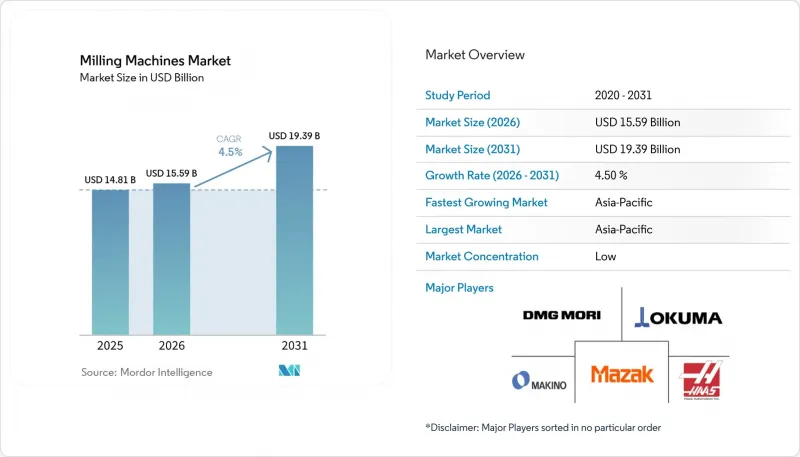
據 Mordor Intelligence 稱,2025 年銑床市值為 148.1 億美元,預計到 2031 年將達到 193.9 億美元,而 2026 年為 155.9 億美元,預測期(2026-2031 年)的複合年成長率為 4.5%。
全球銑床市場趨勢及洞察
對高精度製造的投資
對精密製造設備的投資正在推動銑床市場的設備採購。根據美國製造技術協會 (AMT) 的數據顯示,2026 年第一季美國製造技術訂單總額達到 16 億美元,較 2025 年第一季成長 27.8%。金屬加工工具機製造商的設備運轉率在截至 2025 年 12 月的四個月內連續上升,進一步促進了採購活動的持續進行。牧野機械於 2026 年 5 月在日本富士吉田建成投產,以滿足航太、模具和資料中心設備製造的需求。採用先進的五軸和多功能機床的工廠將能夠參與競爭,爭取品質要求日益嚴格的訂單,這將進一步推動設備採購。這將有利於那些能夠不斷提升工具機性能的製造商,並可能擴大其與使用老舊設備的工廠之間的生產力差距。由此產生的需求,加上設備更新換代和產能擴張,將支撐銑床市場的發展。
傳統工具機的CNC改造
從傳統銑床向數控 (CNC) 設備的轉變仍然是銑床市場的主要需求來源。在印度、東南亞、東歐和拉丁美洲,由於過去對購置成本的重視,老式手動銑床仍被廣泛使用。然而,隨著公差要求日益嚴格、零件設計日益複雜以及入門級控制設備的普及,這種情況正在改變。 2026 年 7 月,美國金屬切削工具機生產者物價指數達到 236.947,以 1983 年 6 月為基準年(100)。售價在 8 萬至 20 萬美元之間的入門級加工中心現在也能提供以前只有更高價位機型才具備的數控功能。一些工廠能夠根據零件配置和運轉率,將多台傳統銑床整合到更強大的CNC加工中心中。自動化設備的日益普及和對電子元件需求的成長,進一步推動了更強大機床的轉變。
高初始投資
高昂的購買成本持續限制銑床市場的普及,尤其是在中小型製造商。入門級立式銑床的初始投資至少需要 8 萬美元,而配置齊全的五軸和多功能平台的價格可能超過 100 萬美元,這還不稅額扣抵安裝、刀具和培訓費用。根據美國國稅局 (IRS) 的規定,合格的投資可享受 48D 條款「先進製造投資抵免」的 25%稅額扣抵。此外,買家還需承擔試運行、工件夾持和操作員資格認證等費用,這進一步增加了總擁有成本。截至 2026 年 7 月,金屬切削工具機的價格指數依然居高不下,這對設備預算帶來了更大的壓力。對於課稅收入有限的企業(例如小規模企業和新興製造地)而言,稅收支持的作用有限。這些資金壁壘將繼續使那些能夠資金籌措設備、獲得獎勵或將購置優勢與自動化相結合的買家佔據優勢。
細分市場分析
到2025年,立式銑床將佔據銑床市場54.8%的佔有率。這一地位反映了其在通用機械加工、模具加工和汽車零件生產的廣泛應用。憑藉其面積小、操作簡便以及成熟的刀具庫,立式銑床已成為代工製造商、委託製造生產商和入門級生產基地的常用選擇。使用者可將這些工具機應用於各種零件的加工,而無需受限於高度專業化的佈局。這種柔軟性確保了即使工廠加大自動化投入,立式平台仍能持續發揮至關重要的作用。由於許多客戶需要可靠且用途廣泛的切削能力,銑床市場將繼續依賴這些已安裝的設備。
臥式銑床的市場成長預測最高,到2031年複合年成長率將達5.61%。航太製造商、大型零件加工商和批量生產製造商正在採用水平平台進行多面加工,無需重複進行切屑控制、托盤更換和對準。這些特性有助於延長無人值守運行時間,並可與自動化托盤儲存系統整合。龍門式、橋式和其他專用銑床也為航太和能源產業的客戶提供了廣泛的加工範圍。 2026年3月,GROB推出了GP1350,這是一款五軸龍門銑削中心,其X軸、Y軸和Z軸的工作範圍分別為1400毫米、1950毫米和1100毫米。該產品反映了市場對大型高精度工具機的需求,而標準的立式和臥式銑床無法滿足這些需求。
截至2025年,三軸加工中心佔據了銑床市場48.2%的佔有率。它們仍然廣泛應用於一般金屬切割、標準消費品模具以及對幾何形狀要求不高的生產任務。其多功能性使其應用廣泛,從訂單工廠到主流生產線均有涉及。這些系統操作簡便,為使用者提供了進入數控生產領域的便捷途徑。四軸加工中心則面向中端用戶群體,用於生產葉輪、引擎缸體、旋轉部件等分度零件以及圓柱形零件。如此廣泛的應用範圍確保了三軸加工中心在銑床市場中保持領先的大規模生產平台地位。
預計到2031年,五軸以上工具機的成長前景最為樂觀,複合年成長率將達到6.41%。航太、醫療和能源產業的客戶正在使用這些工具機製造需要在一次裝夾中加工多個表面的零件,例如葉片轉子、植入和葉輪。透過減少三到四次單獨的裝夾,可以降低累積誤差,縮短加工週期,並減少在製品庫存。這些營運優勢足以彌補在品質要求嚴格的行業中較高的採購價格。 FANUC於2026年8月宣布的舉措旨在整合控制系統、CAD/CAM後處理器和模擬工具,這將使用戶更容易採用五軸加工。此外,航太產業的供應商正面臨嚴格的認證和可追溯性要求,這也推動了軸數增加的趨勢。
區域分析
預計到2025年,亞太地區將佔據銑床市場38.1%的佔有率,在所有地區中成長最為顯著,到2031年年複合成長率(CAGR)將達到6.8%。中國是全球最大的工具機生產和消費市場,國內製造商積極開拓中端應用領域,而來自日本、德國和韓國的供應商則在航太、半導體和汽車等高附加價值領域競爭。在旨在提升國內產能的政策支持下,印度正從主要的進口國轉型為大規模的製造地。 2026年8月,DN Solutions投資7,200萬美元,在班加羅爾開設了自2003年以來的首個海外製造地。在東南亞,隨著電子和精密零件製造商實現供應鏈多元化併升級設備,牧野(Makino)於2025年12月在越南興安省開設了一家工廠和技術中心。
隨著製造商提升國內產能,北美正成為銑床新需求的主要來源。 CHIPS法案下的各項計畫、清潔能源投資以及基礎建設支出,都在支持需要精密設備的工廠建設。半導體產業協會(SIA)的報告顯示,CHIPS法案的資金支持了美國新建製造工廠及相關就業機會的創造。 2026年第一季,美國製造技術訂單達16億美元,較去年同期成長27.8%。遷回美國的工廠往往會在投產初期就安裝自動化和CNC設備,這支撐了對先進銑床平台的需求。隨著供應鏈向北美客戶靠攏,投資也湧入墨西哥和加拿大,墨西哥汽車產業走廊對中端銑床的需求也得到了支持。
歐洲銑床市場因地區而異。儘管一些製造商因汽車行業重組和能源成本上漲而減少了投資意願,但來自航太、國防和發電行業的客戶對高精度設備的訂單仍然源源不斷。 StarragTornos報告稱,受航太和能源產業需求的推動,2026年上半年訂單較2025年上半年成長33.6%。在中東和非洲,尤其是在沙烏地阿拉伯和阿拉伯聯合大公國,投資正朝著國防和能源產業產能在地化的方向發展。南美的需求主要集中在巴西的汽車產業,但受到外匯波動、進口關稅和CNC工具機網路不發達等因素的限制。這些區域差異促使供應商在維護與現有歐洲客戶關係的同時,尋求亞太和北美地區的成長機會。
其他好處:
- Excel格式的市場預測(ME)表
- 3個月的分析師支持
目錄
第1章:引言
- 研究假設和市場定義
- 調查範圍
第2章:調查方法
第3章執行摘要
- 市場概況(2025 年與 2031 年比較)
- 各細分市場的主要發現
- 主要成長機遇
第4章 市場狀況
- 市場概覽
- 全球銑床市場的生態系統
- 銑床的發展歷程
- 市場促進因素
- 高精度製造業資本投資增加
- 傳統工具機採用數控(電腦數控)技術的進程正在加速。
- 對複雜多面體部件的需求日益成長
- 製造業回歸日本,生產能力在地化。
- 電動車動力傳動系統和電氣化零件的製造
- 機械車間自動化技術的進步
- 市場限制因素
- 大量初始資本投資
- 熟練的CNC操作員和程式設計人員短缺
- 這台機器的投資回收期很長。
- 資本財需求的周期性特徵
- 市場趨勢
- 自動化自主銑削單元
- 互聯工具機和預測性維護
- 印度和東南亞製造業擴張
- 價值供應鏈分析
- 原料和關鍵零件
- 機械設計與工程
- 機械製造和組裝
- 分銷、系統整合和安裝
- 售後及生命週期服務
- 監理情勢
- 技術展望
- 人工智慧驅動的CNC加工與自適應加工
- 數位孿生與虛擬加工
- 聯網自主銑床
- 全球工具機市場洞察
- 貿易分析
- 地緣政治事件對市場的影響
第5章 市場規模與成長預測
- 按機器類型
- 立式銑床
- 臥式銑床
- 其他(龍門銑床等)
- 按軸類型
- 三軸工具機
- 四軸加工工具機
- 5個或更多軸
- 透過技術
- 傳統/手動銑床
- CNC銑床
- 混合動力機械
- 按最終用戶行業分類
- 汽車和運輸業
- 航太/國防
- 工業機械
- 能源與電力
- 醫療器材
- 電子和半導體
- 建築和採礦設備
- 一般製造業
- 其他
- 按地區
- 北美洲
- 美國
- 加拿大
- 墨西哥
- 南美洲
- 巴西
- 其他南美國家
- 歐洲
- 德國
- 義大利
- 英國
- 法國
- 西班牙
- 瑞士
- 比荷盧經濟聯盟(比利時、荷蘭、盧森堡)
- 北歐國家(丹麥、芬蘭、冰島、挪威、瑞典)
- 其他歐洲國家
- 亞太地區
- 中國
- 印度
- 日本
- 韓國
- 台灣
- 東協(印尼、泰國、菲律賓、馬來西亞、越南)
- 其他亞太國家
- 中東和非洲
- 沙烏地阿拉伯
- 阿拉伯聯合大公國
- 南非
- 其他中東和非洲國家
- 北美洲
第6章 競爭情勢
- 市場集中度概述
- 關鍵策略趨勢
- 市佔率分析
- 公司簡介
- Yamazaki Mazak Corporation
- DMG MORI
- Okuma Corporation
- Makino Milling Machine
- Haas Automation, Inc.
- DN Solutions Co., Ltd.
- Brother Industries, Ltd.
- Hyundai WIA Corporation
- GROB-WERKE GmbH & Co. KG
- CHIRON Group SE
- GF Machining Solutions
- FANUC Corporation
- Hermle AG
- StarragTornos Group AG
- Hurco Companies, Inc.
- Matsuura Machinery Corporation
- Hardinge Inc.
- Haitian Precision Machinery Co., Ltd.
- Shenyang Machine Tool Co., Ltd.(SMTCL)
- Jier Machine-Tool Group Co., Ltd.
第7章 市場機會與未來展望
According to Mordor Intelligence, the milling machines market size was valued at USD 14.81 billion in 2025 and is estimated to grow from USD 15.59 billion in 2026 to reach USD 19.39 billion by 2031, at a CAGR of 4.5% during the forecast period (2026-2031).
Global Milling Machines Market Trends and Insights
Investment in High-Precision Manufacturing
Investment in precision manufacturing equipment is supporting equipment purchases across the milling machine market. The United States manufacturing technology orders totaled USD 1.6 billion in the first quarter of 2026, up 27.8% from the first quarter of 2025, according to the Association for Manufacturing Technology. Capacity utilization among metalworking machinery manufacturers rose for four consecutive months through December 2025, which supported continuing procurement activity. Makino completed its Fujiyoshida Plant in Japan in May 2026 to support demand from aerospace, die and mold, and data-center equipment manufacturing. Shops that install advanced 5-axis or multitasking equipment can compete for work with stricter quality requirements, which can support subsequent equipment purchases. This favors manufacturers able to continuously upgrade machine capability, potentially widening the productivity gap versus facilities operating legacy equipment. The resulting demand supports the milling machine market because it combines replacement purchases with new production capacity.
CNC Conversion of Conventional Fleets
Conversion from conventional milling machines to CNC equipment remains a major source of demand in the milling machines market. Older manually operated machines are still widely used in India, Southeast Asia, Eastern Europe, and Latin America, where buyers historically placed greater weight on purchase cost. Tighter tolerance requirements, more complex part designs, and wider availability of entry-level CNC controls are changing that decision. The United States Producer Price Index for metal-cutting machine tools reached 236.947 in July 2026, using June 1983 as the base of 100. Entry-level machining centers priced from USD 80,000 to USD 200,000 can now provide CNC capability that was previously associated with higher-priced platforms.Some shops can consolidate multiple conventional machines into a higher-capability CNC machining center, depending on part mix and utilization. Growing use of automated shop equipment and demand for electrification components further support this shift toward more capable machines.
High Initial Capital Investment
High purchase costs continue to limit adoption in the milling machines market, especially among small and medium-sized manufacturers. Entry-level vertical machinery requires at least USD 80,000 of upfront capital, while configured 5-axis and multitasking platforms can exceed USD 1 million before installation, tooling, and training. The Internal Revenue Service states that the Advanced Manufacturing Investment Credit can provide 25% credit for qualified investments under Section 48D. Buyers must also fund commissioning, work holding, and operator qualification, which raises the total cost of ownership. The metal-cutting machine tool price index remained elevated in July 2026, adding pressure to equipment budgets. Tax support is less useful for firms with limited taxable income, which is common in smaller businesses and developing manufacturing locations. The capital barrier will continue to favor buyers who can finance equipment, obtain incentives, or combine a purchase with automation gains.
Other drivers and restraints analyzed in the detailed report include:
- Manufacturing Reshoring and Localization
- Demand for Complex Multi-Surface Components
- Shortage of Skilled CNC Operators and Programmers
For complete list of drivers and restraints, kindly check the Table Of Contents.
Segment Analysis
Vertical machines held 54.8% of the milling machines market share in 2025. Their position reflects broad use in general machining, die and mold work, and automotive component production. A smaller footprint, familiar operating approach, and established tooling base make vertical equipment a common choice for job shops, contract manufacturers, and entry-level production. Buyers can apply these machines across a wide range of parts without committing to a highly specialized layout. This flexibility helps vertical platforms remain relevant even as factories invest in more automation. The milling machines market continues to depend on this installed base because many customers need dependable general-purpose cutting capacity.
Horizontal machines recorded the fastest growth outlook of 5.61% CAGR through 2031. Aerospace producers, heavy-component machinists, and high-volume manufacturers use horizontal platforms for chip control, pallet changing, and multi-face machining without repeated repositioning. These features support longer unattended operating periods and easier integration with automated pallet storage. Gantry, bridge, and other specialized mills also benefit where aerospace and energy customers need large machining envelopes. GROB launched the GP1350 5-axis portal milling center in March 2026 with X, Y, and Z working ranges of 1,400 mm, 1,950 mm, and 1,100 mm. The product shows the demand for large-format, accurate machines where standard vertical and horizontal designs do not provide sufficient capacity.
3-axis machines held 48.2% of the milling machines market share in 2025. They remain widely used in general metal removal, standard consumer-goods molds, and production work with less demanding geometry. Their versatility supports use across job shops and mainstream production lines. The systems are familiar to operators and can provide an accessible route into CNC production. 4-axis machines serve a middle group of users producing indexed or cylindrical components such as impellers, engine blocks, and rotary parts. This broad role maintains 3-axis equipment as the principal volume platform in the milling machines market.
5-axis and above machines recorded the fastest growth outlook through 2031, registering a 6.41% CAGR. Aerospace, medical, and energy customers use these machines for bladed rotors, implants, impellers, and other parts that require several surfaces to be machined in one setup. Removing 3 or 4 separate setups can reduce accumulated errors, shorten cycle times, and lower work-in-process inventory. These operating benefits can justify a higher purchase price where quality requirements are strict. FANUC's August 2026 initiative addressed alignment between controls, CAD/CAM post-processors, and simulation tools, which can make 5-axis implementation easier for users. Aerospace suppliers also face demanding certification and traceability expectations, which support the movement toward higher-axis capability.
Complete Report Scope:
- By Machine Type
- Vertical Milling Machines
- Horizontal Milling Machines
- Others (Gantry mills, etc.)
- By Axis Type
- 3-Axis Machine
- 4-Axis Machine
- 5-Axis and More
- By Technology
- Conventional / Manual Milling Machines
- CNC Milling Machines
- Hybrid Machines
- By End-User Industry
- Automotive & Transportation
- Aerospace & Defense
- Industrial Machinery
- Energy & Power
- Medical Devices
- Electronics & Semiconductor
- Construction & Mining Equipment
- General Manufacturing
- Others
- By Geography
- North America
- United States
- Canada
- Mexico
- South America
- Brazil
- Rest of South America
- Europe
- Germany
- Italy
- United Kingdom
- France
- Spain
- Switzerland
- BENELUX (Belgium, Netherlands, and Luxembourg)
- NORDICS (Denmark, Finland, Iceland, Norway, and Sweden)
- Rest of Europe
- Asia-Pacific
- China
- India
- Japan
- South Korea
- Taiwan
- ASEAN (Indonesia, Thailand, Philippines, Malaysia, Vietnam)
- Rest of Asia-Pacific
- Middle East and Africa
- Saudi Arabia
- United Arab Emirates
- South Africa
- Rest of Middle East and Africa
- North America
Geography Analysis
Asia-Pacific held 38.1% of the milling machines market share in 2025 and recorded the fastest regional growth outlook of 6.8% CAGR through 2031. China is the largest national market for both machine tool production and consumption, with domestic builders active in mid-tier applications and Japanese, German, and Korean suppliers competing in premium aerospace, semiconductor, and automotive work. India is developing from a major importer into a larger manufacturing location as policy programs support domestic production capacity. DN Solutions inaugurated its first overseas manufacturing facility since 2003 in Bengaluru in August 2026, with an investment of USD 72 million. Southeast Asia is also upgrading equipment as electronics and precision-parts producers diversify supply chains, and Makino opened its Hung Yen Factory and Technology Center in Vietnam in December 2025.
North America is a major source of new milling machine demand because manufacturers are adding domestic capacity. CHIPS Act programs, clean-energy investment, and infrastructure-related spending support the construction of facilities that require precision equipment. The Semiconductor Industry Association reported that CHIPS Act funding was supporting new United States manufacturing facilities and related jobs. Manufacturing technology orders in the United States reached USD 1.6 billion in the first quarter of 2026, increasing 27.8% year over year. Reshored factories are more likely to install automation and CNC capacity when they open, supporting demand for advanced milling platforms. Mexico and Canada also receive investment as supply chains move closer to North American customers, with Mexico's automotive corridors supporting demand for mid-tier machinery.
Europe has mixed conditions across the milling machines market. Automotive restructuring and energy costs have reduced investment confidence for some manufacturers, while aerospace, defense, and power-generation customers continue to order high-precision equipment. StarragTornos reported a 33.6% increase in order intake in the first half of 2026 compared with the first half of 2025, supported by aerospace and energy demand. The Middle East and Africa are receiving capacity-localization investment for defense and energy applications, especially in Saudi Arabia and the United Arab Emirates. South American demand is centered on Brazil's automotive sector but is constrained by currency volatility, import tariffs, and less developed CNC tooling networks. These regional differences encourage suppliers to balance established European customer relationships with growth opportunities in Asia-Pacific and North America.
- Yamazaki Mazak Corporation
- DMG MORI
- Okuma Corporation
- Makino Milling Machine
- Haas Automation, Inc.
- DN Solutions Co., Ltd.
- Brother Industries, Ltd.
- Hyundai WIA Corporation
- GROB-WERKE GmbH & Co. KG
- CHIRON Group SE
- GF Machining Solutions
- FANUC Corporation
- Hermle AG
- StarragTornos Group AG
- Hurco Companies, Inc.
- Matsuura Machinery Corporation
- Hardinge Inc.
- Haitian Precision Machinery Co., Ltd.
- Shenyang Machine Tool Co., Ltd. (SMTCL)
- Jier Machine-Tool Group Co., Ltd.
Additional Benefits:
- The market estimate (ME) sheet in Excel format
- 3 months of analyst support
TABLE OF CONTENTS
1 Introduction
- 1.1 Study Assumptions & Market Definition
- 1.2 Scope of the Study
2 Research Methodology
3 Executive Summary
- 3.1 Market Snapshot (2025 vs. 2031)
- 3.2 Key Findings by Segment
- 3.3 Key Growth Opportunities
4 Market Landscape
- 4.1 Market Overview
- 4.1.1 Global Milling Machine Market Ecosystem
- 4.1.2 Evolution of Milling Machines
- 4.2 Market Drivers
- 4.2.1 Rising Capital Investment in High-Precision Manufacturing
- 4.2.2 Accelerating CNC Conversion of Conventional Machine Fleets
- 4.2.3 Growing Demand for Complex, Multi-Surface Components
- 4.2.4 Manufacturing Reshoring and Capacity Localization
- 4.2.5 EV Powertrain and Electrification Component Manufacturing
- 4.2.6 Increasing Automation of Machine Shops
- 4.3 Market Restraints
- 4.3.1 High Initial Capital Investment
- 4.3.2 Shortage of Skilled CNC Operators & Programmers
- 4.3.3 Long Machine Payback Periods
- 4.3.4 Cyclicality of Capital Equipment Demand
- 4.4 Market Trends
- 4.4.1 Automated & Autonomous Milling Cells
- 4.4.2 Connected Milling Machines & Predictive Maintenance
- 4.4.3 India & Southeast Asia Manufacturing Expansion
- 4.5 Value / Supply-Chain Analysis
- 4.5.1 Raw Materials & Critical Components
- 4.5.2 Machine Design & Engineering
- 4.5.3 Machine Manufacturing & Assembly
- 4.5.4 Distribution, System Integration & Installation
- 4.5.5 Aftermarket & Lifecycle Services
- 4.6 Regulatory Landscape
- 4.7 Technological Outlook
- 4.7.1 AI-Enabled CNC & Adaptive Machining
- 4.7.2 Digital Twins & Virtual Machining
- 4.7.3 Connected & Autonomous Milling
- 4.8 Insights on the Global Machine Tools Market
- 4.9 Trade Analysis
- 4.10 Impact of Geopolitical Events on the Market
5 Market Size & Growth Forecasts
- 5.1 By Machine Type
- 5.1.1 Vertical Milling Machines
- 5.1.2 Horizontal Milling Machines
- 5.1.3 Others (Gantry mills, etc.)
- 5.2 By Axis Type
- 5.2.1 3-Axis Machine
- 5.2.2 4-Axis Machine
- 5.2.3 5-Axis and More
- 5.3 By Technology
- 5.3.1 Conventional / Manual Milling Machines
- 5.3.2 CNC Milling Machines
- 5.3.3 Hybrid Machines
- 5.4 By End-User Industry
- 5.4.1 Automotive & Transportation
- 5.4.2 Aerospace & Defense
- 5.4.3 Industrial Machinery
- 5.4.4 Energy & Power
- 5.4.5 Medical Devices
- 5.4.6 Electronics & Semiconductor
- 5.4.7 Construction & Mining Equipment
- 5.4.8 General Manufacturing
- 5.4.9 Others
- 5.5 By Geography
- 5.5.1 North America
- 5.5.1.1 United States
- 5.5.1.2 Canada
- 5.5.1.3 Mexico
- 5.5.2 South America
- 5.5.2.1 Brazil
- 5.5.2.2 Rest of South America
- 5.5.3 Europe
- 5.5.3.1 Germany
- 5.5.3.2 Italy
- 5.5.3.3 United Kingdom
- 5.5.3.4 France
- 5.5.3.5 Spain
- 5.5.3.6 Switzerland
- 5.5.3.7 BENELUX (Belgium, Netherlands, and Luxembourg)
- 5.5.3.8 NORDICS (Denmark, Finland, Iceland, Norway, and Sweden)
- 5.5.3.9 Rest of Europe
- 5.5.4 Asia-Pacific
- 5.5.4.1 China
- 5.5.4.2 India
- 5.5.4.3 Japan
- 5.5.4.4 South Korea
- 5.5.4.5 Taiwan
- 5.5.4.6 ASEAN (Indonesia, Thailand, Philippines, Malaysia, Vietnam)
- 5.5.4.7 Rest of Asia-Pacific
- 5.5.5 Middle East and Africa
- 5.5.5.1 Saudi Arabia
- 5.5.5.2 United Arab Emirates
- 5.5.5.3 South Africa
- 5.5.5.4 Rest of Middle East and Africa
- 5.5.1 North America
6 Competitive Landscape
- 6.1 Market Concentration Overview
- 6.2 Key Strategic Moves
- 6.3 Market Share Analysis
- 6.4 Company Profiles (includes Global level Overview, Market level overview, Core Segments, Financials as available, Strategic Information, Products & Services, and Recent Developments)
- 6.4.1 Yamazaki Mazak Corporation
- 6.4.2 DMG MORI
- 6.4.3 Okuma Corporation
- 6.4.4 Makino Milling Machine
- 6.4.5 Haas Automation, Inc.
- 6.4.6 DN Solutions Co., Ltd.
- 6.4.7 Brother Industries, Ltd.
- 6.4.8 Hyundai WIA Corporation
- 6.4.9 GROB-WERKE GmbH & Co. KG
- 6.4.10 CHIRON Group SE
- 6.4.11 GF Machining Solutions
- 6.4.12 FANUC Corporation
- 6.4.13 Hermle AG
- 6.4.14 StarragTornos Group AG
- 6.4.15 Hurco Companies, Inc.
- 6.4.16 Matsuura Machinery Corporation
- 6.4.17 Hardinge Inc.
- 6.4.18 Haitian Precision Machinery Co., Ltd.
- 6.4.19 Shenyang Machine Tool Co., Ltd. (SMTCL)
- 6.4.20 Jier Machine-Tool Group Co., Ltd.
7 Market Opportunities & Future Outlook
- 7.1 Emerging Growth Opportunities
- 7.2 Strategic Recommendations
- 7.3 Future Outlook

 小型銑床市場:全球市場預測,2026-2032年棕櫚油加工廠市場:全球市場預測,2026-2032年正交銑床市場:全球市場預測,2026-2032年電動道路銑鉋機市場:全球市場預測,2026-2032年
 立式銑床市場規模、佔有率、成長率、全球產業分析、區域趨勢及2026-2034年預測。銑床市場規模、佔有率、成長率、全球產業分析、區域趨勢及2026-2034年預測。
 大型臥式砂磨機市場規模、佔有率和成長分析:按機器類型、研磨介質、應用、最終用戶產業、營運方式和地區分類-2026-2033年產業預測
 中國銑床切割機:市場佔有率分析、產業趨勢與統計及成長預測(2026-2031年)移動式立柱銑床市場:全球市場預測,2026-2032年
 牙科玻璃陶瓷銑床切割機市場規模、佔有率和成長分析:按型號、加工軸、自動化程度、應用、最終用戶和地區分類-2026-2033年產業預測