


 |
市場調查報告書
商品編碼
2163587
資料中心管道:市場佔有率分析、產業趨勢與統計、成長預測(2026-2031)Pipes For Data Centers - Market Share Analysis, Industry Trends & Statistics, Growth Forecasts (2026 - 2031) |
||||||

※ 本網頁內容可能與最新版本有所差異。詳細情況請與我們聯繫。
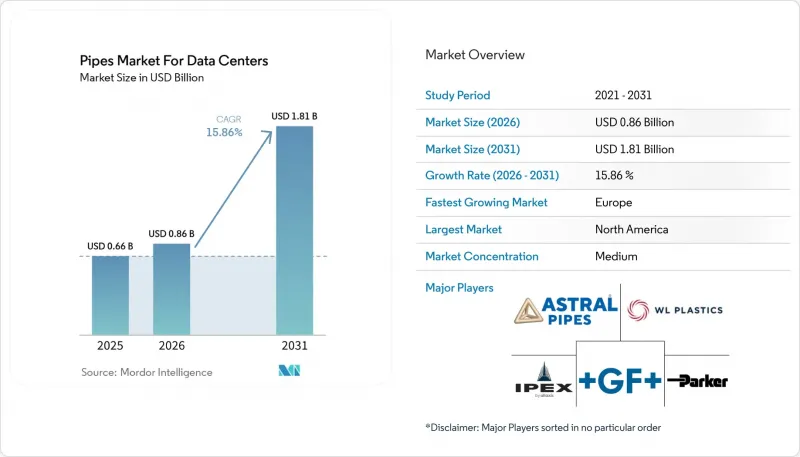
根據 Mordor Intelligence 預測,資料中心管道市場規模將從 2025 年的 6.6 億美元成長到 2026 年的 8.6 億美元,到 2031 年將達到 18.1 億美元。
預計 2026 年至 2031 年的年複合成長率(CAGR)為 15.86%。
資料中心管道市場洞察與趨勢
超大規模和託管資料中心的快速擴張
隨著超大規模資料中心和託管營運商在緊迫的工期內建造大規模設施,資料中心管道市場從中受益。每個園區都需要大量的冷凍水管、冷凝水分支管路、消防系統以及專門用於高密度計算區域的歧管。隨著新增容量的擴大,能夠在現場安裝開始前提供認證組件和預組裝系統的供應商將更具優勢。託管業者還需要標準化、經過測試的管道組件,以便在不影響相鄰運作中機房正常運作的情況下進行安裝。由於管道需要與冷卻系統、IT設備和建築施工進度保持一致,採購工作擴大提前到專案規劃階段。這種時間安排提升了能夠協調材料、製造、測試和交貨的供應商的價值,使他們能夠在一個專案計劃中完成所有環節。
人工智慧和高效能運算的工作量正在不斷增加。
人工智慧 (AI) 和高效能運算 (HPC) 工作負載正在改變新建資料中心的散熱需求。 NVIDIA 指出,其 GB200 NVL72 機架每個機櫃的功耗可超過 120 kW,這進一步增加了對冷卻迴路和冷卻液供應系統的要求。國際能源總署 (IEA) 預測,全球資料中心的電力消耗量將從 2024 年的 415 TWh 增加到 2030 年的 945 TWh。冷卻基礎設施是造成這一成長的主要因素,需要在整個建築物內實現可靠的流體循環。在此背景下,潔淨聚合物系統非常適用,因為冷卻液的純度和腐蝕控制在冷板和快速連接組件中起著至關重要的作用。因此,資料中心管道市場的發展不僅將受到資料中心數量成長的驅動,還將受到人工智慧應用普及後每個機房內管道密度增加的影響。
高昂的安裝和基礎設施成本
液冷設計會增加管道基礎設施成本,因為除了標準的工廠側設備外,還需要分支技術冷卻系統。如果專案包含大量歧管連接,則由於現場焊接和熔接,人事費用也會增加。此外,施工期間硬體佈局的變更可能需要重新設計和修改管道路徑。對於資本預算有限的企業級和邊緣運算項目而言,這些成本更難負擔。基於 ASME B31.3 製程管道標準和 ASHRAE 技術委員會 9.9 指南的要求可能會增加某些安裝項目的文件編制和測試工作。因此,資料中心管道市場必須在不斷增加的初始系統複雜性與高密度運算設備的散熱溫度控管需求之間取得平衡。
細分市場分析
2025年,金屬管道的銷售額佔比高達71.04%。這得益於其在冷凍水管道、冷凝水系統、工廠總管以及其他關鍵資料中心基礎設施中久經考驗的應用經驗。金屬管道具有高機械強度、耐壓性、耐久性以及適用於大直徑管道網路等優點,使其成為大型和超大規模設施的首選材料。根據壓力、溫度、腐蝕環境和水質要求,碳鋼、不銹鋼、銅和球墨鑄鐵等材料被用於不同的應用場景。儘管金屬管道比聚合物管道更重,且需要更高的防腐蝕性能,但由於其廣泛的應用經驗和滿足嚴苛冷卻基礎設施需求的能力,金屬管道仍然是主流材料類型。
預計聚合物管道將成為成長最快的材料類型,2026年至2031年的複合年成長率預計為20.93%。這一成長主要得益於資料中心冷卻基礎設施對輕質、耐腐蝕和低維護管道系統的日益青睞。聚丙烯、高密度聚苯乙烯、聚氯乙烯和聚二氟亞乙烯等材料具有耐腐蝕和耐化學腐蝕的特性,同時比傳統金屬系統更容易搬運和安裝。這些材料適用於冷凍水、冷凝水、廢水和特殊液體冷卻應用,隨著資料中心營運商越來越重視系統的耐用性、清潔度和生命週期性能,這些材料的應用正在加速成長。
到2025年,冷凍水管道將佔資料中心管道市場應用銷售額的49.26%,成為該市場最大的應用領域。這些系統連接冷卻裝置、冷卻設備和數據端口,促進冷凍水循環,從而在傳統和高密度計算環境中有效散熱。冷凍水管道在風冷資料中心的廣泛應用以及與液冷系統日益融合,持續推動可靠的高壓管道網路的需求。
其他應用領域(例如排水和污水系統以及地下公用設施網路)預計將成為成長最快的應用領域,2026 年至 2031 年的複合年成長率 (CAGR) 預計將達到 17.56%。這一成長主要受資料中心園區擴張、水資源管理需求增加以及對高效處理製程用水、冷凝水和污水流量日益重視的推動。隨著資料中心規模的擴大和冷卻水用量的增加,排水基礎設施必須處理更大的水量,同時確保其耐腐蝕性和長期可靠性能。由於聚合物管道系統具有卓越的耐腐蝕性和耐化學性,因此在這些應用中變得越來越重要,它們能夠支援排水和污水網路以及核心冷卻基礎設施的擴展。
區域分析
到2025年,北美將佔全球銷售額的61.73%,成為資料中心管道市場最大的區域佔有率。美國的需求成長主要來自新園區、冷卻系統維修、液冷機房的建設。除了北維吉尼亞已有的發展之外,德克薩斯州和印第安納州的業務也在加速成長。這種市場分佈支撐著冷凍水、冷凝水和技術冷卻系統的區域製造和供應鏈。加拿大Telehouse公司在多倫多部署了一套直接流向終端(DTC)的液冷系統,並將其與Enwave的區域供熱系統和餘熱回收系統整合。
在亞太地區,除了東南亞的新建設外,印度、中國和日本的產能擴張也正在穩步推進。到2025年,馬來西亞柔佛州的運作產能將從401兆瓦增至897兆瓦,孟買的營運產能將達到7,68兆瓦,增幅達42%。這些項目需要大規模採購,並且需要零件供應商和施工團隊之間緊密協調。該地區豐富的工程儲備涵蓋了戶外公用設施應用和機架級冷卻系統。
預計到2031年,歐洲將以18.07%的複合年成長率成長。該地區對高規格管道的需求持續旺盛,尤其是在法蘭克福、倫敦、阿姆斯特丹、巴黎和都柏林等城市集群。歐盟的能源效率指令要求對某些超過500千瓦的資料中心進行能源和用水量報告,這使得人們更加關注冷卻水的使用和系統損耗。 ISOPLUS集團為微軟與Fortum在埃斯波資料中心所進行的餘熱利用專案提供了DN700區域供熱管道。在巴西,該公司透過在聖保羅開發超大規模和託管設施來滿足南美洲的需求。在沙烏地阿拉伯和阿拉伯聯合大公國,高溫環境增加了冷卻需求,需要可靠的液冷基礎設施。
其他好處:
- Excel格式的市場預測(ME)表
- 3個月的分析師支持
目錄
第1章:引言
- 研究假設和市場定義
- 調查範圍
第2章:調查方法
第3章執行摘要
第4章 市場狀況
- 市場概覽
- 市場促進因素
- 超大規模和託管資料中心的快速擴張
- 人工智慧和高效能運算的工作負載增加
- 直接冷卻和浸沒式冷卻技術的應用日益普及。
- 擴大邊緣和模組化資料中心的應用
- 預製和工廠測試的管道系統的需求
- 市場限制因素
- 高昂的安裝和基礎設施成本
- 洩漏和關鍵任務可靠性風險
- 冷卻劑適用性和水化學的不確定性
- 價值鏈分析
- 波特五力分析
第5章 市場規模與成長預測
- 材料類型
- 聚合物管道
- PE管
- PP管
- PVC管
- 其他聚合物管道
- 金屬管
- 碳鋼管
- 不銹鋼管
- 銅管
- 聚合物管道
- 透過使用
- 冷水供應
- 冷凝水系統
- 消防系統
- 供水和水處理
- 其他用途(排水和污水系統以及地下公用設施網路)
- 按類型分類的冷卻技術
- 風冷式資料中心
- 液冷資料中心
- 混合冷卻技術
- 依資料中心類型
- 超大規模資料中心
- 託管資料中心
- 企業資料中心
- 邊緣資料中心
- 按地區
- 亞太地區
- 中國
- 印度
- 日本
- 韓國
- ASEAN
- 其他亞太國家
- 北美洲
- 美國
- 加拿大
- 墨西哥
- 歐洲
- 德國
- 英國
- 法國
- 義大利
- 其他歐洲國家
- 南美洲
- 巴西
- 其他南美國家
- 中東和非洲
- 沙烏地阿拉伯
- 阿拉伯聯合大公國
- 南非
- 其他中東和非洲國家
- 亞太地區
第6章 競爭情勢
- 市場集中度
- 策略趨勢
- 市佔率和排名分析
- 公司簡介
- Agru Kunststofftechnik GmbH
- Aliaxis
- Aquatherm
- Asahi/America
- ASTRAL PIPES
- BRUGG Pipes
- Future Pipe Industries
- GF Piping Systems
- IPEX Inc.
- NIBCO
- PARKER HANNIFIN CORP
- Pipelife(Wienerberger Group)
- POLYMELT Pipe Systems GmbH
- Rehau
- Sekisui Chemical
- Uponor
- Wavin
- WL Plastics
第7章 市場機會與未來展望
According to Mordor Intelligence, the pipes market for data centers industry size is expected to increase from USD 0.66 billion in 2025 to USD 0.86 billion in 2026 and reach USD 1.81 billion by 2031, at a CAGR of 15.86% over 2026-2031.
Insights and Trends of Pipes Market For Data Centers
Rapid Expansion of Hyperscale and Colocation Data Centers
The pipes market for data centers benefits when hyperscale and colocation operators build larger facilities on compressed delivery schedules. Each campus needs extensive chilled-water distribution, condenser-water branches, fire-suppression networks, and dedicated manifolds for dense computing areas. New capacity favors suppliers that can provide qualified components and assembled systems before on-site installation begins. Colocation operators also need standardized, tested pipe assemblies that can be installed without disrupting adjacent operating halls. Procurement is moving earlier in project planning because piping must align with cooling equipment, information technology equipment, and building construction schedules. This timing increases the value of suppliers that can coordinate materials, fabrication, testing, and delivery within a single project schedule.
Rising AI and High-Performance Computing Workloads
Artificial intelligence and high-performance computing workloads are changing the thermal requirements of new facilities. NVIDIA stated that its GB200 NVL72 rack can draw more than 120 kW per cabinet, placing greater demands on cooling circuits and coolant delivery equipment. The International Energy Agency projected global data center electricity use to rise from 415 TWh in 2024 to 945 TWh by 2030. Cooling infrastructure contributes to this increase and requires reliable fluid movement throughout the building. These conditions favor clean polymer systems where coolant purity and corrosion control matter for cold plates and quick-connect components. The pipes market for data centers, therefore, depends not only on more facilities, but also on greater pipe density within each artificial intelligence-enabled hall.
High Installation and Infrastructure Costs
Piping infrastructure becomes more expensive when liquid-cooled designs add technology cooling system branches to the usual plant-side equipment. Field welding and fusion joining can add labor requirements when a project contains many manifold connections. Design revisions can also require rerouting when hardware layouts change during construction. These costs are harder to absorb in enterprise and edge projects with smaller capital budgets. Requirements under the American Society of Mechanical Engineers B31.3 process-piping standards and the American Society of Heating, Refrigerating and Air-Conditioning Engineers Technical Committee 9.9 guidance can add documentation and testing work for some installations. The pipes market for data centers must, therefore, balance higher initial system complexity against the thermal needs of high-density computing equipment.
Other drivers and restraints analyzed in the detailed report include:
- Increasing Adoption of Direct-to-Chip and Immersion Cooling
- Growth of Edge and Modular Data Center Deployments
- Leakage and Mission-Critical Reliability Risks
For complete list of drivers and restraints, kindly check the Table Of Contents.
Segment Analysis
Metal-based pipes accounted for 71.04% of revenue in 2025, supported by their established use in chilled-water distribution, condenser-water systems, plant headers, and other critical data center infrastructure. Their high mechanical strength, pressure-handling capacity, durability, and suitability for large-bore piping networks make them the preferred choice for large-scale and hyperscale facilities. Carbon steel, stainless steel, copper, and ductile iron serve different applications based on pressure, temperature, corrosion exposure, and water-quality requirements. Despite their higher weight and greater corrosion-management needs than polymer alternatives, metal-based pipes remain the dominant material type due to their extensive installed base and ability to support demanding cooling infrastructure.
Polymer-based pipes are projected to be the fastest-growing material type and are expected to register a CAGR of 20.93% during 2026-2031. Their growth is driven by the increasing adoption of lightweight, corrosion-resistant, and low-maintenance piping systems for data center cooling infrastructure. Materials such as polypropylene, high-density polyethylene, chlorinated polyvinyl chloride, and polyvinylidene fluoride resist corrosion and chemical exposure while offering easier handling and installation than conventional metal systems. Their suitability for chilled-water, condenser-water, drainage, and specialized liquid-cooling applications supports their adoption as data center operators increasingly prioritize system durability, cleanliness, and lifecycle performance.
Chilled water distribution accounted for 49.26% of application revenue in 2025, making it the largest application segment in the data center pipes market. These systems connect cooling plants to cooling equipment and data halls, facilitating chilled-water circulation for heat removal across conventional and high-density computing environments. Their established use in air-cooled data centers and growing integration with liquid-cooling systems continue to drive demand for reliable, high-pressure piping networks.
Others, including drainage and wastewater systems and underground utility networks, are projected to be the fastest-growing application segment, set to expand at a CAGR of 17.56% during 2026-2031. Growth is driven by the expansion of data center campuses, rising water-management requirements, and increased emphasis on the efficient handling of process water, condensate, and wastewater streams. As data centers increase in scale and cooling-water use, drainage infrastructure must handle larger water volumes while ensuring corrosion resistance and reliable long-term performance. Polymer-based piping systems are gaining importance in these applications due to their resistance to corrosion and chemical exposure, supporting the expansion of drainage and wastewater networks alongside core cooling infrastructure.
Complete Report Scope:
- By Material Type
- Polymer-based Pipes
- PE Pipes
- PP Pipes
- PVC Pipes
- Other Polymer Pipes
- Metal-based Pipes
- Carbon Steel Pipes
- Stainless Steel Pipes
- Copper Pipes
- Polymer-based Pipes
- By Application
- Chilled Water Distribution
- Condenser Water Systems
- Fire Protection Systems
- Water Supply and Treatment
- Other Applications (Drainage and Wastewater Systems, and Underground Utility Networks)
- By Cooling Technology
- Air-cooled Data Centers
- Liquid-cooled Data Centers
- Hybrid Cooling Technologies
- By Data Center Type
- Hyperscale Data Centers
- Colocation Data Centers
- Enterprise Data Centers
- Edge Data Centers
- By Geography
- Asia-Pacific
- China
- India
- Japan
- South Korea
- ASEAN
- Rest of Asia-Pacific
- North America
- United States
- Canada
- Mexico
- Europe
- Germany
- United Kingdom
- France
- Italy
- Rest of Europe
- South America
- Brazil
- Rest of South America
- Middle East and Africa
- Saudi Arabia
- United Arab Emirates
- South Africa
- Rest of Middle East and Africa
- Asia-Pacific
Geography Analysis
North America held 61.73% of revenue in 2025, representing the largest regional position in the pipes market for data centers. The United States drives requirements for new campuses, cooling retrofits, and liquid-cooling-ready halls. Texas and Indiana have gained activity alongside established Northern Virginia development. This distribution supports regional fabrication and supply arrangements for chilled-water, condenser-water, and technology cooling systems. Telehouse Canada deployed direct-to-chip liquid cooling in Toronto and integrated waste-heat recovery with Enwave's district energy system.
Asia-Pacific includes new construction in Southeast Asia and capacity additions in India, China, and Japan. Malaysia's Johor increased operational capacity from 401 MW to 897 MW in 2025, while Mumbai reached 768 MW after a 42% increase. These projects require large-volume procurement and close scheduling between component suppliers and construction teams. The broad regional pipeline supports both outdoor utility applications and rack-level cooling systems.
Europe is projected to advance at a 18.07% CAGR through 2031. The region remains important for higher-specification piping across the Frankfurt, London, Amsterdam, Paris, and Dublin cluster. The European Union Energy Efficiency Directive requires certain data centers above 500 kW to report energy and water data, which increases attention to cooling-water use and system losses. ISOPLUS Group supplied DN700 district-heating pipes for Microsoft's Espoo data center waste-heat project with Fortum. Brazil supports South American demand through hyperscale and colocation development in Sao Paulo. Saudi Arabia and the United Arab Emirates require reliable liquid-cooling infrastructure because high ambient temperatures increase cooling needs.
- Agru Kunststofftechnik GmbH
- Aliaxis
- Aquatherm
- Asahi/America
- ASTRAL PIPES
- BRUGG Pipes
- Future Pipe Industries
- GF Piping Systems
- IPEX Inc.
- NIBCO
- PARKER HANNIFIN CORP
- Pipelife (Wienerberger Group)
- POLYMELT Pipe Systems GmbH
- Rehau
- Sekisui Chemical
- Uponor
- Wavin
- WL Plastics
Additional Benefits:
- The market estimate (ME) sheet in Excel format
- 3 months of analyst support
TABLE OF CONTENTS
1 Introduction
- 1.1 Study Assumptions and Market Definition
- 1.2 Scope of the Study
2 Research Methodology
3 Executive Summary
4 Market Landscape
- 4.1 Market Overview
- 4.2 Market Drivers
- 4.2.1 Rapid Expansion of Hyperscale and Colocation Data Centers
- 4.2.2 Rising AI and High-Performance Computing Workloads
- 4.2.3 Increasing Adoption of Direct-to-Chip and Immersion Cooling
- 4.2.4 Growth of Edge and Modular Data Center Deployments
- 4.2.5 Demand for Prefabricated and Factory-Tested Piping Systems
- 4.3 Market Restraints
- 4.3.1 High Installation and Infrastructure Costs
- 4.3.2 Leakage and Mission-Critical Reliability Risks
- 4.3.3 Coolant Compatibility and Water-Chemistry Uncertainty
- 4.4 Value Chain Analysis
- 4.5 Porter's Five Forces Analysis
- 4.5.1 Bargaining Power of Suppliers
- 4.5.2 Bargaining Power of Buyers
- 4.5.3 Threat of New Entrants
- 4.5.4 Threat of Substitutes
- 4.5.5 Competitive Rivalry
5 Market Size and Growth Forecasts (Value)
- 5.1 By Material Type
- 5.1.1 Polymer-based Pipes
- 5.1.1.1 PE Pipes
- 5.1.1.2 PP Pipes
- 5.1.1.3 PVC Pipes
- 5.1.1.4 Other Polymer Pipes
- 5.1.2 Metal-based Pipes
- 5.1.2.1 Carbon Steel Pipes
- 5.1.2.2 Stainless Steel Pipes
- 5.1.2.3 Copper Pipes
- 5.1.1 Polymer-based Pipes
- 5.2 By Application
- 5.2.1 Chilled Water Distribution
- 5.2.2 Condenser Water Systems
- 5.2.3 Fire Protection Systems
- 5.2.4 Water Supply and Treatment
- 5.2.5 Other Applications (Drainage and Wastewater Systems, and Underground Utility Networks)
- 5.3 By Cooling Technology
- 5.3.1 Air-cooled Data Centers
- 5.3.2 Liquid-cooled Data Centers
- 5.3.3 Hybrid Cooling Technologies
- 5.4 By Data Center Type
- 5.4.1 Hyperscale Data Centers
- 5.4.2 Colocation Data Centers
- 5.4.3 Enterprise Data Centers
- 5.4.4 Edge Data Centers
- 5.5 By Geography
- 5.5.1 Asia-Pacific
- 5.5.1.1 China
- 5.5.1.2 India
- 5.5.1.3 Japan
- 5.5.1.4 South Korea
- 5.5.1.5 ASEAN
- 5.5.1.6 Rest of Asia-Pacific
- 5.5.2 North America
- 5.5.2.1 United States
- 5.5.2.2 Canada
- 5.5.2.3 Mexico
- 5.5.3 Europe
- 5.5.3.1 Germany
- 5.5.3.2 United Kingdom
- 5.5.3.3 France
- 5.5.3.4 Italy
- 5.5.3.5 Rest of Europe
- 5.5.4 South America
- 5.5.4.1 Brazil
- 5.5.4.2 Rest of South America
- 5.5.5 Middle East and Africa
- 5.5.5.1 Saudi Arabia
- 5.5.5.2 United Arab Emirates
- 5.5.5.3 South Africa
- 5.5.5.4 Rest of Middle East and Africa
- 5.5.1 Asia-Pacific
6 Competitive Landscape
- 6.1 Market Concentration
- 6.2 Strategic Moves
- 6.3 Market Share (%)/Ranking Analysis
- 6.4 Company Profiles (includes Global Overview, Market Overview, Core Segments, Financials as available, Strategic Information, Products and Services, and Recent Developments)
- 6.4.1 Agru Kunststofftechnik GmbH
- 6.4.2 Aliaxis
- 6.4.3 Aquatherm
- 6.4.4 Asahi/America
- 6.4.5 ASTRAL PIPES
- 6.4.6 BRUGG Pipes
- 6.4.7 Future Pipe Industries
- 6.4.8 GF Piping Systems
- 6.4.9 IPEX Inc.
- 6.4.10 NIBCO
- 6.4.11 PARKER HANNIFIN CORP
- 6.4.12 Pipelife (Wienerberger Group)
- 6.4.13 POLYMELT Pipe Systems GmbH
- 6.4.14 Rehau
- 6.4.15 Sekisui Chemical
- 6.4.16 Uponor
- 6.4.17 Wavin
- 6.4.18 WL Plastics
7 Market Opportunities and Future Outlook
- 7.1 White-Space and Unmet-Need Assessment

 FRP管道市場:全球市場預測,2026-2032年CIP(原位清洗硬化)管道市場:全球市場預測,2026-2032年
 印度不鏽鋼管及管件:市場佔有率分析、產業趨勢與統計及成長預測(2026-2031)
 非金屬管道市場:依產品類型、應用、設備類型、最終用戶、國家及地區分類-全球產業分析、市場規模、市場佔有率及2026年至2033年預測。
 現場固化工法市場:依樹脂種類、纖維種類、固化方法、編織方式、塗層方法及地區分類。
 2026年全球現場固化工法(CIPP)襯裡市場報告
 管架和管支撐器具市場規模、佔有率和成長分析:按結構類型、材質、承載能力、應用和地區分類-2026年至2033年產業預測
 2026-2030年全球PPR管材市場PPR管材生產線市場:依管徑範圍、壁厚等級、製造流程、連接類型、自動化程度、應用、最終用戶分類,全球預測,2026-2032年按材料類型、層級構造、管徑、機器配置和應用分類的波紋管擠出生產線市場-全球預測,2026-2032年