


 |
市場調查報告書
商品編碼
2117237
印度不鏽鋼管及管件:市場佔有率分析、產業趨勢與統計及成長預測(2026-2031)India Stainless Steel Plumbing Pipes And Fittings - Market Share Analysis, Industry Trends & Statistics, Growth Forecasts (2026 - 2031) |
||||||

※ 本網頁內容可能與最新版本有所差異。詳細情況請與我們聯繫。
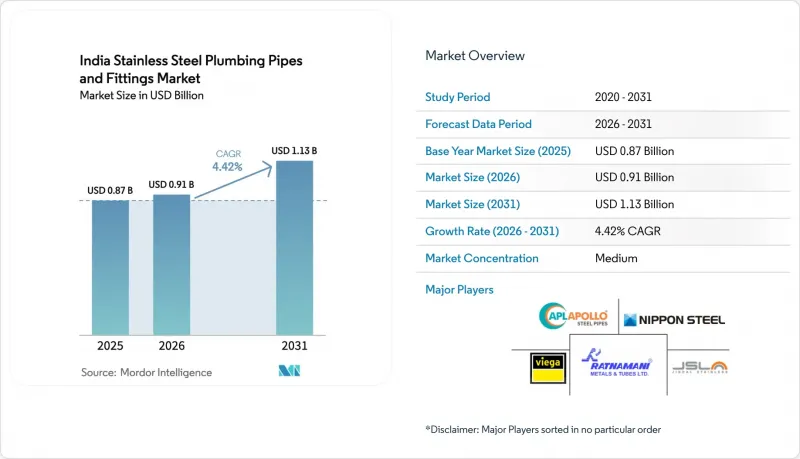
據 Mordor Intelligence 稱,印度不銹鋼管道和配件市場預計到 2026 年價值 9.1 億美元,高於 2025 年的 8.7 億美元,預計到 2031 年將達到 11.3 億美元。
預計 2026 年至 2031 年的複合年成長率為 4.42%。
本報告按類型(無縫、焊接、製造)、市場結構(有組織的市場和無組織的市場)、直徑(50毫米或更小和50毫米或更大)、銷售管道(零售、電子商務等)、應用(飲用水供應、污水和排水、噴灌和消防栓、其他)以及最終用戶行業(住宅和非住宅)進行細分。
印度不銹鋼管道和管件市場趨勢及洞察。
快速的都市化與智慧城市的發展
在150億美元的國家計畫下,智慧城市計劃將近四分之一的預算用於供水系統的維修。負責人目前正指定在都市區管道系統中採用不銹鋼管,預計使用壽命超過10年。原因是這種合金可以減少電磁干擾,並保障物聯網水錶的精確度。普納和蘇拉特已經強制規定直徑150毫米及以上的主管道必須使用不銹鋼管,這項採購先例正被其他私人開發商效仿。預計到2030年,印度的城市人口將以每年2.3%的速度成長,因此,印度不銹鋼管道和配件市場預計將持續受到新興城區和衛星城現有城區維修的需求。建商也強調了這種合金的耐火性能,指出這有助於提高保險評級,並增加專案的可行性。
大規模房地產和基礎設施項目激增。
2024年商業房地產投資額達57億美元,此外,總額達1.4兆美元的「國家基礎設施管道」計畫中,16%的資金將用於用水和污水基礎建設。目前,開發商已在超過500個專案中採用不銹鋼作為標準配置,因為與鍍鋅鋼相比,不銹鋼在整個生命週期中可節省一半的維護成本。 LEED和GRIHA認證對材料耐久性的評估要求進一步推動了這一趨勢。因此,預計到2028年,隨著高層建築和工業園區的建設,印度不銹鋼管道和配件市場將迎來可預測的穩定需求。
低成本PVC/PEX替代品的威脅
PVC和PEX系統因其初始成本比不銹鋼低50%之多,正吸引注重預算的住宅選擇塑膠製品。領先的PVC製造商透過延長保固期和以舊換新計劃,預計2024年銷量將成長12%。此外,高柔軟性的PEX管道可將安裝時間縮短30%,使其成為工期緊張的承包商的理想選擇。雖然行銷宣傳活動強調了PEX的耐腐蝕性,但卻很少提及PEX的最高工作溫度為65 度C,以及其易受紫外線照射的特性。
細分市場分析
2025年,焊接管材佔了54.85%的市場佔有率,這主要得益於其標準化的尺寸,而這種尺寸在大型住宅開發案中備受青睞。同時,預計到2031年,加工管材的複合年成長率將達到4.93%,因為建築師在複雜的暖通空調(HVAC)和消防系統中對客製化立管的需求日益成長。在印度的不銹鋼管道和管件市場中,無縫管材的市場規模仍然較小,但它們已在燃氣和高壓管道系統中佔據了高階市場,因為這些系統對缺陷的容忍度極低。
規模經濟有利於焊接產品的生產。金達爾不銹鋼公司計劃在2024年將其焊接產品產能提高40%,以滿足經濟適用住宅建造商對直徑15-50毫米產品的需求。同時,加工商也透過提供現場規格的管段來滿足這項需求,從而最大限度地減少維修中的安裝錯誤。所有產品均需獲得BIS認證,但由於預製組件需要逐個部件進行測試,因此核准週期較長,但這確保了可追溯的質量,而這正是承包商所重視的。
到2025年,正規生產商將佔銷售額的59.65%,預計到2031年,其佔有率將以4.55%的複合年成長率成長,因為商品和服務稅(GST)的實施將縮小正規生產商與非正規部門之間的價格差距。長期鎳合約可以減輕價格波動的影響,使專案預算更加穩定,並增強品牌信心。在印度不銹鋼管道和管件市場,非正規部門的市場規模正在萎縮。這是因為買家越來越重視保固服務,而正規品牌能夠輕鬆提供這項服務。
Quality Stainless作為一家中型企業,憑藉其在高階品牌和規模較小的本地製造商之間的市場定位,取得了成功。這家組織完善的公司也利用數位化產品目錄和工程師熱線,幫助承包商理解複雜的合金等級表。隨著印度標準局(BIS)強制執行的工廠審核日益嚴格,進入門檻不斷上升,產業整合也正在加速。
其他好處:
- Excel格式的市場預測(ME)表
- 3個月的分析師支持
目錄
第1章:引言
- 研究假設和市場定義
- 調查範圍
第2章:調查方法
第3章執行摘要
第4章 市場狀況
- 市場概覽
- 市場促進因素
- 快速的都市化與智慧城市的發展
- 大規模房地產和基礎設施項目激增。
- 優異的耐腐蝕性和耐熱性
- 強制使用無鉛管(Jal Jeevan Mission)
- 高層建築消防安全標準合規性的需求
- 住宿設施中的衛生型太陽能熱水系統
- 市場限制因素
- 以低成本PVC/PEX取代存在的風險
- 鎳價波動推高了不銹鋼的價格。
- 二、三線城市安裝人員技能差距
- 鉬進口和供應風險
- 價值鏈分析
- 波特五力模型
第5章 市場規模與成長預測
- 按類型
- 無縫的
- 焊接型
- 加工產品
- 按市場結構
- 有組織的市場
- 非正規市場
- 依直徑
- 50毫米或更小(小直徑)
- 50-100毫米(中等直徑)
- 100毫米或以上(大直徑)
- 按銷售管道
- 零售
- 電子商務
- 直接機構/B2B
- 透過使用
- 飲用水供應
- 污水和排水
- 噴灌和消防栓
- 瓦斯和燃料管線
- 暖通空調和冷凍水
- 按最終用戶行業分類
- 住宅
- 非住宅
第6章 競爭情勢
- 市場集中度
- 策略趨勢
- 市佔率和排名分析
- 公司簡介
- APL Apollo
- Finolex Industries Ltd.
- Geberit Plumbing Technology India Private Limited
- Jindal Stainless Ltd
- Kobs India Pipe
- Lanco Pipes & Fittings
- Maharashtra Seamless Ltd
- NeoNickel
- Nippon Steel Corporation
- Outokumpu
- Ratnamani Metals & Tubes Limited
- Ravindra Tubes(P)Limited.
- Sachiya Steel International
- Sandvik Materials Technology
- Steel Tubes India
- Tata Steel
- TubeFit Engineers
- Umiyatubes Private Limited
- Viega India Private Limited
- Vishal Steel India
- Zenith Stainless Solutions.
第7章 市場機會與未來展望
According to Mordor Intelligence, the India stainless steel plumbing pipes and Fittings Market size in 2026 is estimated at USD 0.91 billion, growing from 2025 value of USD 0.87 billion with 2031 projections showing USD 1.13 billion, growing at 4.42% CAGR over 2026-2031.
This report is Segmented by Type (Seamless, Welded, and Fabricated), Market Structure (Organised and Unorganised), Diameter (Less Than or Equal To 50mm and More), Sales Channel (Retail, E-Commerce, and More), Application (Potable Water Supply, Waste-Water and Drainage, Fire-Sprinkler and Hydrant, and More), and End-User Industry (Residential and Non-Residential).
India Stainless Steel Plumbing Pipes And Fittings Market Trends and Insights
Rapid Urbanization and Smart-City Roll-Outs
Smart-city blueprints funded under the USD 15 billion national mission allocate nearly one-quarter of budgets to water supply upgrades. Planners now specify stainless steel piping for municipal loops longer than 10 years, citing the alloy's low electromagnetic interference that safeguards IoT meter accuracy. Pune and Surat have already mandated stainless steel mains above 150 mm, setting procurement precedents that private developers replicate. With India's urban population swelling at 2.3% annually to 2030, the India stainless steel plumbing pipes and fittings market stands to capture recurring demand from both new districts and brownfield retrofits in satellite towns. Contractors further highlight the alloy's fire-safety credentials, linking it with higher insurance ratings that improve project viability.
Surge in Large Real-Estate and Infrastructure Projects
Commercial real-estate investment touched USD 5.7 billion in 2024, complemented by a USD 1.4 trillion National Infrastructure Pipeline earmarking 16% for water and sanitation. Developers now preset stainless steel for projects exceeding 500 units because it halves lifetime maintenance outlays versus galvanized iron. LEED and GRIHA certification matrices, which weigh material durability, further amplify this preference. The India stainless steel plumbing pipes and fittings market therefore gains predictable volume from high-rise clusters and industrial parks scheduled through 2028.
Low-Cost PVC/PEX Substitution Threat
PVC and PEX systems undercut stainless steel by as much as 50% on upfront cost, drawing budget-constrained homeowners toward plastic. Organized PVC producers expanded 2024 sales by 12% through extended warranties and trade-in schemes. Flexible PEX lines also reduce labor time by 30%, tempting contractors on tight schedules. Marketing campaigns accentuate corrosion immunity but seldom mention PEX's 65 °C service-temperature ceiling or UV vulnerability.
Other drivers and restraints analyzed in the detailed report include:
- Superior Corrosion and Temperature Resistance
- Mandatory Lead-Free Plumbing (Jal Jeevan Mission)
- Nickel-Price Volatility Inflates Stainless Steel Costs
For complete list of drivers and restraints, kindly check the Table Of Contents.
Segment Analysis
Welded pipes held 54.85% of 2025 value thanks to standardized dimensions preferred in mass-housing blocks. Fabricated lines are poised for a 4.93% CAGR to 2031 as architects demand bespoke risers in complex HVAC and fire-safety grids. The India stainless steel plumbing pipes and fittings market size for seamless pipes remains smaller but commands premium pricing in gas and high-pressure loops where zero defects are non-negotiable.
Scaling economics favor welded production: Jindal Stainless lifted welded capacity by 40% in 2024 to serve affordable-housing builders aiming for 15-50 mm diameters. Fabrication houses compensate by offering site-specific spools that minimize fit-up errors during retrofits. While BIS certificates apply to all, fabricated assemblies need part-wise testing, extending approval cycles but ensuring traceable quality that contractors welcome.
Organized manufacturers owned 59.65% revenue in 2025, and their share is expanding at a 4.55% CAGR to 2031 as GST compliance erodes informal-sector price gaps. Their long-term nickel contracts buffer price shocks, allowing steadier project quotes and reinforcing brand trust. The India stainless steel plumbing pipes and fittings market size in the unorganized tier is shrinking as buyers weigh warranty coverage, which organized labels readily provide.
Quality Stainless exemplifies mid-tier success by occupying the space between high-end brands and untested local fabricators. Organized firms further leverage digital catalogs and engineer hotlines, helping contractors navigate complex alloy-grade charts. As BIS tightens plant audits, entry costs climb, accelerating consolidation.
Complete Report Scope:
- By Type
- Seamless
- Welded
- Fabricated
- By Market Structure
- Organised
- Unorganised
- By Diameter
- Less than or equal to 50 mm (Small-Bore)
- 50-100 mm (Medium)
- More than 100 mm (Large-Bore)
- By Sales Channel
- Retail
- E-commerce
- Direct Institutional/B2B
- By Application
- Potable Water Supply
- Waste-water and Drainage
- Fire-sprinkler and Hydrant
- Gas and Fuel Lines
- HVAC and Chilled Water
- By End-User Industry
- Residential
- Non-Residential
List of Companies Covered in this Report:
- APL Apollo
- Finolex Industries Ltd.
- Geberit Plumbing Technology India Private Limited
- Jindal Stainless Ltd
- Kobs India Pipe
- Lanco Pipes & Fittings
- Maharashtra Seamless Ltd
- NeoNickel
- Nippon Steel Corporation
- Outokumpu
- Ratnamani Metals & Tubes Limited
- Ravindra Tubes (P) Limited.
- Sachiya Steel International
- Sandvik Materials Technology
- Steel Tubes India
- Tata Steel
- TubeFit Engineers
- Umiyatubes Private Limited
- Viega India Private Limited
- Vishal Steel India
- Zenith Stainless Solutions.
Additional Benefits:
- The market estimate (ME) sheet in Excel format
- 3 months of analyst support
TABLE OF CONTENTS
1 Introduction
- 1.1 Study Assumptions and Market Definition
- 1.2 Scope of the Study
2 Research Methodology
3 Executive Summary
4 Market Landscape
- 4.1 Market Overview
- 4.2 Market Drivers
- 4.2.1 Rapid urbanisation and smart-city roll-outs
- 4.2.2 Surge in large real-estate and infra projects
- 4.2.3 Superior corrosion and temperature resistance
- 4.2.4 Mandatory lead-free plumbing (Jal Jeevan Mission)
- 4.2.5 High-rise fire-safety compliance demand
- 4.2.6 Hygienic solar-water systems in hospitality
- 4.3 Market Restraints
- 4.3.1 Low-cost PVC/PEX substitution threat
- 4.3.2 Nickel-price volatility inflates SS costs
- 4.3.3 Installer skill-gap in Tier-2/3 cities
- 4.3.4 Molybdenum import-supply risk
- 4.4 Value Chain Analysis
- 4.5 Porter's Five Forces
- 4.5.1 Bargaining Power of Suppliers
- 4.5.2 Bargaining Power of Buyers
- 4.5.3 Threat of New Entrants
- 4.5.4 Threat of Substitutes
- 4.5.5 Degree of Competition
5 Market Size and Growth Forecasts (Value)
- 5.1 By Type
- 5.1.1 Seamless
- 5.1.2 Welded
- 5.1.3 Fabricated
- 5.2 By Market Structure
- 5.2.1 Organised
- 5.2.2 Unorganised
- 5.3 By Diameter
- 5.3.1 Less than or equal to 50 mm (Small-Bore)
- 5.3.2 50-100 mm (Medium)
- 5.3.3 More than 100 mm (Large-Bore)
- 5.4 By Sales Channel
- 5.4.1 Retail
- 5.4.2 E-commerce
- 5.4.3 Direct Institutional/B2B
- 5.5 By Application
- 5.5.1 Potable Water Supply
- 5.5.2 Waste-water and Drainage
- 5.5.3 Fire-sprinkler and Hydrant
- 5.5.4 Gas and Fuel Lines
- 5.5.5 HVAC and Chilled Water
- 5.6 By End-User Industry
- 5.6.1 Residential
- 5.6.2 Non-Residential
6 Competitive Landscape
- 6.1 Market Concentration
- 6.2 Strategic Moves
- 6.3 Market Share/Ranking Analysis
- 6.4 Company Profiles (includes Global level Overview, Market level overview, Core Segments, Financials as available, Strategic Information, Market Rank/Share for key companies, Products and Services, and Recent Developments)
- 6.4.1 APL Apollo
- 6.4.2 Finolex Industries Ltd.
- 6.4.3 Geberit Plumbing Technology India Private Limited
- 6.4.4 Jindal Stainless Ltd
- 6.4.5 Kobs India Pipe
- 6.4.6 Lanco Pipes & Fittings
- 6.4.7 Maharashtra Seamless Ltd
- 6.4.8 NeoNickel
- 6.4.9 Nippon Steel Corporation
- 6.4.10 Outokumpu
- 6.4.11 Ratnamani Metals & Tubes Limited
- 6.4.12 Ravindra Tubes (P) Limited.
- 6.4.13 Sachiya Steel International
- 6.4.14 Sandvik Materials Technology
- 6.4.15 Steel Tubes India
- 6.4.16 Tata Steel
- 6.4.17 TubeFit Engineers
- 6.4.18 Umiyatubes Private Limited
- 6.4.19 Viega India Private Limited
- 6.4.20 Vishal Steel India
- 6.4.21 Zenith Stainless Solutions.
7 Market Opportunities and Future Outlook
- 7.1 White-space and Unmet-Need Assessment

 非金屬管道市場:依產品類型、應用、設備類型、最終用戶、國家及地區分類-全球產業分析、市場規模、市場佔有率及2026年至2033年預測。混凝土管材市場報告:趨勢、預測和競爭分析(至2035年)
 現場固化工法市場:依樹脂種類、纖維種類、固化方法、編織方式、塗層方法及地區分類。
 聚烯管道市場:全球市場預測(2026-2032)
 2026年全球鋁管市場報告
 波紋管:市場佔有率分析、產業趨勢與統計、成長預測(2026-2031)2026年全球現場固化工法(CIPP)襯裡市場報告
 管架和管支撐器具市場規模、佔有率和成長分析:按結構類型、材質、承載能力、應用和地區分類-2026年至2033年產業預測
 2026-2030年全球PPR管材市場PPR管材生產線市場:依管徑範圍、壁厚等級、製造流程、連接類型、自動化程度、應用、最終用戶分類,全球預測,2026-2032年