


 |
市場調查報告書
商品編碼
2163390
3D列印氣體:市場佔有率分析、產業趨勢與統計資料、成長預測(2026-2031年)3D Printing Gases - Market Share Analysis, Industry Trends & Statistics, Growth Forecasts (2026 - 2031) |
||||||

※ 本網頁內容可能與最新版本有所差異。詳細情況請與我們聯繫。
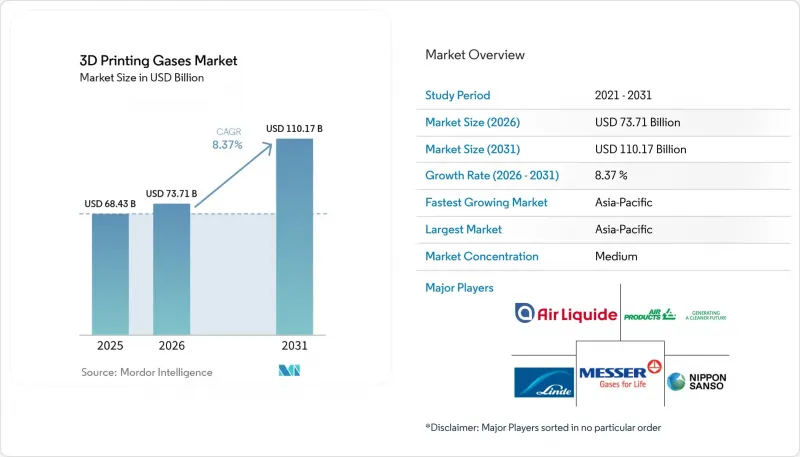
據 Mordor Intelligence 稱,2025 年 3D 列印氣體市值為 684.3 億美元,預計到 2031 年將達到 1101.7 億美元,而 2026 年為 737.1 億美元,預測期(2026-2031 年)的複合年成長率為 8.37%。
全球3D列印氣體市場趨勢與洞察
金屬積層製造的產業化
隨著金屬積層製造技術從小批量原型製作發展到認證的大規模生產,3D列印氣體市場也從中受益。生產設施需要持續供應氬氣和氮氣,長期合約比基於專案的氣瓶採購更為常見。氣體需求不僅限於列印腔,還包括粉末處理、腔體循環控制、熱處理和回收系統。與僅使用列印腔容量相比,這些需求會使氣體用量增加三到五倍。多雷射粉末層熔融平台也加劇了這一需求,因為更大的系統需要在更廣闊的列印區域內保持穩定均勻的氣流。隨著系統從單雷射和雙雷射系統擴展到12雷射系統,以及目前正在開發的大規模配置,即時大氣監測和氣體回收系統的重要性也日益凸顯。
航太領域的認證要求和減重要求
航太領域的認證要求正在推動3D列印氣體市場對高規格氣體的持續需求。 NADCAP於2025年修訂了金屬粉末層熔融(AC7131/1)和定向能量沉積(AC7131/2)標準,擴展了積層製造的框架。這些要求涵蓋氣體管理、粉末採購和人員資質,其中大氣管理成為航太生產的可審核要素。生產活性合金零件的供應商必須在其專案進入批量生產階段之前,證明其擁有嚴格的氣體處理程序。即使替代氣體價格更低,這也使得更改氬氣規格變得困難。 2026年中期,將有超過100家粉末層熔融設備在此框架下完成審核,認證供應商遍佈北美、歐洲、台灣、沙烏地阿拉伯和印度。
高純度氣體基礎設施高成本
高純度氣體基礎設施的成本是小規模積層製造企業進入3D列印氣體市場的一大障礙。金屬的大規模生產需要低溫氬氣物流、氮氣變壓式吸附(PSA)或膜分離系統、高度氣密的管道以及能夠在氧氣濃度低於100 ppm的條件下運作的腔室。擁有少於10台金屬3D列印機的製造商通常依賴外送氬氣鋼瓶,這比批量供應或現場生產成本更高。這種成本結構限制了他們簽訂長期供應合約的能力,並隨著產量的增加而降低營運利潤率。在南美和中東及非洲(MEA)地區,這種限制尤其突出,因為這些地區的液氬物流和高壓發行網路尚不完善。製程氣體專業知識的匱乏會進一步加劇這個問題,因為小規模公司可能缺乏必要的人員來設計、操作和檢驗複雜的氣體氣氛控制系統。
細分市場分析
2025年,氬氣在3D列印氣體市場中佔據45.35%的佔有率。這一地位主要歸功於氬氣與鈦、鎳基高溫合金以及鈷鉻合金在粉末層熔融成型中的結合使用,因為微量的氮會在這些材料中形成夾雜物,從而可能降低其疲勞性能。在航太計畫中,氬氣通常被指定用於在受控品質系統下製造活性合金。這些要求確保了氬氣規格的穩定性,儘管氮氣的單位價格比氬氣便宜30%至40%。混合氣體仍然是市場佔有率最小的類別,但在電弧直接能量沉積(HAD)領域正日益受到關注。一項2025年針對使用Inconel 718合金進行電弧積層製造的研究發現,R7組分(2%氫氣和氬氣的混合氣體)在輪胎邊緣形狀和缺陷控制方面優於單一氣體方案。
氮氣是成長最快的氣體組成,預計到2031年將以9.14%的複合年成長率成長。氮氣因其低惰性而不影響材料性能,常用於不銹鋼、工具鋼和鋁基複合材料等應用領域。在3D列印氣體市場,氮氣用於粉末霧化工藝,其特性有助於提高工業原料生產的經濟效益。一項針對K340工具鋼的研究發現,與氬氣霧化粉末相比,氮氣霧化粉末的流動性提高了20%,且枝晶臂間距更細。採用變壓式吸附(PSA)和膜分離系統進行現場製氮,與鋼瓶供氣相比,每立方米氮氣的成本可降低60%至70%。 2026年8月,梅塞爾公司在中國東部運作了一座高純度氮氣供給能力50,000立方公尺/小時,服務先進製造業客戶。這表明,梅塞爾公司正在開發適用於特定應用的氮氣供應規模。
到2025年,隔熱應用將佔3D列印氣體市場總值的42.83%,成為該市場最大的應用領域。此類別包括吹掃成型腔、覆蓋粉末床以及在成型過程中維持氣氛。這些製程在金屬積層製造中至關重要,因為暴露於氧氣會降低粉末和零件的品質。可控制的氮氣氣氛也有助於控制室溫下黏著劑噴塗成型過程中的表面氧化。 「輻照」是最小的功能類別,涵蓋立體光刻技術和紫外光固化光敏聚合物(例如PolyJet)應用中的氮氣覆蓋。其他類別包括載氣在定向能量沉積、送絲和粉末輸送中的作用。
冷卻是成長最快的功能,預計到2031年複合年成長率將達到9.45%。多雷射粉末層熔融系統和高功率定向能量沉積平台在製造過程的每個階段都會產生更大的熱負荷。控制氮氣和氬氣的流量有助於降低殘餘應力、抑制熱變形並縮短層間循環時間。空氣產品公司指出,控制冷卻氣流對於金屬加工的尺寸精度至關重要,因為熱梯度會影響機械性能。雖然氦氣的高導熱性並不一定能直接轉化為雷射粉末層熔融中零件的冷卻效果,但美國能源局的研究表明,氦氣可以降低能量吸收和匙孔孔隙率,這支持了更有針對性地選擇氣體混合物的方法。
區域分析
到2025年,亞太地區將佔據3D列印氣體市場55.62%的佔有率,預計到2031年將以9.51%的最高複合年成長率成長。這一區域地位得益於中國、日本、印度和其他製造地的積層製造活動。 2025年8月,日本太陽日酸株式會社(Taiyo Nippon Sanso)被新能源產業技術綜合開發機構(NEDO)選中,參與一項為期五年的項目,該項目將燒結積層製造與數位化製程設計相結合。該計畫於2024會計年度至2028會計年度實施,其中包括與Yamaha Motor Co, Ltd.、三菱材料和九州大學合作開發的「3DPro」氣體解決方案。 2026年8月,梅塞爾股份公司(Messer AG)在中國東部運作了一座年產5萬標準立方公尺的高純度氮氣生產設施,以服務電子和先進製造業的客戶。這些發展反映出東北亞和東協製造業走廊正在向更大規模、更長期的天然氣供應合約轉變。
北美是全球第二大3D列印氣體市場。這一地位得益於美國航太和國防工業密集的供應鏈以及不斷擴大的國內粉末生產設施。 2026年6月,Amaero公司在田納西州運作了第三台電極感應熔融氣體霧化(EIGA)霧化器,使其鈦合金粉末年產能提升至480噸。該公司計劃於2027年第一季運作一座氬氣回收廠,目標是將每公斤氬氣的成本降低80%。隨著汽車和航太供應商在北美原始設備製造商(OEM)附近建立積層製造能力,加拿大和墨西哥正在發展成為重要的二級樞紐。這推動了該地區對穩定供應氬氣和氮氣以及專業粉末加工支援的需求。
歐洲仍然是重要的區域市場,德國在汽車和航太領域擁有大規模積層製造設施。液化空氣集團為整個積層製造流程提供氮氣、氬氣和氦氣,包括霧化、儲存、成型室惰性和後處理。 2026年6月,SSAB宣布其位於奧克瑟松德的工廠將於2028年第一季實現積層製造級鋼粉年產能350噸。這將為北歐上游應用領域對氬氣和氮氣的需求增加新的來源。南美洲以及中東和非洲(MEA)是規模較小但正在發展中的3D列印氣體市場。巴西的工業生產設施、海灣合作理事會國家的航太計畫以及南非的醫療設備企業都在創造需求,但目前尚不完善的散裝氣體基礎設施仍然限制了短期內的應用。
其他好處:
- Excel格式的市場預測(ME)表
- 3個月的分析師支持
目錄
第1章:引言
- 研究假設和市場定義
- 調查範圍
第2章:調查方法
第3章執行摘要
第4章 市場狀況
- 市場概覽
- 市場促進因素
- 金屬積層製造的產業化
- 航太領域的認證要求和減重要求
- 粉末噴塗技術的推廣與原料生產的擴大
- 對病患專用醫療組件的需求日益成長
- 即時大氣監測和氣體回收系統
- 市場限制因素
- 高純度氣體基礎設施高成本
- 氦氣和特種氣體的供應和價格波動
- 中小製造商缺乏製程氣體方面的專業知識
- 價值鏈分析
- 波特五力分析
第5章 市場規模與成長預測
- 氣體類型
- 氬氣
- 氮
- 氣體混合物
- 按功能
- 隔熱材料
- 冷卻
- 照明
- 其他
- 透過技術
- 立體光刻技術
- 雷射燒結
- 黏著劑噴塗成型
- PolyJet
- 其他
- 按最終用戶行業分類
- 航太/國防
- 車
- 衛生保健
- 工業製造
- 消費品
- 其他
- 按地區
- 亞太地區
- 中國
- 印度
- 日本
- 韓國
- 東南亞國協
- 其他亞太國家
- 北美洲
- 美國
- 加拿大
- 墨西哥
- 歐洲
- 德國
- 英國
- 法國
- 義大利
- 北歐國家
- 其他歐洲國家
- 南美洲
- 巴西
- 阿根廷
- 其他南美國家
- 中東和非洲
- 沙烏地阿拉伯
- 南非
- 其他中東和非洲國家
- 亞太地區
第6章 競爭情勢
- 市場集中度
- 策略趨勢
- 市佔率和排名分析
- 公司簡介
- Air Liquide
- Air Products and Chemicals, Inc.
- Airgas
- Atlas Copco Group
- Ellenbarrie Industrial Gases Limited
- Gulfcryo
- Iwatani Corporation
- Kaimeite Gases Co., Ltd.
- Linde PLC
- Messer SE & Co. KGaA
- Nippon Sanso Holdings Corporation
- Norco Industries, Inc.
- Rotarex
- SOL Spa
- Universal Industrial Gases, LLC
- Yingde Gases Group Company Limited
第7章 市場機會與未來展望
According to Mordor Intelligence, the 3D printing gases market size was valued at USD 68.43 billion in 2025 and is estimated to grow from USD 73.71 billion in 2026 to reach USD 110.17 billion by 2031, at a CAGR of 8.37% during the forecast period (2026-2031).
Global 3D Printing Gases Market Trends and Insights
Industrialization of Metal Additive Manufacturing
The 3D printing gases market benefits as metal additive manufacturing transitions from low-volume prototyping to certified serial production. Production facilities require a continuous supply of argon and nitrogen, often under long-term contracts rather than project-based cylinder purchases. Gas demand extends beyond the build chamber to powder handling, chamber cycling, thermal processing, and recovery systems. These requirements can multiply gas use by 3X to 5X relative to build chamber capacity alone. Multi-laser powder bed fusion platforms contribute to this demand, as larger machines require stable, uniform gas flow across wider build areas. The expansion from single- and dual-laser systems to 12-laser systems, with larger configurations under development, also increases the value of real-time atmospheric monitoring and gas-recovery equipment.
Aerospace Qualification and Lightweighting Requirements
Aerospace qualification requirements create a sustained need for high-specification gases in the 3D printing gases market. NADCAP expanded its additive manufacturing framework in 2025 through revised criteria for metallic powder bed fusion (AC7131/1) and directed energy deposition (AC7131/2). These requirements cover gas management, powder purchasing, and personnel qualification, making atmospheric control an auditable part of aerospace production. Suppliers producing reactive alloy parts must demonstrate disciplined gas handling before programs move into serial production. This can make it difficult to change argon specifications, even when alternative gases offer lower unit costs. More than 100 powder bed fusion audits were completed under the framework by mid-2026, with accredited suppliers across North America, Europe, Taiwan, Saudi Arabia, and India.
High Cost of High-Purity Gas Infrastructure
The cost of high-purity gas infrastructure limits smaller additive manufacturers' participation in the 3D printing gases market. Serial metal production requires cryogenic argon logistics, nitrogen pressure swing adsorption or membrane systems, leak-tight piping, and chambers capable of operating at oxygen levels below 100 parts per million (ppm). Manufacturers with fewer than 10 metal printers often depend on delivered argon cylinders, which cost more per unit than bulk supply or on-site generation. This cost structure limits their ability to enter long-term supply arrangements and reduces operating margins at higher production output. The constraint is most pronounced in South America and MEA, where bulk liquid argon logistics and high-pressure distribution networks are less developed. Limited process-gas expertise can compound the problem, as smaller firms may lack the personnel needed to specify, operate, and validate complex atmospheric systems.
Other drivers and restraints analyzed in the detailed report include:
- Expansion of Powder Atomization and Feedstock Production
- Rising Demand for Patient-Specific Medical Components
- Supply and Price Volatility of Helium and Specialty Gases
For complete list of drivers and restraints, kindly check the Table Of Contents.
Segment Analysis
Argon held 45.35% of the 3D printing gases market in 2025. Its position reflects its use with titanium, nickel superalloys, and cobalt-chrome in powder bed fusion, where trace nitrogen can form inclusions that reduce fatigue performance. Aerospace programs commonly specify argon for reactive alloy builds under controlled quality systems. These requirements create a degree of specification continuity for argon, even where nitrogen costs 30% to 40% less per unit. Gas mixtures remain the smallest category, but they are gaining interest in wire-arc directed energy deposition. A 2025 study of Inconel 718 wire-arc additive manufacturing found that an R7 composition of 2% hydrogen with argon performed better than single-gas options for bead geometry and defect control.
Nitrogen is the fastest-growing gas type, with a projected CAGR of 9.14% through 2031. It is used where its lower inertness does not compromise material performance, including stainless steel, tool steel, and aluminum composite applications. The 3D printing gases market also uses nitrogen in powder atomization, where its properties can improve the economics of industrial feedstock production. Research on K340 tool steel found that nitrogen-atomized powder had 20% better flowability than argon-atomized powder and exhibited finer dendrite arm spacing. On-site nitrogen generation through pressure swing adsorption or membrane systems can lower the cost per Nm3 by 60% to 70% compared with delivered cylinder supply. Messer commissioned a facility in East China in August 2026 with 50,000 Nm3/h of high-purity nitrogen supply capacity for advanced manufacturing customers, illustrating the scale of supply being developed for compatible uses.
Insulation held 42.83% of the market value in 2025, making it the leading function in the 3D printing gases market. The category includes build chamber purging, powder-bed blanketing, and atmosphere maintenance during printing. These steps are central to metal additive manufacturing because oxygen exposure can damage powder and part quality. Controlled nitrogen atmospheres also support surface oxidation control during binder jetting at ambient temperature. Illumination is the smallest function, covering nitrogen blanketing in UV-curing photopolymer applications such as stereolithography and PolyJet. The other category includes carrier-gas roles in directed energy deposition, wire feeds, and powder conveying.
Cooling is the fastest-growing function, with a projected CAGR of 9.45% through 2031. Multi-laser laser powder bed fusion systems and high-power directed energy deposition platforms create greater thermal loads during each build. Controlled nitrogen and argon flows help reduce residual stress, limit thermal distortion, and shorten inter-layer cycle times. Air Products identifies controlled cooling flows as important for dimensional accuracy in metallic builds because thermal gradients affect mechanical properties. Helium's high thermal conductivity does not necessarily translate into direct cooling of printed parts in laser powder bed fusion. A Department of Energy study instead points to reduced energy absorption and lower keyhole porosity, which supports a more targeted approach to gas-mixture selection.
Complete Report Scope:
- By Gas
- Argon
- Nitrogen
- Gas Mixtures
- By Function
- Insulation
- Cooling
- Illumination
- Others
- By Technology
- Stereolithography
- Laser Sintering
- Binder Jetting
- PolyJet
- Others
- By End-User Industry
- Aerospace and Defense
- Automotive
- Healthcare
- Industrial Manufacturing
- Consumer Products
- Others
- By Geography
- Asia-Pacific
- China
- India
- Japan
- South Korea
- ASEAN Countries
- Rest of Asia-Pacific
- North America
- United States
- Canada
- Mexico
- Europe
- Germany
- United Kingdom
- France
- Italy
- NORDIC Countries
- Rest of Europe
- South America
- Brazil
- Argentina
- Rest of South America
- Middle East and Africa
- Saudi Arabia
- South Africa
- Rest of Middle East and Africa
- Asia-Pacific
Geography Analysis
Asia-Pacific accounted for 55.62% of the 3D printing gases market in 2025 and is expected to record the highest regional CAGR of 9.51% through 2031. The region's position is driven by additive manufacturing activity in China, Japan, India, and other manufacturing centers. In August 2025, Japan's Taiyo Nippon Sanso was selected for a five-year New Energy and Industrial Technology Development Organization (NEDO) project combining sinter-based additive manufacturing and digital process design. The project runs from FY2024 through FY2028 and includes 3DPro gas solutions with Yamaha Motor, Mitsubishi Materials, and Kyushu University. In August 2026, Messer commissioned a 50,000 Nm3/h high-purity nitrogen facility in East China to serve customers in the electronics and advanced manufacturing sectors. These developments reflect a shift toward larger, longer-term gas supply arrangements across Northeast Asia and ASEAN manufacturing corridors.
North America is the second-largest regional market for 3D printing gases. A dense US aerospace and defense supply chain and a growing domestic powder production base support its position. In June 2026, Amaero commissioned its third Electrode Induction-melting Gas Atomization (EIGA) atomizer in Tennessee, expanding titanium alloy powder capacity to 480 tons per year. The company plans to commission an argon recycling plant in Q1 2027, designed to reduce the cost per kilogram of argon by 80%. Canada and Mexico are growing secondary locations as automotive and aerospace suppliers build additive manufacturing capacity near North American original equipment manufacturers. This is increasing regional demand for reliable supplies of argon and nitrogen, as well as specialized powder-processing support.
Europe remains a significant regional market, with Germany maintaining a large automotive and aerospace additive manufacturing base. Air Liquide supplies nitrogen, argon, and helium across the additive manufacturing workflow, including atomization, storage, build-chamber inerting, and post-processing. In June 2026, SSAB announced that its Oxelosund facility will reach 350 tons per year of additive manufacturing-grade steel powder in Q1 2028, adding a new demand point for upstream use of argon and nitrogen in Northern Europe. South America, the Middle East, and Africa (MEA) are smaller but developing markets for 3D printing gases. Brazil's industrial manufacturing base, GCC aerospace programs, and South Africa's medical device activity are generating demand, while underdeveloped bulk gas infrastructure continues to limit near-term adoption.
- Air Liquide
- Air Products and Chemicals, Inc.
- Airgas
- Atlas Copco Group
- Ellenbarrie Industrial Gases Limited
- Gulfcryo
- Iwatani Corporation
- Kaimeite Gases Co., Ltd.
- Linde PLC
- Messer SE & Co. KGaA
- Nippon Sanso Holdings Corporation
- Norco Industries, Inc.
- Rotarex
- SOL Spa
- Universal Industrial Gases, LLC
- Yingde Gases Group Company Limited
Additional Benefits:
- The market estimate (ME) sheet in Excel format
- 3 months of analyst support
TABLE OF CONTENTS
1 Introduction
- 1.1 Study Assumptions and Market Definition
- 1.2 Scope of the Study
2 Research Methodology
3 Executive Summary
4 Market Landscape
- 4.1 Market Overview
- 4.2 Market Drivers
- 4.2.1 Industrialization of Metal Additive Manufacturing
- 4.2.2 Aerospace Qualification and Lightweighting Requirements
- 4.2.3 Expansion of Powder Atomization and Feedstock Production
- 4.2.4 Rising Demand for Patient-Specific Medical Components
- 4.2.5 Real-Time Atmosphere Monitoring and Gas-Recovery Systems
- 4.3 Market Restraints
- 4.3.1 High Cost of High-Purity Gas Infrastructure
- 4.3.2 Supply and Price Volatility of Helium and Specialty Gases
- 4.3.3 Limited Process-Gas Expertise Among Smaller Manufacturers
- 4.4 Value Chain Analysis
- 4.5 Porter's Five Forces Analysis
- 4.5.1 Bargaining Power of Suppliers
- 4.5.2 Bargaining Power of Buyers
- 4.5.3 Threat of New Entrants
- 4.5.4 Threat of Substitutes
- 4.5.5 Competitive Rivalry
5 Market Size and Growth Forecasts (Value)
- 5.1 By Gas
- 5.1.1 Argon
- 5.1.2 Nitrogen
- 5.1.3 Gas Mixtures
- 5.2 By Function
- 5.2.1 Insulation
- 5.2.2 Cooling
- 5.2.3 Illumination
- 5.2.4 Others
- 5.3 By Technology
- 5.3.1 Stereolithography
- 5.3.2 Laser Sintering
- 5.3.3 Binder Jetting
- 5.3.4 PolyJet
- 5.3.5 Others
- 5.4 By End-User Industry
- 5.4.1 Aerospace and Defense
- 5.4.2 Automotive
- 5.4.3 Healthcare
- 5.4.4 Industrial Manufacturing
- 5.4.5 Consumer Products
- 5.4.6 Others
- 5.5 By Geography
- 5.5.1 Asia-Pacific
- 5.5.1.1 China
- 5.5.1.2 India
- 5.5.1.3 Japan
- 5.5.1.4 South Korea
- 5.5.1.5 ASEAN Countries
- 5.5.1.6 Rest of Asia-Pacific
- 5.5.2 North America
- 5.5.2.1 United States
- 5.5.2.2 Canada
- 5.5.2.3 Mexico
- 5.5.3 Europe
- 5.5.3.1 Germany
- 5.5.3.2 United Kingdom
- 5.5.3.3 France
- 5.5.3.4 Italy
- 5.5.3.5 NORDIC Countries
- 5.5.3.6 Rest of Europe
- 5.5.4 South America
- 5.5.4.1 Brazil
- 5.5.4.2 Argentina
- 5.5.4.3 Rest of South America
- 5.5.5 Middle East and Africa
- 5.5.5.1 Saudi Arabia
- 5.5.5.2 South Africa
- 5.5.5.3 Rest of Middle East and Africa
- 5.5.1 Asia-Pacific
6 Competitive Landscape
- 6.1 Market Concentration
- 6.2 Strategic Moves
- 6.3 Market Share (%)/Ranking Analysis
- 6.4 Company Profiles (includes Global Overview, Market Overview, Core Segments, Financials as available, Strategic Information, Products and Services, and Recent Developments)
- 6.4.1 Air Liquide
- 6.4.2 Air Products and Chemicals, Inc.
- 6.4.3 Airgas
- 6.4.4 Atlas Copco Group
- 6.4.5 Ellenbarrie Industrial Gases Limited
- 6.4.6 Gulfcryo
- 6.4.7 Iwatani Corporation
- 6.4.8 Kaimeite Gases Co., Ltd.
- 6.4.9 Linde PLC
- 6.4.10 Messer SE & Co. KGaA
- 6.4.11 Nippon Sanso Holdings Corporation
- 6.4.12 Norco Industries, Inc.
- 6.4.13 Rotarex
- 6.4.14 SOL Spa
- 6.4.15 Universal Industrial Gases, LLC
- 6.4.16 Yingde Gases Group Company Limited
7 Market Opportunities and Future Outlook
- 7.1 White-Space and Unmet-Need Assessment

