


 |
市場調查報告書
商品編碼
2163378
汽車噴漆和塗裝:市場佔有率分析、行業趨勢和統計數據以及成長預測(2026-2031 年)Automotive Refinish Coatings - Market Share Analysis, Industry Trends & Statistics, Growth Forecasts (2026 - 2031) |
||||||

※ 本網頁內容可能與最新版本有所差異。詳細情況請與我們聯繫。
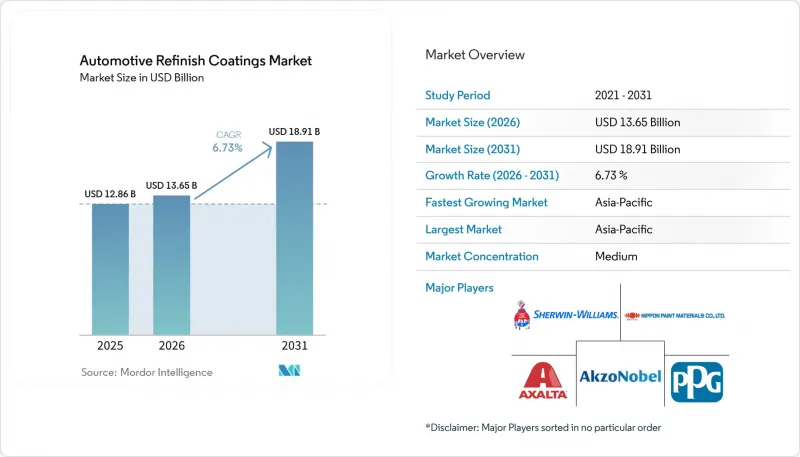
據 Mordor Intelligence 稱,2025 年汽車重新噴漆塗料市場價值為 128.6 億美元,預計到 2031 年將達到 189.1 億美元,而 2026 年為 136.5 億美元,2026 年至 2031 年預測期內的複合年成長率為 6.73%。
全球汽車噴漆市場趨勢及洞察
車輛擁有數量的增加和碰撞維修的反覆發生
2024年,全球註冊車輛數量將超過14.7億輛,這將支撐汽車修補漆的持續需求。隨著老舊車輛使用年限的延長,需要進行碰撞維修、表面修復、腐蝕處理和重新噴漆的車輛數量也隨之增加。 2024年,美國車輛的平均車車齡將達到12.6年,歐洲38%的乘用車車齡將超過10年。這種情況使得汽車修補漆市場受新車銷售短期波動的影響較小,因為車輛售出後仍需進行維修。此外,老舊車輛在維修前通常需要更徹底的表面處理,尤其是在有腐蝕、歷史損傷或基材裸露的情況下。中國超過3.4億輛的汽車保有量進一步鞏固了亞太地區作為汽車修補漆需求、分銷活動和消費主要來源的地位。
有組織的碰撞維修網路的發展及其與保險的整合。
有組織的維修網路正在將油漆採購整合到規模更大、更可預測的採購計劃中。這有利於那些能夠為多個維修點提供產品、技術培訓、色彩工具和現場服務的供應商。 2026年1月,PPG指定Quality Collision Group為其獨家噴漆合作夥伴,涵蓋美國13個州的95多家維修中心。因此,汽車噴漆市場越來越重視與整個維修集團而非單一獨立維修店簽訂的供應商合約。保險公司主導的維修活動對哪些維修點訂單維修服務、哪些油漆系統獲得批准以及維修標準的執行方式有更大的影響。大規模的合約規模也促使供應商將數位化工具、調色設備和技師培訓與油漆產品捆綁銷售,從而提高客戶留存率。
小規模汽車修理廠的監管合規和轉換成本
小規模汽車修理廠在以受監管的水性系統取代溶劑型產品時,面臨更高的改造成本。在洛杉磯地區,第1151號法規對揮發性有機化合物(VOC)的含量設定了限制,並規定了2028年1月的淘汰期限。必要的過渡措施包括使用與水性塗料相容的噴漆房、高低壓噴漆設備、強制通風乾燥機、修訂維護程序以及對工人進行培訓。這將進一步擴大大規模維修網路與小規模獨立維修店在汽車噴漆市場的營運差距。擁有多家門市的維修集團可以將資本成本分攤到更多維修訂單上,而小規模維修店透過運轉率收回投資的機會則十分有限。合規性測試和認證要求也可能限制小規模供應商以具有競爭力的價格提供特定等級產品的能力。
細分市場分析
到2025年,底塗層將佔汽車噴漆市場總銷售額的35.45%,仍將是該市場最大的細分領域。這一地位反映了市場對匹配車輛原廠顏色(包括金屬漆、珠光漆和多角度漆面)的需求。隨著汽車製造商採用更廣泛的效果、顏色組合和多道工序噴塗系統,底塗層的選擇也變得更加複雜。底漆的需求仍然與防腐蝕和增強受損、修復和裸露基材的附著力密切相關,尤其是在表面損傷嚴重的舊車上。此外,還需要使用專用填料、密封劑和活化劑來確保金屬、塑膠、高抗張強度鋼和複合材料車身面板之間的系統相容性。
預計2026年至2031年間,透明塗層的複合年成長率將達到7.34%,在所有塗層類型中增速最高。透明塗層賦予車輛修復後的光澤、耐久性、耐候性和表面保護。 2026年3月,PPG在歐洲、中東和非洲地區推出了「Deltron D8178快速低能耗」透明塗層。本產品可在20 度C下自然風乾,或在50 度C下5分鐘內達到粉塵乾燥狀態。更短的乾燥時間使汽車修理廠能夠更有效率地利用噴漆室,從而降低能耗並縮短維修車輛在廠內的停留時間。因此,市場對透明塗層的需求主要來自那些兼具優異保護性能、更短加工時間和更均勻噴塗效果的產品。
到2025年,聚氨酯將引領樹脂品類,佔40.34%的銷售量。由於其耐磨性、保光澤性和與溶劑型和水性載體系統的兼容性,這種材料被廣泛應用於各種塗層中。環氧樹脂在底漆中繼續發揮至關重要的作用,尤其是在需要強附著力和耐腐蝕性的場合,例如在遭受嚴重氧化或機械損傷的基材表面上。醇酸樹脂在對成本較為敏感的地區仍然佔據重要地位,這些地區對揮發性有機化合物(VOC)的監管力度較弱,價格是採購決策中更重要的因素。這些選擇使化合物設計人員能夠在各種汽車維修車間環境中平衡性能、可加工性、耐久性和成本。
預計2026年至2031年間,丙烯酸樹脂的複合年成長率將達到7.53%。其與水性塗料的相容性、抗紫外線性能以及低溫固化特性,滿足了環保要求和縮短維修週期的需求。水性底塗層的普及正推動著塗料配方從主要由聚氨酯組成的溶劑型配方逐步過渡到高丙烯酸含量的水性產品。 2026年6月,東來塗料技術公司提交了一項使用丙烯酸樹脂的雙組分高溫透明塗層組合物的專利申請,其影像清晰度得分高達92分。汽車修補漆市場中樹脂的選擇很可能越來越依賴水性體系的要求、優異的透明塗層性能以及低能耗固化條件。
區域分析
預計到2025年,亞太地區將佔全球汽車油漆銷售額的42.93%,並在2031年之前以7.71%的複合年成長率成長,成為所有地區中成長最快的地區。該地區受益於龐大的汽車保有量、不斷擴大的維修能力、日益成長的都市區車輛使用量以及對規範塗料系統日益成長的需求。儘管新車銷售成長放緩,但中國汽車保有量超過3.4億輛,這為大範圍地區的活躍維修活動提供了支撐。印度乘用車保有量的成長進一步推動了亞太地區汽車油漆市場的發展,並帶動了未來的維修需求。為了與全球油漆製造商展開競爭,區域供應商正在加大對配色、精準配方和水性技術的投入。
北美是全球第二大汽車維修市場,擁有與保險公司合作建立的成熟維修體系。高保險覆蓋率、直接維修項目以及完善的經銷商網路,使得維修工作能夠順利地流向正規的汽車修理廠。該地區老舊的車輛保有量為持續的維修需求奠定了基礎,而高級駕駛輔助系統(ADAS)的普及則推高了平均維修訂單價值,並增加了對認證維修流程的需求。水性產品、認證透明塗層和智慧配色工具為供應商提供了提升產品價值的機會,以適應不斷變化的車輛維護需求。
在南美洲,需求主要集中在巴西,當地老舊車輛較多,因此需要頻繁進行重新噴漆和維修。製造業和汽車生產領域的投資不斷增加,導致車輛運作量上升,未來維修服務需求也可能隨之成長。在中東和非洲,高溫天氣推動了需求成長,使得耐紫外線和耐熱塗料對於停放在戶外的車輛更加重要。保險普及率的提高和都市化進程的加快,使得碰撞維修逐漸納入常規維修流程,從而催生了對透過專業供應商銷售的塗料系統的需求。
其他好處:
- Excel格式的市場預測(ME)表
- 3個月的分析師支持
目錄
第1章:引言
- 研究假設和市場定義
- 調查範圍
第2章:調查方法
第3章執行摘要
第4章 市場狀況
- 市場概覽
- 市場促進因素
- 車輛保有量的增加以及因碰撞造成的反覆維修
- 有組織的碰撞維修網路的發展及其與保險的整合。
- 過渡到水性低VOC塗料系統
- 對高階內裝和車輛客製化的需求日益成長
- 汽車修理廠中的數位色彩匹配和自動化工作流程
- 市場限制因素
- 小規模汽車修理廠的監管合規和轉換成本
- 原料和特殊顏料的價格波動
- 熟練技術人員短缺以及水性塗料施工的複雜性。
- 價值鏈分析
- 波特五力分析
第5章 市場規模與成長預測
- 一層一層
- 底漆
- 底塗層
- 透明塗層
- 其他
- 依樹脂類型
- 聚氨酯
- 丙烯酸纖維
- 環氧樹脂
- 阿爾基多
- 其他樹脂類型
- 透過技術
- 溶劑型技術
- 水基技術
- 其他技術
- 車輛類型
- 搭乘用車
- 商用車輛
- 摩托車
- 其他
- 按地區
- 亞太地區
- 中國
- 印度
- 日本
- 韓國
- 東南亞國協
- 其他亞太國家
- 北美洲
- 美國
- 加拿大
- 墨西哥
- 歐洲
- 德國
- 英國
- 法國
- 義大利
- 北歐國家
- 其他歐洲國家
- 南美洲
- 巴西
- 阿根廷
- 其他南美國家
- 中東和非洲
- 沙烏地阿拉伯
- 南非
- 其他中東和非洲國家
- 亞太地區
第6章 競爭情勢
- 市場集中度
- 策略趨勢
- 市佔率和排名分析
- 公司簡介
- 3M
- Akzo Nobel NV
- Axalta Coating Systems
- Bernardo Ecenarro SA
- Donglai coating technology
- Kansai Paint Co., Ltd.
- KAPCI Coatings
- KCC Corporation
- MIPA SE
- Nippon Paint Holdings Co., Ltd.
- NOROO Paint & Coatings
- PPG Industries, Inc.
- The Sherwin-Williams Company
- TOA Performance Coating Corporation Co., Ltd.
- WEG Coatings
第7章 市場機會與未來展望
According to Mordor Intelligence, the automotive refinish coatings market size was valued at USD 12.86 billion in 2025 and is estimated to grow from USD 13.65 billion in 2026 to reach USD 18.91 billion by 2031, at a CAGR of 6.73% during the forecast period from 2026 to 2031.
Global Automotive Refinish Coatings Market Trends and Insights
Expanding Vehicle Parc and Recurring Collision Repairs
The global vehicle parc exceeded 1.47 billion registered units in 2024, supporting sustained demand for automotive refinish coatings. Older vehicles remain in service for longer periods, increasing the pool requiring collision repair, surface restoration, corrosion treatment, and repainting. The average age of vehicles in the United States reached 12.6 years in 2024, while 38% of Europe's passenger car fleet was more than 10 years old. These conditions make the automotive refinish coatings market less exposed to short-term swings in new-vehicle sales, as repair needs persist after the original sale. Older vehicles can also require more extensive surface preparation before refinishing, particularly where corrosion, prior damage, or bare metal is present. China's vehicle parc of more than 340 million units further supports Asia-Pacific's role as a major source of repair demand, distribution activity, and coating consumption.
Growth of Organized Collision Repair Networks and Insurance Integration
Organized repair networks are consolidating coating purchases into larger, more predictable procurement programs. This favors suppliers that can provide product availability, technical training, color tools, and local service across multiple repair locations. In January 2026, PPG named Quality Collision Group as its exclusive refinish partner, covering more than 95 repair centers across 13 U.S. states. As a result, the automotive refinish coatings market places increasing value on supplier contracts that span a repair group rather than a single independent shop. Insurer-directed repair activity can further influence which facilities receive repair work, which coating systems are approved, and how repair standards are applied. Larger agreements also encourage suppliers to bundle digital tools, mixing equipment, and technician training with coating products, strengthening customer retention.
Regulatory Compliance and Conversion Costs for Small Body Shops
Small body shops face higher conversion costs when replacing solvent-borne products with compliant waterborne systems. In the Los Angeles region, Rule 1151 includes volatile organic compound (VOC) limits and phase-out dates extending through January 2028. The required transition can include waterborne-compatible spray booths, high-pressure and low-pressure equipment, forced-air drying equipment, revised maintenance practices, and operator training. This creates a wider operating gap between large repair networks and smaller independent facilities in the automotive refinish coatings market. A multi-location repair group can spread capital costs across more repair orders, while a small shop has fewer opportunities to recover the investment through utilization. Compliance testing and certification requirements can also limit smaller suppliers' ability to offer niche grades at competitive prices.
Other drivers and restraints analyzed in the detailed report include:
- Transition Toward Waterborne and Low-VOC Coating Systems
- Digital Color Matching and Automated Body Shop Workflows
- Raw Material and Specialty Pigment Price Volatility
For complete list of drivers and restraints, kindly check the Table Of Contents.
Segment Analysis
Basecoat held 35.45% of revenue in 2025 and remained the largest layer in the automotive refinish coatings market. Its position reflects the need to match original vehicle colors, including metallic, pearlescent, and multi-angle finishes. Basecoat selection has become more complex as original equipment manufacturers use a wider range of effects, color combinations, and multi-stage paint systems. Primer demand remains tied to corrosion protection and adhesion on damaged, repaired, or exposed substrates, especially on older vehicles with more extensive surface damage. Specialty fillers, sealers, and activators also remain necessary for system compatibility across metal, plastic, high-strength steel, and mixed-material body panels.
Clearcoat is forecast to record a 7.34% CAGR from 2026 to 2031, the fastest rate among layer types. Clearcoats support gloss, durability, weather resistance, and surface protection after a repair. PPG launched Deltron D8178 Rapid Low Energy clearcoat in EMEA in March 2026, which can air dry at 20°C or reach dust-dry status in 5 minutes at 50°C. Faster drying can help body shops use spray booths more efficiently, reduce energy use, and shorten the time a repaired vehicle remains in the facility. Clearcoat demand is therefore driven by products that combine finish protection with faster processing times and more consistent application results.
Polyurethane accounted for 40.34% of revenue in 2025, leading the resin category. The material is used across coating layers because it offers abrasion resistance, gloss retention, and compatibility with solvent-borne and waterborne carrier systems. Epoxy resins continue to play an important role in primers, especially where strong adhesion and corrosion resistance are required on bare metal surfaces that have undergone significant oxidation or mechanical damage. Alkyd resins remain relevant in cost-sensitive locations where enforcement of volatile organic compound (VOC) regulations is less stringent and purchasing decisions place greater weight on price. These options allow formulators to balance performance, application needs, durability, and cost across varied body shop conditions.
Acrylic resins are forecast to grow at a 7.53% CAGR between 2026 and 2031. Their waterborne compatibility, ultraviolet resistance, and lower-temperature curing characteristics align with environmental requirements and shorter repair cycles. The move to waterborne basecoats supports a gradual shift from polyurethane-led solvent-borne formulations to acrylic-rich waterborne products. Donglai Coating Technology filed a patent in June 2026 for a 2K high-temperature clearcoat composition that uses acrylic resin and reported a distinctness-of-image value of 92. Resin choice in the automotive refinish coatings market may become more closely linked to waterborne system requirements, premium clearcoat performance, and lower-energy curing conditions.
Complete Report Scope:
- By Layer
- Primer
- Basecoat
- Clearcoat
- Others
- By Resin Type
- Polyurethane
- Acrylic
- Epoxy
- Alkyd
- Other Resin Types
- By Technology
- Solventborne Technology
- Waterborne Technology
- Other Technologies
- By Vehicle Type
- Passenger Cars
- Commercial Vehicles
- Two-Wheelers
- Others
- By Geography
- Asia-Pacific
- China
- India
- Japan
- South Korea
- ASEAN Countries
- Rest of Asia-Pacific
- North America
- United States
- Canada
- Mexico
- Europe
- Germany
- United Kingdom
- France
- Italy
- NORDIC Countries
- Rest of Europe
- South America
- Brazil
- Argentina
- Rest of South America
- Middle East and Africa
- Saudi Arabia
- South Africa
- Rest of Middle East and Africa
- Asia-Pacific
Geography Analysis
Asia-Pacific accounted for 42.93% of revenue in 2025 and grew at a 7.71% CAGR through 2031, the fastest rate among all regions. The region benefits from a large vehicle parc, expanding repair capacity, increasing urban vehicle use, and growing demand for compliant coating systems. China's vehicle parc of more than 340 million units supports high repair activity across a wide geographic area, even as new-vehicle growth moderates. The automotive refinish coatings market in Asia-Pacific is further supported by India's growing passenger vehicle base, which is expanding the future repair pool. Regional suppliers are investing in color matching, precision formulation, and waterborne technologies as they compete with global coating producers.
North America is the second-largest region and has a mature insurer-linked repair system. High insurance penetration, direct-repair programs, and established distributors channel repair activity toward organized body shops. The region's aging vehicle parc provides a continuing repair base, while advanced driver assistance systems raise repair order values and increase the need for certified repair processes. Waterborne products, certified clearcoats, and connected color tools offer suppliers opportunities to improve product value, even as vehicle maintenance needs evolve.
In South America, demand is concentrated in Brazil, where an older vehicle base supports refinish activity and repair frequency. Manufacturing investment and vehicle production are broadening the installed base, requiring repair services over time. In the Middle East and Africa, demand is driven by high temperatures, which increase the importance of ultraviolet-stable and heat-resistant finishes for exposed vehicles. Rising insurance penetration and urbanization are bringing more collision work into formal repair channels, creating demand for professionally distributed coating systems.
- 3M
- Akzo Nobel N.V.
- Axalta Coating Systems
- Bernardo Ecenarro S.A.
- Donglai coating technology
- Kansai Paint Co., Ltd.
- KAPCI Coatings
- KCC Corporation
- MIPA SE
- Nippon Paint Holdings Co., Ltd.
- NOROO Paint & Coatings
- PPG Industries, Inc.
- The Sherwin-Williams Company
- TOA Performance Coating Corporation Co., Ltd.
- WEG Coatings
Additional Benefits:
- The market estimate (ME) sheet in Excel format
- 3 months of analyst support
TABLE OF CONTENTS
1 Introduction
- 1.1 Study Assumptions and Market Definition
- 1.2 Scope of the Study
2 Research Methodology
3 Executive Summary
4 Market Landscape
- 4.1 Market Overview
- 4.2 Market Drivers
- 4.2.1 Expanding Vehicle Parc and Recurring Collision Repairs
- 4.2.2 Growth of Organized Collision-Repair Networks and Insurance Integration
- 4.2.3 Transition Toward Waterborne and Low-VOC Coating Systems
- 4.2.4 Rising Demand for Premium Finishes and Vehicle Customization
- 4.2.5 Digital Color Matching and Automated Body-Shop Workflows
- 4.3 Market Restraints
- 4.3.1 Regulatory Compliance and Conversion Costs for Small Body Shops
- 4.3.2 Raw-Material and Specialty-Pigment Price Volatility
- 4.3.3 Technician Shortages and Waterborne Application Complexity
- 4.4 Value Chain Analysis
- 4.5 Porter's Five Forces Analysis
- 4.5.1 Bargaining Power of Suppliers
- 4.5.2 Bargaining Power of Buyers
- 4.5.3 Threat of New Entrants
- 4.5.4 Threat of Substitutes
- 4.5.5 Competitive Rivalry
5 Market Size and Growth Forecasts (Value)
- 5.1 By Layer
- 5.1.1 Primer
- 5.1.2 Basecoat
- 5.1.3 Clearcoat
- 5.1.4 Others
- 5.2 By Resin Type
- 5.2.1 Polyurethane
- 5.2.2 Acrylic
- 5.2.3 Epoxy
- 5.2.4 Alkyd
- 5.2.5 Other Resin Types
- 5.3 By Technology
- 5.3.1 Solventborne Technology
- 5.3.2 Waterborne Technology
- 5.3.3 Other Technologies
- 5.4 By Vehicle Type
- 5.4.1 Passenger Cars
- 5.4.2 Commercial Vehicles
- 5.4.3 Two-Wheelers
- 5.4.4 Others
- 5.5 By Geography
- 5.5.1 Asia-Pacific
- 5.5.1.1 China
- 5.5.1.2 India
- 5.5.1.3 Japan
- 5.5.1.4 South Korea
- 5.5.1.5 ASEAN Countries
- 5.5.1.6 Rest of Asia-Pacific
- 5.5.2 North America
- 5.5.2.1 United States
- 5.5.2.2 Canada
- 5.5.2.3 Mexico
- 5.5.3 Europe
- 5.5.3.1 Germany
- 5.5.3.2 United Kingdom
- 5.5.3.3 France
- 5.5.3.4 Italy
- 5.5.3.5 NORDIC Countries
- 5.5.3.6 Rest of Europe
- 5.5.4 South America
- 5.5.4.1 Brazil
- 5.5.4.2 Argentina
- 5.5.4.3 Rest of South America
- 5.5.5 Middle East and Africa
- 5.5.5.1 Saudi Arabia
- 5.5.5.2 South Africa
- 5.5.5.3 Rest of Middle East and Africa
- 5.5.1 Asia-Pacific
6 Competitive Landscape
- 6.1 Market Concentration
- 6.2 Strategic Moves
- 6.3 Market Share (%)/Ranking Analysis
- 6.4 Company Profiles (includes Global Overview, Market Overview, Core Segments, Financials as available, Strategic Information, Products and Services, and Recent Developments)
- 6.4.1 3M
- 6.4.2 Akzo Nobel N.V.
- 6.4.3 Axalta Coating Systems
- 6.4.4 Bernardo Ecenarro S.A.
- 6.4.5 Donglai coating technology
- 6.4.6 Kansai Paint Co., Ltd.
- 6.4.7 KAPCI Coatings
- 6.4.8 KCC Corporation
- 6.4.9 MIPA SE
- 6.4.10 Nippon Paint Holdings Co., Ltd.
- 6.4.11 NOROO Paint & Coatings
- 6.4.12 PPG Industries, Inc.
- 6.4.13 The Sherwin-Williams Company
- 6.4.14 TOA Performance Coating Corporation Co., Ltd.
- 6.4.15 WEG Coatings
7 Market Opportunities and Future Outlook
- 7.1 White-Space and Unmet-Need Assessment

 汽車重新噴漆塗料市場規模、佔有率、成長、全球產業分析、區域趨勢及2026年至2034年預測。
 汽車噴漆塗料市場:2026-2032年全球市場預測(依產品類型、產品形態、樹脂類型、技術、車輛類型、最終用戶和銷售管道)
 汽車噴漆及塗裝市場:市場機會、成長要素、產業趨勢分析及2026-2035年預測
 汽車塗料市場規模、佔有率、趨勢和預測:按樹脂類型、產品類型、技術、車輛類型和地區分類,2026-2034年
 2026年全球汽車噴漆市場報告2026年全球汽車塗料市場報告重新噴漆市場:商機、成長要素、產業趨勢分析及2026-2035年預測塗料翻新市場:按應用、技術、樹脂類型、類別和分銷管道分類-2026-2032年全球預測全球汽車噴漆塗料市場規模、佔有率、趨勢及成長分析報告(2026-2034)全球汽車修補漆市場規模、佔有率、趨勢及成長分析報告(2026-2034年)