


 |
市場調查報告書
商品編碼
2038711
汽車噴漆及塗裝市場:市場機會、成長要素、產業趨勢分析及2026-2035年預測Automotive Refinish Coating Market Opportunity, Growth Drivers, Industry Trend Analysis, and Forecast 2026 - 2035 |
||||||

全球汽車重新噴漆塗料市場預計到 2025 年將達到 123 億美元,預計到 2035 年將達到 201 億美元,年複合成長率為 4.9%。
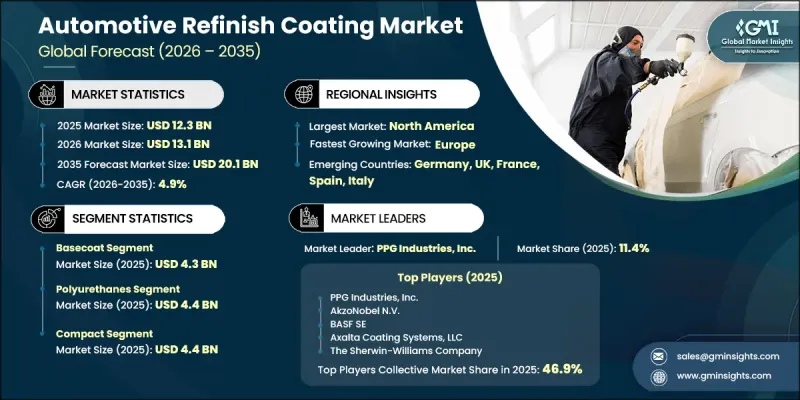
該市場涵蓋車輛製造完成後用於修復外觀和保護表面的塗層系統。這些塗層廣泛應用於碰撞、劣化或環境損害車輛的維修和翻新工作。它們有助於恢復車輛原有的美觀度,同時增強其耐腐蝕性、耐候性和抗機械應力能力。產品線包括底漆、底塗層、透明塗層以及專為各種車輛零件和基材設計的特殊塗料。應用範圍涵蓋乘用車、商用車和摩托車,服務於個人和工業出行領域。汽車維修保養活動的日益活躍也推動了市場成長,修補漆在延長車輛使用壽命方面發揮著至關重要的作用。該行業也在不斷發展,製造商致力於提高施工效率、縮短乾燥時間和提升塗裝品質。環保法規正在加速向低VOC(揮發性有機化合物)水性配方的轉變。此外,數位配色系統和最新噴塗技術的進步正在改變維修工作流程,提高車身修理廠和服務中心的精度並減少材料浪費。
| 市場範圍 | |
|---|---|
| 開始年份 | 2025 |
| 預測期 | 2026-2035 |
| 上市時的市場規模 | 123億美元 |
| 預測市場規模 | 201億美元 |
| 複合年成長率 | 4.9% |
到2025年,底塗層市場規模將達到43億美元,這反映了其在汽車噴漆市場中的重要地位。底塗層在修復車輛表面外觀和實現精準配色方面發揮著至關重要的作用,因此該細分市場仍然不可或缺。受損和重新噴漆車輛的持續美觀修復需求推動了市場需求的成長。此外,底漆在防止腐蝕和確保表面與漆面之間的良好附著力方面也發揮著關鍵作用,而透明塗層則被廣泛用於增強耐久性、提供持久的表面保護以及提高抗刮擦、抗紫外線和抗環境侵蝕的能力。
預計2025年,聚氨酯市場規模將達44億美元。聚氨酯因其耐久性、柔軟性和卓越的塗裝效果而廣受歡迎,使其成為汽車表面長期保護的理想選擇。丙烯酸配方也因其優異的光澤保持性和視覺吸引力而備受關注,而醇酸塗料則因其在修補應用中的成本效益而仍然佔據重要地位。環氧樹脂系統因其強大的附著力和防護性能,尤其是在嚴苛的修補環境中,應用日益廣泛。此外,乙烯基和聚酯樹脂系統也被用於滿足對特定基材相容性的特殊噴漆需求,從而建構了市場上多元化的材料生態系統。
北美汽車噴漆和塗裝市場預計將從2025年的38億美元成長到2035年的63億美元。這一成長主要得益於大量老舊車輛的出現,從而產生了對維修和噴漆服務的穩定需求。車輛的高利用率也促使乘用車和輕型商用車頻繁進行維護和翻新。保險公司支援的維修服務進一步推動了油漆消耗,因為受損車輛需要進行專門的噴漆處理。此外,市場對符合規範、能夠提高維修效率和環保性能的油漆解決方案的重視也在影響市場。預計來自事故維修中心和汽車服務供應商的持續需求將推動全部區域市場的穩定擴張。
目錄
第1章:調查方法和範圍
第2章執行摘要
第3章業界考察
- 生態系分析
- 供應商情況
- 利潤率
- 每個階段增加的價值
- 影響價值鏈的因素
- 中斷
- 影響產業的因素
- 促進因素
- 對輕量且高度耐用材料的需求日益成長。
- 環保意識
- 製造業的技術進步
- 陷阱與挑戰
- 高昂的生產成本
- 缺乏回收基礎設施
- 機會
- 針對特殊應用進行客製化
- 與可再生材料的結合
- 促進因素
- 成長潛力分析
- 監理情勢
- 北美洲
- 歐洲
- 亞太地區
- 拉丁美洲
- 中東和非洲
- 波特五力分析
- PESTEL 分析
- 科技與創新趨勢
- 當前技術趨勢
- 新興技術
- 價格趨勢
- 按地區
- 依產品類型
- 未來市場趨勢
- 專利趨勢
- 貿易統計(HS編碼)
- 主要進口國
- 主要出口國
- 永續性和環境方面
- 永續計劃
- 減少廢棄物策略
- 生產中的能源效率
- 環保意識的舉措
- 考慮碳足跡
第4章 競爭情勢
- 介紹
- 企業市佔率分析
- 按地區
- 北美洲
- 歐洲
- 亞太地區
- 拉丁美洲
- 中東和非洲(MEA)
- 按地區
- 企業矩陣分析
- 主要市場公司的競爭分析
- 競爭定位矩陣
- 主要進展
- 併購
- 夥伴關係和聯盟
- 新產品發布
- 業務拓展計劃
第5章 市場估算與預測:依產品類型分類,2022-2035年
- 底漆
- 底塗層
- 透明塗層
- 活化劑/固化劑
- 其他(填料、黏合促進劑)
第6章 市場估算與預測:依材料類型分類,2022-2035年
- 聚氨酯
- 丙烯酸樹脂
- 阿爾基多
- 環氧樹脂
- 其他(乙烯基樹脂、聚酯樹脂)
第7章 市場估價與預測:依車輛類型分類,2022-2035年
- 袖珍的
- 中號
- 奢華
- 其他
第8章 市場估計與預測:依地區分類,2022-2035年
- 北美洲
- 美國
- 加拿大
- 歐洲
- 德國
- 英國
- 法國
- 西班牙
- 義大利
- 其他歐洲國家
- 亞太地區
- 中國
- 印度
- 日本
- 澳洲
- 韓國
- 其他亞太地區
- 拉丁美洲
- 巴西
- 墨西哥
- 阿根廷
- 其他拉丁美洲
- 中東和非洲
- 沙烏地阿拉伯
- 南非
- 阿拉伯聯合大公國
- 其他中東和非洲地區
第9章:公司簡介
- 3M Company
- AkzoNobel NV
- Allnex Group
- Axalta Coating Systems, LLC
- BASF SE
- Bernardo Ecenarro SA
- Covestro AG
- Nippon Paint Holdings Co., Ltd.
- Dow Inc.
- PPG Industries, Inc.
- Kansai Paint Co., Ltd.
- KAPCI Coatings
- The Sherwin-Williams Company
The Global Automotive Refinish Coating Market was valued at USD 12.3 billion in 2025 and is estimated to grow at a CAGR of 4.9% to reach USD 20.1 billion by 2035.
The market comprises coating systems applied to vehicles after manufacturing to restore appearance and provide surface protection. These coatings are widely used in repair and refurbishment activities where vehicles undergo damage from collisions, wear over time, or environmental exposure. They help restore original aesthetics while also strengthening resistance against corrosion, harsh weather conditions, and mechanical stress. The product range includes primers, basecoats, clearcoats, and specialized coatings designed for different vehicle components and substrates. Applications extend across passenger vehicles, commercial fleets, and two-wheelers, supporting both personal and industrial mobility segments. Growth is further supported by rising automotive repair and maintenance activity, where refinish coatings play a critical role in extending vehicle life cycles. The industry has also evolved technologically, with manufacturers focusing on improved application efficiency, faster drying performance, and enhanced finish quality. Environmental regulations have accelerated the shift toward low-VOC, water-based formulations. Additionally, advancements in digital color-matching systems and modern spray technologies are transforming repair workflows, improving precision and reducing material waste across body shops and service centers.
| Market Scope | |
|---|---|
| Start Year | 2025 |
| Forecast Year | 2026-2035 |
| Start Value | $12.3 Billion |
| Forecast Value | $20.1 Billion |
| CAGR | 4.9% |
The basecoat category accounted for USD 4.3 billion in 2025, reflecting its strong contribution within the automotive refinish coating landscape. This segment remains essential as basecoats are primarily responsible for restoring the visual appearance of vehicle surfaces and achieving accurate color matching after repairs. Demand is supported by the continuous need for aesthetic restoration in damaged or repainted vehicles. Alongside this, primers play a crucial role in preventing corrosion and ensuring proper adhesion between surfaces and coatings, while clearcoats are widely used to enhance durability and provide long-lasting surface protection, improving resistance against scratches, UV exposure, and environmental stress.
The polyurethane-based segment generated USD 4.4 billion in 2025. Polyurethanes are widely preferred due to their durability, flexibility, and strong finish quality, making them suitable for long-term automotive surface protection. Acrylic-based formulations are also gaining traction as they offer improved gloss retention and visual appeal, while alkyd coatings remain relevant due to their cost-effectiveness in repair applications. Epoxy-based systems are increasingly used because of their strong adhesion and protective characteristics, particularly in demanding repair environments. In addition, vinyl and polyester resin systems are adopted for specialized refinishing requirements where compatibility with specific substrates is required, supporting a diverse material ecosystem in the market.
North America Automotive Refinish Coating Market is projected to grow from USD 3.8 billion in 2025 to USD 6.3 billion by 2035. The region's growth is supported by a large aging vehicle fleet, which generates consistent demand for repair and refinishing services. High vehicle usage rates also contribute to frequent maintenance and restoration requirements across passenger and light commercial vehicles. Insurance-supported repair services further strengthen coating consumption, as damaged vehicles undergo professional refinishing processes. The market is also influenced by a strong focus on compliance-driven coating solutions that improve repair efficiency and environmental performance. Continuous demand from collision repair centers and automotive service providers ensures steady market expansion across the region.
Key companies operating in the Global Automotive Refinish Coating Industry include AkzoNobel N.V., Axalta Coating Systems, LLC, and PPG Industries, Inc. Other major participants include BASF SE, The Sherwin-Williams Company, Nippon Paint Holdings Co., Ltd., Kansai Paint Co., Ltd., 3M Company, Dow Inc., Covestro AG, Allnex Group, Bernardo Ecenarro S.A., and KAPCI Coatings. Companies in the Automotive Refinish Coating Market actively focus on expanding their product portfolios through the development of advanced low-VOC and waterborne coating systems that comply with tightening environmental regulations. Manufacturers are investing heavily in research and development to improve durability, drying speed, and color accuracy. Strategic collaborations with automotive repair shops and OEM service networks are helping strengthen distribution and brand presence. Firms are also integrating digital color-matching technologies and automated application systems to enhance precision and reduce operational inefficiencies. Expansion into emerging markets is being prioritized to capture growing vehicle repair demand.
Table of Contents
Chapter 1 Methodology & Scope
- 1.1 Market scope and definition
- 1.2 Research design
- 1.2.1 Research approach
- 1.2.2 Data collection methods
- 1.3 Data mining sources
- 1.3.1 Global
- 1.3.2 Regional/Country
- 1.4 Base estimates and calculations
- 1.4.1 Base year calculation
- 1.4.2 Key trends for market estimation
- 1.5 Primary research and validation
- 1.5.1 Primary sources
- 1.6 Forecast model
- 1.7 Research assumptions and limitations
Chapter 2 Executive Summary
- 2.1 Industry 360° synopsis
- 2.2 Key market trends
- 2.2.1 Product Type
- 2.2.2 Material Type
- 2.2.3 Vehicle Type
- 2.2.4 Regional
- 2.3 TAM Analysis, 2026-2035
- 2.4 CXO perspectives: Strategic imperatives
- 2.5 Future outlook and strategic recommendations
Chapter 3 Industry Insights
- 3.1 Industry ecosystem analysis
- 3.1.1 Supplier landscape
- 3.1.2 Profit margin
- 3.1.3 Value addition at each stage
- 3.1.4 Factor affecting the value chain
- 3.1.5 Disruptions
- 3.2 Industry impact forces
- 3.2.1 Growth drivers
- 3.2.1.1 Rising demand for lightweight and durable materials
- 3.2.1.2 Environmental awareness
- 3.2.1.3 Technological advancements in manufacturing
- 3.2.2 Pitfalls/challenge
- 3.2.2.1 High production costs
- 3.2.2.2 Limited recycling infrastructure
- 3.2.3 Opportunities
- 3.2.3.1 Customization for specialized applications
- 3.2.3.2 Integration with renewable materials
- 3.2.1 Growth drivers
- 3.3 Growth potential analysis
- 3.4 Regulatory landscape
- 3.4.1 North America
- 3.4.2 Europe
- 3.4.3 Asia Pacific
- 3.4.4 Latin America
- 3.4.5 Middle East & Africa
- 3.5 Porter's analysis
- 3.6 PESTEL analysis
- 3.7 Technology and innovation landscape
- 3.7.1 Current technological trends
- 3.7.2 Emerging technologies
- 3.8 Price trends
- 3.8.1 By region
- 3.8.2 By product type
- 3.9 Future market trends
- 3.10 Patent landscape
- 3.11 Trade statistics (HS code)
- 3.11.1 Major importing countries
- 3.11.2 Major exporting countries
- 3.12 Sustainability and environmental aspects
- 3.12.1 Sustainable practices
- 3.12.2 Waste reduction strategies
- 3.12.3 Energy efficiency in production
- 3.12.4 Eco-friendly initiatives
- 3.13 Carbon footprint consideration
Chapter 4 Competitive Landscape, 2025
- 4.1 Introduction
- 4.2 Company market share analysis
- 4.2.1 By region
- 4.2.1.1 North America
- 4.2.1.2 Europe
- 4.2.1.3 Asia Pacific
- 4.2.1.4 LATAM
- 4.2.1.5 MEA
- 4.2.1 By region
- 4.3 Company matrix analysis
- 4.4 Competitive analysis of major market players
- 4.5 Competitive positioning matrix
- 4.6 Key developments
- 4.6.1 Mergers & acquisitions
- 4.6.2 Partnerships & collaborations
- 4.6.3 New product launches
- 4.6.4 Expansion plans
Chapter 5 Market Estimates and Forecast, By Product Type, 2022-2035 (USD Million) (Kilo Tons)
- 5.1 Key trends
- 5.2 Primer
- 5.3 Basecoat
- 5.4 Clearcoat
- 5.5 Activator/Hardener
- 5.6 Others (fillers, adhesion promoters)
Chapter 6 Market Estimates and Forecast, By Material Type, 2022-2035 (USD Million) (Kilo Tons)
- 6.1 Key trends
- 6.2 Polyurethanes
- 6.3 Acrylics
- 6.4 Alkyd
- 6.5 Epoxy
- 6.6 Others (Vinyl Resins, Polyester Resins)
Chapter 7 Market Estimates and Forecast, By Vehicle Type, 2022-2035 (USD Million) (Kilo Tons)
- 7.1 Key trends
- 7.2 Compact
- 7.3 Midsize
- 7.4 Luxury
- 7.5 Other
Chapter 8 Market Estimates and Forecast, By Region, 2022-2035 (USD Million) (Kilo Tons)
- 8.1 Key trends
- 8.2 North America
- 8.2.1 U.S.
- 8.2.2 Canada
- 8.3 Europe
- 8.3.1 Germany
- 8.3.2 UK
- 8.3.3 France
- 8.3.4 Spain
- 8.3.5 Italy
- 8.3.6 Rest of Europe
- 8.4 Asia Pacific
- 8.4.1 China
- 8.4.2 India
- 8.4.3 Japan
- 8.4.4 Australia
- 8.4.5 South Korea
- 8.4.6 Rest of Asia Pacific
- 8.5 Latin America
- 8.5.1 Brazil
- 8.5.2 Mexico
- 8.5.3 Argentina
- 8.5.4 Rest of Latin America
- 8.6 Middle East and Africa
- 8.6.1 Saudi Arabia
- 8.6.2 South Africa
- 8.6.3 UAE
- 8.6.4 Rest of Middle East and Africa
Chapter 9 Company Profiles
- 9.1 3M Company
- 9.2 AkzoNobel N.V.
- 9.3 Allnex Group
- 9.4 Axalta Coating Systems, LLC
- 9.5 BASF SE
- 9.6 Bernardo Ecenarro S.A.
- 9.7 Covestro AG
- 9.8 Nippon Paint Holdings Co., Ltd.
- 9.9 Dow Inc.
- 9.10 PPG Industries, Inc.
- 9.11 Kansai Paint Co., Ltd.
- 9.12 KAPCI Coatings
- 9.13 The Sherwin-Williams Company

 汽車噴漆塗料市場:2026-2032年全球市場預測(依產品類型、產品形態、樹脂類型、技術、車輛類型、最終用戶和銷售管道)
 汽車塗料市場規模、佔有率、趨勢和預測:按樹脂類型、產品類型、技術、車輛類型和地區分類,2026-2034年
 2026年全球汽車噴漆市場報告2026年全球汽車塗料市場報告
 重新噴漆市場:商機、成長要素、產業趨勢分析及2026-2035年預測塗料翻新市場:按應用、技術、樹脂類型、類別和分銷管道分類-2026-2032年全球預測
 全球汽車噴漆塗料市場規模、佔有率、趨勢及成長分析報告(2026-2034)全球汽車修補漆市場規模、佔有率、趨勢及成長分析報告(2026-2034年)2026年全球汽車修補漆市場報告
 亞洲汽車修補漆市場:2025