


 |
市場調查報告書
商品編碼
2163352
電致變色玻璃:市場佔有率分析、產業趨勢與統計、成長預測(2026-2031)Electrochromic Glass - Market Share Analysis, Industry Trends & Statistics, Growth Forecasts (2026 - 2031) |
||||||

※ 本網頁內容可能與最新版本有所差異。詳細情況請與我們聯繫。
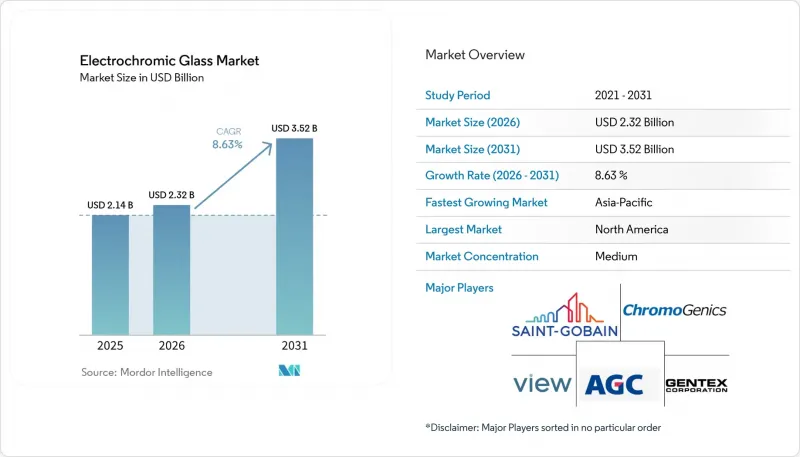
據 Mordor Intelligence 稱,2025 年電致變色玻璃市值為 21.4 億美元,預計到 2031 年將從 2026 年的 23.2 億美元成長至 35.2 億美元,預測期(2026-2031 年)複合年成長率為 8.63%。
全球電致變色玻璃市場趨勢及洞察
建築能源標準和強制性淨零能耗
建築能源標準和強制性淨零能耗要求是業主和建築師考慮採用動態嵌裝玻璃的直接原因。修訂後的《建築能源性能指令》要求歐盟成員國在2026年5月前將其條款納入本國法律。該指令也關注現有建築的維修,如果建築的能源性能較低,則可能需要投資維修建築圍護結構。加州2025年能源法規概述了基於性能的動態嵌裝玻璃合規途徑,該途徑適用於2026年1月起新建建築和重大維修項目。 2026年的一項研究報告顯示,無論氣候帶如何,採用太陽能熱窗和雙波段電致變色窗的暖氣、通風和暖通空調系統(HVAC)平均年節能率可達19.5%。這些要求和性能結果進一步強化了在商業項目中引入電致變色玻璃的合理性,尤其是在太陽輻射控制是更廣泛能源策略一部分的情況下。此外,這些因素將玻璃的選擇與立面設計、機械設備、營運成本和居住者舒適度等決策連結起來。當專案本身就需要提供能源性能文件時,由此得出的理論基礎就顯得格外重要。雖然固定玻璃可以滿足許多專案要求,但動態控制為設計師提供了應對不斷變化的陽光的新方法。如果設計團隊在採購流程早期就考慮帷幕牆設計,而不是在後期才決定玻璃類型,這種優勢將更加明顯。
智慧建築與建築自動化的融合
智慧建築與建築自動化的融合,使電致變色玻璃從被動式圍護結構組件轉變為可控系統。建築管理系統可利用人員佔用、自然光和暖通空調(HVAC)訊號來設定玻璃的著色等級。這既能有效控制眩光和太陽熱量,又能保持室內空間的舒適性。該系統的價值取決於控制系統、玻璃、電氣設備以及整個建築平台之間的可靠協調。一份2025年的研究報告指出,將電致變色智慧窗戶與現有建築能源管理系統整合仍然是一項技術挑戰,尤其是在老舊商業建築中。因此,為建築控制系統和安裝團隊提供支援的供應商可以在電致變色玻璃市場中獲得競爭優勢,尤其是在大規模商業建築專案中。產品不僅要與建築設備協調運行,還要與建築的視覺和熱工設計相協調。這使得試運行、用戶控制和安裝後技術支援更加重要。能夠解釋著色系統在正常建築條件下如何運作的供應商也更有價值。對於業主來說,一個實際的挑戰是他們能否在建築物的整個使用壽命中維護和管理系統。
與傳統雙層玻璃相比,初始成本較高
高昂的初始成本以及與傳統隔熱玻璃相比的劣勢仍然是電致變色玻璃廣泛應用的最大障礙。在美國,電致變色玻璃的安裝成本在每平方英尺 60 至 150 美元之間,是高性能靜態低輻射玻璃成本的三到五倍。如果企劃團隊只評估直接節能效果,則很難證明如此高昂的成本是合理的。然而,如果考慮到遮陽系統的其他作用、暖通空調 (HVAC) 設備的微型化以及可獲得的稅額扣抵抵免,那麼成本負擔可能就不那麼沉重了。材料採購和特殊塗層的需求也會增加系統成本。因此,電致變色玻璃市場在那些全面評估能源效率、舒適度、設計和建築管理效益(而不僅僅是比較初始成本)的項目中仍然表現出最強勁的需求。這解釋了為什麼高階商業建築率先採用了電致變色玻璃,以及機場、辦公大樓和擁有大面積玻璃的綜合用途項目對電致變色玻璃的興趣日益濃厚。在低成本項目中,價格溢價可能會超過採購階段難以衡量的效益。更廣泛的應用取決於供應商能否簡化安裝提案並降低成本。
細分市場分析
2025年,全嵌裝玻璃將佔電致變色玻璃市場的46.05%,而電致變色薄膜預計到2031年將以9.13%的複合年成長率成長。全嵌裝玻璃隔熱玻璃單元在大規模商業項目中繼續發揮至關重要的作用,因為它們可以直接整合到幕牆系統中,並在大面積玻璃表面實現均勻著色。成熟的供應商已建立起處理這些大尺寸產品的生產能力,這鞏固了它們在要求嚴苛的建築項目中的地位。考慮大面積玻璃帷幕牆的客戶通常重視整個立面的中性外觀。他們還要求確保玻璃能夠長期保持其預期的變色性能。這些因素使得擁有良好業績記錄和詳細性能數據的供應商更具優勢。因此,產品選擇不僅是材料的選擇,更是建築系統長期發展的決策。
電致變色薄膜能夠滿足客戶的各種需求,適用於維修工程和汽車應用。溶液法薄膜沉積減少了對傳統大面積塗層製程所需設備的依賴。 ChromoGenics 的「ConverLight」薄膜專為本地玻璃合作夥伴的層壓工藝而設計,從而減少了成品中空玻璃單元長途運輸的需求。該公司於 2025 年獲得了其在北美的首個訂單,用於科羅拉多的一個豪華住宅項目。為了使薄膜產品能夠與成熟的全玻璃系統競爭,一致的測試結果和權威認證仍然至關重要。因此,電致變色玻璃市場仍需要那些能夠提供低成本產品和可靠性能證明的供應商。
區域分析
2025年,北美佔據了電致變色玻璃市場38.61%的佔有率。該地區商業建築需求強勁,且在綠色建築和能源法規方面擁有成熟的舉措。加州2025年能源法規引入了動態嵌裝玻璃合規要求,適用於新建築和大型維修項目,並於2026年1月生效。這個法規環境正在推動大都會圈專案中的電致變色玻璃市場發展,因為這些專案會綜合評估建築圍護結構的性能、居住者舒適度和能耗。雖然加拿大的維修計畫和墨西哥的生產基地也對該地區的需求有所貢獻,但美國仍是最大的市場來源。此外,該地區也為參與其他大型商業開發專案的供應商提供了專案經驗。這一點至關重要,因為設計團隊在選擇不熟悉的建築技術時,通常會參考已完成的項目。在能源成本較高的地區,監管要求和可用的獎勵可能會進一步增強採用該技術的合理性。因此,北美的需求得益於活躍的建設活動和成熟的市場經驗。
預計到2031年,亞太地區將以9.22%的複合年成長率成長。這一成長與電動車的生產、綠色建築項目以及亞洲多個市場酒店設施的建設密切相關。香港「中央庭院」計畫的訂單表明,動態玻璃將應用於一個計劃於2027年開放的大型開發案。日本擁有獨特的產品合規性要求,這可能會影響進口系統進入日本市場。在印度投資精密玻璃鍍膜基礎設施,可以支援未來關鍵商業房地產地段的產能和需求。亞太地區市場監管框架、專案類型和客戶期望各不相同,這為區域供應商和成熟的國際公司都創造了機會。
在歐洲,基於建築能源性能指令 (EPBD) 的維修要求正在推動這一領域的發展。聖戈班於 2025 年 2 月推出了「RealTone」產品,旨在消除傳統電致變色玻璃常見的藍色色調。 2024 年,Chromogenics 公司在其位於瑞典博維爾凱特的總部完成了大規模曲面電致變色玻璃的安裝。在南美洲,高階商業和豪華住宅項目仍然是重點。中東和非洲的需求則集中在特定的基礎設施和永續發展認證的開發項目上,包括與沙烏地阿拉伯「2030 願景」計畫相關的項目。歐洲的維修活動為薄膜改裝系統提供了更成熟的應用途徑。南美洲的商業機會仍然有限,主要集中在高附加價值項目。
其他好處:
- Excel格式的市場預測(ME)表
- 3個月的分析師支持
目錄
第1章:引言
- 研究假設和市場定義
- 調查範圍
第2章:調查方法
第3章執行摘要
第4章 市場狀況
- 市場概覽
- 市場促進因素
- 建築和能源標準以及強制性淨零排放
- 智慧建築與建築自動化的融合
- 豪華車的全景嵌裝玻璃和可調光後視鏡
- 對電力太陽能輻射控制設備維修的需求
- 高通量薄膜沉積技術與軟性電致變色膜
- 市場限制因素
- 與傳統雙層玻璃窗相比,初始成本較高
- 安裝和試運行的複雜性
- 缺乏耐久性、循環穩定性以及全球統一的耐久性標準
- 價值鏈分析
- 波特五力分析
第5章 市場規模與成長預測
- 依產品類型
- 全玻璃牆
- 部分玻璃牆
- 電致變色膜
- 透過使用
- 大樓
- 車
- 航太
- 家用電子產品
- 海上
- 其他用途
- 按地區
- 亞太地區
- 中國
- 印度
- 日本
- 韓國
- 東南亞國協
- 其他亞太國家
- 北美洲
- 美國
- 加拿大
- 墨西哥
- 歐洲
- 德國
- 英國
- 法國
- 義大利
- 北歐國家
- 其他歐洲國家
- 南美洲
- 巴西
- 阿根廷
- 其他南美國家
- 中東和非洲
- 沙烏地阿拉伯
- 南非
- 其他中東和非洲國家
- 亞太地區
第6章 競爭情勢
- 市場集中度
- 策略趨勢
- 市佔率和排名分析
- 公司簡介
- AGC Inc.
- ChromoGenics
- Corning Incorporated
- EControl-Glas GmbH and Co. KG
- GENTEX CORPORATION
- Guardian Glass
- Halio Inc.
- Kinestral Technologies, Inc.
- Nippon Sheet Glass Co., Ltd
- Pleotint LLC
- Polytronix, Inc.
- PPG Industries, Inc.
- RESEARCH FRONTIERS INC.
- Saint-Gobain
- Smartglass International Limited
- View, Inc.
第7章 市場機會與未來展望
According to Mordor Intelligence, the electrochromic glass market size was valued at USD 2.14 billion in 2025 and is estimated to grow from USD 2.32 billion in 2026 to reach USD 3.52 billion by 2031, at a CAGR of 8.63% during the forecast period (2026-2031).
Global Electrochromic Glass Market Trends and Insights
Building-Energy Codes and Net-Zero Mandates
Building-energy codes and net-zero mandates create a direct reason for owners and architects to consider dynamic glazing. The revised Energy Performance of Buildings Directive requires EU member states to transpose its provisions into national law by May 2026. The directive also directs attention toward renovation of existing buildings, where poor energy performance can trigger investment in envelope upgrades. California's 2025 Energy Code provides a dynamic glazing compliance pathway under performance-based approaches and applies to new buildings and major renovations from January 2026. A 2026 study reported average annual heating, ventilation, and air-conditioning energy savings of 19.5% for solar-thermal dual-band electrochromic windows across climate zones. These requirements and performance results strengthen the case for the electrochromic glass market in commercial projects where solar control is part of a broader energy strategy. They also connect glazing choices with decisions on facade design, mechanical systems, operating costs, and occupant comfort. The resulting case is most relevant where a project already needs to document energy performance. Static glazing can meet many project requirements, but dynamic control gives designers another way to respond to changing sunlight. The effect is strongest when design teams consider the facade early, rather than treating glass as a late procurement decision.
Smart-Building and Building-Automation Integration
Smart-building and building-automation integration changes electrochromic glazing from a passive envelope component into a controlled system. Building management systems can use occupancy, daylight, and heating, ventilation, and air-conditioning signals to set tint levels. This can help manage glare and solar heat while keeping interior spaces usable. The value of the system depends on reliable links among controls, glazing, electrical work, and the wider building platform. A 2025 review noted that linking electrochromic smart windows with legacy building energy management systems remains technically challenging, especially in older commercial properties. Suppliers that support building controls and installation teams can, therefore, improve their position in the electrochromic glass market, particularly on large commercial specifications. The product must work with the building's equipment as well as with its visual and thermal design. This places more emphasis on commissioning, user controls, and technical support after installation. It also raises the value of suppliers that can explain how a tinting system operates in normal building conditions. For property owners, the practical issue is whether the system can be maintained through the life of the building.
High Upfront Cost Versus Conventional Insulating Glass
High upfront cost versus conventional insulating glass remains the clearest barrier to broader adoption. Installed electrochromic glass costs in the United States range from USD 60 to USD 150 per sq ft, which is 3-5 times the cost of high-performance static low-emissivity glazing. The premium is especially difficult to justify when project teams evaluate only direct energy savings. It can appear less severe when shading-system displacement, smaller heating, ventilation, and air-conditioning equipment, and available deductions are included. Material supply and the need for specialized coatings can also keep pressure on system costs. The electrochromic glass market, therefore, remains strongest in projects where energy, comfort, design, and building-control benefits are evaluated together rather than through a simple upfront-price comparison. This explains why premium commercial buildings have been an early area of adoption. It also helps explain the interest in airport, office, and mixed-use projects with large, glazed areas. In lower-cost projects, the price premium can outweigh the benefits that are harder to measure at procurement. Wider adoption will depend on whether suppliers can make the installed proposition simpler and less costly.
Other drivers and restraints analyzed in the detailed report include:
- Premium Automotive Panoramic Glazing and Dimmable Mirrors
- Retrofit Demand for Electrified Solar Control
- Installation and Commissioning Complexity
For complete list of drivers and restraints, kindly check the Table Of Contents.
Segment Analysis
Fully glazed held 46.05% of the electrochromic glass market share in 2025, while electrochromic film is projected to advance at a 9.13% CAGR through 2031. Fully glazed, insulated glass units remain important in major commercial projects because they fit directly into curtain-wall systems and can provide consistent tinting across large panes. Established suppliers have built production capability for these large formats, which supports their role in demanding architectural work. Customers evaluating large glass areas can place a high value on a neutral appearance across the facade. They also need assurance that the glazing will retain its intended switching behavior over time. These considerations favor suppliers with established project records and detailed performance data. The product decision is consequently both a material choice and a long-term building-system decision.
Electrochromic film supports a different set of customer needs because it can serve retrofit work and automotive programs. Solution-processed film deposition can reduce reliance on the equipment used for conventional large-area coating processes. ChromoGenics' ConverLight foil is designed to be laminated by local glass partners, which can reduce the need to move finished insulated glass units over long distances. The company received its first North American order for a luxury residential project in Colorado in 2025. Film products still need consistent test results and accepted certification to compete with established, fully glazed systems. This leaves room in the electrochromic glass market for suppliers that can pair lower-cost formats with reliable performance evidence.
Complete Report Scope:
- By Product Type
- Fully Glazed
- Partial Glazed
- Electrochromic Film
- By Application
- Architectural
- Automotive
- Aerospace
- Consumer Electronics
- Marine
- Other Applications
- By Geography
- Asia-Pacific
- China
- India
- Japan
- South Korea
- ASEAN Countries
- Rest of Asia-Pacific
- North America
- United States
- Canada
- Mexico
- Europe
- Germany
- United Kingdom
- France
- Italy
- NORDIC Countries
- Rest of Europe
- South America
- Brazil
- Argentina
- Rest of South America
- Middle East and Africa
- Saudi Arabia
- South Africa
- Rest of Middle East and Africa
- Asia-Pacific
Geography Analysis
North America held 38.61% of the electrochromic glass market share in 2025. The region has strong commercial construction demand and a mature base of green-building and energy-code activity. California's 2025 Energy Code created dynamic glazing compliance pathways for new buildings and major renovations from January 2026. This regulatory setting supports the electrochromic glass market in metropolitan projects where envelope performance, occupant comfort, and energy use are evaluated together. Canada's retrofit activity and Mexico's manufacturing base add to regional demand, although the United States remains the largest contributor. The region also provides a base of project references for suppliers working on other large commercial developments. This matters because design teams often consider completed installations when selecting less familiar building technologies. Regulatory requirements and available incentives can further improve the case in locations with high energy costs. North American demand is, therefore, supported by both construction activity and established market experience.
Asia-Pacific is projected to advance at a 9.22% CAGR through 2031. Growth is tied to electric vehicle production, green-building programs, and hospitality construction in several Asian markets. The Central Yards order in Hong Kong shows the use of dynamic glass in a large development that is scheduled to open in 2027. Japan has its own product compliance requirements, which can affect access for imported systems. India's investment in precision glass coating infrastructure could support future production capacity and demand in major commercial real estate centers. Asia-Pacific includes markets with different regulatory systems, project types, and customer expectations. This creates opportunities for both regional suppliers and established international companies.
Europe benefits from renovation requirements under the Energy Performance of Buildings Directive. Saint-Gobain launched RealTone in February 2025 to address the blue hue historically associated with electrochromic glazing. ChromoGenics completed a large curved electrochromic glass installation at Boverket's headquarters in Sweden during 2024. South America remains focused on premium commercial and luxury residential projects. The Middle East and Africa demand is concentrated in selected infrastructure and sustainability-certified developments, including projects connected with Saudi Arabia's Vision 2030 program. European renovation activity provides a more established route for film-based retrofit systems. The South American opportunity remains narrower and more focused on high-value projects.
- AGC Inc.
- ChromoGenics
- Corning Incorporated
- EControl-Glas GmbH and Co. KG
- GENTEX CORPORATION
- Guardian Glass
- Halio Inc.
- Kinestral Technologies, Inc.
- Nippon Sheet Glass Co., Ltd
- Pleotint LLC
- Polytronix, Inc.
- PPG Industries, Inc.
- RESEARCH FRONTIERS INC.
- Saint-Gobain
- Smartglass International Limited
- View, Inc.
Additional Benefits:
- The market estimate (ME) sheet in Excel format
- 3 months of analyst support
TABLE OF CONTENTS
1 Introduction
- 1.1 Study Assumptions and Market Definition
- 1.2 Scope of the Study
2 Research Methodology
3 Executive Summary
4 Market Landscape
- 4.1 Market Overview
- 4.2 Market Drivers
- 4.2.1 Building-Energy Codes and Net-Zero Mandates
- 4.2.2 Smart-Building and Building-Automation Integration
- 4.2.3 Premium Automotive Panoramic Glazing and Dimmable Mirrors
- 4.2.4 Retrofit Demand for Electrified Solar Control
- 4.2.5 High-Throughput Thin-Film Deposition and Flexible Electrochromic Films
- 4.3 Market Restraints
- 4.3.1 High Upfront Cost Versus Conventional Insulating Glass
- 4.3.2 Installation and Commissioning Complexity
- 4.3.3 Durability, Cycling Stability, and Absence of a Globally Harmonized Durability Standard
- 4.4 Value Chain Analysis
- 4.5 Porter's Five Forces Analysis
- 4.5.1 Threat of New Entrants
- 4.5.2 Bargaining Power of Suppliers
- 4.5.3 Bargaining Power of Buyers
- 4.5.4 Threat of Substitutes
- 4.5.5 Competitive Rivalry
5 Market Size and Growth Forecasts (Value)
- 5.1 By Product Type
- 5.1.1 Fully Glazed
- 5.1.2 Partial Glazed
- 5.1.3 Electrochromic Film
- 5.2 By Application
- 5.2.1 Architectural
- 5.2.2 Automotive
- 5.2.3 Aerospace
- 5.2.4 Consumer Electronics
- 5.2.5 Marine
- 5.2.6 Other Applications
- 5.3 By Geography
- 5.3.1 Asia-Pacific
- 5.3.1.1 China
- 5.3.1.2 India
- 5.3.1.3 Japan
- 5.3.1.4 South Korea
- 5.3.1.5 ASEAN Countries
- 5.3.1.6 Rest of Asia-Pacific
- 5.3.2 North America
- 5.3.2.1 United States
- 5.3.2.2 Canada
- 5.3.2.3 Mexico
- 5.3.3 Europe
- 5.3.3.1 Germany
- 5.3.3.2 United Kingdom
- 5.3.3.3 France
- 5.3.3.4 Italy
- 5.3.3.5 NORDIC Countries
- 5.3.3.6 Rest of Europe
- 5.3.4 South America
- 5.3.4.1 Brazil
- 5.3.4.2 Argentina
- 5.3.4.3 Rest of South America
- 5.3.5 Middle East and Africa
- 5.3.5.1 Saudi Arabia
- 5.3.5.2 South Africa
- 5.3.5.3 Rest of Middle East and Africa
- 5.3.1 Asia-Pacific
6 Competitive Landscape
- 6.1 Market Concentration
- 6.2 Strategic Moves
- 6.3 Market Share (%)/Ranking Analysis
- 6.4 Company Profiles (includes Global Overview, Market Overview, Core Segments, Financials as available, Strategic Information, Products and Services, and Recent Developments)
- 6.4.1 AGC Inc.
- 6.4.2 ChromoGenics
- 6.4.3 Corning Incorporated
- 6.4.4 EControl-Glas GmbH and Co. KG
- 6.4.5 GENTEX CORPORATION
- 6.4.6 Guardian Glass
- 6.4.7 Halio Inc.
- 6.4.8 Kinestral Technologies, Inc.
- 6.4.9 Nippon Sheet Glass Co., Ltd
- 6.4.10 Pleotint LLC
- 6.4.11 Polytronix, Inc.
- 6.4.12 PPG Industries, Inc.
- 6.4.13 RESEARCH FRONTIERS INC.
- 6.4.14 Saint-Gobain
- 6.4.15 Smartglass International Limited
- 6.4.16 View, Inc.
7 Market Opportunities and Future Outlook
- 7.1 White-Space and Unmet-Need Assessment

 全球電致變色材料市場規模、佔有率、趨勢及成長分析報告(2026-2034年)
 電致變色玻璃市場規模、佔有率和趨勢分析報告:按最終用途、應用、地區和細分市場預測(2026-2033 年)
 電致變色材料:市場佔有率分析、產業趨勢與統計、成長預測(2026-2031)
 電致變色玻璃及裝置市場-2026-2032年全球市場預測
 2026年全球電動變色智慧玻璃市場報告
 電致變色玻璃市場報告:按應用、終端用戶產業和地區分類(2026-2034 年)
 電致變色玻璃市場:按應用、最終用途和地區分類全球電致變色玻璃市場規模、佔有率、趨勢和成長分析報告(2026-2034年)電致變色材料市場:按材料、應用、最終用戶和產品分類-2026-2032年全球市場預測
 電致變色材料市場規模、佔有率及成長分析(按產品、應用、最終用戶及地區分類)-產業預測,2026-2033年