


 |
市場調查報告書
商品編碼
2122797
電致變色材料:市場佔有率分析、產業趨勢與統計、成長預測(2026-2031)Electrochromic Materials - Market Share Analysis, Industry Trends & Statistics, Growth Forecasts (2026 - 2031) |
||||||

※ 本網頁內容可能與最新版本有所差異。詳細情況請與我們聯繫。
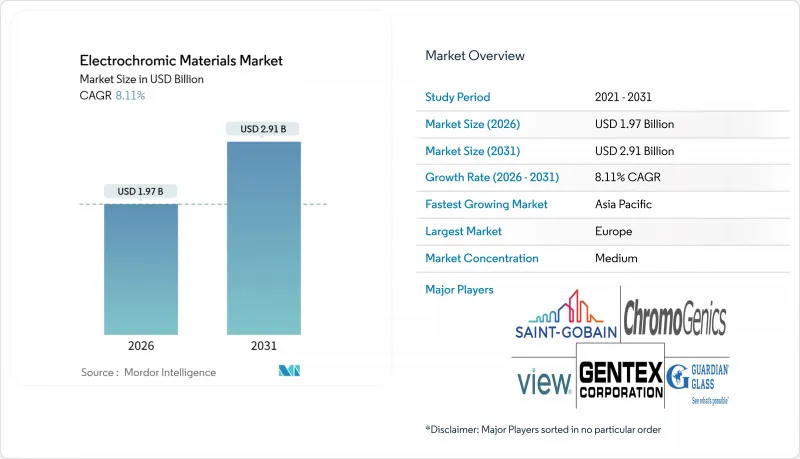
據 Mordor Intelligence 稱,電致變色材料市場預計在 2026 年達到 19.7 億美元,預計在預測期(2026-2031 年)內將以 8.11% 的複合年成長率成長,到 2031 年達到 29.1 億美元。
本報告按產品類型(金屬氧化物、紫精及其他)、裝置類型(智慧窗戶、鏡子、顯示器及其他)、外形規格(玻璃基板、聚合物薄膜、油墨和塗料)、終端用戶產業(建築、汽車及其他)和地區(亞太、北美、歐洲及其他)進行細分。市場預測以美元計價。
全球電致變色材料市場趨勢及洞察
能源效率法規正在加速智慧窗戶。
在歐洲、美國和英國的建築規範中,動態玻璃如今已不再被視為可選項,而是主要的合規手段,能夠縮短投資回收期並促進大規模維修。法國的RE2020標準規定,如果外牆能夠減少20%的暖通空調(HVAC)運作時間,則可獲得15%的碳抵消額度,而電致變色玻璃恰好符合這一標準。能源之星7.0版引入了名為「動態性能」的新評估類別,只有電致變色玻璃或懸浮顆粒系統才能達到該標準。美國國家再生能源實驗室(NREL)在2024年進行的一項實地研究表明,由於高峰需求激增,鳳凰城一棟辦公大樓維修計畫的簡單投資回收期縮短至7.2年。英國的「未來住宅標準」規定,從2025年起,建築運行碳排放量必須減少75%,這將間接促進電致變色玻璃的普及,因為僅靠隔熱材料已不足以滿足需求。
汽車領域對自動防眩後視鏡和全景天窗的需求
目前,豪華電動車配備了薄膜式電致變色車頂,可在90秒內完成開關,有效解決了長期的眩光問題。通用汽車公司於2024年獲得了一項分區式擋風玻璃專利,這表明汽車行業正朝著分段式調光技術發展,該技術可以阻擋來自乘客側的陽光,同時保持駕駛員的視野。雖然尺寸超過1.5米×1.6米的大型原型車表明該技術預計將擴大生產規模,但其800至1200美元的額外成本與電池續航里程的提升形成競爭,導致其在大眾市場車型中的普及率低於5%。
與傳統鍍膜玻璃相比,單價更高
每平方英尺85美元的平均安裝成本遠高於低輻射(Low-E)雙層玻璃窗每平方英尺22美元的基準價格,因此其應用僅限於A級和豪華住宅項目。僅有12%的美國開發人員在投機性辦公大樓專案中指定使用電致變色玻璃,但客製化建造(BTO)專案如果能降低租戶的營運成本,則願意接受更高的資本支出(CAPEX)。 View Inc.在2024年的倒閉凸顯了大規模生產主導的成本削減所帶來的資本外流風險,而這種削減並未涉及規模化。
細分市場分析
到2025年,金屬氧化物將佔銷售額的49.51%,這主要得益於其60-70%的光學調製範圍和超過5萬次循環的使用壽命(相比三氧化鎢而言)。層狀多孔W3O8薄膜可在5秒內實現開關,從而拓展了先前僅限於響應速度更快的化學物質的儀錶板應用。導電聚合物市場正呈現10.71%的成長率。這主要歸功於原始設備製造商(OEM)和維修採用卷對卷PEDOT和PANI層,這些材料可降低40%的製造成本,並可彎曲以適應曲面支撐。然而,添加紫外線阻隔塗層會使成本增加每平方公尺8-12美元,抑制了短期價格走勢。紫精和普魯士藍在一些細分市場仍然存在,在這些市場中,低於1秒的反應速度和防眩光性能比使用壽命更為重要。
在電致變色材料市場,基板的柔軟性以及對比度如今都受到嚴格評估。Ricoh的曲面A柱薄膜展示了PEDOT如何克服脆性氧化物的開裂問題,而鎢基系統則在長達30年的外牆質保方面表現出色。目前正在研究的混合複合材料有望兼具氧化物等級的耐久性和聚合物般的可加工性,但由於合成工藝複雜和許可壁壘,大規模市場推廣仍受阻。
預計到2025年,智慧窗戶將佔銷售額的46.13%,主要得益於數千平方公尺的建築訂單。同時,由於即使在陽光下也能清晰可見的汽車儀錶板和戶外零售標牌,顯示器市場預計將以11.12%的複合年成長率成長。電致變色顯示器即使在低於10萬勒克斯的環境下也能保持10:1的對比度,性能優於半透反射式液晶顯示器,其中一款名為「Crown」的原型產品可在兩秒鐘內完成切換。雖然隨著基於攝影機的後視系統的普及,後視鏡的市場佔有率正在下降,但自動防眩光玻璃在商用車改裝市場仍然很受歡迎。 Polytronics公司將安裝成本降低至每平方英尺40美元,為維修薄膜和塗層開闢了一個新的大規模生產領域。將調光功能與側入式LED結合的多功能面板正在模糊設備之間的界限,並增加每平方公尺的內容顯示量。
區域分析
到2025年,歐洲的銷售額佔全球的33.45%。這主要得益於《能源性能建築指令》(EPBD)的修訂,該修訂要求公共建築每年進行3%的維修,以及德國復興信貸銀行(KfW)的「高效住宅40」獎勵。法國的「RE2020」和英國的「未來住宅標準」透過設定傳統玻璃無法達到的碳排放上限,推動了電致變色技術的應用。在北歐一些已採用被動式房屋的國家,電致變色玻璃用於冬季采暖和夏季遮陽,但在義大利和西班牙,由於電費較低導致投資回收期較長,電致變色玻璃的普及速度較為緩慢。
亞太地區正以11.12%的複合年成長率快速成長,這主要得益於中國「中國製造2025」計畫下的進口替代舉措、日本原始設備製造商對電致變色屋頂的整合應用,以及韓國主要顯示器製造商向即使在陽光下也清晰可見的電子紙的轉型。印度的「2024年節能建築標準」為採用動態玻璃提供自願性積分獎勵,為未來的需求奠定了基礎。新加坡的「綠建築標誌白金級」認證標準獎勵那些將冷暖氣空調空調(HVAC)能耗降低20%的建築,鼓勵地方政府儘早採用相關技術。
在北美,加州第24號法規修正案和紐約州第97號地方法律對碳排放施加了懲罰性措施,從而促進了動態玻璃的發展;同時,聯邦政府的淨零排放目標也為2030年之前的發展創造了穩定的市場需求。由於301條款關稅導致從中國進口玻璃的成本增加了25%,聖戈班公司正在明尼蘇達州推進4500萬美元的擴建項目。加拿大的泛加拿大框架正在推動各省建築規範的協調統一,其中不列顛哥倫比亞省和安大略省已強制要求在公共基礎設施中使用電致變色玻璃。在拉丁美洲和中東,高階辦公大樓和大型城市開發案(例如沙烏地阿拉伯的NEOM)也持續推動動態玻璃的應用。
其他好處
- Excel格式的市場預測(ME)表
- 3個月的分析師支持
目錄
第1章:引言
- 研究假設和市場定義
- 調查範圍
第2章:調查方法
第3章執行摘要
第4章 市場狀況
- 市場概覽
- 市場促進因素
- 能源效率法規正在加速智慧窗戶。
- 汽車領域對自動防眩後視鏡和全景天窗的需求
- 旨在減輕重量和減少眩光的航太窗戶改進。
- 自發電電致變色智慧窗戶,整合太陽能發電系統
- 關稅導致電致變色材料供應鏈回流國內
- 市場限制因素
- 與傳統鍍膜玻璃相比,單價更高
- 與循環特性、穩定性和耐久性相關的挑戰
- 數位後視鏡的廣泛應用導致汽車對電子後視鏡的需求下降。
- 價值鏈分析
- 波特五力模型
第5章 市場規模與成長預測
- 依產品類型
- 金屬氧化物
- 紫精
- 導電聚合物
- 普魯士藍
- 其他
- 依設備類型
- 智慧窗戶
- 鏡子
- 展示
- 薄膜塗層
- 其他
- 按外形規格
- 玻璃基板
- 聚合物薄膜
- 墨水和顏料
- 按最終用戶行業分類
- 建築/施工
- 車
- 電氣和電子設備
- 航太/國防
- 其他
- 按地區
- 亞太地區
- 中國
- 印度
- 日本
- 韓國
- ASEAN
- 其他亞太國家
- 北美洲
- 美國
- 加拿大
- 墨西哥
- 歐洲
- 德國
- 英國
- 義大利
- 法國
- 北歐國家
- 其他歐洲國家
- 南美洲
- 巴西
- 阿根廷
- 其他南美國家
- 中東和非洲
- 沙烏地阿拉伯
- 南非
- 其他中東和非洲國家
- 亞太地區
第6章 競爭情勢
- 市場集中度
- 策略趨勢
- 市佔率和排名分析
- 公司簡介
- AGC Inc.
- Changzhou YAPU new material Co., Ltd.
- ChromoGenics
- Crown Electrokinetics Corp.
- EControl-Glas GmbH & Co. KG
- GENTEX CORPORATION
- Guardian Glass
- KIBING GROUP
- Kinestral Technologies(Halio)
- Miru Smart Technologies
- Ningbo Miruo Electronic Technology Co., Ltd.
- Polytronix, Inc.
- Ricoh
- Saint-Gobain
- View, Inc.
- Zhuhai Kaivo Optoelectronic Technology Co., Ltd.
第7章 市場機會與未來展望
According to Mordor Intelligence, the electrochromic materials market size is estimated at USD 1.97 billion in 2026, and is expected to reach USD 2.91 billion by 2031, at a CAGR of 8.11% during the forecast period (2026-2031).
This report is Segmented by Product Type (Metal Oxides, Viologens, and More), Device Type (Smart Windows, Mirrors, Displays, and More), Form Factor (Glass Substrates, Polymer Films, and Inks and Paints), End-User Industry (Building and Construction, Automotive, and More), and Geography (Asia-Pacific, North America, Europe, and More). The Market Forecasts are Provided in Terms of Value (USD).
Global Electrochromic Materials Market Trends and Insights
Energy-Efficiency Regulations Accelerating Smart-Window Adoption
European, U.S. and U.K. building codes now recognize dynamic glazing as a primary compliance route rather than a discretionary feature, compressing payback periods and triggering large scale retrofits. France's RE2020 grants a 15% carbon-offset credit for facades that reduce HVAC runtime by 20%, a threshold met by electrochromic glass. ENERGY STAR Version 7.0 created a "dynamic performance" tier that only electrochromic or suspended-particle devices satisfy. NREL field work in 2024 showed that Phoenix office retrofits cut simple payback to 7.2 years as peak-demand charges escalated. The UK Future Homes Standard mandates 75% lower operational carbon from 2025, indirectly boosting electrochromics as insulation-only packages become insufficient.
Automotive Demand for Auto-Dimming Mirrors and Panoramic Sunroofs
Premium electric vehicles now rely on film-based electrochromic roofs that switch in under 90 seconds, addressing legacy glare complaints. GM's 2024 patent for zone-specific windshields illustrates the shift toward segmented dimming that preserves driver sightlines while shading passengers. Large-format prototypes exceeding 1.5 m X 1.6 m confirm manufacturing scale-up, yet penetration in mass-market trims remains below 5% because the USD 800-1,200 adder competes with battery-range upgrades.
High Unit Cost Versus Conventional Coated Glass
Installed prices averaging USD 85 per ft2 dwarf the USD 22 per ft2 baseline for low-e double glazing, limiting adoption to Class-A and high-end residential projects. Only 12% of U.S. developers specify electrochromics for speculative offices, though build-to-suit projects accept higher capex when operational savings accrue to tenants. Bankruptcy of View Inc. in 2024 highlights the cash-burn risk of volume-driven cost reduction without scale.
Other drivers and restraints analyzed in the detailed report include:
- Aerospace Window Upgrades for Weight and Glare Reduction
- Self-Powered Electrochromic Smart Windows Integrating Solar Harvesters
- Cycling-Stability and Durability Challenges
For complete list of drivers and restraints, kindly check the Table Of Contents.
Segment Analysis
Metal oxides maintained 49.51% revenue in 2025, anchored by tungsten-trioxide's 60-70% light-modulation range and more than 50,000 cycle life. Hierarchically porous W3O8 films achieved sub-5 s switching, opening dashboard opportunities previously reserved for faster chemistries. Conducting polymers grow at 10.71% as OEMs and retrofitters adopt roll-to-roll PEDOT and PANI layers that cut manufacturing costs 40% and bend onto curved pillars. However, additional ultraviolet-barrier coatings add USD 8-12 per m2, tempering the near-term price narrative. Viologen and Prussian blue niches persist where less than 1 s response or anti-glare performance outweighs lifetime concerns.
The electrochromic materials market now evaluates substrate flexibility as rigorously as contrast ratio. Ricoh's curved A-pillar film shows how PEDOT overcomes brittle-oxide cracking, whereas tungsten systems excel in 30-year facade warranties. Hybrid composites under investigation promise oxide-level durability with polymer-style processability, yet synthesis complexity and licensing hurdles stall large-scale launch.
Smart windows captured 46.13% revenue in 2025 on the back of multi-thousand-square-meter building orders, but displays will post an 11.12% CAGR thanks to sunlight-readable automotive clusters and outdoor retail signage. Electrochromic displays maintain 10:1 contrast under 100,000 lux, outperforming transflective LCDs, and crown-labeled prototypes transition fully in less than 2s. Mirrors lose share as camera-based rear vision scales, yet after-market commercial vehicles still specify auto-dimming glass. Retrofit films and coatings furnish a new volume tier as Polytronix cuts install costs to USD 40 ft2. Multi-function panels that fuse dimming with edge LEDs blur device boundaries and raise content per square meter.
Complete Report Scope:
- By Product Type
- Metal Oxides
- Viologens
- Conducting Polymers
- Prussian Blue
- Other Product Types
- By Device Type
- Smart Windows
- Mirrors
- Displays
- Films and Coatings
- Other Device Types
- By Form Factor
- Glass Substrates
- Polymer Films
- Inks and Paints
- By End-user Industry
- Building and Construction
- Automotive
- Electrical and Electronics
- Aerospace and Defense
- Other End-user Industries
- By Geography
- Asia-Pacific
- China
- India
- Japan
- South Korea
- ASEAN Countries
- Rest of Asia-Pacific
- North America
- United States
- Canada
- Mexico
- Europe
- Germany
- United Kingdom
- Italy
- France
- NORDIC Countries
- Rest of Europe
- South America
- Brazil
- Argentina
- Rest of South America
- Middle-East and Africa
- Saudi Arabia
- South Africa
- Rest of Middle-East and Africa
- Asia-Pacific
Geography Analysis
Europe delivered 33.45% revenue in 2025, propelled by the EPBD recast that obliges 3% annual public building retrofits and Germany's KfW Efficiency House 40 incentives. France's RE2020 and the U.K.'s Future Homes Standard push electrochromic uptake by setting carbon ceilings that static glazing cannot breach. Nordic passive-house adopters exploit EC glass for winter gain and summer shading, while Italy and Spain lag as lower electricity tariffs prolong payback.
Asia-Pacific, advancing at an 11.12% CAGR, benefits from China's import-substitution push under Made in China 2025, Japanese OEM integration of electrochromic roofs, and South Korean display giants turning to sunlight-readable e-paper. India's 2024 Energy Conservation Building Code offers a voluntary dynamic-glazing credit, setting the groundwork for future demand. Singapore's Green Mark Platinum pathway rewards 20% HVAC energy cuts, fostering early municipal adoption.
In North America, California's Title 24 updates and New York's Local Law 97 impose carbon penalties that favor dynamic glazing, while federal net-zero mandates create a captive demand pipeline through 2030. Section 301 tariffs increase landed costs for Chinese imports by 25%, spurring Saint-Gobain's USD 45 million Minnesota expansion. Canada's Pan-Canadian Framework backs provincial code harmonization, with British Columbia and Ontario specifying EC glass in public infrastructure. Latin American and Middle-East uptake remains project-driven in prestige office towers and megacity developments like Saudi Arabia's NEOM.
- AGC Inc.
- Changzhou YAPU new material Co., Ltd.
- ChromoGenics
- Crown Electrokinetics Corp.
- EControl-Glas GmbH & Co. KG
- GENTEX CORPORATION
- Guardian Glass
- KIBING GROUP
- Kinestral Technologies (Halio)
- Miru Smart Technologies
- Ningbo Miruo Electronic Technology Co., Ltd.
- Polytronix, Inc.
- Ricoh
- Saint-Gobain
- View, Inc.
- Zhuhai Kaivo Optoelectronic Technology Co., Ltd.
Additional Benefits:
- The market estimate (ME) sheet in Excel format
- 3 months of analyst support
TABLE OF CONTENTS
1 Introduction
- 1.1 Study Assumptions and Market Definition
- 1.2 Scope of the Study
2 Research Methodology
3 Executive Summary
4 Market Landscape
- 4.1 Market Overview
- 4.2 Market Drivers
- 4.2.1 Energy-Efficiency Regulations Accelerating Smart-Window Adoption
- 4.2.2 Automotive Demand for Auto-Dimming Mirrors and Panoramic Sunroofs
- 4.2.3 Aerospace Window Upgrades for Weight and Glare Reduction
- 4.2.4 Self-Powered Electrochromic Smart Windows Integrating Solar Harvesters
- 4.2.5 Tariff-Driven Reshoring of Electrochromic Material Supply Chains
- 4.3 Market Restraints
- 4.3.1 High Unit Cost Versus Conventional Coated Glass
- 4.3.2 Cycling-Stability and Durability Challenges
- 4.3.3 Digital Rear-View Mirrors Eroding Automotive EC Mirror Demand
- 4.4 Value Chain Analysis
- 4.5 Porter's Five Forces
- 4.5.1 Bargaining Power of Suppliers
- 4.5.2 Bargaining Power of Consumers
- 4.5.3 Threat of New Entrants
- 4.5.4 Threat of Substitute Products and Services
- 4.5.5 Degree of Competition
5 Market Size and Growth Forecasts (Value)
- 5.1 By Product Type
- 5.1.1 Metal Oxides
- 5.1.2 Viologens
- 5.1.3 Conducting Polymers
- 5.1.4 Prussian Blue
- 5.1.5 Other Product Types
- 5.2 By Device Type
- 5.2.1 Smart Windows
- 5.2.2 Mirrors
- 5.2.3 Displays
- 5.2.4 Films and Coatings
- 5.2.5 Other Device Types
- 5.3 By Form Factor
- 5.3.1 Glass Substrates
- 5.3.2 Polymer Films
- 5.3.3 Inks and Paints
- 5.4 By End-user Industry
- 5.4.1 Building and Construction
- 5.4.2 Automotive
- 5.4.3 Electrical and Electronics
- 5.4.4 Aerospace and Defense
- 5.4.5 Other End-user Industries
- 5.5 By Geography
- 5.5.1 Asia-Pacific
- 5.5.1.1 China
- 5.5.1.2 India
- 5.5.1.3 Japan
- 5.5.1.4 South Korea
- 5.5.1.5 ASEAN Countries
- 5.5.1.6 Rest of Asia-Pacific
- 5.5.2 North America
- 5.5.2.1 United States
- 5.5.2.2 Canada
- 5.5.2.3 Mexico
- 5.5.3 Europe
- 5.5.3.1 Germany
- 5.5.3.2 United Kingdom
- 5.5.3.3 Italy
- 5.5.3.4 France
- 5.5.3.5 NORDIC Countries
- 5.5.3.6 Rest of Europe
- 5.5.4 South America
- 5.5.4.1 Brazil
- 5.5.4.2 Argentina
- 5.5.4.3 Rest of South America
- 5.5.5 Middle-East and Africa
- 5.5.5.1 Saudi Arabia
- 5.5.5.2 South Africa
- 5.5.5.3 Rest of Middle-East and Africa
- 5.5.1 Asia-Pacific
6 Competitive Landscape
- 6.1 Market Concentration
- 6.2 Strategic Moves
- 6.3 Market Share(%)/Ranking Analysis
- 6.4 Company Profiles (includes Global level Overview, Market level overview, Core Segments, Financials as available, Strategic Information, Products and Services, and Recent Developments)
- 6.4.1 AGC Inc.
- 6.4.2 Changzhou YAPU new material Co., Ltd.
- 6.4.3 ChromoGenics
- 6.4.4 Crown Electrokinetics Corp.
- 6.4.5 EControl-Glas GmbH & Co. KG
- 6.4.6 GENTEX CORPORATION
- 6.4.7 Guardian Glass
- 6.4.8 KIBING GROUP
- 6.4.9 Kinestral Technologies (Halio)
- 6.4.10 Miru Smart Technologies
- 6.4.11 Ningbo Miruo Electronic Technology Co., Ltd.
- 6.4.12 Polytronix, Inc.
- 6.4.13 Ricoh
- 6.4.14 Saint-Gobain
- 6.4.15 View, Inc.
- 6.4.16 Zhuhai Kaivo Optoelectronic Technology Co., Ltd.
7 Market Opportunities and Future Outlook
- 7.1 White-space and Unmet-need Assessment

 全球電致變色材料市場規模、佔有率、趨勢及成長分析報告(2026-2034年)
 電致變色玻璃:市場佔有率分析、產業趨勢與統計、成長預測(2026-2031)
 電致變色玻璃市場規模、佔有率和趨勢分析報告:按最終用途、應用、地區和細分市場預測(2026-2033 年)
 電致變色玻璃及裝置市場-2026-2032年全球市場預測
 2026年全球電動變色智慧玻璃市場報告
 電致變色玻璃市場報告:按應用、終端用戶產業和地區分類(2026-2034 年)
 電致變色玻璃市場:按應用、最終用途和地區分類全球電致變色玻璃市場規模、佔有率、趨勢和成長分析報告(2026-2034年)電致變色材料市場:按材料、應用、最終用戶和產品分類-2026-2032年全球市場預測
 電致變色材料市場規模、佔有率及成長分析(按產品、應用、最終用戶及地區分類)-產業預測,2026-2033年