


 |
市場調查報告書
商品編碼
2163344
CoaXPress 機器視覺組件:市場佔有率分析、行業趨勢和統計數據、成長預測(2026-2031 年)CoaXPress Machine Vision Components - Market Share Analysis, Industry Trends & Statistics, Growth Forecasts (2026 - 2031) |
||||||

※ 本網頁內容可能與最新版本有所差異。詳細情況請與我們聯繫。
根據 Mordor Intelligence 預測,CoaXPress 機器視覺組件市場規模預計將在 2025 年達到 8.2 億美元,2026 年達到 8.8 億美元,到 2031 年達到 13.7 億美元,2026 年至 2031 年的複合年成長率為 9.26%。
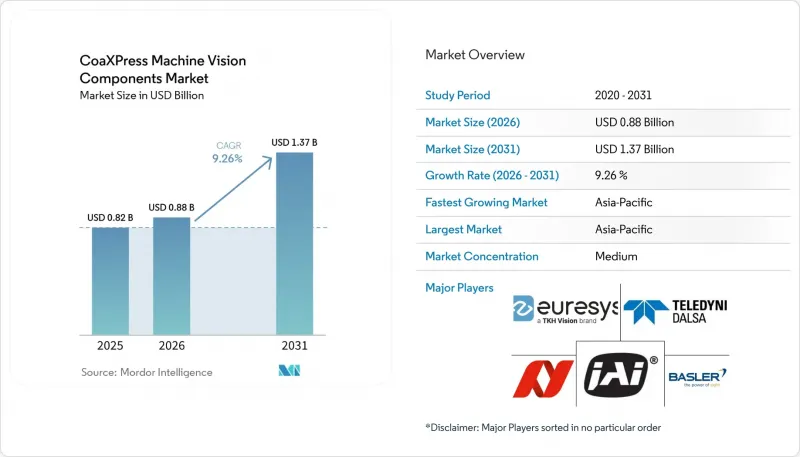
全球 CoaXPress 機器視覺組件市場趨勢與洞察
高通量半導體和顯示器測試構成了協定需求的基礎。
半導體檢測仍然是CoaXPress機器視覺組件市場的主要需求驅動力。高頻寬記憶體、晶片組和共封裝光學元件需要進行全晶圓掃描,並產生大量的影像資料。 Basler公司已展示了支援16K解析度和500 kHz線速率的晶圓偵測系統,可用於即時缺陷檢測。在這些條件下,多鏈路CXP-12系統非常適用,因為壓縮會降低偵測品質。 TDI相機和CXP-12光纖系統也能夠滿足先進代晶圓代工廠線的掃描速度需求。顯示器偵測領域也出現了類似的需求,OLED和mini-LED生產線需要穩定、高速的成像。
工廠自動化和線上品質檢測正在擴大終端市場基礎。
製造商正從批量抽樣轉向在每個組裝階段進行檢測,並增加生產線上使用的攝影機數量。 BMW已在其伍德拉夫電池工廠實施了對電池焊接和發泡過程的連續檢測。通用汽車 (GM) 開發了「BVSeal」技術,該技術利用氣體成像和人工智慧驅動的協作機器人來識別電池托盤中的洩漏。這些應用需要在夾具或機器人工具移動之前進行精確協調的影像擷取。 CoaXPress 提供了一個 41.6 Mbps 的上行鏈路通道,可支援超過 500 kHz 的觸發頻率。此功能減少了多攝影機系統中單獨上行鏈路佈線的需求,並簡化了工作站的安裝。
CoaXPress 影像擷取卡系統的高昂初始成本阻礙了其廣泛應用。
一款相容於 PCIe Gen4 的 4 連結 CXP-12 影像擷取卡單價超過 3000 美元。據 KAYA Vision 稱,這相當於同等規格 GigE Vision 影像擷取卡價格的三倍。如此高的初始成本可能會迫使南亞和東南亞的系統整合商選擇 GigE Vision 系統,儘管其性能略遜一籌。減少丟幀和重檢查週期帶來的成本節約可能超過硬體採購預算。 2026 年 4 月,Basler 發布了 imaFlex 2 Dual 100 系統,該系統採用基於 FPGA 的預處理功能,可將下游 GPU、CPU 和影像擷取卡的需求降低 20% 至 50%。然而,這種方法仍然需要對 VisualApplets 程式設計能力進行投資。
細分市場分析
到2025年,相機將佔據CoaXPress機器視覺組件市場52.70%的佔有率。這一地位得益於老舊Camera Link設計的淘汰以及背照式全域百葉窗感測器的普及。影像擷取卡和介面卡是第二大組件類別,其中基於FPGA的預處理和PCIe Gen4闆卡中的GPU直接DMA技術的應用日益廣泛。線纜、連接器和線纜組件對於任何相機安裝仍然至關重要。 JIIA CXP-001-2021標準規定了符合該標準的CoaXPress設備,包括線纜相關的要求。
預計到2031年,軟體、SDK和IP核將以11.26%的複合年成長率成長。 CoaXPress機器視覺組件市場區隔領域將受益於設備製造商採用FPGA IP而非自行開發協定功能。 Silicon Software的VisualApplets和Microchip的PolarFire IP支援此流程,同時,隨著現有CXP-12相機群透過光纖橋接模組的擴展,中繼器和訊號調理產品的重要性也日益凸顯。 KAYA Instruments提供雙訊號轉換器,支援在超過80公里的單模光纖上進行傳輸。與取決於出貨量的相機收入不同,軟體收入可以基於同一設計建構的整個系統進行規模化成長。
從相機架構來看,面陣掃描相機預計在2025年將佔總銷售量的61.40%。這些相機廣泛應用於電子組裝檢驗、測量、汽車車體檢測和醫學影像等領域。新型2400萬像素至1.27億像素的感測器正在加速從CXP-6向CXP-12的過渡。線陣掃描相機在材料連續通過檢測站的應用中仍然發揮著至關重要的作用,例如捲材檢測和印刷基板製造。 CXP-12能夠提升這些應用的頻寬並延長電纜傳輸距離。
預計到2031年,TDI相機市場將以11.34%的複合年成長率成長。 CoaXPress機器視覺組件市場的這一細分領域主要面向晶圓和先進封裝檢測,這些領域對靈敏度要求極高。 2025年3月,Tucsen推出了Gemini 8KTDI相機,採用100G CoaXPress光纖介面,峰值量子效率高達94.2%,線速率為1MHz。 2026年6月,Teledyne DALSA推出了Linea HS2 8k TDI相機,該相機配備多個TDI級,可調節線速率、動態範圍和滿阱容量的平衡。此外,Vieworks在2026年自動化世界展上展示了其VT-16K混合TDI相機,該相機配備8通道CoaXPress介面。
區域分析
預計到2025年,亞太地區將佔據CoaXPress機器視覺組件市場43.70%的佔有率,並將以12.02%的複合年成長率持續成長至2031年。該地區集中了眾多半導體晶圓代工廠、顯示器工廠和電動車電池工廠。台灣和韓國擁有尖端的邏輯半導體生產能力,而中國正在擴大其國內晶圓代工廠產能和本地CoaXPress供應商規模。 2026年7月,BOPIXEL推出了用於半導體和封裝檢測的100 Gbps CoaXPress光纖相機系列。同年8月,途勝在無錫發布了“Libra 27105”,進一步展現了其在該地區深厚的產品研發實力。
日本透過JIIA的標準化活動和合規工具保持核心地位,而韓國則在高階TDI系統方面不斷提升能力,Vieworks在2026年自動化世界大會上展示了其成果。隨著半導體和電動車製造領域投資的成長,印度正在崛起成為新的需求來源。 Basler於2025年10月收購了Alpha TechSys Automation India 76%的股份,從而增強了其在當地的系統整合和售後服務能力。北美是第二大區域市場,其發展得益於航太、國防、半導體製造和機器視覺軟體開發。同時,主要晶圓廠仍處於採用階段,預計在2027年和2028年將進一步擴張。
歐洲在汽車製造、電動車電池檢測和機器視覺軟體方面擁有豐富的專業知識,德國、比利時和英國仍然是系統開發人員和供應商的關鍵中心。 Allied Vision 的 FXO CXP-12 相機主要針對德國無塵室中的半導體和電子產品應用。南美洲、中東和非洲的收入基礎相對較小,主要透過經銷商提供服務。巴西和阿根廷擁有活躍的汽車和家用電子電器生產,而阿拉伯聯合大公國、沙烏地阿拉伯和南非在工業自動化、國防成像和汽車供應鏈方面的需求有限。由於初始成本較高,CoaXPress 機器視覺組件市場僅限於其性能優勢具有商業性價值的應用領域。
其他好處:
- Excel格式的市場預測(ME)表
- 3個月的分析師支持
目錄
第1章:引言
- 研究假設和市場定義
- 調查範圍
第2章:調查方法
第3章執行摘要
第4章 市場狀況
- 市場概覽
- 市場促進因素
- 提高高速感測器的解析度
- 工廠自動化和線上品質檢測
- CoaXPress 2.0 和 PCIe頻寬擴展
- 高通量半導體和顯示器測試
- 邊緣端的FPGA和GPU直接資料縮減
- 在電磁干擾受限的安裝環境中實施CoaXPress-over-Fiber技術
- 市場限制因素
- CoaXPress影像擷取卡系統的初始成本較高
- 與 10GigE 和新興以乙太網路為基礎網路介面的競爭
- CoaXPress 整合和 FPGA 工程技能不足
- 高密度多鏈路系統中的電源供應和散熱限制
- 宏觀經濟因素對市場的影響
- 產業供應鏈分析
- 科技趨勢
- 監理情勢
- 波特五力分析
第5章 市場規模與成長預測
- 依組件類型
- CoaXPress 相機
- CoaXPress 影像擷取卡和介面卡
- CoaXPress 電纜、連接器和電纜組件
- CoaXPress中繼器、訊號調理和連接組件
- CoaXPress 軟體、SDK 和 IP 核
- 相機架構
- 臉部掃描相機
- 線掃描相機
- TDI相機
- CoaXPress 按速度等級
- CXP-1~CXP-6
- CXP-10
- CXP-12
- 按最終用戶行業分類
- 電子和半導體製造
- 汽車和電動汽車製造
- 航太/國防
- 醫療保健和生命科學
- 一般製造業和機械製造商
- 研究機構和大學
- 家用電子電器OEM製造商
- 按地區
- 北美洲
- 美國
- 加拿大
- 墨西哥
- 南美洲
- 巴西
- 阿根廷
- 其他南美國家
- 歐洲
- 德國
- 英國
- 法國
- 義大利
- 西班牙
- 其他歐洲國家
- 亞太地區
- 中國
- 日本
- 印度
- 韓國
- 澳洲
- 其他亞太國家
- 中東
- 阿拉伯聯合大公國
- 沙烏地阿拉伯
- 其他中東國家
- 非洲
- 南非
- 其他非洲國家
- 北美洲
第6章 競爭情勢
- 市場集中度
- 策略趨勢
- 市佔率分析
- 公司簡介
- Adimec Advanced Image Systems BV
- Active Silicon Ltd
- Allied Vision Technologies GmbH
- Basler AG
- BitFlow, Inc.
- Euresys SA
- Gidel Ltd
- Imperx, Inc.
- JAI A/S
- KAYA Instruments Ltd
- Matrox Electronic Systems Ltd.
- Optronis GmbH
- Pleora Technologies Inc.
- Raptor Photonics Limited
- Silicon Software GmbH
- SVS-Vistek GmbH
- Teledyne DALSA, Inc.
- Emergent Vision Technologies Inc.
- Photron Limited
- IDS Imaging Development Systems GmbH
第7章 市場機會與未來展望
According to Mordor Intelligence, the CoaXPress machine vision components market size is projected to be USD 0.82 billion in 2025, USD 0.88 billion in 2026, and reach USD 1.37 billion by 2031, expanding at a CAGR of 9.26% from 2026 to 2031.
Global CoaXPress Machine Vision Components Market Trends and Insights
High-Throughput Semiconductor and Display Inspection Underpins Protocol Demand
Semiconductor inspection remains the primary driver of demand in the CoaXPress machine vision components market. High-bandwidth memory, chiplets, and co-packaged optics require full-wafer scans with heavy image data loads. Basler described wafer inspection systems that support 16K resolution and 500 kHz line rates for real-time defect inspection. These conditions favor multi-link CXP-12 systems, in which compression can compromise inspection quality. TDI cameras and CXP-12-over-Fiber systems also suit the scan speed requirements of advanced foundry lines. Display inspection creates a similar need, as OLED and mini-LED production lines require consistent, high-speed imaging.
Factory Automation and Inline Quality Inspection Widen the End-Market Base
Manufacturers are replacing batch sampling with inspection at each assembly stage, increasing the number of cameras used on a line. BMW used continuous checks for battery weld seams and foaming processes at its Woodruff battery facility. General Motors developed BVSeal to use gas imaging and AI-enabled cobots to identify battery tray leaks. These applications need tightly coordinated image capture before fixtures or robotic tools move. CoaXPress provides a 41.6 Mbps uplink channel that can support trigger rates above 500 kHz. That capability can reduce separate uplink cabling in multi-camera systems and simplify station installation.
High Upfront Cost of CoaXPress Frame Grabber Systems Limits Adoption
Four-link CXP-12 frame grabbers with PCIe Gen4 support cost more than USD 3,000 per card. KAYA Vision reported that this is 3 times the cost of comparable GigE Vision frame grabbers. The initial cost can lead integrators in South and Southeast Asia to select GigE Vision systems despite lower performance. Savings from fewer missed frames and fewer reinspection cycles may sit outside the hardware purchasing budget. Basler introduced its imaFlex 2 Dual 100 system in April 2026, featuring FPGA preprocessing that can reduce downstream GPU, CPU, and frame-grabber requirements by 20-50%. However, the approach still requires investment in VisualApplets programming capability.
Other drivers and restraints analyzed in the detailed report include:
- CoaXPress 2.0 and PCIe Bandwidth Expansion Raise the Throughput Floor
- High-Speed Sensor Resolution Escalation Accelerates Bandwidth Demand
- Competition From 10GigE and Ethernet-Based Interfaces Pressures Mid-Range Tiers
For complete list of drivers and restraints, kindly check the Table Of Contents.
Segment Analysis
Cameras held 52.70% of the CoaXPress machine vision components market share in 2025. The replacement of aging Camera Link designs and the adoption of backside-illuminated global-shutter sensors supported this position. Frame grabbers and interface cards constitute the second-largest component category, with PCIe Gen4 boards increasingly incorporating FPGA preprocessing and GPU-direct DMA. Cables, connectors, and cable assemblies remain necessary with every camera installation. The JIIA CXP-001-2021 standard covers compliant CoaXPress equipment, including cable-related requirements.
Software, SDKs, and IP cores are projected to expand at an 11.26% CAGR through 2031. This CoaXPress machine vision components market segment benefits when equipment builders use FPGA IP rather than developing protocol functions in-house. Silicon Software VisualApplets and Microchip PolarFire IP support this process, while repeaters and signal-conditioning products gain relevance as fiber bridge modules extend installed CXP-12 camera fleets. KAYA Instruments offers a dual-signal converter that supports transmission over single-mode fiber beyond 80 km. Software revenue can scale across systems built on the same design, unlike camera revenue, which depends on unit shipments.
Area-scan cameras held 61.40% of 2025 revenue by camera architecture. They support electronics assembly verification, metrology, automotive body inspection, and healthcare imaging. New 24 MP to 127 MP sensors are accelerating the move from CXP-6 to CXP-12 connections. Line-scan cameras remain important where material moves continuously through an inspection station, including web inspection and printed circuit board manufacturing. CXP-12 provides added bandwidth and longer cable reach for these applications.
TDI cameras are projected to expand at an 11.34% CAGR through 2031. This segment of the CoaXPress machine vision components market supports wafer and advanced-packaging inspection, where sensitivity is critical. Tucsen launched the Gemini 8KTDI in March 2025 with a 100G CoaXPress-over-Fiber interface, 94.2% peak quantum efficiency, and a 1 MHz line rate. Teledyne DALSA released the Linea HS2 8k TDI camera in June 2026 with a configurable TDI stage count that balances line rate, dynamic range, and full-well capacity. Vieworks also showed its VT-16K Hybrid TDI camera with a CoaXPress 8-channel interface at Automation World 2026.
Complete Report Scope:
- By Component Type
- CoaXPress Cameras
- CoaXPress Frame Grabbers and Interface Cards
- CoaXPress Cables, Connectors and Cable Assemblies
- CoaXPress Repeaters, Signal-Conditioning and Connectivity Components
- CoaXPress Software, SDKs and IP Cores
- By Camera Architecture
- Area-Scan Cameras
- Line-Scan Cameras
- TDI Cameras
- By CoaXPress Speed Class
- CXP-1 to CXP-6
- CXP-10
- CXP-12
- By End-User Industry
- Electronics and Semiconductor Manufacturing
- Automotive and EV Manufacturing
- Aerospace and Defense
- Healthcare and Life Sciences
- General Manufacturing and Machine Builders
- Research Institutes and Universities
- Consumer Electronics OEMs
- By Geography
- North America
- United States
- Canada
- Mexico
- South America
- Brazil
- Argentina
- Rest of South America
- Europe
- Germany
- United Kingdom
- France
- Italy
- Spain
- Rest of Europe
- Asia-Pacific
- China
- Japan
- India
- South Korea
- Australia
- Rest of Asia-Pacific
- Middle East
- United Arab Emirates
- Saudi Arabia
- Rest of Middle East
- Africa
- South Africa
- Rest of Africa
- North America
Geography Analysis
Asia-Pacific held 43.70% of the CoaXPress machine vision components market share in 2025 and is projected to expand at a 12.02% CAGR through 2031. Semiconductor foundries, display plants, and EV battery factories are concentrated across the region. Taiwan and South Korea support advanced logic production, while China is expanding domestic foundry capacity and its local CoaXPress supplier base. BOPIXEL launched a 100 Gbps CoaXPress-over-Fiber camera series in July 2026 for semiconductor and packaging inspection. Tucsen also presented the Libra 27105 in Wuxi in August 2026, demonstrating the depth of its regional product development.
Japan retains a central role through JIIA standards work and compliance tooling, while South Korea is building capability in higher-end TDI systems, as shown by Vieworks at Automation World 2026. India is an emerging source of demand as investments in semiconductor and EV manufacturing increase. Basler acquired a 76% stake in Alpha TechSys Automation India in October 2025, adding local systems integration and after-sales support. North America is the second-largest regional market, supported by aerospace, defense, semiconductor construction, and machine vision software development, while major fabs remain in installation phases and deployment is expected to strengthen in 2027 and 2028.
Europe benefits from automotive production, EV battery inspection, and machine vision software expertise, with Germany, Belgium, and the United Kingdom remaining important locations for system developers and suppliers. Allied Vision's FXO CXP-12 cameras were positioned for cleanroom semiconductor and electronics work in Germany. South America, the Middle East, and Africa have smaller revenue bases and are served mainly through distributors. Brazil and Argentina are active in automotive and domestic electronics production, while the United Arab Emirates, Saudi Arabia, and South Africa offer selective demand in industrial automation, defense imaging, and automotive supply chains. Higher upfront costs limit the CoaXPress machine vision components market to applications where its performance benefit is commercially justified.
- Adimec Advanced Image Systems B.V.
- Active Silicon Ltd
- Allied Vision Technologies GmbH
- Basler AG
- BitFlow, Inc.
- Euresys SA
- Gidel Ltd
- Imperx, Inc.
- JAI A/S
- KAYA Instruments Ltd
- Matrox Electronic Systems Ltd.
- Optronis GmbH
- Pleora Technologies Inc.
- Raptor Photonics Limited
- Silicon Software GmbH
- SVS-Vistek GmbH
- Teledyne DALSA, Inc.
- Emergent Vision Technologies Inc.
- Photron Limited
- IDS Imaging Development Systems GmbH
Additional Benefits:
- The market estimate (ME) sheet in Excel format
- 3 months of analyst support
TABLE OF CONTENTS
1 INTRODUCTION
- 1.1 Study Assumptions and Market Definition
- 1.2 Scope of the Study
2 RESEARCH METHODOLOGY
3 EXECUTIVE SUMMARY
4 MARKET LANDSCAPE
- 4.1 Market Overview
- 4.2 Market Drivers
- 4.2.1 High-Speed Sensor Resolution Escalation
- 4.2.2 Factory Automation and Inline Quality Inspection
- 4.2.3 CoaXPress 2.0 and PCIe Bandwidth Expansion
- 4.2.4 High-Throughput Semiconductor and Display Inspection
- 4.2.5 FPGA and GPU-Direct Data Reduction at the Edge
- 4.2.6 CoaXPress-over-Fiber Adoption in EMI-Constrained Installations
- 4.3 Market Restraints
- 4.3.1 High Upfront Cost of CoaXPress Frame Grabber Systems
- 4.3.2 Competition from 10GigE and Emerging Ethernet-Based Interfaces
- 4.3.3 Shortage of CoaXPress Integration and FPGA Engineering Skills
- 4.3.4 Power Delivery and Thermal Constraints in Dense Multi-Link Systems
- 4.4 Impact of Macroeconomic Factors on the Market
- 4.5 Industry Supply-Chain Analysis
- 4.6 Technology Outlook
- 4.7 Regulatory Landscape
- 4.8 Porter's Five Forces Analysis
- 4.8.1 Threat of New Entrants
- 4.8.2 Bargaining Power of Suppliers
- 4.8.3 Bargaining Power of Buyers
- 4.8.4 Threat of Substitutes
- 4.8.5 Intensity of Competitive Rivalry
5 MARKET SIZE AND GROWTH FORECASTS (VALUE)
- 5.1 By Component Type
- 5.1.1 CoaXPress Cameras
- 5.1.2 CoaXPress Frame Grabbers and Interface Cards
- 5.1.3 CoaXPress Cables, Connectors and Cable Assemblies
- 5.1.4 CoaXPress Repeaters, Signal-Conditioning and Connectivity Components
- 5.1.5 CoaXPress Software, SDKs and IP Cores
- 5.2 By Camera Architecture
- 5.2.1 Area-Scan Cameras
- 5.2.2 Line-Scan Cameras
- 5.2.3 TDI Cameras
- 5.3 By CoaXPress Speed Class
- 5.3.1 CXP-1 to CXP-6
- 5.3.2 CXP-10
- 5.3.3 CXP-12
- 5.4 By End-User Industry
- 5.4.1 Electronics and Semiconductor Manufacturing
- 5.4.2 Automotive and EV Manufacturing
- 5.4.3 Aerospace and Defense
- 5.4.4 Healthcare and Life Sciences
- 5.4.5 General Manufacturing and Machine Builders
- 5.4.6 Research Institutes and Universities
- 5.4.7 Consumer Electronics OEMs
- 5.5 By Geography
- 5.5.1 North America
- 5.5.1.1 United States
- 5.5.1.2 Canada
- 5.5.1.3 Mexico
- 5.5.2 South America
- 5.5.2.1 Brazil
- 5.5.2.2 Argentina
- 5.5.2.3 Rest of South America
- 5.5.3 Europe
- 5.5.3.1 Germany
- 5.5.3.2 United Kingdom
- 5.5.3.3 France
- 5.5.3.4 Italy
- 5.5.3.5 Spain
- 5.5.3.6 Rest of Europe
- 5.5.4 Asia-Pacific
- 5.5.4.1 China
- 5.5.4.2 Japan
- 5.5.4.3 India
- 5.5.4.4 South Korea
- 5.5.4.5 Australia
- 5.5.4.6 Rest of Asia-Pacific
- 5.5.5 Middle East
- 5.5.5.1 United Arab Emirates
- 5.5.5.2 Saudi Arabia
- 5.5.5.3 Rest of Middle East
- 5.5.6 Africa
- 5.5.6.1 South Africa
- 5.5.6.2 Rest of Africa
- 5.5.1 North America
6 COMPETITIVE LANDSCAPE
- 6.1 Market Concentration
- 6.2 Strategic Moves
- 6.3 Market Share Analysis
- 6.4 Company Profiles (includes Global Level Overview, Market Level Overview, Core Segments, Financials as available, Strategic Information, Market Rank/Share, Products and Services, Recent Developments)
- 6.4.1 Adimec Advanced Image Systems B.V.
- 6.4.2 Active Silicon Ltd
- 6.4.3 Allied Vision Technologies GmbH
- 6.4.4 Basler AG
- 6.4.5 BitFlow, Inc.
- 6.4.6 Euresys SA
- 6.4.7 Gidel Ltd
- 6.4.8 Imperx, Inc.
- 6.4.9 JAI A/S
- 6.4.10 KAYA Instruments Ltd
- 6.4.11 Matrox Electronic Systems Ltd.
- 6.4.12 Optronis GmbH
- 6.4.13 Pleora Technologies Inc.
- 6.4.14 Raptor Photonics Limited
- 6.4.15 Silicon Software GmbH
- 6.4.16 SVS-Vistek GmbH
- 6.4.17 Teledyne DALSA, Inc.
- 6.4.18 Emergent Vision Technologies Inc.
- 6.4.19 Photron Limited
- 6.4.20 IDS Imaging Development Systems GmbH
7 MARKET OPPORTUNITIES AND FUTURE OUTLOOK
- 7.1 White-Space and Unmet-Need Assessment

 電動車充電管理系統市場:全球市場預測(2026-2032年)
 2026年全球低程式碼物聯網(IoT)應用平台市場報告機器視覺連結組件市場:全球市場預測,2026-2032年
 CAMARA API 生態系統:市場佔有率分析、行業趨勢和統計數據、成長預測(2026-2031 年)
 物聯網網路和平台調查服務物聯網 (IoT) 平台:市場佔有率分析、行業趨勢和統計數據、成長預測 (2026-2031)
 Localink平台市場預測至2034年-按平台類型、部署模式、技術、應用、最終用戶和地區分類的全球分析工業IoT平台市場預測至2034年-按平台類型、組件、技術、產業、最終用戶和地區分類的全球分析2034年物聯網電子設備市場預測:按設備類型、組件、連接技術、應用和地區分類的全球分析全球矽即平台市場:依平台類型、應用、技術節點、整合類型、最終用戶和地區劃分 - 市場規模、產業趨勢、機會分析和預測(2026-2035年)