


 |
市場調查報告書
商品編碼
2123321
物聯網 (IoT) 平台:市場佔有率分析、行業趨勢和統計數據、成長預測 (2026-2031)Internet Of Things (IoT) Platform - Market Share Analysis, Industry Trends & Statistics, Growth Forecasts (2026 - 2031) |
||||||

※ 本網頁內容可能與最新版本有所差異。詳細情況請與我們聯繫。
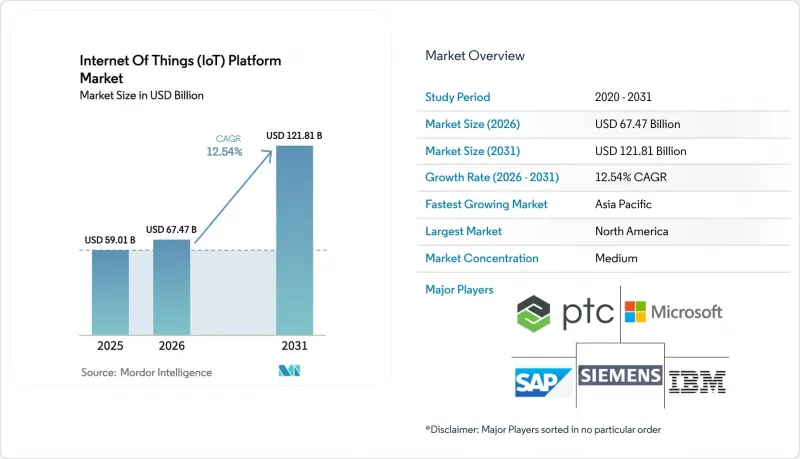
根據 Mordor Intelligence 預測,物聯網 (IoT) 平台市場預計將從 2025 年的 590.1 億美元成長到 2026 年的 674.7 億美元,到 2031 年達到 1218.1 億美元,2026 年至 2031 年的複合年成長率為 12.5%。
本報告按部署類型(本地部署、雲端/SaaS、混合部署)、平台層(應用程式賦能、設備管理等)、最終用戶產業(工業、智慧建築等)、企業規模(中小企業、大型企業)和地區進行細分。市場預測以美元計價。
全球物聯網 (IoT) 平台市場趨勢與洞察
快速採用雲原生物聯網平台
憑藉其強大的可擴展性、付費使用制以及與資料湖和機器學習服務的無縫整合,雲端原生架構已成為物聯網工作負載的標準選擇。從本地中間件遷移到 Kubernetes 上的容器化微服務的企業報告稱,發布週期縮短,基礎設施開銷降低。 Azure IoT Hub 和 AWS IoT Core 等託管服務整合了邊緣編配和即時串流處理,預計可將整合工作量減少 40%。然而,對少數超大規模供應商的依賴引發了人們對供應商鎖定和營運風險集中的擔憂,促使許多採用者試驗混合部署。
降低感測器和模組的成本
2024年至2025年間,NB-IoT和LTE-M模組的平均價格下降了15%至20%,大量採購的單價甚至跌破5美元。這使得在物流、農業和公共產業的部署更加切實可行。成熟製程節點半導體的持續過剩正在推動價格下降,使得建構先前成本過高的高密度感測器網路成為可能。硬體成本的降低直接轉化為平台供應商收入的增加(這些供應商按連接設備收費),進一步鞏固了物聯網(IoT)平台市場的成長動能。亞太地區的價格下降最為顯著,當地的製造能力加劇了模組供應商之間的競爭。
人們越來越關注網路安全和資料隱私問題
一系列備受矚目的資料外洩事件凸顯了廣泛分佈的設備所帶來的龐大且難以防禦的攻擊面,導致物聯網專案受到董事會層面的更嚴格監管。醫療設備製造商現在必須根據美國食品藥物管理局 (FDA) 的最新指南提供軟體材料清單(BOM) 和漏洞管理流程。在歐洲,平台業者必須在偵測到安全事件後 24 小時內提供安全修補程式並上報。這些要求增加了合規成本,尤其對中小型供應商而言更是如此。諸如 GDPR(一般資料保護規則)之類的隱私法規進一步加劇了跨境資料流動的複雜性,限制了全球擴充性,並增加了消費者和醫療保健部署的程序負擔。
細分市場分析
到 2025 年,混合架構將成為成長最快的部署模式,預計到 2031 年將以 13.22% 的複合年成長率 (CAGR) 成長,因為企業需要在雲端的彈性和邊緣級延遲要求之間取得平衡。雲端和 SaaS 模式將繼續在按需擴展方面佔據主導地位,到 2025 年,兩者合計將佔據物聯網平台市場佔有率的 62.29%。然而,在國防和關鍵基礎設施等領域,監管指南意味著對於需要空氣間隙網路的工作負載而言,本地部署方案仍然可行。供應商正在透過提供編配框架來解決這個問題,這些框架能夠實現容器在雲端、邊緣和本地節點之間的無縫遷移。
這種轉變凸顯了架構向分散式運算方向的更廣泛重構,因為在工業自動化和自主系統中,往返集中式資料中心的延遲是不可接受的,畢竟需要實現低於10毫秒的延遲目標。此外,混合架構也符合資料主權法規,即必須在國內處理。因此,由混合部署驅動的物聯網平台市場規模預計將超過純雲端和純本地部署模式的成長率。然而,對於缺乏足夠DevOps負責人的組織而言,維運複雜性仍然是一個障礙。
2025年,應用賦能層將佔總支出的42.51%,但隨著企業從說明儀錶板轉向預測性引擎,高階分析組件的成長速度更快,複合年成長率高達12.97%。設備管理和連接服務如今已高度商品化,其競爭主要集中在總體擁有成本 (TCO) 和空中下載 (OTA) 更新效率。提供特定領域資料模型、數位孿生工具和人工智慧驅動的異常檢測的供應商保持著競爭優勢。例如,SAP 的記憶體內分析可直接與串流感測器輸入整合,從而實現生產線的近即時最佳化。
邊緣加速晶片和配備GPU的伺服器的出現,進一步加劇了關於分析處理應該在本地還是雲端進行的爭論。邊緣推理可以最大限度地減少延遲,但集中式運算能力對於重新訓練高精度模型仍然有效。因此,物聯網平台市場中分析領域的市場規模呈現兩極化,一方是基於雲端的訓練管道,另一方是基於邊緣的推理引擎,因此需要能夠跨越這種連續體的編配能力。
區域分析
到2025年,北美將以37.59%的市場佔有率引領物聯網應用,這得益於超大規模雲端基礎設施的普及以及聯邦政府訂定的網路安全指南,這些指南明確了採購規則。美國在工業IoT的應用方面主導地位,重點在於製造自動化和能源網路現代化;而加拿大則在林業和採礦業中擴展物聯網驅動的資源管理。墨西哥對智慧工廠的投資受益於近岸外包趨勢,該趨勢將供應鏈轉移到更靠近美國消費點的位置。儘管規模龐大,但隨著早期應用市場趨於飽和,區域成長正在放緩,剩餘的機會主要體現在現有設施的維修和合規性升級。
亞太地區是成長最快的地區,預計到2031年將以13.67%的複合年成長率成長。中國的國家主導製造業政策、印度的「數位印度」計畫以及日本的「社會5.0」計劃,正推動著互聯工廠、智慧城市和醫療保健領域的持續高投資。華為和阿里雲等供應商正在根據當地法規和語言最佳化其服務,這加劇了對西方老牌企業的競爭壓力。 5G普及率的提高和感測器價格的下降,進一步推動了東南亞和大洋洲農村及工業地區的物聯網平台市場發展。
歐洲在監管發展中扮演著至關重要的角色,網路安全和隱私保護正透過《網路韌性法案》和《一般資料保護規則》(GDPR)等法律被納入採購標準。德國正利用工業4.0資金推動離散製造業的數位轉型,而法國和義大利則將物聯網技術應用於農業和交通運輸領域。區域資料主權法規正在推動對混合或本地部署架構的需求。此外,中東和非洲正在加速推進物聯網在石油天然氣、公共產業和智慧城市等大型企劃專案中的應用,而南美洲則在試點精密農業和城市交通平台。儘管這些地區的規模仍然相對較小,但它們為新市場的發展提供了充滿希望的機遇,推動了衛星通訊和低功耗網路等替代方案的採用。
其他好處:
- Excel格式的市場預測(ME)表
- 3個月的分析師支持
目錄
第1章:引言
- 研究假設和市場定義
- 調查範圍
第2章:調查方法
第3章執行摘要
第4章 市場狀況
- 市場概覽
- 市場促進因素
- 快速採用雲原生物聯網平台
- 降低感測器和模組的成本
- 自動化和巨量資料分析技術的進步正成為重要的資產。
- 促進產業數位轉型的監管措施正在加速推進。
- TinyML在裝置端分析領域的興起
- 擴展衛星物聯網連接以用於遠端資產
- 市場限制因素
- 市場碎片化和互通性問題
- 人們越來越關注網路安全和資料隱私問題
- 邊緣雲整合的複雜性
- 全端物聯網開發人員短缺,且缺乏標準。
- 產業價值鏈分析
- 監理情勢
- 技術展望
- 波特五力分析
- 宏觀經濟因素對市場的影響
第5章 市場規模與成長預測
- 按實現類型
- 現場
- 雲/SaaS
- 混合
- 平台層
- 應用程式啟用
- 設備管理
- 進階分析
- 連接性
- 雲端儲存/基礎設施即服務
- 按最終用戶行業分類
- 產業
- 互聯建築
- 智慧家庭
- 流動性
- 衛生保健
- 農業
- 其他
- 按公司規模
- 中小企業
- 大公司
- 按地區
- 北美洲
- 美國
- 加拿大
- 墨西哥
- 南美洲
- 巴西
- 阿根廷
- 其他南美國家
- 歐洲
- 德國
- 英國
- 法國
- 義大利
- 西班牙
- 俄羅斯
- 其他歐洲國家
- 亞太地區
- 中國
- 日本
- 印度
- 韓國
- 澳洲和紐西蘭
- 其他亞太國家
- 中東
- 阿拉伯聯合大公國
- 沙烏地阿拉伯
- 土耳其
- 其他中東國家
- 非洲
- 南非
- 奈及利亞
- 其他非洲國家
- 北美洲
第6章 競爭情勢
- 市場集中度
- 策略趨勢
- 市佔率分析
- 公司簡介
- IBM Corporation
- Microsoft Corporation
- Amazon Web Services, Inc.
- PTC Inc.
- SAP SE
- Siemens AG
- Cisco Systems Inc.
- Oracle Corporation
- GE Digital LLC
- Hitachi Ltd
- Software AG
- ABB Ltd
- Schneider Electric SE(AVEVA Group plc)
- Robert Bosch GmbH
- Google LLC(Google Cloud Platform)
- Huawei Technologies Co. Ltd.
- Nokia Corporation
- Arm Holdings plc
- Telit Communications plc
- Ericsson AB
第7章 市場機會與未來展望
According to Mordor Intelligence, the internet of things platform market size is expected to increase from USD 59.01 billion in 2025 to USD 67.47 billion in 2026 and reach USD 121.81 billion by 2031, growing at a CAGR of 12.54% over 2026-2031.
This report is Segmented by Deployment (On-Premise, Cloud/SaaS, and Hybrid), Platform Layer (Application Enablement, Device Management, and More), End-User Industry (Industrial, Connected Building, and More), Enterprise Size (Small and Medium Enterprises, and Large Enterprises), and Geography. The Market Forecasts are Provided in Terms of Value (USD).
Global Internet Of Things (IoT) Platform Market Trends and Insights
Rapid Adoption of Cloud-Native IoT Platforms
Elastic scalability, pay-per-use billing, and seamless integration with data lake and machine-learning services have made cloud-native architectures the default choice for IoT workloads. Enterprises migrating from on-premises middleware to containerized microservices on Kubernetes are reporting shorter release cycles and lower infrastructure overhead. Managed offerings such as Azure IoT Hub and AWS IoT Core now bundle edge orchestration and real-time stream processing, reducing integration effort by an estimated 40%. Nevertheless, dependency on a handful of hyperscale providers raises vendor-lock-in concerns and concentrates operational risk, prompting many adopters to experiment with hybrid deployments.
Declining Sensor and Module Costs
Between 2024 and 2025, average prices for NB-IoT and LTE-M modules fell 15-20%, pushing unit costs below USD 5 in high volumes and expanding deployment feasibility in logistics, agriculture, and utilities. Semiconductor oversupply in mature process nodes continues to depress pricing, enabling high-density sensor networks that were previously cost-prohibitive. Lower hardware costs translate directly into greater recurring revenue for platform vendors that charge per connected device, reinforcing the growth trajectory of the Internet of Things (IoT) platform market. Price declines are most pronounced in Asia Pacific, where local fabrication capacity intensifies competition among module suppliers.
Heightened Cyber-Security and Data-Privacy Concerns
High-profile breaches have increased board-level scrutiny of IoT projects, as widely distributed devices create vast, hard-to-defend attack surfaces. Medical device makers must now provide software bills of materials and vulnerability management processes under updated FDA guidance. In Europe, platforms must issue security patches and file incident reports within 24 hours of detection. These requirements inflate compliance costs, especially for smaller vendors. Privacy rules such as GDPR further complicate cross-border data flows, constraining global scalability and adding procedural overhead to deployments in consumer and healthcare segments.
Other drivers and restraints analyzed in the detailed report include:
- Growing Automation and Big Data Analytics Becoming a Key Asset
- Increasing Regulatory Push for Industrial Digitalization
- Market Fragmentation and Interoperability Issues
For complete list of drivers and restraints, kindly check the Table Of Contents.
Segment Analysis
Hybrid architectures represented the fastest-growing deployment model in 2025, advancing at a 13.22% CAGR through 2031 as organizations balance cloud elasticity with edge-level latency demands. On-demand scalability continues to favour cloud and SaaS arrangements, which collectively retained 62.29% of the Internet of Things (IoT) platform market share in 2025. Even so, regulatory directives in sectors such as defense and critical infrastructure keep on-premises options viable for workloads that require air-gapped networks. Vendors are responding by offering orchestration frameworks that enable seamless container migration across cloud, edge, and on-premises nodes.
The shift underscores a broader re-architecture toward distributed compute, where sub-10-millisecond latency targets in industrial automation and autonomous systems cannot tolerate round-trip delays to centralized data centers. Hybrid designs also satisfy data-sovereignty statutes that obligate local processing within national borders. Consequently, the IoT platform market size attributable to hybrid installations is projected to outpace growth in pure cloud or pure on-premises models. Organizations lacking DevOps personnel, however, cite operational complexity as a lingering obstacle.
Application enablement layers absorbed 42.51% of spending in 2025, but advanced analytics components are scaling faster, rising at a 12.97% CAGR as firms migrate from descriptive dashboards to prescriptive engines. Device management and connectivity services, now widely commoditized, compete primarily on total cost of ownership and over-the-air update efficiencies. Vendors that deliver domain-specific data models, digital-twin tooling, and AI-powered anomaly detection hold a competitive advantage. For example, SAP's in-memory analytics integrate directly with streaming sensor inputs, allowing near-real-time optimization of production lines.
Edge-side acceleration chips and GPU-enabled servers amplify the debate over whether analytics should reside locally or in the cloud. While edge inference minimizes latency, high-fidelity model retraining still benefits from centralized compute power. The Internet of Things (IoT) platform market size allocation to analytics is therefore bifurcating between cloud-resident training pipelines and edge-resident inference engines, demanding orchestration capabilities that span this continuum.
Complete Report Scope:
- By Deployment
- On-premise
- Cloud/SaaS
- Hybrid
- By Platform Layer
- Application Enablement
- Device Management
- Advanced Analytics
- Connectivity
- Cloud Storage/IaaS
- By End-user Industry
- Industrial
- Connected Building
- Smart Home
- Mobility
- Healthcare
- Agriculture
- Rest of End-user Industries
- By Enterprise Size
- Small and Medium Enterprises (SMEs)
- Large Enterprises
- By Geography
- North America
- United States
- Canada
- Mexico
- South America
- Brazil
- Argentina
- Rest of South America
- Europe
- Germany
- United Kingdom
- France
- Italy
- Spain
- Russia
- Rest of Europe
- Asia Pacific
- China
- Japan
- India
- South Korea
- Australia and New Zealand
- Rest of Asia Pacific
- Middle East
- United Arab Emirates
- Saudi Arabia
- Turkey
- Rest of Middle East
- Africa
- South Africa
- Nigeria
- Rest of Africa
- North America
Geography Analysis
North America led deployments with a 37.59% share in 2025, anchored by the presence of hyperscale cloud infrastructure and federal cybersecurity guidelines that clarify procurement rules. The United States dominates industrial IoT rollouts focused on manufacturing automation and energy grid modernization, while Canada scales IoT-driven resource management in forestry and mining. Mexico's smart-factory investments benefit from near-shoring trends that re-route supply chains closer to U.S. consumption hubs. Notwithstanding its size, regional growth is moderating as early adopter segments reach saturation, leaving incremental opportunities primarily in brownfield retrofits and compliance-driven upgrades.
Asia Pacific is the fastest-growing territory, slated to expand at a 13.67% CAGR through 2031. China's sovereign manufacturing directives, India's Digital India initiative, and Japan's Society 5.0 program converge to sustain high investment in connected factories, smart cities, and healthcare. Domestic providers such as Huawei and Alibaba Cloud tailor offerings to local regulations and language, thereby intensifying competitive pressure on Western incumbents. Rising 5G penetration and falling sensor prices further enlarge the Internet of Things (IoT) platform market in rural and industrial zones across Southeast Asia and Oceania.
Europe occupies a pivotal role in regulatory shaping, with the Cyber Resilience Act and GDPR embedding cybersecurity and privacy into procurement criteria. Germany leverages Industrie 4.0 funding to digitalize discrete manufacturing, while France and Italy integrate IoT into agriculture and transportation. Regional data-sovereignty provisions foster demand for hybrid or on-premises architectures. Elsewhere, the Middle East and Africa accelerate IoT adoption in oil and gas, utilities, and smart-city megaprojects, whereas South America pilots' precision agriculture and urban mobility platforms. Although their absolute volumes remain smaller, these regions present greenfield prospects that invite satellite connectivity and low-power network alternatives.
- IBM Corporation
- Microsoft Corporation
- Amazon Web Services, Inc.
- PTC Inc.
- SAP SE
- Siemens AG
- Cisco Systems Inc.
- Oracle Corporation
- GE Digital LLC
- Hitachi Ltd
- Software AG
- ABB Ltd
- Schneider Electric SE (AVEVA Group plc)
- Robert Bosch GmbH
- Google LLC (Google Cloud Platform)
- Huawei Technologies Co. Ltd.
- Nokia Corporation
- Arm Holdings plc
- Telit Communications plc
- Ericsson AB
Additional Benefits:
- The market estimate (ME) sheet in Excel format
- 3 months of analyst support
TABLE OF CONTENTS
1 INTRODUCTION
- 1.1 Study Assumptions and Market Definition
- 1.2 Scope of the Study
2 RESEARCH METHODOLOGY
3 EXECUTIVE SUMMARY
4 MARKET LANDSCAPE
- 4.1 Market Overview
- 4.2 Market Drivers
- 4.2.1 Rapid Adoption of Cloud-Native IoT Platforms
- 4.2.2 Declining Sensor and Module Costs
- 4.2.3 Growing Automation and Big Data Analytics Becoming a Key Asset
- 4.2.4 Increasing Regulatory Push for Industrial Digitalization
- 4.2.5 Emergence of TinyML-Enabled On-Device Analytics
- 4.2.6 Expansion of Satellite IoT Connectivity for Remote Assets
- 4.3 Market Restraints
- 4.3.1 Market Fragmentation and Interoperability Issues
- 4.3.2 Heightened Cyber-Security and Data-Privacy Concerns
- 4.3.3 Edge-Cloud Integration Complexity
- 4.3.4 Shortage of Full-Stack IoT Developers and Standards
- 4.4 Industry Value Chain Analysis
- 4.5 Regulatory Landscape
- 4.6 Technological Outlook
- 4.7 Porter's Five Forces Analysis
- 4.7.1 Threat of New Entrants
- 4.7.2 Bargaining Power of Buyers/Consumers
- 4.7.3 Bargaining Power of Suppliers
- 4.7.4 Threat of Substitutes
- 4.7.5 Intensity of Competitive Rivalry
- 4.8 Impact of Macroeconomic Factors on the Market
5 MARKET SIZE AND GROWTH FORECASTS (VALUE)
- 5.1 By Deployment
- 5.1.1 On-premise
- 5.1.2 Cloud/SaaS
- 5.1.3 Hybrid
- 5.2 By Platform Layer
- 5.2.1 Application Enablement
- 5.2.2 Device Management
- 5.2.3 Advanced Analytics
- 5.2.4 Connectivity
- 5.2.5 Cloud Storage/IaaS
- 5.3 By End-user Industry
- 5.3.1 Industrial
- 5.3.2 Connected Building
- 5.3.3 Smart Home
- 5.3.4 Mobility
- 5.3.5 Healthcare
- 5.3.6 Agriculture
- 5.3.7 Rest of End-user Industries
- 5.4 By Enterprise Size
- 5.4.1 Small and Medium Enterprises (SMEs)
- 5.4.2 Large Enterprises
- 5.5 By Geography
- 5.5.1 North America
- 5.5.1.1 United States
- 5.5.1.2 Canada
- 5.5.1.3 Mexico
- 5.5.2 South America
- 5.5.2.1 Brazil
- 5.5.2.2 Argentina
- 5.5.2.3 Rest of South America
- 5.5.3 Europe
- 5.5.3.1 Germany
- 5.5.3.2 United Kingdom
- 5.5.3.3 France
- 5.5.3.4 Italy
- 5.5.3.5 Spain
- 5.5.3.6 Russia
- 5.5.3.7 Rest of Europe
- 5.5.4 Asia Pacific
- 5.5.4.1 China
- 5.5.4.2 Japan
- 5.5.4.3 India
- 5.5.4.4 South Korea
- 5.5.4.5 Australia and New Zealand
- 5.5.4.6 Rest of Asia Pacific
- 5.5.5 Middle East
- 5.5.5.1 United Arab Emirates
- 5.5.5.2 Saudi Arabia
- 5.5.5.3 Turkey
- 5.5.5.4 Rest of Middle East
- 5.5.6 Africa
- 5.5.6.1 South Africa
- 5.5.6.2 Nigeria
- 5.5.6.3 Rest of Africa
- 5.5.1 North America
6 COMPETITIVE LANDSCAPE
- 6.1 Market Concentration
- 6.2 Strategic Moves
- 6.3 Market Share Analysis
- 6.4 Company Profiles {(includes Global Level Overview, Market Level Overview, Core Segments, Financials as Available, Strategic Information, Market Rank/Share for Key Companies, Products and Services, and Recent Developments)}
- 6.4.1 IBM Corporation
- 6.4.2 Microsoft Corporation
- 6.4.3 Amazon Web Services, Inc.
- 6.4.4 PTC Inc.
- 6.4.5 SAP SE
- 6.4.6 Siemens AG
- 6.4.7 Cisco Systems Inc.
- 6.4.8 Oracle Corporation
- 6.4.9 GE Digital LLC
- 6.4.10 Hitachi Ltd
- 6.4.11 Software AG
- 6.4.12 ABB Ltd
- 6.4.13 Schneider Electric SE (AVEVA Group plc)
- 6.4.14 Robert Bosch GmbH
- 6.4.15 Google LLC (Google Cloud Platform)
- 6.4.16 Huawei Technologies Co. Ltd.
- 6.4.17 Nokia Corporation
- 6.4.18 Arm Holdings plc
- 6.4.19 Telit Communications plc
- 6.4.20 Ericsson AB
7 MARKET OPPORTUNITIES AND FUTURE OUTLOOK
- 7.1 White-space and Unmet-need Assessment

 CAMARA API 生態系統:市場佔有率分析、行業趨勢和統計數據、成長預測(2026-2031 年)
 物聯網網路和平台調查服務
 Localink平台市場預測至2034年-按平台類型、部署模式、技術、應用、最終用戶和地區分類的全球分析工業IoT平台市場預測至2034年-按平台類型、組件、技術、產業、最終用戶和地區分類的全球分析2034年物聯網電子設備市場預測:按設備類型、組件、連接技術、應用和地區分類的全球分析全球矽即平台市場:依平台類型、應用、技術節點、整合類型、最終用戶和地區劃分 - 市場規模、產業趨勢、機會分析和預測(2026-2035年)
 商用香氛行銷機市場(按機器類型、香氛類型、應用程式和終端用戶產業分類)-全球預測,2026-2032年
 IoT平台市場:2025-2030年
 全球物聯網平台市場
 物聯網平台市場規模、佔有率、趨勢分析報告:2024-2030 年按組件、部署、組織規模、應用程式、地區和細分市場預測