


 |
市場調查報告書
商品編碼
2157140
生物分解性塑膠:市場佔有率分析、產業趨勢和統計數據、成長預測(2026-2031)Biodegradable Plastics - Market Share Analysis, Industry Trends & Statistics, Growth Forecasts (2026 - 2031) |
||||||

※ 本網頁內容可能與最新版本有所差異。詳細情況請與我們聯繫。
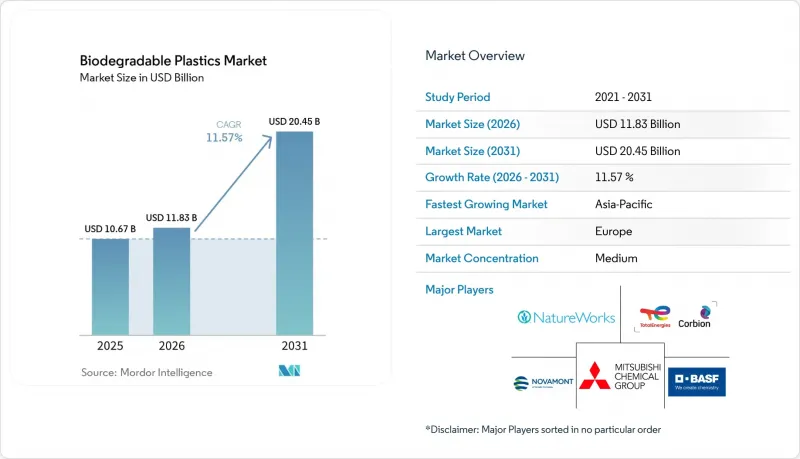
據 Mordor Intelligence 稱,2025 年生物分解性塑膠市場價值為 106.7 億美元,預計到 2031 年將達到 204.5 億美元,而 2026 年為 118.3 億美元,預測期(2026-2031 年)複合年成長率為 11.57%。
全球生物分解性塑膠市場趨勢及洞察
一次性塑膠製品監管和生產者責任擴大
歐盟的《包裝及包裝廢棄物法規》於2026年8月12日全面生效,該法規對包裝廢棄物、再利用和生產者責任提出了要求。該法規支持可堆肥包裝,因為材料選擇會影響生產者責任成本。價格調整可以提高經認證的可堆肥包裝對那些需要控制合規成本的買家的吸引力。包裝加工商正在將EN 13432堆肥要求納入長期供應合約。亞太地區和美國多個州實施的類似生產者責任措施正在擴大生物分解性塑膠的潛在需求基礎。這些措施凸顯了包裝採購中認證、供應可靠性和監管準備的重要性。
零售商和餐飲服務品牌採購永續包裝材料
大型零售商和餐飲服務企業正在製定包裝目標,以滿足市場對經認證的可堆肥材料的需求。 Grupo Bimbo的目標是在2025年底實現其包裝可回收、可生物分解或可堆肥。這些目標要求包裝團隊在更廣泛的法規生效之前,對眾多產品的材料選擇進行評估。亞馬遜在西班牙試點使用了Novamont的生物基配送袋“Mater-Bi”,該項目由“循環生物基歐洲”計劃支持。鑑於餐飲服務業一次性產品用量龐大且材料轉換相對容易,該行業的應用仍然十分重要。企業碳排放揭露和內部碳定價也在影響材料選擇決策;例如,資生堂在2025年的生產投資決策中應用了內部碳定價。
原物料和能源價格波動
聚乳酸 (PLA) 和澱粉混合物的生產商極易受到農產品價格波動的影響。其成本結構還包括高能耗的加工和物流環節,這些都加劇了成本壓力。 2025 年初,美國中西部地區的乾旱和巴西甘蔗出口的下降導致玉米粉成本上漲,從而降低了 PLA 的利潤率。雖然石化生產商可以利用一體化的原料供應系統和期貨避險策略,但許多生物聚合物生產商卻難以獲得這些資源。本研究探討了利用嗜鹽和嗜熱微生物平台,從木質纖維素生質能中生產聚羥基烷酯(PHA),以此作為糧食作物的替代方案。儘管這些方法未來可能減少對原料的依賴,但可生物生物分解性塑膠市場的商業化生產仍然有限。
細分市場分析
2025年,澱粉混合物佔生物分解性塑膠市場佔有率的40.23%。這一佔有率反映了其配方的廣泛發展以及在塑膠購物袋、食品接觸膜和農業地膜等領域的日益普及。在這些應用中,EN 13432工業堆肥認證可用於支援產品生命週期結束時的處置聲明。然而,澱粉混合物不具備PHA在嚴苛應用中所提供的海洋生物分解性、家庭堆肥性或機械性質。這種差異決定了每種材料的競爭定位。 2025年11月,Novamont公司的「Mater-Bi」地膜獲得了無機土壤改良劑認證,從而將其檢驗途徑擴展到了傳統工業堆肥環境之外。
預計到2031年,PHA的複合年成長率將達到19.60%,在生物分解性塑膠市場的所有聚合物中增速最高。其認證支援多種應用,例如海洋可生物分解漁具、家用可堆肥軟包裝和生物相容性醫療包裝。 2026年5月,CJ 生醫材料推出了“PHACT CB0504A”,這是一款用於紙質食品服務餐具的全PHA擠壓塗布樹脂。據該公司稱,該樹脂已獲得奧地利TUV的「OK compost HOME」、「INDUSTRIAL」和「MARINE」認證。此次發布表明,該公司除了專注於特殊應用外,也開始關注食品服務服務業。 PLA仍廣泛用於硬質包裝和熱成型托盤,而PBAT和PBS則用於軟包裝和特殊應用。
區域分析
到2025年,歐洲將佔據38.84%的生物分解性塑膠市場。這得歸功於監管要求、工業堆肥能力和成熟的生產基地。 Novamont公司在義大利的年總產能為15萬噸。德國、義大利和法國佔據了歐洲消費的大部分佔有率,推動了對受監管包裝應用的需求。義大利生物聚合物叢集整合了原料供應、聚合物生產和下游加工。北美是第二大區域市場,加州、奧勒岡州和科羅拉多的州級生產者延伸責任制(EPR)措施正在影響市場需求。在歐洲運營的美國品牌可以在其更廣泛的採購計劃中採用符合EN 13432標準的規範。
預計2026年至2031年,亞太地區生物分解性塑膠市場將以12.84%的複合年成長率成長,成為該地區成長最快的區域市場。中國的塑膠法規、印度的生產者責任延伸制度(EPR)以及國內Polybutylene Adipate Terephthalate(PBAT)產能的擴張,都提振了該地區的市場前景。金髮、萬華、中石化和華豐等公司正在大規模擴大PBAT的生產規模。產能擴張將降低對成本敏感的包裝材料買家的單價,並增加中國以外生產商的競爭壓力。 NatureWorks於2026年4月在泰國那空沙旺府開設了其全一體化的「Ingeo」聚乳酸(PLA)生產廠。該廠年產能為7.5萬噸,使用當地甘蔗作為原料,降低了東南亞加工商對進口的依賴。在印度,強制要求 100% 回收第四類可堆肥塑膠,但由於工業堆肥能力有限,這項要求對需求的全面影響被延遲了。
在南美洲,原料供應有保障,這得益於巴西的甘蔗生產和生質乙醇發酵基礎設施。巴西主要產區的甘蔗產量為每公頃54至111噸。隨著國內相關法規的完善,巴西有望成為PLA和PHA的生產基地。阿根廷也提供了額外的農業原料來源,儘管其生物聚合物的生產仍處於試驗階段。中東和非洲是目前最小的區域市場,但沙烏地阿拉伯在生物基材料領域的努力以及南非零售商的需求正在推動市場發展。到2031年,更嚴格的塑膠廢棄物監管可望促進該地區的市場發展。
其他好處:
- Excel格式的市場預測(ME)表
- 3個月的分析師支持
目錄
第1章:引言
- 研究假設和市場定義
- 調查範圍
第2章:調查方法
第3章執行摘要
第4章 市場狀況
- 市場概覽
- 市場促進因素
- 一次性塑膠製品監管和生產者責任擴大
- 零售商和餐飲服務品牌採購永續包裝材料
- PLA、PBAT 和 PHA 基材的性能和成本改進
- 生物分解型農地膜的廣泛應用
- 企業碳排放資訊揭露與內部碳定價
- 市場限制因素
- 原物料和能源價格波動
- 成本溢價塑膠與一般塑膠的比較
- 工業堆肥與垃圾分類收集之間的差距。
- 價值鏈分析
- 波特五力分析
第5章 市場規模與成長預測
- 按類型
- 聚乳酸(PLA)
- 澱粉混合物
- Polybutylene Adipate Terephthalate(PBAT)
- 聚丁二酸丁二醇酯(PBS)
- 聚羥基烷酯(PHA)
- 纖維素基塑膠
- 其他生物分解性塑膠
- 按產品形式
- 樹脂和化合物
- 薄膜
- 模製產品
- 其他
- 按最終用戶行業分類
- 包裝
- 消費品
- 農業和園藝
- 紡織品
- 其他終端用戶產業
- 按地區
- 亞太地區
- 中國
- 印度
- 日本
- 韓國
- 東南亞國協
- 其他亞太國家
- 北美洲
- 美國
- 加拿大
- 墨西哥
- 歐洲
- 德國
- 英國
- 法國
- 義大利
- 北歐國家
- 俄羅斯
- 其他歐洲國家
- 南美洲
- 巴西
- 阿根廷
- 其他南美國家
- 中東和非洲
- 沙烏地阿拉伯
- 南非
- 其他中東和非洲國家
- 亞太地區
第6章 競爭情勢
- 市場集中度
- 策略趨勢
- 市佔率和排名分析
- 公司簡介
- BASF
- Biome Bioplastics
- BIOTEC Biologische Naturverpackungen GmbH & Co. KG
- Braskem
- CJ CheilJedang Corp.
- Danimer Scientific
- FKuR Kunststoff GmbH
- KANEKA CORPORATION
- KURARAY CO., LTD.
- Mitsubishi Chemical Group Corporation
- NatureWorks LLC
- Novamont SpA
- PTT MCC Biochem Co., Ltd.
- RWDC Industries Limited
- TORAY INDUSTRIES, INC.
- TotalEnergies Corbion
第7章 市場機會與未來展望
According to Mordor Intelligence, the biodegradable plastics market size was valued at USD 10.67 billion in 2025 and is estimated to grow from USD 11.83 billion in 2026 to reach USD 20.45 billion by 2031, at a CAGR of 11.57% during the forecast period (2026-2031).
Global Biodegradable Plastics Market Trends and Insights
Single-Use Plastic Restrictions and Extended Producer Responsibility
The EU Packaging and Packaging Waste Regulation has applied in full since August 12, 2026, establishing requirements for packaging waste, reuse, and producer responsibility. The regulation supports compostable formats where material selection affects producer responsibility costs. Fee modulation can make certified compostable packaging more attractive to buyers managing compliance costs. Packaging converters are incorporating EN 13432 compostability requirements into long-term supply agreements. Similar producer responsibility measures across Asia-Pacific and several U.S. states are expanding the addressable demand base for the biodegradable plastics market. These measures increase the importance of certification, supply reliability, and regulatory readiness in packaging procurement.
Sustainable Packaging Procurement by Retailers and Foodservice Brands
Major retailers and foodservice operators are using packaging targets to support demand for certified compostable materials. Grupo Bimbo worked toward making its packaging recyclable, biodegradable, or compostable by the end of 2025. These targets required packaging teams to evaluate material options across numerous products before broader regulations took effect. Amazon trialed Novamont Mater-Bi bio-based delivery bags in Spain through a project supported by the Circular Bio-based Europe program. Foodservice applications remain relevant because they combine high single-use with relatively straightforward material transitions. Corporate carbon disclosure and internal carbon pricing also influence material selection decisions, as Shiseido applied internal carbon pricing to its 2025 manufacturing investment decisions.
Feedstock and Energy Price Volatility
Polylactic acid (PLA) and starch-blend manufacturers are exposed to agricultural commodity cycles. Their cost structures also include energy-intensive processing and logistics, creating concurrent cost pressures. Drought conditions in the U.S. Midwest and lower Brazilian sugarcane exports in early 2025 increased corn starch costs and reduced PLA margins. Petrochemical producers can leverage integrated feedstock systems and futures hedging strategies, which are less accessible to many biopolymer producers. Research has explored the production of polyhydroxyalkanoates (PHA) from lignocellulosic biomass using halophilic and thermophilic microbial platforms as an alternative to food-crop feedstocks. These approaches may reduce feedstock exposure over time; however, commercial-scale production remains limited in the biodegradable plastics market.
Other drivers and restraints analyzed in the detailed report include:
- Performance and Cost Improvements in Polylactic Acid (PLA), Polybutylene Adipate Terephthalate (PBAT), and Polyhydroxyalkanoates (PHA) Formulations
- Biodegradable Agricultural Mulch Film Adoption
- Cost Premium Versus Commodity Plastics and Composting Gaps
For complete list of drivers and restraints, kindly check the Table Of Contents.
Segment Analysis
Starch blends accounted for 40.23% of the biodegradable plastics market in 2025. Their position reflects extensive formulation development and use in carrier bags, food-contact films, and agricultural mulch films. These applications can use EN 13432 industrial composting certification to support end-of-life claims. However, starch blends do not provide the marine biodegradability, home compostability, or mechanical performance that PHA offers in demanding applications. This distinction defines the competitive positioning of each material. In November 2025, Novamont secured certification for its Mater-Bi mulch film as an inorganic soil improver, expanding its validation pathway beyond conventional industrial composting environments.
PHA is forecast to register a 19.60% CAGR through 2031, the highest among polymer types in the biodegradable plastics market. Its certifications support applications including marine-biodegradable fishing materials, home-compostable flexible films, and biocompatible medical packaging. In May 2026, CJ Biomaterials launched PHACT CB0504A, an all-PHA extrusion-coating resin for paper food service ware. The company stated that the resin received TUV Austria OK compost HOME, INDUSTRIAL, and MARINE certifications. The launch indicates a focus on foodservice applications beyond specialty uses. PLA remains widely used in rigid packaging and thermoformed trays, while PBAT and PBS are used in flexible-film and specialty applications.
Complete Report Scope:
- By Type
- Polylactic Acid (PLA)
- Starch Blends
- Polybutylene Adipate Terephthalate (PBAT)
- Polybutylene Succinate (PBS)
- Polyhydroxyalkanoates (PHA)
- Cellulose-Based Plastics
- Other Biodegradable Plastics
- By Product Form
- Resins and Compounds
- Films and Sheets
- Molded Products
- Others
- By End-User Industry
- Packaging
- Consumer Goods
- Agriculture and Horticulture
- Textile
- Other End-Use Industries
- By Geography
- Asia-Pacific
- China
- India
- Japan
- South Korea
- ASEAN Countries
- Rest of Asia-Pacific
- North America
- United States
- Canada
- Mexico
- Europe
- Germany
- United Kingdom
- France
- Italy
- NORDIC Countries
- Russia
- Rest of Europe
- South America
- Brazil
- Argentina
- Rest of South America
- Middle East and Africa
- Saudi Arabia
- South Africa
- Rest of Middle East and Africa
- Asia-Pacific
Geography Analysis
Europe accounted for 38.84% of the biodegradable plastics market share in 2025, supported by regulatory requirements, industrial composting capacity, and an established production base. Novamont's Italian sites have a combined annual capacity of 150,000 tons. Germany, Italy, and France account for most European consumption and generate demand for regulated packaging applications. Italy's biopolymer cluster integrates raw material supply, polymer production, and downstream conversion. North America is the second-largest regional market, where state-level extended producer responsibility (EPR) measures in California, Oregon, and Colorado shape demand. U.S. brands serving European operations can standardize EN 13432-compliant specifications across broader procurement programs.
Asia-Pacific is projected to grow at a CAGR of 12.84% during 2026-2031, representing the highest regional growth rate in the biodegradable plastics market. China's plastic restrictions, India's EPR mandates, and the expansion of domestic polybutylene adipate terephthalate (PBAT) capacity support the regional outlook. Kingfa, Wanhua, Sinopec, and Huafon are expanding PBAT production at an industrial scale. This capacity expansion reduces unit prices for cost-sensitive packaging buyers and increases competitive pressure on producers outside China. NatureWorks opened its fully integrated Ingeo polylactic acid (PLA) facility in Nakhon Sawan, Thailand, in April 2026. The facility has an annual capacity of 75,000 tons, uses locally sourced sugarcane, and reduces Southeast Asian converters' dependence on imports. India requires 100% collection of Category IV compostable plastics; however, limited industrial composting capacity delays the full impact of this requirement on demand.
South America has feedstock availability, driven by Brazil's sugarcane production and bioethanol fermentation infrastructure. Sugarcane yields in key Brazilian regions range from 54 to 111 tons per hectare. As domestic regulations mature, Brazil could emerge as a production location for PLA and PHA. Argentina provides additional agricultural feedstock availability, although biopolymer manufacturing remains at the pilot stage. The Middle East and Africa represent the smallest regional markets; however, Saudi initiatives for bio-based materials and South African retailer requirements are generating demand. Stricter plastic waste regulations could support market development in the region through 2031.
- BASF
- Biome Bioplastics
- BIOTEC Biologische Naturverpackungen GmbH & Co. KG
- Braskem
- CJ CheilJedang Corp.
- Danimer Scientific
- FKuR Kunststoff GmbH
- KANEKA CORPORATION
- KURARAY CO., LTD.
- Mitsubishi Chemical Group Corporation
- NatureWorks LLC
- Novamont S.p.A.
- PTT MCC Biochem Co., Ltd.
- RWDC Industries Limited
- TORAY INDUSTRIES, INC.
- TotalEnergies Corbion
Additional Benefits:
- The market estimate (ME) sheet in Excel format
- 3 months of analyst support
TABLE OF CONTENTS
1 Introduction
- 1.1 Study Assumptions and Market Definition
- 1.2 Scope of the Study
2 Research Methodology
3 Executive Summary
4 Market Landscape
- 4.1 Market Overview
- 4.2 Market Drivers
- 4.2.1 Single-Use Plastic Restrictions and Extended Producer Responsibility
- 4.2.2 Sustainable Packaging Procurement by Retailers and Foodservice Brands
- 4.2.3 Performance and Cost Improvements in PLA, PBAT and PHA Formulations
- 4.2.4 Biodegradable Agricultural Mulch Film Adoption
- 4.2.5 Corporate Carbon Disclosure and Internal Carbon Pricing
- 4.3 Market Restraints
- 4.3.1 Feedstock and Energy Price Volatility
- 4.3.2 Cost Premium Versus Commodity Plastics
- 4.3.3 Industrial Composting and Separate-Collection Gaps
- 4.4 Value Chain Analysis
- 4.5 Porter's Five Forces Analysis
- 4.5.1 Bargaining Power of Suppliers
- 4.5.2 Bargaining Power of Buyers
- 4.5.3 Threat of New Entrants
- 4.5.4 Threat of Substitutes
- 4.5.5 Competitive Rivalry
5 Market Size and Growth Forecasts (Value)
- 5.1 By Type
- 5.1.1 Polylactic Acid (PLA)
- 5.1.2 Starch Blends
- 5.1.3 Polybutylene Adipate Terephthalate (PBAT)
- 5.1.4 Polybutylene Succinate (PBS)
- 5.1.5 Polyhydroxyalkanoates (PHA)
- 5.1.6 Cellulose-Based Plastics
- 5.1.7 Other Biodegradable Plastics
- 5.2 By Product Form
- 5.2.1 Resins and Compounds
- 5.2.2 Films and Sheets
- 5.2.3 Molded Products
- 5.2.4 Others
- 5.3 By End-User Industry
- 5.3.1 Packaging
- 5.3.2 Consumer Goods
- 5.3.3 Agriculture and Horticulture
- 5.3.4 Textile
- 5.3.5 Other End-Use Industries
- 5.4 By Geography
- 5.4.1 Asia-Pacific
- 5.4.1.1 China
- 5.4.1.2 India
- 5.4.1.3 Japan
- 5.4.1.4 South Korea
- 5.4.1.5 ASEAN Countries
- 5.4.1.6 Rest of Asia-Pacific
- 5.4.2 North America
- 5.4.2.1 United States
- 5.4.2.2 Canada
- 5.4.2.3 Mexico
- 5.4.3 Europe
- 5.4.3.1 Germany
- 5.4.3.2 United Kingdom
- 5.4.3.3 France
- 5.4.3.4 Italy
- 5.4.3.5 NORDIC Countries
- 5.4.3.6 Russia
- 5.4.3.7 Rest of Europe
- 5.4.4 South America
- 5.4.4.1 Brazil
- 5.4.4.2 Argentina
- 5.4.4.3 Rest of South America
- 5.4.5 Middle East and Africa
- 5.4.5.1 Saudi Arabia
- 5.4.5.2 South Africa
- 5.4.5.3 Rest of Middle East and Africa
- 5.4.1 Asia-Pacific
6 Competitive Landscape
- 6.1 Market Concentration
- 6.2 Strategic Moves
- 6.3 Market Share (%)/Ranking Analysis
- 6.4 Company Profiles (includes Global Overview, Market Overview, Core Segments, Financials as available, Strategic Information, Products and Services, and Recent Developments)
- 6.4.1 BASF
- 6.4.2 Biome Bioplastics
- 6.4.3 BIOTEC Biologische Naturverpackungen GmbH & Co. KG
- 6.4.4 Braskem
- 6.4.5 CJ CheilJedang Corp.
- 6.4.6 Danimer Scientific
- 6.4.7 FKuR Kunststoff GmbH
- 6.4.8 KANEKA CORPORATION
- 6.4.9 KURARAY CO., LTD.
- 6.4.10 Mitsubishi Chemical Group Corporation
- 6.4.11 NatureWorks LLC
- 6.4.12 Novamont S.p.A.
- 6.4.13 PTT MCC Biochem Co., Ltd.
- 6.4.14 RWDC Industries Limited
- 6.4.15 TORAY INDUSTRIES, INC.
- 6.4.16 TotalEnergies Corbion
7 Market Opportunities and Future Outlook
- 7.1 White-Space and Unmet-Need Assessment

 PBAT改質材料市場:全球市場預測,2026-2032年
 2026-2030年全球可堆肥塑膠市場
 2034年生物分解性塑膠市場預測-按聚合物類型、原料、生物分解環境、應用和地區分類的全球分析
 2026年全球澱粉基可生物分解生質塑膠市場報告
 中東地區生物分解性塑膠:市場佔有率分析、產業趨勢與統計及成長預測(2026-2031 年)
 建築用生物分解泡棉市場分析及預測(至2035年):類型、產品、技術、應用、材料類型、製程、最終用戶、功能、安裝類型智慧可生物分解包裝晶片市場分析及預測(至2035年):類型、產品、技術、應用、材料類型、製程、最終用戶、功能、解決方案、形式
 全球可堆肥塑膠市場:按產品、最終用途、技術、堆肥標準、國家和地區分類-產業分析、市場規模、市場佔有率和預測(2026-2033 年)生物分解性塑膠市場:2026-2032年全球市場預測(依產品類型、材料類型、厚度、應用和銷售管道)生物分解性塑膠市場:2026-2032年全球市場預測(按材料類型、原料、分解技術、製造流程、產品類型、分銷管道和應用分類)