


 |
市場調查報告書
商品編碼
2116967
中東地區生物分解性塑膠:市場佔有率分析、產業趨勢與統計及成長預測(2026-2031 年)Middle East Biodegradable Plastics - Market Share Analysis, Industry Trends & Statistics, Growth Forecasts (2026 - 2031) |
||||||

※ 本網頁內容可能與最新版本有所差異。詳細情況請與我們聯繫。
據 Mordor Intelligence 稱,2025 年中東生物分解性塑膠市場價值為 175.93 千噸,預計到 2031 年將從 2026 年的 208.52 千噸成長至 488.17 千噸,預測期(2026-2031 年)複合年成長率為 18.4%。
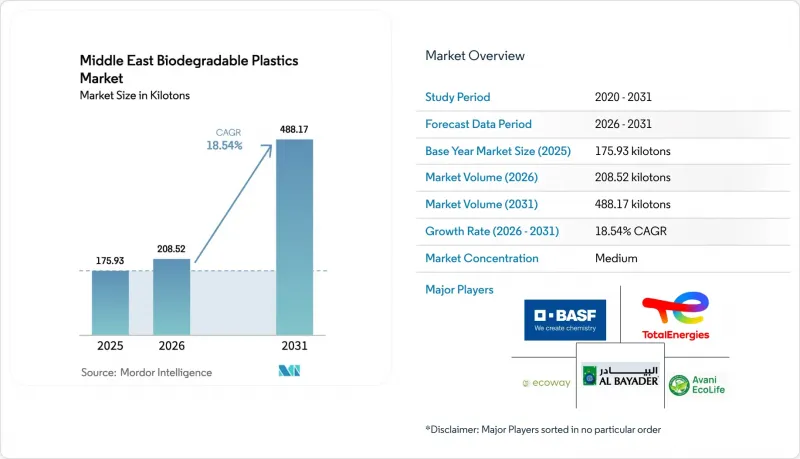
本報告按聚合物類型(澱粉基塑膠、聚乳酸 (PLA)、聚羥基烷酯(PHA)、聚酯 (PBS) 等以及其他生物基生物分解性塑膠)、應用領域(包裝及其他應用)和地區(阿拉伯聯合大公國、沙烏地阿拉伯、卡達、伊朗及其他中東國家)進行細分。市場預測以噸為單位。
中東生物分解性塑膠市場趨勢與洞察
政府對一次性塑膠製品的禁令正在推動對替代品的需求。
杜拜於2024年6月實施了一次性塑膠製品禁令,家樂福阿拉伯聯合大公國公司報告稱,在禁令生效後的第一季,塑膠購物袋的使用量減少了70%。沙烏地阿拉伯也透過其國家廢棄物管理中心推出了類似的法規,該中心的目標是到2040年將掩埋量減少90%,並正在撥款擴大其五大大都會圈堆肥能力。由於該禁令的執行是透過對零售商和進口檢查站的審計,而不是對製造商附加稅,因此成本壓力正在轉嫁到下游加工商身上。大型快速消費品品牌所有者正在承擔塑膠價格上漲帶來的成本,以換取品牌差異化,而小規模加工商則在苦苦掙扎以融資。這項政策的方向表明,隨著堆肥能力的擴大,未來可能會對餐飲服務業的硬質容器和餐具實施禁令。
企業永續發展目標正在重塑採購規範。
Majid Al Huttime計劃在2024年前逐步淘汰其生活方式部門的一次性塑膠製品,並在2025年前將此政策推廣至其所有自有設施。這要求供應商採購符合ISO 14855或EN 13432認證標準的樹脂。 Lulu集團正在試行一種可在熱水中生物分解的可食用薄膜包裝,這既是一種行銷策略,也是一種規避監管風險的措施。 Total Energy Co-Bion的Luminy PLA與石油基塑膠相比,可減少85%的從搖籃到大門的碳足跡,其100%再生材料等級更實現了負碳足跡。這使得採購負責人更容易展現產品令人信服的生命週期效益。零售業的「綠色之星」租賃協議將租戶評估與永續材料的使用掛鉤,表明環境指標正在深入滲透到購物中心的供應鏈中,並預示著永續性條款很快將成為海灣合作理事會(GCC)地區商業房地產的標配。
在價格敏感型細分市場中,成本溢價會限制產品的普及。
由於原料成本高且產能有限,可生物分解塑膠的售價比原生聚乙烯和聚丙烯高出20%至50%。大型日常消費品公司為了實現其環境、社會和治理(ESG)目標,能夠消化這一價格差異,但生產低利潤必需品的通用包裝製造商卻無力負擔。由於缺乏生產者責任延伸(EPR)計畫的補貼,市場往往偏向高階產品和旅館業試驗計畫,而非大眾零售商。經銷商試圖透過從亞洲轉運小包裹來降低運費,但遠東至海灣航線的現貨運費仍然波動劇烈。一旦本地PLA產能投入運作,由於運費和關稅的節省,價格差異將會縮小。在此之前,價格仍然是最大的障礙。
細分市場分析
預計到2025年,聚酯將佔據中東生物分解性塑膠市場38.05%的佔有率。這主要得益於PBS和PBAT能夠無縫整合到現有的薄膜生產線中,以及加工商所重視的聚酯的高韌性,使其能夠承受沿岸地區夏季嚴酷的物流環境。此外,東協供應鏈也為該領域帶來了益處,提供了符合食品接觸標準的預配方產品。儘管當地的聚丁二酸丁二醇酯(PBS)合成能力仍然有限,但領先的PET樹脂生產商正在探索克服生物丁二酸生產瓶頸的方法。
預計PHA將以19.34%的複合年成長率快速成長。其海洋生物分解性使其適用於以減少塑膠垃圾為首要任務的沿海旅遊區。阿拉伯聯合大公國生物技術公司表示,一旦其PLA生產線投入運營,將有意擴大PHA共聚物的生產,這反映了市場對可在海水中分解的樹脂轉化器的運作。然而,PHA的發酵產量仍低於PLA,且價格居高不下。該公司計劃透過與酵素專家的技術合作,提高產量,並力爭在2020年代末期將PHA應用於吸管包裝紙和零食薄膜等大規模生產的產品中。
其他好處:
- Excel格式的市場預測(ME)表
- 3個月的分析師支持
目錄
第1章:引言
- 研究假設和市場定義
- 調查範圍
第2章:調查方法
第3章執行摘要
第4章 市場狀況
- 市場概覽
- 市場促進因素
- 政府關於一次性塑膠製品的法規(阿拉伯聯合大公國、沙烏地阿拉伯)
- 快速消費品和零售業的企業永續發展目標
- 消費者對環保包裝的需求日益成長
- 海灣合作理事會的工業堆肥項目
- 「沙烏地阿拉伯2030願景」下的生物煉製廠資金
- 市場限制因素
- 石油基塑膠的成本溢價
- 該地區缺乏堆肥和回收基礎設施
- 石化產業遊說對政策的影響
- 價值鏈分析
- 波特五力模型
第5章 市場規模與成長預測
- 按聚合物類型
- 澱粉基塑膠
- 聚乳酸(PLA)
- 聚羥基烷酯(PHA)
- 聚酯(PBS、PBAT、PCL)
- 其他生物基可生物分解材料
- 透過使用
- 包裝
- 其他用途
- 按地區
- 阿拉伯聯合大公國
- 沙烏地阿拉伯
- 卡達
- 伊朗
- 其他中東國家
第6章 競爭情勢
- 市場集中度
- 策略趨勢
- 市佔率和排名分析
- 公司簡介
- BASF
- Al Bayader International
- Al-Habib Polymers
- Avani Eco
- Avient Corporation
- Cargill Incorporated
- Eastman Chemical Company
- EcoPlast Solutions
- ECOWAY GLOBAL LLC
- Green Packaging Industries
- KiSabz(Maadiran)
- NatureWorks LLC
- Planet Green
- Plastcom Middle East FZC
- TotalEnergies Corbion
第7章 市場機會與未來展望
According to Mordor Intelligence, the middle east biodegradable plastics market size was valued at 175.93 kilotons in 2025 and estimated to grow from 208.52 kilotons in 2026 to reach 488.17 kilotons by 2031, at a CAGR of 18.54% during the forecast period (2026-2031).
This report is Segmented by Polymer Type (Starch-Based Plastics, Polylactic Acid (PLA), Polyhydroxy Alkanoates (PHA), Polyesters (PBS, and More), and Other Bio-Based Biodegradables), Application (Packaging and Other Applications), and Geography (United Arab Emirates, Saudi Arabia, Qatar, Iran, and Rest of Middle East). The Market Forecasts are Provided in Terms of Volume (Tons).
Middle East Biodegradable Plastics Market Trends and Insights
Government Bans on Single-Use Plastics Drive Substitution Demand
Dubai enforced its single-use plastic ban in June 2024, and Carrefour UAE reported a 70% drop in carrier bag usage during the first quarter of compliance. Saudi Arabia is introducing mirror regulations through the National Center for Waste Management, which aims to achieve 90% landfill diversion by 2040 and allocates capital for expanding composting capacity in the five largest urban clusters. Retail audits and import checkpoints, rather than producer levies, ensure compliance, so cost pressure shifts downstream to converters. Larger FMCG brand owners absorb the resin premium in exchange for label differentiation, but small converters struggle with cash-flow lockups. The policy trajectory hints at future bans on rigid containers and food-service ware once composting throughput ramps.
Corporate Sustainability Targets Reshape Procurement Specifications
Majid Al Futtaim phased out single-use plastics in its Lifestyle division in 2024 and intends to extend this policy across its owned properties by 2025, requiring suppliers to source resins certified to ISO 14855 or EN 13432. Lulu Group is piloting edible film wraps that disintegrate in hot water, a marketing play that doubles as a compliance hedge. TotalEnergies Corbion's Luminy PLA boasts an 85% lower cradle-to-gate carbon footprint compared to petroleum plastics, and its 100% recycled-content grade features a negative footprint, providing procurement officers with a ready-made lifecycle narrative. Retail Green Star leases link tenant ratings to sustainable materials, pushing ecological metrics deep into mall supply chains and signaling that sustainability clauses will soon be standard in GCC commercial property.
Cost Premium Constrains Adoption in Price-Sensitive Segments
Biodegradable resins sell at a 20-50% markup to virgin polyethylene and polypropylene due to high feedstock costs and lower line throughput. FMCG giants absorb the delta to meet ESG targets, but commodity packagers that serve low-margin staples cannot. In the absence of EPR subsidies, the market tends to skew toward premium categories and pilot hospitality programs rather than mass retail. Distributors attempt to mitigate freight costs by transshipping from Asia in break-bulk lots; however, spot rates on the Far East-Gulf lane remain volatile. Local PLA capacity, once operational, will narrow the premium by saving on freight and duties; until then, price remains the primary barrier.
Other drivers and restraints analyzed in the detailed report include:
- Rising Consumer Willingness to Pay for Eco-Labeled Products
- Industrial Composting Infrastructure Determines End-of-Life Viability
- Limited Composting Infrastructure Creates End-of-Life Uncertainty
For complete list of drivers and restraints, kindly check the Table Of Contents.
Segment Analysis
Polyesters secured 38.05% of the Middle East biodegradable plastics market share in 2025 because PBS and PBAT drop seamlessly into existing film lines, and converters appreciate their toughness in extreme Gulf summer logistics. The segment also benefits from ASEAN supply chains that deliver ready-compounded grades with food-contact status. Local poly-butylene succinate synthesis remains limited, but PET resin majors contemplate debottlenecking to run bio-succinate.
PHA is projected to enjoy the fastest growth at a 19.34% CAGR. Its marine biodegradability suits coastal tourism zones under pressure to curb plastic litter. Emirates Biotech has signaled interest in PHA copolymer expansion once its PLA trains are settled, reflecting the converter's appetite for resins that degrade in seawater. Still, fermentation yields lag PLA, keeping PHA price points at a premium. Technology partnerships with enzyme specialists aim to increase yields and make PHA viable for high-volume items, such as straw wraps and snack films, by the late 2020s.
Complete Report Scope:
- By Polymer Type
- Starch-based Plastics
- Polylactic Acid (PLA)
- Polyhydroxy Alkanoates (PHA)
- Polyesters (PBS, PBAT and PCL)
- Other Bio-based Biodegradables
- By Application
- Packaging
- Other Applications
- By Geography
- United Arab Emirates
- Saudi Arabia
- Qatar
- Iran
- Rest of Middle-East
List of Companies Covered in this Report:
- BASF
- Al Bayader International
- Al-Habib Polymers
- Avani Eco
- Avient Corporation
- Cargill Incorporated
- Eastman Chemical Company
- EcoPlast Solutions
- ECOWAY GLOBAL L.L.C.
- Green Packaging Industries
- KiSabz (Maadiran)
- NatureWorks LLC
- Planet Green
- Plastcom Middle East FZC
- TotalEnergies Corbion
Additional Benefits:
- The market estimate (ME) sheet in Excel format
- 3 months of analyst support
TABLE OF CONTENTS
1 Introduction
- 1.1 Study Assumptions and Market Definition
- 1.2 Scope of the Study
2 Research Methodology
3 Executive Summary
4 Market Landscape
- 4.1 Market Overview
- 4.2 Market Drivers
- 4.2.1 Government bans on single-use plastics (UAE, KSA)
- 4.2.2 Corporate sustainability targets from FMCG and retail
- 4.2.3 Rising consumer demand for eco-friendly packaging
- 4.2.4 Industrial composting projects in GCC
- 4.2.5 Saudi Vision 2030 funding bio-refineries
- 4.3 Market Restraints
- 4.3.1 Cost premium over petroleum plastics
- 4.3.2 Limited regional composting / recycling infrastructure
- 4.3.3 Petro-chemical lobby influence on policy
- 4.4 Value Chain Analysis
- 4.5 Porter's Five Forces
- 4.5.1 Bargaining Power of Suppliers
- 4.5.2 Bargaining Power of Buyers
- 4.5.3 Threat of New Entrants
- 4.5.4 Threat of Substitutes
- 4.5.5 Industry Rivalry
5 Market Size and Growth Forecasts (Volume)
- 5.1 By Polymer Type
- 5.1.1 Starch-based Plastics
- 5.1.2 Polylactic Acid (PLA)
- 5.1.3 Polyhydroxy Alkanoates (PHA)
- 5.1.4 Polyesters (PBS, PBAT and PCL)
- 5.1.5 Other Bio-based Biodegradables
- 5.2 By Application
- 5.2.1 Packaging
- 5.2.2 Other Applications
- 5.3 By Geography
- 5.3.1 United Arab Emirates
- 5.3.2 Saudi Arabia
- 5.3.3 Qatar
- 5.3.4 Iran
- 5.3.5 Rest of Middle-East
6 Competitive Landscape
- 6.1 Market Concentration
- 6.2 Strategic Moves
- 6.3 Market Share (%)/Ranking Analysis
- 6.4 Company Profiles (includes Global level Overview, Market level overview, Core Segments, Financials as available, Strategic Information, Market Rank/Share for key companies, Products and Services, and Recent Developments)
- 6.4.1 BASF
- 6.4.2 Al Bayader International
- 6.4.3 Al-Habib Polymers
- 6.4.4 Avani Eco
- 6.4.5 Avient Corporation
- 6.4.6 Cargill Incorporated
- 6.4.7 Eastman Chemical Company
- 6.4.8 EcoPlast Solutions
- 6.4.9 ECOWAY GLOBAL L.L.C.
- 6.4.10 Green Packaging Industries
- 6.4.11 KiSabz (Maadiran)
- 6.4.12 NatureWorks LLC
- 6.4.13 Planet Green
- 6.4.14 Plastcom Middle East FZC
- 6.4.15 TotalEnergies Corbion
7 Market Opportunities and Future Outlook
- 7.1 White-space and Unmet-need Assessment

 2026年全球澱粉基可生物分解生質塑膠市場報告
 建築用生物分解泡棉市場分析及預測(至2035年):類型、產品、技術、應用、材料類型、製程、最終用戶、功能、安裝類型智慧可生物分解包裝晶片市場分析及預測(至2035年):類型、產品、技術、應用、材料類型、製程、最終用戶、功能、解決方案、形式
 全球可堆肥塑膠市場:按產品、最終用途、技術、堆肥標準、國家和地區分類-產業分析、市場規模、市場佔有率和預測(2026-2033 年)
 生物分解性塑膠市場:2026-2032年全球市場預測(依產品類型、材料類型、厚度、應用和銷售管道)生物分解性塑膠市場:2026-2032年全球市場預測(按材料類型、原料、分解技術、製造流程、產品類型、分銷管道和應用分類)
 可堆肥塑膠市場-全球產業規模、佔有率、趨勢、機會、預測:按類型、最終用途產業、地區和競爭格局分類的可堆肥塑膠市場,2021-2031年
 生物分解性塑膠市場規模、佔有率、趨勢和預測:按類型、應用和地區分類,2026-2034年
 生物分解泡沫市場:按材料類型、終端用戶產業、泡沫類型和地區分類生物分解性塑膠市場:按類型、應用和地區分類 -