


 |
市場調查報告書
商品編碼
2157137
精煉鎳:市場佔有率分析、產業趨勢與統計、成長預測(2026-2031)Refined Nickel - Market Share Analysis, Industry Trends & Statistics, Growth Forecasts (2026 - 2031) |
||||||

※ 本網頁內容可能與最新版本有所差異。詳細情況請與我們聯繫。
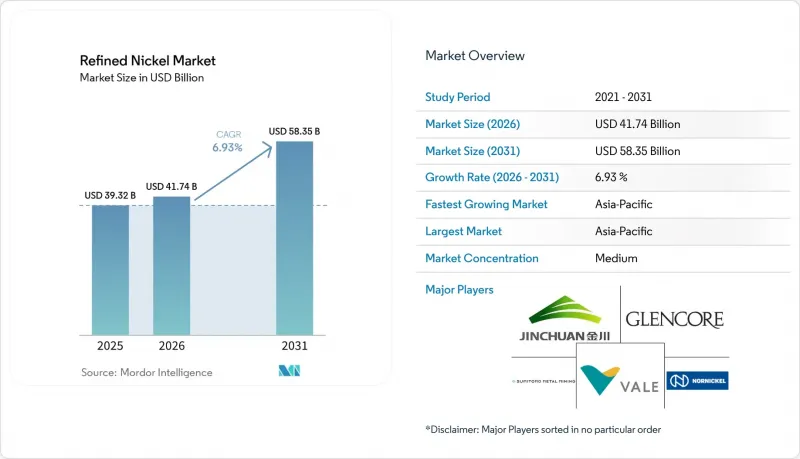
根據 Mordor Intelligence 預測,精煉鎳市場規模將從 2025 年的 393.2 億美元和 2026 年的 417.4 億美元成長到 2031 年的 583.5 億美元,2026 年至 2031 年的年複合成長率(CAGR)為 6.93%。
全球精煉鎳市場趨勢與分析
對不銹鋼和特殊鋼的需求
由於建築、機械、運輸設備和加工行業廣泛使用含鎳奧氏體不銹鋼,不銹鋼仍然是精煉鎳市場的主要需求來源。 INSG預測,到2026年,不銹鋼將佔原生鎳總消費量的三分之二以上,凸顯了其作為生產商和貿易商主要需求基礎的持續地位。中國和印尼憑藉其不銹鋼產能支撐著這一需求,而這些產能與基礎設施建設、機械製造、出口製造和國內鎳加工密切相關。增加廢鋼的使用可以減少排放和成本,同時不會影響對300系列不銹鋼的需求,這些不銹鋼在需要耐腐蝕性和耐久性的應用中仍然至關重要。航太和能源設備中使用的特種鋼為精煉金屬提供了一個規模雖小但價值極高的市場,尤其是在高溫和惡劣運作使用的零件中。這些應用對電池化學成分的變化較不敏感,即使整體不銹鋼採購價格波動,也能支撐對高等級材料的需求。
高鎳電池和儲能簡介
精煉鎳市場受益於長續航里程汽車、大型電動車以及電池重量和能量密度直接影響產品設計的應用中對高鎳含量NMC正極材料的需求。儘管製造商優先考慮降低成本並在部分車型中使用磷酸鐵鋰電池,但這些正極材料在能量密度影響車輛性能和續航里程的領域仍然發揮著至關重要的作用。預計到2025年,全球電池儲能容量將達到301.7吉瓦,年增66%,這將在整個電池供應鏈中創造更大的需求基礎。因此,儘管固定式儲能系統的大部分容量使用的是磷酸鐵鋰電池而非含鎳正極材料,但它們正在為電池材料創造新的市場。美國採購法規鼓勵汽車製造商對中國主導供應鏈以外的1級鎳供應商進行認證,這正在改變人們對可追溯材料的認知。這推動了符合採購標準且可在車輛專案整個運作內可靠供應的材料的長期採購協議談判。
鎳市場供應過剩和價格波動
鎳市場整體精煉鎳供應過剩仍然是投資的主要阻礙因素,因為它壓低了價格,並增加了提煉和礦業開發商未來現金流的不確定性。 2025年,市場供應過剩20.9萬噸,原因是印尼鎳生鐵和混合氫氧化物沉澱物的產量成長速度超過了多個終端用途的消耗量。截至2025年10月,總合金屬交易所(LME)和上海期貨交易所(SHFE)的倉庫庫存合計超過28.95萬噸,顯示交易所的可見庫存量龐大。 2025年4月,LME鎳價在每噸13,815美元至2026年5月之間波動,導致生產商、消費者和庫存擁有者面臨較大的價格波動區間。價格波動使得利潤率規劃變得困難,如果營運商無法預見新增產能的投資回報,則可能會延遲長期專案決策。雖然整體供應仍然充足,但對於一些需要所有權、來源和品質特性的歐洲和美國買家來說,獲得符合標準的 1 級材料變得越來越困難。
細分市場分析
到2025年,標準純度精煉鎳將佔精煉鎳市場佔有率的60.15%,這反映出不鏽鋼製造商對金屬的龐大需求,而非少數消費群組的需求。不銹鋼生產透過成熟的現貨市場和長期鋼鐵廠供貨合約支撐著這一市場地位,這些合約為買家提供了可預測的品質和交付條款。倫敦金屬交易所(LME)註冊的陰極鎳、圓鎳和球團鎳因其廣泛的認可度、易於處理以及適用於現有熔煉工藝,在不銹鋼供應鏈中仍然佔據重要地位。該領域受益於現有的處理系統和公認的產品標準,從而減少了客戶修改製程或驗證替代原料合格的需求。
預計到2031年,純度為99.9%或更高的高純度鎳市場將以7.34%的複合年成長率成長,超過標準等級鎳,這主要得益於技術要求的日益嚴格。電池正極材料前驅物、特殊電鍍和高溫合金等領域對雜質的控制要求非常嚴格,即使是微小的偏差也會影響性能、生產一致性或認證。 NMC 811的生產需要純度超過99.95%的鎳,並嚴格控制鈷和銅的含量,這與不銹鋼主要使用的金屬截然不同。諾裡爾斯克鎳業公司報告稱,到2025年,其「Nornickel電鍍級」產品的銷量將成長30%,這表明成熟的提煉正在尋求在其產品系列中實現更高附加價值的銷售。此外,歐洲的永續金融政策可能會透過將資本獲取與精煉材料在能源轉型中的作用更緊密地聯繫起來,從而促進高純度鎳精煉項目的發展。
到2025年,電解精煉和電解提取將佔精煉鎳市場佔有率的52.54%,這得益於眾多成熟的精煉廠的支撐。諾裡爾斯克鎳業、住友金屬礦業和神奈川集團等公司經營的現有設施,憑藉其穩定的加工流程、豐富的營運經驗以及與買家建立的牢固關係,鞏固了該技術的地位。這些企業擁有知名品牌、一體化的工藝流程以及生產符合交易所和行業要求的高純度鎳產品的豐富經驗。硫化物礦石的供應也為印尼以外地區的電解提煉提供了支持,在這些地區,電解精煉在對紅土礦和高壓酸浸(HPAL)製程依賴性較低的地區發揮著重要作用。
預計到2031年,濕式提煉將以7.56%的複合年成長率成長,主要受紅土基加工產能擴張和電池材料中間體需求成長的推動。這項擴張與印尼、菲律賓和澳洲的高壓酸浸-甲基異氰酸鎳-硫酸鎳(HPAL-MHP-to-Nislal)生產能力密切相關,這些國家的營運商正在將礦石加工與下游化學轉化相結合。鎳工業公司的ENC專案新增了甲基異氰酸鎳、硫酸鎳和鎳正極的產能,顯示透過一體化營運可以實現廣泛的產品組合。電池回收也可能促進電解提煉的發展。研究表明,從鋰離子電池黑浸出液中沉澱鎳的效率在78%至93%之間,沉澱物純度超過90%。雖然熱冶金提煉仍然發揮著至關重要的作用,但它面臨著來自紅土基加工路線的壓力,後者可以更直接地滿足電池化學品的需求。
區域分析
到2025年,亞太地區將佔據精煉鎳市場62.22%的佔有率,預計到2031年將以8.09%的複合年成長率成長。中國、印尼、日本和韓國擁有大規模的消費、加工能力和高附加價值製造能力。 2025年,中國佔全球原生鎳消費量的65%以上。預計到2026年,中國的原生鎳消費量將成長4.3%。印尼的消費量在2025年成長了5.3%,預計到2026年將成長10.3%。該國的鋼廠和電池廠消耗國內生產的原生鎳和金屬加工鎳。日本繼續保持著高品質的提煉基地,而印度則透過不銹鋼和電動車相關活動擴大了需求。
在北美和歐洲,鎳消費成長緩慢,但對本地加工和合規供應的興趣日益濃厚。美國原生鎳消費量預計在2025年將成長5.2%,2026年將成長0.8%。美國《232條款》措施正在支撐國內不銹鋼生產和鋼鐵廠需求。預計歐洲鎳消費量在2025年將下降0.5%,然後在2026年回升1.8%。歐盟《關鍵原物料法案》正在促進對戰略項目的投資,並爭取2030年實現40%的國內加工目標。這些政策正在為滿足區域採購要求的材料創造獨特的需求基礎。
南美洲的鎳源包括淡水河谷基礎金屬公司在巴西的業務、Sherritt International在古巴的Moa合資計畫以及South32在哥倫比亞的Cerro Matoso計畫。 2026年2月,淡水河谷基礎金屬公司組成了一個財團,計劃在加拿大湯普森鎳礦帶投資高達2億美元。 Sherritt計劃在2025年於Moa專案生產25,240噸精煉鎳,並預計2026年產量將達到26,000至28,000噸。中東和非洲的鎳供應量仍然小規模。隨著政策環境日趨嚴格,中國生產商正在印尼以外尋求商機。
其他好處:
- Excel格式的市場預測(ME)表
- 3個月的分析師支持
目錄
第1章:引言
- 研究假設和市場定義
- 調查範圍
第2章:調查方法
第3章執行摘要
第4章 市場狀況
- 市場概覽
- 市場促進因素
- 對不銹鋼和特殊鋼的需求
- 高鎳電池和能源儲存系統系統的介紹
- 工業化和基礎設施投資
- 關鍵礦產加工的策略性本地化
- 亞太地區硫磺路線及MHP制硫酸鹽的整合
- 市場限制因素
- 鎳市場供應過剩和價格波動
- 磷酸鐵鋰電池的淘汰以及高鎳電動車普及速度的放緩
- 硫磺海峽和霍爾木茲海峽的物流風險
- 價值鏈分析
- 波特五力分析
第5章 市場規模與成長預測
- 按純度等級
- 高純度(99.9%或以上)
- 標準純度(低於99.9%)
- 透過生產技術
- 提煉和電萃取
- 熱冶金提煉
- 濕式提煉
- 其他
- 透過使用
- 不銹鋼
- 電池
- 電鍍
- 其他用途
- 按最終用途行業分類
- 工業機械
- 冶金
- 電子設備
- 汽車和運輸業
- 建築/施工
- 其他終端用戶產業
- 按地區
- 亞太地區
- 中國
- 印度
- 日本
- 韓國
- 東南亞國協
- 其他亞太國家
- 北美洲
- 美國
- 加拿大
- 墨西哥
- 歐洲
- 德國
- 英國
- 法國
- 義大利
- 北歐國家
- 俄羅斯
- 其他歐洲國家
- 南美洲
- 巴西
- 阿根廷
- 其他南美國家
- 中東和非洲
- 沙烏地阿拉伯
- 南非
- 其他中東和非洲國家
- 亞太地區
第6章 競爭情勢
- 市場集中度
- 策略趨勢
- 市佔率和排名分析
- 公司簡介
- Anglo American
- BHP
- Eramet
- Glencore
- IGO Limited
- Jinchuan Group Co., Ltd.
- Nickel Industries Limited
- Norilsk Nickel
- PT Aneka Tambang Tbk
- Sherritt International Corporation
- South32
- Sumitomo Metal Mining Co., Ltd.
- TSINGSHAN HOLDING GROUP
- Vale
- Zhejiang Huayou Cobalt Co., Ltd.
第7章 市場機會與未來展望
According to Mordor Intelligence, the refined nickel market size is projected to expand from USD 39.32 billion in 2025 and USD 41.74 billion in 2026 to USD 58.35 billion by 2031, registering a CAGR of 6.93% between 2026 and 2031.
Global Refined Nickel Market Trends and Insights
Stainless Steel And Special Steel Demand
Stainless steel remains the main source of demand in the refined nickel market because it uses nickel-bearing austenitic grades across construction, machinery, transport equipment, and process industries. INSG expects stainless steel to account for more than two-thirds of total primary nickel consumption in 2026, confirming its continuing role as the volume base for producers and traders. China and Indonesia support this demand through infrastructure work, machinery production, export manufacturing, and stainless steel capacity that is closely linked to domestic nickel processing. Greater use of scrap can lower emissions and costs without eliminating nickel demand from 300-series stainless grades, which remain important where corrosion resistance and durability are required. Special steels used in aerospace and energy equipment provide a smaller but higher-value outlet for refined metal, particularly in components exposed to high temperatures or demanding operating conditions. These applications are less exposed to battery chemistry changes and support demand for high-grade material when broader stainless purchasing is affected by price movements.
High-Nickel Battery And Energy-Storage Deployment
The refined nickel market benefits from demand for nickel-rich NMC cathodes in long-range vehicles, larger electric vehicle formats, and uses where battery weight and energy density directly affect the product design. These cathodes remain relevant where energy density affects vehicle performance and driving range, even as manufacturers use LFP cells in models where lower cost is the priority. Global battery energy storage capacity reached 301.7 gigawatts in 2025, a 66% increase from the prior year, creating a much larger base for demand across the wider battery supply chain. Stationary storage, therefore, creates an additional channel for battery materials, even though much of its capacity uses LFP chemistry rather than nickel-bearing cathodes. United States sourcing rules are encouraging automakers to qualify Class 1 nickel suppliers outside Chinese-controlled supply chains, which changes the value placed on traceable material. This supports long-term offtake discussions for material that meets required sourcing standards and can be supplied consistently through the operating life of vehicle programs.
Nickel Market Surpluses And Price Volatility
Supply surpluses remain a major constraint on investment across the refined nickel market because they lower prices and make future cash flows less certain for refiners and mine developers. The market recorded a 209,000-tonne surplus in 2025 as Indonesian nickel pig iron and mixed hydroxide precipitate output increased faster than consumption in several end uses. Combined LME and SHFE warehouse stocks exceeded 289,500 tonnes by October 2025, showing the extent of material available in visible exchange inventories. LME nickel traded between USD 13,815 per ton in April 2025 and USD 19,365 per tonne in May 2026, creating a broad range for producers, consumers, and inventory holders. Price volatility makes margin planning difficult and can delay long-cycle project decisions when operators cannot establish a clear return on new capacity. Aggregate supply can still coexist with tighter availability of compliant Class 1 material for certain Western buyers that require ownership, origin, and quality characteristics.
Other drivers and restraints analyzed in the detailed report include:
- Industrialization And Infrastructure Investment
- Strategic Localization Of Critical-Mineral Processing
- LFP Battery Substitution And Slower High-Nickel EV Penetration
For complete list of drivers and restraints, kindly check the Table Of Contents.
Segment Analysis
Standard purity refined nickel held 60.15% of the refined nickel market in 2025, reflecting the large volume of metal needed by stainless steel producers rather than a narrow group of specialty consumers. Stainless steel production supports this position through established spot markets and long-term mill supply agreements that give buyers predictable quality and delivery arrangements. LME-registered cathodes, rounds, and pellets remain important to the stainless supply chain because they are widely recognized, easy to handle, and suitable for established melting practices. The segment benefits from existing handling systems and recognized product standards, which reduce the need for customers to alter processes or qualify alternative feedstocks.
High purity nickel with 99.9% or greater purity is forecast to expand at a 7.34% CAGR through 2031, ahead of standard grades as technical requirements become more demanding. Battery cathode precursors, specialty electroplating, and superalloys require tight control over impurities because minor variations can affect performance, production consistency, or qualification. NMC 811 production requires purity above 99.95% and closely controlled cobalt and copper content, creating a clear distinction from metal used primarily in stainless steel. Norilsk Nickel reported 30% volume growth for its Nornickel Plating Grade product in 2025, showing how established refiners are seeking higher-value sales within their product portfolios. European sustainable-finance policy could also support high-purity refining projects by making access to capital more closely tied to the role of refined materials in the energy transition.
Electrorefining and electrowinning held 52.54% of the refined nickel market size in 2025, supported by a substantial installed base of proven refinery operations. Established facilities operated by Norilsk Nickel, Sumitomo Metal Mining, and Jinchuan Group support this technology's position through integrated processing, long operating histories, and established relationships with buyers. These operations have recognized brands, integrated processes, and experience producing high-purity material that can meet exchange and industrial requirements. Sulfide ore feed also supports electrorefining outside Indonesia, giving this route an important position in regions that are less reliant on laterite ore and HPAL processing.
Hydrometallurgical refining is forecast to grow at a 7.56% CAGR through 2031, driven by the growth of laterite-based processing capacity and the need for battery-material intermediates. This expansion is tied to HPAL-MHP-to-sulfate capacity in Indonesia, the Philippines, and Australia, where operators are connecting ore processing with downstream chemical conversion. Nickel Industries' ENC project adds new capacity for MHP, nickel sulfate, and nickel cathode, illustrating the wider product mix available from integrated operations. Battery recycling can also support electrowinning, as research showed nickel deposition efficiencies of 78% to 93% from lithium-ion battery black mass leachate and deposit purity above 90%. Pyrometallurgical refining retains a role but faces pressure from laterite-based processing routes that can serve battery-chemical demand more directly.
Complete Report Scope:
- By Purity Grade
- High Purity (99.9%+)
- Standard Purity (Below 99.9%)
- By Production Technology
- Electrorefining and Electrowinning
- Pyrometallurgical Refining
- Hydrometallurgical Refining
- Others
- By Application
- Stainless Steel
- Batteries
- Plating
- Other Applications
- By End-Use Industry
- Industrial Machinery
- Metallurgy
- Electronics
- Automotive and Transportation
- Building and Construction
- Other End-Use Industries
- By Geography
- Asia-Pacific
- China
- India
- Japan
- South Korea
- ASEAN Countries
- Rest of Asia-Pacific
- North America
- United States
- Canada
- Mexico
- Europe
- Germany
- United Kingdom
- France
- Italy
- NORDIC Countries
- Russia
- Rest of Europe
- South America
- Brazil
- Argentina
- Rest of South America
- Middle East and Africa
- Saudi Arabia
- South Africa
- Rest of Middle East and Africa
- Asia-Pacific
Geography Analysis
Asia-Pacific accounted for 62.22% of the refined nickel market share in 2025 and is forecast to grow at an 8.09% CAGR through 2031. China, Indonesia, Japan, and South Korea combine large consumption with processing and high-grade manufacturing capacity. China accounted for more than 65% of global primary nickel consumption in 2025. Chinese primary nickel consumption is forecast to grow 4.3% in 2026. Indonesia's consumption grew 5.3% in 2025 and is forecast to increase 10.3% in 2026. Its stainless mills and battery plants consume NPI and MHP within the country. Japan retains a premium refining base, while India adds demand through stainless steel and electric vehicle activity.
North America and Europe have slower volume growth but greater interest in local processing and compliant supply. The United States primary nickel consumption grew 5.2% in 2025 and is forecast to grow 0.8% in 2026. United States Section 232 measures support domestic stainless steel production and mill demand. Europe's nickel usage is forecast to recover 1.8% in 2026 after a 0.5% decline in 2025. The European Union's Critical Raw Materials Act supports investment in strategic projects and a 40% domestic processing target by 2030. These policies create a separate demand base for material that meets regional sourcing requirements.
South American supply includes Vale Base Metals' Brazilian operations, Sherritt International's Moa joint venture in Cuba, and South32's Cerro Matoso operation in Colombia. Vale Base Metals formed a consortium in February 2026 to invest up to USD 200 million in the Thompson Nickel Belt in Canada. Sherritt produced 25,240 tonnes of finished nickel at Moa in 2025 and guided for 26,000 to 28,000 tonnes in 2026. The Middle East and Africa remain smaller supply regions. Chinese producers are assessing opportunities outside Indonesia as policy conditions become more restrictive.
- Anglo American
- BHP
- Eramet
- Glencore
- IGO Limited
- Jinchuan Group Co., Ltd.
- Nickel Industries Limited
- Norilsk Nickel
- PT Aneka Tambang Tbk
- Sherritt International Corporation
- South32
- Sumitomo Metal Mining Co., Ltd.
- TSINGSHAN HOLDING GROUP
- Vale
- Zhejiang Huayou Cobalt Co., Ltd.
Additional Benefits:
- The market estimate (ME) sheet in Excel format
- 3 months of analyst support
TABLE OF CONTENTS
1 INTRODUCTION
- 1.1 Study Assumptions and Market Definition
- 1.2 Scope of the Study
2 RESEARCH METHODOLOGY
3 EXECUTIVE SUMMARY
4 MARKET LANDSCAPE
- 4.1 Market Overview
- 4.2 Market Drivers
- 4.2.1 Stainless Steel and Special Steel Demand
- 4.2.2 High-Nickel Battery and Energy-Storage Deployment
- 4.2.3 Industrialization and Infrastructure Investment
- 4.2.4 Strategic Localization of Critical-Mineral Processing
- 4.2.5 Sulfur-Route and MHP-to-Sulfate Integration in Asia-Pacific
- 4.3 Market Restraints
- 4.3.1 Nickel Market Surpluses and Price Volatility
- 4.3.2 LFP Battery Substitution and Slower High-Nickel EV Penetration
- 4.3.3 Sulfur and Strait-of-Hormuz Logistics Exposure
- 4.4 Value Chain Analysis
- 4.5 Porter's Five Forces Analysis
- 4.5.1 Bargaining Power of Suppliers
- 4.5.2 Bargaining Power of Buyers
- 4.5.3 Threat of New Entrants
- 4.5.4 Threat of Substitutes
- 4.5.5 Competitive Rivalry
5 MARKET SIZE AND GROWTH FORECASTS (VALUE)
- 5.1 By Purity Grade
- 5.1.1 High Purity (99.9%+)
- 5.1.2 Standard Purity (Below 99.9%)
- 5.2 By Production Technology
- 5.2.1 Electrorefining and Electrowinning
- 5.2.2 Pyrometallurgical Refining
- 5.2.3 Hydrometallurgical Refining
- 5.2.4 Others
- 5.3 By Application
- 5.3.1 Stainless Steel
- 5.3.2 Batteries
- 5.3.3 Plating
- 5.3.4 Other Applications
- 5.4 By End-Use Industry
- 5.4.1 Industrial Machinery
- 5.4.2 Metallurgy
- 5.4.3 Electronics
- 5.4.4 Automotive and Transportation
- 5.4.5 Building and Construction
- 5.4.6 Other End-Use Industries
- 5.5 By Geography
- 5.5.1 Asia-Pacific
- 5.5.1.1 China
- 5.5.1.2 India
- 5.5.1.3 Japan
- 5.5.1.4 South Korea
- 5.5.1.5 ASEAN Countries
- 5.5.1.6 Rest of Asia-Pacific
- 5.5.2 North America
- 5.5.2.1 United States
- 5.5.2.2 Canada
- 5.5.2.3 Mexico
- 5.5.3 Europe
- 5.5.3.1 Germany
- 5.5.3.2 United Kingdom
- 5.5.3.3 France
- 5.5.3.4 Italy
- 5.5.3.5 NORDIC Countries
- 5.5.3.6 Russia
- 5.5.3.7 Rest of Europe
- 5.5.4 South America
- 5.5.4.1 Brazil
- 5.5.4.2 Argentina
- 5.5.4.3 Rest of South America
- 5.5.5 Middle East and Africa
- 5.5.5.1 Saudi Arabia
- 5.5.5.2 South Africa
- 5.5.5.3 Rest of Middle East and Africa
- 5.5.1 Asia-Pacific
6 COMPETITIVE LANDSCAPE
- 6.1 Market Concentration
- 6.2 Strategic Moves
- 6.3 Market Share (%)/Ranking Analysis
- 6.4 Company Profiles (includes Global Level Overview, Market Level Overview, Core Segments, Financials as available, Strategic Information, Products and Services, Recent Developments)
- 6.4.1 Anglo American
- 6.4.2 BHP
- 6.4.3 Eramet
- 6.4.4 Glencore
- 6.4.5 IGO Limited
- 6.4.6 Jinchuan Group Co., Ltd.
- 6.4.7 Nickel Industries Limited
- 6.4.8 Norilsk Nickel
- 6.4.9 PT Aneka Tambang Tbk
- 6.4.10 Sherritt International Corporation
- 6.4.11 South32
- 6.4.12 Sumitomo Metal Mining Co., Ltd.
- 6.4.13 TSINGSHAN HOLDING GROUP
- 6.4.14 Vale
- 6.4.15 Zhejiang Huayou Cobalt Co., Ltd.
7 MARKET OPPORTUNITIES AND FUTURE OUTLOOK
- 7.1 White-Space and Unmet-Need Assessment

 高孔隙率鎳泡沫市場:全球市場預測,2026-2032年鎳市場:全球市場預測,2026-2032年
 氫氧化鎳:市場佔有率分析、產業趨勢與統計、成長預測(2026-2031)
 鎳市場規模、佔有率、趨勢和預測:按產品類型、應用、最終用途行業和地區分類,2026-2034年
 鎳市場分析及預測(至2035年):類型、產品類型、應用、形態、材質類型、最終用戶、技術、製程、組件、安裝類型
 2026-2034年全球鎳市場規模、佔有率、趨勢和成長分析報告
 2026年全球鎳市場報告PVD鎳泡棉市場按產品、製造流程、厚度範圍、應用和終端用戶產業分類-2026-2032年全球預測依電池類型、形態、純度等級、製造流程和應用分類的電動車電池用硫酸鎳市場-2026年至2032年全球預測全球高溫球形氫氧化鎳材料市場(依等級、粒徑、純度、製造製程及應用分類)2026-2032年預測