


 |
市場調查報告書
商品編碼
2117502
氫氧化鎳:市場佔有率分析、產業趨勢與統計、成長預測(2026-2031)Nickel Hydroxide - Market Share Analysis, Industry Trends & Statistics, Growth Forecasts (2026 - 2031) |
||||||

※ 本網頁內容可能與最新版本有所差異。詳細情況請與我們聯繫。
據 Mordor Intelligence 稱,2025 年氫氧化鎳市值為 24.2 億美元,預計到 2031 年將從 2026 年的 26.6 億美元成長至 35.2 億美元,預測期(2026-2031 年)複合年成長率為 5.76%。
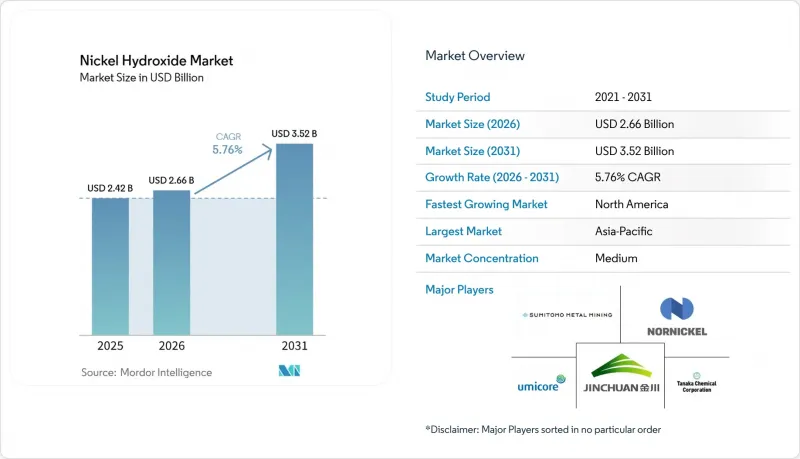
本報告按產品類型(例如,電池用氫氧化鎳)、純度(電池級、工業級)、形態(例如,粉末)、應用(例如,可充電電池)、終端用戶行業(例如,電池製造、汽車行業)和地區(亞太地區、北美地區、歐洲地區、南美地區、中東和非洲地區)進行細分。市場預測以美元計價。
全球氫氧化鎳市場趨勢及洞察
電動車的快速普及正在加速對正極前驅的需求。
預計2025年,全球電動車電池裝置容量將達到1.2太瓦時(TWh),較2024年成長30%。這將持續推動電池材料需求的強勁成長。氫氧化鎳市場正受益於這一轉變,因為富鎳正極材料在高能量密度電池平台中被廣泛應用,以實現更長的續航里程和更高的性能。高階電動車市場仍然至關重要,在以長續航里程為目標的車輛項目中,含鎳化學成分仍然優於低成本的替代品,尤其是在中國以外的市場。這一趨勢維持了對可直接轉化為正極前驅體且滿足穩定純度和顆粒控制要求的材料的需求。因此,氫氧化鎳市場不僅與電動車的銷量有關,還與這些車輛中使用的電池化學成分密切相關。隨著高鎳含量電池平台的商業化程度不斷提高,材料需求也變得更加集中,並受到規格的主導。
向高純度電池級規格的結構性轉變重新定義了供應標準。
氫氧化鎳市場正從工業級材料轉向能夠滿足更嚴格的正極材料製造標準的電池級材料。到2025年,純度為99%或更高的電池級材料將佔銷售額的64.9%,這表明市場對先進電池應用的依賴程度已經很高。這項轉變也受到正規供應鏈要求的進一步推動,包括對電池材料採購的品質和可追溯性提出更嚴格的要求。能夠維持更嚴格的雜質控制和可靠的共沉澱生產性能的生產商更有可能獲得客戶的長期認可。此外,隨著認證標準與額定產能同等重要,新進業者進入氫氧化鎳市場的難度也越來越大。儘管鎳的整體供應狀況看起來相對寬鬆,但這些因素共同促使現有供應商採取價格約束策略。
高昂的資金需求限制了電池級產品的產能擴張。
由於建設和認證電池級共沉澱生產線高成本,氫氧化鎳市場面臨許多挑戰。新建工廠不僅需要建造資金,還需要製程驗證、廢棄物管理系統以及客戶核准,這些都需要數年時間才能完成。北美和歐洲的人事費用和環境合規成本高於中國,因此這項挑戰尤其突出。此外,美國的政策討論也強調了關鍵礦物和電池材料的國內生產成本持續低於進口成本。這種趨勢在加工階段尤其明顯,因為與鋰和石墨相比,加工環節的支持力道較弱。因此,氫氧化鎳市場更有利於能夠分攤採礦、中間加工和前驅體製造成本的大型綜合企業。雖然小規模生產商也可以進入市場,但他們往往難以保持價格和規格的穩定性。
細分市場分析
到2025年,電池用氫氧化鎳將佔氫氧化鎳市場佔有率的53.81%,反映出市場需求正顯著轉向電池相關應用。此細分市場的主導地位主要歸功於正極活性材料製造商對能夠滿足高鎳含量電池配方和更嚴格製程公差要求的氫氧化鎳前驅體的需求不斷成長。工業用氫氧化鎳仍繼續用於電鍍、顏料和一般化學合成應用,在整個氫氧化鎳產業中保持其地位。然而,隨著銷售結構持續向更高價值的電池規格轉變,其成長速度正在放緩。因此,氫氧化鎳市場越來越依賴能夠提供認證電池材料的製造商,而非通用化學級產品。
預計到2031年,鈷包覆氫氧化鎳的複合年成長率將達到6.62%,成為氫氧化鎳市場中成長最快的子類別。隨著正極材料製造商採用鈷表面處理來提高循環穩定性並減少高鎳電極的結構劣化,市場需求不斷成長。高密度氫氧化鎳在固態電池前驅體的開發中也備受關注,因為堆積密度和漿料性能至關重要。隨著買家除了關注化學性能外,也越來越重視永續性和供應鏈合規性,產品差異化越來越依賴技術性能和採購可靠性。這一趨勢正推動氫氧化鎳市場繼續專注於難以替代且難以認證的高規格產品。
純度為99%或以上的電池級氫氧化鎳預計在2025年將佔總銷售額的64.93%,並在2031年之前以6.31%的複合年成長率成長。這一表現表明,純度已成為氫氧化鎳市場的商業性必要條件,而不僅僅是可選的高階特性。電池供應鏈中的買家要求對雜質進行更嚴格的控制,顆粒特性更加穩定,批次間一致性更可靠。純度低於99%的工業級氫氧化鎳持續在電鍍、陶瓷、顏料和通用化學品等領域應用,保持一定的市場需求。然而,由於其在先進電池採購中並非核心產品,因此其價格決定力較低。
隨著標準日益嚴格,能夠在氫氧化鎳市場有效競爭的企業格局也在改變。能夠持續供應高純度材料的生產商更有利於獲得客戶認可並維持更高的利潤率。監管壓力進一步加劇了這種差距,因為電池相關供應鏈中的品質、可追溯性和製程控制正受到越來越多的正式關注。儘管目前新興電池平台對超高純度材料的小批量需求可能仍屬於小眾市場,但它為產品線增添了重要的高階價值。因此,氫氧化鎳市場正變得越來越注重質量,這為擁有成熟加工能力的現有供應商提供了支持。
區域分析
到2025年,亞太地區將佔據59.23%的氫氧化鎳市場佔有率,鞏固其作為全球生產和消費中心的地位。中國在這一地位中仍佔據核心地位,將正極前驅體加工、電池製造和大規模的終端市場需求整合在一個緊密相連的單一供應鏈中。日本憑藉其精密鎳精煉和特殊材料製造能力,為市場注入了強勁動力,這些能力支撐著高規格電池原料的生產。韓國也憑藉其一體化的電池材料集團發揮核心作用,該集團持續保障上游鎳供應並擴大下游正極材料產能。因此,亞太地區氫氧化鎳市場擁有其他地區仍在建構的規模優勢、製程深度優勢和供應鏈互聯互通優勢。
預計到2031年,北美將以6.37%的複合年成長率成長,成為鎳氫氧化物市場規模成長最快的地區。這一成長主要得益於《通貨膨脹抑制法案》、在地採購目標以及一系列旨在減少對進口電池材料依賴的措施。隨著該地區持續建設上游基礎設施,支持國內鎳加工具有重要的戰略意義。隨著原始設備製造商(OEM)努力滿足有關本地採購比例和供應鏈合格的法規要求,加拿大和墨西哥也日益融入該地區的電池網路。對於鎳氫氧化物市場而言,這意味著北美未來的需求成長將取決於能否建立合格的前驅體和原料以及電池組裝的本地生產能力。
由於歐洲擁有成熟的鎳基複合材料(NMC)電池製造地和嚴格的監管要求,因此仍然是氫氧化鎳市場的重要需求中心。德國、英國、法國和義大利透過與汽車製造商合作投資電池以及對工業化學品的需求,持續支撐著區域需求。歐盟電池法規是一項關鍵的商業性篩選機制,因為它加強了電動車電池供應鏈的碳足跡揭露和實質審查要求。南美、中東和非洲雖然目前市場規模相對較小,但由於電動車普及推廣措施、煉油需求以及新的電池材料計畫為未來的加工成長創造了空間,這些地區的重要性正在日益提升。
其他好處:
- Excel格式的市場預測(ME)表
- 3個月的分析師支持
目錄
第1章:引言
- 研究假設和市場定義
- 調查範圍
第2章:調查方法
第3章執行摘要
第4章 市場狀況
- 市場概覽
- 市場促進因素
- 電動車和高鎳鋰離子電池的快速普及。
- 高純度電池向氫氧化鎳過渡
- 對能源儲存系統的需求日益成長。
- 鎳氫氧化物在催化劑和特殊化學品的應用日益廣泛。
- 政府支持以本地化為導向的電池材料供應鏈。
- 市場限制因素
- 生產電池用氫氧化鎳需要大量的資金投入。
- 過渡到鎳含量較低的替代電池化學體系
- 鎳原料價格波動
- 價值鏈分析
- 波特五力分析
第5章 市場規模與成長預測
- 依產品類型
- 用於電池的氫氧化鎳
- 工業用氫氧化鎳
- 鈷包覆氫氧化鎳
- 高密度氫氧化鎳
- 其他產品類型
- 純度
- 電池等級(99%或更高)
- 工業級(低於99%)
- 按形式
- 粉末
- 顆粒
- 球形
- 其他形式
- 透過使用
- 可充電電池
- 電鍍
- 催化劑
- 陶瓷和顏料
- 化學中間體
- 其他用途
- 按最終用途行業分類
- 電池製造
- 車
- 電子設備
- 化工
- 航太/國防
- 其他終端用戶產業
- 按地區
- 亞太地區
- 中國
- 印度
- 日本
- 韓國
- 其他亞太國家
- 北美洲
- 美國
- 加拿大
- 墨西哥
- 歐洲
- 德國
- 英國
- 法國
- 義大利
- 俄羅斯
- 其他歐洲國家
- 南美洲
- 巴西
- 阿根廷
- 其他南美國家
- 中東和非洲
- 沙烏地阿拉伯
- 南非
- 其他中東和非洲國家
- 亞太地區
第6章 競爭情勢
- 市場集中度
- 策略趨勢
- 市佔率和排名分析
- 公司簡介
- Sumitomo Metal Mining Co., Ltd.
- Jinchuan Group International Resources Co. Ltd.
- Umicore
- Tanaka Chemical Corporation
- Jilin Jien Nickel Industry Co., Ltd.
- Jiangmen Fangyuan New Materials Co., Ltd.
- Henan Kelong New Energy Co., Ltd.
- American Elements
- CNGR Advanced Material Co., Ltd.
- Guangxi Yinyi Science and Technology Co., Ltd.
- Anhui Yaland New Materials Co., Ltd.
- Zhejiang Taikai Battery Materials Co., Ltd.
- GFS Chemicals
- Johnson Matthey
- Nornickel Harjavalta Oy
- GEM Co., Ltd.
第7章 市場機會與未來展望
According to Mordor Intelligence, the nickel hydroxide market size was valued at USD 2.42 billion in 2025 and is estimated to grow from USD 2.66 billion in 2026 to reach USD 3.52 billion by 2031, at a CAGR of 5.76% during the forecast period (2026-2031).
This report is Segmented by Product Type (Battery-Grade Nickel Hydroxide, and More), Purity (Battery Grade, Industrial Grade), Form (Powder, and More), Application (Rechargeable Batteries, and More), End-Use Industry (Battery Manufacturing, Automotive, and More), and Geography (Asia-Pacific, North America, Europe, South America, Middle East and Africa). The Market Forecasts are Provided in Terms of Value (USD).
Global Nickel Hydroxide Market Trends and Insights
Rapid EV Adoption Intensifying Cathode Precursor Demand
Global EV battery deployment is expected to reach 1.2 TWh in 2025, a 30% increase from 2024, keeping battery materials demand on a strong upward trajectory. The nickel hydroxide market benefits from this shift, as higher-energy battery platforms continue to rely on nickel-rich cathode chemistries to deliver longer range and stronger performance. The premium EV segment remains especially important, as vehicle programs targeting longer driving ranges continue to favor nickel-bearing chemistries over lower-cost alternatives outside China. This trend sustains demand for materials that can move directly into cathode precursor production while meeting consistent purity and particle control requirements. Therefore, the nickel hydroxide market tracks not only EV unit sales but also the battery chemistry mix selected for those vehicles. As high-nickel cell platforms advance further into commercial use, material demand increases in a more concentrated and specification-driven manner.
Structural Shift Toward High-Purity Battery-Grade Specifications Redefining Supply Standards
The nickel hydroxide market is moving away from industrial-grade material and toward battery-grade supply that can meet stricter cathode manufacturing standards. Battery Grade with 99% and above purity held 64.9% of revenue in 2025, which shows how much the market already depends on advanced battery applications. This change is being reinforced by formal supply chain requirements, including tighter quality and traceability expectations across battery materials procurement . Producers that can maintain tighter impurity controls and more reliable co-precipitation performance are better placed to secure long-term customer approvals. The nickel hydroxide market is also becoming harder for new entrants to access because qualification standards now matter as much as nominal installed capacity. That combination supports pricing discipline for established suppliers, even when broader nickel supply appears more comfortable.
High Capital Requirements Constraining Battery-Grade Capacity Expansion
The nickel hydroxide market faces a significant barrier due to the high cost of building and qualifying battery-grade co-precipitation lines. New facilities require more than construction capital; they also need process validation, waste treatment systems, and customer approvals, which can take years to complete. This challenge is more pronounced in North America and Europe, where labor and environmental compliance costs are higher than in China. U.S. policy discussions have also highlighted that domestic critical mineral and battery material production still carries a cost disadvantage compared to imports, especially in processing stages that have received less support than lithium and graphite. As a result, the nickel hydroxide market favors larger, more integrated players that can spread costs across mining, intermediate processing, and precursor manufacturing. Smaller producers can still participate, but they often struggle to match price and specification consistency simultaneously.
Other drivers and restraints analyzed in the detailed report include:
- Growing Grid-Scale Energy Storage Deployment Broadening Demand Beyond EVs
- Government Localization Mandates Reshaping Supply Chain Geography
- LFP Chemistry Adoption Moderating But Not Eliminating Demand Growth
For complete list of drivers and restraints, kindly check the Table Of Contents.
Segment Analysis
Battery-grade nickel hydroxide accounted for 53.81% of the nickel hydroxide market share in 2025, reflecting the strong shift in demand toward battery-related applications. This segment leads as cathode active material producers increasingly require precursor inputs that support nickel-rich battery formulations and stricter process tolerances. Industrial-grade nickel hydroxide continues to serve electroplating, pigments, and general chemical synthesis applications, maintaining its role in the broader nickel hydroxide industry. However, it has a slower growth profile as the revenue mix continues to shift toward higher-value battery specifications. As a result, the nickel hydroxide market is becoming more dependent on producers that can supply qualified battery materials rather than generic chemical grades.
Cobalt-coated nickel hydroxide is projected to register a CAGR of 6.62% through 2031, making it the fastest-growing product sub-category in the nickel hydroxide market. Demand is increasing as cathode producers use cobalt surface treatment to improve cycle stability and reduce structural degradation in high-nickel electrodes. High-density nickel hydroxide is also gaining traction in solid-state battery precursor development, where packing density and slurry performance are critical. Product differentiation now depends on both technical performance and procurement confidence, as buyers increasingly assess sustainability and supply chain compliance alongside chemistry. This trend keeps the nickel hydroxide market focused on higher-specification products that are harder to replace and more difficult to qualify.
Battery Grade nickel hydroxide with 99% and above purity accounted for 64.93% of revenue in 2025 and is expected to grow at a 6.31% CAGR through 2031. This performance indicates that purity has become a commercial requirement in the nickel hydroxide market rather than an optional premium feature. Buyers in battery supply chains require tighter impurity control, more stable particle characteristics, and more reliable lot-to-lot consistency. Industrial Grade nickel hydroxide with below 99% purity continues to support electroplating, ceramics, pigments, and commodity chemical applications, keeping its demand base intact. However, it has lower pricing power because it does not occupy a central position in advanced battery procurement.
The shift toward tighter standards is also changing which companies can compete effectively in the nickel hydroxide market. Producers that consistently supply higher-purity material are better positioned to secure customer approvals and maintain stronger margins. Regulatory pressure further reinforces this divide, as quality, traceability, and process control are receiving greater formal attention across battery-related supply chains. Small volumes of ultra-high-purity material for emerging battery platforms may remain niche today, but they add an important premium layer to the product mix. As a result, the nickel hydroxide market is becoming more quality-driven, supporting established suppliers with proven processing capabilities.
Complete Report Scope:
- By Product Type
- Battery-Grade Nickel Hydroxide
- Industrial-Grade Nickel Hydroxide
- Cobalt-Coated Nickel Hydroxide
- High-Density Nickel Hydroxide
- Other Product Types
- By Purity
- Battery Grade (99% and Above)
- Industrial Grade (Below 99%)
- By Form
- Powder
- Granules
- Spherical
- Other Forms
- By Application
- Rechargeable Batteries
- Electroplating
- Catalysts
- Ceramics and Pigments
- Chemical Intermediates
- Other Applications
- By End-Use Industry
- Battery Manufacturing
- Automotive
- Electronics
- Chemical Industry
- Aerospace and Defense
- Other End-Use Industries
- By Geography
- Asia-Pacific
- China
- India
- Japan
- South Korea
- Rest of Asia Pacific
- North America
- United States
- Canada
- Mexico
- Europe
- Germany
- United Kingdom
- France
- Italy
- Russia
- Rest of Europe
- South America
- Brazil
- Argentina
- Rest of South America
- Middle East and Africa
- Saudi Arabia
- South Africa
- Rest of Middle East and Africa
- Asia-Pacific
Geography Analysis
Asia-Pacific held 59.23% of the nickel hydroxide market share in 2025, which kept the region firmly at the center of global production and consumption. China remains the core of this position because it combines cathode precursor processing, battery manufacturing, and large end-market demand within one tightly linked supply chain. Japan adds strength through precision nickel refining and specialty materials capability, which supports higher-specification battery inputs. South Korea also plays a central role through integrated battery materials groups that continue to secure upstream nickel supply and expand downstream cathode capacity. The nickel hydroxide market in Asia-Pacific therefore benefits from scale, process depth, and supply chain coordination that other regions are still building.
North America is projected to grow at a 6.37% CAGR through 2031, which makes it the fastest-growing regional part of the nickel hydroxide market size. This growth is being driven by the Inflation Reduction Act, localization targets, and a broad effort to reduce dependence on imported battery materials. The region is still building its upstream base, which is why support for domestic nickel processing has become strategically important. Canada and Mexico are also becoming more integrated into this regional battery network as OEMs work to meet domestic content and supply chain eligibility rules. For the nickel hydroxide market, this means future demand growth in North America will depend not only on battery assembly, but also on whether qualified precursor and feedstock capacity can be built locally.
Europe remains an important demand center in the nickel hydroxide market because it has an established NMC battery manufacturing base and strict regulatory expectations. Germany, the UK, France, and Italy continue to anchor regional demand through automaker-linked battery investment and industrial chemicals use. The EU Battery Regulation is a major commercial filter because it strengthens carbon footprint disclosure and due diligence requirements for EV battery supply chains . South America and the Middle East and Africa remain smaller in current size, but they are becoming more relevant as EV incentives, refining demand, and new battery materials projects create room for future processing growth.
- Sumitomo Metal Mining Co., Ltd.
- Jinchuan Group International Resources Co. Ltd.
- Umicore
- Tanaka Chemical Corporation
- Jilin Jien Nickel Industry Co., Ltd.
- Jiangmen Fangyuan New Materials Co., Ltd.
- Henan Kelong New Energy Co., Ltd.
- American Elements
- CNGR Advanced Material Co., Ltd.
- Guangxi Yinyi Science and Technology Co., Ltd.
- Anhui Yaland New Materials Co., Ltd.
- Zhejiang Taikai Battery Materials Co., Ltd.
- GFS Chemicals
- Johnson Matthey
- Nornickel Harjavalta Oy
- GEM Co., Ltd.
Additional Benefits:
- The market estimate (ME) sheet in Excel format
- 3 months of analyst support
TABLE OF CONTENTS
1 Introduction
- 1.1 Study Assumptions and Market Definition
- 1.2 Scope of the Study
2 Research Methodology
3 Executive Summary
4 Market Landscape
- 4.1 Market Overview
- 4.2 Market Drivers
- 4.2.1 Rapid adoption of electric vehicles and high-nickel lithium-ion batteries.
- 4.2.2 Shift to High-Purity Battery-Grade Nickel Hydroxide
- 4.2.3 Increasing demand for energy storage systems.
- 4.2.4 Growing use of nickel hydroxide in catalyst and specialty chemical applications.
- 4.2.5 Government support for localized battery material supply chains.
- 4.3 Market Restraints
- 4.3.1 High capital investment required for battery-grade nickel hydroxide production.
- 4.3.2 Shift toward alternative battery chemistries with lower nickel content
- 4.3.3 Nickel Feedstock Price Volatility
- 4.4 Value Chain Analysis
- 4.5 Porter's Five Forces Analysis
- 4.5.1 Threat of New Entrants
- 4.5.2 Bargaining Power of Suppliers
- 4.5.3 Bargaining Power of Buyers
- 4.5.4 Threat of Substitutes
- 4.5.5 Competitive Rivalry
5 Market Size and Growth Forecasts (Value)
- 5.1 By Product Type
- 5.1.1 Battery-Grade Nickel Hydroxide
- 5.1.2 Industrial-Grade Nickel Hydroxide
- 5.1.3 Cobalt-Coated Nickel Hydroxide
- 5.1.4 High-Density Nickel Hydroxide
- 5.1.5 Other Product Types
- 5.2 By Purity
- 5.2.1 Battery Grade (99% and Above)
- 5.2.2 Industrial Grade (Below 99%)
- 5.3 By Form
- 5.3.1 Powder
- 5.3.2 Granules
- 5.3.3 Spherical
- 5.3.4 Other Forms
- 5.4 By Application
- 5.4.1 Rechargeable Batteries
- 5.4.2 Electroplating
- 5.4.3 Catalysts
- 5.4.4 Ceramics and Pigments
- 5.4.5 Chemical Intermediates
- 5.4.6 Other Applications
- 5.5 By End-Use Industry
- 5.5.1 Battery Manufacturing
- 5.5.2 Automotive
- 5.5.3 Electronics
- 5.5.4 Chemical Industry
- 5.5.5 Aerospace and Defense
- 5.5.6 Other End-Use Industries
- 5.6 By Geography
- 5.6.1 Asia-Pacific
- 5.6.1.1 China
- 5.6.1.2 India
- 5.6.1.3 Japan
- 5.6.1.4 South Korea
- 5.6.1.5 Rest of Asia Pacific
- 5.6.2 North America
- 5.6.2.1 United States
- 5.6.2.2 Canada
- 5.6.2.3 Mexico
- 5.6.3 Europe
- 5.6.3.1 Germany
- 5.6.3.2 United Kingdom
- 5.6.3.3 France
- 5.6.3.4 Italy
- 5.6.3.5 Russia
- 5.6.3.6 Rest of Europe
- 5.6.4 South America
- 5.6.4.1 Brazil
- 5.6.4.2 Argentina
- 5.6.4.3 Rest of South America
- 5.6.5 Middle East and Africa
- 5.6.5.1 Saudi Arabia
- 5.6.5.2 South Africa
- 5.6.5.3 Rest of Middle East and Africa
- 5.6.1 Asia-Pacific
6 Competitive Landscape
- 6.1 Market Concentration
- 6.2 Strategic Moves
- 6.3 Market Share (%)/Ranking Analysis
- 6.4 Company Profiles (includes Global Overview, Market Overview, Core Segments, Financials as available, Strategic Information, Products and Services, and Recent Developments)
- 6.4.1 Sumitomo Metal Mining Co., Ltd.
- 6.4.2 Jinchuan Group International Resources Co. Ltd.
- 6.4.3 Umicore
- 6.4.4 Tanaka Chemical Corporation
- 6.4.5 Jilin Jien Nickel Industry Co., Ltd.
- 6.4.6 Jiangmen Fangyuan New Materials Co., Ltd.
- 6.4.7 Henan Kelong New Energy Co., Ltd.
- 6.4.8 American Elements
- 6.4.9 CNGR Advanced Material Co., Ltd.
- 6.4.10 Guangxi Yinyi Science and Technology Co., Ltd.
- 6.4.11 Anhui Yaland New Materials Co., Ltd.
- 6.4.12 Zhejiang Taikai Battery Materials Co., Ltd.
- 6.4.13 GFS Chemicals
- 6.4.14 Johnson Matthey
- 6.4.15 Nornickel Harjavalta Oy
- 6.4.16 GEM Co., Ltd.
7 Market Opportunities and Future Outlook
- 7.1 White-Space and Unmet-Need Assessment

 鎳市場:全球市場預測,2026-2032年
 鎳市場-全球產業規模、佔有率、趨勢、機會和預測:按應用、終端用戶產業、地區和競爭格局分類,2021-2031年
 鎳市場規模、佔有率、趨勢和預測:按產品類型、應用、最終用途行業和地區分類,2026-2034年
 鎳市場分析及預測(至2035年):類型、產品類型、應用、形態、材質類型、最終用戶、技術、製程、組件、安裝類型
 2026-2034年全球鎳市場規模、佔有率、趨勢和成長分析報告日本鎳市場規模、佔有率、趨勢和預測:按產品類型、應用、最終用途行業和地區分類,2026-2034年
 2026年全球鎳市場報告PVD鎳泡棉市場按產品、製造流程、厚度範圍、應用和終端用戶產業分類-2026-2032年全球預測依電池類型、形態、純度等級、製造流程和應用分類的電動車電池用硫酸鎳市場-2026年至2032年全球預測全球高溫球形氫氧化鎳材料市場(依等級、粒徑、純度、製造製程及應用分類)2026-2032年預測