


 |
市場調查報告書
商品編碼
2157109
歐洲、中東和非洲(EMEA)生物農藥種子處理:市場佔有率分析、行業趨勢和統計數據以及成長預測(2026-2031 年)Europe, Middle East, and Africa (EMEA) Biopesticides Seed Treatment - Market Share Analysis, Industry Trends & Statistics, Growth Forecasts (2026 - 2031) |
||||||

※ 本網頁內容可能與最新版本有所差異。詳細情況請與我們聯繫。
據 Mordor Intelligence 稱,2025 年歐洲、中東和非洲 (EMEA) 地區的生物農藥種子處理市場價值為 12.8 億美元,預計到 2026 年將達到 14.4 億美元,到 2031 年將達到 26.9 億美元,2026 年至 2031 年的複合年成長率為 13.31%。
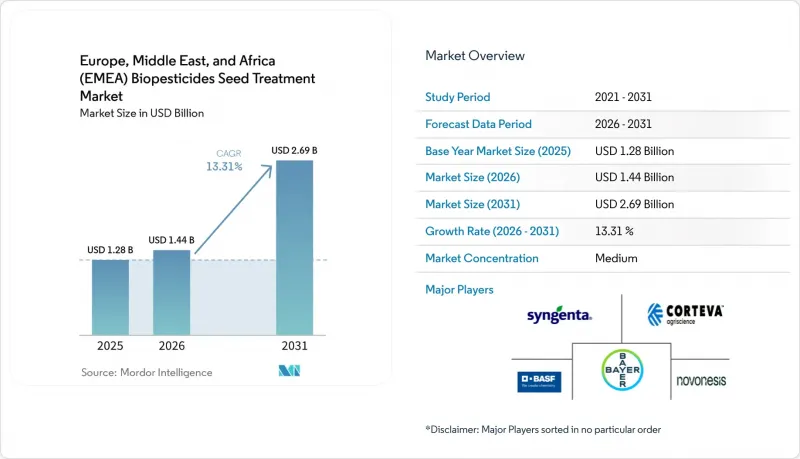
歐洲、中東和非洲(EMEA)地區生物農藥種子處理市場的趨勢和見解。
低殘留農藥的需求日益成長
出口導向農業體係正在推動歐洲、中東和非洲地區(EMEA)生物農藥種子處理市場投入品選擇的新變化。為歐洲食品供應鏈供貨的買家持續優先考慮符合嚴格的殘留標準,這正日益影響播前種子處理的決策。此趨勢在種植系統中尤其明顯,種植者力求在作物生長後期減少化學農藥的使用,並在作物生長季伊始就採用更乾淨、更永續的作物保護方案。政策方向持續支持這項轉型,監管策略著重於減少對傳統化學農藥的依賴,並推廣更安全的替代方案。 「從農場到餐桌戰略」仍然是這項轉變的核心,目標是到2030年將歐盟化學農藥的使用量和風險降低50%。近期政策發展也透過為生物農作物保護產品創造更有利的監管途徑,鼓勵更快採用生物防治解決方案。在市場上,這些趨勢正在提高微生物和生物種子處理的商業性可行性,這些處理方法能夠兼顧農業實踐和貿易要求,並考慮殘留法規。此外,隨著有機農業的普及,其應用範圍從認證有機農業擴展到主流商業農業,整體潛在需求基礎也在擴大。
生技藥品在種子披衣製程的應用拓展
在歐洲、中東和非洲地區(EMEA),生物農藥種子處理市場正蓬勃發展,生物活性物質不再局限於小眾測試項目,而是擴大被整合到標準種子披衣過程中。隨著種子企業將生物處理融入常規包衣工藝,其應用更加規範,對農場層級操作的依賴也降低。這種轉變透過提高擴充性和營運效率,增強了生物農藥的商業性可行性。據BASF公司稱,基於解澱粉芽孢桿菌MBI600的「Integral Pro」已在歐洲保護了數百萬公頃的油菜籽。該公司於2025年11月在法國獲得了首個向日葵註冊,並計劃在2026年種植季期間在歐盟範圍內推出該產品。同時,向先進包衣系統的轉變也提升了配方適用性和製程整合的重要性。因此,市場正變得更加依賴配方專業知識和包衣性能,而不僅僅是活性成分的供應。這些趨勢有利於那些能夠將生物功效與工業種子加工的物理和操作要求相結合的供應商。
由於土壤和氣候條件不同,不同地塊的藥效有差異。
土壤和氣候條件造成的有效性差異仍然是市場上的主要限制因素。從播種到作物出苗的短暫時期內,生物活性高度依賴土壤溫度、濕度、pH值和當地微生物群落。這些條件在歐洲、中東和非洲地區(EMEA)差異顯著,尤其是在溫帶歐洲和炎熱乾燥的產區之間。 2026年發表在《植物》(Plants)雜誌上的一項研究評估了沙烏地阿拉伯條件下針對橄欖蟎害蟲的細菌生物防治劑,強調了針對特定氣候和害蟲的田間試驗生物解決方案的重要性。在EMEA生物農藥種子處理市場,即使一項不充分的田間試驗結果也可能產生重大影響,因為生產商在採用新的處理方法時通常依賴同行的經驗。因此,基於田間試驗的數據比來自其他地區的有效性聲明更具說服力。除非供應商在高溫和缺水下的種植系統中進行更廣泛的檢驗,否則氣候引起的性能差異將繼續阻礙其推廣應用。
細分市場分析
至2025年,殺蟲劑將佔歐洲、中東和非洲地區生物農藥種子處理市場44.0%的市場佔有率,成為目前產品組合中佔比最大的產品類型。這一領先地位反映了西歐和中歐地區穀物、玉米、甜菜和油籽種子種植系統中對早期病蟲害防治的持續需求。某些合成種子處理劑的日益普及,使得生物防治在這些種植系統中顯得特別重要。因此,病蟲害防治仍是市場大規模應用於農作物的主要切入點。
殺菌劑是第二大細分市場,這得益於微生物病害防治產品在種子階段防治方案的成熟應用。例如,Koppert BV公司的Cerall和Cedomon等產品持續推動大麥、燕麥及相關作物種子傳播病害的生物防治應用,生技藥品持續與綜合蟲害管理(IPM)實踐緊密結合。其他農藥細分市場預計在2026年至2031年間將以14.8%的複合年成長率成長,主要得益於供應商拓展生化殺線蟲劑、生物驅避劑和植物防禦活化劑等產品線。這一成長得益於法規環境日益有利於低風險作物保護領域。業內人士認為,產品多元化趨勢將持續,而病蟲害防治仍將維持其領先地位。
到2025年,商業通路將佔歐洲、中東和非洲地區生物農藥種子處理市場58.0%的佔有率,這反映出市場對專業種子處理基礎設施的高度依賴。領先的種子企業和種子處理機構正在應用生物來源產品,與農場作業相比,這些產品具有更高的施用精度、包衣均勻性和操作可靠性。這種操作優勢意義重大,因為生物來源種子處理對施用品質的要求比傳統產品更高。因此,商業通路仍是擴大市場規模最有效的途徑。
此外,預計2026年至2031年間,商業領域將成長13.9%,成為終端用戶中成長最快的領域,因為供應商優先考慮擁有最穩健工作流程管理的環境。 Incotec BV(科萊恩國際有限公司)開發的無微塑膠塗層反映了商業加工環境中向更先進、更規範的加工系統轉變的趨勢。 Novonesis A/S也在2026年擴大了其生物解決方案的銷售範圍,涵蓋主要大田作物和特種作物的種子處理應用,從而支持生物製品正規商業管道的長期發展。雖然在非洲一些集中加工基礎設施不完善的地區,農場級加工仍然很重要,但商業加工商仍然是主要管道。在市場中,這一趨勢有利於那些不僅能提供活性成分,還能提供可靠應用方案的公司。
其他好處:
- Excel格式的市場預測(ME)表
- 3個月的分析師支持
目錄
第1章:引言
- 研究假設和市場定義
- 調查範圍
第2章:調查方法
第3章執行摘要
第4章 市場狀況
- 市場概覽
- 市場促進因素
- 低殘留農藥的需求日益成長
- 種子披衣製生技藥品的擴展
- 生產者引入預防性和早期作物保護措施
- 針對合成種子處理劑的監管壓力
- 高精準度種子供應及與微劑量技術的兼容性
- 品種穩定性和種子處理的創新
- 市場限制因素
- 土壤和氣候條件導致作物產量變化
- 生物製藥的保存期限有限,且對儲存條件敏感。
- 人們普遍認為,與傳統化學物質相比,它的成本績效較低。
- 註冊分散化和種子處理核准程序的複雜性
- 監理情勢
- 技術展望
- 波特五力分析
第5章 市場規模與成長預測
- 依產品類型
- 殺蟲劑
- 消毒劑
- 其他農藥
- 最終用戶
- 商業的
- 農場級別
- 透過應用技術
- 種子披衣
- 種子製粒
- 種子處理
- 其他適用技術
- 按作物類型
- 穀物和穀類
- 豆類和油籽
- 水果和蔬菜
- 其他作物類型
- 按地區
- 歐洲
- 英國
- 德國
- 俄羅斯
- 西班牙
- 義大利
- 法國
- 其他歐洲國家
- 中東
- 沙烏地阿拉伯
- 阿拉伯聯合大公國
- 阿曼
- 其他中東國家
- 非洲
- 埃及
- 衣索比亞
- 南非
- 其他非洲國家
- 歐洲
第6章 競爭情勢
- 市場集中度
- 策略趨勢
- 市佔率分析
- 公司簡介
- Bayer AG
- Syngenta AG
- BASF SE
- Corteva Agriscience
- Novonesis A/S
- Koppert Biological Systems BV
- Certis Biologicals(Mitsui and Co., Ltd.)
- Valent BioSciences LLC(Sumitomo Chemical Company, Limited)
- Lallemand Inc.
- Bioceres Crop Solutions Corp.
- BioWorks, Inc.
- Andermatt Biocontrol AG
- Plant Health Care plc
- Incotec BV(Croda International plc)
- Seipasa SA
第7章 市場機會與未來展望
According to Mordor Intelligence, the Europe, Middle East, and Africa (EMEA) biopesticides seed treatment market size was valued at USD 1.28 billion in 2025 and is projected to reach USD 1.44 billion in 2026 and USD 2.69 billion by 2031, growing at a CAGR of 13.31% from 2026 to 2031.
Europe, Middle East, and Africa (EMEA) Biopesticides Seed Treatment Market Trends and Insights
Rising Demand for Low-Residue Crop Protection
Export-oriented farm systems are reshaping input decisions across the EMEA biopesticides seed treatment market. Buyers supplying European food chains continue to prioritize strict residue compliance, increasingly influencing seed treatment decisions before planting begins. This trend is particularly relevant in crop systems where growers seek to reduce later-stage chemical applications and start the season with cleaner, more sustainable crop protection programs. Policy direction continues to reinforce this transition, with regulatory strategies focusing on reducing reliance on conventional chemical pesticides and promoting safer alternatives. The Farm to Fork Strategy remains central to this shift, targeting a 50% reduction in chemical pesticide use and risk by 2030 in the European Union. Recent policy developments also support the faster adoption of biocontrol solutions by creating a more favorable regulatory pathway for biological crop protection products. In the market, these developments strengthen the commercial case for microbial and biological seed treatments that align agronomic practices with residue-sensitive trade requirements. They also expand the overall addressable demand base, as adoption increasingly extends beyond certified organic production into mainstream commercial agriculture.
Expansion of Biologicals in Seed Coating Workflows
The EMEA biopesticides seed treatment market is gaining momentum as biological actives are increasingly incorporated into standard seed-coating workflows rather than remaining limited to niche trial programs. Once a seed company integrates a biological treatment into its routine coating process, adoption becomes more consistent and less dependent on farm-level handling. This transition is strengthening the commercial case for biologicals by improving scalability and operational efficiency. BASF SE states that Integral Pro, which is based on Bacillus amyloliquefaciens MBI600, has protected millions of hectares of oilseed rape in Europe. The company received its first sunflower registration in France in November 2025, with European Union (EU)-wide availability planned for the 2026 sowing season. At the same time, the shift toward advanced coating systems is increasing the importance of formulation compatibility and process integration. As a result, the market is becoming more closely linked to formulation expertise and coating performance rather than the simple availability of active ingredients. This dynamic favors suppliers that can align biological efficacy with the physical and operational requirements of industrial seed processing.
Variable Field Efficacy Across Soil And Climate Conditions
Variable performance across soil and climate conditions remains a major constraint on the market. Biological activity during the short window between sowing and crop establishment depends heavily on soil temperature, moisture, pH, and the local microbial community. These conditions vary considerably across EMEA, particularly between temperate Europe and hot, arid production zones. A 2026 study in Plants evaluated bacterial biocontrol agents against olive mite pests under Saudi Arabian conditions, highlighting the importance of locally tested biological solutions for climate- and pest-specific applications. In the EMEA biopesticides seed treatment market, a single poor field result can have an outsized effect, as growers often rely on peer observation before adopting a new treatment approach. This makes locally generated trial data more important than efficacy claims from other geographies. Until suppliers build broader validation across hot and moisture-stressed cropping systems, climate-linked performance variability will continue to restrain adoption.
Other drivers and restraints analyzed in the detailed report include:
- Grower Adoption of Preventive, Early-Season Crop Protection
- Regulatory Pressure on Synthetic Seed Treatments
- Limited Shelf Life And Storage Sensitivity Of Biologicals
For complete list of drivers and restraints, kindly check the Table Of Contents.
Segment Analysis
Insecticides accounted for 44.0% of the EMEA biopesticides seed treatment market share in 2025, making them the largest product type in the current mix. This leadership reflects the continued need for early-season pest protection in cereals, maize, sugar beet, and oilseed systems across Western and Central Europe. The gradual reduction in availability of certain synthetic seed treatment options has increased the relevance of biological insect control alternatives in these crop systems. As a result, the market continues to rely on insect control as a primary entry point into large-scale row-crop applications.
Fungicide is the second-largest segment, supported by the established use of microbial disease-control products in seed-stage protection programs. Products such as Koppert B.V.'s Cerall and Cedomon continue to support the adoption of biological control for seed-borne diseases in barley, oats, and related crops, keeping fungicidal biologicals closely aligned with integrated pest management practices. The other pesticides segment is forecast to register a 14.8% CAGR from 2026 through 2031 as suppliers expand into biochemical nematicides, biorepellents, and plant defense activators. This growth is supported by a regulatory environment increasingly favorable to lower-risk crop protection categories. Within the industry, this suggests the product mix will continue to diversify, even as insect control maintains its leading position.
The Commercial segment accounted for 58.0% of the EMEA biopesticides seed treatment market in 2025, reflecting strong reliance on professional seed treatment infrastructure. Large seed companies and conditioning facilities apply biological products with greater dosing accuracy, coating consistency, and handling reliability compared to farm-level operations. This operational advantage is important because biological seed treatments are more sensitive to application quality than conventional products. For this reason, commercial channels remain the most effective route for market scaling.
The Commercial segment is also forecast to grow at 13.9%, from 2026 through 2031, making it the fastest end-user profile, as suppliers prioritize environments with the strongest workflow control. Incotec B.V. (Croda International plc) work on microplastic-free coatings reflects a broader shift toward more advanced, regulation-ready processing systems in commercial treatment environments. Novonesis A/S also expanded its biosolutions distribution reach in 2026, covering seed treatment applications across major row and specialty crops, supporting the long-term development of formal commercial channels for biological products. Farm-level treatment remains relevant in parts of Africa where centralized treating infrastructure is less developed, but commercial processors remain the primary channel. Within the market, this pattern favors companies that can offer not only active ingredients, but also application reliability.
Complete Report Scope:
- By Product Type
- Insecticide
- Fungicide
- Other Pesticides
- By End User
- Commercial
- Farm Level
- By Application Technique
- Seed Coating
- Seed Pelleting
- Seed Dressing
- Other Application Techniques
- By Crop Type
- Grains and Cereals
- Pulses and Oilseeds
- Fruits and Vegetables
- Other Crop Types
- By Geography
- Europe
- United Kingdom
- Germany
- Russia
- Spain
- Italy
- France
- Rest of Europe
- Middle East
- Saudi Arabia
- United Arab Emirates
- Oman
- Rest of Middle East
- Africa
- Egypt
- Ethiopia
- South Africa
- Rest of Africa
- Europe
List of Companies Covered in this Report:
- Bayer AG
- Syngenta AG
- BASF SE
- Corteva Agriscience
- Novonesis A/S
- Koppert Biological Systems B.V.
- Certis Biologicals (Mitsui and Co., Ltd.)
- Valent BioSciences LLC (Sumitomo Chemical Company, Limited)
- Lallemand Inc.
- Bioceres Crop Solutions Corp.
- BioWorks, Inc.
- Andermatt Biocontrol AG
- Plant Health Care plc
- Incotec B.V. (Croda International plc)
- Seipasa S.A.
Additional Benefits:
- The market estimate (ME) sheet in Excel format
- 3 months of analyst support
TABLE OF CONTENTS
1 INTRODUCTION
- 1.1 Study Assumptions and Market Definition
- 1.2 Scope of the Study
2 RESEARCH METHODOLOGY
3 EXECUTIVE SUMMARY
4 MARKET LANDSCAPE
- 4.1 Market Overview
- 4.2 Market Drivers
- 4.2.1 Rising Demand for Low-Residue Crop Protection
- 4.2.2 Expansion of Biologicals in Seed Coating Workflows
- 4.2.3 Grower Adoption of Preventive, Early-Season Crop Protection
- 4.2.4 Regulatory Pressure on Synthetic Seed Treatments
- 4.2.5 Precision Seed Delivery and Micro-Dosing Compatibility
- 4.2.6 Strain Stability and Seed-Handling Innovation
- 4.3 Market Restraints
- 4.3.1 Variable Field Efficacy Across Soil and Climate Conditions
- 4.3.2 Limited Shelf Life and Storage Sensitivity of Biologicals
- 4.3.3 Higher Cost-to-Performance Perception Versus Conventional Chemicals
- 4.3.4 Fragmented Registration and Seed Treatment Approval Complexity
- 4.4 Regulatory Landscape
- 4.5 Technological Outlook
- 4.6 Porter's Five Forces Analysis
- 4.6.1 Bargaining Power of Suppliers
- 4.6.2 Bargaining Power of Buyers
- 4.6.3 Threat of New Entrants
- 4.6.4 Threat of Substitutes
- 4.6.5 Intensity of Competitive Rivalry
5 MARKET SIZE AND GROWTH FORECASTS (VALUE)
- 5.1 By Product Type
- 5.1.1 Insecticide
- 5.1.2 Fungicide
- 5.1.3 Other Pesticides
- 5.2 By End User
- 5.2.1 Commercial
- 5.2.2 Farm Level
- 5.3 By Application Technique
- 5.3.1 Seed Coating
- 5.3.2 Seed Pelleting
- 5.3.3 Seed Dressing
- 5.3.4 Other Application Techniques
- 5.4 By Crop Type
- 5.4.1 Grains and Cereals
- 5.4.2 Pulses and Oilseeds
- 5.4.3 Fruits and Vegetables
- 5.4.4 Other Crop Types
- 5.5 By Geography
- 5.5.1 Europe
- 5.5.1.1 United Kingdom
- 5.5.1.2 Germany
- 5.5.1.3 Russia
- 5.5.1.4 Spain
- 5.5.1.5 Italy
- 5.5.1.6 France
- 5.5.1.7 Rest of Europe
- 5.5.2 Middle East
- 5.5.2.1 Saudi Arabia
- 5.5.2.2 United Arab Emirates
- 5.5.2.3 Oman
- 5.5.2.4 Rest of Middle East
- 5.5.3 Africa
- 5.5.3.1 Egypt
- 5.5.3.2 Ethiopia
- 5.5.3.3 South Africa
- 5.5.3.4 Rest of Africa
- 5.5.1 Europe
6 COMPETITIVE LANDSCAPE
- 6.1 Market Concentration
- 6.2 Strategic Moves
- 6.3 Market Share Analysis
- 6.4 Company Profiles (Includes Global Level Overview, Market Level Overview, Core Segments, Financials as Available, Strategic Information, Market Rank/Share, Products and Services, Recent Developments)
- 6.4.1 Bayer AG
- 6.4.2 Syngenta AG
- 6.4.3 BASF SE
- 6.4.4 Corteva Agriscience
- 6.4.5 Novonesis A/S
- 6.4.6 Koppert Biological Systems B.V.
- 6.4.7 Certis Biologicals (Mitsui and Co., Ltd.)
- 6.4.8 Valent BioSciences LLC (Sumitomo Chemical Company, Limited)
- 6.4.9 Lallemand Inc.
- 6.4.10 Bioceres Crop Solutions Corp.
- 6.4.11 BioWorks, Inc.
- 6.4.12 Andermatt Biocontrol AG
- 6.4.13 Plant Health Care plc
- 6.4.14 Incotec B.V. (Croda International plc)
- 6.4.15 Seipasa S.A.
7 MARKET OPPORTUNITIES AND FUTURE OUTLOOK

 微生物種子接種劑市場預測至2034年—按微生物類型、配方、種子處理方法、應用、最終用戶和地區分類的全球分析
 全球生物種子處理市場規模、佔有率、趨勢和成長分析報告(2026-2034)
 生物種子加工市場報告:趨勢、預測與競爭分析(至2035年)
 生物種子處理市場規模、佔有率和趨勢分析報告:按產品、功能、技術、作物、地區和細分市場分類(2026-2033 年)生物種子處理市場:預測至2034年-按產品類型、活性成分、作物類型、應用方法和地區分類的全球分析
 2026年全球生物種子處理市場報告
 生物種子處理市場:按功能、作物類型和地區分類
 青貯發酵接種劑市場按類型、作物類型、劑型、最終用戶和分銷管道分類,全球預測(2026-2032年)
 全球生物種子處理市場佔有率分析、產業趨勢與統計、成長預測(2025-2030)生物種子處理市場:2025-2030 年預測