


 |
市場調查報告書
商品編碼
2157076
北美 eSIM 硬體:市場佔有率分析、產業趨勢與統計及成長預測(2026-2031 年)North America Esim Hardware - Market Share Analysis, Industry Trends & Statistics, Growth Forecasts (2026 - 2031) |
||||||

※ 本網頁內容可能與最新版本有所差異。詳細情況請與我們聯繫。
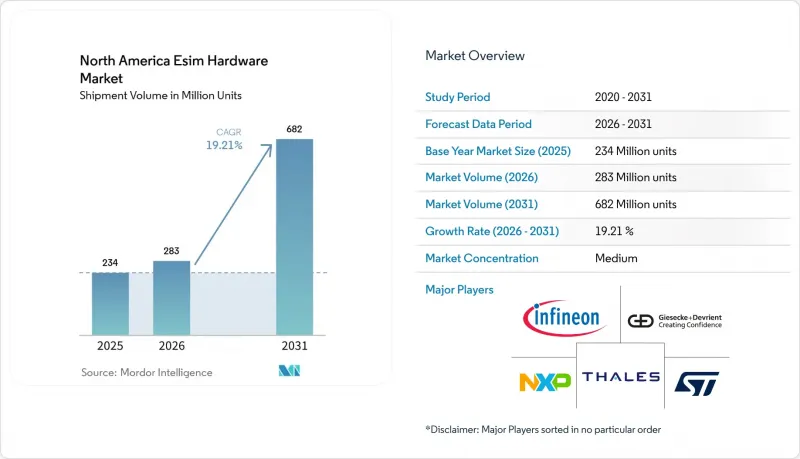
根據 Mordor Intelligence 的數據,北美 eSIM 硬體市場(以出貨量計算)預計將從 2025 年的 2.34 億台成長到 2026 年的 2.83 億台,然後在 2031 年達到 6.82 億台,2026 年至 2031 年的複合年成長率為 19.21%。
北美eSIM硬體市場趨勢與洞察
iPhone引領了旗艦機型向僅支援eSIM的轉變。
2025年9月,蘋果公司在美國、加拿大和墨西哥推出了僅支援eSIM的iPhone 17系列機種。同時,iPhone 17 Air也在全球發布,成為首款沒有實體SIM卡槽的iPhone。這項決定促使北美三大市場採用通用的設備設計要求。由於營運商要求高階設備用戶使用相容的遠端配置系統,北美eSIM硬體市場從中受益。該政策也提高了智慧型手機組件和設定檔管理的技術標準。這將使包括三星在內的高階OEM廠商能夠迅速在其北美機型中擴展eSIM支援。同時,由於低價安卓市場中支援eSIM的硬體供應有限,高階設備和低價設備之間的eSIM普及率仍然不均衡。蘋果的設備策略將遠端配置作為營運商的基本要求,而非早期採用者的功能。營運商必須支援GSMA認證的SM-DP+和SM-DS基礎設施,才能支援僅支援eSIM的設備。這項要求可能會給行動虛擬網路營運商(MVNO)帶來更大的投資壓力。因此,北美eSIM硬體市場將受益於硬體需求的成長和營運商支持的擴大。由此,目前高階eUICC的採購量與未來低價設備採用eUICC之間將會出現差距。這種時間滯後可能意味著部分設備使用者群體仍需相容於實體SIM卡。截至2026年,美國、加拿大和墨西哥的旗艦智慧型手機廠商將不再在整個地區提供僅支援實體SIM卡的選項。
5G固定無線存取和專用網路擴展
私有 5G 網路在傳統消費者營運商管道之外創造了對 eSIM 硬體的需求。企業部署需要連網的控制器、感測器、閘道器和相關終端。這些設備通常採用 MFF2 或整合式 iUICC 設計,因為組件是焊接在設備上的。隨著企業為工廠、園區和物流營運採購硬體,北美 eSIM 硬體市場預計將會成長。私有網路買家也管理與標準消費者啟動流程不同的用戶系統。這可能導致 eSIM 作業系統供應商直接參與企業系統整合專案。 2026 年 6 月,Verizon 將愛立信的私人 5G 網路擴展到了國際企業園區。在這種企業模式下,部分採購決策權從營運商轉移到了設備製造商和私人網路營運商。這凸顯了能夠支援遠端生命週期管理和多重憑證的元件的重要性。這也促使製造商在設備設計的早期階段就融入連接功能。工業硬體的生命週期比智慧型手機的更換週期更長。因此,需求受年度設備發布的影響較小。因此,北美eSIM硬體市場與多個終端用戶專用網路的投資決策密切相關。這些部署也凸顯了檢驗的設定和安全功能的重要性。
傳統物聯網規格與下一代物聯網規格的碎片化
SGP.02、SGP.22 和 SGP.32 繼續在機器對機器 (M2M)、消費性電子和物聯網 (IoT) 應用中使用。這導致連網型設備項目的採購和整合路徑分散。大型企業正在車輛集群、智慧電錶和工業感測器網路中部署支援 SGP.02 的設備。這些設備無法在不更換硬體的情況下直接遷移到 SGP.32。超過五年的更新周期可能會延遲這種遷移。因此,北美 eSIM 硬體市場必須同時滿足新的 SGP.32 項目和對相容舊版設備的替代需求。意法半導體 (STMicroelectronics) 和 COMPRION 於 2026 年 9 月發布了 SGP.32互通性參考環境。他們的努力表明,組件級協議認證仍然是一項關鍵要求。企業可以在檢驗新的配置方法的同時繼續進行傳統採購。這種方法增加了專案的複雜性,並可能延遲大規模硬體部署的決策。此外,這也使供應商和設備製造商更難進行需求預測。雖然這項限制不會完全消除需求,但它會減緩全面過渡到SGP.32協議所帶來的市場整合速度。北美eSIM硬體市場仍將受已安裝設備更換速度的驅動。
細分市場分析
預計到2025年,5G將佔據北美eSIM硬體市場45.86%的佔有率,並將以19.87%的複合年成長率持續成長至2031年。這一主導地位反映了5G智慧型手機的普及以及其在工業和汽車領域的應用日益廣泛。北美5G eSIM硬體市場也受惠於需要管理設備認證憑證的專用網路。 2026年7月,AT&T為FirstNet運作了覆蓋全美的專用5G獨立網路(SA)核心網路。該服務將支援超過27,500個公共安全機構和550萬個連接。該項目還包括20億美元的額外投資。這將加速公共安全採購中從4G和LTE SIM模組到5G eSIM硬體的過渡。
在網路覆蓋有限的地區,4G 和 LTE eSIM 硬體對於企業物聯網仍然至關重要。這些模組用於現有設備,這些設備無需 5G 的性能或成本要求。 NB-IoT 和 LTE-M 適用於低功耗追蹤和智慧計量應用。當設備需要長時間運作且無需頻繁維護時,這些低功耗要求尤其有利。 5G 切片可能需要裝置管理各個服務等級的憑證。此時,具備多活動設定檔功能的 eSIM 作業系統就顯得格外重要。英飛凌的 OPTIGA Connect Consumer OC1230 是符合 GSMA SGP.22 v3 標準的 28nm eSIM 解決方案。本產品支援「多啟用設定檔」功能,可同時處理多個運營商憑證。
到2025年,MFF2封裝將佔所有封裝形式的33.53%,而系統級封裝(SiP)和整合式iUICC預計到2031年將以20.17%的複合年成長率成長。 MFF2廣泛應用於需要永久固定組件的場合。工業和汽車設備可能暴露於振動、濕度和溫度變化等環境。焊接介面可以減少常見的物理故障點。因此,在北美eSIM硬體市場,針對嚴苛工作環境的設備,MFF2的需求依然強勁。此外,對於那些優先考慮設備長期可靠性而非可拆卸卡片柔軟性的製造商而言,MFF2也是理想之選。
整合設計在穿戴式裝置、可聽裝置以及小型物聯網裝置領域日益受到關注。這些設備需要在晶片面積、重量、電池容量和連接性之間取得平衡。雖然晶圓級CSP(晶片級儲存處理器)支援小型消費性設備,但插入式eSIM在替代型和行動虛擬網路營運商(MVNO)環境中仍扮演著重要角色。意法半導體(STMicroelectronics)於2026年6月發布了ST54M,這是一款整合了NFC、安全元件、eSIM和後量子密碼加速器的單晶片裝置。 Valid公司基於英飛凌TEGRION SLx22晶片的SGP.32物聯網eUICC(整合使用者介面整合晶片)於2026年8月獲得了GSMA eSA認證。
其他好處:
- Excel格式的市場預測(ME)表
- 3個月的分析師支持
目錄
第1章:引言
- 研究假設和市場定義
- 調查範圍
第2章:調查方法
第3章執行摘要
第4章 市場狀況
- 市場概覽
- 宏觀經濟因素對市場的影響
- 市場促進因素
- 以 iPhone 為首的旗艦機型開始轉向僅支援 eSIM 的模式。
- 5G固定無線存取和專用網路的擴展
- 用於空中下載 (OTA) 更新的汽車嵌入式連接
- GSMA SGP.32:實現大規模無頭物聯網部署
- 為公共安全網路提供營運商級 eSIM 配置
- 保險關聯資產追蹤系統的實施現狀
- 市場限制因素
- 碎片化的舊有系統與下一代物聯網規範
- 電信業者不願解鎖SIM卡的經濟原因
- 遠端身分互換帶來的網路安全風險
- 超薄穿戴裝置的空間和功率限制
- 產業價值鏈分析
- 監理情勢
- 技術展望
- 波特五力分析
第5章 市場規模與成長預測
- 依網路類型
- 4G/LTE
- 5G
- NB-IoT/LTE-M
- 按外形規格
- MFF2
- 晶圓級CSP
- 插入式 eSIM
- 系統級封裝與整合式 iUICC
- 依設備類型
- 智慧型手機和功能手機
- 平板電腦和筆記型電腦
- 穿戴式裝置
- M2M 和物聯網模組
- 透過使用
- 家用電子產品
- 汽車和運輸業
- 工業和製造業
- 物流和資產追蹤
- 其他用途(能源和公共產業、醫療保健和醫療設備)
- 按地區
- 美國
- 加拿大
- 墨西哥
第6章 競爭情勢
- 市場集中度
- 策略趨勢
- 市佔率分析
- 公司簡介
- Thales SA
- Giesecke+Devrient GmbH
- IDEMIA France SAS
- Infineon Technologies AG
- STMicroelectronics NV
- NXP Semiconductors NV
- Qualcomm Technologies, Inc.
- Kigen Limited
- Valid Solucoes SA
- Sierra Wireless, Inc.
- Semtech Corporation
- Telit Cinterion Deutschland GmbH
- KORE Group Holdings, Inc.
- Workz Group Limited
- Soracom, Inc.
- Apple Inc.
- Samsung Electronics Co., Ltd.
- AT&T Inc.
- Verizon Communications Inc.
- T-Mobile US, Inc.
- Rogers Communications Inc.
- BCE Inc.
- America Movil, SAB de CV
第7章 市場機會與未來展望
According to Mordor Intelligence, the North America esim hardware market size in terms of shipment volume is expected to grow from 234 million units in 2025 to 283 million units in 2026 and is forecast to reach 682 million units by 2031 at 19.21% CAGR over 2026-2031.
North America Esim Hardware Market Trends and Insights
IPhone-Led Migration to eSIM-Only Flagships
Apple made the iPhone 17 series eSIM-only across the United States, Canada, and Mexico in September 2025. The iPhone 17 Air also became the first iPhone sold globally without a physical SIM tray exception. This decision moved all 3 North American markets to a common device design requirement. The North America eSIM hardware market benefits because carriers need compatible remote provisioning systems for premium device users. The policy also raises the technical standard for smartphone components and profile management. It creates a faster path for Samsung and other premium OEMs to expand eSIM support in North American models. Budget Android brands still have limited eSIM hardware availability at volume, so adoption remains uneven between premium and lower-priced devices. Apple's device direction makes provisioning capability a basic carrier requirement rather than a feature reserved for early adopters. Carriers must support GSMA-certified SM-DP+ and SM-DS infrastructure to serve eSIM-only handsets. This requirement can place greater investment pressure on mobile virtual network operators. The North America eSIM hardware market therefore gains from hardware demand and from wider carrier readiness. The resulting divide is between premium eUICC procurement today and later adoption in lower-priced devices. That lag can preserve physical-SIM compatibility needs in parts of the handset base. No flagship smartphone OEM in the region retained a physical-SIM-only option across the United States, Canada, and Mexico in 2026.
5G Fixed-Wireless Access and Private Network Expansion
Private 5G networks create an eSIM hardware demand base outside traditional consumer carrier channels. Enterprise installations require connected controllers, sensors, gateways, and related endpoints. These devices commonly use MFF2 or integrated iUICC designs because the components are soldered into equipment. The North America eSIM hardware market gains where enterprises procure hardware for factory, campus, and logistics operations. Private network buyers also manage subscriber systems that differ from standard consumer activation processes. This can bring eSIM operating-system vendors directly into enterprise integration projects. Verizon extended Ericsson Private 5G to international enterprise campuses in June 2026. The enterprise model shifts part of the procurement decision from carriers to equipment makers and private-network operators. It favors components that can support remote lifecycle management and multiple credentials. It also gives manufacturers a reason to package connectivity features during the original device design stage. Industrial hardware cycles are longer than smartphone replacement cycles. This can make demand less exposed to annual handset launches. The North America eSIM hardware market is consequently linked to private network investment decisions across several end uses. These deployments also increase the relevance of tested provisioning and security capabilities.
Legacy and Next-Generation IoT Specification Fragmentation
SGP.02, SGP.22, and SGP.32 remain in use for M2M, consumer, and IoT applications. This creates separate procurement and integration paths for connected-device programs. Large enterprises have installed SGP.02 devices in fleets, smart meters, and industrial sensor networks. Those devices cannot move directly to SGP.32 without replacing hardware. Refresh cycles of 5 years or more can delay that transition. The North America eSIM hardware market must therefore serve both new SGP.32 programs and legacy-compatible replacement demand. STMicroelectronics and COMPRION introduced an SGP.32 interoperability reference environment in September 2026. Their work shows that component-level protocol qualification remains an active requirement. Enterprises may maintain parallel purchases while they validate newer provisioning methods. This approach increases project complexity and can delay larger hardware commitments. It also makes demand forecasting less direct for vendors and device makers. The constraint does not eliminate demand, but it slows the consolidation that a complete SGP.32 transition could provide. The North America eSIM hardware market remains exposed to the pace at which installed equipment is replaced.
Other drivers and restraints analyzed in the detailed report include:
- Automotive Embedded Connectivity for Software Updates
- GSMA SGP.32 for Headless IoT Deployments
- Carrier Resistance to Losing SIM-Lock Economics
For complete list of drivers and restraints, kindly check the Table Of Contents.
Segment Analysis
5G held 45.86% of the North America eSIM hardware market share in 2025 and is projected to expand at a 19.87% CAGR through 2031. Its lead reflects established 5G smartphone adoption and wider use in industrial and automotive programs. The North America eSIM hardware market size for 5G also benefits from private networks that require managed device credentials. ATandT activated a nationwide dedicated 5G Standalone core for FirstNet in July 2026. The service supports more than 27,500 public-safety agencies and 5.5 million connections. The program includes a USD 2 billion incremental investment. It supports a shift from 4G and LTE SIM modules toward 5G eSIM hardware in public-safety procurement.
4G and LTE eSIM hardware remains important for enterprise IoT in places with coverage constraints. These modules serve established devices that do not need the performance or cost profile of 5G. NB-IoT and LTE-M support low-power tracking and smart-meter uses. Their lower power requirements are useful when devices must operate for long periods without frequent maintenance. 5G slicing can require devices to manage separate service-level credentials. This favors eSIM operating systems with multiple active profile capabilities. Infineon's OPTIGA Connect Consumer OC1230 is a 28 nm eSIM solution compliant with GSMA SGP.22 v3. It supports Multiple Enabled Profile functionality for simultaneous carrier credentials.
MFF2 held 33.53% of form-factor volume in 2025, while System-in-Package and Integrated iUICC are projected to expand at a 20.17% CAGR through 2031. MFF2 is widely used where a permanently bonded component is required. Industrial and automotive equipment can be exposed to vibration, humidity, and temperature changes. A soldered interface can reduce a common physical failure point. The North America eSIM hardware market, therefore, retains MFF2 demand in equipment designed for difficult operating conditions. MFF2 also suits manufacturers that prioritize long-term device reliability over removable card flexibility.
Integrated designs are gaining attention in wearables, hearables, and compact IoT devices. These categories must balance silicon area, weight, battery capacity, and connectivity features. Wafer-Level CSP supports smaller consumer devices, while Plug-In eSIM remains relevant in replacement and mobile virtual network operator settings. STMicroelectronics introduced the ST54M in June 2026. The single-die device combines NFC, a secure element, eSIM, and a post-quantum cryptography accelerator. Valid received GSMA eSA certification for an SGP.32 IoT eUICC based on Infineon's TEGRION SLx22 in August 2026.
Complete Report Scope:
- By Network Type
- 4G/LTE
- 5G
- NB-IoT/LTE-M
- By Form Factor
- MFF2
- Wafer-Level CSP
- Plug-In eSIM
- System-in-Package and Integrated iUICC
- By Device Type
- Smartphones and Feature Phones
- Tablets and Laptops
- Wearables
- M2M and IoT Modules
- By Application
- Consumer Electronics
- Automotive and Transportation
- Industrial and Manufacturing
- Logistics and Asset Tracking
- Other Applications (Energy and Utilities and Healthcare and Medical Devices)
- By Geography
- United States
- Canada
- Mexico
List of Companies Covered in this Report:
- Thales S.A.
- Giesecke+Devrient GmbH
- IDEMIA France SAS
- Infineon Technologies AG
- STMicroelectronics N.V.
- NXP Semiconductors N.V.
- Qualcomm Technologies, Inc.
- Kigen Limited
- Valid Solucoes S.A.
- Sierra Wireless, Inc.
- Semtech Corporation
- Telit Cinterion Deutschland GmbH
- KORE Group Holdings, Inc.
- Workz Group Limited
- Soracom, Inc.
- Apple Inc.
- Samsung Electronics Co., Ltd.
- AT&T Inc.
- Verizon Communications Inc.
- T-Mobile US, Inc.
- Rogers Communications Inc.
- BCE Inc.
- America Movil, S.A.B. de C.V.
Additional Benefits:
- The market estimate (ME) sheet in Excel format
- 3 months of analyst support
TABLE OF CONTENTS
1 INTRODUCTION
- 1.1 Study Assumptions and Market Definition
- 1.2 Scope of the Study
2 RESEARCH METHODOLOGY
3 EXECUTIVE SUMMARY
4 MARKET LANDSCAPE
- 4.1 Market Overview
- 4.2 Impact of Macroeconomic Factors on the Market
- 4.3 Market Drivers
- 4.3.1 iPhone-Led Migration to eSIM-Only Flagships
- 4.3.2 Expansion of 5G Fixed-Wireless Access and Private Networks
- 4.3.3 Automotive Embedded Connectivity for Over-the-Air Updates
- 4.3.4 GSMA SGP.32 Enabling Mass-Scale Headless IoT Deployments
- 4.3.5 Carrier-Grade eSIM Provisioning for Public-Safety Networks
- 4.3.6 Insurance-Linked Asset Tracking Adoption
- 4.4 Market Restraints
- 4.4.1 Fragmented Legacy and Next-Generation IoT Specifications
- 4.4.2 Carrier Reluctance to Surrender SIM-Lock Economics
- 4.4.3 Remote Profile-Swap Cybersecurity Exposure
- 4.4.4 Ultra-Thin Wearable Space and Power Constraints
- 4.5 Industry Value Chain Analysis
- 4.6 Regulatory Landscape
- 4.7 Technological Outlook
- 4.8 Porter's Five Forces Analysis
- 4.8.1 Bargaining Power of Semiconductor Suppliers
- 4.8.2 Bargaining Power of Device OEMs and Module Buyers
- 4.8.3 Threat of New Entrants
- 4.8.4 Threat of Substitutes
- 4.8.5 Competitive Rivalry
5 MARKET SIZE AND GROWTH FORECASTS (VOLUME)
- 5.1 By Network Type
- 5.1.1 4G/LTE
- 5.1.2 5G
- 5.1.3 NB-IoT/LTE-M
- 5.2 By Form Factor
- 5.2.1 MFF2
- 5.2.2 Wafer-Level CSP
- 5.2.3 Plug-In eSIM
- 5.2.4 System-in-Package and Integrated iUICC
- 5.3 By Device Type
- 5.3.1 Smartphones and Feature Phones
- 5.3.2 Tablets and Laptops
- 5.3.3 Wearables
- 5.3.4 M2M and IoT Modules
- 5.4 By Application
- 5.4.1 Consumer Electronics
- 5.4.2 Automotive and Transportation
- 5.4.3 Industrial and Manufacturing
- 5.4.4 Logistics and Asset Tracking
- 5.4.5 Other Applications (Energy and Utilities and Healthcare and Medical Devices)
- 5.5 By Geography
- 5.5.1 United States
- 5.5.2 Canada
- 5.5.3 Mexico
6 COMPETITIVE LANDSCAPE
- 6.1 Market Concentration
- 6.2 Strategic Moves
- 6.3 Market Share Analysis
- 6.4 Company Profiles (includes Global Level Overview, Market Level Overview, Core Segments, Financials as available, Strategic Information, Market Rank/Share, Products and Services, Recent Developments)
- 6.4.1 Thales S.A.
- 6.4.2 Giesecke+Devrient GmbH
- 6.4.3 IDEMIA France SAS
- 6.4.4 Infineon Technologies AG
- 6.4.5 STMicroelectronics N.V.
- 6.4.6 NXP Semiconductors N.V.
- 6.4.7 Qualcomm Technologies, Inc.
- 6.4.8 Kigen Limited
- 6.4.9 Valid Solucoes S.A.
- 6.4.10 Sierra Wireless, Inc.
- 6.4.11 Semtech Corporation
- 6.4.12 Telit Cinterion Deutschland GmbH
- 6.4.13 KORE Group Holdings, Inc.
- 6.4.14 Workz Group Limited
- 6.4.15 Soracom, Inc.
- 6.4.16 Apple Inc.
- 6.4.17 Samsung Electronics Co., Ltd.
- 6.4.18 AT&T Inc.
- 6.4.19 Verizon Communications Inc.
- 6.4.20 T-Mobile US, Inc.
- 6.4.21 Rogers Communications Inc.
- 6.4.22 BCE Inc.
- 6.4.23 America Movil, S.A.B. de C.V.
7 MARKET OPPORTUNITIES AND FUTURE OUTLOOK
- 7.1 White-Space and Unmet-Need Assessment

 國際數據SIM卡市場:全球市場預測,2026-2032年
 eSIM全球市場規模、佔有率、趨勢和成長分析報告(2026-2034年)
 嵌入式SIM卡(eSIM):市場佔有率分析、產業趨勢與統計資料、成長預測(2026-2031年)
 eSIM 和 SIM 解決方案研究服務eSIM市場-2026-2032年全球市場預測
 eSIM市場:按應用、產業、地區分類
 eSIM市場:市場規模、佔有率和趨勢分析(按解決方案、應用和地區分類),細分市場預測(2026-2033年)面向消費者和物聯網的eSIM市場eSIM市場規模、佔有率、成長及全球產業分析:按類型、應用和地區分類的洞察,2026-2034年預測
 2026 年 eSIM 全球市場報告