


 |
市場調查報告書
商品編碼
2124543
嵌入式SIM卡(eSIM):市場佔有率分析、產業趨勢與統計資料、成長預測(2026-2031年)Embedded SIM (eSIM) - Market Share Analysis, Industry Trends & Statistics, Growth Forecasts (2026 - 2031) |
||||||

※ 本網頁內容可能與最新版本有所差異。詳細情況請與我們聯繫。
據 Mordor Intelligence 稱,根據出貨量預測,嵌入式 SIM 卡市場到 2025 年將達到 4.8 億張,到 2026 年將達到 6.5 億張,到 2031 年將達到 21.2 億張,2026 年至 2031 年的複合年成長率為 26.67%。
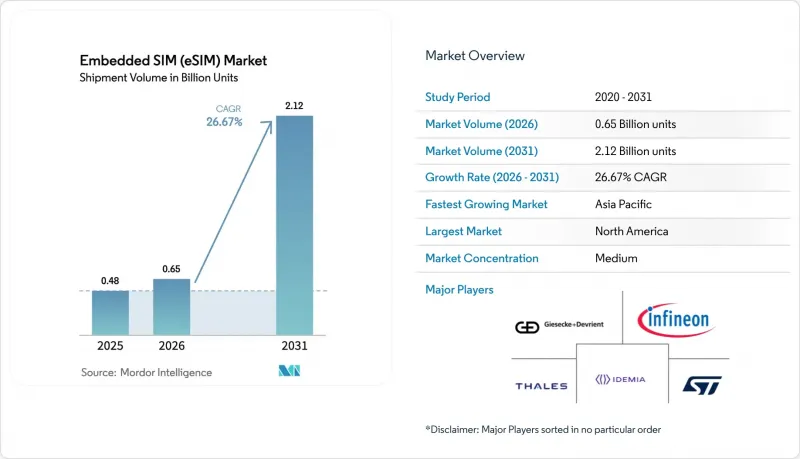
本報告按網路類型(5G、4G/LTE 等)、裝置類型(智慧型手機、平板電腦和筆記型電腦等)、終端用戶產業(家用電子電器、汽車和運輸設備等)、外形規格(MFF2、晶圓級 CSP 等)、配置規格(SGP.02 等)和地區進行細分。市場預測以銷售量(單位)為基礎。
全球嵌入式SIM卡(eSIM)市場趨勢與洞察
5G的快速部署正在加速eSIM的需求。
獨立組網的5G網路消除了以往限制蜂巢式物聯網的延遲和吞吐量限制,使設備無需物理干預即可切換網路切片和漫遊合作夥伴。在中國,5G連接用戶將在2024年突破10億,營運商將於2025年10月前完成全國範圍的eSIM支援。日本將在2024年實現98.4%的人口覆蓋率,目標是在2030年達到99%,這將確保全國範圍內持續的網路基礎設施,從而實現遠端配置。在歐洲,家庭覆蓋率將在2024年達到94.3%,為部署依賴焊接SIM卡的智慧家庭和工業感測器奠定基礎。 2025年4月,沃達豐與A1和愛立信合作的5G獨立組網漫遊演示,展示了無縫的跨境設定檔切換。電信業者對網路切片的商業化應用,將使企業能夠在保證服務品質的前提下動態選擇營運商,這將促進工業閘道器和聯網汽車的出貨量。
強制性的 eCall 和 UN-R155 標準將加速汽車產業的採用。
將於2024年7月起強制應用於新車的UN-R155法規要求進行網路威脅監控和安全的空中升級,這兩項要求推動了防篡改嵌入式SIM卡的設計。歐洲eCall指令已強制要求乘用車整合蜂巢緊急通訊功能,而新車也擴大採用焊接式eSIM卡以滿足防篡改要求。 2024年11月,大陸集團發布了一款符合UN-R155標準的網路安全解決方案,整合了eSIM模組並可遠端提供安全證書。隨後,在2025年2月,泰雷茲和Cubic聯合發布了一款符合SGP.32標準的汽車平台,該平台將允許車隊管理員透過空中升級切換行動營運商,從而降低跨境營運中的漫遊費用(thalesgroup.com)。隨著歐洲框架在其他地區的推廣,汽車產量的成長將直接轉化為對高可靠性eSIM卡外形尺寸的多年需求。
碎片化的M2M進入許可權規範
管理長期工業資產的公司被迫在運行傳統的 SGP.02 配置堆疊的同時,還要運行較新的 SGP.32 工作流程,這導致整合預算膨脹,攻擊面擴大。 Giesecke & Devlint 於 2025 年 4 月完成的 SGP.32 全面認證凸顯了其巨大的技術負擔,需要大規模的伺服器重建和跨廠商的測試週期。在公共產業、物流和運輸業,設備生命週期長達 15 年,因此企業不願放棄現有的 SGP.02 設備,迫使雙棧運作至少持續到 2035 年。由此產生的複雜性正在減緩 SGP.32 模組出貨量的短期成長,並部分抵消嵌入式 SIM 卡 (eSIM) 市場的快速擴張。
細分市場分析
2025年,隨著智慧型手機和物聯網感測器的大規模部署持續在現有網路中普及,4G/LTE在嵌入式SIM卡(eSIM)市場仍維持52.11%的佔有率。然而,5G市場預計將以26.89%的複合年成長率成長,這反映出營運商正轉向獨立核心網,以實現網路切片、超高可靠性、低延遲通訊和載波聚合等功能。中國三大營運商於2025年10月完成了全國範圍的eSIM部署,利用5G架構在專用車道上為自動駕駛卡車實現了動態配置文件切換。在日本和歐盟,5G人口覆蓋率總合超過94%,為互聯工廠和智慧城市網路提供了即時無線配置的可能性。
隨著毫米波網路覆蓋範圍的不斷擴大,都市區專用網路將採用市場規模的嵌入式SIM卡(eSIM)模組,實現公共網路和專用網路之間的無縫切換。同時,農村地區的電信業者將繼續部署NB-IoT和LTE-M,用於低頻寬感測器,從而形成雙網策略,該策略更有利於多模eSIM晶片組的應用。在預測期內,隨著4G網路逐步進入維護階段,5G網路在嵌入式SIM卡(eSIM)市場收入中所佔佔有率預計將大幅成長,這主要得益於工業自動化、遠端醫療和身臨其境型媒體應用對確定性延遲保證的需求。
儘管智慧型手機在2025年佔出貨量的60.29%,但預計該類別將以中等個位數的速度成長,而穿戴式裝置預計到2031年將以26.76%的複合年成長率成長。Medtronic和雅培的連續血糖監測儀、心臟植入和跌倒檢測吊墜依賴於始終線上蜂窩網路連接雲端控制面板,無需智慧型手機共享網路。嵌入式SIM卡解決方案對於全天候佩戴的醫療和健身設備至關重要,可消除潮氣、灰塵和人為篡改的入口。筆記型電腦和平板電腦正在利用「即時連接」融資模式,在銷售點捆綁資料方案,而M2M模組則支援資產追蹤信標和智慧電錶維修。
穿戴式裝置也受惠於晶圓級晶片封裝技術,可將功耗降低一半,並在輕薄的機身中延長電池續航時間。三星的 eSIM v3.0 規範引入了多模式啟動功能,支援在單一手錶中使用個人和企業線路。同時,高通泰雷茲的 iSIM 平台將安全元件整合到系統晶片(SoC) 中。隨著健康保險公司報銷遠端監控費用,以及企業推動現場工作人員數位轉型,預計到預測期中期,穿戴式設備嵌入式 SIM 卡 (eSIM) 的出貨量將超過平板電腦,鞏固其作為僅次於智慧型手機的第二大市場佔有率的地位。
區域分析
預計到2025年,北美地區的eSIM出貨量將佔全球總量的39.39%,這主要得益於蘋果僅支援eSIM的iPhone產品線,以及企業物聯網在醫療保健和物流領域的廣泛應用。營運商正利用成熟的5G獨立組網核心網,實現高階資料方案的商業化,並遠端部署覆蓋油田和鐵路網路的工業閘道器。營運商透過大力推廣,將旅行eSIM套餐與無限流量套餐捆綁銷售,從而推動了eSIM在消費者中的普及。
預計到2031年,亞太地區將成為成長最快的地區,複合年成長率將達到27.36%。 2025年10月,中國將在全國範圍內全面部署5G網路,屆時將實現超過10億個5G連接,這將使低成本安卓手機製造商能夠取消SIM卡槽,從而騰出更多基板安裝更大容量的電池。在印度,塔塔通訊和BSNL將於2025年10月推出全國性的eSIM服務,目標用戶包括智慧型手機用戶以及農村電氣化專案中智慧電錶的部署。在日本和韓國,5G網路覆蓋已接近飽和,eSIM正被應用於聯網汽車、穿戴式支付終端和智慧工廠等領域。
在歐洲,監管支援已將5G家庭覆蓋率提升至94.3%,並推出了eCall和UN-R155等法規,強制要求將網路連接功能納入車輛類型認證。將於2025年8月生效的無線電設備指令(REED)提高了網路安全標準,並鼓勵設備製造商採用焊接式eSIM設計。中東地區的部署正在加速,沙烏地阿拉伯stc的全國性平台減少了SIM卡的物流環節,預計到2028年,中東和北非地區的連線數將達到1.35億。除南非和奈及利亞的試驗計畫外,非洲仍處於起步階段。在這些國家,都市區電信業者正在為外籍人士和企業車隊試行使用eSIM。
在南美洲,eSIM 服務發展勢頭強勁,已有 14 個國家的 30 家電信公司提供此服務。受巴西和阿根廷等漫遊友好的旅遊市場的推動,預計到 2030 年,eSIM 的普及率將達到智慧型手機連線的 75%,而 2023 年這一比例僅為 5%。消費者意識提升宣傳活動,加上低成本 eSIM 相容設備的普及,預計將刺激整個預付市場的潛在需求。
其他好處:
- Excel格式的市場預測(ME)表
- 3個月的分析師支持
目錄
第1章:引言
- 研究假設和市場定義
- 調查範圍
第2章:調查方法
第3章執行摘要
第4章 市場狀況
- 市場概覽
- 市場促進因素
- 5G的快速普及正在加速對eSIM的需求。
- eCall 和 UN-R155 的強制實施正在推動汽車產業的採用。
- 蘋果和其他智慧型手機廠商正在轉向僅支援 eSIM 的旗艦機型。
- 遠端SIM卡配置可降低電信業者的營運成本。
- 政府物聯網安全法規對焊接式SIM卡具有優勢。
- GSMA SGP.32 規範的出現使得大規模物聯網部署成為可能。
- 市場限制因素
- M2M進入許可權規範的碎片化
- 除了高階設備之外,消費者的認知度有限。
- 對供應鏈可靠性的擔憂(篡改攻擊和側通道攻擊)
- 企業物聯網買家對營運商鎖定問題感到擔憂。
- 產業價值/價值鏈分析
- 監理情勢
- 技術展望
- 宏觀經濟因素對市場的影響
- 波特五力分析
第5章 市場規模與成長預測
- 整個市場的估算
- 總市場價值
- 依網路類型
- 5G
- 4G/LTE
- NB-IoT/LTE-M
- 依設備類型
- 智慧型手機
- 平板電腦和筆記型電腦
- 穿戴式裝置
- M2M/IoT模組
- 按最終用戶行業分類
- 家用電子產品
- 汽車和運輸業
- 工業和製造業
- 物流和資產追蹤
- 能源公用事業
- 醫療保健和穿戴式設備
- 按外形規格
- MFF2
- 晶圓級CSP
- 插入式 eSIM
- 透過提供規範
- SGP.02(M2M)
- SGP.22(消費者)
- SGP.32(IoT)
- 按地區
- 北美洲
- 美國
- 加拿大
- 墨西哥
- 南美洲
- 巴西
- 阿根廷
- 其他南美國家
- 歐洲
- 英國
- 德國
- 法國
- 義大利
- 西班牙
- 其他歐洲國家
- 亞太地區
- 中國
- 日本
- 韓國
- 印度
- 其他亞太國家
- 中東
- 沙烏地阿拉伯
- 阿拉伯聯合大公國
- 以色列
- 其他中東國家
- 非洲
- 南非
- 奈及利亞
- 其他非洲國家
- 北美洲
第6章 競爭情勢
- 市場集中度
- 策略趨勢
- 市佔率分析
- 公司簡介
- Thales Group
- Giesecke+Devrient GmbH
- STMicroelectronics NV
- Infineon Technologies AG
- IDEMIA Group SAS
- Valid SA
- Workz Group
- Arm Ltd./Kigen
- Truphone Ltd.
- GigSky Inc.
- Apple Inc.
- Samsung Electronics Co. Ltd.
- Qualcomm Technologies Inc.
- NXP Semiconductors NV
- Deutsche Telekom AG
- Vodafone Group Plc
- Sierra Wireless Inc.(Semtech)
- u-blox Holding AG
- Telit Cinterion
- Nordic Semiconductor ASA
第7章 市場機會與未來展望
According to Mordor Intelligence, the embedded SIM market size in terms of shipment volume is projected to be 0.48 Billion units in 2025, 0.65 Billion units in 2026, and reach 2.12 Billion units by 2031, growing at a CAGR of 26.67% from 2026 to 2031.
This report is Segmented by Network Type (5G, 4G/LTE, and More), Device Type (Smartphones, Tablets and Laptops, and More), End-User Industry (Consumer Electronics, Automotive and Transportation, and More), Form Factor (MFF2, Wafer-Level CSP, and More), Provisioning Specification (SGP. 02, and More), and Geography. The Market Forecasts are Provided in Terms of Volume (Units).
Global Embedded SIM (eSIM) Market Trends and Insights
Rapid 5G Roll-Outs Accelerating eSIM Demand
Standalone 5G networks remove latency and throughput constraints that previously limited cellular IoT, enabling devices to switch network slices and roaming partners without physical intervention. China surpassed 1 billion 5G connections in 2024, and carriers there finalized nationwide eSIM enablement by October 2025. Japan achieved 98.4% population coverage in 2024 and targets 99% by 2030, giving enterprises a contiguous national footprint for remote provisioning. In Europe, household coverage reached 94.3% in 2024, creating a launchpad for smart-home and industrial sensors that rely on soldered SIMs. Vodafone's 5G standalone roaming proof-of-concept with A1 and Ericsson in April 2025 showcased frictionless cross-border profile switching. As operators commercialize network slicing, enterprises can guarantee quality of service while dynamically selecting carriers, catalyzing shipment growth across industrial gateways and connected vehicles.
Mandates for eCall and UN-R155 Driving Automotive Adoption
The United Nations UN-R155 regulation, compulsory for new vehicle types from July 2024, demands cyber-threat monitoring and secure over-the-air updates, both of which favor tamper-resistant embedded SIM designs. Europe's eCall directive has already hard-wired cellular emergency connectivity into passenger cars, and new models increasingly adopt soldered eSIMs to meet anti-removal requirements. Continental launched UN-R155-aligned cybersecurity solutions in November 2024 integrating eSIM modules to push security certificates remotely. Thales and Cubic followed in February 2025 with an SGP.32-compliant automotive platform that allows fleet managers to change mobile network operators over the air, lowering roaming charges for cross-border operations thalesgroup.com. As other regions copy the European framework, vehicle production volumes translate directly into multi-year demand for robust eSIM form factors.
Fragmented M2M Entitlement Specifications
Enterprises managing long-life industrial assets must juggle legacy SGP.02 provisioning stacks alongside newer SGP.32 workflows, inflating integration budgets and expanding the attack surface. Giesecke and Devrient's April 2025 attainment of full SGP.32 certification required major server re-architecture and cross-vendor test cycles, illustrating the technical lift. Utilities, logistics, and transportation verticals with 15-year device lifecycles are unwilling to abandon installed SGP.02 fleets, forcing dual-stack operations through at least 2035. The resulting complexity dampens near-term shipment growth for SGP.32 modules and partially offsets the embedded SIM (eSIM) market's otherwise steep expansion curve.
Other drivers and restraints analyzed in the detailed report include:
- Apple-Led Smartphone OEM Shift to eSIM-Only Flagships
- Limited Consumer Awareness Outside Premium Handsets
For complete list of drivers and restraints, kindly check the Table Of Contents.
Segment Analysis
4G/LTE retained 52.11% embedded SIM (eSIM) market share in 2025 as a sizable installed base of smartphones and IoT sensors remained anchored to established networks. The 5G segment is, however, projected to scale at a 26.89% CAGR, reflecting operator migration to standalone cores that permit network slicing, ultra-reliable low-latency communication, and carrier aggregation. China's three national carriers concluded nationwide eSIM rollouts in October 2025, leveraging 5G architecture to deliver dynamic profile switching for autonomous trucking corridors. In Japan and the European Union, combined 5G population coverage above 94% enables real-time over-the-air provisioning for connected factories and smart-city grids.
As millimeter-wave densification advances, urban private networks will adopt embedded SIM (eSIM) market size modules that can toggle between public and dedicated slices without downtime. Operators in rural markets continue to deploy NB-IoT and LTE-M for low-bandwidth sensors, creating a dual-network strategy that favors multi-mode eSIM chipsets. Over the forecast horizon, 4G will migrate into maintenance mode, while 5G's contribution to embedded SIM (eSIM) market revenues surges, propelled by industrial automation, remote health care, and immersive media applications that demand deterministic latency guarantees.
Smartphones accounted for 60.29% of 2025 unit shipments, yet the category's mid-single-digit growth contrasts with the 26.76% CAGR expected for wearables through 2031. Continuous-glucose monitors, cardiac implants, and fall-detection pendants from Medtronic and Abbott rely on always-on cellular links to cloud dashboards, removing the need for handset tethering. Embedded SIM solutions eliminate ingress points for moisture, dust, and tampering, critical to medical and fitness devices worn 24 hours a day. Laptops and tablets exploit instant-connect financing models that bundle data plans at point of sale, while M2M modules enable asset-tracking beacons and smart-meter retrofits.
Wearables also benefit from wafer-level chip-scale packaging that halves energy draw, extending battery life for thin form factors. Samsung's eSIM v3.0 specification introduces multiple enabled profiles, supporting personal and corporate lines on a single watch, while Qualcomm-Thales iSIM platforms place the secure element inside the system-on-chip. As health insurers reimburse remote monitoring and enterprises embrace field-force digitization, embedded SIM (eSIM) market size shipments for wearables are set to eclipse tablets by mid-forecast, solidifying the segment as the second-largest contributor after smartphones.
Complete Report Scope:
- Overall Market Estimates
- Total Market Value
- By Network Type
- 5G
- 4G/LTE
- NB-IoT / LTE-M
- By Device Type
- Smartphones
- Tablets and Laptops
- Wearables
- M2M/IoT Modules
- By End-User Industry
- Consumer Electronics
- Automotive and Transportation
- Industrial and Manufacturing
- Logistics and Asset Tracking
- Energy and Utilities
- Healthcare and Wearables
- By Form Factor
- MFF2
- Wafer-Level CSP
- Plug-In eSIM
- By Provisioning Specification
- SGP.02 (M2M)
- SGP.22 (Consumer)
- SGP.32 (IoT)
- By Geography
- North America
- United States
- Canada
- Mexico
- South America
- Brazil
- Argentina
- Rest of South America
- Europe
- United Kingdom
- Germany
- France
- Italy
- Spain
- Rest of Europe
- Asia-Pacific
- China
- Japan
- South Korea
- India
- Rest of Asia-Pacific
- Middle East
- Saudi Arabia
- United Arab Emirates
- Israel
- Rest of Middle East
- Africa
- South Africa
- Nigeria
- Rest of Africa
- North America
Geography Analysis
North America held 39.39% of 2025 unit volumes on the back of Apple's eSIM-only iPhone lineup and enterprise IoT rollouts in healthcare and logistics. Operators leverage matured 5G standalone cores to monetize premium data plans and remotely provision industrial gateways across oilfields and rail networks. Consumer adoption benefits from widespread carrier marketing that bundles travel eSIM packages into unlimited plans.
Asia Pacific is set to become the fastest-expanding region at a 27.36% CAGR to 2031. China's October 2025 nationwide rollout covers more than 1 billion 5G connections, enabling low-cost Android makers to eliminate SIM trays and free board space for larger batteries. India followed with Tata Communications and BSNL launching pan-India eSIM in October 2025, targeting both smartphone users and smart-meter deployments in rural electrification programs. Japan and South Korea, already near-saturated in 5G coverage, deploy eSIM in connected cars, wearable payment devices, and smart factories.
Europe enjoys regulatory pull, with 94.3% household 5G coverage and mandates such as eCall and UN-R155 that embed connectivity into vehicle homologation. The Radio Equipment Directive coming into force in August 2025 raises cybersecurity bars, nudging device makers toward soldered eSIM designs. Middle East adoption accelerates, with stc's national platform in Saudi Arabia cutting SIM logistics and MENA connections forecast to reach 135 million by 2028. Africa remains at a nascent stage except for pilot programs in South Africa and Nigeria, where urban operators test eSIM to serve expatriates and enterprise fleets.
South America shows rising momentum as 30 operators in 14 nations offer eSIM services. Penetration jumps from 5% in 2023 to an expected 75% of smartphone connections by 2030, aided by roaming-friendly tourist markets in Brazil and Argentina. Consumer awareness campaigns, combined with lower-cost eSIM-ready handsets, are expected to unlock latent demand across prepaid segments.
- Thales Group
- Giesecke + Devrient GmbH
- STMicroelectronics N.V.
- Infineon Technologies AG
- IDEMIA Group S.A.S
- Valid S.A.
- Workz Group
- Arm Ltd. / Kigen
- Truphone Ltd.
- GigSky Inc.
- Apple Inc.
- Samsung Electronics Co. Ltd.
- Qualcomm Technologies Inc.
- NXP Semiconductors N.V.
- Deutsche Telekom AG
- Vodafone Group Plc
- Sierra Wireless Inc. (Semtech)
- u-blox Holding AG
- Telit Cinterion
- Nordic Semiconductor ASA
Additional Benefits:
- The market estimate (ME) sheet in Excel format
- 3 months of analyst support
TABLE OF CONTENTS
1 INTRODUCTION
- 1.1 Study Assumptions and Market Definition
- 1.2 Scope of the Study
2 RESEARCH METHODOLOGY
3 EXECUTIVE SUMMARY
4 MARKET LANDSCAPE
- 4.1 Market Overview
- 4.2 Market Drivers
- 4.2.1 Rapid 5G Roll-Outs Accelerating eSIM Demand
- 4.2.2 Mandates for eCall and UN-R155 Driving Automotive Adoption
- 4.2.3 Apple-Led Smartphone OEM Shift to eSIM-Only Flagships
- 4.2.4 Telco OPEX Savings Via Remote SIM Provisioning
- 4.2.5 Government IoT Security Regulations Favouring Soldered SIMs
- 4.2.6 Emergence of GSMA SGP.32 Specification Unlocking Mass-Scale IoT Deployments
- 4.3 Market Restraints
- 4.3.1 Fragmented M2M Entitlement Specifications
- 4.3.2 Limited Consumer Awareness Outside Premium Handsets
- 4.3.3 Supply-Chain Trust Concerns (Tamper and Side-Channel Attacks)
- 4.3.4 Operator Lock-In Worries Among Enterprise IoT Buyers
- 4.4 Industry Value/Supply-Chain Analysis
- 4.5 Regulatory Landscape
- 4.6 Technological Outlook
- 4.7 Impact of Macroeconomic Factors on the Market
- 4.8 Porter's Five Forces Analysis
- 4.8.1 Bargaining Power of Suppliers
- 4.8.2 Bargaining Power of Consumers
- 4.8.3 Threat of New Entrants
- 4.8.4 Threat of Substitute Products
- 4.8.5 Intensity of Competitive Rivalry
5 MARKET SIZE AND GROWTH FORECASTS (VALUE)
- 5.1 Overall Market Estimates
- 5.1.1 Total Market Value
- 5.2 By Network Type
- 5.2.1 5G
- 5.2.2 4G/LTE
- 5.2.3 NB-IoT / LTE-M
- 5.3 By Device Type
- 5.3.1 Smartphones
- 5.3.2 Tablets and Laptops
- 5.3.3 Wearables
- 5.3.4 M2M/IoT Modules
- 5.4 By End-User Industry
- 5.4.1 Consumer Electronics
- 5.4.2 Automotive and Transportation
- 5.4.3 Industrial and Manufacturing
- 5.4.4 Logistics and Asset Tracking
- 5.4.5 Energy and Utilities
- 5.4.6 Healthcare and Wearables
- 5.5 By Form Factor
- 5.5.1 MFF2
- 5.5.2 Wafer-Level CSP
- 5.5.3 Plug-In eSIM
- 5.6 By Provisioning Specification
- 5.6.1 SGP.02 (M2M)
- 5.6.2 SGP.22 (Consumer)
- 5.6.3 SGP.32 (IoT)
- 5.7 By Geography
- 5.7.1 North America
- 5.7.1.1 United States
- 5.7.1.2 Canada
- 5.7.1.3 Mexico
- 5.7.2 South America
- 5.7.2.1 Brazil
- 5.7.2.2 Argentina
- 5.7.2.3 Rest of South America
- 5.7.3 Europe
- 5.7.3.1 United Kingdom
- 5.7.3.2 Germany
- 5.7.3.3 France
- 5.7.3.4 Italy
- 5.7.3.5 Spain
- 5.7.3.6 Rest of Europe
- 5.7.4 Asia-Pacific
- 5.7.4.1 China
- 5.7.4.2 Japan
- 5.7.4.3 South Korea
- 5.7.4.4 India
- 5.7.4.5 Rest of Asia-Pacific
- 5.7.5 Middle East
- 5.7.5.1 Saudi Arabia
- 5.7.5.2 United Arab Emirates
- 5.7.5.3 Israel
- 5.7.5.4 Rest of Middle East
- 5.7.6 Africa
- 5.7.6.1 South Africa
- 5.7.6.2 Nigeria
- 5.7.6.3 Rest of Africa
- 5.7.1 North America
6 COMPETITIVE LANDSCAPE
- 6.1 Market Concentration
- 6.2 Strategic Moves
- 6.3 Market Share Analysis
- 6.4 Company Profiles (includes Global Level Overview, Market Level Overview, Core Segments, Financials as Available, Strategic Information, Market Rank/Share for Key Companies, Products and Services, and Recent Developments)
- 6.4.1 Thales Group
- 6.4.2 Giesecke + Devrient GmbH
- 6.4.3 STMicroelectronics N.V.
- 6.4.4 Infineon Technologies AG
- 6.4.5 IDEMIA Group S.A.S
- 6.4.6 Valid S.A.
- 6.4.7 Workz Group
- 6.4.8 Arm Ltd. / Kigen
- 6.4.9 Truphone Ltd.
- 6.4.10 GigSky Inc.
- 6.4.11 Apple Inc.
- 6.4.12 Samsung Electronics Co. Ltd.
- 6.4.13 Qualcomm Technologies Inc.
- 6.4.14 NXP Semiconductors N.V.
- 6.4.15 Deutsche Telekom AG
- 6.4.16 Vodafone Group Plc
- 6.4.17 Sierra Wireless Inc. (Semtech)
- 6.4.18 u-blox Holding AG
- 6.4.19 Telit Cinterion
- 6.4.20 Nordic Semiconductor ASA
7 MARKET OPPORTUNITIES AND FUTURE OUTLOOK
- 7.1 White-Space and Unmet-Need Assessment

 國際數據SIM卡市場:全球市場預測,2026-2032年
 eSIM全球市場規模、佔有率、趨勢和成長分析報告(2026-2034年)
 eSIM 和 SIM 解決方案研究服務eSIM市場-2026-2032年全球市場預測
 eSIM市場:按應用、產業、地區分類
 eSIM市場:市場規模、佔有率和趨勢分析(按解決方案、應用和地區分類),細分市場預測(2026-2033年)面向消費者和物聯網的eSIM市場eSIM市場規模、佔有率、成長及全球產業分析:按類型、應用和地區分類的洞察,2026-2034年預測
 2026 年 eSIM 全球市場報告
 旅遊 eSIM 市場規模、佔有率和成長分析(按設備類型、啟動類型、資料方案、合約期限、分銷管道、最終用途和地區分類)—產業預測 2026-2033 年