


 |
市場調查報告書
商品編碼
2157014
水溶性塗料:市場佔有率分析、產業趨勢與統計資料、成長預測(2026-2031 年)Water-Soluble Coatings - Market Share Analysis, Industry Trends & Statistics, Growth Forecasts (2026 - 2031) |
||||||

※ 本網頁內容可能與最新版本有所差異。詳細情況請與我們聯繫。
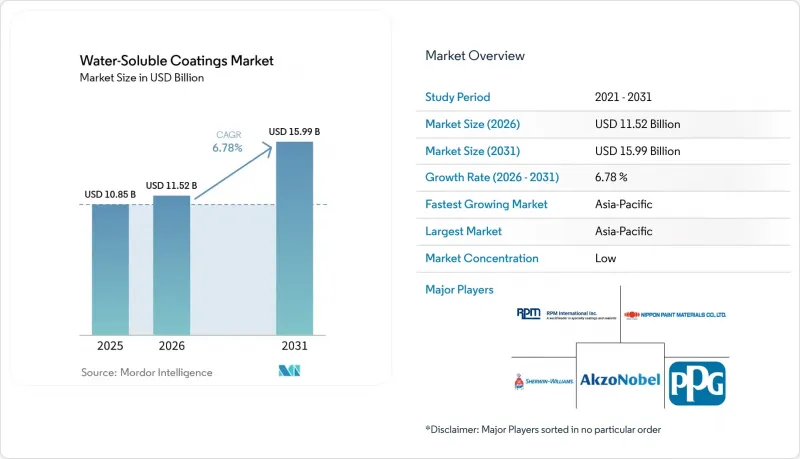
據 Mordor Intelligence 稱,2025 年水溶性塗料市場價值為 108.5 億美元,預計在預測期(2026-2031 年)內將以 6.78% 的複合年成長率成長,從 2026 年的 115.2 億美元成長到 2031 億美元的 159.900 億美元。
全球水溶性塗料市場趨勢及洞察
加強對揮發性有機化合物和室內空氣品質的監管
揮發性有機化合物 (VOC) 的相關法規正日益成為水性塗料市場產品選擇的重要標準。美國環保署 (EPA) 於 2025 年 1 月修訂了建築塗料的國家標準。加州南海岸空氣品質管理區 (SCAQMD) 的第 1113 號法規將大多數建築塗料類別的 VOC 含量限制在 50 克/公升以下。這些措施有利於水性塗料體系,因為製造商必須確保嚴格遵守相關法規。英國皇家化學學會 (英國) 發表的一項研究表明,歐盟塗料指令實施後,英國裝飾塗料的 VOC 排放量從 2004 年的每人每年 0.532 公斤下降到 2019 年的每人每年 0.210 公斤。中國的 GB/T 41659-2025 標準將此監管方向推廣到主要製造業經濟體。
建築重新粉刷及綠建築活動
綠色建築項目正在推動建築和維修整體對低排放材料的需求不斷成長。 LEED認證已在180多個國家實施,它對室內環境品質提出了要求。英國建築研究院的環境評估方法(英國)也建議在許多建築項目中使用低排放材料。如果初始施工合約中包含低VOC(揮發性有機化合物)要求,水性塗料市場將從中受益。這些規範會在建築物的整個生命週期中持續影響重新粉刷和維修的決策。印度的綠色居住環境評估(GRIHA)計畫和新加坡的綠色建築標誌(Green Mark)計畫也建議在建築採購中使用水性塗料。
乾燥和固化時間較長,對濕度和溫度敏感。
水性塗料系統需要嚴格控制環境條件以確保成膜的可靠性。與溶劑型塗料相比,高濕度和低溫會導致乾燥時間延長。如果沒有溫濕度可控的噴漆室,濕度超過 80% 會影響塗膜質量,從而增加小規模製造商和本地承包商的設備成本。此外,高濕度也會縮短雙組分水性聚氨酯塗料系統的適用期。雖然速乾添加劑、吸濕樹脂和紅外線固化可以緩解這些問題,但都會增加整體成本。
細分市場分析
到2025年,丙烯酸塗料將佔據水性塗料市場38.11%的佔有率,這得益於其在建築內外牆塗料領域久經考驗的良好口碑。承包商普遍了解這些配方,其成本優勢正推動它們在大規模建設項目中廣泛應用。在中國,水性塗料在內外牆塗料領域的滲透率預計在2025年將達到99%。這反映了多年來監管機構的壓力以及消費者對水性建築產品的接受度。醇酸塗料繼續用於對漆膜硬度有要求的木飾面應用。環氧樹脂塗料滿足了金屬直接塗裝和高耐用地板材料的需求。氟聚合物塗料適用於高耐久性外牆和冷屋頂應用。甲醛塗料在紙張和紡織品塗料領域仍佔有一席之地,但歐洲日益嚴格的化學品註冊、評估、授權和限制(REACH)法規正在推動替代產品的開發。
在水性塗料市場,聚氨酯在2031年之前將以7.23%的複合年成長率成長。需求主要來自木地板、家具製造和汽車噴漆等行業,這些行業對塗料的機械性能要求更高。雙交聯水性聚氨酯的拉伸強度、硬度和附著力與傳統的溶劑型雙組分(2K)產品相當。聚氨酯和丙烯酸酯的結合實現了性能要求和成本之間的平衡。路博潤公司於2025年7月推出的「Sancure 942」表明,特種聚氨酯分散體的商業應用將進一步擴大。這些配方用於住宅和商業木地板飾面,縮小了先前限制水性塗料在高階應用領域使用的性能差距。因此,水性塗料市場的產品線已擴展到標準建築塗料之外。
區域分析
預計到2025年,亞太地區將佔水溶性塗料市場39.73%的佔有率,並在2031年之前以7.48%的複合年成長率成長。中國憑藉著都市區住宅需求、製造業規模以及持續推動的VOC監管改革,正引領區域需求成長。水溶性牆面塗料的滲透率反映了建築應用領域轉變的進程。日本和韓國對高規格工業塗料的需求也貢獻良多。東南亞國協則透過建築和汽車組裝進一步推動市場成長。該地區既擁有龐大的現有生產規模,也對受監管配方的需求不斷成長。
北美在水性塗料市場佔有第二大佔有率。加州南海岸空氣品質管理區 (SCAQMD) 第 1113 號規則將大多數建築塗料類別的揮發性有機化合物 (VOC) 含量限制在 50 克/公升以下。聯邦和州級建築塗料標準進一步鞏固了這項法規的基礎。公共和商業建築的建設支撐著對受監管塗料產品的穩定需求。加拿大的永續建築實踐符合 LEED v4.1 標準,目前正在向 LEED v5 過渡。墨西哥也受惠於汽車組裝和電子製造領域的近岸外包投資。
歐洲是一個成熟的市場,水性塗料在裝飾塗料領域的滲透率很高。歐盟塗料指令和REACH法規已在許多其他市場之前實現了區域協調。在德國、英國和法國,向水性裝飾塗料的過渡已接近完成。成長主要集中在維護、外牆保護、工業應用和特殊產品領域。南美洲、中東和非洲的市場規模較小,但其重要性日益凸顯。在巴西,建築和汽車組裝需求的主要因素,但高濕度可能會對塗料的形成帶來挑戰。阿拉伯聯合大公國的Estida-Ma珍珠評級系統和沙烏地阿拉伯的「2030願景」專案正在推動商業和工業採購中採用低VOC(揮發性有機化合物)標準。
其他好處:
- Excel格式的市場預測(ME)表
- 3個月的分析師支持
目錄
第1章:引言
- 研究假設和市場定義
- 調查範圍
第2章:調查方法
第3章執行摘要
第4章 市場狀況
- 市場概覽
- 市場促進因素
- 加強對揮發性有機化合物和室內空氣品質的監管要求
- 建築重新粉刷和綠建築計劃
- 汽車OEM和重新噴漆產業向水性系統的過渡
- 提高了丙烯酸、聚氨酯、環氧樹脂和混合系統的性能。
- 運作中設施對低氣味塗料的需求尚未滿足。
- 市場限制因素
- 乾燥時間延長,易受濕度和溫度影響而固化。
- 原料和添加劑成本波動
- 防水性能不足、基材處理不當、防防腐蝕措施不足。
- 價值鏈分析
- 波特五力分析
第5章 市場規模與成長預測
- 按塗層類型
- 丙烯酸纖維
- 聚氨酯
- 阿爾基多
- 環氧樹脂
- 氟聚合物
- 甲醛基體系
- 其他類型
- 按最終用戶行業分類
- 建築和基礎設施
- 汽車和運輸業
- 家具、地板材料、木製品
- 電子設備及家用電器
- 包裝
- 海洋/近海
- 航太/國防
- 其他
- 按地區
- 亞太地區
- 中國
- 印度
- 日本
- 韓國
- 東南亞國協
- 其他亞太國家
- 北美洲
- 美國
- 加拿大
- 墨西哥
- 歐洲
- 德國
- 英國
- 法國
- 義大利
- 北歐國家
- 其他歐洲國家
- 南美洲
- 巴西
- 阿根廷
- 其他南美國家
- 中東和非洲
- 沙烏地阿拉伯
- 南非
- 其他中東和非洲國家
- 亞太地區
第6章 競爭情勢
- 市場集中度
- 策略趨勢
- 市佔率和排名分析
- 公司簡介
- Akzo Nobel NV
- Arkema
- Asian Paints Limited
- Axalta Coating Systems
- Berger Paints
- Covestro AG
- Hempel
- Jotun
- Kansai Paint Co., Ltd.
- Nippon Paint Holdings Co., Ltd.
- PPG Industries, Inc.
- RPM International Inc.
- Teknos Group
- The Sherwin-Williams Company
- Tikkurila
第7章 市場機會與未來展望
According to Mordor Intelligence, the water-soluble coatings market size was valued at USD 10.85 billion in 2025 and is estimated to grow from USD 11.52 billion in 2026 to USD 15.99 billion by 2031, at a CAGR of 6.78% during the forecast period (2026-2031).
Global Water-Soluble Coatings Market Trends and Insights
Tightening VOC and Indoor-Air-Quality Requirements
Volatile organic compound (VOC) regulation is becoming a stronger basis for product selection in the water-soluble coatings market. The U.S. Environmental Protection Agency updated national architectural coatings standards in January 2025. California's South Coast Air Quality Management District (SCAQMD) Rule 1113 limits most architectural categories to less than 50 g/L VOC. These measures favor waterborne systems where manufacturers need dependable compliance. Research published by the Royal Society of Chemistry (RSC) showed that UK decorative paint VOC emissions fell from 0.532 kg per person per year in 2004 to 0.210 kg per person per year in 2019 following the implementation of the EU Paints Directive. China's GB/T 41659-2025 standard extends this regulatory direction into a major manufacturing economy.
Architectural Repainting and Green-Building Activity
Green building programs are increasing demand for low-emission materials across construction and renovation work. LEED operates across more than 180 countries and applies requirements for indoor environmental quality. The Building Research Establishment Environmental Assessment Method (BREEAM) also supports lower-emission material specifications across many construction projects. The water-soluble coatings market benefits when low VOC requirements are included in original construction contracts. These specifications can continue to influence repainting and refurbishment decisions during a building's operating life. India's Green Rating for Integrated Habitat Assessment (GRIHA) program and Singapore's Green Mark scheme also support waterborne specifications in construction procurement.
Longer Drying and Cure Sensitivity to Humidity and Temperature
Water-based systems require controlled conditions for reliable film formation. High humidity or low temperatures can extend drying times compared with solvent-borne alternatives. Humidity above 80% can impair film quality without climate-controlled application booths, adding capital costs for smaller fabricators and regional contractors. Two-component waterborne polyurethane systems can also have shorter pot life under elevated humidity. Fast-drying additives, water-release resins, and infrared curing can mitigate these issues, but add to overall costs.
Other drivers and restraints analyzed in the detailed report include:
- Automotive OEM and Refinish Conversion to Water-Based Systems
- Performance Gains in Acrylic, Polyurethane, Epoxy, and Hybrid Systems
- Raw-Material and Additive Cost Volatility
For complete list of drivers and restraints, kindly check the Table Of Contents.
Segment Analysis
Acrylic accounted for 38.11% of the water-soluble coatings market in 2025, supported by its established use in interior and exterior architectural coatings. Contractors widely recognize these formulations, and their cost position supports use across large building projects. China's interior and exterior wall coatings category reached 99% waterborne penetration in 2025, reflecting years of regulatory pressure and customer acceptance for water-based architectural products. Alkyd systems continue to serve wood trim applications that require film hardness. Epoxy systems address direct-to-metal and heavy-duty flooring requirements. Fluoropolymer systems support durable facade and cool-roof applications. Formaldehyde-based systems retain narrow roles in paper and textile coatings, although increasing enforcement of the Registration, Evaluation, Authorization and Restriction of Chemicals (REACH) in Europe is driving pressure to substitute.
Polyurethane grew at a 7.23% CAGR through 2031 within the water-soluble coatings market. Demand came from wood flooring, furniture manufacturing, and automotive refinishing, which required greater mechanical performance. Double-crosslinked waterborne polyurethane exhibited tensile strength, hardness, and adhesion performance comparable to those of conventional solvent-borne two-component (2K) products. Polyurethane-acrylic combinations balanced performance requirements with cost considerations. Lubrizol's July 2025 launch of Sancure 942 illustrated the move toward broader commercial use of specialty polyurethane dispersions. These formulations were used for residential and commercial wood-floor finishes, reducing the performance gap that had previously restricted waterborne use in premium applications. The water-soluble coatings market, therefore, expanded its offering beyond standard architectural paint.
Complete Report Scope:
- By Coating Type
- Acrylic
- Polyurethane
- Alkyd
- Epoxy
- Fluoropolymers
- Formaldehyde-Based Systems
- Other Types
- By End-User Industry
- Construction and Infrastructure
- Automotive and Transportation
- Furniture, Flooring and Wood Products
- Electronics and Appliances
- Packaging
- Marine and Offshore
- Aerospace and Defense
- Others
- By Geography
- Asia-Pacific
- China
- India
- Japan
- South Korea
- ASEAN Countries
- Rest of Asia-Pacific
- North America
- United States
- Canada
- Mexico
- Europe
- Germany
- United Kingdom
- France
- Italy
- NORDIC Countries
- Rest of Europe
- South America
- Brazil
- Argentina
- Rest of South America
- Middle East and Africa
- Saudi Arabia
- South Africa
- Rest of Middle East and Africa
- Asia-Pacific
Geography Analysis
Asia-Pacific accounted for 39.73% of the water-soluble coatings market in 2025 and is forecast to expand at a 7.48% CAGR through 2031. China supports regional demand through urban housing, manufacturing scale, and successive VOC reforms. The penetration of water-based wall coatings reflects the extent of conversion in architectural applications. Japan and South Korea contribute to the demand for high-specification industrial coatings. ASEAN countries offer further growth through construction and vehicle assembly. The region combines large existing output with growing requirements for compliant formulations.
North America holds the second-largest position in the water-soluble coatings market. California's South Coast Air Quality Management District (SCAQMD) Rule 1113 limits most architectural categories to less than 50 g/L VOC. Federal architectural-coatings requirements and state-level standards reinforce this regulatory foundation. Institutional and commercial construction supports steady demand for compliant coating products. Canada's sustainable building activity is aligned with LEED v4.1 and is transitioning to LEED v5. Mexico also benefits from nearshoring investment in automotive assembly and electronics manufacturing.
Europe is a mature market with high waterborne penetration across decorative coatings. The EU Paints Directive and REACH requirements established regional harmonization ahead of many other markets. Germany, the United Kingdom, and France have largely completed decorative-paint conversion. Growth is concentrated in maintenance, facade protection, industrial applications, and specialty products. South America, the Middle East, and Africa are smaller but increasingly relevant markets. Brazil's construction and automotive assembly support demand, although humid conditions can present challenges for film formation. The UAE's Estidama Pearl Rating System and Saudi Arabia's Vision 2030 projects are driving the adoption of low-VOC specifications in commercial and industrial procurement.
- Akzo Nobel N.V.
- Arkema
- Asian Paints Limited
- Axalta Coating Systems
- Berger Paints
- Covestro AG
- Hempel
- Jotun
- Kansai Paint Co., Ltd.
- Nippon Paint Holdings Co., Ltd.
- PPG Industries, Inc.
- RPM International Inc.
- Teknos Group
- The Sherwin-Williams Company
- Tikkurila
Additional Benefits:
- The market estimate (ME) sheet in Excel format
- 3 months of analyst support
TABLE OF CONTENTS
1 Introduction
- 1.1 Study Assumptions and Market Definition
- 1.2 Scope of the Study
2 Research Methodology
3 Executive Summary
4 Market Landscape
- 4.1 Market Overview
- 4.2 Market Drivers
- 4.2.1 Tightening VOC and Indoor-Air-Quality Requirements
- 4.2.2 Architectural Repainting and Green-Building Activity
- 4.2.3 Automotive OEM and Refinish Conversion to Water-Based Systems
- 4.2.4 Performance Gains in Acrylic, Polyurethane, Epoxy and Hybrid Systems
- 4.2.5 Under-Served Demand for Low-Odor Coatings in Occupied Facilities
- 4.3 Market Restraints
- 4.3.1 Longer Drying and Cure Sensitivity to Humidity and Temperature
- 4.3.2 Raw-Material and Additive Cost Volatility
- 4.3.3 Water Sensitivity, Substrate Preparation and Corrosion-Protection Gaps
- 4.4 Value Chain Analysis
- 4.5 Porter's Five Forces Analysis
- 4.5.1 Bargaining Power of Suppliers
- 4.5.2 Bargaining Power of Buyers
- 4.5.3 Threat of New Entrants
- 4.5.4 Threat of Substitutes
- 4.5.5 Competitive Rivalry
5 Market Size And Growth Forecasts (Value)
- 5.1 By Coating Type
- 5.1.1 Acrylic
- 5.1.2 Polyurethane
- 5.1.3 Alkyd
- 5.1.4 Epoxy
- 5.1.5 Fluoropolymers
- 5.1.6 Formaldehyde-Based Systems
- 5.1.7 Other Types
- 5.2 By End-User Industry
- 5.2.1 Construction and Infrastructure
- 5.2.2 Automotive and Transportation
- 5.2.3 Furniture, Flooring and Wood Products
- 5.2.4 Electronics and Appliances
- 5.2.5 Packaging
- 5.2.6 Marine and Offshore
- 5.2.7 Aerospace and Defense
- 5.2.8 Others
- 5.3 By Geography
- 5.3.1 Asia-Pacific
- 5.3.1.1 China
- 5.3.1.2 India
- 5.3.1.3 Japan
- 5.3.1.4 South Korea
- 5.3.1.5 ASEAN Countries
- 5.3.1.6 Rest of Asia-Pacific
- 5.3.2 North America
- 5.3.2.1 United States
- 5.3.2.2 Canada
- 5.3.2.3 Mexico
- 5.3.3 Europe
- 5.3.3.1 Germany
- 5.3.3.2 United Kingdom
- 5.3.3.3 France
- 5.3.3.4 Italy
- 5.3.3.5 NORDIC Countries
- 5.3.3.6 Rest of Europe
- 5.3.4 South America
- 5.3.4.1 Brazil
- 5.3.4.2 Argentina
- 5.3.4.3 Rest of South America
- 5.3.5 Middle East and Africa
- 5.3.5.1 Saudi Arabia
- 5.3.5.2 South Africa
- 5.3.5.3 Rest of Middle East and Africa
- 5.3.1 Asia-Pacific
6 Competitive Landscape
- 6.1 Market Concentration
- 6.2 Strategic Moves
- 6.3 Market Share (%)/Ranking Analysis
- 6.4 Company Profiles (includes Global Overview, Market Overview, Core Segments, Financials as available, Strategic Information, Products and Services, and Recent Developments)
- 6.4.1 Akzo Nobel N.V.
- 6.4.2 Arkema
- 6.4.3 Asian Paints Limited
- 6.4.4 Axalta Coating Systems
- 6.4.5 Berger Paints
- 6.4.6 Covestro AG
- 6.4.7 Hempel
- 6.4.8 Jotun
- 6.4.9 Kansai Paint Co., Ltd.
- 6.4.10 Nippon Paint Holdings Co., Ltd.
- 6.4.11 PPG Industries, Inc.
- 6.4.12 RPM International Inc.
- 6.4.13 Teknos Group
- 6.4.14 The Sherwin-Williams Company
- 6.4.15 Tikkurila
7 Market Opportunities and Future Outlook
- 7.1 White-Space and Unmet-Need Assessment

 全球水性塗料市場
 水性塗料市場報告:趨勢、預測及競爭分析(至2035年)
 水性塗料:市場佔有率分析、產業趨勢與統計數據、成長預測(2026-2031)
 水性塗料市場規模、佔有率和趨勢分析報告:按樹脂、應用、地區和細分市場預測(2026-2033 年)
 水性塗料市場分析及預測(至2035年):按類型、產品類型、應用、技術、成分、最終用戶和功能分類
 全球水性塗料市場規模、佔有率、趨勢及成長分析報告(2026-2034)
 2026年全球水性塗料市場報告
 ACE低溫水性塗料市場依樹脂類型、應用及通路-2026-2032年全球預測
 水性塗料市場-全球產業規模、佔有率、趨勢、機會及預測,按樹脂類型、應用、地區及競爭情況細分,2020-2030 年