


 |
市場調查報告書
商品編碼
2120674
水性塗料:市場佔有率分析、產業趨勢與統計數據、成長預測(2026-2031)Waterborne Coatings - Market Share Analysis, Industry Trends & Statistics, Growth Forecasts (2026 - 2031) |
||||||

※ 本網頁內容可能與最新版本有所差異。詳細情況請與我們聯繫。
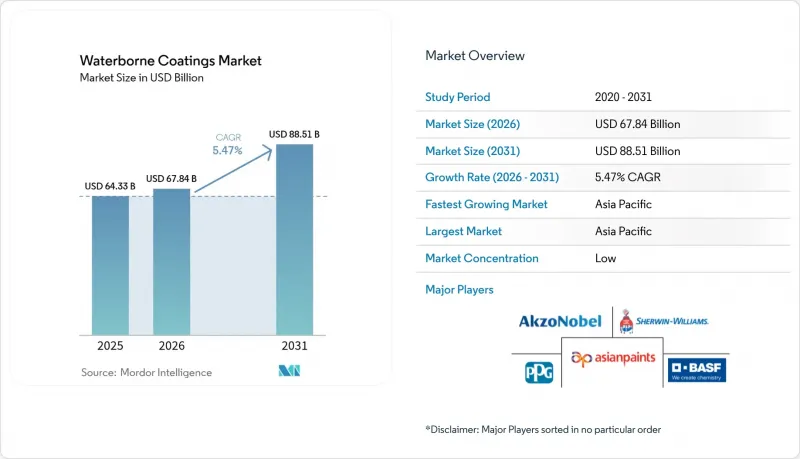
據 Mordor Intelligence 稱,2026 年水性塗料市場規模估計為 678.4 億美元,高於 2025 年的 643.3 億美元,預計到 2031 年將達到 885.1 億美元。
預計 2026 年至 2031 年的複合年成長率為 5.47%。
本報告按樹脂類型(丙烯酸樹脂、醇酸樹脂、環氧樹脂、聚氨酯樹脂、聚酯樹脂、Polyvinylidene氯乙烯等)、終端用戶行業(建築、汽車、工業、木材及其他終端用戶行業)和地區(亞太地區、北美、歐洲、南美、中東和非洲)進行細分。市場預測以美元計價。
全球水性塗料市場趨勢及洞察
加強揮發性有機化合物(VOC)法規和脫碳法規
加州空氣資源委員會已將工業維護中揮發性有機化合物 (VOC) 的濃度限制在 50 克/公升,比聯邦基準值嚴格約 10 倍。這迫使化合物生產商開發超低排放配方,並通過黏合力、光澤度和耐久性測試。加拿大也逐步收緊相關法規,130 個產品類別的國家標準將於 2024 年 1 月生效,這將增加擁有全球統一 SKU 的跨國公司的合規風險。在歐洲,更新後的 REACH 法規藍圖針對 PVC 添加劑和鄰苯二甲酸酯,縮短了採用不含 PFAS 的多元醇的時間。隨著各個司法管轄區朝著雄心勃勃的脫碳目標邁進,能夠跨洲統一水性配方規範的公司可以減輕合規負擔並加快市場准入。同時,落後的公司則可能面臨被分散的傳統產品線束縛的風險。
亞洲和非洲基礎設施快速發展
中國經濟獎勵策略推動的產業復甦以及印度高速公路和地鐵的擴建,是水性塗料市場成長的主要驅動力。海灣合作理事會(GCC)國家的建設計畫也開始考慮氣候變遷因素。在巴林和阿曼,超過45%的新建住宅使用快乾、低氣味的水性底漆,隨著當地建築商努力獲得LEED和Estidama認證,預計這一比例還將進一步上升。亞洲開發銀行(亞銀)發布的《2024年關鍵指標》強調,需要將氣候變遷適應能力納入基礎設施支出,預計每年基礎設施支出將達到1.7兆美元,這將推動能夠最大限度減少室內空氣污染物的水性化學品成為採購清單上的首選。從印尼到肯亞,各種會議的討論都表明,技術顧問越來越傾向於推薦醫院和學校使用水性環氧樹脂,這證實了人們對水性環氧樹脂的堅定偏好,並將提高長期需求成長的下限。
特殊流變助劑的供不應求與價格波動
流變助劑雖然只佔重量的4%,卻佔原料成本的13%,在供應緊張時會對整體生產利潤產生顯著影響。複雜ASE和HASE化學品生產商之間的整合加劇了價格衝擊。一次停產可能導致全球每誇脫噸成本飆升兩位數。帶狀聚矽酸鹽在低劑量下即可實現高pH穩定性流動性,但需要進行廣泛的相容性測試,這會將創新週期延長一年以上。確保即時庫存是唯一的對沖選擇,但這會佔用原本可用於新研發的資金。
細分市場分析
到2025年,丙烯酸類產品將佔水性塗料市場80.90%的佔有率,這反映了其長期以來經受考驗的抗紫外線、保色性和成本效益等特性,這些特性使其深受全球建築商和DIY消費者的青睞。在市政翻新工程和DIY管道擴張的推動下,使用丙烯酸樹脂的水性塗料市場規模預計將穩定成長。
儘管聚氨酯市場規模較小,但隨著汽車製造商和工業維護技術人員轉向使用單組分水性化學品(可縮短噴漆室工作時間並提高耐化學性),其成長速度正在加快,預計到2031年將以5.82%的複合年成長率成長。環氧樹脂在重腐蝕防腐蝕應用領域仍佔據主導地位,但隨著逐步淘汰全氟烷基和多氟烷基物質(PFAS)的努力,為了維持其阻隔性能,也需要進行相應的技術創新。醇酸樹脂正面臨揮發性有機化合物(VOC)課稅的壓力,但使用壬二酸代替石油基原料的生物基替代品為其帶來了一線生機,這些替代品在保持現有操作性能的同時,也減輕了監管審查的難度。
區域分析
預計到2025年,亞太地區將佔全球銷售額的42.40%,並在2031年之前保持5.93%的市場領先複合年成長率,鞏固其作為水性塗料市場成長引擎的地位。中國的經濟獎勵策略正在推動工業生產的復甦,並擴大對通用工業搪瓷塗料的基本需求;而在印度,大量使用混凝土的智慧城市走廊建設正在為彈性體屋頂和橋樑防水卷材帶來長期訂單。
在北美,監管的成熟和技術的領先地位促成了加州50克/公升的VOC限值,迫使全美各地的產品都必須符合最低允許VOC含量標準,這一規定影響整個分銷鏈,並促使產品配方迅速調整。加拿大全國性的VOC法規統一了各省的限值,促進了從魁北克到不列顛哥倫比亞等受監管的水基產品線進入市場。
歐洲透過其「永續性化學品策略」持續引領永續性潮流,加速了水性塗料在建築、工業和DIY領域的應用。阿克蘇諾貝爾旗下Dulux Easycare在英國的重新上市,採用了BASF的技術,進一步實踐了該品牌致力於將產品碳排放量減少至少5%的承諾,從而增強了環保意識強的地方政府的支持。東歐的都市化也推動了銷售量成長,尤其是在歐盟復甦計畫資助的道路和鐵路維修計畫中。
其他好處:
- Excel格式的市場預測(ME)表
- 3個月的分析師支持
目錄
第1章:引言
- 研究假設和市場定義
- 調查範圍
第2章:調查方法
第3章執行摘要
第4章 市場狀況
- 市場概覽
- 市場促進因素
- 加強揮發性有機化合物(VOC)法規和脫碳法規
- 亞洲和非洲基礎設施快速發展
- OEM製造中從溶劑型單組分塗料轉向水性單組分塗料的轉變。
- 生物基樹脂(例如木質素、藻類等)的技術進步
- 智慧工廠對低溫固化生產線的需求
- 市場限制因素
- 特殊流變助劑的供不應求與價格波動
- 熱帶地區濕度過高,導致乾燥效果不佳
- 不含 PFAS 的產品在極度耐腐蝕性方面的性能差異
- 價值鏈分析
- 波特五力模型
第5章 市場規模與成長預測
- 依樹脂類型
- 丙烯酸纖維
- 阿爾基多
- 環氧樹脂
- 聚氨酯
- 聚酯纖維
- Polyvinylidene氯乙烯(PVDC)
- 聚二氟亞乙烯(PVDF)
- 其他樹脂類型
- 按最終用戶行業分類
- 建築/施工
- 車
- 產業
- 樹
- 其他終端用戶產業
- 按地區
- 亞太地區
- 中國
- 印度
- 日本
- 韓國
- 東南亞
- 其他亞太國家
- 北美洲
- 美國
- 加拿大
- 墨西哥
- 歐洲
- 德國
- 英國
- 法國
- 義大利
- 俄羅斯
- 其他歐洲國家
- 南美洲
- 巴西
- 阿根廷
- 其他南美國家
- 中東和非洲
- 沙烏地阿拉伯
- 阿拉伯聯合大公國
- 南非
- 埃及
- 其他中東和非洲國家
- 亞太地區
第6章 競爭情勢
- 市場集中度
- 策略趨勢
- 市佔率分析
- 公司簡介
- Akzo Nobel NV
- Arkema
- Asian Paints Ltd.
- Axalta Coating Systems, LLC
- BASF
- Benjamin Moore & Co.
- Berger Paints India
- Chokwang Paint
- Dow
- Hempel A/S
- Jotun
- Kansai Paint Co., Ltd.
- KCC Corporation
- Masco Corporation
- Nippon Paint Holdings Co., Ltd.
- PPG Industries, Inc.
- RPM International Inc.
- Sika AG
- Teknos Group
- Tenaris
- The Sherwin-Williams Company
- Tikkurila
第7章 市場機會與未來展望
According to Mordor Intelligence, waterborne coatings market size in 2026 is estimated at USD 67.84 billion, growing from 2025 value of USD 64.33 billion with 2031 projections showing USD 88.51 billion, growing at 5.47% CAGR over 2026-2031.
This report is Segmented by Resin Type (Acrylic, Alkyd, Epoxy, Polyurethane, Polyester, Polyvinylidene Chloride, and More), End-User Industry (Building and Construction, Automotive, Industrial, Wood, and Other End-User Industries), and Geography (Asia-Pacific, North America, Europe, South America, and Middle-East and Africa). The Market Forecasts are Provided in Terms of Value (USD).
Global Waterborne Coatings Market Trends and Insights
Stricter VOC and Decarbonization Mandates
California's Air Resources Board restricts industrial-maintenance VOCs to 50 g/L, nearly a ten-fold tightening against federal thresholds, forcing formulators to engineer ultra-low emission blends that still pass adhesion, gloss, and durability tests. Similar tightening unfolds across Canada, where national limits on 130 product classes took effect in January 2024 and extend compliance risk for multinationals with globally harmonized SKUs. In Europe, the updated REACH Restrictions Roadmap targets PVC additives and ortho-phthalates, compressing the adoption window for PFAS-free polyols. As jurisdictions converge on ambitious decarbonization metrics, companies able to harmonize one waterborne specification across continents will lower compliance overhead and speed market entry, leaving laggards boxed into fragmented legacy lines.
Rapid Infrastructure Buildouts in Asia and Africa
China's stimulus-driven industrial revival and India's highway and metro expansions underpin the largest share of incremental liters for the waterborne coatings market. GCC construction pipelines add a climatic angle: quick-drying, low-odor waterborne primers now coat more than 45% of new residential stock in Bahrain and Oman, a share expected to widen as regional contractors chase LEED and Estidama credentials. The Asian Development Bank's 2024 Key Indicators emphasize that USD 1.7 trillion annual infrastructure spending must integrate climate resilience, thrusting waterborne chemistries with minimal indoor-air pollutants to the top of procurement lists. Conference dialogues from Indonesia to Kenya indicate that technical consultants increasingly recommend water-based epoxies for hospitals and schools, confirming an entrenched preference that raises the floor for long-run demand growth.
Scarcity and Price Volatility of Specialty Rheology Additives
Rheology packages, barely 4% by weight yet 13% of raw-material spend, swing overall production margins when supply tightens. Producer consolidation around complex ASE and HASE chemistries magnifies price shocks; a single outage can inflate global quarti-ton costs by double digits. Ribbon polysilicates promise pH-stable flow at lower dosages but need extensive compatibility trials, stretching innovation timelines to one year or more. Interim stock buffers remain the only hedge, locking capital that could fund new research and development.
Other drivers and restraints analyzed in the detailed report include:
- OEM One-Component Conversion from Solvent to Water Systems
- Bio-Based Resin Breakthroughs
- PFAS-Free Performance Gap for Extreme Anticorrosion
For complete list of drivers and restraints, kindly check the Table Of Contents.
Segment Analysis
Acrylic formulations anchored 80.90% of the waterborne coatings market in 2025, reflecting a time-tested blend of UV resistance, color retention, and cost efficiency that builders and DIY consumers favor worldwide. The waterborne coatings market size for acrylic resins is projected to expand steadily, supported by municipal repaint programs and widening do-it-yourself channels.
Polyurethane, though a smaller base, is accelerating at 5.82% CAGR to 2031 as vehicle makers and industrial-maintenance engineers shift to one-component waterborne chemistries that cut booth times and raise chemical resistance. Epoxies retain their foothold in heavy anticorrosive service, though PFAS exit paths demand parallel innovation to sustain barrier metrics. Alkyds, squeezed by VOC levies, find reprieve in bio-sourced variants that swap azelaic acid for petroleum feedstocks, easing regulatory scrutiny while keeping familiar workability.
Complete Report Scope:
- By Resin Type
- Acrylic
- Alkyd
- Epoxy
- Polyurethane
- Polyester
- Polyvinylidene Chloride (PVDC)
- Polyvinylidene Fluoride (PVDF)
- Other Resin Types
- By End-user Industry
- Building and Construction
- Automotive
- Industrial
- Wood
- Other End-user Industries
- By Geography
- Asia-Pacific
- China
- India
- Japan
- South Korea
- Southeast Asia
- Rest of Asia-Pacific
- North America
- United States
- Canada
- Mexico
- Europe
- Germany
- United Kingdom
- France
- Italy
- Russia
- Rest of Europe
- South America
- Brazil
- Argentina
- Rest of South America
- Middle-East and Africa
- Saudi Arabia
- United Arab Emirates
- South Africa
- Egypt
- Rest of Middle-East and Africa
- Asia-Pacific
Geography Analysis
Asia-Pacific commanded 42.40% of global revenue in 2025 and is on track for a market-leading 5.93% CAGR to 2031, cementing its position as the growth engine for the waterborne coatings market. China's stimulus packages revive industrial output, expanding baseline demand for general-industrial enamels, while India's concrete-intensive smart-city corridors open long-haul orders for elastomeric roof and bridge membranes.
North America reflects regulatory maturity mixed with technology leadership. California's 50 g/L cap forces nationwide SKUs to align at the lowest permissible VOC, rippling through distribution chains and spurring rapid reformulation. Canada's national VOC rulebook harmonizes provincial limits, smoothing market access for compliant waterborne lines from Quebec to British Columbia.
Europe remains a sustainability trend-setter through the Chemicals Strategy for Sustainability, accelerating waterborne adoption across architectural, industrial, and DIY shelves. AkzoNobel's BASF-enabled Dulux Easycare relaunch in the UK advances its pledge to cut product carbon by 5% minimum, strengthening brand pull among eco-conscious shoppers. Eastern-European urbanization also drives incremental liters, especially in municipal road and rail renovations funded by EU recovery programs.
- Akzo Nobel N.V.
- Arkema
- Asian Paints Ltd.
- Axalta Coating Systems, LLC
- BASF
- Benjamin Moore & Co.
- Berger Paints India
- Chokwang Paint
- Dow
- Hempel A/S
- Jotun
- Kansai Paint Co., Ltd.
- KCC Corporation
- Masco Corporation
- Nippon Paint Holdings Co., Ltd.
- PPG Industries, Inc.
- RPM International Inc.
- Sika AG
- Teknos Group
- Tenaris
- The Sherwin-Williams Company
- Tikkurila
Additional Benefits:
- The market estimate (ME) sheet in Excel format
- 3 months of analyst support
TABLE OF CONTENTS
1 Introduction
- 1.1 Study Assumptions and Market Definition
- 1.2 Scope of the Study
2 Research Methodology
3 Executive Summary
4 Market Landscape
- 4.1 Market Overview
- 4.2 Market Drivers
- 4.2.1 Stricter VOC and Decarbonization Mandates
- 4.2.2 Rapid Infrastructure Buildouts in Asia and Africa
- 4.2.3 OEM One-Component Conversion from Solvent to Water Systems
- 4.2.4 Bio-Based Resin Breakthroughs (eg, Lignin, Algae)
- 4.2.5 Smart Factory Demand for Low-Temperature Cure Lines
- 4.3 Market Restraints
- 4.3.1 Scarcity and Price Volatility of Specialty Rheology Additives
- 4.3.2 Humidity-Related Drying Defects in Tropical Regions
- 4.3.3 PFAS-Free Performance Gap for Extreme Anticorrosion
- 4.4 Value Chain Analysis
- 4.5 Porter's Five Forces
- 4.5.1 Bargaining Power of Suppliers
- 4.5.2 Bargaining Power of Buyers
- 4.5.3 Threat of New Entrants
- 4.5.4 Threat of Substitutes
- 4.5.5 Degree of Competition
5 Market Size and Growth Forecasts (Value)
- 5.1 By Resin Type
- 5.1.1 Acrylic
- 5.1.2 Alkyd
- 5.1.3 Epoxy
- 5.1.4 Polyurethane
- 5.1.5 Polyester
- 5.1.6 Polyvinylidene Chloride (PVDC)
- 5.1.7 Polyvinylidene Fluoride (PVDF)
- 5.1.8 Other Resin Types
- 5.2 By End-user Industry
- 5.2.1 Building and Construction
- 5.2.2 Automotive
- 5.2.3 Industrial
- 5.2.4 Wood
- 5.2.5 Other End-user Industries
- 5.3 By Geography
- 5.3.1 Asia-Pacific
- 5.3.1.1 China
- 5.3.1.2 India
- 5.3.1.3 Japan
- 5.3.1.4 South Korea
- 5.3.1.5 Southeast Asia
- 5.3.1.6 Rest of Asia-Pacific
- 5.3.2 North America
- 5.3.2.1 United States
- 5.3.2.2 Canada
- 5.3.2.3 Mexico
- 5.3.3 Europe
- 5.3.3.1 Germany
- 5.3.3.2 United Kingdom
- 5.3.3.3 France
- 5.3.3.4 Italy
- 5.3.3.5 Russia
- 5.3.3.6 Rest of Europe
- 5.3.4 South America
- 5.3.4.1 Brazil
- 5.3.4.2 Argentina
- 5.3.4.3 Rest of South America
- 5.3.5 Middle-East and Africa
- 5.3.5.1 Saudi Arabia
- 5.3.5.2 United Arab Emirates
- 5.3.5.3 South Africa
- 5.3.5.4 Egypt
- 5.3.5.5 Rest of Middle-East and Africa
- 5.3.1 Asia-Pacific
6 Competitive Landscape
- 6.1 Market Concentration
- 6.2 Strategic Moves
- 6.3 Market Share Analysis
- 6.4 Company Profiles (includes Global level Overview, Market level overview, Core Segments, Financials as available, Strategic Information, Market Rank/Share for key companies, Products and Services, and Recent Developments)
- 6.4.1 Akzo Nobel N.V.
- 6.4.2 Arkema
- 6.4.3 Asian Paints Ltd.
- 6.4.4 Axalta Coating Systems, LLC
- 6.4.5 BASF
- 6.4.6 Benjamin Moore & Co.
- 6.4.7 Berger Paints India
- 6.4.8 Chokwang Paint
- 6.4.9 Dow
- 6.4.10 Hempel A/S
- 6.4.11 Jotun
- 6.4.12 Kansai Paint Co., Ltd.
- 6.4.13 KCC Corporation
- 6.4.14 Masco Corporation
- 6.4.15 Nippon Paint Holdings Co., Ltd.
- 6.4.16 PPG Industries, Inc.
- 6.4.17 RPM International Inc.
- 6.4.18 Sika AG
- 6.4.19 Teknos Group
- 6.4.20 Tenaris
- 6.4.21 The Sherwin-Williams Company
- 6.4.22 Tikkurila
7 Market Opportunities and Future Outlook
- 7.1 White-space and Unmet-need Assessment

 全球水性塗料市場
 水溶性塗料:市場佔有率分析、產業趨勢與統計資料、成長預測(2026-2031 年)
 水性塗料市場報告:趨勢、預測及競爭分析(至2035年)
 水性塗料市場規模、佔有率和趨勢分析報告:按樹脂、應用、地區和細分市場預測(2026-2033 年)
 水性塗料市場分析及預測(至2035年):按類型、產品類型、應用、技術、成分、最終用戶和功能分類
 全球水性塗料市場規模、佔有率、趨勢及成長分析報告(2026-2034)
 2026年全球水性塗料市場報告
 ACE低溫水性塗料市場依樹脂類型、應用及通路-2026-2032年全球預測
 水性塗料市場-全球產業規模、佔有率、趨勢、機會及預測,按樹脂類型、應用、地區及競爭情況細分,2020-2030 年