


 |
市場調查報告書
商品編碼
2157003
3D智慧相機:市佔率分析、產業趨勢與統計及成長預測(2026-2031年)3D Smart Camera - Market Share Analysis, Industry Trends & Statistics, Growth Forecasts (2026 - 2031) |
||||||

※ 本網頁內容可能與最新版本有所差異。詳細情況請與我們聯繫。
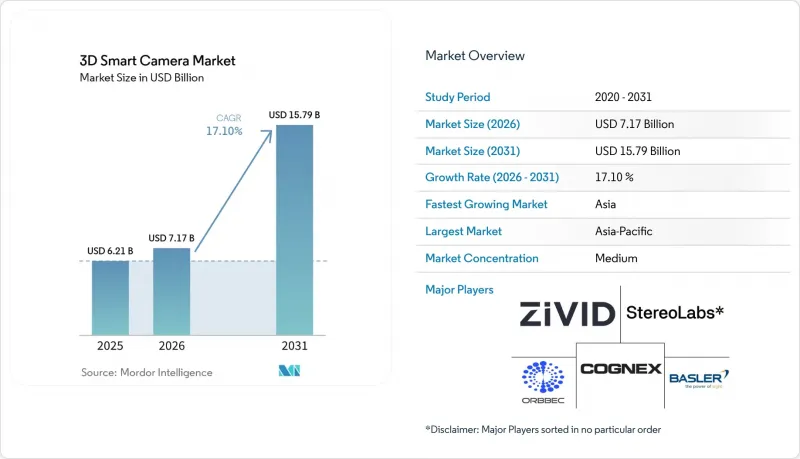
據 Mordor Intelligence 稱,2025 年 3D 智慧相機市值為 62.1 億美元,預計將從 2026 年的 71.7 億美元成長到 2031 年的 157.9 億美元。
預測期(2026-2031 年)的複合年成長率預計為 17.10%。
全球3D智慧相機市場趨勢與洞察
工業自動化和機器人視覺的擴展
根據國際機器人聯合會(IFR)的數據,2024年全球工業機器人部署數量達54.2萬台,連續第四年超過50萬台。亞洲佔總數的74%,其中中國佔29.5萬台。 IFR預測,到2025年,機器人安裝數量將達到57.5萬台,2028年將超過70萬台。每個機械臂、協作工作空間和揀貨站都需要可靠的深度感知能力,才能在不斷變化的物體和佈局中正常運作。不斷擴大的部署規模也催生了升級需求,因為老舊的視覺系統正被嵌入式人工智慧攝影機所取代。因此,3D智慧攝影機市場正受益於新的自動化項目和現有生產線的現代化改造。
ADAS與車載監控系統的發展
關於3D智慧攝影機市場,歐盟通用安全法規(EU General Safety Regulations)將於2024年7月起強制要求新車安裝「駕駛員疲勞和分心警報系統」。此外,自2026年7月起,所有新車型都必須配備基於攝影機的「高級駕駛員分心警報系統」。這些要求推動了對能夠檢測駕駛員分心和疲勞的車載成像模組的需求。 2026年3月,Mobileye與一家美國汽車製造商達成了一項駕駛員監控生產計劃,該計劃使用單個EyeQ6L晶片進行駕駛員和乘客監控,併計劃於2027年開始生產。汽車製造商正從單一功能的警報系統轉向能夠評估駕駛狀態、乘客位置和兒童安全座椅是否存在等資訊的系統。這種轉變導致每輛車的攝影機數量增加,為參與大型汽車專案的供應商創造了商機。
攝影機、軟體和系統整合高成本
在3D智慧相機市場,完整的部署方案包括感測器硬體、邊緣AI軟體、校準工具以及系統整合的人事費用。這些總合成本可能會超出成本敏感地區中小型製造商的資本預算。此外,軟體訂閱還會增加持續的營運成本,而採購流程本身就以硬體採購為主。完整的配置方案,包括安裝、佈線、人事費用和軟體,通常每個站點的成本在2萬至5萬美元之間。網路安全要求(例如IEC 62443)和機器安全要求(例如ISO 13849)會增加整合工作和專業服務成本。因此,醫療、航空航太和國防領域的使用者可能需要更長的專案核准時間,因為合規性挑戰會影響預期的投資回報。
細分市場分析
2025年,飛行時間(ToF)技術將佔據3D智慧相機市場34.71%的佔有率。其全場深度捕捉能力和抗環境光波動能力將為工業自動化、門禁控制和車載監控等領域提供支援。 LIPS公司的「LIPSedge T235」採用了三星ISOCELL VIZION 63D間接ToF感測器。平台將測量範圍擴展至10公尺以上,同時維持1%以下的深度精度。這項優異性能使其適用於以往需要更昂貴的雷射雷達(LiDAR)系統的大規模物流區域和廣域監控應用。
混合多感測器系統預計到2031年將以20.87%的複合年成長率成長。這些系統結合了兩種或多種深度感知方法,以支援近距離操作和中距離障礙物偵測。結構光在電子設備和汽車車體部件的精細測量中繼續發揮著至關重要的作用。立體視覺廣泛應用於倉庫導航與揀選。 SICK的「Visionary AI-Assist」將立體3D相機與感測端AI結合,使自主移動機器人能夠避免碰撞。在3D智慧相機市場,預計差異化將更多地體現在感測器融合和自適應感知上,而不是單一模態。
到2025年,800萬像素段將佔據3D智慧相機市場52.63%的佔有率。對於機器人引導、物流尺寸測量、揀選和門禁控制等應用,通常不需要更高的像素數。影格速率、深度精度和邊緣運算吞吐量在這些應用中變得更加重要。高速全域百葉窗也適用於標準的工業應用場景。 8-1600萬像素段則滿足中等程度的偵測任務需求,並有望在製造規範日益嚴格的背景下滿足市場需求。
預計到2031年,像素超過1,600萬的細分市場將以20.69%的複合年成長率成長。半導體晶圓檢測、電動車電池分析和電子組裝都需要精細的缺陷檢測。在這些領域,空間解析度直接影響微米級異常的辨識能力。 LMI的Gocator 6300實現了小於2.1微米的X軸輪廓間距,而Gocator 2600型號則可在寬廣的視野範圍內測量每個輪廓4200個點。電池製造商對高解析度的需求也從電芯檢測擴展到了物流和包裝線。這使得對高解析度的需求不再局限於專業的品管控制站。
區域分析
預計到2025年,亞太地區將佔3D智慧相機市場38.57%的佔有率,並將以21.47%的複合年成長率持續成長至2031年。 2024年,中國部署了29.5萬台工業機器人,佔全球部署總量的54%,創下單一國家年度部署量的最高紀錄。中國是製造業和物流業相機需求最集中的地區。海康機器人和威信科技等公司正將業務拓展至中國以外的東協供應商網路。
在日本,汽車和精密電子產業對結構光和飛行時間(ToF)系統的應用推動了3D智慧相機市場的發展。在韓國,半導體和顯示器製造廠正在尋求能夠進行亞微米級測量的輪廓感測器。在與生產連結獎勵計畫計畫的支持下,印度的電子和汽車製造走廊正在崛起,成為國內快速成長的機會。北美佔據第二大區域市場佔有率,需求集中在汽車製造、半導體製造、物流自動化和國防領域。美國仍然是該地區的需求中心,密西根州、田納西州、德克薩斯州和亞利桑那州的業務活動十分活躍。
Mobileye生產計畫,這顯示在預測期內車載感測技術的應用將進一步擴展。加拿大的人工智慧和電腦視覺機構正在為安大略省的早期用戶提供支持,而墨西哥的一級供應商正在採用符合北美汽車項目標準的系統。歐洲是第三大區域市場,主要由德國、英國、法國、義大利和西班牙推動。歐洲的安全法規已將駕駛員監控列為最低合規要求,SICK和Basler仍然是成熟的工業視覺供應商。南美洲、中東和非洲是新興市場,汽車組裝、食品加工、智慧城市計畫和安防基礎設施等產業正在推動這些地區的需求。
其他好處:
- Excel格式的市場預測(ME)表
- 3個月的分析師支持
目錄
第1章:引言
- 研究假設和市場定義
- 調查範圍
第2章:調查方法
第3章執行摘要
第4章 市場狀況
- 市場概覽
- 市場促進因素
- 工業自動化和機器人視覺的擴展
- 將深度感知功能整合到智慧型手機和平板電腦中
- ADAS與車載監控系統的發展
- 對3D檢測和品質保證的需求日益成長
- 邊緣人工智慧實現即時自主感知。
- 標準化的 3D 視覺介面加快了現有設備的整合。
- 市場限制因素
- 攝影機、軟體和系統整合成本高昂
- 招募技術嫻熟的3D視覺工程師很困難。
- 高通量工業環境中的校準漂移
- 分散化點雲資料和人工智慧模型的標準化
- 宏觀經濟因素對市場的影響
- 產業供應鏈分析
- 科技趨勢
- 監理情勢
- 波特五力分析
第5章 市場規模與成長預測
- 透過技術
- 飛行時間法
- 立體視覺
- 結構光
- 混合多感測器
- 通過決議
- 小於 8 兆像素
- 8~16 MP
- 1600萬像素或以上
- 不同的發展
- 嵌入式智慧攝影機
- 基於PC的攝影機系統
- 雲端連接攝影機系統
- 透過使用
- 3D掃描和建模
- 機器人與自動化
- 品質檢驗和測量
- 擴增實境(AR)和虛擬實境(VR)
- 駕駛員和乘客監控
- 門禁控制和監控
- 醫學和診斷影像
- 3D列印與積層製造
- 其他用途
- 按最終用戶行業分類
- 家用電子產品
- 車
- 工業製造
- 物流和倉儲
- 醫療保健和生命科學
- 安全監控
- 建築和房地產
- 農業
- 其他終端用戶產業
- 按地區
- 北美洲
- 美國
- 加拿大
- 墨西哥
- 南美洲
- 巴西
- 阿根廷
- 其他南美國家
- 歐洲
- 德國
- 英國
- 法國
- 義大利
- 西班牙
- 其他歐洲國家
- 亞太地區
- 中國
- 日本
- 印度
- 韓國
- 其他亞太國家
- 中東和非洲
- 中東
- 沙烏地阿拉伯
- 阿拉伯聯合大公國
- 土耳其
- 其他中東國家
- 非洲
- 南非
- 奈及利亞
- 其他非洲國家
- 中東
- 北美洲
第6章 競爭情勢
- 市場集中度
- 策略趨勢
- 市佔率分析
- 公司簡介
- AT-Automation Technology GmbH
- Basler AG
- Chromasens GmbH
- Cognex Corporation
- FARO Technologies, Inc.
- Giraffe360 Limited
- Hikrobot Co., Ltd.
- LMI Technologies Inc.
- LuminWave Technology Co., Ltd.
- Luxonis Holding Corporation
- Matterport, Inc.
- Nerian Vision GmbH
- Orbbec Inc.
- photonicSENS, Inc.
- Photoneo sro
- Roboception GmbH
- SICK AG
- Stereolabs Inc.
- Vision Components GmbH
- Vzense Technology(Shenzhen)Co., Ltd.
- Zivid AS
第7章 市場機會與未來展望
According to Mordor Intelligence, the 3D smart camera market size was valued at USD 6.21 billion in 2025 and estimated to expand from USD 7.17 billion in 2026 to reach USD 15.79 billion by 2031, at a CAGR of 17.10% during the forecast period (2026-2031).
Global 3D Smart Camera Market Trends and Insights
Expansion of Industrial Automation and Robotic Vision
The International Federation of Robotics recorded 542,000 industrial robot installations worldwide in 2024, the fourth consecutive year above 500,000 units. Asia accounted for 74% of those installations, with China accounting for 295,000 units. The federation expects installations to reach 575,000 in 2025 and exceed 700,000 by 2028. Each robot arm, collaborative workspace, and bin-picking station needs reliable depth perception to operate in the presence of changing objects and layouts. This expanding installed base also supports replacement demand as older vision systems are upgraded with embedded AI cameras. The 3D Smart Camera Market, therefore, benefits from both new automation projects and modernization of existing lines.
Growth of ADAS and In-Cabin Monitoring Systems
For the 3D Smart Camera Market, the European Union General Safety Regulation requires Driver Drowsiness and Attention Warning systems on new vehicles from July 2024. Camera-based Advanced Driver Distraction Warning is required across new vehicles from July 2026. These requirements increase demand for in-cabin imaging modules capable of detecting distraction and drowsiness. In March 2026, Mobileye secured a driver-monitoring production program with a U.S. automaker, using a single EyeQ6L chip for driver and occupant monitoring, with production planned for 2027. Vehicle makers are moving from single-purpose warnings toward systems that assess driver status, passenger position, and child-seat presence. This shift raises camera content per vehicle and broadens opportunities for suppliers serving major vehicle programs.
High Camera, Software, and System Integration Costs
In the 3D Smart Camera Market, a full deployment includes sensor hardware, edge-AI software, calibration tools, and systems-integration labor. These combined costs can exceed the capital budgets of smaller manufacturers in cost-sensitive locations. Software subscriptions also introduce recurring operating costs to procurement processes built around hardware purchases. Full configurations with mounting, wiring, labor, and software commonly cost USD 20,000 to USD 50,000 per station. IEC 62443 cybersecurity requirements and ISO 13849 machine-safety requirements can increase integration work and professional-service fees. Healthcare, aerospace, and defense users may therefore take longer to approve projects because compliance work affects the expected payback period.
Other drivers and restraints analyzed in the detailed report include:
- Edge AI Enables Real-Time Autonomous Perception
- Increasing Demand for 3D Inspection and Quality Assurance
- Limited Availability of Skilled 3D Vision Engineers
For complete list of drivers and restraints, kindly check the Table Of Contents.
Segment Analysis
Time-of-Flight held 34.71% of the 3D Smart Camera Market share in 2025. Its full-field depth capture and tolerance for ambient-light variation support industrial automation, access control, and in-cabin monitoring. LIPS Corporation's LIPSedge T235 uses Samsung's ISOCELL VIZION 63D indirect ToF sensor. The platform extends measurement range beyond 10 meters while maintaining sub-1% depth accuracy. This performance supports large logistics areas and wide-field surveillance uses that previously required more costly LiDAR systems.
Hybrid Multi-Sensor systems are projected to expand at a 20.87% CAGR through 2031. They combine 2 or more depth-sensing methods to support near-field manipulation and mid-range obstacle detection. Structured light remains important for detailed metrology in electronics and automotive body parts. Stereo vision is widely used in warehouse navigation and bin picking. SICK's Visionary AI-Assist combines a stereoscopic 3D camera with on-sensor AI for autonomous mobile robot collision avoidance. The 3D Smart Camera Market is likely to see differentiation through sensor fusion and adaptive sensing rather than a single modality.
The 8 MP band held 52.63% of the 3D Smart Camera Market share in 2025. Robotic guidance, logistics dimensioning, bin picking, and access control often do not need higher pixel counts. These uses place more value on frame rate, depth accuracy, and edge-compute throughput. Fast global shutters also fit standard industrial use cases. The 8-16 MP tier addresses intermediate inspection work and can absorb demand as manufacturing specifications become stricter.
The above 16 MP segment is projected to expand at a 20.69% CAGR through 2031. Semiconductor wafer inspection, EV battery analysis, and electronics assembly require detailed defect detection. In these settings, spatial resolution directly affects the ability to identify micron-scale anomalies. LMI's Gocator 6300 offers X-profile intervals below 2.1 microns, while a Gocator 2600 variant provides 4,200 points per profile across wide fields. Battery manufacturers are also extending high-resolution requirements from cell inspection into logistics packaging lines. This broadens demand beyond specialized quality-control stations.
Complete Report Scope:
- By Technology
- Time-of-Flight
- Stereo Vision
- Structured Light
- Hybrid Multi-Sensor
- By Resolution
- Less Than 8 MP
- 8-16 MP
- Above 16 MP
- By Deployment
- Embedded Smart Camera
- PC-Based Camera System
- Cloud-Connected Camera System
- By Application
- 3D Scanning and Modeling
- Robotics and Automation
- Quality Inspection and Metrology
- Augmented Reality and Virtual Reality
- Driver and Occupant Monitoring
- Access Control and Surveillance
- Medical and Diagnostic Imaging
- 3D Printing and Additive Manufacturing
- Other Applications
- By End-User Industry
- Consumer Electronics
- Automotive
- Industrial Manufacturing
- Logistics and Warehousing
- Healthcare and Life Sciences
- Security and Surveillance
- Construction and Real Estate
- Agriculture
- Other End-User Industries
- By Geography
- North America
- United States
- Canada
- Mexico
- South America
- Brazil
- Argentina
- Rest of South America
- Europe
- Germany
- United Kingdom
- France
- Italy
- Spain
- Rest of Europe
- Asia-Pacific
- China
- Japan
- India
- South Korea
- Rest of Asia-Pacific
- Middle East and Africa
- Middle East
- Saudi Arabia
- United Arab Emirates
- Turkey
- Rest of the Middle East
- Africa
- South Africa
- Nigeria
- Rest of Africa
- Middle East
- North America
Geography Analysis
Asia-Pacific held 38.57% of the 3D Smart Camera Market share in 2025 and is projected to expand at a 21.47% CAGR through 2031. China installed 295,000 industrial robots in 2024, equal to 54% of global installations. This was the highest annual deployment total for a single country. China is the largest concentration of demand for manufacturing and logistics cameras. Hikrobot and Vzense Technology are also expanding beyond China into ASEAN supplier networks.
In Japan, the 3D Smart Camera Market is supported by automotive and precision-electronics purchases of structured-light and ToF systems. South Korean semiconductor and display fabs require profiling sensors capable of sub-micron measurement. India's electronics and automotive manufacturing corridor is emerging as a fast-developing national opportunity, supported by production-linked incentive programs. North America holds the second-largest regional share, with demand concentrated in automotive manufacturing, semiconductor fabrication, logistics automation, and defense. The United States remains the central regional demand hub, with activity in Michigan, Tennessee, Texas, and Arizona.
Mobileye's March 2026 U.S. production program points to broader adoption of in-cabin sensing through the forecast period. Canada's AI and computer-vision institutions support early adopters in Ontario, while Mexico's Tier 1 suppliers are adopting systems aligned with North American vehicle programs. Europe is the third-largest regional market, led by Germany, the United Kingdom, France, Italy, and Spain. European safety rules make driver monitoring a baseline compliance requirement, while SICK and Basler remain established industrial vision suppliers. South America, the Middle East, and Africa are emerging markets where automotive assembly, food processing, smart-city projects, and security infrastructure drive targeted demand.
- AT - Automation Technology GmbH
- Basler AG
- Chromasens GmbH
- Cognex Corporation
- FARO Technologies, Inc.
- Giraffe360 Limited
- Hikrobot Co., Ltd.
- LMI Technologies Inc.
- LuminWave Technology Co., Ltd.
- Luxonis Holding Corporation
- Matterport, Inc.
- Nerian Vision GmbH
- Orbbec Inc.
- photonicSENS, Inc.
- Photoneo s.r.o.
- Roboception GmbH
- SICK AG
- Stereolabs Inc.
- Vision Components GmbH
- Vzense Technology (Shenzhen) Co., Ltd.
- Zivid AS
Additional Benefits:
- The market estimate (ME) sheet in Excel format
- 3 months of analyst support
TABLE OF CONTENTS
1 INTRODUCTION
- 1.1 Study Assumptions and Market Definition
- 1.2 Scope of the Study
2 RESEARCH METHODOLOGY
3 EXECUTIVE SUMMARY
4 MARKET LANDSCAPE
- 4.1 Market Overview
- 4.2 Market Drivers
- 4.2.1 Expansion of Industrial Automation and Robotic Vision
- 4.2.2 Integration of Depth Sensing in Smartphones and Tablets
- 4.2.3 Growth of ADAS and In-Cabin Monitoring Systems
- 4.2.4 Increasing Demand for 3D Inspection and Quality Assurance
- 4.2.5 Edge AI Enables Real-Time Autonomous Perception
- 4.2.6 Standardized 3D Vision Interfaces Accelerate Retrofit Adoption
- 4.3 Market Restraints
- 4.3.1 High Camera, Software, and System Integration Costs
- 4.3.2 Limited Availability of Skilled 3D Vision Engineers
- 4.3.3 Calibration Drift in High-Throughput Industrial Environments
- 4.3.4 Fragmented Point-Cloud Data and AI Model Standards
- 4.4 Impact of Macroeconomic Factors on the Market
- 4.5 Industry Supply-Chain Analysis
- 4.6 Technology Outlook
- 4.7 Regulatory Landscape
- 4.8 Porter's Five Forces Analysis
- 4.8.1 Threat of New Entrants
- 4.8.2 Bargaining Power of Suppliers
- 4.8.3 Bargaining Power of Buyers
- 4.8.4 Threat of Substitutes
- 4.8.5 Intensity of Competitive Rivalry
5 MARKET SIZE AND GROWTH FORECASTS (VALUE)
- 5.1 By Technology
- 5.1.1 Time-of-Flight
- 5.1.2 Stereo Vision
- 5.1.3 Structured Light
- 5.1.4 Hybrid Multi-Sensor
- 5.2 By Resolution
- 5.2.1 Less Than 8 MP
- 5.2.2 8-16 MP
- 5.2.3 Above 16 MP
- 5.3 By Deployment
- 5.3.1 Embedded Smart Camera
- 5.3.2 PC-Based Camera System
- 5.3.3 Cloud-Connected Camera System
- 5.4 By Application
- 5.4.1 3D Scanning and Modeling
- 5.4.2 Robotics and Automation
- 5.4.3 Quality Inspection and Metrology
- 5.4.4 Augmented Reality and Virtual Reality
- 5.4.5 Driver and Occupant Monitoring
- 5.4.6 Access Control and Surveillance
- 5.4.7 Medical and Diagnostic Imaging
- 5.4.8 3D Printing and Additive Manufacturing
- 5.4.9 Other Applications
- 5.5 By End-User Industry
- 5.5.1 Consumer Electronics
- 5.5.2 Automotive
- 5.5.3 Industrial Manufacturing
- 5.5.4 Logistics and Warehousing
- 5.5.5 Healthcare and Life Sciences
- 5.5.6 Security and Surveillance
- 5.5.7 Construction and Real Estate
- 5.5.8 Agriculture
- 5.5.9 Other End-User Industries
- 5.6 By Geography
- 5.6.1 North America
- 5.6.1.1 United States
- 5.6.1.2 Canada
- 5.6.1.3 Mexico
- 5.6.2 South America
- 5.6.2.1 Brazil
- 5.6.2.2 Argentina
- 5.6.2.3 Rest of South America
- 5.6.3 Europe
- 5.6.3.1 Germany
- 5.6.3.2 United Kingdom
- 5.6.3.3 France
- 5.6.3.4 Italy
- 5.6.3.5 Spain
- 5.6.3.6 Rest of Europe
- 5.6.4 Asia-Pacific
- 5.6.4.1 China
- 5.6.4.2 Japan
- 5.6.4.3 India
- 5.6.4.4 South Korea
- 5.6.4.5 Rest of Asia-Pacific
- 5.6.5 Middle East and Africa
- 5.6.5.1 Middle East
- 5.6.5.1.1 Saudi Arabia
- 5.6.5.1.2 United Arab Emirates
- 5.6.5.1.3 Turkey
- 5.6.5.1.4 Rest of the Middle East
- 5.6.5.2 Africa
- 5.6.5.2.1 South Africa
- 5.6.5.2.2 Nigeria
- 5.6.5.2.3 Rest of Africa
- 5.6.5.1 Middle East
- 5.6.1 North America
6 COMPETITIVE LANDSCAPE
- 6.1 Market Concentration
- 6.2 Strategic Moves
- 6.3 Market Share Analysis
- 6.4 Company Profiles (includes Global Level Overview, Market Level Overview, Core Segments, Financials as available, Strategic Information, Market Rank/Share, Products and Services, Recent Developments)
- 6.4.1 AT - Automation Technology GmbH
- 6.4.2 Basler AG
- 6.4.3 Chromasens GmbH
- 6.4.4 Cognex Corporation
- 6.4.5 FARO Technologies, Inc.
- 6.4.6 Giraffe360 Limited
- 6.4.7 Hikrobot Co., Ltd.
- 6.4.8 LMI Technologies Inc.
- 6.4.9 LuminWave Technology Co., Ltd.
- 6.4.10 Luxonis Holding Corporation
- 6.4.11 Matterport, Inc.
- 6.4.12 Nerian Vision GmbH
- 6.4.13 Orbbec Inc.
- 6.4.14 photonicSENS, Inc.
- 6.4.15 Photoneo s.r.o.
- 6.4.16 Roboception GmbH
- 6.4.17 SICK AG
- 6.4.18 Stereolabs Inc.
- 6.4.19 Vision Components GmbH
- 6.4.20 Vzense Technology (Shenzhen) Co., Ltd.
- 6.4.21 Zivid AS
7 MARKET OPPORTUNITIES AND FUTURE OUTLOOK
- 7.1 White-Space and Unmet-Need Assessment

 智慧托盤感測器市場規模、佔有率和成長分析:按感測器類型、連接方式、托盤類型、應用、最終用戶和地區分類-2026-2033年產業預測
 2026年全球智慧感測器專利情報-專利格局、申請趨勢、主要專利持有人策略分析、技術領域、閒置頻段及未來智慧財產權展望全球智慧感測器競爭情報,2026—主要參與者、技術趨勢、製造、創新和競爭格局的策略分析
 智慧感測器:市場佔有率分析、產業趨勢與統計、成長預測(2026-2031)
 智慧感測器市場-2026-2032年全球市場預測
 智慧托盤感測器市場:按應用、終端用戶產業和地區分類-市場規模、佔有率、前景和機會分析,2025-2032年
 全球智慧感測器市場規模、佔有率、趨勢和成長分析報告(2026-2034)
 2026年全球智慧感測器市場報告3D智慧感測器市場:依技術、組件、平台、產品、應用、通路分類,全球預測(2026-2032年)
 智慧感測器市場分析及預測(至2035年):按類型、產品類型、服務、技術、組件、應用、部署類型、最終用戶和功能分類