


 |
市場調查報告書
商品編碼
2122046
智慧感測器:市場佔有率分析、產業趨勢與統計、成長預測(2026-2031)Smart Sensors - Market Share Analysis, Industry Trends & Statistics, Growth Forecasts (2026 - 2031) |
||||||

※ 本網頁內容可能與最新版本有所差異。詳細情況請與我們聯繫。
根據 Mordor Intelligence 估計,智慧感測器市場在 2026 年的價值將達到 903.1 億美元,高於 2025 年的 770.5 億美元,預計到 2031 年將達到 1996.8 億美元。
預計 2026 年至 2031 年的複合年成長率為 17.21%。
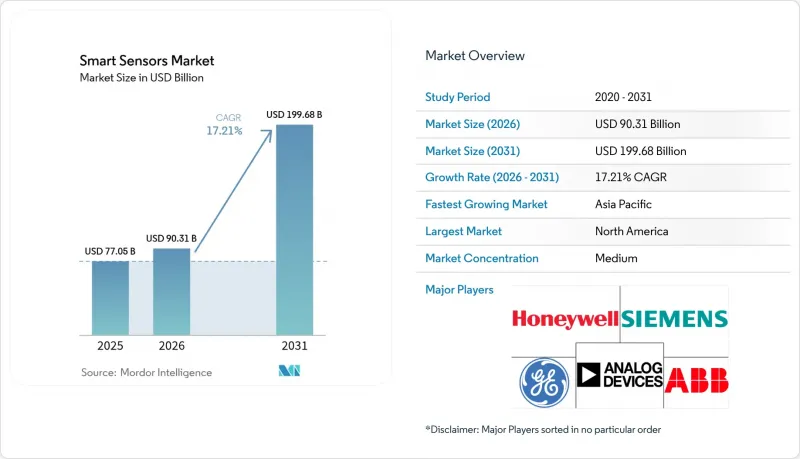
本報告按類型(流量感測器、濕度感測器、位置感測器、壓力感測器等)、技術(MEMS、CMOS、光學光譜等)、組件(A/D轉換器、D/A轉換器、放大器等)、應用(航太與國防、汽車與交通運輸等)和地區進行細分。市場預測以美元計價。
全球智慧感測器市場趨勢及洞察
提升工業IoT的能源效率
由於具有法律約束力的永續發展報告要求,製造商被迫部署智慧感測器,以實現可衡量的千瓦時 (kWh) 減少和二氧化碳 (CO2) 減排。歐盟企業永續發展報告指令 (ECSR) 要求提供詳細的能源指標,這推動了工廠採用邊緣人工智慧感測器,以持續最佳化暖通空調 (HVAC)、照明和機器運轉率。 SECO 的智慧數控 (CNC) 升級展現了切實的經濟效益,生產損失減少了 30%,備件支出減少了 10%,因此值得在所有工廠推廣應用。 Lech-Stahlwerke 的 5G 賦能鋼鐵廠也取得了類似的成果,這使得能源效率專案成為董事會層級的優先事項。隨著早期採用者報告兩位數的成本節約,落後企業面臨迎頭趕上的競爭壓力,從而形成對智慧感測器需求的自我強化循環。
感測器在家用電子電器中的廣泛應用
智慧型手機和穿戴式裝置廠商目前在每個裝置中整合多達12種不同的感測器,支援空氣品質測量、高級生物識別和自學習活動追蹤等功能。博世預計,2025年發表的行動電話中,超過一半將配備多感測器模組。龐大的消費者需求正在推動規模經濟,降低工業和汽車市場的單價,並樹立新的成本績效標準。為穿戴式裝置而完善的微型化和毫瓦級低功耗技術,如今正應用於工廠狀態監測節點和自動配送機器人,而邊緣感測器堆疊正在各行各業迅速普及。
前期實施成本高
全面部署智慧感測器通常需要同時投資於邊緣閘道器、專用 5G 網路和員工技能再培訓。對於許多中小型工廠而言,總支出可能超過年收入的 0.5%,導致盈虧平衡點延長至四個季度甚至更久。 Milesight 為首爾中小企業提供的承包物聯網套件透過捆綁 LoRaWAN 閘道和控制器降低了整合門檻,但即使是這種「一體化」方案也會對資本預算造成壓力。雖然隨著 MEMS 產量的擴大,成本壓力有所緩解,但預計未來 24 個月內,預算謹慎仍將抑制智慧感測器的普及,尤其對於融資緊張的企業而言更是如此。
細分市場分析
預計到2025年,壓力感測器市場規模將達到216.1億美元,佔整個智慧感測器市場28.05%的佔有率,成為該細分市場最大的佔有率。這一細分市場的強勁表現歸功於其在高級駕駛輔助系統(ADAS)煞車控制、電動車(EV)電池管理和醫用人工呼吸器等領域不可替代的作用。此外,碳化矽(SiC)膜片技術的同步創新正將動作溫度範圍擴展至600°C以上,使其能夠應用於航太和氫燃料電池堆等領域。儘管影像感測器的銷量目前仍相對較小,但由於自動駕駛法規中行人偵測攝影機的標準化程度不斷提高,預計其年複合成長率將達到18.85%。全局百葉窗和基於事件的像素的整合,即使在快速變化的光照條件下也能實現高對比度性能,使汽車製造商無需昂貴的雷射雷達冗餘即可滿足自動緊急制動(AEB)法規的要求。
需求多元化也正在改變單位經濟效益。溫度、濕度和流量感測器在智慧城市供水網路和資料中心溫度控管專案中應用日益廣泛,而六軸位置感測器在協作機器人中也變得至關重要。整合了壓力、溫度和相對濕度感測功能的混合模組在降低安裝成本的同時,也提高了原始設備製造商 (OEM) 的轉換成本,從而加劇了供應商鎖定。
到2025年,MEMS裝置將佔據智慧感測器市場45.45%的佔有率,這得益於成熟的晶圓代工廠生態系統和適合智慧型手機大規模生產的成本結構。光是博世一家公司在2024年就出貨了超過60億顆MEMS,凸顯了其規模優勢。然而,光子感測器和量子感測器預計也將以20.95%的複合年成長率(CAGR)快速成長,這可能會蠶食MEMS在高精度導航和醫療診斷等領域的市場佔有率。花旗集團估計,到2030年,量子感測市場規模將達到14億美元,這正在推動創業投資的湧入。為了應對這種情況,現有的MEMS製造商正試圖透過在其技術藍圖中整合BioMEMS通道和用於邊緣人工智慧的DSP內核,來留住大批量客戶。
諸如美國聯合創新網路(U.S.-JOINT)計畫等產業聯盟正在加速材料研發,以確保先進基板的國內供應鏈。同時,各方也在努力將神經形態運算單元整合到微機電系統(MEMS)模組中,旨在實現認知功能,同時又不犧牲MEMS模組賴以生存的尺寸和成本優勢。
區域分析
預計到2025年,亞太地區將佔全球銷售額的44.10%,並在2031年之前維持19.15%的複合年成長率。這得歸功於中國「十四五」規劃對國產感測積體電路的補貼,以及日本對量子感測研發的協調津貼。 2024年,中國國內市場規模將達到2,850億元人民幣(約398億美元),其中汽車、工廠自動化和網路通訊三大領域分別佔市場佔有率的20%以上。區域代工廠受益於自身需求和投入成本通膨的抑制,這使得垂直整合的原始設備製造商(OEM)能夠實現整個供應鏈的本地化。
北美持續保持技術領先地位,尤其是在汽車ADAS(高級駕駛輔助系統)和航太感測領域。Honeywell與恩智浦半導體(NXP)的策略合作,共同開發人工智慧航空電子設備,正是該地區重視功能安全和邊緣運算的典型例證。美國持續推出的產業政策獎勵,包括《晶片法案》(CHIPS Act)下的津貼,正促使歐司朗(OSRAM)和格羅方德(GlobalFoundries)等公司將微機電系統(MEMS)生產線遷回美國,從而增強了該地區的韌性。
儘管歐洲在產量上落後於亞太地區,但它正受益於監管激勵措施。歐盟的《通用安全法規II》強制要求所有新車配備全套感測器,確保即使在景氣衰退時期也能保持穩定的產量成長。此外,企業減碳目標也刺激了德國、法國和北歐國家對建築自動化和工業效率感測器的需求。
在中東、非洲和南美等新興市場,由於智慧城市建設和資源產業數位轉型,感測器應用正在加速發展。沙烏地阿拉伯的「超級專案」需要高密度感測器網路進行環境和交通管理,而智利銅礦正在部署耐環境振動感測器以提高採礦效率。低延遲衛星回程傳輸解決方案正在消除連接障礙,即使在缺乏現有通訊基礎設施的地區,也能採用先進的感測技術。
其他好處:
- Excel格式的市場預測(ME)表
- 3個月的分析師支持
目錄
第1章:引言
- 研究假設和市場定義
- 調查範圍
第2章:調查方法
第3章執行摘要
第4章 市場狀況
- 市場概覽
- 市場促進因素
- 工業IoT中的節能措施
- 感測器在家用電子電器中的廣泛應用
- 汽車和電子醫療領域的安全標準
- 無線技術的微型化與進步
- 感測器邊緣人工智慧可降低延遲。
- 引入ESG驅動的即時監測
- 市場限制因素
- 較高的初始設定成本
- 缺乏複雜設計和整合方面的技能
- 物聯網的網路安全風險
- 稀土元素包裝的供應風險
- 價值供應鏈分析
- 監理情勢
- 技術展望
- 波特五力模型
第5章 市場規模與成長預測
- 按類型
- 流量感測器
- 濕度感測器
- 位置感測器
- 壓力感測器
- 溫度感測器
- 影像/光學感測器
- 其他類型
- 透過技術
- MEMS
- CMOS
- 光學光譜學
- 量子與光電
- 其他技術
- 按組件
- 類比數位轉換器
- 數位類比轉換器
- 擴大機
- 收發器/射頻前端
- 嵌入式人工智慧核心
- 其他規則
- 透過使用
- 航太/國防
- 汽車和運輸業
- 醫療保健和醫療設備
- 工業自動化
- 建築和家庭自動化
- 家用電子產品
- 農業與環境
- 其他用途
- 按地區
- 北美洲
- 美國
- 加拿大
- 墨西哥
- 南美洲
- 巴西
- 阿根廷
- 其他南美國家
- 歐洲
- 英國
- 德國
- 法國
- 義大利
- 西班牙
- 俄羅斯
- 其他歐洲國家
- 亞太地區
- 中國
- 印度
- 日本
- 韓國
- 其他亞太國家
- 中東和非洲
- 中東
- 沙烏地阿拉伯
- UAE
- 土耳其
- 其他中東國家
- 非洲
- 南非
- 奈及利亞
- 肯亞
- 其他非洲國家
- 中東
- 北美洲
第6章 競爭情勢
- 市場集中度
- 策略趨勢
- 市佔率分析
- 公司簡介
- ABB
- Honeywell International
- Eaton Corporation
- Analog Devices
- Infineon Technologies
- NXP Semiconductors
- STMicroelectronics
- Siemens AG
- TE Connectivity
- Legrand
- General Electric
- Vishay Intertechnology
- Bosch Sensortec
- Texas Instruments
- Omron Corporation
- Sensirion AG
- Murata Manufacturing
- Sony Semiconductor
- Samsung Electronics
- Robert Bosch GmbH
第7章 市場機會與未來展望
According to Mordor Intelligence, smart sensors market size in 2026 is estimated at USD 90.31 billion, growing from 2025 value of USD 77.05 billion with 2031 projections showing USD 199.68 billion, growing at 17.21% CAGR over 2026-2031.
This report is Segmented by Type (Flow Sensor, Humidity Sensor, Position Sensor, Pressure Sensor, and More), by Technology (MEMS, CMOS, Optical Spectroscopy, and More), by Component (Analog-To-Digital Converter, Digital-To-Analog Converter, Amplifier, and More), by Application (Aerospace and Defense, Automotive and Transportation, and More), and by Geography. The Market Forecasts are Provided in Terms of Value (USD).
Global Smart Sensors Market Trends and Insights
Energy-efficiency Push Across Industrial IoT
Legally binding sustainability reporting is prompting manufacturers to deploy intelligent sensors that deliver measurable kWh savings and CO2 reductions. The European Corporate Sustainability Reporting Directive requires granular energy metrics, pushing factories to install edge-AI sensors that continuously optimise HVAC, lighting, and machine utilisation. SECO's smart CNC retrofit cut production waste by 30% and spare-parts spend by 10%, showcasing hard-dollar returns that justify fleet-wide rollouts. Similar results at Lech-Stahlwerke's 5G-enabled mill have turned energy-efficiency projects into board-level priorities. As early adopters report double-digit cost reductions, laggards face competitive pressure to follow suit, creating a self-reinforcing demand cycle for intelligent sensors.
Consumer-electronics Sensor Proliferation
Smartphone and wearable OEMs now integrate up to a dozen sensor types per device, supporting features such as air-quality measurement, advanced biometrics, and self-learning activity tracking. Bosch confirms that more than half of 2025 handset launches ship with its multi-sensor modules. High-volume consumer demand delivers scale economies that drive per-unit cost down across industrial and automotive tiers, opening new price-performance thresholds. Miniaturisation and milliwatt-level power consumption perfected for wearables are now migrating into factory condition-monitoring nodes and autonomous delivery robots, accelerating cross-industry adoption of edge-ready sensor stacks.
High Upfront Deployment Cost
Comprehensive smart sensor rollouts frequently require parallel investment in edge gateways, private 5G networks, and workforce reskilling. For many small and midsized plants, total outlay can exceed 0.5% of annual revenue, deferring breakeven beyond four fiscal quarters. Milesight's turnkey IoT kit for Seoul SMEs bundles LoRaWAN gateways and controllers to lower integration friction, yet even this "all-in-one" package strains capital budgets. Cost headwinds are easing as MEMS volumes scale, but budgetary caution is expected to temper adoption among cash-constrained operators over the next 24 months.
Other drivers and restraints analyzed in the detailed report include:
- Automotive & E-health Safety Mandates
- On-sensor Edge-AI Lowers Latency
- Complex Design & Integration Skill Gap
For complete list of drivers and restraints, kindly check the Table Of Contents.
Segment Analysis
Pressure sensors contributed USD 21.61 billion in 2025, translating to the largest 28.05% share of the smart sensors market. The segment's durability stems from its irreplaceable role in ADAS braking, EV battery management, and medical ventilators. Parallel innovation in silicon-carbide diaphragms now extends operating envelopes above 600 °C for aerospace and hydrogen fuel-cell stacks. Image sensors, while smaller in revenue terms, are forecast to grow at 18.85% CAGR as autonomous driving mandates make pedestrian-detection cameras standard equipment. Integration of global-shutter and event-based pixels is allowing high-contrast performance under rapidly changing lighting, enabling vehicle OEMs to comply with AEB regulations without expensive LiDAR redundancy.
Demand diversification is also reshaping unit economics. Temperature, humidity, and flow sensors are piggy-backing on smart-city water-grid and data-center thermal-management projects, while six-axis position sensors are becoming mandatory in collaborative robots. Hybrid modules that blend pressure, temperature, and relative humidity sensing deliver installation savings and strengthen vendor lock-in by raising switching costs for OEMs.
MEMS devices captured 45.45% of smart sensors market share in 2025 due to mature foundry ecosystems and cost structures tuned for smartphone volumes. Bosch alone shipped over 6 billion MEMS units in 2024, underscoring the scale advantage. However, photonic and quantum-enhanced sensors are projected to expand at 20.95% CAGR and could clip MEMS share in high-precision navigation and medical diagnostics. Citigroup estimates the quantum sensing addressable market could reach USD 1.4 billion by 2030, catalyzing venture capital inflows. MEMS incumbents are responding by co-integrating BioMEMS channels and edge-AI DSP cores to keep volume buyers within their technology roadmap.
Industry consortia such as the US-JOINT program, which includes 3M, are accelerating material R&D to secure domestic supply chains for advanced substrates. A parallel push into neuromorphic compute tiles embedded in MEMS modules aims to deliver cognitive functionality without sacrificing the size-cost advantage that underpin MEMS leadership.
Complete Report Scope:
- By Type
- Flow Sensors
- Humidity Sensors
- Position Sensors
- Pressure Sensors
- Temperature Sensors
- Image/Optical Sensors
- Other Types
- By Technology
- MEMS
- CMOS
- Optical Spectroscopy
- Quantum and Photonic
- Other Technologies
- By Component
- Analog-to-Digital Converter
- Digital-to-Analog Converter
- Amplifier
- Transceiver / RF Front-End
- Embedded AI Core
- Other Components
- By Application
- Aerospace and Defence
- Automotive and Transportation
- Healthcare and Medical Devices
- Industrial Automation
- Building and Home Automation
- Consumer Electronics
- Agriculture and Environmental
- Other Applications
- By Geography
- North America
- United States
- Canada
- Mexico
- South America
- Brazil
- Argentina
- Rest of South America
- Europe
- United Kingdom
- Germany
- France
- Italy
- Spain
- Russia
- Rest of Europe
- APAC
- China
- India
- Japan
- South Korea
- Rest of APAC
- Middle East and Africa
- Middle East
- Saudi Arabia
- UAE
- Turkey
- Rest of Middle East
- Africa
- South Africa
- Nigeria
- Kenya
- Rest of Africa
- Middle East
- North America
Geography Analysis
Asia-Pacific delivered 44.10% of 2025 global revenue and is expected to record a 19.15% CAGR through 2031, underpinned by China's 14th Five-Year Plan subsidies for domestic sensing ICs and Japan's coordinated quantum-sensing R&D grants. China's domestic market hit CNY 285 billion (USD 39.8 billion) in 2024, with automotive, factory automation, and network communications each capturing above-20% share. Regional foundries benefit from captive demand and lower input-cost inflation, prompting vertically integrated OEMs to localise entire supply chains.
North America remains technological bellwether, particularly in automotive ADAS and aerospace sensing. Honeywell's strategic partnership with NXP to co-develop AI-ready avionics exemplifies the region's focus on functional safety and edge compute. Ongoing US industrial-policy incentives, including CHIPS Act grants, are encouraging on-shoring of MEMS lines by ams OSRAM and GlobalFoundries, improving regional resilience.
Europe, while trailing APAC in volume, benefits from regulatory pull. The EU General Safety Regulation II sets a baseline of mandatory sensor suites in every new vehicle, guaranteeing steady volume ramps even in economic downturns. Additionally, corporate carbon-reduction targets are stimulating demand for building-automation and industrial-efficiency sensors across Germany, France, and the Nordics.
Emerging markets in the Middle East, Africa, and South America show accelerating sensor uptake through smart-city and resource-sector digitisation agendas. Saudi Arabia's giga-projects require dense environmental and traffic-management sensor grids, whereas Chilean copper mines are installing ruggedised vibration sensors to raise extraction efficiency. Low-latency satellite backhaul solutions are easing connectivity barriers, allowing these regions to adopt advanced sensing without legacy telecom infrastructure.
- ABB
- Honeywell International
- Eaton Corporation
- Analog Devices
- Infineon Technologies
- NXP Semiconductors
- STMicroelectronics
- Siemens AG
- TE Connectivity
- Legrand
- General Electric
- Vishay Intertechnology
- Bosch Sensortec
- Texas Instruments
- Omron Corporation
- Sensirion AG
- Murata Manufacturing
- Sony Semiconductor
- Samsung Electronics
- Robert Bosch GmbH
Additional Benefits:
- The market estimate (ME) sheet in Excel format
- 3 months of analyst support
TABLE OF CONTENTS
1 INTRODUCTION
- 1.1 Study Assumptions and Market Definition
- 1.2 Scope of the Study
2 RESEARCH METHODOLOGY
3 EXECUTIVE SUMMARY
4 MARKET LANDSCAPE
- 4.1 Market Overview
- 4.2 Market Drivers
- 4.2.1 Energy-efficiency push across industrial IoT
- 4.2.2 Consumer-electronics sensor proliferation
- 4.2.3 Automotive and e-health safety mandates
- 4.2.4 Miniaturisation and wireless advances
- 4.2.5 On-sensor edge-AI lowers latency
- 4.2.6 ESG-driven live-monitoring adoption
- 4.3 Market Restraints
- 4.3.1 High upfront deployment cost
- 4.3.2 Complex design and integration skill gap
- 4.3.3 IoT cybersecurity exposure
- 4.3.4 Rare-earth packaging supply risk
- 4.4 Value / Supply-Chain Analysis
- 4.5 Regulatory Landscape
- 4.6 Technological Outlook
- 4.7 Porter's Five Forces
- 4.7.1 Threat of New Entrants
- 4.7.2 Bargaining Power of Buyers
- 4.7.3 Bargaining Power of Suppliers
- 4.7.4 Threat of Substitutes
- 4.7.5 Competitive Rivalry
5 MARKET SIZE AND GROWTH FORECASTS (VALUE)
- 5.1 By Type
- 5.1.1 Flow Sensors
- 5.1.2 Humidity Sensors
- 5.1.3 Position Sensors
- 5.1.4 Pressure Sensors
- 5.1.5 Temperature Sensors
- 5.1.6 Image/Optical Sensors
- 5.1.7 Other Types
- 5.2 By Technology
- 5.2.1 MEMS
- 5.2.2 CMOS
- 5.2.3 Optical Spectroscopy
- 5.2.4 Quantum and Photonic
- 5.2.5 Other Technologies
- 5.3 By Component
- 5.3.1 Analog-to-Digital Converter
- 5.3.2 Digital-to-Analog Converter
- 5.3.3 Amplifier
- 5.3.4 Transceiver / RF Front-End
- 5.3.5 Embedded AI Core
- 5.3.6 Other Components
- 5.4 By Application
- 5.4.1 Aerospace and Defence
- 5.4.2 Automotive and Transportation
- 5.4.3 Healthcare and Medical Devices
- 5.4.4 Industrial Automation
- 5.4.5 Building and Home Automation
- 5.4.6 Consumer Electronics
- 5.4.7 Agriculture and Environmental
- 5.4.8 Other Applications
- 5.5 By Geography
- 5.5.1 North America
- 5.5.1.1 United States
- 5.5.1.2 Canada
- 5.5.1.3 Mexico
- 5.5.2 South America
- 5.5.2.1 Brazil
- 5.5.2.2 Argentina
- 5.5.2.3 Rest of South America
- 5.5.3 Europe
- 5.5.3.1 United Kingdom
- 5.5.3.2 Germany
- 5.5.3.3 France
- 5.5.3.4 Italy
- 5.5.3.5 Spain
- 5.5.3.6 Russia
- 5.5.3.7 Rest of Europe
- 5.5.4 APAC
- 5.5.4.1 China
- 5.5.4.2 India
- 5.5.4.3 Japan
- 5.5.4.4 South Korea
- 5.5.4.5 Rest of APAC
- 5.5.5 Middle East and Africa
- 5.5.5.1 Middle East
- 5.5.5.1.1 Saudi Arabia
- 5.5.5.1.2 UAE
- 5.5.5.1.3 Turkey
- 5.5.5.1.4 Rest of Middle East
- 5.5.5.2 Africa
- 5.5.5.2.1 South Africa
- 5.5.5.2.2 Nigeria
- 5.5.5.2.3 Kenya
- 5.5.5.2.4 Rest of Africa
- 5.5.5.1 Middle East
- 5.5.1 North America
6 COMPETITIVE LANDSCAPE
- 6.1 Market Concentration
- 6.2 Strategic Moves
- 6.3 Market Share Analysis
- 6.4 Company Profiles (includes Global level Overview, Market level overview, Core Segments, Financials as available, Strategic Information, Market Rank/Share, Products and Services, Recent Developments)
- 6.4.1 ABB
- 6.4.2 Honeywell International
- 6.4.3 Eaton Corporation
- 6.4.4 Analog Devices
- 6.4.5 Infineon Technologies
- 6.4.6 NXP Semiconductors
- 6.4.7 STMicroelectronics
- 6.4.8 Siemens AG
- 6.4.9 TE Connectivity
- 6.4.10 Legrand
- 6.4.11 General Electric
- 6.4.12 Vishay Intertechnology
- 6.4.13 Bosch Sensortec
- 6.4.14 Texas Instruments
- 6.4.15 Omron Corporation
- 6.4.16 Sensirion AG
- 6.4.17 Murata Manufacturing
- 6.4.18 Sony Semiconductor
- 6.4.19 Samsung Electronics
- 6.4.20 Robert Bosch GmbH
7 MARKET OPPORTUNITIES AND FUTURE OUTLOOK
- 7.1 White-space and Unmet-Need Assessment

 智慧感測器市場-2026-2032年全球市場預測
 智慧感測器市場預測(2034 年)—按組件、感測器類型、連接方式、技術、應用和地區分類的全球分析
 智慧感測器市場報告:按類型、最終用戶和地區分類(2026-2034 年)
 智慧感測器市場:按感測器類型、應用、技術和地區分類智慧托盤感測器市場:按應用、終端用戶產業和地區分類-市場規模、佔有率、前景和機會分析,2025-2032年
 全球智慧感測器市場規模、佔有率、趨勢和成長分析報告(2026-2034)
 2026年全球智慧感測器市場報告3D智慧感測器市場:依技術、組件、平台、產品、應用、通路分類,全球預測(2026-2032年)
 智慧感測器市場分析及預測(至2035年):按類型、產品類型、服務、技術、組件、應用、部署類型、最終用戶和功能分類日本工業智慧感測器市場規模、佔有率、趨勢和預測:按類型、最終用戶和地區分類,2026-2034年