


 |
市場調查報告書
商品編碼
2156978
歐洲草坪保護:市場佔有率分析、行業趨勢和統計數據、成長預測(2026-2031 年)Europe Turf Protection - Market Share Analysis, Industry Trends & Statistics, Growth Forecasts (2026 - 2031) |
||||||

※ 本網頁內容可能與最新版本有所差異。詳細情況請與我們聯繫。
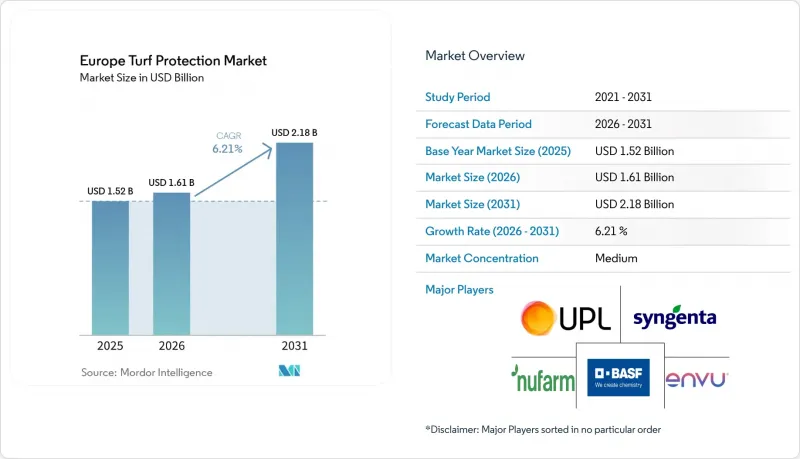
根據 Mordor Intelligence 預測,歐洲草坪保護市場規模將從 2025 年的 15.2 億美元和 2026 年的 16.1 億美元成長到 2031 年的 21.8 億美元,在 2026 年至 2031 年的預測期內,複合年成長率將達到 6.21%。
歐洲草坪保護市場的趨勢與洞察
專業運動和高爾夫基礎設施的擴建
歐洲各地對專業體育設施、高爾夫球場、練習場和多功能場館的投資正在推動對草坪保護產品的需求。新建和維修的運動場地在安裝期間以及整個使用壽命期間都需要徹底的維護,以控制病蟲害、雜草和草坪壓力。對高品質、耐用運動場地的日益重視也促使場館營運者實施系統的草坪保護和維護計畫。在專業管理的場館中,場地表面的一致性、可玩性和快速恢復至關重要,因此對可靠的保護產品及其配套技術支援的需求預計將會增加。因此,除了產品解決方案外,能夠提供全面草坪管理方案的供應商將能夠從歐洲對體育和高爾夫基礎設施的持續投資中獲益。
氣候變遷導致疾病和害蟲威脅加劇
在歐洲草坪保護市場,人工草坪病害的威脅日益加劇。 2024年,英國國際高爾夫球場草坪管理員協會(BIGGA)確認,法國北部和德國的高爾夫球場出現了背斑病,此前未受影響的地區也出現了灰葉斑病。 2025年發表在《國際草坪學會研究期刊》上的一項研究在德國某球場採集的樣本中發現了克拉里迪氏菌屬(Clariledia),證實了該病害在歐洲的廣泛存在。在北歐高爾夫球場,葉斑病爆發期。多種病害的重疊使得擁有廣泛病害控制產品的供應商受益,促使他們採用產品類別輪調作為抗病策略。因此,歐洲草坪保護市場對及時診斷、預防方案和治療指南的需求日益成長。
撤銷活性成分登記並限制農藥使用
根據歐盟第1107/2009號法規,活性成分的註銷導致草坪管理人員可用的活性成分數量減少。由於草坪的商業性銷售量遠低於主要田間作物,因此維持草坪專用註冊較為困難。即使是獲得歐盟批准的產品,也必須滿足各個成員國的批准要求。各地區的法規在核准時間、資料要求、允許用途和公共採購標準方面可能存在差異。即使產品已獲得有效的國家註冊,地方政府採購負責人仍可能要求其採用無農藥或環保方案。這種市場進入的分散性會推高產品准入成本,並延緩新產品進入整個歐洲草坪保護市場。
細分市場分析
到2025年,殺菌劑將佔歐洲草坪保護市場31.8%的佔有率,反映出它們在球場、體育設施和景觀設施的病害控制中發揮核心作用。在病害管理方案中,殺菌劑對於維持草坪表面品質、保障使用者安全和維持草坪外觀至關重要。除草劑在商業景觀和草坪農場中繼續發揮重要作用,因為雜草會影響草坪的外觀和潔淨度。當草坪害蟲損害根系或草坪表面時,則需要使用殺蟲劑。植物生長調節劑有助於控制修剪、維持草坪密度,並維持高爾夫球場穩定的比賽環境。
預計2026年至2031年間,生物促效劑和生物肥料的複合年成長率將達9.4%。這些產品能夠有效補充殺菌劑的使用,改善土壤壓實度、土壤狀況,增強植物在乾旱和重度踐踏下的反應能力,並幫助草坪抵禦逆境。監管壓力也促使管理者將環保產品納入其養護方案。歐洲草坪保護市場並非簡單地從一種產品類型轉向另一種。相反,草坪管理者正在建構多層次的養護方案,將土壤健康和逆境管理要素融入其中,同時兼顧病害控制。殺菌劑、生技藥品和植物生長調節劑的供應商更有能力滿足這些綜合採購需求。
2025年,園林綠化產業佔歐洲草坪保護市場佔有率的34.5%。此類別涵蓋商業、住宅和市政物業的綠地維護。與預算不規律的維修項目相比,長期合約能更好地預測需求。高爾夫球場是高價值應用領域,因為每個果嶺、發球檯、球道和長草區都需要獨特的保護方案。草坪農場的作用相對較小,主要為體育設施、高爾夫球場和園林綠化項目供應草坪。由於需要健康成熟的草坪,他們往往是高效保護產品的早期採用者。這些應用領域支撐著歐洲整體草坪保護市場的持續需求。
預計2026年至2031年間,運動場地產業將以6.8%的複合年成長率成長。體育場館維修、新建訓練設施以及日益嚴格的場地品質標準是推動這一成長的主要因素。專業運動場地性能要求的不斷提高意味著病蟲害和雜草造成的場地損傷越來越難以容忍,因此對可靠的病蟲害控制和快速草坪恢復的需求也日益成長。因此,這些場地的營運方往往更注重產品性能的穩定性和應用效果,這可能會降低他們對專業場地維護產品價格的敏感度。此外,當場館管理人員在採購產品的同時要求提供應用指導時,供應商也將從中受益,從而強化技術支援在運動場地採購中的作用。
其他好處:
- Excel格式的市場預測(ME)表
- 3個月的分析師支持
目錄
第1章:引言
- 研究假設和市場定義
- 調查範圍
第2章:調查方法
第3章執行摘要
第4章 市場狀況
- 市場概覽
- 市場促進因素
- 職業運動和高爾夫基礎設施的發展
- 氣候變遷導致病蟲害威脅加劇
- 對優質商業和住宅物業的需求
- 實施綜合草坪管理和生物解決方案
- 精準灌溉和基於感測器的草坪監測
- 歐盟監管合規支出正在加速低殘留產品的創新。
- 市場限制因素
- 撤銷活性成分登記並限制農藥使用
- 特種草坪產品的高額報名費用和研發成本
- 生技藥品在寒冷潮濕環境下保存期限短。
- 核准要求因國家而異,採購要求也因地方政府而異。
- 監理情勢
- 技術展望
- 波特五力分析
第5章 市場規模與成長預測
- 依產品類型
- 消毒劑
- 除草劑
- 殺蟲劑
- 植物生長調節劑
- 生物促效劑和生物肥料
- 透過使用
- 景觀設計
- 高爾夫球場
- 運動場
- 草皮農場
- 最終用戶
- 住宅用戶
- 商業景觀設計師
- 體育設施所有者
- 地方政府和學校
- 透過作用機制
- 化學品
- 生物
- 整合解決方案
- 配方
- 顆粒狀
- 濃縮液
- 可濕性粉
- 按地區
- 歐洲
- 德國
- 英國
- 法國
- 義大利
- 西班牙
- 荷蘭
- 波蘭
- 俄羅斯
- 其他歐洲國家
- 歐洲
第6章 競爭情勢
- 市場集中度
- 策略趨勢
- 市佔率分析
- 公司簡介
- Syngenta AG
- BASF SE
- UPL Limited
- Nufarm Limited
- Corteva, Inc.
- AMVAC Chemical Corporation(American Vanguard Corporation)
- Sumitomo Chemical Co., Ltd.
- ICL Group Ltd.
- Envu GmbH
- Koppert Biological Systems BV
- The Andersons, Inc.
第7章 市場機會與未來展望
According to Mordor Intelligence, the Europe turf protection market is projected to grow from USD 1.52 billion in 2025 and USD 1.61 billion in 2026 to USD 2.18 billion by 2031, registering a CAGR of 6.21% during the forecast period 2026 and 2031.
Europe Turf Protection Market Trends and Insights
Growth in Professional Sports and Golf Infrastructure
Investment in professional sports facilities, golf courses, training grounds, and multipurpose venues across Europe is supporting demand for turf protection products. New and renovated playing surfaces require intensive maintenance during establishment and throughout their operating life to manage disease, weeds, pests, and turf stress. The increasing emphasis on high-quality, durable playing surfaces also encourages venue operators to adopt structured turf-protection and maintenance programs. As professionally managed facilities place greater importance on surface consistency, playability, and rapid recovery, demand for reliable protection products and accompanying technical support is anticipated to increase. Suppliers that can provide integrated turf-management programs alongside product solutions are therefore well positioned to benefit from continued investment in European sports and golf infrastructure.
Rising Disease and Pest Pressure Under Climate Volatility
Disease pressure is increasing across managed turf in the European turf protection market. In 2024, the British and International Golf Greenkeepers Association (BIGGA) documented dollar spot on golf courses in northern France and Germany, while grey leaf spot was confirmed at sites where it had not previously caused damage . A 2025 study in the International Turfgrass Society Research Journal identified Clarireedia species in samples from courses in Germany, providing evidence of the disease's wider presence across Europe. Courses in northern Europe must also manage Microdochium patch during cold, wet periods, which extend the effective disease season. This overlap favors suppliers with broad disease-control portfolios and supports the rotation of product classes to manage resistance. As a result, the Europe turf protection market shows stronger demand for timely diagnosis, preventive programs, and treatment guidance.
Active-Ingredient Withdrawals and Pesticide-Use Restrictions
Withdrawals under Regulation (EC) No. 1107/2009 are reducing the number of active ingredients available to turf managers. Specialty turf registrations are difficult to support because their commercial volumes are smaller than those of major arable crops. A product authorized at the European Union level must also meet country-specific approval conditions in individual member states. Local rules can differ in approval timing, data requirements, permitted uses, and public procurement standards. Municipal buyers may require pesticide-free or low-impact programs even when a product holds a valid national registration. This fragmented access pattern raises launch costs and may delay the availability of new products across the Europe turf protection market.
Other drivers and restraints analyzed in the detailed report include:
- Demand for High-Quality Commercial and Residential Landscapes
- Adoption of Integrated Turf Management and Biological Solutions
- High Registration and R&D Costs for Specialty Turf Products
For complete list of drivers and restraints, kindly check the Table Of Contents.
Segment Analysis
Fungicides accounted for 31.8% of the Europe turf protection market in 2025, reflecting their central role in disease control across golf, sports, and landscape sites. Disease management programs rely on fungicides to maintain surface quality, player safety, and visual condition. Herbicides remain important for commercial landscaping and sod farms, as weeds affect appearance and grass purity. Insecticides are used where turf pests damage root systems or playing surfaces. Plant growth regulators support mowing management, canopy density, and consistent playing conditions at golf courses.
Biostimulants and bio-fertilizers are forecast to grow at a 9.4% CAGR between 2026 and 2031. These products support soil condition and plant response under compaction, drought, and heavy traffic, and can complement fungicide programs by helping turf tolerate stress. Regulatory pressure is also encouraging managers to include lower-impact products in treatment plans. The Europe turf protection market is not shifting from one product category to another in a simple sequence. Instead, turf managers are building layered programs that maintain disease control while incorporating soil health and stress management inputs. Suppliers offering fungicides, biological products, and plant growth regulators are better positioned to meet these integrated purchasing requirements.
Landscaping accounted for 34.5% of the Europe turf protection market share in 2025. This category includes commercial, residential, and municipal green-space maintenance. Long-term contracts make demand more predictable compared to sites with irregular renovation budgets. Golf courses represent a high-value application, as greens, tees, fairways, and roughs each require distinct protection programs. Sod farms play a smaller role but supply grass to sports venues, golf courses, and landscaping projects. Their need for healthy establishment turf makes them early adopters of effective protection products. These applications support recurring demand across the Europe turf protection market.
The sports fields segment is forecast to expand at a CAGR of 6.8% between 2026 and 2031. Stadium upgrades, new training facilities, and increasingly stringent surface-quality standards are supporting this growth. Higher performance requirements for professional sports pitches make surface damage from disease and weeds less acceptable, increasing the need for reliable disease control and rapid turf recovery. Operators at these facilities, therefore, tend to prioritize consistent product performance and application outcomes, which can reduce price sensitivity for products used in professionally managed pitch programs. Suppliers also benefit when venue managers seek application guidance alongside products, strengthening the role of technical support in sports-field procurement.
Complete Report Scope:
- By Product Type
- Fungicides
- Herbicides
- Insecticides
- Plant Growth Regulators
- Biostimulants and Bio-fertilizers
- By Application
- Landscaping
- Golf Courses
- Sports Fields
- Sod Farms
- By End-user
- Residential Customers
- Commercial Landscape Contractors
- Sports Facility Owners
- Municipalities and Schools
- By Mode of Action
- Chemical
- Biological
- Integrated Solutions
- By Formulation
- Granular
- Liquid Concentrates
- Wettable Powder
- By Geography
- Europe
- Germany
- United Kingdom
- France
- Italy
- Spain
- Netherlands
- Poland
- Russia
- Rest of Europe
- Europe
List of Companies Covered in this Report:
- Syngenta AG
- BASF SE
- UPL Limited
- Nufarm Limited
- Corteva, Inc.
- AMVAC Chemical Corporation (American Vanguard Corporation)
- Sumitomo Chemical Co., Ltd.
- ICL Group Ltd.
- Envu GmbH
- Koppert Biological Systems B.V.
- The Andersons, Inc.
Additional Benefits:
- The market estimate (ME) sheet in Excel format
- 3 months of analyst support
TABLE OF CONTENTS
1 INTRODUCTION
- 1.1 Study Assumptions and Market Definition
- 1.2 Scope of the Study
2 RESEARCH METHODOLOGY
3 EXECUTIVE SUMMARY
4 MARKET LANDSCAPE
- 4.1 Market Overview
- 4.2 Market Drivers
- 4.2.1 Growth in professional sports and golf infrastructure
- 4.2.2 Rising disease and pest pressure under climate volatility
- 4.2.3 Demand for high-quality commercial and residential landscapes
- 4.2.4 Adoption of integrated turf management and biological solutions
- 4.2.5 Precision irrigation and sensor-based turf monitoring
- 4.2.6 EU compliance spending accelerating low-residue product innovation
- 4.3 Market Restraints
- 4.3.1 Active-ingredient withdrawals and pesticide-use restrictions
- 4.3.2 High registration and r&d costs for specialty turf products
- 4.3.3 Short efficacy windows of biologicals in cold, wet conditions
- 4.3.4 Fragmented national approval and municipal procurement requirements
- 4.4 Regulatory Landscape
- 4.5 Technological Outlook
- 4.6 Porter's Five Forces Analysis
- 4.6.1 Intensity of Competitive Rivalry
- 4.6.2 Supplier Bargaining Power
- 4.6.3 Buyer Bargaining Power
- 4.6.4 Threat of New Entrants
- 4.6.5 Threat of Substitutes
5 MARKET SIZE AND GROWTH FORECASTS (VALUE)
- 5.1 By Product Type
- 5.1.1 Fungicides
- 5.1.2 Herbicides
- 5.1.3 Insecticides
- 5.1.4 Plant Growth Regulators
- 5.1.5 Biostimulants and Bio-fertilizers
- 5.2 By Application
- 5.2.1 Landscaping
- 5.2.2 Golf Courses
- 5.2.3 Sports Fields
- 5.2.4 Sod Farms
- 5.3 By End-user
- 5.3.1 Residential Customers
- 5.3.2 Commercial Landscape Contractors
- 5.3.3 Sports Facility Owners
- 5.3.4 Municipalities and Schools
- 5.4 By Mode of Action
- 5.4.1 Chemical
- 5.4.2 Biological
- 5.4.3 Integrated Solutions
- 5.5 By Formulation
- 5.5.1 Granular
- 5.5.2 Liquid Concentrates
- 5.5.3 Wettable Powder
- 5.6 By Geography
- 5.6.1 Europe
- 5.6.1.1 Germany
- 5.6.1.2 United Kingdom
- 5.6.1.3 France
- 5.6.1.4 Italy
- 5.6.1.5 Spain
- 5.6.1.6 Netherlands
- 5.6.1.7 Poland
- 5.6.1.8 Russia
- 5.6.1.9 Rest of Europe
- 5.6.1 Europe
6 COMPETITIVE LANDSCAPE
- 6.1 Market Concentration
- 6.2 Strategic Moves
- 6.3 Market Share Analysis
- 6.4 Company Profiles (Includes Global Level Overview, Market Level Overview, Core Segments, Financials as Available, Strategic Information, Market Rank/Share, Products and Services, Recent Developments)
- 6.4.1 Syngenta AG
- 6.4.2 BASF SE
- 6.4.3 UPL Limited
- 6.4.4 Nufarm Limited
- 6.4.5 Corteva, Inc.
- 6.4.6 AMVAC Chemical Corporation (American Vanguard Corporation)
- 6.4.7 Sumitomo Chemical Co., Ltd.
- 6.4.8 ICL Group Ltd.
- 6.4.9 Envu GmbH
- 6.4.10 Koppert Biological Systems B.V.
- 6.4.11 The Andersons, Inc.
7 MARKET OPPORTUNITIES AND FUTURE OUTLOOK

 全球草坪保護市場
 全球草坪保護市場規模、佔有率、趨勢和成長分析報告(2026-2034年)
 草坪保護:市場佔有率分析、產業趨勢與統計、成長預測(2026-2031)草坪保護市場規模、佔有率、成長、全球產業分析、區域趨勢及2026年至2034年預測。
 草坪保護市場-2026-2032年全球市場預測
 2026年全球草坪保護市場報告草坪保護市場-2026-2031年預測
 草坪保護市場-全球產業規模、佔有率、趨勢、機會及預測,依應用領域(園林綠化、高爾夫、運動、草皮種植)、地區及競爭格局分類,2020-2030年預測
 到 2030 年草坪保護市場預測:按產品類型、解決方案類型、應用模式、應用、最終用戶和地區進行的全球分析