


 |
市場調查報告書
商品編碼
2123487
草坪保護:市場佔有率分析、產業趨勢與統計、成長預測(2026-2031)Turf Protection - Market Share Analysis, Industry Trends & Statistics, Growth Forecasts (2026 - 2031) |
||||||

※ 本網頁內容可能與最新版本有所差異。詳細情況請與我們聯繫。
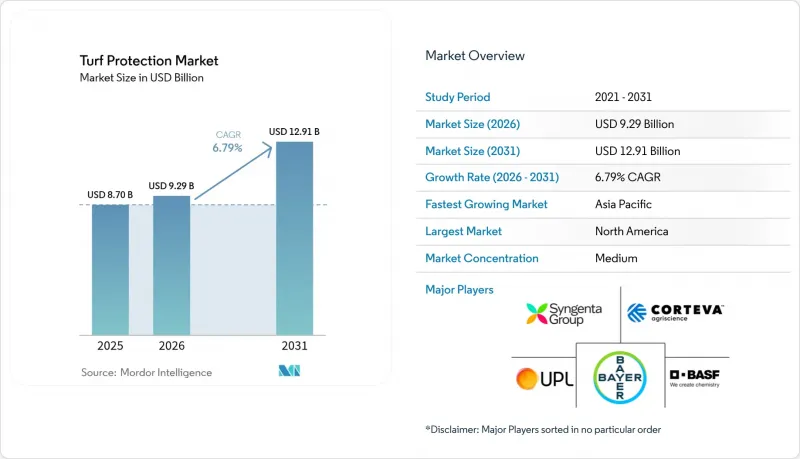
據 Mordor Intelligence 稱,2025 年草坪保護市場價值 87 億美元,預計到 2031 年將從 2026 年的 92.9 億美元成長至 129.1 億美元,預測期(2026-2031 年)複合年成長率為 6.79%。
本報告按產品類型(殺菌劑、除草劑等)、應用領域(園林綠化、高爾夫球場、運動場等)、最終用戶(住宅等)、作用機制(化學、生物、綜合解決方案)、劑型(顆粒劑等)和地區(北美、歐洲、亞太等)進行分類。本報告以美元計價提供預測數據。
全球草坪保護市場趨勢及洞察
高爾夫球場和專業運動設施建設增加
疫情之後,用於新建場館的資金投入激增,尤其是在印度、中國和海灣國家,這催生了對兼具耐用性和自然運動性能的混合草坪系統的穩定需求。隨著職業聯賽正式製定場地品質評估標準,場館業主現在會指定使用經過更嚴格安全測試的殺菌劑、植物生長調節劑和抗逆產品。場館建成後,需要在整個賽季進行病蟲害防治,這為供應商提供了持續的收入來源。此外,開發商傾向於採用包含種子、營養液和數位化監控的一體化方案,這為草坪保護市場創造了交叉銷售機會。
草坪病害發生率增加
冬季氣溫升高和持續高濕度加劇了草坪白斑症和褐斑病的發生,促使球場管理者採用動態輪作方案,即時應對病原體威脅,而非依賴固定的施肥時間表。研究表明,與中等施肥的草坪相比,高氮濃度處理的高羊茅草坪褐斑病發生率高出40%,凸顯了均衡營養管理策略的重要性。先進的診斷試劑盒和人工智慧模型目前能夠以97%的準確率檢測出白斑病,從而實現早期干預和最佳化殺菌劑的使用。這一趨勢正推動草坪保護產業朝著預測分析方向發展,以保護有益的土壤微生物並進行針對特定地點的防治。
人工草皮解決方案的迅速普及
人工草皮草坪因其無需定期修剪和使用殺蟲劑,正吸引那些面臨人力和水資源短缺的學校和市政當局。目前,美國每年約有1200至1500個人造草坪計畫。然而,歐洲每年估計值1.6萬噸微塑膠排放,並伴隨全氟烷基和多氟烷基物質(PFAS)污染的報道,這促使人們重新審視相關政策,而這些政策可能會阻礙人工草皮的普及,並重新提倡使用天然草坪的替代品。草坪保護供應商正透過推出混合技術和開展公共關係宣傳活動來應對這一趨勢,這些活動旨在強調天然草坪系統的健康和永續性優勢。
細分市場分析
到2025年,殺菌劑將佔據草坪保護市場37.50%的銷售佔有率,成為最大的銷售主力,這反映出背斑病、褐斑病和腐霉枯萎病等病害持續存在的威脅。對於旨在維持錦標賽級草坪的球場而言,結合SDHI、QoI和DMI類殺菌劑的複雜輪作方案仍然至關重要。然而,生物促效劑的年複合成長率高達10.81%,凸顯了市場正向永續材料轉變,已被證實具有增強抗逆性和促進根系健康的作用。除草劑在總需求中佔很大佔有率,因為管理者需要應對一年生早熟禾和闊葉雜草,而植物生長調節劑因其能夠降低割草機燃油和人事費用而日益受到歡迎。
由於勞動力短缺日益嚴重以及永續性目標的不斷提高,草坪保護植物生長調節劑的市場規模預計將會擴大。鐵基替代品和微生物製劑正在與傳統殺菌劑形成互補,在控制背斑病方面具有相當的功效,同時降低了環境風險。結合生物來源和合成產品的複合製劑的出現,透過提高吸收率和持久性,為球場管理人員提供了更多選擇。
由於住宅和商業房地產在美觀方面的持續支出,園林綠化產業預計在2025年將繼續佔總整體需求的42.10%。產品組合將專注於廣譜除草劑、緩釋肥料和用於打造統一外觀的著色劑。相較之下,運動場地以9.36%的複合年成長率領先成長,因為俱樂部和大學都將運動員安全和場地表面均勻性放在首位。美國國家橄欖球聯盟(NFL)推動的場地檢查標準化已經促使採購規範轉向高性能殺菌劑和混合補播草種。
雖然高爾夫球場草坪保護市場佔據相當大的佔有率,但與體育場館相比,其成長已趨於平緩,因為許多成熟的球場正從資本擴張轉向維修。草坪農場雖然屬於小眾領域,但透過供應無病蟲害且需要徹底病蟲害防治的草坪,對市場施加影響。
區域分析
北美擁有超過15,000個高爾夫球場和世界最大的專業體育場之一,預計到2025年將佔全球整體收入的34.70%。美國約佔該地區需求的90%,並受益於物聯網土壤探測和人工智慧驅動的噴灑調度工具的早期應用。在加拿大,生長季節較短,病害爆發集中在夏季高峰期,促使人們採用高品質的殺菌劑防治方案。在墨西哥度假區,人們正增加對耐鹽草坪品種和適合沿海土壤的施肥方案的投資。
亞太地區預計將以8.32%的複合年成長率成為全球成長最快的地區。中國科研機構正在擴充其耐逆性草坪遺傳資源庫,而球場營運商仍需要進口許多優質品種。印度都市區的高爾夫和板球基礎設施建設推動了對能夠應對季風快速變化的殺菌劑和生長調節劑組合的強勁需求。在日本成熟的高爾夫產業中,為了實現政府的永續性目標,正轉向精準灌溉和生物來源材料。澳洲球場管理者面臨嚴格的用水配額限制,他們越來越依賴潤濕劑和耐旱組合藥物來維持球場的正常運作。
歐洲仍然是一個由技術和監管主導的市場。歐盟委員會推動農藥的永續使用和微塑膠禁令,正在促進生物防治方案和可生物分解載體的應用。德國和英國在實施感測器網路以精確控制殺菌劑施用時間方面處於領先地位。法國的土地管理團隊迅速採用生物促效劑進行種子處理,以符合該國的農藥減量目標,顯示政策如何影響採購選擇。
其他好處:
- Excel格式的市場預測(ME)表
- 3個月的分析師支持
目錄
第1章:引言
- 研究假設和市場定義
- 調查範圍
第2章:調查方法
第3章執行摘要
第4章 市場狀況
- 市場概覽
- 市場促進因素
- 高爾夫球場和專業體育設施的建設正在增加。
- 草坪疾病發生率增加
- 擁有美麗草坪的住宅需求日益成長
- 向生物來源殺菌劑和生物促效劑的轉移
- 引入利用感測器進行精準草坪管理。
- 緩解氣候變遷引起的熱應激的措施
- 市場限制因素
- 人工草皮解決方案的迅速普及
- 新化學技術的研發成本很高
- 對傳統殺菌劑的監管壓力
- 人們擔心草坪上使用的材料會造成微塑膠和奈米塑膠污染。
- 技術展望
- 監理情勢
- 波特五力分析
第5章 市場規模與成長預測
- 依產品類型
- 消毒劑
- 除草劑
- 殺蟲劑
- 植物生長調節劑
- 生物促效劑和生物肥料
- 透過使用
- 景觀設計
- 高爾夫球場
- 體育設施
- 草皮農場
- 最終用戶
- 住宅用戶
- 商業景觀設計師
- 體育設施所有者
- 地方政府和學校
- 透過作用機制
- 化學品
- 生物
- 整合解決方案
- 配方
- 顆粒狀
- 濃縮液
- 可濕性粉
- 按地區
- 北美洲
- 美國
- 加拿大
- 墨西哥
- 北美及其他地區
- 南美洲
- 巴西
- 阿根廷
- 其他南美國家
- 歐洲
- 德國
- 英國
- 法國
- 義大利
- 西班牙
- 俄羅斯
- 其他歐洲國家
- 亞太地區
- 中國
- 印度
- 日本
- 澳洲
- 韓國
- 其他亞太國家
- 中東
- 沙烏地阿拉伯
- 阿拉伯聯合大公國
- 其他中東國家
- 非洲
- 南非
- 埃及
- 其他非洲國家
- 北美洲
第6章 競爭情勢
- 市場集中度
- 策略趨勢
- 市佔率分析
- 公司簡介
- Syngenta Group
- Bayer AG
- BASF SE
- UPL Limited
- Nufarm Limited
- AMVAC Chemical Corporation
- Sumitomo Group
- Bioceres LLC(Morrone Bio Innovations)
- ICL Group
- FMC Corporation
- Corteva Agriscience
- SePRO Corporation
- Gowan Company, LLC
- Koch Agronomic Services, LLC
- LebanonTurf(Lebanon Seaboard Corporation)
第7章 市場機會與未來展望
According to Mordor Intelligence, the turf protection market size was valued at USD 8.7 billion in 2025 and estimated to grow from USD 9.29 billion in 2026 to reach USD 12.91 billion by 2031, at a CAGR of 6.79% during the forecast period (2026-2031).
This report is Segmented by Product Type (Fungicides, Herbicides, and More), Application (Landscaping, Golf Courses, Sports Fields, and More), by End-User (Residential Customers, and More), by Mode of Action (Chemical, Biological, and Integrated Solution), by Formulation (Granular, and More) and Geography (North America, Europe, Asia-Pacific, and More). The Report Offers Forecasts in Terms of Value (USD).
Global Turf Protection Market Trends and Insights
Rising construction of golf courses and professional sports venues
Capital allocations for new facilities surged after the pandemic, particularly across India, China, and Gulf states, creating steady pull-through demand for hybrid turf systems that balance durability with natural playability. Professional leagues have formalized surface-quality metrics, prompting venue owners to specify fungicides, plant growth regulators, and stress-mitigation products that pass stricter safety tests. Once built, each venue requires season-long disease control, anchoring recurring revenue for suppliers. Developers also lean on integrated packages that bundle seed, nutrition, and digital monitoring, opening cross-selling opportunities in the turf protection market.
Increasing incidence of turfgrass diseases
Milder winters and prolonged humidity are intensifying outbreaks of dollar spot and brown patch, prompting superintendents to adopt dynamic rotation programs that respond to real-time pathogen pressure instead of calendar schedules. Research shows tall fescue plots receiving high nitrogen suffer 40% higher brown patch severity than moderately fertilized turf, underscoring the need for balanced nutrition strategies. Advanced diagnostic kits and AI models now detect dollar spot with 97% accuracy, enabling earlier interventions and optimized fungicide loads. The trend is pushing the turf protection industry toward predictive analytics and site-specific treatments that preserve beneficial soil organisms.
Rapid penetration of artificial turf solutions
Synthetic fields eliminate routine mowing and pesticide spending, enticing school boards and municipalities wrestling with labor and water constraints. Installations in the United States now run between 1,200 and 1,500 per year. Nonetheless, PFAS contamination findings and microplastic-shed estimates of 16,000 tons annually in Europe have triggered policy reviews that could stall conversions and breathe life into natural alternatives. Turf protection vendors are responding with hybrid technology and communication campaigns highlighting the health and sustainability benefits of natural systems.
Other drivers and restraints analyzed in the detailed report include:
- Growing residential demand for aesthetic lawns
- Shift toward biological fungicides and biostimulants
- Regulatory pressure on conventional fungicides
For complete list of drivers and restraints, kindly check the Table Of Contents.
Segment Analysis
Fungicides generated the largest slice of turf protection market revenue with a 37.50% share in 2025, reflecting the continual threat of dollar spot, brown patch, and Pythium. Sophisticated rotation plans mixing SDHI, QoI, and DMI chemistry remain indispensable for courses aiming to maintain tournament-grade surfaces. However, biostimulants, posting an 10.81% CAGR, highlight the market's pivot toward sustainable inputs backed by proven stress tolerance and root health gains. Herbicides hold a prominent share in total demand as managers tackle annual bluegrass and broadleaf weeds, while plant growth regulators find traction by trimming mower fuel and labor costs.
The turf protection market size for plant growth regulators is poised to expand in tandem with heightened labor constraints and sustainability targets. Iron-based alternatives and microbial cocktails now supplement conventional fungicides, demonstrating equivalent dollar spot suppression with lower environmental risk. Biologicals and synthetics are spawning co-formulations that enhance uptake and persistence, broadening choice for superintendents.
Landscaping maintained 42.10% of overall demand in 2025, supported by steady residential and commercial spending on curb appeal. Product mixes focus on broad-spectrum weed control, slow-release nutrition, and colorants that deliver a uniform appearance. In contrast, sports fields are leading the growth table with a 9.36% CAGR, as franchises and universities prioritize athlete safety and surface consistency. The NFL's push for standardized field testing is already shaping purchasing specifications toward high-performance fungicide programs and hybrid overseeding blends.
The turf protection market size dedicated to golf courses holds a significant share, but growth plateaus relative to sports arenas, as many mature courses transition from capital expansion to a renovation mode. Sod farms, while niche, exert influence through their role in supplying disease-free sod that demands intensive pest control.
Complete Report Scope:
- By Product Type
- Fungicides
- Herbicides
- Insecticides
- Plant Growth Regulators
- Biostimulants and Bio-fertilizers
- By Application
- Landscaping
- Golf Courses
- Sports Fields
- Sod Farms
- By End-user
- Residential Customers
- Commercial Landscape Contractors
- Sports Facility Owners
- Municipalities and Schools
- By Mode of Action
- Chemical
- Biological
- Integrated Solutions
- By Formulation
- Granular
- Liquid Concentrate
- Wettable Powder
- By Geography
- North America
- United States
- Canada
- Mexico
- Rest of the North America
- South America
- Brazil
- Argentina
- Rest of South America
- Europe
- Germany
- United Kingdom
- France
- Italy
- Spain
- Russia
- Rest of Europe
- Asia-Pacific
- China
- India
- Japan
- Australia
- South Korea
- Rest of Asia-Pacific
- Middle East
- Saudi Arabia
- United Arab Emirates
- Rest of Middle East
- Africa
- South Africa
- Egypt
- Rest of Africa
- North America
Geography Analysis
North America retained 34.70% of global revenue in 2025, anchored by more than 15,000 golf courses and one of the world's largest portfolios of professional stadiums. The United States represents roughly 90% of regional demand and benefits from the early adoption of IoT soil probes and AI spray scheduling tools. Canada's shorter growing window concentrates disease outbreaks into intense summer peaks, encouraging premium fungicide programs. Mexico's resort corridors channel investment into salt-tolerant turf cultivars and fertility programs that thrive in coastal soils.
Asia-Pacific is projected to clock an 8.32% CAGR, the fastest worldwide. China's research institutes are expanding germplasm collections for stress-resistant turf, but course operators still import many premium cultivars. India's urban golf and cricket infrastructure underpins robust demand for fungicide and growth-regulator packages capable of withstanding monsoon swings. Japan's mature golf scene is pivoting toward precision irrigation and biological inputs to meet government sustainability targets. Australian course managers face stringent water quotas, increasing reliance on wetting agents and drought-resilient blends to safeguard playing quality.
Europe remains a technology- and regulation-driven arena. The European Commission's push for sustainable pesticide use and microplastic bans incentivizes biological programs and biodegradable carriers. Germany and the United Kingdom spearhead the uptake of connected-sensor networks that fine-tune fungicide timing. France's grounds crews are early adopters of biostimulant seed treatments to comply with national pesticide-reduction objectives, showcasing how policy influences procurement choices.
- Syngenta Group
- Bayer AG
- BASF SE
- UPL Limited
- Nufarm Limited
- AMVAC Chemical Corporation
- Sumitomo Group
- Bioceres LLC (Morrone Bio Innovations)
- ICL Group
- FMC Corporation
- Corteva Agriscience
- SePRO Corporation
- Gowan Company, L.L.C.
- Koch Agronomic Services, LLC
- LebanonTurf (Lebanon Seaboard Corporation)
Additional Benefits:
- The market estimate (ME) sheet in Excel format
- 3 months of analyst support
TABLE OF CONTENTS
1 Introduction
- 1.1 Study Assumptions and Market Definition
- 1.2 Scope of the Study
2 Research Methodology
3 Executive Summary
4 Market Landscape
- 4.1 Market Overview
- 4.2 Market Drivers
- 4.2.1 Rising construction of golf courses and professional sports venues
- 4.2.2 Increasing incidence of turfgrass diseases
- 4.2.3 Growing residential demand for aesthetic lawns
- 4.2.4 Shift toward biological fungicides and biostimulants
- 4.2.5 Adoption of sensor-based precision turf management
- 4.2.6 Climate-change-induced heat-stress mitigation solutions
- 4.3 Market Restraints
- 4.3.1 Rapid penetration of artificial turf solutions
- 4.3.2 High Research and Development cost for novel chemistries
- 4.3.3 Regulatory pressure on conventional fungicides
- 4.3.4 Micro- and nanoplastic pollution concerns from turf inputs
- 4.4 Technological Outlook
- 4.5 Regulatory Landscape
- 4.6 Porter's Five Forces Analysis
- 4.6.1 Threat of New Entrants
- 4.6.2 Bargaining Power of Buyers
- 4.6.3 Bargaining Power of Suppliers
- 4.6.4 Threat of Substitutes
- 4.6.5 Intensity of Competitive Rivalry
5 Market Size and Growth Forecasts (Value)
- 5.1 By Product Type
- 5.1.1 Fungicides
- 5.1.2 Herbicides
- 5.1.3 Insecticides
- 5.1.4 Plant Growth Regulators
- 5.1.5 Biostimulants and Bio-fertilizers
- 5.2 By Application
- 5.2.1 Landscaping
- 5.2.2 Golf Courses
- 5.2.3 Sports Fields
- 5.2.4 Sod Farms
- 5.3 By End-user
- 5.3.1 Residential Customers
- 5.3.2 Commercial Landscape Contractors
- 5.3.3 Sports Facility Owners
- 5.3.4 Municipalities and Schools
- 5.4 By Mode of Action
- 5.4.1 Chemical
- 5.4.2 Biological
- 5.4.3 Integrated Solutions
- 5.5 By Formulation
- 5.5.1 Granular
- 5.5.2 Liquid Concentrate
- 5.5.3 Wettable Powder
- 5.6 By Geography
- 5.6.1 North America
- 5.6.1.1 United States
- 5.6.1.2 Canada
- 5.6.1.3 Mexico
- 5.6.1.4 Rest of the North America
- 5.6.2 South America
- 5.6.2.1 Brazil
- 5.6.2.2 Argentina
- 5.6.2.3 Rest of South America
- 5.6.3 Europe
- 5.6.3.1 Germany
- 5.6.3.2 United Kingdom
- 5.6.3.3 France
- 5.6.3.4 Italy
- 5.6.3.5 Spain
- 5.6.3.6 Russia
- 5.6.3.7 Rest of Europe
- 5.6.4 Asia-Pacific
- 5.6.4.1 China
- 5.6.4.2 India
- 5.6.4.3 Japan
- 5.6.4.4 Australia
- 5.6.4.5 South Korea
- 5.6.4.6 Rest of Asia-Pacific
- 5.6.5 Middle East
- 5.6.5.1 Saudi Arabia
- 5.6.5.2 United Arab Emirates
- 5.6.5.3 Rest of Middle East
- 5.6.6 Africa
- 5.6.6.1 South Africa
- 5.6.6.2 Egypt
- 5.6.6.3 Rest of Africa
- 5.6.1 North America
6 Competitive Landscape
- 6.1 Market Concentration
- 6.2 Strategic Moves
- 6.3 Market Share Analysis
- 6.4 Company Profiles (includes Global level Overview, Market level overview, Core Segments, Financials as available, Strategic Information, Market Rank/Share, Products and Services, Recent Developments)
- 6.4.1 Syngenta Group
- 6.4.2 Bayer AG
- 6.4.3 BASF SE
- 6.4.4 UPL Limited
- 6.4.5 Nufarm Limited
- 6.4.6 AMVAC Chemical Corporation
- 6.4.7 Sumitomo Group
- 6.4.8 Bioceres LLC (Morrone Bio Innovations)
- 6.4.9 ICL Group
- 6.4.10 FMC Corporation
- 6.4.11 Corteva Agriscience
- 6.4.12 SePRO Corporation
- 6.4.13 Gowan Company, L.L.C.
- 6.4.14 Koch Agronomic Services, LLC
- 6.4.15 LebanonTurf (Lebanon Seaboard Corporation)


