


 |
市場調查報告書
商品編碼
2155671
玻璃纖維地板材料:市場佔有率分析、產業趨勢與統計、成長預測(2026-2031)Fiberglass Flooring - Market Share Analysis, Industry Trends & Statistics, Growth Forecasts (2026 - 2031) |
||||||

※ 本網頁內容可能與最新版本有所差異。詳細情況請與我們聯繫。
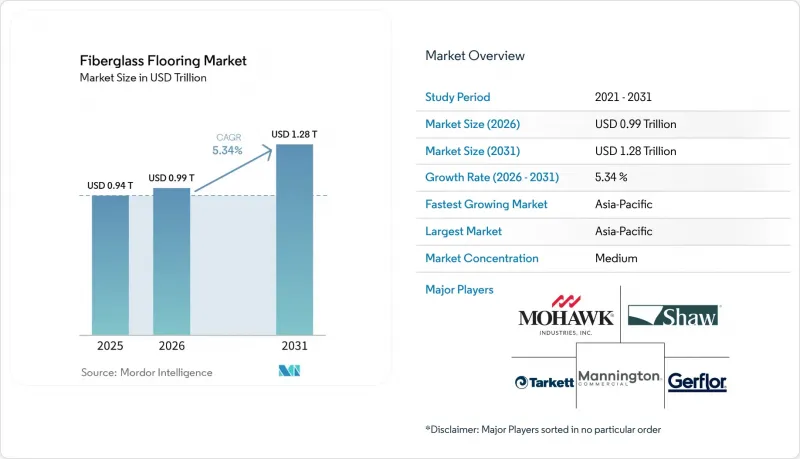
根據 Mordor Intelligence 預測,玻璃纖維地板材料市場規模預計在 2025 年達到 9.4 億美元,2026 年達到 9.9 億美元,到 2031 年達到 12.8 億美元,2026 年至 2031 年的複合年成長率為 5.34%。
全球玻璃纖維地板材料市場趨勢與洞察
對具有優異防水性和尺寸穩定性的地板材料的需求。
玻璃纖維地板材料市場的發展動力源自於商業領域對即使在正常溫度波動下也能保持穩定性的地板材料的需求。玻璃纖維增強材料能夠最大限度地減少翹曲、邊緣翹起和明顯的底層不平整,從而避免設施運作中期間地板材料過早更換。醫療保健、餐飲服務和教育行業的負責人越來越要求確保即使在商業設施的暖通空調(HVAC)環境下,地板的尺寸穩定性也能得到保證。數位印刷技術的進步正在縮小彈性地板材料和瓷磚在商業室內空間的視覺差異。因此,採購決策越來越重視尺寸效能和維護要求,以及外觀。 2026年2月,Interface公司發表了Noravant,聚氯乙烯(PVC)的彈性地板材料平台,使用壽命長達35年。這一發展反映了商業設施對低揮發性有機化合物(VOC)和尺寸穩定性強的彈性地板材料的需求。
商業設施改造和公共設施建設的擴展。
在價格敏感的採購環境下,玻璃纖維背襯地板市場面臨初始成本的挑戰。玻璃纖維背襯的高級乙烯基瓷磚(LVT)和乙烯基捲材產品的價格可能比傳統的瓷磚或無特定厚度的乙烯基產品高出20%至40%。亞太、中東和非洲以及南美洲等新興市場的買家往往優先考慮年度資本預算,而非節省多年的維護成本。這一趨勢導致已開發國家商業項目和新興市場低成本項目在採購模式上有明顯差異。隨著2020年至2022年間資本投資的恢復,維修計畫正在支撐玻璃纖維地板材料市場。醫療機構、公立學校和政府大樓持續解決累積的地板材料更換需求。在印度,2025年1月工業生產指數成長了5.0%,顯示製造業活動強勁,支撐了下游對商業和工業地板材料的需求。
玻璃纖維、聚氯乙烯、樹脂和塑化劑的成本波動
玻璃纖維地板材料市場持續受到玻璃纖維、PVC樹脂、塑化劑和能源價格波動的影響。 PVC樹脂佔玻璃纖維背襯PVC地板材料總投入成本的45-50%,而石化產品價格的波動直接影響成品的利潤率。 2025年,歐洲製造商面臨能源成本上漲、需求疲軟、進口競爭、運轉率下降等問題,這些因素將影響區域供應狀況。 2025年9月,受關稅壓力影響,中國玻璃纖維製造商將紗線直接價格提高了5-10%。此外,《化學品註冊、評估、授權和限制法規》(REACH)迫使歐洲製造商轉向使用不含鄰苯二甲酸酯塑化劑的產品,但這些產品的成本比傳統替代品高出15-30%。與現貨採購相比,整合供應鏈和簽訂長期原料採購合約可以降低投入成本波動帶來的風險。
細分市場分析
2025年,豪華乙烯基瓷磚(LVT)的銷售額佔比達到46.32%。這一地位反映了其在包括醫療機構、零售商店和企業室內裝修在內的廣泛領域的應用,其尺寸穩定性、豐富的款式選擇和低維護成本支撐了其高附加價值。乙烯基複合磁磚(VCT)預計在2026年至2031年間將以6.07%的複合年成長率成長,是所有產品類型中成長率最高的。 VCT將繼續應用於公立學校、政府辦公大樓和地方政府醫療機構等對初始資本預算要求較高的場所,這些場所對材料選擇有嚴格的要求。 VCT的快速成長並不意味著高價值項目中LVT的趨勢將會逆轉。相反,這反映了VCT在預算有限的機構中的作用,以及其在新興市場(LVT價格高於市場閾值)的普及應用。
在醫院走廊、機場候機廳、食品加工廠和無塵室等場所,乙烯基薄膜在無縫施工中繼續發揮至關重要的作用。在這些環境中,出於衛生和安全考慮,無縫表面是必需的,而瓷磚無法完全複製這一點。材料研發持續致力於解決多層玻璃纖維地板材料在使用後所面臨的挑戰。一項2025年的專利申請描述了一種用玻璃纖維織物增強的多層PVC覆層,旨在實現PVC的完全回收利用。到2028年,歐洲公共採購中可回收的玻璃纖維背襯乙烯基薄膜的供應,可能會使玻璃纖維地板材料市場在競標中獲得競爭優勢。這項發展將有助於解決玻璃纖維地板材料市場中某些環保採購決策所面臨的限制,尤其是在除了性能規格之外,還需要循環經濟相關文件的情況下。硬芯石塑複合材料(SPC)產品正在對LVT(豪華乙烯基瓷磚)類別構成一定的競爭壓力,但其不斷增加的厚度可能會使現有地板的翻新變得複雜。由於這些限制,軟性玻璃纖維氈背襯LVT在商業設施維修專案中仍扮演著重要角色。
區域分析
預計到2025年,亞太地區將佔全球玻璃纖維地板材料市場佔有率的44.83%,並在2031年之前以6.19%的複合年成長率成長。中國仍然是該地區最大的貢獻者,商業室內裝修和基礎設施投資持續推動地板材料規格的發展。印度的「總理住房計畫城市2.0」(Pradan Mantri Awas Yojana Urban 2.0)計畫已獲得2024-2025會計年度22億盧比(約263億美元)的建設計畫經濟適用住宅、學校和社區醫療設施。預計到2025年1月,印度的工業生產也將成長5.0%,從而提振對商業和工業地板材料的需求。在日本,室內空氣品質法規正在推動對經認證的低揮發性地板材料的需求,LX Hausys和NOX Corporation等製造商正向日本國內和東協地區的商業項目供應產品。
除亞太地區外,北美和歐洲是最大的收入來源,但需求推動要素有所不同。在北美,1990年代至21世紀初安裝在學校、政府大樓和社區醫療中心的乙烯基複合地板(VCT)的更換是主要需求促進因素。在更換項目中,玻璃纖維背襯的豪華乙烯基複合地板(LVT)的使用量不斷增加,這推高了現有商業房地產的平均售價。在歐洲,建築和維修需求的成長在2025年有所放緩。福爾波地板系統公司累計,2025年的銷售額為7.382億瑞士法郎(約8.24億美元)。在北歐國家和德國,對經證實低排放且具有環境產品聲明(EPD)的地板材料的需求持續存在,而由於REACH法規的實施,傳統含塑化劑產品的合規成本正在增加。
南美洲、中東和非洲在符合規範標準的玻璃纖維地板材料的應用方面仍處於起步階段。巴西在南美洲商業建築和酒店翻新市場佔據最大佔有率,儘管經濟波動減緩了阿根廷的維修步伐。然而,阿根廷的零售商店和醫療機構仍在繼續採用彈性地板材料規範。沙烏地阿拉伯的「2030願景」相關建設項目正在推動飯店、醫療機構和機場航站大樓的室內裝修需求。南非也透過酒店業和私人醫療機構的維修項目推動了需求。在這些地區,需求水準可能不足以支撐投資建造新的本地生產設施,因此玻璃纖維地板材料市場可以透過擴大分銷協議來滿足這些地區的需求。這種方式使現有供應商能夠透過現有分銷管道滿足區域專案需求,而無需在需求達到足夠規模之前就製造地。
其他好處:
- Excel格式的市場預測(ME)表
- 3個月的分析師支持
目錄
第1章:引言
- 研究假設和市場定義
- 調查範圍
第2章:調查方法
第3章執行摘要
第4章 市場狀況
- 市場概覽
- 市場促進因素
- 對具有優異防水性和尺寸穩定性的地板材料的需求。
- 商業設施改造和公共設施建設的擴展。
- 消費者對維護成本低、具有出色抗過敏性能的地板材料的需求日益成長。
- 高級玻璃纖維背襯乙烯基複合地板的成長
- 醫療、住宿和零售設施的維修
- 市場限制因素
- 玻璃纖維、聚氯乙烯、樹脂和塑化劑的成本波動
- 與傳統的地板材料或陶瓷地板材料相比,其初始成本較高。
- 多層地板廢棄後缺乏回收基礎設施。
- 價值鏈分析
- 波特五力分析
第5章 市場規模與成長預測
- 依產品類型
- 豪華乙烯基瓷磚
- 乙烯基複合地磚
- 塑膠薄膜
- 透過使用
- 住宅
- 商業的
- 產業
- 按地區
- 亞太地區
- 中國
- 印度
- 日本
- 韓國
- 東南亞國協
- 其他亞太國家
- 北美洲
- 美國
- 加拿大
- 墨西哥
- 歐洲
- 德國
- 英國
- 法國
- 義大利
- 北歐國家
- 其他歐洲國家
- 南美洲
- 巴西
- 阿根廷
- 其他南美國家
- 中東和非洲
- 沙烏地阿拉伯
- 南非
- 其他中東和非洲國家
- 亞太地區
第6章 競爭情勢
- 市場集中度
- 策略趨勢
- 市佔率和排名分析
- 公司簡介
- AWI Licensing, LLC
- Beaulieu International Group
- Congoleum
- Forbo Flooring Systems
- Gerflor
- Interface, Inc.
- IVC Group
- Karndean Designflooring
- LG Hausys
- Lico AG
- Mannington Commercial
- Milliken
- MOHAWK INDUSTRIES, INC.
- Novalis
- NOX Corporation
- Shaw Industries Group, Inc.
- Tarkett
第7章 市場機會與未來展望
According to Mordor Intelligence, the fiberglass flooring market size is projected to be USD 0.94 billion in 2025, USD 0.99 billion in 2026, and reach USD 1.28 billion by 2031, growing at a CAGR of 5.34% from 2026 to 2031.
Global Fiberglass Flooring Market Trends and Insights
Demand for Waterproof and Dimensionally Stable Flooring
The fiberglass flooring market is driven by commercial demand for flooring that remains stable under normal temperature fluctuations. Fiberglass reinforcement minimizes curling, edge lift, and visible subfloor irregularities, which can lead to early replacement in occupied facilities. Healthcare, foodservice, and education buyers increasingly require warranties that ensure dimensional stability under commercial heating, ventilation, and air conditioning (HVAC) conditions. Advancements in digital printing have reduced visual differences between resilient flooring and ceramic tile in commercial interiors. Consequently, procurement decisions increasingly prioritize dimensional performance and maintenance requirements over appearance alone. Interface introduced its polyvinyl chloride (PVC)-free Noravant resilient platform in February 2026, with a stated service life of up to 35 years. This development reflects demand for low-volatile organic compound (VOC), dimensionally stable, resilient flooring in commercial settings.
Expansion of Commercial Renovation and Institutional Construction
The fiberglass flooring market faces a first-cost barrier in price-sensitive procurement environments. Fiberglass-backed luxury vinyl tile (LVT) and vinyl sheet products may carry a 20-40% premium over conventional ceramic tile and ungauged vinyl. Buyers in emerging Asia-Pacific, the Middle East, Africa, and South America may prioritize annual capital budgets over multiyear maintenance savings. This dynamic creates distinct purchasing patterns between developed commercial projects and lower-cost projects in emerging markets. Renovation programs that resumed following delayed capital expenditure between 2020 and 2022 support the fiberglass flooring market. Healthcare systems, public schools, and government facilities continue to address accumulated flooring replacement requirements. India recorded 5.0% growth in its Index of Industrial Production in January 2025, indicating manufacturing activity that supports downstream demand for commercial and industrial flooring.
Volatility in Glass Fiber, PVC, Resin, and Plasticizer Costs
The fiberglass flooring market remains exposed to fluctuations in the prices of glass fiber, PVC resin, plasticizers, and energy. PVC resin represents 45-50% of the total input cost for fiberglass-backed vinyl flooring, directly linking petrochemical price movements to finished-product margins. In 2025, European producers faced higher energy costs, lower demand, competitive imports, and limited operating rates, affecting regional supply conditions. In September 2025, Chinese glass fiber manufacturers increased direct yarn prices by 5-10% in response to tariff-related pressures. In addition, Registration, Evaluation, Authorisation and Restriction of Chemicals (REACH) regulations prompted European producers to shift toward phthalate-free plasticizers, which cost 15-30% more than conventional alternatives. Integrated supply chains and long-term material procurement agreements can reduce exposure to input-cost fluctuations compared with spot purchasing.
Other drivers and restraints analyzed in the detailed report include:
- Low-Maintenance and Anti-Allergen Flooring Preference
- Growth of Fiberglass-Backed Luxury Vinyl Flooring
- Higher Initial Cost Compared with Conventional Vinyl and Ceramic Flooring
For complete list of drivers and restraints, kindly check the Table Of Contents.
Segment Analysis
Luxury vinyl tile (LVT) accounted for 46.32% of revenue in 2025. Its position reflects its use across healthcare, retail, and corporate interiors, where dimensional stability, design options, and lower maintenance requirements support a premium in value. Vinyl composite tile (VCT) is forecast to grow at a CAGR of 6.07% from 2026 to 2031, the fastest rate among product types. VCT remains used in public schools, government offices, and municipal healthcare facilities, where initial capital budgets drive material selection. Its faster growth does not reverse the shift toward LVT specifications in higher-value projects. Instead, it reflects VCT's role in budget-conscious institutions and its adoption in emerging markets where LVT exceeds purchasing thresholds.
Vinyl sheets remain relevant for seamless installations in hospital corridors, airport concourses, food-processing facilities, and clean rooms. These environments require joint-free surfaces for hygiene and safety reasons that tile formats cannot fully replicate. Material development continues to address end-of-life constraints associated with multilayer fiberglass flooring. A 2025 patent application described a multilayer PVC covering with woven fiberglass reinforcement designed to enable full recyclability of PVC. The fiberglass flooring market could gain a tender advantage if recyclable fiberglass-backed vinyl becomes commercially available in European public procurement before 2028. This development would address a concern that limits certain environmental procurement decisions in the fiberglass flooring market, particularly where circularity documentation is required alongside performance specifications. Rigid-core stone-plastic composite (SPC) products create some substitution pressure within the LVT category, but their added thickness can complicate renovations on existing floors. This limitation preserves a role for flexible glass-mat-backed LVT in commercial retrofit projects.
Complete Report Scope:
- By Product Type
- Luxury Vinyl Tiles
- Vinyl Composite Tiles
- Vinyl Sheets
- By Application
- Residential
- Commercial
- Industrial
- By Geography
- Asia-Pacific
- China
- India
- Japan
- South Korea
- ASEAN Countries
- Rest of Asia-Pacific
- North America
- United States
- Canada
- Mexico
- Europe
- Germany
- United Kingdom
- France
- Italy
- NORDIC Countries
- Rest of Europe
- South America
- Brazil
- Argentina
- Rest of South America
- Middle East and Africa
- Saudi Arabia
- South Africa
- Rest of Middle East and Africa
- Asia-Pacific
Geography Analysis
Asia-Pacific accounted for 44.83% of the fiberglass flooring market in 2025 and is projected to grow at a CAGR of 6.19% through 2031. China remains the region's largest contributor, as commercial fit-out activity and infrastructure investment continue to support flooring specifications. India's Pradhan Mantri Awas Yojana Urban 2.0 received an allocation of INR 2.2 lakh crore (USD 26.3 billion) for 2024-25, supporting a pipeline of affordable housing, schools, and community healthcare facilities. India also recorded 5.0% growth in industrial production in January 2025, supporting demand for commercial and industrial flooring. Japan's indoor air quality requirements support demand for certified low-emission flooring, while manufacturers such as LX Hausys and NOX Corporation supply domestic and ASEAN commercial projects.
North America and Europe represent the largest revenue-generating regions outside Asia-Pacific, although their demand drivers differ. In North America, demand is primarily driven by the replacement of Vinyl Composition Tile (VCT) installed in schools, government buildings, and community health centers during the 1990s and early 2000s. Replacement projects increasingly use fiberglass-backed Luxury Vinyl Tile (LVT), supporting higher average selling prices across the installed commercial base. Europe experienced slower construction and renovation demand in 2025. Forbo Flooring Systems generated CHF 738.2 million (USD 824 million) in sales in 2025. Nordic countries and Germany continue to demonstrate demand for documented low-emission flooring and Environmental Product Declarations, while REACH requirements increase compliance costs for conventional plasticizer formulations.
South America, the Middle East, and Africa remain early-stage regions for specification-grade fiberglass flooring. Brazil accounts for the largest share of South American commercial construction and hospitality renovations, while economic volatility in Argentina slows the pace of upgrades. However, retail and healthcare facilities in Argentina continue to use resilient flooring specifications. Saudi Arabia's Vision 2030-related construction programs support demand for hospitality, healthcare, and airport terminal fit-outs. South Africa also contributes demand through hospitality and private healthcare renovation projects. The fiberglass flooring market can serve these regions through expanded distribution agreements, as demand levels may not justify investments in new local manufacturing facilities. This approach enables established suppliers to meet regional project demand through existing channels without committing to a manufacturing footprint before demand reaches sufficient scale.
- AWI Licensing, LLC
- Beaulieu International Group
- Congoleum
- Forbo Flooring Systems
- Gerflor
- Interface, Inc.
- IVC Group
- Karndean Designflooring
- LG Hausys
- Lico AG
- Mannington Commercial
- Milliken
- MOHAWK INDUSTRIES, INC.
- Novalis
- NOX Corporation
- Shaw Industries Group, Inc.
- Tarkett
Additional Benefits:
- The market estimate (ME) sheet in Excel format
- 3 months of analyst support
TABLE OF CONTENTS
1 Introduction
- 1.1 Study Assumptions and Market Definition
- 1.2 Scope of the Study
2 Research Methodology
3 Executive Summary
4 Market Landscape
- 4.1 Market Overview
- 4.2 Market Drivers
- 4.2.1 Demand for Waterproof and Dimensionally Stable Flooring
- 4.2.2 Expansion of Commercial Renovation and Institutional Construction
- 4.2.3 Low-Maintenance and Anti-Allergen Flooring Preference
- 4.2.4 Growth of Fiberglass-Backed Luxury Vinyl Flooring
- 4.2.5 Retrofitting of Healthcare, Hospitality, and Retail Facilities
- 4.3 Market Restraints
- 4.3.1 Volatility in Glass Fiber, PVC, Resin, and Plasticizer Costs
- 4.3.2 Higher Initial Cost Compared With Conventional Vinyl and Ceramic Flooring
- 4.3.3 Limited End-of-Life Recycling Infrastructure for Multilayer Flooring
- 4.4 Value Chain Analysis
- 4.5 Porter's Five Forces Analysis
- 4.5.1 Bargaining Power of Suppliers
- 4.5.2 Bargaining Power of Buyers
- 4.5.3 Threat of New Entrants
- 4.5.4 Threat of Substitutes
- 4.5.5 Competitive Rivalry
5 Market Size and Growth Forecasts (Value)
- 5.1 By Product Type
- 5.1.1 Luxury Vinyl Tiles
- 5.1.2 Vinyl Composite Tiles
- 5.1.3 Vinyl Sheets
- 5.2 By Application
- 5.2.1 Residential
- 5.2.2 Commercial
- 5.2.3 Industrial
- 5.3 By Geography
- 5.3.1 Asia-Pacific
- 5.3.1.1 China
- 5.3.1.2 India
- 5.3.1.3 Japan
- 5.3.1.4 South Korea
- 5.3.1.5 ASEAN Countries
- 5.3.1.6 Rest of Asia-Pacific
- 5.3.2 North America
- 5.3.2.1 United States
- 5.3.2.2 Canada
- 5.3.2.3 Mexico
- 5.3.3 Europe
- 5.3.3.1 Germany
- 5.3.3.2 United Kingdom
- 5.3.3.3 France
- 5.3.3.4 Italy
- 5.3.3.5 NORDIC Countries
- 5.3.3.6 Rest of Europe
- 5.3.4 South America
- 5.3.4.1 Brazil
- 5.3.4.2 Argentina
- 5.3.4.3 Rest of South America
- 5.3.5 Middle East and Africa
- 5.3.5.1 Saudi Arabia
- 5.3.5.2 South Africa
- 5.3.5.3 Rest of Middle East and Africa
- 5.3.1 Asia-Pacific
6 Competitive Landscape
- 6.1 Market Concentration
- 6.2 Strategic Moves
- 6.3 Market Share (%)/Ranking Analysis
- 6.4 Company Profiles (includes Global Overview, Market Overview, Core Segments, Financials as available, Strategic Information, Products and Services, and Recent Developments)
- 6.4.1 AWI Licensing, LLC
- 6.4.2 Beaulieu International Group
- 6.4.3 Congoleum
- 6.4.4 Forbo Flooring Systems
- 6.4.5 Gerflor
- 6.4.6 Interface, Inc.
- 6.4.7 IVC Group
- 6.4.8 Karndean Designflooring
- 6.4.9 LG Hausys
- 6.4.10 Lico AG
- 6.4.11 Mannington Commercial
- 6.4.12 Milliken
- 6.4.13 MOHAWK INDUSTRIES, INC.
- 6.4.14 Novalis
- 6.4.15 NOX Corporation
- 6.4.16 Shaw Industries Group, Inc.
- 6.4.17 Tarkett
7 Market Opportunities and Future Outlook
- 7.1 White-Space and Unmet-Need Assessment

 防水乙烯基瓷磚地板材料市場:全球市場預測,2026-2032年地毯安裝服務市場:全球市場預測,2026-2032年高性能抗靜電塗料產品市場:全球市場預測(2026-2032)
 住宅防靜電地板材料解決方案市場預測至2034年-全球分析(按地板材料產品類型、防靜電性能、安裝方法、住宅應用、分銷管道和地區分類)防滑玻璃地板市場:全球市場預測(2026-2032年)導電地板材料市場:全球市場預測,2026-2032年貨櫃木地板市場:全球市場預測,2026-2032年
 實木地板:市場佔有率分析、產業趨勢與統計、成長預測(2026-2031)
 網球場維護服務市場分析及預測(至2035年):依類型、產品、服務、技術、應用、材料類型、製程、最終用戶、設備及解決方案分類
 混凝土地板材料市場規模、佔有率、成長、全球產業分析、區域趨勢及2026-2034年預測。