


 |
市場調查報告書
商品編碼
2116093
實木地板:市場佔有率分析、產業趨勢與統計、成長預測(2026-2031)Hardwood Flooring - Market Share Analysis, Industry Trends & Statistics, Growth Forecasts (2026 - 2031) |
||||||

※ 本網頁內容可能與最新版本有所差異。詳細情況請與我們聯繫。
根據 Mordor Intelligence 預測,硬木地板市場規模將從 2025 年的 523.8 億美元成長到 2026 年的 554.6 億美元,到 2031 年將達到 737.9 億美元,2026 年至 2031 年的複合年成長率為 5.88%。
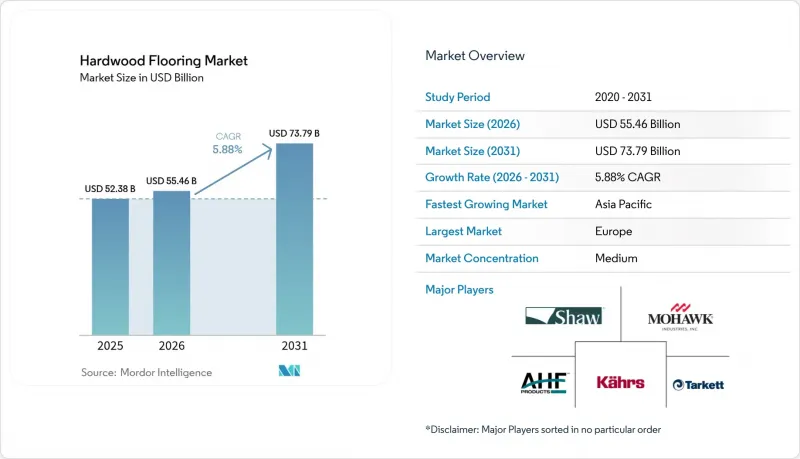
本報告按產品類型(實木、複合板)、最終用戶類型(住宅、商業)、分銷管道(線下門市、網路商店)和地區(北美、南美、歐洲、亞太、中東和非洲)進行細分。市場預測以美元計價。
全球實木地板市場趨勢及洞察
已開發國家住宅裝修支出激增
不斷上漲的房屋抵押貸款成本促使家庭選擇翻新而非搬遷,從而推動了北美和歐洲對實木地板的穩定需求。市場調查顯示,地板翻新工程不僅能帶來較高的房屋轉售價值,還能實際提升生活品質,即使在宏觀經濟不確定性加劇的情況下,優質實木地板仍是人們青睞的投資選擇。這一趨勢透過刺激對老舊住宅存量的需求,而非依賴波動不定的新建房屋供應,從而緩解了收入週期性波動。製造商正利用地板材料更換週期,將設計服務和延長保固捆綁銷售,以提高利潤率。零售商也受益於可預測的客流量和更高的平均交易額,因為消費者傾向於優先改善生活空間而非購買偏好。因此,儘管經濟情勢不斷變化,但翻新預算仍保持強勁,從而蘊含著成長動力。
工程木材ClickLock技術的擴展
獨特的壓鉚機制,例如 Uniclic 和 Valinge 5G 的折疊式型材,實現了浮動安裝,安裝時間最多可縮短 60%,從而擴大了實木地板市場,吸引了眾多 DIY 愛好者和小規模商業設施的規範負責人。防潮芯材減少了翹曲問題,使工程木地板適用於以往通常鋪設乙烯基地板材料的廚房和地下室。鎖扣系統的專利保護賦予了技術擁有者定價權和授權收入來源,同時也刺激了整個產業的研發,以實現更薄、更穩定的結構。這種效率降低了整體專案成本,使工程實木地板成為一種切實可行的升級選擇,即使預算有限,原本可能只能選擇彈性地板材料。因此,卡扣技術的創新正在推動具有全球影響力的長期結構需求。
與乙烯基和複合地板等替代品相比,初始成本較高。
高階乙烯基瓷磚以其媲美實木地板的外觀和觸感,同時將材料和人事費用降低到原先的幾分之一,正在蠶食入門級市場對實木地板的需求。地板材料價格的上漲進一步擴大了這一差距,並加劇了消費者對價格的敏感度。易於DIY的彈性地板無需打磨或塗飾,可進一步降低30-50%的安裝人事費用。商業設施的設計者在權衡預算和耐用性時,意識到實木地板在後台區域和潮濕環境中的投資報酬率有限。製造商正透過強調可翻新、耐用性和使用壽命結束後的可回收性等價值提案來應對這一挑戰,但在價格主導的競標中,實現成本平等仍然十分困難。
細分市場分析
預計到2025年,複合地板將佔據實木地板市場71.98%的佔有率,並在2031年之前保持6.05%的複合年成長率,展現其在規模和發展勢頭上的主導地位。這一主導地位歸功於其多層芯材結構,該結構能夠有效抑制季節性翹曲,並可實現工廠預塗飾,從而減少返工需求,提高安裝效率。預計到2031年,複合地板在實木地板市場將實現顯著成長,其在住宅翻新和大規模商業項目中的重要性將日益凸顯。
實木地板在歷史建築修復和豪華訂製住宅中仍然扮演著重要角色,其經久耐用,可承受多次拋光,使用壽命可達百年以上。紅橡木和白橡木因其紋理均勻且產地豐富,價格不菲;而楓木則因其硬度,在運動地板領域佔據了一席之地。然而,可擴展的產品創新正逐漸轉向複合地板。 Valinge 的「Woodura」表面緻密化技術透過打造更薄的耐磨層,將抗凹陷性能提升三倍,並最佳化了原料利用率。製造商們也透過在芯層中添加再生木纖維,在不影響穩定性的前提下,提高了地板的永續性。這些進步鞏固了複合地板在硬木地板市場中的技術領先地位。
區域分析
2025年,歐洲仍將佔據硬木地板市場33.05%的佔有率。這得歸功於嚴格的生態標章標準以及以維修為主的龐大建築存量。淺色調的工程橡木地板,尤其是採用天然油飾面的款式,深受北歐設計偏好的青睞,這一趨勢也正在向德國和荷蘭市場蔓延。隨著歐盟木材法規(EUDR)合規期限的臨近,國內鋸木廠正積極爭取產銷監管鏈認證,以增強區域供應的穩定性。法國的「MaPrimeRenov」補貼計畫正在推動住宅翻新,同時,由於與2024年巴黎奧運遺產項目相關的商業設施維修,對酒店業和綜合用途開發項目的需求也在成長。
亞太地區以7.48%的複合年成長率呈現最快成長勢頭,每年新增公寓面積達數百萬平方英尺。在中國沿海省份,為滿足消費者對高階住宅的需求,室內裝修預算不斷增加;二線城市則推出地方補貼,鼓勵使用低甲醛地板材料。印度的「總理住房計畫」(Pradhan Mantri Awas Yojana)和雅加達的「交通導向開發」(TOD)等項目均包含綠色建築條款,推動了複合板的普及。各地區的鋸木廠都在整合窯乾設備和UV光刻生產線,以滿足受反傾銷稅約束的出口市場需求,並提升亞洲地區的附加價值。
在北美,受房屋翻新支出的推動,市場需求依然成熟且規模龐大。儘管木材關稅和植物檢疫檢驗偶爾會導致供應波動,但由於FSC認證的阿巴拉契亞橡木儲量豐富,國內生產商的原料成本保持穩定。美國建築商擴大指定使用熱處理木材建造露台和三季房,同時也銷售室內膠合板以確保設計風格的一致性。加拿大建築商則利用有利的外匯從歐洲鋸木廠採購木材,以實現供應來源多元化。儘管北美的成長速度落後於亞洲,但穩定的重建需求仍使北美成為跨國公司收入來源的核心組成部分。
其他好處
- Excel格式的市場預測(ME)表
- 3個月的分析師支持
目錄
第1章:引言
- 研究假設和市場定義
- 調查範圍
第2章:調查方法
第3章執行摘要
第4章 市場狀況
- 市場概覽
- 市場促進因素
- 已開發國家住宅裝修支出激增
- 複合板。
- 人們對親生物室內設計美學的日益青睞
- 亞洲新興國家住宅增加
- 熱處理硬木地板的商業性化普及
- 擴大在循環經濟項目中使用回收和再生硬木。
- 市場限制因素
- 與乙烯基或複合地板等替代品相比,其初始成本較高。
- 加強永續發展和森林砍伐的監管
- 植物檢疫部門進行的進口檢查導致供應鏈中斷。
- 生物黏合劑樹脂的價格波動
- 價值供應鏈分析
- 監理情勢
- 技術展望
- 波特五力分析
第5章 市場規模與成長預測
- 依產品類型
- 實木
- 紅橡樹
- 白橡木
- 楓
- 其他實木
- 複合板
- 實木
- 按最終用戶類型
- 住宅
- 商業
- 透過分銷管道
- 實體門市
- 網路商店
- 按地區
- 北美洲
- 加拿大
- 美國
- 墨西哥
- 南美洲
- 巴西
- 秘魯
- 智利
- 阿根廷
- 其他南美國家
- 歐洲
- 英國
- 德國
- 法國
- 西班牙
- 義大利
- 比荷盧經濟聯盟(比利時、荷蘭、盧森堡)
- 北歐國家(丹麥、芬蘭、冰島、挪威、瑞典)
- 其他歐洲國家
- 亞太地區
- 印度
- 中國
- 日本
- 澳洲
- 韓國
- 東南亞(新加坡、馬來西亞、泰國、印尼、越南、菲律賓)
- 其他亞太國家
- 中東和非洲
- 阿拉伯聯合大公國
- 沙烏地阿拉伯
- 南非
- 奈及利亞
- 其他中東和非洲國家
- 北美洲
第6章 競爭情勢
- 市場集中度
- 策略趨勢
- 市佔率分析
- 公司簡介
- Armstrong Flooring
- Mohawk Industries
- Shaw Industries Group
- AHF Products(Bruce Hardwood)
- Tarkett SA
- Mannington Mills
- Somerset Hardwood Flooring
- Kahrs Group
- Bauwerk Group
- Boral Timber
- Haro(Hamberger Flooring)
- Swiss Krono Group
- Quick-Step(Unilin)
- Balterio
- Mirage(Boa-Franc)
- Dinesen
- Floor & Decor Holdings
- LL Flooring(Lumber Liquidators)
- Greenply Industries
- Nature Home Holding
第7章 市場機會與未來展望
According to Mordor Intelligence, the hardwood flooring market size is expected to grow from USD 52.38 billion in 2025 to USD 55.46 billion in 2026 and is forecast to reach USD 73.79 billion by 2031 at 5.88% CAGR over 2026-2031.
This report is Segmented by Product Type (Solid Wood, Engineered Wood), End-User Type (Residential, Commercial), Distribution Channel (Offline Stores, Online Stores), and Geography (North America, South America, Europe, Asia-Pacific, Middle East, and Africa). The Market Forecasts are Provided in Terms of Value (USD).
Global Hardwood Flooring Market Trends and Insights
Surging Home-Renovation Spending in Developed Economies
Elevated mortgage costs encourage households to remodel rather than relocate, fueling steady hardwood flooring upgrades in North America and Europe. Market research shows flooring projects deliver high resale value and tangible lifestyle benefits, making premium hardwood a favored investment even during macro uncertainty. The trend smooths revenue cyclicality by trying to increase demand for an aging housing stock rather than to volatile newly built pipelines. Manufacturers leverage the replacement cycle by bundling design services and extended-warranty packages that lift margins. Retailers benefit from predictable traffic and higher ticket values as consumers prioritize living-space enhancements over discretionary goods. Growth momentum is therefore embedded in renovation budgets that remain resilient despite shifting economic sentiment.
Expansion of Engineered-Wood Click-Lock Technologies
Proprietary locking mechanisms such as Uniclic and Valinge 5G fold-down profiles enable floating installations that cut labor time by up to 60%, expanding the hardwood flooring market among DIY enthusiasts and light-commercial specifiers. Moisture-resistant cores mitigate cupping concerns, allowing kitchens and basements to adopt engineered planks historically reserved for vinyl. Patent protection around locking systems creates pricing power and licensing revenue streams for technology owners, while driving industry-wide R&D is aimed at slimmer, more dimensionally stable constructions. This efficiency gains lower total project costs, making engineered hardwood a feasible upgrade path when budgets might otherwise tilt to resilient flooring. As a result, click-lock innovation acts as a structural demand driver with long-tail global relevance.
High Upfront Cost Versus Vinyl & Laminate Alternatives
Luxury vinyl tile replicates wood visuals at a fraction of the material and labor costs, siphoning entry-level demand away from hardwood. Inflation-driven lumber price spikes widen the gap, amplifying consumer price sensitivity. DIY-friendly resilient planks require no sanding or finishing, saving an additional 30-50% on installation labor. Commercial specifiers balancing budget and durability perceive limited ROI in hardwood for back-of-house or moisture-exposed zones. Manufacturers counter by amplifying value propositions around refinishing longevity and end-of-life recyclability yet cost parity remains elusive in price-driven bids.
Other drivers and restraints analyzed in the detailed report include:
- Growing Preference for Biophilic Interior Aesthetics
- Rising Residential Construction in Emerging Asia
- Stricter Sustainability & Deforestation Regulations
For complete list of drivers and restraints, kindly check the Table Of Contents.
Segment Analysis
Engineered planks captured 71.98% of the hardwood flooring market share in 2025 and are forecast to maintain a 6.05% CAGR to 2031, underscoring their dominance in both scale and momentum. This leadership stems from multilayer cores that curb seasonal movement and accept factory-applied finishes, translating into lower call-backs and higher installer productivity. Engineered wood in the hardwood flooring market is anticipated to witness significant growth by 2031, highlighting its importance in both residential renovations and expansive commercial projects.
Solid wood maintains relevance among heritage restorations and premium custom homes, where the capability to sand multiple times supports century-long lifespans. Red and white oak species command pricing premiums due to grain uniformity and domestic availability, while maple earns niche demand in sports flooring for its hardness. Yet, scalable product innovation skews toward engineered formats: Valinge's Woodura surface densification triples dent resistance and unlocks thinner wear layers that optimize raw-material yield. Producers also integrate recycled wood fibers into core layers, elevating sustainability credentials without compromising stability. These advances consolidate engineered wood's status as the hardwood flooring market's technology bellwether.
Complete Report Scope:
- By Product Type
- Solid Wood
- Red Oak
- White Oak
- Maple
- Other Solid Woods
- Engineered Wood
- Solid Wood
- By End-User Type
- Residential
- Commercial
- By Distribution Channel (Value)
- Offline Stores
- Online Stores
- By Geography
- North America
- Canada
- United States
- Mexico
- South America
- Brazil
- Peru
- Chile
- Argentina
- Rest of South America
- Europe
- United Kingdom
- Germany
- France
- Spain
- Italy
- BENELUX (Belgium, Netherlands, Luxembourg)
- NORDICS (Denmark, Finland, Iceland, Norway, Sweden)
- Rest of Europe
- Asia-Pacific
- India
- China
- Japan
- Australia
- South Korea
- South East Asia (Singapore, Malaysia, Thailand, Indonesia, Vietnam, Philippines)
- Rest of Asia-Pacific
- Middle East And Africa
- United Arab Emirates
- Saudi Arabia
- South Africa
- Nigeria
- Rest of Middle East And Africa
- North America
Geography Analysis
Europe retained a 33.05% share of the hardwood flooring market in 2025, underpinned by stringent eco-labeling norms and a renovation-oriented building stock. Nordic design preferences favor light-tone engineered oak finished with natural oils, a look that permeates German and Dutch markets. The pending EUDR compliance deadline incentivizes domestic mills to secure chain-of-custody certifications, reinforcing regional supply security. France's MaPrimeRenov' subsidy boosts residential retrofits, while commercial upgrades linked to the Paris 2024 legacy program elevate demand in hospitality and mixed-use venues.
Asia-Pacific registers the fastest momentum with a 7.48% CAGR, adding millions of square feet of new apartments annually. China's coastal provinces allocate higher finish budgets in response to up-market consumer shifts, while tier-two cities introduce local subsidies that reward low-formaldehyde flooring. India's Pradhan Mantri Awas Yojana projects and Jakarta's TOD schemes include green-building clauses that lift engineered-wood inclusion rates. Regional sawmills integrate kiln-drying and UV finishing lines to serve export markets facing anti-dumping duties, bolstering intra-Asia value addition.
North America sustains a mature, yet sizeable demand base anchored by renovation spending. Lumber tariffs and phytosanitary checks create periodic supply volatility, yet abundant FSC-certified Appalachian oak stabilizes input costs for domestic producers. U.S. builders increasingly specify thermally modified species for decking and three-season rooms, cross-selling indoor planks for design continuity. Canadian installers capitalize on favorable currency dynamics when sourcing from European mills, diversifying supply. While growth lags Asia, stable replacement demand ensures North America remains core to multinationals' revenue mix.
- Armstrong Flooring
- Mohawk Industries
- Shaw Industries Group
- AHF Products (Bruce Hardwood)
- Tarkett S.A.
- Mannington Mills
- Somerset Hardwood Flooring
- Kahrs Group
- Bauwerk Group
- Boral Timber
- Haro (Hamberger Flooring)
- Swiss Krono Group
- Quick-Step (Unilin)
- Balterio
- Mirage (Boa-Franc)
- Dinesen
- Floor & Decor Holdings
- LL Flooring (Lumber Liquidators)
- Greenply Industries
- Nature Home Holding
Additional Benefits:
- The market estimate (ME) sheet in Excel format
- 3 months of analyst support
TABLE OF CONTENTS
1 Introduction
- 1.1 Study Assumptions & Market Definition
- 1.2 Scope of the Study
2 Research Methodology
3 Executive Summary
4 Market Landscape
- 4.1 Market Overview
- 4.2 Market Drivers
- 4.2.1 Surging home-renovation spending in developed economies
- 4.2.2 Expansion of engineered-wood click-lock technologies
- 4.2.3 Growing preference for biophilic interior aesthetics
- 4.2.4 Rising residential construction in emerging Asia
- 4.2.5 Commercial adoption of thermally-modified hardwood floors
- 4.2.6 Uptake of reclaimed & recycled hardwood within circular-economy projects
- 4.3 Market Restraints
- 4.3.1 High upfront cost versus vinyl & laminate alternatives
- 4.3.2 Stricter sustainability & deforestation regulations
- 4.3.3 Supply-chain disruptions from phytosanitary import checks
- 4.3.4 Volatility in bio-based adhesive resin pricing
- 4.4 Value / Supply-Chain Analysis
- 4.5 Regulatory Landscape
- 4.6 Technological Outlook
- 4.7 Porter's Five Forces Analysis
- 4.7.1 Threat of New Entrants
- 4.7.2 Bargaining Power of Suppliers
- 4.7.3 Bargaining Power of Buyers
- 4.7.4 Threat of Substitutes
- 4.7.5 Competitive Rivalry
5 Market Size & Growth Forecasts
- 5.1 By Product Type
- 5.1.1 Solid Wood
- 5.1.1.1 Red Oak
- 5.1.1.2 White Oak
- 5.1.1.3 Maple
- 5.1.1.4 Other Solid Woods
- 5.1.2 Engineered Wood
- 5.1.1 Solid Wood
- 5.2 By End-User Type
- 5.2.1 Residential
- 5.2.2 Commercial
- 5.3 By Distribution Channel (Value)
- 5.3.1 Offline Stores
- 5.3.2 Online Stores
- 5.4 By Geography
- 5.4.1 North America
- 5.4.1.1 Canada
- 5.4.1.2 United States
- 5.4.1.3 Mexico
- 5.4.2 South America
- 5.4.2.1 Brazil
- 5.4.2.2 Peru
- 5.4.2.3 Chile
- 5.4.2.4 Argentina
- 5.4.2.5 Rest of South America
- 5.4.3 Europe
- 5.4.3.1 United Kingdom
- 5.4.3.2 Germany
- 5.4.3.3 France
- 5.4.3.4 Spain
- 5.4.3.5 Italy
- 5.4.3.6 BENELUX (Belgium, Netherlands, Luxembourg)
- 5.4.3.7 NORDICS (Denmark, Finland, Iceland, Norway, Sweden)
- 5.4.3.8 Rest of Europe
- 5.4.4 Asia-Pacific
- 5.4.4.1 India
- 5.4.4.2 China
- 5.4.4.3 Japan
- 5.4.4.4 Australia
- 5.4.4.5 South Korea
- 5.4.4.6 South East Asia (Singapore, Malaysia, Thailand, Indonesia, Vietnam, Philippines)
- 5.4.4.7 Rest of Asia-Pacific
- 5.4.5 Middle East And Africa
- 5.4.5.1 United Arab Emirates
- 5.4.5.2 Saudi Arabia
- 5.4.5.3 South Africa
- 5.4.5.4 Nigeria
- 5.4.5.5 Rest of Middle East And Africa
- 5.4.1 North America
6 Competitive Landscape
- 6.1 Market Concentration
- 6.2 Strategic Moves
- 6.3 Market Share Analysis
- 6.4 Company Profiles (includes Global level Overview, Market level overview, Core Segments, Financials as available, Strategic Information, Market Rank/Share for key companies, Products & Services, and Recent Developments)
- 6.4.1 Armstrong Flooring
- 6.4.2 Mohawk Industries
- 6.4.3 Shaw Industries Group
- 6.4.4 AHF Products (Bruce Hardwood)
- 6.4.5 Tarkett S.A.
- 6.4.6 Mannington Mills
- 6.4.7 Somerset Hardwood Flooring
- 6.4.8 Kahrs Group
- 6.4.9 Bauwerk Group
- 6.4.10 Boral Timber
- 6.4.11 Haro (Hamberger Flooring)
- 6.4.12 Swiss Krono Group
- 6.4.13 Quick-Step (Unilin)
- 6.4.14 Balterio
- 6.4.15 Mirage (Boa-Franc)
- 6.4.16 Dinesen
- 6.4.17 Floor & Decor Holdings
- 6.4.18 LL Flooring (Lumber Liquidators)
- 6.4.19 Greenply Industries
- 6.4.20 Nature Home Holding
7 Market Opportunities & Future Outlook
- 7.1 Carbon-neutral, FSC-certified hardwood product lines
- 7.2 AI-enabled customization & virtual design tools for consumers

 防滑玻璃地板市場:全球市場預測(2026-2032年)導電地板材料市場:全球市場預測,2026-2032年貨櫃木地板市場:全球市場預測,2026-2032年
 網球場維護服務市場分析及預測(至2035年):依類型、產品、服務、技術、應用、材料類型、製程、最終用戶、設備及解決方案分類
 混凝土地板材料市場規模、佔有率、成長、全球產業分析、區域趨勢及2026-2034年預測。陶瓷地板材料市場-2026-2032年全球市場預測
 美國地板市場規模、佔有率和趨勢分析報告:按產品、顏色、紋理、圖案、最終用途、分銷管道、板材寬度、板材厚度和細分市場預測(2026-2035 年)
 實木地板市場報告:按應用、原料和地區分類(2026-2034 年)
 2026年全球全鋁防靜電地板市場報告2026年全球工業混凝土共振器市場報告