


 |
市場調查報告書
商品編碼
2155638
散貨運輸:市場佔有率分析、產業趨勢與統計、成長預測(2026-2031)Bulk Cargo Shipping - Market Share Analysis, Industry Trends & Statistics, Growth Forecasts (2026 - 2031) |
||||||

※ 本網頁內容可能與最新版本有所差異。詳細情況請與我們聯繫。
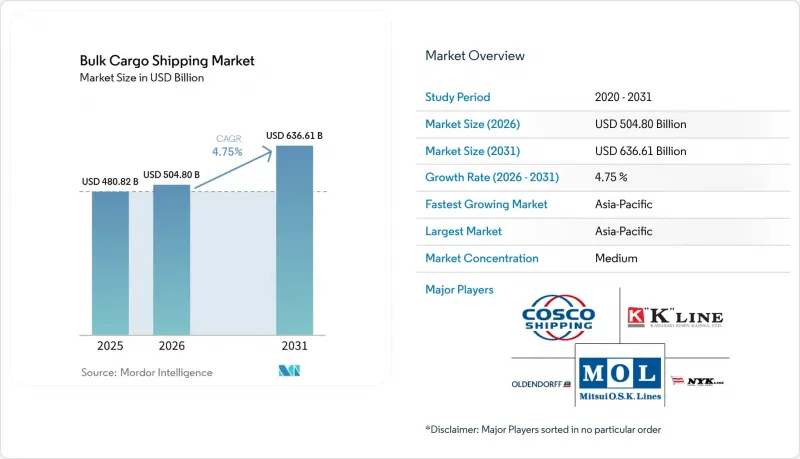
據 Mordor Intelligence 稱,2025 年散貨運輸市場價值 4808.2 億美元,預計將從 2026 年的 5048 億美元成長到 2031 年的 6366.1 億美元,2026 年至 2031 年的複合年成長率為 4.75%。
全球散貨運輸市場的趨勢與洞察
鐵礦石和煤炭海運的需求增加
鐵礦石運輸仍是散裝貨運市場的主要需求來源。西芒杜礦商業化生產的擴張改變了運往中國的鐵礦石組成。據報道,該項目到2026年5月的月出貨量將超過220萬噸。從幾內亞到中國的航線,以噸英里計算,是同等貨運量從澳洲出發航線的四倍。儘管貨運總量有所波動,但波羅的海國際航運公會(BIMCO)預測,2026年干散貨船需求成長的一半將歸因於平均航程的延長。雖然由於印尼煤炭出口下降,煤炭貿易有所下滑,但從大西洋到亞洲的更長航線仍然可以維持船舶運轉率,即使買家更換供應商。
糧食和化肥貿易量的擴張
在散裝運輸市場,農產品運輸需求正超越鐵礦石和煤炭,成為新的成長點。 2025年,海運農產品貿易量量達7.165億噸。 2026年前六週,受南美洲糧食產量過剩推動出口增加,糧食運輸量較去年同期成長15%。霍爾木茲海峽的交通中斷導致大量化肥運輸停滯,尿素、硫磺和磷酸鹽的運輸也因此延誤。國際肥料協會預測,2026/27種植季氮肥供應將趨緊。一旦供應恢復,現有庫存的買家可能會同時重返貨運市場,從而提振農產品航線對超靈便型和巴拿馬型船舶的需求。
對乾散貨運費週期性的影響
運費仍然高度依賴船舶交付量與貨物需求之間的平衡。乾散貨訂單累積訂單與船隊規模比從2025年上半年的9.5%上升至2026年上半年的11.0%。訂單包括計劃於2026年交付的600艘船舶。波羅的海國際航運公會(BIMCO)預測,2026年船舶供應量將增加2.8%,而船舶需求量預計將成長1.5%至2.5%。巴拿馬型和超大型船舶將受到更大的影響,因為它們佔計劃交付船舶的60%以上。透過長期租船合約營運的船東比依賴即期航次的業者享有更大的保障。
細分市場分析
到2025年,乾散貨將佔總收入的75.12%,成為散裝運輸市場中佔有率最大的貨物。鐵礦石和煤炭佔散貨貿易總量的52%以上,支撐著往返於澳洲和中國以及巴西和中國之間的海岬型和巴拿馬型船舶的運作。由於這些貨物的數量龐大,乾散貨在船隊運轉率中仍佔核心地位。礬土也推動了從西非長途運輸的需求。穀物是第三大主要貨物類別,為船東提供了進入季節性農產品貿易的機會。這個細分市場的廣泛性有利於散貨運輸市場,因為它有助於營運商避免對單一商品的依賴。
預計2026年至2031年,液體散貨運輸將以6.17%的複合年成長率成長。這項預測主要得益於霍爾木茲海峽中斷導致原油運輸路線的延長、液化天然氣(LNG)產能的擴張以及亞洲對化學品運輸船的需求。這一轉變表明,能源和化學產品的運輸在整體散裝貨物運輸市場的重要性日益凸顯。中遠海運散裝有限公司已推出「遠海四陸號」,該船被譽為全球首艘32.5萬載重噸甲醇雙燃料礦砂裝運船隻。該船展現了將裝載能力和燃料轉換應對力整合於單一資產的能力。同時營運乾散貨和液體散貨的營運商可以利用多元化的需求來應對航線中斷。
區域分析
亞太地區預計到2025年將佔全球營收的51.88%,並預計到2031年將以5.63%的複合年成長率成長。該地區在散貨運輸市場佔據最大佔有率,因為中國仍然是主要的商品進口國。澳洲是鐵礦石和煤炭的主要出口國,而中國是散裝貨的主要目的地。西芒杜港的開發正在為亞洲買家拓展跨大西洋的供應路線。越南、印尼和印度正透過工業化、基礎建設規劃和沿海航運改革推動區域需求。
歐洲和北美在散貨運輸市場中扮演不同的角色。由於歐洲逐步淘汰煤炭政策導致海運蒸氣需求下降,其在乾散貨進口市場的重要性正在降低。另一方面,北美在散貨運輸市場中主要扮演糧食和冶金煤出口國的角色,向全球市場供應煤炭。五大湖和聖勞倫斯海峽也為該地區的工業和建築材料運輸提供了支持。以巴西為首的南美洲是重要的跨大西洋糧食和鐵礦石供應地。這一地理位置使得桑托斯-青島航線對巴拿馬型船舶的運作至關重要,該航線連接亞洲的農產品和消費中心。
2026年,中東和非洲將面臨相互衝突的力量。霍爾木茲海峽的封鎖擾亂了沿岸地區的原油和化肥運輸,但沙烏地阿拉伯的東西向輸油管和紅海通道提供了部分替代方案。隨著西曼杜礦的投產和礬土運輸的擴張,非洲作為乾散貨出口地區的重要性日益提升。西曼杜礦預計將實現年產6000萬噸的產能。隨著大西洋沿岸貨物運輸量的增加,非洲在散貨運輸市場中的作用進一步增強。能源供應路線的重組也提升了受阻走廊以外的過境和貿易樞紐的重要性。
其他好處:
- Excel格式的市場預測(ME)表
- 3個月的分析師支持
目錄
第1章:引言
- 研究假設和市場定義
- 調查範圍
第2章:調查方法
第3章執行摘要
第4章 市場狀況
- 市場概況及散裝貨物運輸的重要性
- 市場促進因素
- 鐵礦石和煤炭海運的需求增加
- 糧食和化肥貿易量的擴張
- 利用大型散裝貨船提高船隊效率
- 港口自動化和數位導航最佳化
- 特殊液體散裝運輸走廊的發展
- 商品供應的重新區域化與貿易轉型
- 市場限制因素
- 面臨乾散貨運費週期性波動的風險
- 應對脫碳和燃料轉換成本
- 主要碼頭的港口擁擠和吃水限制
- 與大宗商品價格相關的航運合約交易對手風險
- 產業法規結構
- 價值鍊和分銷管道的結構分析
- 散貨運輸的技術大趨勢和結構性變化
- 波特五力分析
- 票價分析
- 票價趨勢
- 現貨市場分析
- 區域票價比較
- 影響票價的因素
- 成本結構分析
- 運輸成本構成
- 燃料成本趨勢
- 港口費用
- 成本最佳化策略
- 進出口貿易分析
- 港口和碼頭基礎設施分析
- 永續性和ESG分析
- 地緣政治事件對供應鏈變化的影響
第5章 市場規模及成長預測(價值,2026-2031 年)
- 按貨物類型
- 乾散貨
- 鐵礦石
- 煤炭
- 穀物(小麥、玉米、大豆等)
- 肥料
- 水泥和水泥熟料
- 礬土和氧化鋁
- 鋼鐵產品
- 其他少量乾散貨產品
- 液體散貨
- 原油
- 石油精煉產品
- 液化天然氣(LNG)
- 液化石油氣(LPG)
- 化學品
- 食用油和植物油
- 糖蜜
- 其他液體散貨
- 乾散貨
- 透過交通路線
- 國內(沿海)
- 國際的
- 按最終用途行業分類
- 採礦和金屬
- 能源公用事業
- 農業
- 化工/石油化工
- 建築和基礎設施
- 食品加工
- 製造業(一般工業)
- 其他
- 按地區/國家
- 北美洲
- 美國
- 加拿大
- 墨西哥
- 南美洲
- 巴西
- 秘魯
- 智利
- 阿根廷
- 其他南美國家
- 亞太地區
- 中國
- 日本
- 韓國
- 印度
- 澳洲
- 東南亞
- 其他亞太國家
- 歐洲
- 英國
- 德國
- 法國
- 西班牙
- 義大利
- 比利時
- 荷蘭
- 北歐國家(丹麥、芬蘭、冰島、挪威、瑞典)
- 其他歐洲國家
- 中東和非洲
- 阿拉伯聯合大公國
- 沙烏地阿拉伯
- 南非
- 奈及利亞
- 埃及
- 其他中東和非洲國家
- 北美洲
第6章 競爭情勢
- 市場集中度
- 關鍵策略趨勢
- 市佔率分析
- 公司簡介
- Oldendorff Carriers
- COSCO Shipping Bulk Co., Ltd.
- NYK Line
- Mitsui OSK Lines(MOL)
- Kawasaki Kisen Kaisha("K" Line)
- Star Bulk Carriers Corp.
- CMB.TECH(Including Golden Ocean Group)
- Pacific Basin Shipping Ltd.
- Berge Bulk
- D/S NORDEN
- Ultrabulk A/S
- Genco Shipping and Trading Ltd.
- Diana Shipping Inc.
- Navios Maritime Partners LP
- Safe Bulkers Inc.
- Fednav Ltd.
- CSL Group
- Bahri
- Wisdom Marine Group
- Algoma Central Corporation
- Pangaea Logistics Solutions
- Lauritzen Bulkers
第7章 市場機會與未來展望
According to Mordor Intelligence, the bulk cargo shipping market size was valued at USD 480.82 billion in 2025 and is estimated to grow from USD 504.80 billion in 2026 to reach USD 636.61 billion by 2031 at 4.75% CAGR over 2026-2031.
Global Bulk Cargo Shipping Market Trends and Insights
Rising Seaborne Demand for Iron Ore and Coal
Seaborne iron ore remains a central source of cargo demand for the bulk cargo shipping market. Simandou's commercial ramp-up changed the origin mix for iron ore bound for China. The project reported monthly shipments above 2.2 million tonnes by May 2026. A Guinea-to-China voyage creates 4 times the tonne-miles of an equivalent Australian shipment. BIMCO expects longer average sailing distances to account for half of dry bulk ship demand growth in 2026, independent of changes in total cargo volumes. Coal trade declined as Indonesian exports contracted, but longer Atlantic-to-Asia routes can still support vessel utilization where buyers substitute supply origins.
Expansion of Grain and Fertilizer Trade Flows
Agricultural cargoes broaden demand beyond iron ore and coal in the bulk cargo shipping market. Seaborne agricultural trade reached 716.5 million tonnes in 2025. Grain shipments rose 15% year over year in the first 6 weeks of 2026 as South American surpluses increased exports. The Strait of Hormuz disruption halted a significant share of fertilizer movements and delayed urea, sulfur, and phosphate cargoes. The International Fertilizer Association expects constrained nitrogen availability during the 2026/27 crop cycle. When supply resumes, buyers drawing down inventories may return to the freight market at the same time, supporting Supramax and Panamax demand on agricultural routes.
Exposure to Dry Bulk Freight Rate Cyclicality
Freight rates remain vulnerable to the balance between vessel deliveries and cargo demand. The dry bulk orderbook-to-fleet ratio reached 11.0% in H1 2026, compared with 9.5% in H1 2025. The orderbook included 600 vessels scheduled for delivery during 2026. BIMCO forecasts ship supply growth of 2.8% in 2026, compared with ship demand growth of 1.5% to 2.5%. Panamax and Supramax fleets face greater exposure because they account for more than 60% of scheduled deliveries. Owners operating through long-term charters have greater protection than operators dependent on spot voyages.
Other drivers and restraints analyzed in the detailed report include:
- Fleet Efficiency Gains From Larger Bulk Carriers
- Port Automation and Digital Voyage Optimization
- Decarbonization Compliance and Fuel Transition Costs
For complete list of drivers and restraints, kindly check the Table Of Contents.
Segment Analysis
Dry bulk cargo held 75.12% of 2025 revenue, giving it the largest position in the bulk cargo shipping market size. Iron ore and coal represented more than 52% of total bulk trade by volume and supported Capesize and Panamax employment on Australia-China and Brazil-China routes. The scale of these cargoes keeps dry bulk at the center of fleet utilization. Bauxite also adds to long-haul demand from West African origins. Grain provides a third major cargo stream and gives owners exposure to seasonal agricultural trade. The bulk cargo shipping market benefits because the segment's breadth helps protect operators from reliance on a single commodity.
Liquid bulk cargo is forecast to expand at a 6.17% CAGR from 2026 to 2031. Longer crude oil routes after the Hormuz disruption, new LNG liquefaction capacity, and Asian chemical tanker demand support this outlook. The shift indicates that energy and chemical flows are becoming more important to the broader bulk cargo shipping market. COSCO Shipping Bulk commissioned the YUAN HAI SI LU, described as the world's first 325,000-DWT methanol dual-fuel ore carrier. The vessel shows how cargo capacity and fuel-transition readiness can be combined in a single asset. Operators serving both dry and liquid trades can use diversified demand to manage route disruption.
Complete Report Scope:
- By Cargo Type
- Dry Bulk Cargo
- Iron Ore
- Coal
- Grain (Wheat, Corn, Soybeans, etc.)
- Fertilizers
- Cement and Clinker
- Bauxite and Alumina
- Steel Products
- Other Minor Dry Bulk Commodities
- Liquid Bulk Cargo
- Crude Oil
- Refined Petroleum Products
- Liquefied Natural Gas (LNG)
- Liquefied Petroleum Gas (LPG)
- Chemicals
- Edible and Vegetable Oils
- Molasses
- Other Liquid Bulk Commodities
- Dry Bulk Cargo
- By Shipping Route
- Domestic (Coastal)
- International
- By End-Use Industry
- Mining and Metals
- Energy and Utilities
- Agriculture
- Chemicals and Petrochemicals
- Construction and Infrastructure
- Food Processing
- Manufacturing (General Industrial)
- Others
- By Region/Country
- North America
- United States
- Canada
- Mexico
- South America
- Brazil
- Peru
- Chile
- Argentina
- Rest of South America
- Asia-Pacific
- China
- Japan
- South Korea
- India
- Australia
- Southeast Asia
- Rest of Asia-Pacific
- Europe
- United Kingdom
- Germany
- France
- Spain
- Italy
- Belgium
- Netherlands
- NORDICS (Denmark, Finland, Iceland, Norway, and Sweden)
- Rest of Europe
- Middle East and Africa
- United Arab Emirates
- Saudi Arabia
- South Africa
- Nigeria
- Egypt
- Rest of the Middle East and Africa
- North America
Geography Analysis
Asia-Pacific held 51.88% of 2025 revenue and is forecast to grow at a 5.63% CAGR through 2031. The region has the largest position in the Bulk cargo shipping market share because China remains the leading commodity importer. Australia is a major exporter of iron ore and coal, while China is a major destination for bulk cargoes. Simandou's development also gives Asian buyers a growing Atlantic supply route. Vietnam, Indonesia, and India broaden regional demand through industrialization, infrastructure programs, and coastal shipping reforms.
Europe and North America have different roles in the bulk cargo shipping market. For the bulk cargo shipping market, Europe is losing dry bulk import importance as coal phase-out policies reduce demand for seaborne steam coal. North America functions in the bulk cargo shipping market primarily as an exporter of grain and metallurgical coal to global markets. The Great Lakes and St. Lawrence Seaway also support regional industrial and construction commodity movements. South America, led by Brazil, is an important Atlantic source for grain and iron ore. Its position makes the Santos-to-Qingdao route important for Panamax activity and links agricultural output to Asian consumption.
The Middle East and Africa face opposing forces in 2026. The Hormuz closure disrupted Gulf crude and fertilizer cargo movements, while Saudi Arabia's East-West pipeline and Red Sea access provided partial alternatives. Africa is becoming a more important dry bulk export region through Simandou and expanding bauxite movements. Simandou is progressing toward 60 million tonnes of annual capacity. The movement of more cargo from Atlantic origins increases the role of Africa in the bulk cargo shipping market. Redirected energy flows also raise the importance of transit and trading hubs outside the disrupted corridor.
- Oldendorff Carriers
- COSCO Shipping Bulk Co., Ltd.
- NYK Line
- Mitsui O.S.K. Lines (MOL)
- Kawasaki Kisen Kaisha ("K" Line)
- Star Bulk Carriers Corp.
- CMB.TECH (Including Golden Ocean Group)
- Pacific Basin Shipping Ltd.
- Berge Bulk
- D/S NORDEN
- Ultrabulk A/S
- Genco Shipping and Trading Ltd.
- Diana Shipping Inc.
- Navios Maritime Partners L.P.
- Safe Bulkers Inc.
- Fednav Ltd.
- CSL Group
- Bahri
- Wisdom Marine Group
- Algoma Central Corporation
- Pangaea Logistics Solutions
- Lauritzen Bulkers
Additional Benefits:
- The market estimate (ME) sheet in Excel format
- 3 months of analyst support
TABLE OF CONTENTS
1 Introduction
- 1.1 Study Assumptions and Market Definition
- 1.2 Scope of the Study
2 Research Methodology
3 Executive Summary
4 Market Landscape
- 4.1 Market Overview and Importance of Bulk Cargo Shipping
- 4.2 Market Drivers
- 4.2.1 Rising Seaborne Demand for Iron Ore and Coal
- 4.2.2 Expansion of Grain and Fertilizer Trade Flows
- 4.2.3 Fleet Efficiency Gains From Larger Bulk Carriers
- 4.2.4 Port Automation and Digital Voyage Optimization
- 4.2.5 Growth in Specialized Liquid Bulk Trade Corridors
- 4.2.6 Commodity Supply Re-Localization and Trade Diversion
- 4.3 Market Restraints
- 4.3.1 Exposure to Dry Bulk Freight Rate Cyclicality
- 4.3.2 Decarbonization Compliance and Fuel Transition Costs
- 4.3.3 Port Congestion and Draft Constraints at Key Terminals
- 4.3.4 Counterparty Risk in Commodity-Led Shipping Contracts
- 4.4 Industry Regulatory Framework
- 4.5 Value Chain and Distribution Channel Architecture Analysis
- 4.6 Technology Megatrends and Structural Shifts Bulk Cargo Shipping
- 4.7 Porter's Five Forces Analysis
- 4.7.1 Threat of New Entrants
- 4.7.2 Bargaining Power of Suppliers
- 4.7.3 Bargaining Power of Buyers
- 4.7.4 Threat of Substitutes
- 4.7.5 Rivalry Among Competitors
- 4.8 Freight Rate Analysis
- 4.8.1 Freight Rate Trends
- 4.8.2 Spot Market Analysis
- 4.8.3 Regional Freight Rate Comparison
- 4.8.4 Factors Influencing Freight Rates
- 4.9 Cost Structure Analysis
- 4.9.1 Shipping Cost Components
- 4.9.2 Fuel Cost Trends
- 4.9.3 Port Charges
- 4.9.4 Cost Optimization Strategies
- 4.10 Import-Export Trade Analysis
- 4.11 Port and Terminal Infrastructure Analysis
- 4.12 Sustainability and ESG Analysis
- 4.13 Impact of Geo-Political Events on Supply Chain Shifts
5 Market Size and Growth Forecasts (Value, 2026-2031)
- 5.1 By Cargo Type
- 5.1.1 Dry Bulk Cargo
- 5.1.1.1 Iron Ore
- 5.1.1.2 Coal
- 5.1.1.3 Grain (Wheat, Corn, Soybeans, etc.)
- 5.1.1.4 Fertilizers
- 5.1.1.5 Cement and Clinker
- 5.1.1.6 Bauxite and Alumina
- 5.1.1.7 Steel Products
- 5.1.1.8 Other Minor Dry Bulk Commodities
- 5.1.2 Liquid Bulk Cargo
- 5.1.2.1 Crude Oil
- 5.1.2.2 Refined Petroleum Products
- 5.1.2.3 Liquefied Natural Gas (LNG)
- 5.1.2.4 Liquefied Petroleum Gas (LPG)
- 5.1.2.5 Chemicals
- 5.1.2.6 Edible and Vegetable Oils
- 5.1.2.7 Molasses
- 5.1.2.8 Other Liquid Bulk Commodities
- 5.1.1 Dry Bulk Cargo
- 5.2 By Shipping Route
- 5.2.1 Domestic (Coastal)
- 5.2.2 International
- 5.3 By End-Use Industry
- 5.3.1 Mining and Metals
- 5.3.2 Energy and Utilities
- 5.3.3 Agriculture
- 5.3.4 Chemicals and Petrochemicals
- 5.3.5 Construction and Infrastructure
- 5.3.6 Food Processing
- 5.3.7 Manufacturing (General Industrial)
- 5.3.8 Others
- 5.4 By Region/Country
- 5.4.1 North America
- 5.4.1.1 United States
- 5.4.1.2 Canada
- 5.4.1.3 Mexico
- 5.4.2 South America
- 5.4.2.1 Brazil
- 5.4.2.2 Peru
- 5.4.2.3 Chile
- 5.4.2.4 Argentina
- 5.4.2.5 Rest of South America
- 5.4.3 Asia-Pacific
- 5.4.3.1 China
- 5.4.3.2 Japan
- 5.4.3.3 South Korea
- 5.4.3.4 India
- 5.4.3.5 Australia
- 5.4.3.6 Southeast Asia
- 5.4.3.7 Rest of Asia-Pacific
- 5.4.4 Europe
- 5.4.4.1 United Kingdom
- 5.4.4.2 Germany
- 5.4.4.3 France
- 5.4.4.4 Spain
- 5.4.4.5 Italy
- 5.4.4.6 Belgium
- 5.4.4.7 Netherlands
- 5.4.4.8 NORDICS (Denmark, Finland, Iceland, Norway, and Sweden)
- 5.4.4.9 Rest of Europe
- 5.4.5 Middle East and Africa
- 5.4.5.1 United Arab Emirates
- 5.4.5.2 Saudi Arabia
- 5.4.5.3 South Africa
- 5.4.5.4 Nigeria
- 5.4.5.5 Egypt
- 5.4.5.6 Rest of the Middle East and Africa
- 5.4.1 North America
6 Competitive Landscape
- 6.1 Market Concentration
- 6.2 Key Strategic Moves
- 6.3 Market Share Analysis
- 6.4 Company Profiles (Includes Global Level Overview, Market Level Overview, Core Segments, Financials as Available, Strategic Information, Geographic/Network Coverage, Products & Services, and Recent Developments)
- 6.4.1 Oldendorff Carriers
- 6.4.2 COSCO Shipping Bulk Co., Ltd.
- 6.4.3 NYK Line
- 6.4.4 Mitsui O.S.K. Lines (MOL)
- 6.4.5 Kawasaki Kisen Kaisha ("K" Line)
- 6.4.6 Star Bulk Carriers Corp.
- 6.4.7 CMB.TECH (Including Golden Ocean Group)
- 6.4.8 Pacific Basin Shipping Ltd.
- 6.4.9 Berge Bulk
- 6.4.10 D/S NORDEN
- 6.4.11 Ultrabulk A/S
- 6.4.12 Genco Shipping and Trading Ltd.
- 6.4.13 Diana Shipping Inc.
- 6.4.14 Navios Maritime Partners L.P.
- 6.4.15 Safe Bulkers Inc.
- 6.4.16 Fednav Ltd.
- 6.4.17 CSL Group
- 6.4.18 Bahri
- 6.4.19 Wisdom Marine Group
- 6.4.20 Algoma Central Corporation
- 6.4.21 Pangaea Logistics Solutions
- 6.4.22 Lauritzen Bulkers
7 Market Opportunities and Future Outlook
- 7.1 White-space and Unmet-Need Assessment


