


 |
市場調查報告書
商品編碼
2155625
MS聚合物:市場佔有率分析、產業趨勢與統計資料、成長預測(2026-2031年)MS Polymer - Market Share Analysis, Industry Trends & Statistics, Growth Forecasts (2026 - 2031) |
||||||

※ 本網頁內容可能與最新版本有所差異。詳細情況請與我們聯繫。
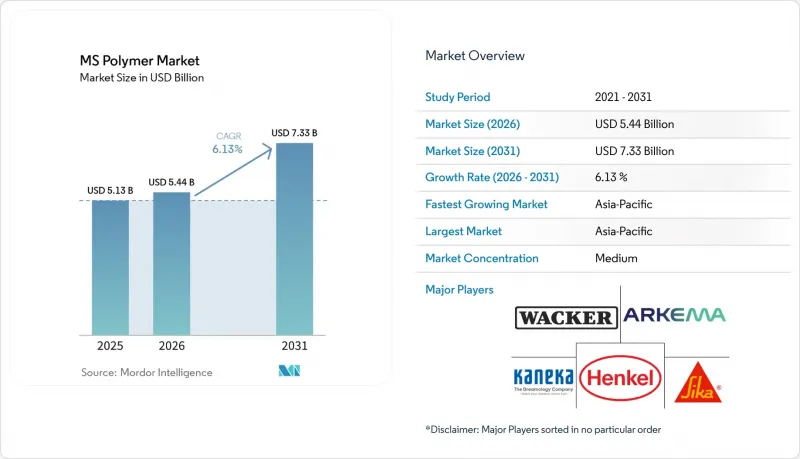
據 Mordor Intelligence 稱,2025 年 MS 聚合物市值為 51.3 億美元,預計到 2031 年將達到 73.3 億美元,而 2026 年為 54.4 億美元,預測期(2026-2031 年)的複合年成長率為 6.13%。
全球MS聚合物市場趨勢與洞察
低揮發性有機化合物和不含異氰酸酯的替代品
向低揮發性有機化合物 (VOC) 和無異氰酸酯替代品的轉變是 MS 聚合物市場需求的核心驅動力。對於工業買家而言,合規性和配方選擇密切相關,MS 聚合物市場正受益於此轉變,尤其是在現場管理人員需要更簡便的操作流程,且供應商能夠證明產品符合所需的健康、安全和環境文件要求的情況下。歐盟委員會第 2020/1149 號法規根據《化學品註冊、評估、授權和限制》(REACH) 引入了關於二異氰酸酯的分階段法規,其中也包括對工業用戶的培訓要求。這些要求鼓勵製造商減輕與傳統材料相關的安全管理負擔和職業健康風險,尤其是在黏合劑和密封產品在多個工廠和產品線中反覆使用的情況下。 2026 年 4 月,漢高股份公司推出了用於重型機械的「Teroson MS 9381 HPT」。這是一種單組分矽烷改質聚合物黏合劑和密封劑,不含錫、溶劑、異氰酸酯、矽酮或聚氯乙烯的材料清單(BOM) 進行認證,重新使用聚氨酯可能需要重新進行完整的檢驗流程。這將有助於維持對成熟配方的持續需求,並使已通過核准的供應商在未來的採購決策中佔據更有利的地位。
綠建築和能源效率方面的規範
綠建築和節能規範正在推動MS聚合物在商業建築、醫療設施和教育機構的應用。 LEED(能源與環境設計先鋒獎)和BREEAM(英國建築研究院環境評估法)框架內的低排放材料要求優先考慮符合總揮發性有機化合物(TVOC)限值且可在項目規範和材料審查階段清晰記錄的黏合劑和密封劑。修訂後的建築能源性能指令正引導歐洲建築政策朝著更高的能源性能方向發展,進一步提升了耐用型圍護結構密封解決方案的重要性。 MS聚合物產品可提供許多建築圍護結構應用所需的可塗漆性和低揮發性,使承包商能夠在可見接縫、立面細節和其他需要完美外觀的區域採用單一材料方案。符合南海岸空氣品質管理區1168號規則限值的產品,在滿足其他適用要求的前提下,還有助於跨多個司法管轄區進行認證工作。這有利於那些旨在承接具有類似但各自獨立管理的低排放材料要求的專案的供應商。這種一致性減輕了供應商在早期投入文件和測試方面的行政負擔,並幫助建築承包商比較符合規範的產品,同時最大限度地減少個別技術審查。
矽烷原料價格波動
矽烷原料價格的波動仍是MS聚合物市場的阻礙因素。這是因為矽烷封端聚醚的生產依賴於氯矽烷和烷氧基矽烷中間體。這些中間體的生產需要大量的資本和能源投入,且集中在有限的上游供應基地,因此供應中斷會影響下游黏合劑和密封劑價值鏈中所有原料的供應。金屬矽的成本會因能源價格、中國的生產限制以及來自太陽能電池和半導體供應鏈的競爭需求而波動。因此,下游製造商容易受到成本波動的影響,而這些波動並不能直接反映黏合劑和密封劑成品的需求情況。 2026年初,出口貨櫃的供應限制降低了矽烷現貨市場的流動性,並推高了價格。瓦克化學股份公司(Wacker Chemie AG)的專有GENIOSIL α-矽烷技術清晰地表明,一體化製造商比那些在合約市場或現貨市場採購原料的配方製造商更具優勢。透過內部管理專用原料,我們可以更清楚地了解整個客戶專案的成本、供應狀況和產品一致性。隨著需求的成長,尤其是在流動性有限、製造商優先考慮現有框架合約客戶的時期,對於小規模的製劑製造商而言,長期供應關係可能比現貨採購更為重要。
細分市場分析
至2025年,混合型MS聚合物將佔MS聚合物市場規模的57.46%。這一地位反映了混合骨架配方能夠平衡黏合力、模量、固化速度和紫外線穩定性。配方生產商可以將相同基礎平台應用於建築密封膠、地板黏合劑和組裝黏合劑等領域。這降低了整個商業產品線原料的複雜性,使企業能夠滿足更廣泛的客戶需求,而無需單獨維護各種聚合物原料和基礎配方。混合型產品還有助於供應商根據不同的基材組合調整性能,而無需徹底重新設計配方。這提高了同時服務於建設產業和工業領域的製造商的產品系列的柔軟性。
純MS聚合物構成剩餘的產品類型,適用於對監管合規性和廣泛基材相容性要求極高的應用領域。例如,可將玻璃直接安裝到帷幕牆、用於食品接觸設備的維護以及醫療設施的黏合。此外,MS聚合物產業正從有機錫催化劑體系轉向無錫催化劑體系。 2025年3月,瓦克化學公司宣布推出GENIOSIL STP-E 140和STP-E 340,這兩種無錫矽烷封端聚醚無需使用錫催化劑即可在建築密封劑中實現低模量。在歐洲,由於REACH法規對有機錫化合物的持續修訂,提交監管文件已成為許多專業建築和工業採購流程中的關鍵環節,人們對無錫混合型MS聚合物的興趣日益濃厚。
區域分析
預計到2025年,亞太地區將佔MS聚合物市場規模的41.25%,並將以7.07%的複合年成長率成長至2031年。 MS聚合物市場受益於其區域優勢,該地區擁有成熟的製造地和不斷擴大的基礎設施建設規劃。在中國,除了對建築密封膠的巨大需求外,由於國內電動車製造業的發展,對汽車黏合劑的需求也在不斷成長,這使得供應商能夠在同一大製造業和建築經濟區內觸及建築和交通運輸行業的終端用戶。印度的基礎設施建設規劃推動了道路、鐵路、機場和城市住宅等各個領域對建築密封膠和黏合劑的需求,多樣化的項目類型為能夠處理普通建築接縫和具有更嚴格要求的施工接縫的供應商創造了機會。在日本,「綠色轉型」和「零能耗住宅」等建築和維修項目正在推動對建築圍護結構維修和低揮發性有機化合物(VOC)密封解決方案的投資。在韓國,電子製造業和汽車製造業的需求也為市場做出了貢獻。越南、印尼和馬來西亞正透過產業建設和區域汽車組裝成為新興的需求中心,進一步提振了全部區域需求,此外還有中國、日本、韓國和印度等更成熟的市場。
歐洲受REACH法規、建築能耗要求和「翻新浪潮」的影響。德國、英國、法國和義大利是主要的國內需求中心,其中德國的汽車OEM製造商和一級供應商支撐著需求。歐洲的合規要求可能會影響亞洲和北美以出口為導向的供應鏈。這意味著,即使最終組裝或建設活動在歐洲以外進行,供應商也需要使其配方符合通用文件和性能標準。北美是另一個重要的區域市場,這主要得益於美國維修驅動的建築業。 LEED和被動式房屋專案正在催生對低排放產品的特定需求,而墨西哥汽車產業的成長正在加強符合美國標準的跨境採購,並提升區域汽車製造商價值鏈中認可的配方的價值。
以巴西和阿根廷為首的南美洲,除了矽酮和聚氨酯系統外,MS聚合物產品在基礎設施投資和住宅維修的應用也日益廣泛。在巴西,強烈的紫外線輻射、持續的高濕度和熱循環可能會推動外牆和交通系統中高耐久性密封系統的應用,因為這些條件會對接縫性能造成長期的考驗。中東和非洲地區則受益於沙烏地阿拉伯、阿拉伯聯合大公國和南非的建設計畫。在這些地區,高溫環境下的玻璃帷幕牆和外牆施工是關鍵應用領域。沙烏地阿拉伯的「2030願景」支持建造需要高性能圍護結構的商業、飯店和基礎設施建築。南非也是撒哈拉以南非洲建築需求的配送中心,其本地庫存和技術支援的重要性不僅限於國內建設項目。
其他好處:
- Excel格式的市場預測(ME)表
- 3個月的分析師支持
目錄
第1章:引言
- 研究假設和市場定義
- 調查範圍
第2章:調查方法
第3章執行摘要
第4章 市場狀況
- 市場概覽
- 市場促進因素
- 低揮發性有機化合物和不含異氰酸酯的替代品
- 綠建築和能源效率方面的規範
- 輕型複合材料車輛的組裝
- 電子設備的封裝與熱循環保護
- 老舊建築外圍護結構的翻新
- 市場限制因素
- 矽烷原料價格波動
- 濕固化樹脂加工能力的局限性
- OEM和電子產業的認證週期很長。
- 價值鏈分析
- 波特五力分析
第5章 市場規模與成長預測
- 依產品類型
- 混合MS聚合物
- 純MS聚合物
- 透過使用
- 黏合劑
- 密封劑
- 塗層
- 其他
- 最終用戶
- 建築和基礎設施
- 汽車和運輸業
- 電子與電機工程
- 海上
- 航太
- 其他
- 按地區
- 亞太地區
- 中國
- 印度
- 日本
- 韓國
- 其他亞太國家
- 北美洲
- 美國
- 加拿大
- 墨西哥
- 歐洲
- 德國
- 英國
- 法國
- 義大利
- 其他歐洲國家
- 南美洲
- 巴西
- 阿根廷
- 其他南美國家
- 中東和非洲
- 沙烏地阿拉伯
- 南非
- 其他中東和非洲國家
- 亞太地區
第6章 競爭情勢
- 市場集中度
- 策略趨勢
- 市佔率和排名分析
- 公司簡介
- 3M
- Arkema
- Dow
- Evonik Industries AG
- HB Fuller Company
- Henkel AG & Co. KGaA
- Kaneka Corporation
- MAPEI SpA
- Sika AG
- Soudal Group
- Tremco Illbruck GmbH & Co. KG
- Wacker Chemie AG
第7章 市場機會與未來展望
According to Mordor Intelligence, the MS polymer market size was valued at USD 5.13 billion in 2025 and is estimated to grow from USD 5.44 billion in 2026 to reach USD 7.33 billion by 2031, at a CAGR of 6.13% during the forecast period (2026-2031).
Global MS Polymer Market Trends and Insights
Low-VOC and Isocyanate-Free Substitution
Low-VOC and isocyanate-free substitution is a central source of demand for the MS polymer market. The MS polymer market gains from this change because compliance and formulation choices are closely connected for industrial buyers, especially when site managers need simpler handling procedures and suppliers can demonstrate that the product supports the required health, safety, and environmental documentation. Commission Regulation (EU) 2020/1149 introduced phased restrictions on diisocyanates under Registration, Evaluation, Authorisation and Restriction of Chemicals (REACH), including training requirements for industrial users. These requirements encourage manufacturers to reduce safety-management burdens and occupational-health exposure associated with legacy materials, particularly when operations use adhesive and sealing products repeatedly across several plants and product lines. In April 2026, Henkel AG & Co. KGaA introduced Teroson MS 9381 HPT for heavy equipment, a one-component silane-modified polymer adhesive-sealant that excludes tin, solvents, isocyanates, silicones, and polyvinyl chloride. Henkel AG & Co. KGaA stated that the product can reduce application steps from 3 to 2 and can cut cradle-to-gate carbon dioxide emissions by up to 50% compared with conventional polyurethane materials. Once a buyer qualifies an isocyanate-free bill of materials, a return to polyurethane can require another full validation cycle, which supports repeat demand for established formulations and gives approved suppliers a stronger position in later purchasing decisions.
Green-Building and Energy-Efficiency Specifications
Green-building and energy-efficiency specifications support the use of the MS polymer market in commercial buildings, health care facilities, and educational projects. Low-emitting material requirements within Leadership in Energy and Environmental Design (LEED) and Building Research Establishment Environmental Assessment Method (BREEAM) frameworks favor adhesive and sealant products that meet total volatile organic compound limits and can be documented clearly during project specification and material review. The revised Energy Performance of Buildings Directive directs European building policy toward higher energy performance, which increases the relevance of durable envelope sealing solutions. MS polymer products can provide paintability and low-emission characteristics needed for many building-envelope uses, helping contractors use a single material approach across visible joints, facade details, and other areas that require a finished appearance. Products that satisfy South Coast Air Quality Management District Rule 1168 limits can also support certification work across several jurisdictions when other applicable requirements are met, which is useful for suppliers seeking to serve projects with similar but separately administered low-emission material requirements. This alignment can reduce the administrative burden for suppliers that invest early in documentation and testing, while helping building contractors compare acceptable products with fewer separate technical reviews.
Silane Feedstock Price Volatility
Silane feedstock price volatility remains a constraint on the MS polymer market because silane-terminated polyether production depends on chlorosilane and alkoxysilane intermediates. Their production is capital intensive, energy intensive, and concentrated in a limited upstream supply base, so a disruption can affect material availability throughout the downstream adhesives and sealants value chain. Silicon metal costs can change with energy prices, Chinese production limits, and competing demand from solar and semiconductor supply chains, leaving downstream producers exposed to cost movements that do not directly reflect conditions in finished adhesive and sealant demand. Export-container constraints tightened silane spot liquidity in early 2026 and supported higher prices. Wacker Chemie AG's proprietary GENIOSIL alpha-silane technology illustrates why integrated producers can have an advantage over formulators that buy feedstock on contract or spot markets, as control over specialized inputs can provide greater visibility into cost, availability, and product consistency across a customer program. As demand increases, long-term supply relationships may become more important than spot purchasing for smaller formulators, especially when producers prioritize established framework customers during periods of limited liquidity.
Other drivers and restraints analyzed in the detailed report include:
- Aging Building-Envelope Replacement
- Lightweight Mixed-Material Vehicle Assembly
- Moisture-Cure Throughput Constraints
For complete list of drivers and restraints, kindly check the Table Of Contents.
Segment Analysis
Hybrid MS polymer held 57.46% of the MS polymer market size in 2025. This position reflected the ability of blended-backbone formulations to balance adhesion, modulus, cure speed, and ultraviolet stability. Formulators can use the same underlying platform across construction sealants, flooring adhesives, and assembly adhesives. This can reduce raw-material complexity across commercial product lines, allowing companies to manage a wider range of customer requirements without carrying an unnecessarily broad set of separate polymer inputs and base formulations. Hybrid grades also help suppliers tailor performance for different substrate combinations without rebuilding the full formulation approach, which can improve portfolio flexibility for producers serving construction and industrial customers at the same time.
Pure MS polymer held the remaining product-type demand and is relevant where a clean regulatory profile and broad substrate compatibility matter most. Direct glazing on curtain-wall facades, food-contact equipment maintenance, and health care facility bonding are examples of such uses. The MS polymer industry is also shifting from organotin-catalyzed systems toward tin-free options. In March 2025, Wacker Chemie AG presented GENIOSIL STP-E 140 and STP-E 340 as tin-free silane-terminated polyethers that achieve low modulus in construction sealants without tin catalysts. Continued REACH review of organotin compounds supports attention to tin-free hybrid grades in Europe, where regulatory documentation is an important part of many professional construction and industrial procurement processes.
Complete Report Scope:
- By Product Type
- Hybrid MS Polymer
- Pure MS Polymer
- By Application
- Adhesives
- Sealants
- Coatings
- Others
- By End-User
- Construction and Infrastructure
- Automotive and Transportation
- Electronics and Electrical
- Marine
- Aerospace
- Others
- By Geography
- Asia-Pacific
- China
- India
- Japan
- South Korea
- Rest of Asia-Pacific
- North America
- United States
- Canada
- Mexico
- Europe
- Germany
- United Kingdom
- France
- Italy
- Rest of Europe
- South America
- Brazil
- Argentina
- Rest of South America
- Middle East and Africa
- Saudi Arabia
- South Africa
- Rest of Middle East and Africa
- Asia-Pacific
Geography Analysis
Asia-Pacific held 41.25% of the MS polymer market size in 2025 and is projected to advance at a 7.07% CAGR through 2031. The MS polymer market benefits from a regional base that combines established manufacturing centers with expanding infrastructure programs. China combines large construction sealant demand with growing automotive adhesive demand from domestic electric vehicle manufacturing, giving suppliers access to building and transportation end uses within the same broad manufacturing and construction economy. India's infrastructure agenda supports demand for construction-grade sealants and adhesives across roads, rail, airports, and urban housing, with the range of project types creating opportunities for suppliers that can address both general building joints and more demanding construction interfaces. Japan's Green Transformation, Zero Energy House building-renovation program directs investment toward envelope refurbishment and low-volatile-organic-compound sealing solutions. South Korea adds demand from electronics manufacturing and automotive production. Vietnam, Indonesia, and Malaysia are emerging demand centers through industrial construction and regional automotive assembly, adding to regional demand beyond the more established markets of China, Japan, South Korea, and India.
Europe is shaped by REACH restrictions, building-energy requirements, and the Renovation Wave. Germany, the United Kingdom, France, and Italy are major national demand centers, with Germany supported by automotive original equipment manufacturers and Tier-1 suppliers. European compliance requirements can influence export-oriented supply chains in Asia and North America. This creates a need for suppliers to align formulations with common documentation and performance standards, even when final assembly or construction activity takes place outside Europe. North America follows as another important regional block, supported by renovation-led construction in the United States. LEED and Passive House projects add specification demand for lower-emission products, while Mexico's automotive growth strengthens cross-border procurement aligned with United States standards and reinforces the value of formulations accepted by regional original equipment manufacturer supply chains.
South America is led by Brazil and Argentina, where infrastructure spending and housing renovation are introducing MS polymer products alongside silicone and polyurethane systems. Brazil's high ultraviolet exposure, persistent humidity, and thermal cycling can favor durable sealing systems in facades and transportation, because these operating conditions can place greater stress on joint performance over an extended service period. The Middle East and Africa is supported by construction programs in Saudi Arabia, the United Arab Emirates, and South Africa. High-ambient-temperature glazing and facade work are important uses in these locations. Saudi Arabia's Vision 2030 supports commercial, hospitality, and infrastructure construction that needs high-performance envelope systems. South Africa also serves as a distribution base for construction demand across Sub-Saharan Africa, extending the relevance of local inventory and technical support beyond its domestic building projects.
- 3M
- Arkema
- Dow
- Evonik Industries AG
- H.B. Fuller Company
- Henkel AG & Co. KGaA
- Kaneka Corporation
- MAPEI S.p.A.
- Sika AG
- Soudal Group
- Tremco Illbruck GmbH & Co. KG
- Wacker Chemie AG
Additional Benefits:
- The market estimate (ME) sheet in Excel format
- 3 months of analyst support
TABLE OF CONTENTS
1 Introduction
- 1.1 Study Assumptions and Market Definition
- 1.2 Scope of the Study
2 Research Methodology
3 Executive Summary
4 Market Landscape
- 4.1 Market Overview
- 4.2 Market Drivers
- 4.2.1 Low-VOC and Isocyanate-Free Substitution
- 4.2.2 Green-Building and Energy-Efficiency Specifications
- 4.2.3 Lightweight Mixed-Material Vehicle Assembly
- 4.2.4 Electronics Encapsulation and Thermal-Cycling Protection
- 4.2.5 Aging Building-Envelope Replacement
- 4.3 Market Restraints
- 4.3.1 Silane Feedstock Price Volatility
- 4.3.2 Moisture-Cure Throughput Constraints
- 4.3.3 Long OEM and Electronics Qualification Cycles
- 4.4 Value Chain Analysis
- 4.5 Porter's Five Forces Analysis
- 4.5.1 Threat of New Entrants
- 4.5.2 Bargaining Power of Suppliers
- 4.5.3 Bargaining Power of Buyers
- 4.5.4 Threat of Substitutes
- 4.5.5 Competitive Rivalry
5 Market Size and Growth Forecasts (Value)
- 5.1 By Product Type
- 5.1.1 Hybrid MS Polymer
- 5.1.2 Pure MS Polymer
- 5.2 By Application
- 5.2.1 Adhesives
- 5.2.2 Sealants
- 5.2.3 Coatings
- 5.2.4 Others
- 5.3 By End-User
- 5.3.1 Construction and Infrastructure
- 5.3.2 Automotive and Transportation
- 5.3.3 Electronics and Electrical
- 5.3.4 Marine
- 5.3.5 Aerospace
- 5.3.6 Others
- 5.4 By Geography
- 5.4.1 Asia-Pacific
- 5.4.1.1 China
- 5.4.1.2 India
- 5.4.1.3 Japan
- 5.4.1.4 South Korea
- 5.4.1.5 Rest of Asia-Pacific
- 5.4.2 North America
- 5.4.2.1 United States
- 5.4.2.2 Canada
- 5.4.2.3 Mexico
- 5.4.3 Europe
- 5.4.3.1 Germany
- 5.4.3.2 United Kingdom
- 5.4.3.3 France
- 5.4.3.4 Italy
- 5.4.3.5 Rest of Europe
- 5.4.4 South America
- 5.4.4.1 Brazil
- 5.4.4.2 Argentina
- 5.4.4.3 Rest of South America
- 5.4.5 Middle East and Africa
- 5.4.5.1 Saudi Arabia
- 5.4.5.2 South Africa
- 5.4.5.3 Rest of Middle East and Africa
- 5.4.1 Asia-Pacific
6 Competitive Landscape
- 6.1 Market Concentration
- 6.2 Strategic Moves
- 6.3 Market Share (%)/Ranking Analysis
- 6.4 Company Profiles (includes Global Overview, Market Overview, Core Segments, Financials as available, Strategic Information, Products and Services, and Recent Developments)
- 6.4.1 3M
- 6.4.2 Arkema
- 6.4.3 Dow
- 6.4.4 Evonik Industries AG
- 6.4.5 H.B. Fuller Company
- 6.4.6 Henkel AG & Co. KGaA
- 6.4.7 Kaneka Corporation
- 6.4.8 MAPEI S.p.A.
- 6.4.9 Sika AG
- 6.4.10 Soudal Group
- 6.4.11 Tremco Illbruck GmbH & Co. KG
- 6.4.12 Wacker Chemie AG
7 Market Opportunities and Future Outlook
- 7.1 White-Space and Unmet-Need Assessment

 生物基丙烯酸單體市場:全球市場預測(2026-2032年)聚四氟乙烯中顆粒樹脂市場:全球市場預測,2026-2032年
 自修復聚合物和塗料市場預測至2034年—按材料類型、修復機制、形態、最終用戶和地區分類的全球分析
 末端羥基聚丁二烯市場規模、佔有率和成長分析:按等級、應用、最終用戶和地區分類-2026-2033年產業預測
 無機和有機雜化聚合物市場規模、佔有率和成長分析:按聚合物類型、無機成分、形態、應用、最終用途產業和地區分類 - 2026-2033 年產業預測
 矽烷封端聚合物市場報告:趨勢、預測與競爭分析(至2035年)
 2026年全球均聚聚丙烯市場報告
 丙烯酸酯共聚物市場規模、佔有率和趨勢分析報告:按產品形式、應用、地區和細分市場預測(2026-2033 年)綠色聚合物添加劑市場預測至2034年—按產品類型、聚合物類型、應用、功能、最終用戶和地區分類的全球分析
 聚合物:市場佔有率分析、產業趨勢和統計數據、成長預測(2026-2031)