


 |
市場調查報告書
商品編碼
2119085
聚合物:市場佔有率分析、產業趨勢和統計數據、成長預測(2026-2031)Polymers - Market Share Analysis, Industry Trends & Statistics, Growth Forecasts (2026 - 2031) |
||||||

※ 本網頁內容可能與最新版本有所差異。詳細情況請與我們聯繫。
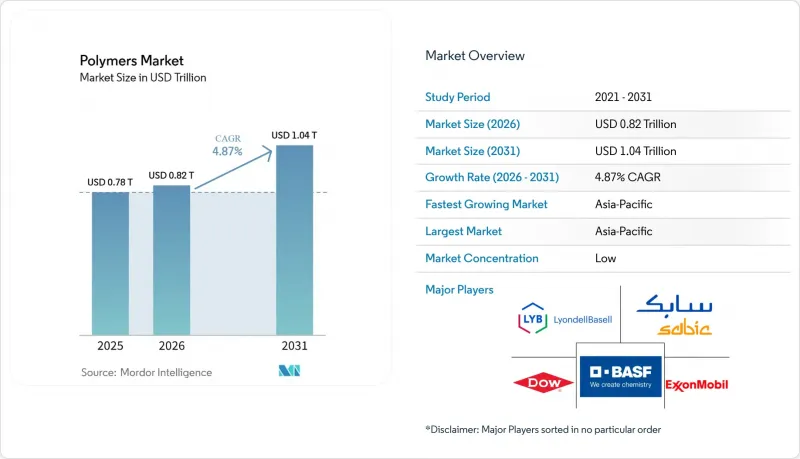
根據 Mordor Intelligence 估計,2025 年聚合物市值為 7,800 億美元,預計在預測期(2026-2031 年)內將以 4.87% 的複合年成長率成長,從 2026 年的 8,200 億美元成長到 2031 年的 1.04 億美元。
本報告按聚合物類型(例如熱塑性塑膠)、樹脂(例如聚乙烯 (PE))、加工技術(例如射出成型)、應用領域(例如包裝)、終端用戶產業(如包裝產業)和地區(亞太地區、北美地區、歐洲地區、南美地區、中東和非洲)進行細分。市場預測以美元 (USD) 為單位。
全球聚合物市場趨勢與洞察
受電子商務、食品配送和醫療保健供應鏈的推動,包裝產業對聚合物的需求不斷成長。
電子商務包裝仍然是全球物流網路中聚合物需求的主要來源。聚乙烯薄膜郵寄信封、聚丙烯打包帶和聚對苯二甲酸乙二醇酯(PET)托盤為大規模的末端配送提供了支援。醫療供應鏈也需要使用高等級聚乙烯(PE)和聚丙烯(PP)的一次性包裝。中國、印度和東南亞食品配送的成長正在推動對聚丙烯容器和保溫包裝的需求。信實工業報告稱,即使中東供應中斷影響了2026年的整體石化產品需求,國內包裝需求仍然強勁。這些因素綜合起來,使得聚合物市場的包裝需求比單一終端用途的需求更具韌性。
輕質聚合物在汽車和電動車 (EV) 製造領域的應用日益廣泛
隨著電動車的生產,聚合物的應用正轉向工程級材料,用於電池外殼、溫度控管系統和結構件。用聚合物取代某些金屬部件可以減輕車輛重量,並有助於增加續航里程。汽車製造商正與特種聚合物供應商合作,開發既滿足性能要求又滿足再生材料含量要求的材料。 2026年2月,Autoneum公司發表了一款基於聚酯的電池式電動車前行李箱解決方案,其再生材料含量高達70%。該產品已被亞洲和歐洲的三家領先製造商採用並投入量產。經Composites United認證的熱塑性電池外殼與標準鋁製設計相比,重量減輕了15%,並通過了Euro NCAP碰撞測試。這些應用推動了聚合物市場高價值細分市場的發展。
嚴格的塑膠廢棄物法規和不斷上漲的環境合規成本
歐盟包裝及包裝廢棄物法規 (PPWR) 規定,到 2030 年,歐盟市場上流通的塑膠包裝必須可回收利用,並達到最低消費後再生材料含量要求。對於非 PET 包裝(食品接觸應用中再生材料的使用受到限制),所需的再生材料含量為 10%;對於一般塑膠包裝,則為 35%,並且計劃在 2040 年實施更高的標準。包裝製造商和品牌所有者必須審查其設計、對材料合格,並投資於經認證的再生材料。這些成本可能相當可觀,尤其是在食品接觸或性能要求限制了可用材料選擇的情況下。此外,法國、德國和荷蘭的生產者延伸責任制 (EPR) 計劃將對進入這些市場的包裝材料徵收年度費用。因此,聚合物市場面臨更嚴格的合規環境,尤其是在歐洲。
細分市場分析
預計到2025年,熱塑性塑膠將佔銷售額的68.72%,成為聚合物市場中最大的細分市場。其可回收性以及與射出成型和擠出成型工藝的兼容性,使其應用範圍十分廣泛。聚乙烯(PE)、聚丙烯(PP)和聚氯乙烯(PVC)在熱塑性塑膠市場中佔據重要佔有率。工程熱塑性塑膠,例如聚醯胺、聚碳酸酯和聚醚醚酮(PEEK),則廣泛應用於高價值的汽車和電子產品領域。熱固性樹脂在風力發電機葉片、航太複合材料和電子層壓板等領域仍然發揮著重要作用,但其較低的可回收性在永續性要求更為嚴格的地區造成了壓力。
預計2026年至2031年間,生物基聚合物的複合年成長率將達9.42%。由於各品牌的努力和採購需求,這些材料正逐漸擺脫小眾市場的限制。 NatureWorks公司已將其泰國工廠的PLA產能提高了7.5萬噸,有助於降低大批量包裝加工商的成本門檻。在巴西和芬蘭建造的第二代木質纖維素原料生產設施正在拓展原料選擇範圍,減少對與糧食作物競爭的農作物的依賴,並推動整個聚合物產業開發低碳材料。
到2025年,聚乙烯將佔銷售額的28.16%,成為聚合物市場中最大的樹脂細分市場。高密度聚乙烯(HDPE)、低密度聚乙烯(LDPE)和線性低密度聚乙烯(LLDPE)兼具食品接觸適用性、靈活的加工性能和具有競爭力的成本,廣泛應用於硬質包裝、軟包裝薄膜、管道和消費品領域。聚丙烯仍然是建築、汽車和醫療行業的主要樹脂。聚對苯二甲酸乙二醇酯(PET)用於飲料包裝和紡織品應用,而聚氯乙烯(PVC)仍然是建築材料和醫用導管的重要材料。
預計到2031年,工程塑膠的複合年成長率將達到5.74%。汽車電氣化對聚碳酸酯和聚醯胺的需求日益成長,這些材料必須能夠滿足熱學和電學要求。半導體和5G應用也需要高度穩定和高純度的聚合物材料。再生聚碳酸酯共聚物能夠滿足汽車裝飾件應用和再生材料含量的要求。專用等級的聚合物使製造商能夠專注於高性能產品而非通用產品,從而推動聚合物市場向高附加價值樹脂的需求轉型。
區域分析
預計到2025年,亞太地區將佔全球銷售額的50.76%,並在2031年之前以6.35%的複合年成長率成長,成為聚合物市場最大的佔有率地區。中國擁有大規模的生產能力和可觀的國內消費量。 2026年3月,BASF在湛江開設了一家全球一體化生產基地,其中包括一座運作再生能源的年產100萬噸乙烯蒸氣裂解裝置。在印度,巴斯夫正透過信實工業在達赫杰和納戈坦的項目,擴大聚氯乙烯(PVC)和氯化聚氯乙烯(CPVC)的產能。
在東南亞,包裝材料和消費品是推動需求的主要因素。日本和韓國是電子和汽車應用領域工程聚合物的重要市場。在北美,乙烷裂解裝置由於運作成本低於石腦油裂解系統,因此在原料成本方面具有優勢。萊昂內爾·巴塞爾公司於2025年3月批准了其位於Channel Vue的丙烯產能增加40萬噸的計劃,預計將於2028年下半年運作。在歐洲,企業正透過停產、減產以及投資可回收和再生等級聚合物來應對石腦油成本劣勢。這些發展正在重塑聚合物市場的區域貿易和投資格局。
在南美洲、中東和非洲,建築、包裝和工業發展是推動需求的主要因素。在巴西,基礎設施項目和加工食品生產支撐著當地的消費。中東仍然是主要的生產中心,對建築和醫療材料的需求不斷成長。海灣國家的建設項目支撐著沙烏地阿拉伯、阿拉伯聯合大公國(阿拉伯聯合大公國)和埃及的消費。非洲的成長則得益於包裝、灌溉和建築業的低迷需求。儘管這些市場在材料需求和本地生產能力方面存在差異,但它們正在擴大聚合物市場的地域覆蓋範圍。
其他好處:
- Excel格式的市場預測(ME)表
- 3個月的分析師支持
目錄
第1章:引言
- 研究假設和市場定義
- 調查範圍
第2章:調查方法
第3章執行摘要
第4章 市場狀況
- 市場概覽
- 市場促進因素
- 受電子商務、食品配送和醫療保健供應鏈的推動,對包裝聚合物的需求正在擴大。
- 在汽車和電動車製造中擴大輕質聚合物的使用
- 基礎設施、住宅建築和公共工程管道應用中聚合物消耗量增加。
- 對再生材料含量的強制性要求日益提高,推動了對經認證的再生聚合物樹脂的需求。
- 擴大聚合物生產能力並實現下游加工設施的本地化。
- 市場限制因素
- 嚴格的塑膠廢棄物法規和不斷上漲的環境合規成本
- 石油化工原料與能源價格波動
- 用於食品接觸和汽車應用的高品質再生樹脂供應有限。
- 價值鏈分析
- 波特五力分析
第5章 市場規模與成長預測
- 按聚合物類型
- 熱塑性塑膠
- 通用熱塑性樹脂
- 工程熱塑性樹脂
- 高性能熱塑性塑膠
- 熱固性
- 彈性體
- 生物基聚合物
- 其他聚合物種類
- 熱塑性塑膠
- 依樹脂類型
- 聚乙烯(PE)
- 高密度聚苯乙烯(HDPE)
- 低密度聚乙烯(LDPE)
- 線型低密度聚乙烯(LLDPE)
- 聚丙烯(PP)
- 聚氯乙烯(PVC)
- 聚對苯二甲酸乙二醇酯(PET)
- 聚苯乙烯(PS)
- 聚氨酯(PU)
- 工程塑膠
- 其他樹脂
- 聚乙烯(PE)
- 透過加工技術
- 射出成型
- 擠壓
- 吹塑成型
- 熱成型
- 壓縮成型
- 日曆
- 旋轉成型和澆鑄
- 積層製造(3D列印)
- 其他加工技術
- 透過使用
- 包裝
- 軟包裝
- 硬包裝
- 建造
- 汽車和運輸業
- 農業
- 電氣和電子設備
- 紡織品
- 醫療保健
- 消費品
- 其他用途
- 包裝
- 按最終用戶行業分類
- 包裝產業
- 建築/施工
- 汽車和運輸業
- 電氣和電子設備
- 農業
- 醫療和藥品
- 紡織業
- 消費品
- 工業和能源
- 其他終端用戶產業
- 按地區
- 亞太地區
- 中國
- 印度
- 日本
- 韓國
- 其他亞太國家
- 北美洲
- 美國
- 加拿大
- 墨西哥
- 歐洲
- 德國
- 英國
- 法國
- 義大利
- 俄羅斯
- 其他歐洲國家
- 南美洲
- 巴西
- 阿根廷
- 其他南美國家
- 中東和非洲
- 沙烏地阿拉伯
- 南非
- 其他中東和非洲國家
- 亞太地區
第6章 競爭情勢
- 市場集中度
- 策略趨勢
- 市佔率和排名分析
- 公司簡介
- BASF
- Arkema
- Celanese Corporation
- Chevron Phillips Chemical Company LLC
- Covestro AG
- Dow
- Eastman Chemical Company
- Evonik Industries AG
- Exxon Mobil Corporation
- Formosa Plastics Corporation
- INEOS
- LG Chem Ltd.
- LyondellBasell Industries Holdings BV
- Mitsubishi Chemical Group Corporation
- Reliance Industries Limited
- SABIC
- Solvay SA
- Toray Industries, Inc.
第7章 市場機會與未來展望
According to Mordor Intelligence, the polymers market size was estimated at USD 0.78 trillion in 2025 and is estimated to grow from USD 0.82 trillion in 2026 to USD 1.04 trillion by 2031, at a CAGR of 4.87% during the forecast period (2026-2031).
This report is Segmented by Polymer Type (Thermoplastics and More), Resin (Polyethylene (PE) and More), Processing Technology (Injection Molding and More), Application (Packaging and More), End-User Industry (Packaging Industry and More), and Geography (Asia-Pacific, North America, Europe, South America, and Middle-East and Africa). The Market Forecasts are Provided in Terms of Value (USD).
Global Polymers Market Trends and Insights
Growing Demand for Polymers in Packaging Driven by E-Commerce, Food Delivery, and Healthcare Supply Chains
E-commerce packaging remains a major source of polymer demand across global shipping networks. Polyethylene film mailers, polypropylene strapping, and polyethylene terephthalate (PET) trays support last-mile delivery formats at commercial scale. Healthcare supply chains also require single-use packaging that uses higher-specification polyethylene (PE) and polypropylene (PP) grades. Growth in food delivery in China, India, and Southeast Asia is driving demand for polypropylene containers and insulated packaging. Reliance Industries reported healthy domestic packaging demand even when Middle-East supply disruptions affected broader petrochemical offtake in 2026. This combination makes packaging demand more resilient for the polymers market than demand tied to a single end use.
Rising Adoption of Lightweight Polymers in Automotive and Electric Vehicle Manufacturing
Electric vehicle production is shifting polymer use toward engineering grades for battery housing, thermal systems, and structural parts. Replacing selected metal components with polymers can lower vehicle weight and support driving range. Automotive manufacturers are working with specialty polymer suppliers to develop materials that meet both performance and recycled-content requirements. Autoneum introduced a polyester-based front trunk solution in February 2026 with up to 70% recycled content for battery electric vehicles. The product was already selected by three major manufacturers in Asia and Europe for serial production. A thermoplastic battery housing recognized by Composites United reduced weight by 15% against an aluminum reference design and passed Euro NCAP impact tests. These applications serve a higher-value segment of the polymers market.
Stringent Plastic Waste Regulations and Rising Environmental Compliance Costs
The Packaging and Packaging Waste Regulation (PPWR) requires that plastic packaging placed on the EU market be recyclable and contain a minimum post-consumer recycled content by 2030. Required recycled content ranges from 10% for contact-sensitive non-PET packaging to 35% for general plastic packaging, with higher thresholds planned for 2040. Packaging converters and brand owners must invest in redesign, material qualification, and certified recycled feedstock. These costs can be high when food-contact or performance requirements limit available material choices. Extended producer responsibility schemes in France, Germany, and the Netherlands also add annual fees for packaging placed on those markets. The polymers market, therefore, faces a more demanding compliance environment, particularly in Europe.
Other drivers and restraints analyzed in the detailed report include:
- Increasing Polymer Consumption in Infrastructure, Residential Construction, and Utility Pipe Applications
- Expanding Recycled Content Mandates Driving Demand for Certified Recycled Polymer Resins
- Volatility in Petrochemical Feedstock and Energy Prices
For complete list of drivers and restraints, kindly check the Table Of Contents.
Segment Analysis
Thermoplastics accounted for 68.72% of revenue in 2025, making them the largest segment of the polymers market. Their recyclability and compatibility with injection molding and extrusion support wide use. PE, PP, and PVC make up a large share of the thermoplastic market. Engineering thermoplastics such as polyamide, polycarbonate, and PEEK serve higher-value automotive and electronics applications. Thermosets remain important in wind turbine blades, aerospace composites, and electrical laminates, though their limited recyclability creates pressure in regions with stricter sustainability requirements.
Bio-based polymers are forecast to grow at a 9.42% CAGR from 2026 to 2031. Brand commitments and purchasing requirements are moving these materials beyond a voluntary niche. NatureWorks added 75,000 metric tons of PLA capacity at its Thailand facility, helping reduce the cost barrier for high-capacity packaging converters. Second-generation lignocellulosic feedstock facilities in Brazil and Finland have broadened raw material options, reducing reliance on food-competitive crops and supporting the development of lower-carbon material choices across the polymers industry.
Polyethylene accounted for 28.16% of revenue in 2025, making it the largest resin segment in the polymers market. HDPE, LDPE, and LLDPE offer food-contact suitability, flexible processing, and competitive costs, and are used in rigid packaging, flexible films, pipes, and consumer products. Polypropylene remains a major resin for construction, automotive, and healthcare applications. PET supports beverage packaging and textile fiber, while PVC remains essential in construction products and medical tubing.
Engineering plastics are projected to grow at a 5.74% CAGR through 2031. Automotive electrification requires polycarbonate and polyamide grades capable of managing heat and electrical demands. Semiconductor and 5G applications also require stable, high-purity polymer materials. Recycled-content polycarbonate copolymers can support automotive trim applications and recycled-content requirements. Specialty grades allow producers to focus on performance rather than commodity output, giving the polymers market a path toward higher-value resin demand.
Complete Report Scope:
- By Polymer Type
- Thermoplastics
- Commodity Thermoplastics
- Engineering Thermoplastics
- High-Performance Thermoplastics
- Thermosets
- Elastomers
- Bio-Based Polymers
- Other Polymer Types
- Thermoplastics
- By Resin
- Polyethylene (PE)
- High-Density Polyethylene (HDPE)
- Low-Density Polyethylene (LDPE)
- Linear Low-Density Polyethylene (LLDPE)
- Polypropylene (PP)
- Polyvinyl Chloride (PVC)
- Polyethylene Terephthalate (PET)
- Polystyrene (PS)
- Polyurethane (PU)
- Engineering Plastics
- Other Resins
- Polyethylene (PE)
- By Processing Technology
- Injection Molding
- Extrusion
- Blow Molding
- Thermoforming
- Compression Molding
- Calendering
- Rotational Molding and Casting
- Additive Manufacturing (3D Printing)
- Other Processing Technologies
- By Application
- Packaging
- Flexible Packaging
- Rigid Packaging
- Construction
- Automotive and Transportation
- Agriculture
- Electrical and Electronics
- Textile
- Healthcare and Medical
- Consumer Goods
- Other Applications
- Packaging
- By End-User Industry
- Packaging Industry
- Building and Construction
- Automotive and Transportation
- Electrical and Electronics
- Agriculture
- Healthcare and Pharmaceuticals
- Textile Industry
- Consumer Goods
- Industrial and Energy
- Other End-User Industries
- By Geography
- Asia-Pacific
- China
- India
- Japan
- South Korea
- Rest of Asia-Pacific
- North America
- United States
- Canada
- Mexico
- Europe
- Germany
- United Kingdom
- France
- Italy
- Russia
- Rest of Europe
- South America
- Brazil
- Argentina
- Rest of South America
- Middle-East and Africa
- Saudi Arabia
- South Africa
- Rest of Middle-East and Africa
- Asia-Pacific
Geography Analysis
Asia-Pacific accounted for 50.76% of global revenue in 2025 and is expected to grow at a 6.35% CAGR through 2031, giving the region the largest share of the polymers market. China combines large-scale production capacity with significant domestic consumption. BASF inaugurated its world-scale Verbund site in Zhanjiang in March 2026, which includes a 1-million-ton ethylene steam cracker powered by renewable electricity. India is expanding polyvinyl chloride (PVC) and chlorinated polyvinyl chloride (CPVC) capacity through Reliance Industries projects at Dahej and Nagothane.
Southeast Asia supports demand through packaging and consumer goods. Japan and South Korea are important markets for engineering polymers used in electronics and automotive applications. North America retains a feedstock cost advantage, as ethane-based crackers operate at lower costs than naphtha-based systems. LyondellBasell approved a 400,000-ton expansion of propylene capacity at Channelview in March 2025, with startup targeted for late 2028. Europe is adjusting to its naphtha cost disadvantage through closures, capacity reductions, and investment in recyclable and recycled-content grades. These conditions are reshaping regional trade and investment patterns in the polymers market.
South America, the Middle-East, and Africa contribute demand through construction, packaging, and industrial development. Brazil supports regional consumption through infrastructure projects and processed food production. The Middle-East remains a major production center and a growing demand area for construction and healthcare materials. Gulf construction programs are supporting consumption in Saudi Arabia, the UAE, and Egypt. Africa is growing from a lower base in packaging, irrigation, and construction. These markets expand the geographic reach of the polymers market while differing in material needs and local production capacity.
- BASF
- Arkema
- Celanese Corporation
- Chevron Phillips Chemical Company LLC
- Covestro AG
- Dow
- Eastman Chemical Company
- Evonik Industries AG
- Exxon Mobil Corporation
- Formosa Plastics Corporation
- INEOS
- LG Chem Ltd.
- LyondellBasell Industries Holdings B.V.
- Mitsubishi Chemical Group Corporation
- Reliance Industries Limited
- SABIC
- Solvay S.A.
- Toray Industries, Inc.
Additional Benefits:
- The market estimate (ME) sheet in Excel format
- 3 months of analyst support
TABLE OF CONTENTS
1 Introduction
- 1.1 Study Assumptions and Market Definition
- 1.2 Scope of the Study
2 Research Methodology
3 Executive Summary
4 Market Landscape
- 4.1 Market Overview
- 4.2 Market Drivers
- 4.2.1 Growing Demand for Polymers in Packaging Driven by E-Commerce, Food Delivery, and Healthcare Supply Chains
- 4.2.2 Rising Adoption of Lightweight Polymers in Automotive and Electric Vehicle Manufacturing
- 4.2.3 Increasing Polymer Consumption in Infrastructure, Residential Construction, and Utility Pipe Applications
- 4.2.4 Expanding Recycled Content Mandates Driving Demand for Certified Recycled Polymer Resins
- 4.2.5 Capacity Expansion in Polymer Production and Localization of Downstream Processing Facilities
- 4.3 Market Restraints
- 4.3.1 Stringent Plastic Waste Regulations and Rising Environmental Compliance Costs
- 4.3.2 Volatility in Petrochemical Feedstock and Energy Prices
- 4.3.3 Limited Availability of High-Quality Recycled Resins for Food-Contact and Automotive Applications
- 4.4 Value Chain Analysis
- 4.5 Porter's Five Forces Analysis
- 4.5.1 Threat of New Entrants
- 4.5.2 Bargaining Power of Suppliers
- 4.5.3 Bargaining Power of Buyers
- 4.5.4 Threat of Substitutes
- 4.5.5 Competitive Rivalry
5 Market Size and Growth Forecasts (Value)
- 5.1 By Polymer Type
- 5.1.1 Thermoplastics
- 5.1.1.1 Commodity Thermoplastics
- 5.1.1.2 Engineering Thermoplastics
- 5.1.1.3 High-Performance Thermoplastics
- 5.1.2 Thermosets
- 5.1.3 Elastomers
- 5.1.4 Bio-Based Polymers
- 5.1.5 Other Polymer Types
- 5.1.1 Thermoplastics
- 5.2 By Resin
- 5.2.1 Polyethylene (PE)
- 5.2.1.1 High-Density Polyethylene (HDPE)
- 5.2.1.2 Low-Density Polyethylene (LDPE)
- 5.2.1.3 Linear Low-Density Polyethylene (LLDPE)
- 5.2.2 Polypropylene (PP)
- 5.2.3 Polyvinyl Chloride (PVC)
- 5.2.4 Polyethylene Terephthalate (PET)
- 5.2.5 Polystyrene (PS)
- 5.2.6 Polyurethane (PU)
- 5.2.7 Engineering Plastics
- 5.2.8 Other Resins
- 5.2.1 Polyethylene (PE)
- 5.3 By Processing Technology
- 5.3.1 Injection Molding
- 5.3.2 Extrusion
- 5.3.3 Blow Molding
- 5.3.4 Thermoforming
- 5.3.5 Compression Molding
- 5.3.6 Calendering
- 5.3.7 Rotational Molding and Casting
- 5.3.8 Additive Manufacturing (3D Printing)
- 5.3.9 Other Processing Technologies
- 5.4 By Application
- 5.4.1 Packaging
- 5.4.1.1 Flexible Packaging
- 5.4.1.2 Rigid Packaging
- 5.4.2 Construction
- 5.4.3 Automotive and Transportation
- 5.4.4 Agriculture
- 5.4.5 Electrical and Electronics
- 5.4.6 Textile
- 5.4.7 Healthcare and Medical
- 5.4.8 Consumer Goods
- 5.4.9 Other Applications
- 5.4.1 Packaging
- 5.5 By End-User Industry
- 5.5.1 Packaging Industry
- 5.5.2 Building and Construction
- 5.5.3 Automotive and Transportation
- 5.5.4 Electrical and Electronics
- 5.5.5 Agriculture
- 5.5.6 Healthcare and Pharmaceuticals
- 5.5.7 Textile Industry
- 5.5.8 Consumer Goods
- 5.5.9 Industrial and Energy
- 5.5.10 Other End-User Industries
- 5.6 By Geography
- 5.6.1 Asia-Pacific
- 5.6.1.1 China
- 5.6.1.2 India
- 5.6.1.3 Japan
- 5.6.1.4 South Korea
- 5.6.1.5 Rest of Asia-Pacific
- 5.6.2 North America
- 5.6.2.1 United States
- 5.6.2.2 Canada
- 5.6.2.3 Mexico
- 5.6.3 Europe
- 5.6.3.1 Germany
- 5.6.3.2 United Kingdom
- 5.6.3.3 France
- 5.6.3.4 Italy
- 5.6.3.5 Russia
- 5.6.3.6 Rest of Europe
- 5.6.4 South America
- 5.6.4.1 Brazil
- 5.6.4.2 Argentina
- 5.6.4.3 Rest of South America
- 5.6.5 Middle-East and Africa
- 5.6.5.1 Saudi Arabia
- 5.6.5.2 South Africa
- 5.6.5.3 Rest of Middle-East and Africa
- 5.6.1 Asia-Pacific
6 Competitive Landscape
- 6.1 Market Concentration
- 6.2 Strategic Moves
- 6.3 Market Share (%)/Ranking Analysis
- 6.4 Company Profiles (includes Global Overview, Market Overview, Core Segments, Financials as available, Strategic Information, Products and Services, and Recent Developments)
- 6.4.1 BASF
- 6.4.2 Arkema
- 6.4.3 Celanese Corporation
- 6.4.4 Chevron Phillips Chemical Company LLC
- 6.4.5 Covestro AG
- 6.4.6 Dow
- 6.4.7 Eastman Chemical Company
- 6.4.8 Evonik Industries AG
- 6.4.9 Exxon Mobil Corporation
- 6.4.10 Formosa Plastics Corporation
- 6.4.11 INEOS
- 6.4.12 LG Chem Ltd.
- 6.4.13 LyondellBasell Industries Holdings B.V.
- 6.4.14 Mitsubishi Chemical Group Corporation
- 6.4.15 Reliance Industries Limited
- 6.4.16 SABIC
- 6.4.17 Solvay S.A.
- 6.4.18 Toray Industries, Inc.
7 Market Opportunities and Future Outlook
- 7.1 White-Space and Unmet-Need Assessment
- 7.2 Certified Recycled Resin for Food-Contact and Medical Applications

 自修復聚合物和塗料市場預測至2034年—按材料類型、修復機制、形態、最終用戶和地區分類的全球分析
 末端羥基聚丁二烯市場規模、佔有率和成長分析:按等級、應用、最終用戶和地區分類-2026-2033年產業預測
 無機和有機雜化聚合物市場規模、佔有率和成長分析:按聚合物類型、無機成分、形態、應用、最終用途產業和地區分類 - 2026-2033 年產業預測
 矽烷封端聚合物市場報告:趨勢、預測與競爭分析(至2035年)
 2026年全球均聚聚丙烯市場報告
 丙烯酸酯共聚物市場規模、佔有率和趨勢分析報告:按產品形式、應用、地區和細分市場預測(2026-2033 年)綠色聚合物添加劑市場預測至2034年—按產品類型、聚合物類型、應用、功能、最終用戶和地區分類的全球分析
 血液相容性聚合物市場規模、佔有率和成長分析:按聚合物類型、應用、形態、最終用戶和地區分類-2026-2033年產業預測
 超分子聚合物市場分析與預測(至2035年):類型、產品、技術、應用、形態、材料類型、製程、最終用戶、功能、解決方案
 聚乙烯亞胺市場-2026-2032年全球市場預測