


 |
市場調查報告書
商品編碼
2155620
太陽能塗層:市場佔有率分析、產業趨勢與統計、成長預測(2026-2031)Photovoltaic Coating - Market Share Analysis, Industry Trends & Statistics, Growth Forecasts (2026 - 2031) |
||||||

※ 本網頁內容可能與最新版本有所差異。詳細情況請與我們聯繫。
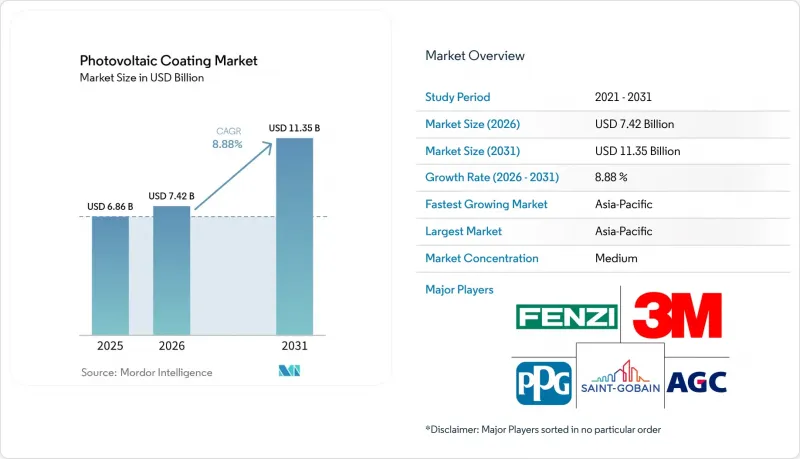
據 Mordor Intelligence 稱,2025 年太陽能塗層市場價值為 68.6 億美元,預計將從 2026 年的 74.2 億美元成長到 2031 年的 113.5 億美元,預測期(2026-2031 年)的複合年成長率為 8.88%。
全球太陽能塗層市場趨勢與洞察
太陽能發電能力的擴張和組件製造的成長
預計2025年,新增太陽能發電裝置容量將達到698吉瓦,使全球累積發電量超過3太瓦。如此龐大的裝置規模正推動著太陽能塗層市場對需要功能性表面處理的組件玻璃的需求不斷成長。由於塗層組件的玻璃面積較大,即使新裝置中塗佈應用略有增加,也能產生顯著的需求。預計2025年,中國新增太陽能發電裝置容量將達到415吉瓦,國內需求將驅動供應商的供應和採購慣例行為。預計到2025年,印度將新增55.9吉瓦,其多塵的運作環境將促使防污處理的應用更加廣泛。國際能源總署(IEA)預測,到2030年代中期,新增太陽能發電裝置容量將超過每年600吉瓦,這將支撐本報告涵蓋時期之後的持續需求。
透過防反射和多功能塗層提高效率。
在光伏塗層市場,抗反射塗層仍然至關重要,因為透過蓋玻片損失的光線無法透過下游電池精煉製程回收。 2026 年的一項同行評審研究表明,最佳化後的介電塗層組合可以根據太陽光的頻譜特性進行客製化。這些結果使得在製造商追求高發電量且不改變組件面積的情況下,塗層的選擇變得更加關鍵。多功能塗層還可以結合抗反射和溫度控管功能,這在組件溫度升高導致功率輸出下降的情況下非常有用。因此,採購團隊可以結合預期發電量、減少清潔頻率和運作條件來評估塗層成本,而不是只是將其視為裝飾性元素。
優質塗層的成本相對於組件價格的下降
根據國際光電技術藍圖(ITRPV),2024年大部分時間光電模組現貨價格為每瓦0.07至0.08美元,但2025年回升至加權平均每瓦0.09美元。優質塗層會增加每瓦0.005至0.010美元的成本,因此受到優先考慮專案初始成本的開發商的嚴格審查。在新興市場,這種限制更為顯著,因為在這些市場,資本投資往往優先於生命週期性能。同時,歐洲和北美的開發人員更重視由獨立機構檢驗的發電量和營運數據。此外,銀價飆升也減少了組件製造商在2025年吸收額外材料成本的空間。即使產品的技術價值顯而易見,這些價格壓力也正在減緩光電塗層市場的普及。
細分市場分析
到2025年,抗反射膜將佔據太陽能塗層市場42.67%的佔有率。這一佔有率反映了組件玻璃在OEM(目的地設備製造商)和維修應用中的廣泛使用。這些塗層可以減少外表面的反射損耗,從而提高運作條件下的發電效率。對抗反射結構的持續研究不斷提升了最佳化介電層以匹配太陽頻譜的能力。在太陽能塗層產業,這種性能優勢使抗反射塗層區別於主要用於清潔和外觀的處理過程。其對標準晶體矽組件的廣泛適用性也鞏固了其市場地位。
自清潔塗層預計到2031年將以9.35%的複合年成長率成長。此類光伏塗層的市場規模主要受乾旱地區電力項目的需求驅動,因為在這些地區,灰塵積聚會顯著降低年發電量。親水塗層和疏水塗層旨在減少人工清潔的頻率和工作量,但其性能取決於當地的氣候條件和灰塵特性。中國標準T/CADZ 0077-2026規定了應用於光伏玻璃的自清潔奈米塗層的技術要求、測試方法、檢驗標準和分類。導電塗層的應用相對較少,但仍作為異質接面技術(HJT)和薄膜組件設計中的透明電極層發揮重要作用。其他產品,例如疏水塗層、防霧塗層和紫外線阻隔塗層,則用於某些住宅和家用電子電器應用,在這些應用中,外觀和耐久性是關鍵的選擇標準。
區域分析
預計到2025年,亞太地區將以41.34%的市佔率引領太陽能塗層市場,並在2031年之前以9.67%的複合年成長率持續成長。根據國際能源總署光伏發電戰略(IEA-PVPS)的數據,中國將在2025年新增415吉瓦的太陽能發電裝置容量,使其累積設備容量達到1463吉瓦。如此龐大的裝機規模使中國在需求、標準和供應商認證方面都處於全球太陽能塗層市場的中心地位。印度預計2025年新增55.9吉瓦的裝置容量,該國高粉塵暴露環境將推動防污產品的需求。中國標準「T/CERS 0144-2025」和「T/CADZ 0077-2026」正式規定了電站和太陽能玻璃自清潔奈米塗層的要求。日本累積裝置容量達102.7吉瓦,是適用於高濕度和沿海污染環境的塗層成熟市場。
在北美和歐洲,對高性能、高規格塗料的需求仍然強勁。德國計劃在2025年新增17吉瓦的產能,使其累積產能達到117.3吉瓦,計畫中的部署將滿足工廠塗料和維修解決方案的需求。南歐是半乾式運轉條件下防污塗料的關鍵市場,西班牙計畫在2025年新增14吉瓦的產能。歐洲的PFAS法規給依賴傳統氟聚合物化學的供應商帶來了壓力,同時也為滿足性能和合規要求的替代方案開闢了道路。在北美,《通膨控制法案》下的國內採購獎勵可能會增強那些生產或滿足本地採購要求的供應商的地位。
在中東、非洲和南美洲,清潔和水資源管理是需要重點考慮的運作環境。沙烏地阿拉伯在國營電力公司的支持下,預計到2025年將新增約7吉瓦的太陽能發電裝置容量。在沙漠環境中,灰塵積聚和清潔延遲會導致發電量顯著下降。巴西預計到2025年將新增13.8吉瓦的太陽能發電裝置容量,其半乾旱內陸地區與其他乾旱地區的太陽能發電環境共用一些相似的運作特性。南非預計到2025年太陽能發電裝置容量將超過3吉瓦,凸顯了建立系統化運作維護系統的必要性。在這些地區,採用自清潔塗層可以減少清潔頻率和用水量。
其他好處:
- Excel格式的市場預測(ME)表
- 3個月的分析師支持
目錄
第1章:引言
- 研究假設和市場定義
- 調查範圍
第2章:調查方法
第3章執行摘要
第4章 市場狀況
- 市場概覽
- 市場促進因素
- 太陽能發電能力的擴張和組件製造的成長
- 透過抗反射膜和多功能塗層提高效率。
- 水資源短缺和太陽能板清潔成本上升
- 雙面光電探測器、TOPCon、HJT 和鈣鈦礦模組的成長
- 塗層認證作為新型模組技術中「銀行貸款合格」的區分因素。
- 市場限制因素
- 優質塗層的成本相對於組件價格的下降
- 長期耐久性檢驗與保固風險
- 改裝線的整合和塗層應用的均勻性有限制。
- 價值鏈分析
- 波特五力分析
第5章 市場規模與成長預測
- 按塗層類型
- 抗反射膜
- 自清潔塗層
- 導電塗層
- 其他
- 透過使用
- 太陽能板
- 車
- 家用電子產品
- 紡織品
- 其他
- 按地區
- 亞太地區
- 中國
- 印度
- 日本
- 韓國
- 東南亞國協
- 其他亞太國家
- 北美洲
- 美國
- 加拿大
- 墨西哥
- 歐洲
- 德國
- 英國
- 法國
- 義大利
- 北歐國家
- 其他歐洲國家
- 南美洲
- 巴西
- 阿根廷
- 其他南美國家
- 中東和非洲
- 沙烏地阿拉伯
- 南非
- 其他中東和非洲國家
- 亞太地區
第6章 競爭情勢
- 市場集中度
- 策略趨勢
- 市佔率和排名分析
- 公司簡介
- 3M
- AGC Inc.
- Akzo Nobel NV
- Arkema
- BASF
- Covestro AG
- DuPont
- Eastman Chemical Company
- FENZI SpA
- Guardian Glass
- Koninklijke DSM NV
- nanopool GmbH
- Pellucere
- PPG Industries, Inc.
- Saint-Gobain
第7章 市場機會與未來展望
According to Mordor Intelligence, the photovoltaic coating market size was valued at USD 6.86 billion in 2025 and is estimated to grow from USD 7.42 billion in 2026 to USD 11.35 billion by 2031, at a CAGR of 8.88% during the forecast period (2026-2031).
Global Photovoltaic Coating Market Trends and Insights
Solar PV Capacity Expansion and Module Manufacturing Growth
Solar photovoltaic additions reached 698 GW in 2025, bringing cumulative global capacity beyond 3 TW. This deployment base provides the photovoltaic coating market with a large and growing quantity of module glass requiring functional surface treatment. Even a limited increase in coating adoption in new installations can create substantial demand, as each coated module has a large glass area. China installed 415 GW of capacity in 2025, making domestic demand central to suppliers' quantities and procurement practices. India added 55.9 GW in 2025, and its dusty operating conditions strengthen the use case for anti-soiling treatments. The International Energy Agency expects solar additions to remain above 600 GW annually through the mid-2030s, which supports sustained demand beyond the report period.
Efficiency Gains from Anti-Reflective and Multifunctional Coatings
Anti-reflective products remain important to the photovoltaic coating market because light lost at the cover glass cannot be recovered by downstream cell improvements. A 2026 peer-reviewed study also showed how optimized combinations of dielectric coatings can be tuned for solar spectral performance. These results make coating selection more relevant when manufacturers seek higher yield without changing the module footprint. Multifunctional layers can also combine anti-reflection with thermal management, which is useful where high module temperatures reduce electrical output. Procurement teams can therefore assess coating costs against expected energy yield, cleaning reduction, and operating conditions, rather than treating the coating as a purely cosmetic input.
Premium Coating Cost Relative to Declining Module Prices
Module spot prices were USD 0.07-0.08/W for much of 2024 before recovering to a weighted-average of USD 0.09/W in 2025, according to the International Technology Roadmap for Photovoltaic (ITRPV). Premium coatings that add USD 0.005 to USD 0.010/W per watt face close scrutiny from developers focused on upfront project costs. This constraint is more visible in emerging markets, where capital expenditure often outweighs lifecycle performance in purchasing decisions. Developers in Europe and North America place greater emphasis on independently verified yield and operating data. Rising silver costs also reduced the margin available for module makers to absorb additional material costs in 2025. This pricing pressure slows uptake in the photovoltaic coating market, even when the technical value of a product is clear.
Other drivers and restraints analyzed in the detailed report include:
- Water Scarcity and Rising Solar-Panel Cleaning Costs
- Growth of Bifacial, TOPCon, HJT, and Perovskite Modules
- Long-Duration Durability Validation and Warranty Risk
For complete list of drivers and restraints, kindly check the Table Of Contents.
Segment Analysis
Anti-reflective coatings held 42.67% of the photovoltaic coating market share in 2025. Their position reflects widespread use of module glass across large areas in both original equipment manufacturing and retrofit applications. These coatings reduce reflection losses at the outer surface, supporting energy yield under operating conditions. Ongoing research on anti-reflective architectures continues to improve the ability to tailor dielectric layers for the solar spectrum. Within the photovoltaic coating industry, this performance role distinguishes anti-reflective layers from treatments selected primarily for cleaning or appearance. Their broad applicability across standard crystalline-silicon modules sustains their position.
Self-cleaning coatings are forecast to grow at a CAGR of 9.35% through 2031. The photovoltaic coating market size for this coating type is supported by utility projects in dry regions where dust accumulation can materially reduce annual generation. Hydrophilic and hydrophobic coatings aim to reduce the frequency or intensity of manual cleaning, although their performance depends on local weather and dust characteristics. China's T/CADZ 0077-2026 defined technical requirements, test methods, inspection criteria, and classifications for self-cleaning nanocoatings on photovoltaic glass. Conductive coatings serve a smaller role but remain important as transparent electrode layers in Heterojunction Technology (HJT) and thin-film module designs. Other products, including hydrophobic, anti-fogging, and ultraviolet-protective coatings, serve selected residential and consumer electronics applications where appearance and durability influence selection.
Complete Report Scope:
- By Coating Type
- Anti-Reflective Coatings
- Self-Cleaning Coatings
- Conductive Coatings
- Others
- By Application
- Solar Panels
- Automotive
- Consumer Electronics
- Textile
- Others
- By Geography
- Asia-Pacific
- China
- India
- Japan
- South Korea
- ASEAN Countries
- Rest of Asia-Pacific
- North America
- United States
- Canada
- Mexico
- Europe
- Germany
- United Kingdom
- France
- Italy
- NORDIC Countries
- Rest of Europe
- South America
- Brazil
- Argentina
- Rest of South America
- Middle East and Africa
- Saudi Arabia
- South Africa
- Rest of Middle East and Africa
- Asia-Pacific
Geography Analysis
Asia-Pacific led the photovoltaic coating market with a 41.34% share in 2025 and is forecast to expand at a 9.67% CAGR through 2031. China installed 415 GW of new photovoltaic capacity in 2025, bringing cumulative capacity to 1,463 GW, according to IEA-PVPS. This installation scale gives China a central role in demand, standards, and supplier qualification across the photovoltaic coating market. India added 55.9 GW in 2025, where high dust exposure supports demand for anti-soiling products. China's T/CERS 0144-2025 and T/CADZ 0077-2026 standards formalized requirements for self-cleaning nano coatings in power plants and on photovoltaic glass. Japan has 102.7 GW of cumulative capacity and is a mature market for coatings suited to high-humidity coastal soiling conditions.
North America and Europe have a strong demand for high-performance, premium-specification coatings. Germany added 17 GW in 2025 and held 117.3 GW of cumulative capacity, while its planned deployment pipeline supports demand for factory-applied and retrofit solutions. Spain installed 14 GW in 2025, making southern Europe relevant for anti-soiling applications in semi-arid operating conditions. European PFAS restrictions are placing pressure on suppliers that depend on legacy fluoropolymer chemistry, creating a pathway for alternatives that can meet both performance and compliance requirements. In North America, domestic-content incentives under the Inflation Reduction Act can strengthen the position of suppliers that qualify for local manufacturing or sourcing.
The Middle East, Africa, and South America present operating conditions where cleaning and water management are major considerations. Saudi Arabia added nearly 7 GW of solar capacity in 2025, supported by state utility programs. Desert environments can experience high output losses when dust accumulates and cleaning is delayed. Brazil installed 13.8 GW in 2025, and its semi-arid interior shares some operating characteristics with dry solar regions elsewhere. South Africa exceeded 3 GW of solar photovoltaic installations in 2025, underscoring the need for systematic operations and maintenance practices. In these regions, self-cleaning coatings can reduce cleaning frequency and water use where both are constrained.
- 3M
- AGC Inc.
- Akzo Nobel N.V.
- Arkema
- BASF
- Covestro AG
- DuPont
- Eastman Chemical Company
- FENZI S.p.A.
- Guardian Glass
- Koninklijke DSM NV
- nanopool GmbH
- Pellucere
- PPG Industries, Inc.
- Saint-Gobain
Additional Benefits:
- The market estimate (ME) sheet in Excel format
- 3 months of analyst support
TABLE OF CONTENTS
1 Introduction
- 1.1 Study Assumptions and Market Definition
- 1.2 Scope of the Study
2 Research Methodology
3 Executive Summary
4 Market Landscape
- 4.1 Market Overview
- 4.2 Market Drivers
- 4.2.1 Solar PV Capacity Expansion and Module Manufacturing Growth
- 4.2.2 Efficiency Gains from Anti-Reflective and Multifunctional Coatings
- 4.2.3 Water Scarcity and Rising Solar-Panel Cleaning Costs
- 4.2.4 Growth of Bifacial, TOPCon, HJT and Perovskite Modules
- 4.2.5 Coating Qualification as a Bankability Differentiator for New Module Technologies
- 4.3 Market Restraints
- 4.3.1 Premium Coating Cost Relative to Declining Module Prices
- 4.3.2 Long-Duration Durability Validation and Warranty Risk
- 4.3.3 Retrofit-Line Integration and Coating-Application Uniformity Constraints
- 4.4 Value Chain Analysis
- 4.5 Porter's Five Forces Analysis
- 4.5.1 Bargaining Power of Suppliers
- 4.5.2 Bargaining Power of Buyers
- 4.5.3 Threat of New Entrants
- 4.5.4 Threat of Substitutes
- 4.5.5 Competitive Rivalry
5 Market Size and Growth Forecasts (Value)
- 5.1 By Coating Type
- 5.1.1 Anti-Reflective Coatings
- 5.1.2 Self-Cleaning Coatings
- 5.1.3 Conductive Coatings
- 5.1.4 Others
- 5.2 By Application
- 5.2.1 Solar Panels
- 5.2.2 Automotive
- 5.2.3 Consumer Electronics
- 5.2.4 Textile
- 5.2.5 Others
- 5.3 By Geography
- 5.3.1 Asia-Pacific
- 5.3.1.1 China
- 5.3.1.2 India
- 5.3.1.3 Japan
- 5.3.1.4 South Korea
- 5.3.1.5 ASEAN Countries
- 5.3.1.6 Rest of Asia-Pacific
- 5.3.2 North America
- 5.3.2.1 United States
- 5.3.2.2 Canada
- 5.3.2.3 Mexico
- 5.3.3 Europe
- 5.3.3.1 Germany
- 5.3.3.2 United Kingdom
- 5.3.3.3 France
- 5.3.3.4 Italy
- 5.3.3.5 NORDIC Countries
- 5.3.3.6 Rest of Europe
- 5.3.4 South America
- 5.3.4.1 Brazil
- 5.3.4.2 Argentina
- 5.3.4.3 Rest of South America
- 5.3.5 Middle East and Africa
- 5.3.5.1 Saudi Arabia
- 5.3.5.2 South Africa
- 5.3.5.3 Rest of Middle East and Africa
- 5.3.1 Asia-Pacific
6 Competitive Landscape
- 6.1 Market Concentration
- 6.2 Strategic Moves
- 6.3 Market Share (%)/Ranking Analysis
- 6.4 Company Profiles (includes Global Overview, Market Overview, Core Segments, Financials as available, Strategic Information, Products and Services, and Recent Developments)
- 6.4.1 3M
- 6.4.2 AGC Inc.
- 6.4.3 Akzo Nobel N.V.
- 6.4.4 Arkema
- 6.4.5 BASF
- 6.4.6 Covestro AG
- 6.4.7 DuPont
- 6.4.8 Eastman Chemical Company
- 6.4.9 FENZI S.p.A.
- 6.4.10 Guardian Glass
- 6.4.11 Koninklijke DSM NV
- 6.4.12 nanopool GmbH
- 6.4.13 Pellucere
- 6.4.14 PPG Industries, Inc.
- 6.4.15 Saint-Gobain
7 Market Opportunities and Future Outlook
- 7.1 White-Space and Unmet-Need Assessment

 即插即用光電系統市場:全球市場預測,2026-2032年陽台系統整合設備市場:全球市場預測,2026-2032年電池供電陽台太陽能發電系統市場:全球市場預測,2026-2032年
 全球聚光型太陽光電)市場規模、佔有率、趨勢和成長分析報告(2026-2034)太陽能光電市場-全球預測,2026-2032年拋物槽式聚光太陽能發電市場 - 全球預測,2026-2032年
 聚光型太陽光電市場:按類型、產品、應用、國家和地區分類-全球產業分析、市場規模及佔有率和未來預測(2026-2033)太陽能發電系統安裝市場:按技術、安裝方式、功率轉換架構、應用和最終用戶分類-2026-2032年全球市場預測聚光型太陽熱能發電市場:按技術、容量、應用和最終用戶分類-2026-2032年全球市場預測
 聚光型太陽熱能發電(CSP):市場佔有率分析、行業趨勢和統計數據以及成長預測(2026-2031 年)