


 |
市場調查報告書
商品編碼
2100516
聚光型太陽熱能發電(CSP):市場佔有率分析、行業趨勢和統計數據以及成長預測(2026-2031 年)Concentrated Solar Power (CSP) - Market Share Analysis, Industry Trends & Statistics, Growth Forecasts (2026 - 2031) |
||||||

※ 本網頁內容可能與最新版本有所差異。詳細情況請與我們聯繫。
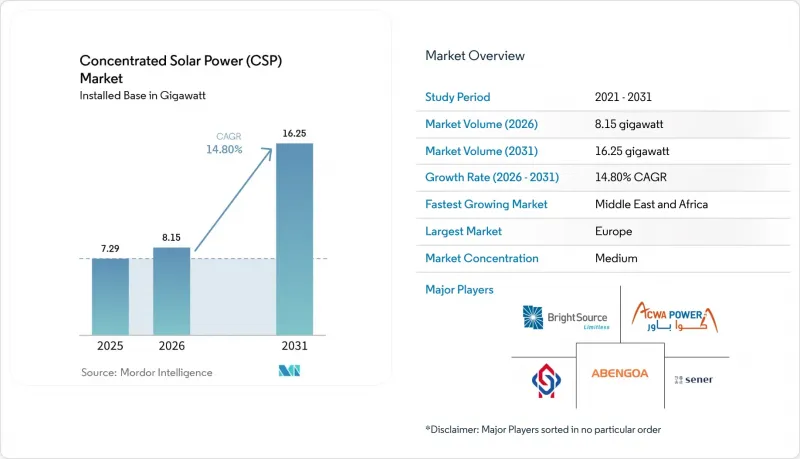
根據 Mordor Intelligence 預測,聚光型太陽熱能發電(CSP) 市場規模(基於裝置容量)預計將從 2025 年的 7.29 吉瓦和 2026 年的 8.15 吉瓦成長到 2031 年的 16.25 吉瓦,2026 年吉瓦成長到 2031 年的 16.25 吉瓦,2026 年至 2031 年的年複合成長率(CAGR)為 2031 年。
本報告按技術(槽式、菲涅爾式、塔式、碟式/斯特林式)、傳熱介質(熔鹽、合成油、直接蒸氣/水、其他傳熱介質)、功率輸出範圍(50兆瓦以下、50-150兆瓦、150兆瓦以上)和地區(歐洲、亞太地區、中東和非洲及其他地區)進行細分。市場規模和預測以功率輸出(吉瓦)為單位。
全球聚光型太陽熱能發電市場趨勢與洞察
降低具有儲熱功能的聚光太陽能發電的平準化能源成本
2010年至2024年間,採用熔鹽儲熱系統的聚光太陽能發電(CSP)的平準化電力成本(LCOE)曲線下降了70%,全球整體平均達到每千瓦時0.092美元。同時,到2024年底,中國的專案LCOE將降至每千瓦時0.069美元。標準化的定日鏡設計、中國和海灣國家的本地化生產以及競爭性競標是推動這一下降的主要因素,進一步鞏固了聚光太陽能發電市場的經濟基礎。杜拜950兆瓦的穆罕默德·本·拉希德·阿勒馬克圖姆四期計畫在2023年獲得了每千瓦時0.073美元的創紀錄低上網電價,展現了其在碳排放法規嚴格的市場中與燃氣渦輪機的競爭力。長達15小時的儲能能力使得電力業者能夠延後大規模電池儲能系統的採購。在資本市場,獲利波動性的降低已開始反映在加權平均資本成本(WACC)模型中,近期資金籌措所需的股本回報率(ROE)已下降至多150個基點。開發商目前正基於2030年前資本支出(CAPEX)每年減少5%至7%的假設來計算專案獲利能力,這正在加速補貼較少地區的專案擴張。
電網需要支援長期、可調節的可再生能源
全球輸電業者報告稱,隨著太陽能發電普及率的提高,淨負載突變的幅度也不斷增加。 2024年春季,加州經歷了「鴨子曲線」式負荷波動,三小時內負荷波動高達13吉瓦,給備用容量帶來了巨大壓力。鋰離子電池在四小時放電時間內表現良好,但超過八小時後其經濟效益就會下降,而熔鹽聚光太陽能發電(CSP)則以更低的生命週期成本填補了這一空白。 CSP渦輪機可在10分鐘內啟動,並具有良好的慣性和頻率響應,且不會劣化循環壽命。目前,在西班牙、南非和智利,根據容量信用計劃,CSP的分配容量最高可達額定輸出的85%,而混合太陽能和電池系統的分配容量僅為30%至50%。隨著電網力求實現全天候可再生能源供電,負責人擴大在資源充足性採購中納入長期儲能的最低分配標準,這直接推動了聚光型太陽熱能發電市場的發展。
太陽能發電+電池儲能的成本降低幅度低於聚光太陽能發電的競標價格。
2024年,太陽能模組價格年減12%,鋰離子電池組價格較2010年下降89%。這使得在太陽輻射量高的市場,儲能容量為4小時的混合系統能夠以每千瓦時約0.055美元的競標。在澳洲2024-2025年的競標中,沒有聚光太陽能發電(CSP)計畫得標,自2020年以來,美國也沒有宣布任何新的CSP計畫。這是因為投資者更傾向於投資更快、更成熟的太陽能發電工程。除非提案書(RFP)明確要求放電時間達到8小時或更長,或碳排放上限政策對CSP有利,否則由於競標競爭的減少,預計聚光型太陽光電的市場佔有率將在短期內繼續萎縮。
細分市場分析
2025年,在聚光型太陽熱能發電市場中,槽式太陽能熱發電系統的市場規模為4.86吉瓦,佔總裝置容量的66.7%;而塔式太陽能熱發電系統正以16.8%的複合年成長率快速成長,預計到2031年將達到7.3吉瓦。塔式太陽能熱發電系統最高溫度可達攝氏565度C,並整合15小時的儲熱功能,因此在2023年獲得了杜拜第四期100兆瓦的訂單。儘管塔式太陽能熱發電系統的成本溢價為15%至20%,但在2025年的西班牙競標,塔式太陽能熱發電系統獲得了85%的容量信用,而槽式太陽能熱發電系統僅佔70%,從而在新訂單中實現了平衡。線性菲涅爾和碟式史特林太陽能熱發電系統仍處於小眾市場,預計到2025年,兩者的總合總和將低於3%。然而,菲涅爾陣列在土地資源有限且對溫度要求較高的製程熱項目中正獲得越來越多的支持。
隨著定日鏡自動化技術的進步以及超臨界二氧化碳循環技術力爭在2030年實現50%的渦輪機效率,投資學習曲線正朝著有利於塔式太陽能電站的方向發展。槽式電站則繼續用於混合維修項目,這些項目可以重複利用渦輪機和電站設備,從而將改造投資減少高達40%。如今,技術選擇更著重於發電正常運作時間和與儲能系統的整合,而非光學設計,預計這種轉變將使塔式電站在未來十年內主導集中式太陽熱能發電市場,同時保持市場的多樣性。
區域分析
預計到2025年,歐洲的太陽能發電裝置容量將維持在2.34吉瓦,佔全球總裝置容量的32.1%,但由於混合太陽能和電池儲能系統在競標中更受青睞,歐洲的太陽能發電成長正在放緩。西班牙的Solgest-1計畫(110兆瓦直接蒸氣槽式太陽能熱發電)是歐洲目前唯一正在興建的新建太陽能熱發電項目,計畫於2026年投入運作。政策的不確定性以及北歐豐富的離岸風能資源限制了聚光型太陽熱能發電市場的發展機會。
中東和非洲地區成長最快,複合年成長率達22.5%。沙烏地阿拉伯計畫興建的2.6吉瓦計畫、阿拉伯聯合大公國已運作中的950兆瓦計畫以及埃及600兆瓦的競標都推動了這一成長動能。摩洛哥的努爾(Noor)計畫證明了聚光太陽能發電(CSP)在北非的可行性,並促使突尼斯和阿爾及利亞進行可行性研究。努爾計畫也計畫在2024年擴建200兆瓦。政府擔保已納入競標規則,這降低了外部債務風險,並有助於該地區聚光太陽能發電市場的快速成長。
亞太地區的成長以中國為中心。中國預計到2024年將有838兆瓦的太陽能熱發電裝置容量運作,目前正在建設3.3吉瓦,目標是到2030年達到15吉瓦。這得歸功於省級政府對儲能容量超過10小時的電站提供的上網電價補貼政策。印度的太陽能熱發電計畫進展緩慢,在最初為賈瓦哈拉爾·尼赫魯計畫分配的500兆瓦容量中,目前僅完成了225兆瓦。澳洲的奧羅拉計畫仍未資金籌措。在北美,除了現有的1.7吉瓦裝置容量外,自2014年以來沒有啟動任何新計畫,這反映出投資者更傾向於高信用評級的太陽能發電和儲能組合項目。在南美,目前只有智利的110兆瓦塞羅多米納多電站投入運作,後續的太陽能熱發電項目提案由於國內鋰離子電池製造政策而被擱置,凸顯了聚光型太陽熱能發電市場的區域差異。
其他好處
- Excel格式的市場預測(ME)表
- 3個月的分析師支持
目錄
第1章:引言
- 研究假設和市場定義
- 調查範圍
第2章:調查方法
第3章執行摘要
第4章 市場狀況
- 市場概覽
- 市場促進因素
- 降低具有儲能功能的聚光太陽能發電的平準化能源成本
- 電網對能夠長時間運作且輸出功率可調的可再生能源的需求。
- 中東和北非地區以及中國的政策競標正在加速基礎建設。
- 工業製程熱與綠色氫能的融合
- 在缺水地區採用混合式聚光太陽能發電和海水淡化技術
- 超大規模資料中心全天候清潔熱能需求
- 市場限制因素
- 太陽能發電(PV)和電池儲能成本的下降幅度低於聚光太陽能發電(CSP)的競標價格。
- 專案初期資本支出(CAPEX)高,且資金籌措來源有限。
- 高科技鹽供應鏈價格波動
- 沙漠地區工程現場冷卻水短缺
- 供應鏈分析
- 監理情勢
- 技術展望
- 波特五力模型
第5章 市場規模與成長預測
- 透過技術
- 拋物線槽
- 線性菲涅爾
- 動力塔
- 銀盤/純銀
- 通過熱介質
- 熔鹽
- 合成油
- 直接蒸氣/水
- 其他傳熱流體(二氧化碳、奈米流體)
- 輸出範圍
- 50兆瓦或以下
- 50~150MW
- 150兆瓦或以上
- 按地區
- 北美洲
- 美國
- 加拿大
- 墨西哥
- 歐洲
- 英國
- 德國
- 法國
- 西班牙
- 北歐國家
- 俄羅斯
- 其他歐洲國家
- 亞太地區
- 中國
- 印度
- 日本
- 韓國
- 馬來西亞
- 泰國
- 印尼
- 越南
- 澳洲
- 其他亞太國家
- 南美洲
- 巴西
- 阿根廷
- 哥倫比亞
- 其他南美國家
- 中東和非洲
- 阿拉伯聯合大公國
- 沙烏地阿拉伯
- 南非
- 埃及
- 其他中東和非洲國家
- 北美洲
第6章 競爭情勢
- 市場集中度
- 策略趨勢(併購、聯盟、購電協議)
- 市場佔有率分析(主要公司的市場排名和市場佔有率)
- 公司簡介
- ACWA Power
- Abengoa Solar/Atlantica
- BrightSource Energy
- SENER
- Nextera Energy
- ENGIE
- Acciona Energia
- Shouhang High-Tech
- Aalborg CSP
- TSK Flagsol
- Cobra Energia
- Bechtel
- Chiyoda Corporation
- SR Energy
- SolarReserve
- SEPCO III
- DEWA(Dubai Electricity & Water Authority)
- EDF Renewables
- China Power International Development
- Masdar
第7章 市場機會與未來展望
According to Mordor Intelligence, the concentrated solar power market size in terms of installed base is projected to expand from 7.29 gigawatt in 2025 and 8.15 gigawatt in 2026 to 16.25 gigawatt by 2031, registering a CAGR of 14.80% between 2026 to 2031.
This report is Segmented by Technology (Parabolic Trough, Linear Fresnel, Power Tower, and Dish/Stirling), Heat Transfer Fluid (Molten Salt, Synthetic Oil, Direct Steam/Water, and Other Fluids), Capacity Range (Below 50 MW, 50-150 MW, and Above 150 MW), and Geography (Europe, Asia-Pacific, Middle East and Africa, and More). The Market Sizes and Forecasts are Provided in Terms of Capacity (GW).
Global Concentrated Solar Power (CSP) Market Trends and Insights
Declining LCOE for CSP With Storage
Levelized-cost curves for CSP combined with molten-salt storage fell 70% between 2010 and 2024, hitting USD 0.092 per kWh worldwide, while Chinese projects landed at USD 0.069 per kWh in late 2024. Standardized heliostat designs, local manufacturing in China and Gulf states, and auction-driven competition underpin that drop, creating a stronger economic foundation for the CSP market. Dubai's 950 MW Mohammed bin Rashid Al Maktoum Phase 4 locked a record USD 0.073 per kWh tariff in 2023, proving competitiveness against gas turbines in carbon-constrained markets. Fifteen-hour storage lets utilities defer large battery procurements. Capital markets have started to factor the lower revenue volatility into weighted-average cost of capital models, reducing required equity returns by up to 150 basis points in recent financings. Developers are now underwriting projects assuming a 5% to 7% annual capex decline through 2030, which accelerates pipeline growth in subsidy-light jurisdictions.
Grid Need for Long-Duration Dispatchable Renewables
Global transmission operators report deepening net-load ramps as solar penetration rises. California's spring 2024 "duck curve" saw a 13 GW three-hour ramp, straining reserves. Lithium-ion batteries excel at four-hour discharge but become uneconomic beyond eight hours, leaving a gap that molten-salt CSP supplies at a lower lifetime cost. CSP turbines can start in under ten minutes, offering inertia and frequency response without cycle-life degradation. Capacity-credit frameworks now assign CSP up to 85% of nameplate rating in Spain, South Africa, and Chile, compared with 30%-50% for photovoltaic-battery hybrids. As grids target 24/7 renewable portfolios, planners are increasingly embedding minimum long-duration storage quotas in resource-adequacy procurements, directly boosting the Concentrated Solar Power market.
PV + Battery Cost Declines Undercutting CSP Bids
Photovoltaic modules fell another 12% year-on-year in 2024, while lithium-ion packs are 89% cheaper than in 2010, letting four-hour hybrids clear auctions near USD 0.055 per kWh in high-irradiance markets. Australia's 2024-2025 tenders awarded no CSP, and the United States has not announced new CSP since 2020, as financiers prefer faster, proven photovoltaic projects. Unless RFPs explicitly demand eight-hour-plus discharge or carbon caps favor CSP, bid competitiveness will keep eroding near-term Concentrated Solar Power market share.
Other drivers and restraints analyzed in the detailed report include:
- MENA & China Policy Auctions Accelerating Build-Out
- Industrial Process-Heat & Green-Hydrogen Coupling
- High Upfront CAPEX & Limited Project Finance Pools
For complete list of drivers and restraints, kindly check the Table Of Contents.
Segment Analysis
The Concentrated Solar Power market size for parabolic trough systems stood at 4.86 GW in 2025, equal to 66.7% of total capacity, yet power towers are expanding at a 16.8% CAGR en route to 7.3 GW by 2031. Power towers reach 565 °C, integrate 15-hour storage, and secured 100 MW at Dubai Phase 4 in 2023. Although towers carry a 15%-20% cost premium, Spain's 2025 auctions awarded them 85% capacity credits against 70% for troughs, tilting new orders. Linear Fresnel and dish-Stirling remain niche, collectively under 3% of 2025 installations, but Fresnel arrays find traction in process-heat projects where land constraints and lower temperature needs dominate economics.
Capex learning rates favor towers as heliostat automation improves and supercritical CO2 cycles target 50% turbine efficiency by 2030. Troughs continue in hybrid retrofits that reuse turbines and balance-of-plant gear, cutting repower capex by up to 40%. Technology choice now hinges less on optical design and more on dispatch duration and storage integration, a shift that will keep the Concentrated Solar Power market diversified yet tower-weighted through the decade.
Complete Report Scope:
- By Technology
- Parabolic Trough
- Linear Fresnel
- Power Tower
- Dish/Stirling
- By Heat Transfer Fluid
- Molten Salt
- Synthetic Oil
- Direct Steam/Water
- Other Fluids (CO2, Nanofluids)
- By Capacity Range
- Below 50 MW
- 50 to 150 MW
- Above 150 MW
- By Geography
- North America
- United States
- Canada
- Mexico
- Europe
- United Kingdom
- Germany
- France
- Spain
- Nordic Countries
- Russia
- Rest of Europe
- Asia-Pacific
- China
- India
- Japan
- South Korea
- Malaysia
- Thailand
- Indonesia
- Vietnam
- Australia
- Rest of Asia-Pacific
- South America
- Brazil
- Argentina
- Colombia
- Rest of South America
- Middle East and Africa
- United Arab Emirates
- Saudi Arabia
- South Africa
- Egypt
- Rest of Middle East and Africa
- North America
Geography Analysis
Europe retained 2.34 GW of capacity in 2025, equal to 32.1% of the global base, yet growth is muted as auctions favor PV-battery hybrids. Spain's Solgest-1, a 110 MW direct-steam trough, is the only new European CSP under construction, slated for 2026 commissioning. Policy uncertainty and ample offshore wind resources in Northern Europe limit further uptake, constraining expansion opportunities in the concentrated solar power market.
The Middle East and Africa posted the fastest expansion at 22.5% CAGR. Saudi Arabia's 2.6 GW pipeline, the UAE's operating 950 MW complex, and Egypt's 600 MW tender underpin that momentum. Morocco's Noor complex proves CSP viability in North Africa, spurring feasibility studies in Tunisia and Algeria, while a 200 MW expansion at Noor was evaluated in 2024. Auction rules bundle sovereign guarantees, de-risking foreign debt, and helping the Concentrated Solar Power market grow rapidly in the region.
Asia-Pacific growth is China-centric. Operating 838 MW in 2024, China has 3.3 GW under construction and targets 15 GW by 2030, backed by provincial feed-in premiums for >=10-hour storage. India's CSP ambitions stalled after only 225 MW out of the original 500 MW Jawaharlal Nehru Mission quota reached completion, and Australia's Aurora project remains unfunded. North America's 1.7 GW legacy fleet has seen no new projects since 2014, reflecting investor preference for credit-enhanced photovoltaic storage. South America hosts only Chile's 110 MW Cerro Dominador, with subsequent CSP proposals sidelined by domestic lithium-battery manufacturing policy, highlighting regional disparities within the concentrated solar power market.
- ACWA Power
- Abengoa Solar / Atlantica
- BrightSource Energy
- SENER
- Nextera Energy
- ENGIE
- Acciona Energia
- Shouhang High-Tech
- Aalborg CSP
- TSK Flagsol
- Cobra Energia
- Bechtel
- Chiyoda Corporation
- SR Energy
- SolarReserve
- SEPCO III
- DEWA (Dubai Electricity & Water Authority)
- EDF Renewables
- China Power International Development
- Masdar
Additional Benefits:
- The market estimate (ME) sheet in Excel format
- 3 months of analyst support
TABLE OF CONTENTS
1 Introduction
- 1.1 Study Assumptions & Market Definition
- 1.2 Scope of the Study
2 Research Methodology
3 Executive Summary
4 Market Landscape
- 4.1 Market Overview
- 4.2 Market Drivers
- 4.2.1 Declining LCOE for CSP with storage
- 4.2.2 Grid need for long-duration, dispatchable renewables
- 4.2.3 MENA & China policy auctions accelerating build-out
- 4.2.4 Industrial process-heat & green-hydrogen coupling
- 4.2.5 Hybrid CSP-desalination in water-stressed regions
- 4.2.6 24/7 clean heat demand from hyperscale datacentres
- 4.3 Market Restraints
- 4.3.1 PV + battery cost declines undercutting CSP bids
- 4.3.2 High upfront CAPEX & limited project finance pools
- 4.3.3 Hitec-salt supply-chain price volatility
- 4.3.4 Cooling-water scarcity at desert project sites
- 4.4 Supply-Chain Analysis
- 4.5 Regulatory Landscape
- 4.6 Technological Outlook
- 4.7 Porter's Five Forces
- 4.7.1 Bargaining Power of Suppliers
- 4.7.2 Bargaining Power of Buyers
- 4.7.3 Threat of New Entrants
- 4.7.4 Threat of Substitutes
- 4.7.5 Competitive Rivalry
5 Market Size & Growth Forecasts
- 5.1 By Technology
- 5.1.1 Parabolic Trough
- 5.1.2 Linear Fresnel
- 5.1.3 Power Tower
- 5.1.4 Dish/Stirling
- 5.2 By Heat Transfer Fluid
- 5.2.1 Molten Salt
- 5.2.2 Synthetic Oil
- 5.2.3 Direct Steam/Water
- 5.2.4 Other Fluids (CO2, Nanofluids)
- 5.3 By Capacity Range
- 5.3.1 Below 50 MW
- 5.3.2 50 to 150 MW
- 5.3.3 Above 150 MW
- 5.4 By Geography
- 5.4.1 North America
- 5.4.1.1 United States
- 5.4.1.2 Canada
- 5.4.1.3 Mexico
- 5.4.2 Europe
- 5.4.2.1 United Kingdom
- 5.4.2.2 Germany
- 5.4.2.3 France
- 5.4.2.4 Spain
- 5.4.2.5 Nordic Countries
- 5.4.2.6 Russia
- 5.4.2.7 Rest of Europe
- 5.4.3 Asia-Pacific
- 5.4.3.1 China
- 5.4.3.2 India
- 5.4.3.3 Japan
- 5.4.3.4 South Korea
- 5.4.3.5 Malaysia
- 5.4.3.6 Thailand
- 5.4.3.7 Indonesia
- 5.4.3.8 Vietnam
- 5.4.3.9 Australia
- 5.4.3.10 Rest of Asia-Pacific
- 5.4.4 South America
- 5.4.4.1 Brazil
- 5.4.4.2 Argentina
- 5.4.4.3 Colombia
- 5.4.4.4 Rest of South America
- 5.4.5 Middle East and Africa
- 5.4.5.1 United Arab Emirates
- 5.4.5.2 Saudi Arabia
- 5.4.5.3 South Africa
- 5.4.5.4 Egypt
- 5.4.5.5 Rest of Middle East and Africa
- 5.4.1 North America
6 Competitive Landscape
- 6.1 Market Concentration
- 6.2 Strategic Moves (M&A, Partnerships, PPAs)
- 6.3 Market Share Analysis (Market Rank/Share for key companies)
- 6.4 Company Profiles (includes Global level Overview, Market level overview, Core Segments, Financials as available, Strategic Information, Products & Services, and Recent Developments)
- 6.4.1 ACWA Power
- 6.4.2 Abengoa Solar / Atlantica
- 6.4.3 BrightSource Energy
- 6.4.4 SENER
- 6.4.5 Nextera Energy
- 6.4.6 ENGIE
- 6.4.7 Acciona Energia
- 6.4.8 Shouhang High-Tech
- 6.4.9 Aalborg CSP
- 6.4.10 TSK Flagsol
- 6.4.11 Cobra Energia
- 6.4.12 Bechtel
- 6.4.13 Chiyoda Corporation
- 6.4.14 SR Energy
- 6.4.15 SolarReserve
- 6.4.16 SEPCO III
- 6.4.17 DEWA (Dubai Electricity & Water Authority)
- 6.4.18 EDF Renewables
- 6.4.19 China Power International Development
- 6.4.20 Masdar
7 Market Opportunities & Future Outlook
- 7.1 White-space & Unmet-Need Assessment

 全球聚光型太陽光電)市場規模、佔有率、趨勢和成長分析報告(2026-2034)
 太陽能光電市場-全球預測,2026-2032年拋物槽式聚光太陽能發電市場 - 全球預測,2026-2032年
 聚光型太陽光電市場:按類型、產品、應用、國家和地區分類-全球產業分析、市場規模及佔有率和未來預測(2026-2033)太陽能發電系統安裝市場:按技術、安裝方式、功率轉換架構、應用和最終用戶分類-2026-2032年全球市場預測聚光型太陽熱能發電市場:按技術、容量、應用和最終用戶分類-2026-2032年全球市場預測
 2026年全球太陽能發電用直插式熔斷器座市場報告2026年熔鹽塔式聚光型太陽熱能發電(CSP)全球市場報告
 聚光型太陽熱能發電市場預測至2034年—按儲能方式、容量範圍、技術、應用、最終用戶和地區分類的全球分析
 聚光型太陽光電市場規模、佔有率和趨勢分析報告:按類型、應用、地區和細分市場分類(2026-2033 年)