


 |
市場調查報告書
商品編碼
2155567
醫療保健金融科技:市場佔有率分析、產業趨勢與統計、成長預測(2026-2031)Healthcare Fintech - Market Share Analysis, Industry Trends & Statistics, Growth Forecasts (2026 - 2031) |
||||||

※ 本網頁內容可能與最新版本有所差異。詳細情況請與我們聯繫。
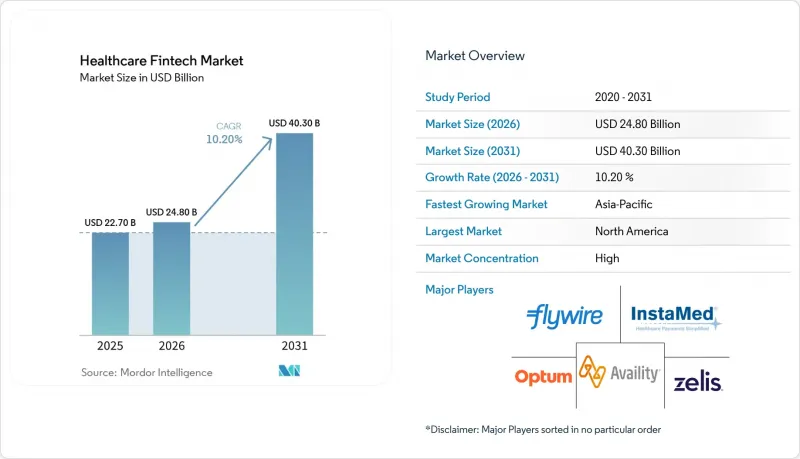
據 Mordor Intelligence 稱,醫療保健金融科技市場預計將從 2025 年的 227 億美元成長到 2026 年的 248 億美元,到 2031 年達到 403 億美元,預計 2026 年至 2031 年的複合年成長率為 10.2%。
全球醫療保健金融科技市場趨勢與洞察
醫療成本不斷上漲,造成患者日益沉重的經濟負擔。
由於醫療費用分攤,病患的經濟負擔往往在需要醫療服務時直接落在家庭身上,這使得醫療金融科技市場持續受到需求驅動。 2025年,擁有雇主提供的醫療保險計畫的單身用戶平均自付費用達到1,886美元,其中34%的受保人自付費用超過2,000美元。與沒有此類保險計劃的人相比,擁有高額保險計劃的人接受推薦醫療服務的可能性低4.7個百分點,這凸顯了資金籌措工具在幫助患者獲得必要治療方面的重要作用。 2025年7月,聯邦法院推翻了有關醫療債務信用報告的規定,使得病患的信用風險仍面臨政策不確定性。患者的未償餘額越大,醫療服務提供者就越需要盡快收回款項,尤其是在延遲付款影響後續追蹤、財務規劃和員工工作量的情況下。消費貸款、分期付款計劃和清晰的電子發票有助於患者獲得醫療保健服務,同時為醫療保健提供者提供更系統化的流程來管理自付費用餘額。
醫療保健支付和金融交易的數位化
數位支付工具正在推動醫療機構的收入周期運作從帳單產生後轉向早期確認、自動化決策和快速支付處理。約80%的醫療機構正在探索、試行或實施生成式人工智慧工具,其中27%已大規模應用。這種普及使得醫療機構更有理由將支付、匯款、編碼和帳單拒付管理整合到同一業務流程中,而不是讓資訊在不同團隊之間交換。自動化工作流程能夠在帳單進入緩慢的人工審核隊列之前識別出錯誤訊息,從而避免延誤並增加醫護人員和患者的負擔。利用即時支付基礎設施和應用程式介面(API)可以縮短審核、匯款、記帳和財務跟進所需資訊的獲取時間。醫療金融科技市場將受益於這些功能成為整合到現有收入週期流程中的常規營運工具,而不是孤立的技術先導計畫。
醫療和金融資料的隱私、安全和網路安全風險
網路安全是一項至關重要的阻礙因素,因為醫療保健金融平台需要處理涉及多個合作機構的患者、支付、帳單和身分等敏感資料。 Change Healthcare 的資料外洩事件影響了 1.927 億人,表明支付基礎設施提供者的故障可能會擾亂整個醫療保健提供者網路的帳單和發票處理。供應商必須滿足醫療保健隱私義務和支付卡安全要求,同時在採購、部署和持續營運的各個階段展現可靠的控制措施。這些要求增加了獲取企業客戶的成本和時間,因為買家需要證明敏感資訊在處理的每個階段都受到保護。能夠提供安全措施、業務永續營運計劃、審計回應系統和關鍵事件回應程序等文件的信譽良好的供應商的價值也隨之提升。因此,在產品設計、供應商監管、營運流程和客戶保證文件中內建的安全功能在醫療保健金融科技市場至關重要。
細分市場分析
到2025年,醫療保健消費信貸將佔醫療保健金融科技市場29.1%的佔有率,成為最大的功能類別,並清楚地展現了患者直接支付責任的規模。這個類別反映了患者信貸產品在醫院系統、專科診所和門診機構的廣泛應用,在這些機構中,治療決策可能需要即時支付。 CareCredit、PatientFi、PayZen和AccessOne等公司滿足了借款人的各種需求,從在職分期付款計劃到長期醫療貸款,每個方案都針對不同的經濟狀況。病患支付、支付便利化和消費者主導的帳戶管理是此功能配置中的其他關鍵要素,將病患與醫療服務提供者的財務運作連結起來。隨著雇主和帳戶擁有者利用健康儲蓄帳戶(HSA)來管理符合條件的醫療費用並在接受治療前獲得資金,HSA的管理也不斷擴展。根據 HealthEquity 的報告,截至 2026 年 7 月,健康儲蓄帳戶的數量將達到 1,070 萬個,年增 8%,總資產價值 380 億美元。
預計到2031年,醫療保健產業的B2B支付和醫療機構的應付帳款管理將以14.4%的複合年成長率成長,在所有功能類別中增速最高。推動該功能領域醫療保健金融科技市場規模成長的因素是需要更快地核對帳單資訊、匯款明細、支付累計和內部會計記錄。由於付款和匯款流程是分開的,醫療保健核算團隊不得不執行一些可以自動化的例行核對任務,尤其是在批次包含大量帳單和支付記錄的情況下。直通式處理、即時支付方式和人工智慧驅動的匯款核對功能可以幫助員工更快地識別相關信息,從而減輕他們的工作負擔。 MediStreams在擴展了用於直接導入支付方資料饋送和智慧分類的API連線後,預計2025年將取得突破性績效。計費、資格審核和匯款途徑仍然是基礎要素,因為它們支撐著防止付款被拒絕和預先批准的工作流程,從而影響付款的準確性和速度。大規模平台和新進入的供應商正在將這些功能整合到更廣泛的收入週期解決方案中,以支援醫療保健金融科技市場的擴張。
區域分析
到2025年,北美將佔據醫療保健金融科技市場78.9%的佔有率。這主要得益於美國的多方支付保險體系、高額的病患自付費用以及電子健康記錄的廣泛應用。該地區的行政負擔催生了對收入週期管理、支付便利、福利帳戶和患者貸款的需求。加拿大的單一支付體系限制了病患貸款的潛在需求,但仍支援自動付款給醫療服務提供者和雇主福利帳戶。墨西哥多元化的支付方和醫療服務提供者環境進一步放大了該地區的需求。 Optum和Waystar等美國平台以系統規模運營,而PayZen和PatientFi則更直接地關注患者的財務需求。 2025年,雇主計畫的平均自付費用為1,886美元,凸顯了病患在支持這些服務方面所承擔的巨大經濟負擔。
歐洲雖然規模較小,但由於各國醫療保健資金籌措體系的支付需求各不相同,因此在醫療保健金融科技市場中扮演著獨特的角色。英國以國民醫療服務體系(NHS)為中心的模式優先考慮管理效率和與員工相關的支付工具,而非消費者資金籌措。德國公私混合的保險體系則在整個財務流程中產生了更為多樣化的需求。歐洲健康資料空間(European Health Data Space)支援數位醫療領域的互通性和基於價值的報銷模式。南美洲仍處於起步階段,但其分散的私人保險體係正在催生對理賠檢驗和支付中介的需求。 Osigu專注於拉丁美洲市場,連接了超過130家醫院,每年處理1,200萬筆交易。
預計到2031年,亞太地區醫療保健金融科技市場將以14.7%的複合年成長率成長,成為所有地區中成長最快的市場。全部區域醫療保健金融科技市場規模的擴張主要得益於數位醫療基礎設施的完善和成熟的數位支付生態系統。印度的「阿尤斯曼·巴拉特數位醫療計畫」(Ayushman Bharat Digital Mission)於2026年7月實現了超過9億個獨立健康ID,為認證醫療交易建立了大規模的數位基礎。印度的支付基礎設施能夠透過成熟的即時支付系統處理患者向醫療服務提供者的收款和付款。中國擁有成熟的支付寶和微信支付網路,能夠支援醫療保健支付服務。沙烏地阿拉伯和阿拉伯聯合大公國(阿拉伯聯合大公國)雖然正在發展其數位醫療能力,但其短期目標市場規模仍落後於北美和亞太地區。全部區域在隱私、支付和金融方面的監管日益嚴格,提高了准入門檻,能夠證明自身合規的供應商將獲得競爭優勢。
其他好處:
- Excel格式的市場預測(ME)表
- 3個月的分析師支持
目錄
第1章:引言
- 研究假設和市場定義
- 調查範圍
第2章:調查方法
第3章執行摘要
第4章 市場狀況
- 市場概覽
- 市場促進因素
- 醫療成本不斷上漲,病患自付費用日益增加。
- 醫療保健領域的支付和金融交易數位化
- 醫療保健產業的收入、計費和報銷流程日益複雜。
- 人們對貫穿整個護理過程的一體化財務體驗的需求日益成長。
- 拓展數位化和遠端醫療服務模式
- 擴大嵌入式支付和資金籌措解決方案在醫療保健領域的應用。
- 市場限制因素
- 醫療和金融資料的隱私、安全和網路安全風險
- 與現有醫療保健和金融系統進行複雜的整合
- 支付方、醫療服務提供者和報銷體系的分散化
- 醫療保健和金融服務業的複雜監管要求
- 價值鏈分析
- 金融基礎設施和支付網路營運商
- 醫療保健金融科技平台和解決方案提供商
- 醫療保健技術和整合平台
- 醫療保健生態系統的最終用戶和貿易商
- 監理情勢
- 醫療資料病患資訊的隱私、安全和保護要求
- 支付處理和金融交易的安全要求
- 有關消費者保護和醫療保健資金籌措的法規
- 金融犯罪、身分驗證和合規要求
- 技術展望
- 應用程式介面(API)、嵌入式金融和醫療保健系統的整合。
- 利用人工智慧和機器學習實現金融營運自動化
- 基於雲端和API驅動的金融基礎設施
- 即時支付、數位錢包和高級支付認證
- 波特五力分析
第5章 市場規模與成長預測
- 按功能
- 消費者主導型健康帳戶的管理
- 用於醫療保健的消費貸款
- 協助支付患者自付部分費用和醫療費用。
- 索賠、資格和支付途徑
- 醫療保健產業的B2B支付和應付帳款
- 經濟買家
- 醫療服務提供方
- 醫療保健支付方
- 雇主和計劃發起人
- 病人和個人消費者
- 通道特異性
- 直接企業
- 銀行/發卡機構合作夥伴
- 第三方管理機構/仲介/福利顧問
- 嵌入式/API/OEM
- 按地區
- 北美洲
- 美國
- 加拿大
- 墨西哥
- 南美洲
- 巴西
- 阿根廷
- 其他南美國家
- 歐洲
- 英國
- 德國
- 法國
- 義大利
- 西班牙
- 其他歐洲國家
- 亞太地區
- 中國
- 日本
- 印度
- 韓國
- 澳洲
- 印尼
- 泰國
- 馬來西亞
- 新加坡
- 越南
- 其他亞太國家
- 中東和非洲
- 沙烏地阿拉伯
- 阿拉伯聯合大公國
- 土耳其
- 南非
- 埃及
- 其他中東和非洲國家
- 北美洲
第6章 競爭情勢
- 市場集中度
- 策略趨勢
- 市佔率分析(前5-6家公司)
- 公司簡介
- Optum
- Zelis
- Availity
- Flywire
- InstaMed
- Rectangle Health
- Waystar
- Experian Health
- R1 RCM
- athenahealth
- FinThrive
- Cedar
- Phreesia
- RevSpring
- HealthEquity
- CareCredit
- PayZen
- AccessOne
- CarePayment
- PatientFi
第7章 市場機會與未來展望
According to Mordor Intelligence, the healthcare fintech market size is expected to increase from USD 22.7 billion in 2025 to USD 24.8 billion in 2026 and reach USD 40.3 billion by 2031, growing at a CAGR of 10.2% over 2026-2031.
Global Healthcare Fintech Market Trends and Insights
Rising Healthcare Costs And Growing Patient Financial Responsibility
Patient financial exposure remains a durable source of demand for the healthcare fintech market because cost sharing places more payment responsibility directly on households, often at the point when care is needed. The average single-coverage deductible for employer-plan participants reached USD 1,886 in 2025, and 34% of covered workers had deductibles above USD 2,000. High-deductible plan enrollees were 4.7 percentage points less likely to receive recommended care than people without such plans, which gives financing tools a role in helping patients proceed with needed treatment. A federal court vacated the medical-debt credit-reporting rule in July 2025, leaving patient credit exposure subject to continued policy uncertainty. Providers need faster collections when patients carry larger balances, especially when delayed payments affect follow-up outreach, cash planning, and staff workload. Consumer financing, payment plans, and clear digital billing can support patient access while giving providers a more organized process for managing self-pay balances.
Digitalization Of Healthcare Payment And Financial Transactions
Digital payment tools are moving revenue-cycle work from follow-up billing toward earlier checks, automated decisions, and faster payment posting across provider operations. Around 80% of health systems were exploring, piloting, or implementing generative AI tools in the revenue cycle, and 27% were already using them at scale. This adoption gives providers stronger reasons to connect payment, remittance, coding, and denial management within the same operating process, instead of passing information between separate teams. Automated workflows can identify incomplete information before claims move into slower manual review queues, where delays can create further work for both staff and patients. Real-time payment rails and application programming interfaces can reduce the time between adjudication, remittance, posting, and the availability of information for financial follow-up. The healthcare fintech market benefits when these capabilities become routine operating tools that are connected to existing revenue-cycle processes rather than isolated technology pilots.
Healthcare And Financial Data Privacy, Security, And Cybersecurity Risks
Cybersecurity is a material constraint because healthcare financial platforms handle sensitive patient, payment, claims, and identity data across several connected organizations. The Change Healthcare breach affected 192.7 million people and showed how disruption at a payment infrastructure provider can interrupt claims and billing across provider networks. Vendors must meet healthcare privacy duties and payment-card security requirements while demonstrating reliable controls during procurement, implementation, and ongoing operations. These requirements increase the cost and time needed to win enterprise customers because buyers need evidence that sensitive information remains protected through every processing stage. They also increase the value of established vendors that can document security practices, continuity planning, audit readiness, and response procedures for a significant incident. The healthcare fintech market, therefore, favors security capabilities that are built into product design, vendor oversight, operational processes, and customer assurance materials.
Other drivers and restraints analyzed in the detailed report include:
- Increasing Complexity Of Healthcare Revenue, Claims, And Reimbursement Workflows
- Growing Adoption Of Healthcare-Specific Embedded Payments And Financing Solutions
- Complex Integration With Legacy Healthcare And Financial Systems
For complete list of drivers and restraints, kindly check the Table Of Contents.
Segment Analysis
Healthcare consumer financing held 29.1% of the healthcare fintech market share in 2025, making it the largest function category and showing the scale of direct patient payment responsibility. The category reflects broad use of patient credit products in hospital systems, specialty practices, and ambulatory settings, where treatment decisions may create an immediate payment need. CareCredit, PatientFi, PayZen, and AccessOne have served different borrower needs, from point-of-care installment arrangements to longer-duration medical loans, with each approach addressing a distinct affordability situation. Patient payments, payment facilitation, and consumer-directed account administration represent other important parts of the function mix and connect patients with providers' financial operations. Health savings account administration has continued to expand as employers and account holders use these accounts to manage eligible medical expenses and set aside funds before care occurs. HealthEquity reported 10.7 million health savings accounts in July 2026, up 8% year over year, with USD 38 billion in assets.
Healthcare B2B payments and provider AP are forecast to grow at a 14.4% CAGR through 2031, the highest rate among function categories. The healthcare fintech market size for this function is supported by the need to align claims information, remittance details, payment posting, and internal accounting records more quickly. Separate payment and remittance rails have left provider accounting teams with routine reconciliation work that can be automated, particularly when batches contain many claims or payment records. Straight-through processing, real-time payment methods, and AI-supported remittance matching address this workload by helping staff identify relevant information sooner. MediStreams reported a record 2025 after expanding application programming interface connectivity for direct ingestion and intelligent categorization of payer data feeds. Claims, eligibility, and remittance rails remain foundational because they support denial prevention and prior authorization workflows that affect payment accuracy and speed. Larger platforms and newer suppliers are building these capabilities into broader revenue-cycle offerings, supporting the expansion of the healthcare fintech market.
Complete Report Scope:
- By Function
- Consumer-Directed Health Account Administration
- Healthcare Consumer Financing
- Patient Payments and Healthcare Payment Facilitation
- Claims, Eligibility and Remittance Rails
- Healthcare B2B Payments and Provider AP
- By Economic Buyer
- Healthcare Providers
- Healthcare Payers
- Employers and Plan Sponsors
- Patients and Individual Consumers
- By Channel
- Direct Enterprise
- Bank/Issuer Partner
- TPA/Broker/Benefits Consultant
- Embedded/API/OEM
- By Geography
- North America
- United States
- Canada
- Mexico
- South America
- Brazil
- Argentina
- Rest of South America
- Europe
- United Kingdom
- Germany
- France
- Italy
- Spain
- Rest of Europe
- Asia-Pacific
- China
- Japan
- India
- South Korea
- Australia
- Indonesia
- Thailand
- Malaysia
- Singapore
- Vietnam
- Rest of Asia-Pacific
- Middle East and Africa
- Saudi Arabia
- United Arab Emirates
- Turkey
- South Africa
- Egypt
- Rest of Middle East and Africa
- North America
Geography Analysis
North America held 78.9% of the healthcare fintech market share in 2025, supported by the United States' multi-payer insurance structure, high patient cost sharing, and extensive use of electronic health records. The region's administrative burden creates demand for revenue-cycle management, payment facilitation, benefit accounts, and patient financing. Canada's single-payer structure limits the addressable need for patient financing but still supports provider payment automation and employer benefit accounts. Mexico adds regional demand through its varied payer and provider environment. United States platforms such as Optum and Waystar operate at system scale, while PayZen and PatientFi focus more directly on patient financial needs. The USD 1,886 average employer-plan deductible in 2025 illustrates the patient exposure that supports these services.
Europe has a smaller but distinct role in the healthcare fintech market, as payment needs vary across national healthcare funding systems. The United Kingdom's NHS-centered model emphasizes administrative efficiency and workforce-related payment tools more than consumer financing. Germany's mixed statutory and private insurance framework creates more varied demand across financial workflows. The European Health Data Space supports interoperability and value-based reimbursement models for digital health. South America remains at an earlier stage, but fragmented private insurance arrangements create demand for claims validation and payment intermediation. Osigu has focused on Latin America, connecting more than 130 hospitals and processing 12 million transactions annually.
Asia-Pacific is forecast to grow at a 14.7% CAGR through 2031, the fastest regional rate in the healthcare fintech market. Growth in the healthcare fintech market size across the region is supported by expanding digital health infrastructure and established digital payment ecosystems. India's Ayushman Bharat Digital Mission crossed 900 million unique health IDs in July 2026, creating a large digital foundation for authenticated healthcare interactions. India's payment infrastructure can support patient collections and provider disbursements through established real-time rails. China has mature Alipay and WeChat Pay payment networks that can support healthcare payment services. Saudi Arabia and the United Arab Emirates are developing digital healthcare capabilities, although their near-term addressable scale remains below that of North America and Asia-Pacific. Privacy, payment, and financial regulations raise entry requirements across the region and support suppliers that can demonstrate compliance.
- Optum
- Zelis
- Availity
- Flywire
- InstaMed
- Rectangle Health
- Waystar
- Experian Health
- R1 RCM
- athenahealth
- FinThrive
- Cedar
- Phreesia
- RevSpring
- HealthEquity
- CareCredit
- PayZen
- AccessOne
- CarePayment
- PatientFi
Additional Benefits:
- The market estimate (ME) sheet in Excel format
- 3 months of analyst support
TABLE OF CONTENTS
1 INTRODUCTION
- 1.1 Study Assumptions and Market Definition
- 1.2 Scope of the Study
2 RESEARCH METHODOLOGY
3 EXECUTIVE SUMMARY
4 MARKET LANDSCAPE
- 4.1 Market Overview
- 4.2 Market Drivers
- 4.2.1 Rising Healthcare Costs and Growing Patient Financial Responsibility
- 4.2.2 Digitalization of Healthcare Payment and Financial Transactions
- 4.2.3 Increasing Complexity of Healthcare Revenue, Claims, and Reimbursement Workflows
- 4.2.4 Growing Demand for Integrated Financial Experiences Across the Care Journey
- 4.2.5 Expansion of Digital and Remote Healthcare Delivery Models
- 4.2.6 Growing Adoption of Healthcare-Specific Embedded Payments and Financing Solutions
- 4.3 Market Restraints
- 4.3.1 Healthcare and Financial Data Privacy, Security, and Cybersecurity Risks
- 4.3.2 Complex Integration with Legacy Healthcare and Financial Systems
- 4.3.3 Fragmented Payer, Provider, and Reimbursement Ecosystems
- 4.3.4 Complex Regulatory Requirements Across Healthcare and Financial Services
- 4.4 Value Chain Analysis
- 4.4.1 Financial Infrastructure and Payment Network Providers
- 4.4.2 Healthcare FinTech Platform and Solution Providers
- 4.4.3 Healthcare Technology and Integration Platforms
- 4.4.4 Healthcare Ecosystem End Users and Transaction Participants
- 4.5 Regulatory Landscape
- 4.5.1 Healthcare Data Privacy, Security, and Patient Information Protection Requirements
- 4.5.2 Payment Processing and Financial Transaction Security Requirements
- 4.5.3 Consumer Protection and Healthcare Financing Regulations
- 4.5.4 Financial Crime, Identity Verification, and Compliance Requirements
- 4.6 Technological Outlook
- 4.6.1 Application Programming Interfaces, Embedded Finance, and Healthcare System Integration
- 4.6.2 Artificial Intelligence and Machine Learning for Financial Automation
- 4.6.3 Cloud-Based and API-Driven Financial Infrastructure
- 4.6.4 Real-Time Payments, Digital Wallets, and Advanced Payment Authentication
- 4.7 Porter's Five Forces Analysis
- 4.7.1 Threat of New Entrants
- 4.7.2 Bargaining Power of Suppliers
- 4.7.3 Bargaining Power of Buyers
- 4.7.4 Threat of Substitutes
- 4.7.5 Competitive Rivalry
5 MARKET SIZE AND GROWTH FORECASTS
- 5.1 By Function
- 5.1.1 Consumer-Directed Health Account Administration
- 5.1.2 Healthcare Consumer Financing
- 5.1.3 Patient Payments and Healthcare Payment Facilitation
- 5.1.4 Claims, Eligibility and Remittance Rails
- 5.1.5 Healthcare B2B Payments and Provider AP
- 5.2 By Economic Buyer
- 5.2.1 Healthcare Providers
- 5.2.2 Healthcare Payers
- 5.2.3 Employers and Plan Sponsors
- 5.2.4 Patients and Individual Consumers
- 5.3 By Channel
- 5.3.1 Direct Enterprise
- 5.3.2 Bank/Issuer Partner
- 5.3.3 TPA/Broker/Benefits Consultant
- 5.3.4 Embedded/API/OEM
- 5.4 By Geography
- 5.4.1 North America
- 5.4.1.1 United States
- 5.4.1.2 Canada
- 5.4.1.3 Mexico
- 5.4.2 South America
- 5.4.2.1 Brazil
- 5.4.2.2 Argentina
- 5.4.2.3 Rest of South America
- 5.4.3 Europe
- 5.4.3.1 United Kingdom
- 5.4.3.2 Germany
- 5.4.3.3 France
- 5.4.3.4 Italy
- 5.4.3.5 Spain
- 5.4.3.6 Rest of Europe
- 5.4.4 Asia-Pacific
- 5.4.4.1 China
- 5.4.4.2 Japan
- 5.4.4.3 India
- 5.4.4.4 South Korea
- 5.4.4.5 Australia
- 5.4.4.6 Indonesia
- 5.4.4.7 Thailand
- 5.4.4.8 Malaysia
- 5.4.4.9 Singapore
- 5.4.4.10 Vietnam
- 5.4.4.11 Rest of Asia-Pacific
- 5.4.5 Middle East and Africa
- 5.4.5.1 Saudi Arabia
- 5.4.5.2 United Arab Emirates
- 5.4.5.3 Turkey
- 5.4.5.4 South Africa
- 5.4.5.5 Egypt
- 5.4.5.6 Rest of Middle East and Africa
- 5.4.1 North America
6 COMPETITIVE LANDSCAPE
- 6.1 Market Concentration
- 6.2 Strategic Moves
- 6.3 Market Share Analysis (Top 5-6 players)
- 6.4 Company Profiles (includes Global Level Overview, Market Level Overview, Core Segments, Financials as available, Strategic Information, Market Rank/Share, Products and Services, Recent Developments)
- 6.4.1 Optum
- 6.4.2 Zelis
- 6.4.3 Availity
- 6.4.4 Flywire
- 6.4.5 InstaMed
- 6.4.6 Rectangle Health
- 6.4.7 Waystar
- 6.4.8 Experian Health
- 6.4.9 R1 RCM
- 6.4.10 athenahealth
- 6.4.11 FinThrive
- 6.4.12 Cedar
- 6.4.13 Phreesia
- 6.4.14 RevSpring
- 6.4.15 HealthEquity
- 6.4.16 CareCredit
- 6.4.17 PayZen
- 6.4.18 AccessOne
- 6.4.19 CarePayment
- 6.4.20 PatientFi
7 MARKET OPPORTUNITIES AND FUTURE OUTLOOK
- 7.1 White-Space and Unmet-Need Assessment
- 7.1.1 Affordable Financing for Underinsured and High-Deductible Patients
- 7.1.2 Transparent and Predictable Financing Without Deferred-Interest Risk
- 7.1.3 Interoperable Embedded Financing Across Healthcare Billing and Patient Workflows

 2026年全球人工智慧(AI)驅動的金融科技合規和監管科技平台市場報告
 人工智慧在金融科技領域的應用:市場佔有率分析、產業趨勢與統計數據以及成長預測(2026-2031 年)
 金融科技人工智慧市場規模、佔有率、趨勢和預測:按類型、部署模式、應用和地區分類,2026-2034年
 金融科技領域人工智慧(AI)市場規模、佔有率和成長分析:按組件、技術、部署模式、企業規模、應用、最終用戶和地區分類-2026-2033年產業預測
 2026-2030年全球金融科技領域人工智慧市場
 金融科技領域人工智慧市場-全球產業規模、佔有率、趨勢、機會和預測:按組件、部署模式、應用、地區和競爭格局分類,2021-2031年2026年全球利用人工智慧(AI)進行債務風險配置市場報告2026年金融領域生成式人工智慧全球市場報告2026年金融科技領域人工智慧全球市場報告
 金融科技市場:依產品類型、經營模式、平台模式和最終用戶分類-2026-2032年全球預測