


 |
市場調查報告書
商品編碼
2155313
防水膠帶:市場佔有率分析、產業趨勢與統計、成長預測(2026-2031)Waterproof Tapes - Market Share Analysis, Industry Trends & Statistics, Growth Forecasts (2026 - 2031) |
||||||

※ 本網頁內容可能與最新版本有所差異。詳細情況請與我們聯繫。
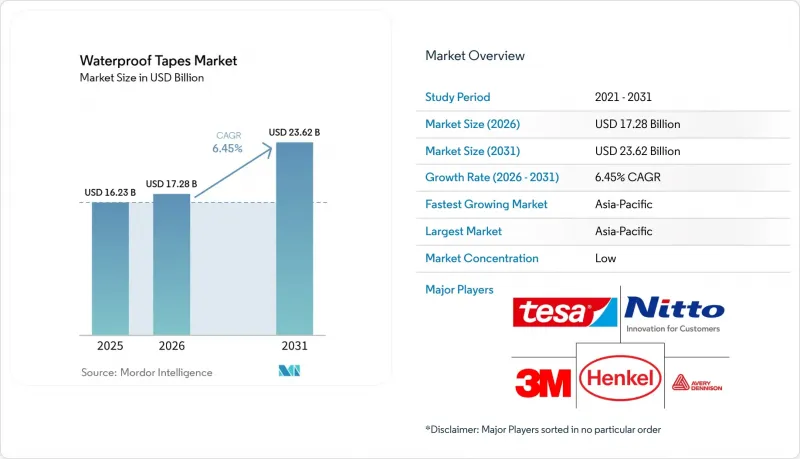
據 Mordor Intelligence 稱,2025 年防水膠帶市場價值為 162.3 億美元,預計到 2031 年將達到 236.2 億美元,而 2026 年為 172.8 億美元,預測期(2026-2031 年)的複合年成長率為 6.45%。
全球防水膠帶市場趨勢及洞察
擴大建築物和基礎設施維護管理的防水工程
與新建工程相比,基礎設施現代化為防水膠帶提供了更穩定的需求來源。舊屋頂、外牆和接縫的維修需要使用可應用於現有結構的防潮產品。在美國,老舊住宅經常需要進行建築圍護結構的維修,這推動了對用於維修的密封系統的需求。膠帶產品無需像液體產品一樣等待固化時間,一次即可完成施工。這使得它們在商業項目和預製建築中非常實用,因為在這些項目中,施工速度會影響工期。當承包商優先考慮減少準備工作、易於操作以及在複雜表面上的可靠性能時,防水膠帶市場將從中受益。這些情況在維修工作、預製項目以及場地受限或工期緊張的場所中很常見。此外,使用膠帶還可以簡化工作流程,使承包商無需等待濕塗層固化即可開始下一步工作。
電子產品和電動車對防潮性能的要求日益提高。
交通運輸設備的電氣化正在改變膠帶的需求。電池模組需要同時具備絕緣性、防潮性和熱穩定性。當傳統膠帶無法承受重複的熱循環時,矽膠或高性能丙烯酸基膠帶成為首選。在這些應用中,對即使在持續工作應力下也能保持黏合力的更薄材料的需求日益成長。需要在有限空間內進行精密模切的設備設計也推動了防水膠帶市場的擴張。歐洲智慧型手機維修需求可能會增加設備拆裝過程中對密封件的需求。製造商必須在輕薄設計與防潮、耐熱以及組裝後反覆操作的性能之間取得平衡。高性能膠帶正是在此發揮至關重要的作用,它們能夠在不增加重量和空間的情況下保護設備,而無需採用更複雜的密封技術。
原物料價格波動
防水膠帶的生產依賴薄膜、丙烯酸單體、丁基橡膠和矽酮等原料,這些原料的價格波動劇烈。對於沒有供應合約或內部樹脂生產能力的加工商而言,這種價格波動尤其具有挑戰性。原物料價格的頻繁調整可能導致一個季度內多次價格表變更,從而對客戶的專案預算造成困難。大型製造商可以透過簽訂長期採購合約和建立廣泛的供應商網路來管理部分風險。而小規模加工商可能被迫透過縮短與客戶的合約期限來轉嫁成本波動。防水膠帶市場持續受到這種成本失衡的影響,尤其是在市場競爭限制了製造商收回不斷上漲的原料成本的能力時。由此產生的壓力會影響產品選擇、合約條款和客戶的採購時間。這也促使製造商改進其採購系統,並優先考慮那些技術價值較高、價格更穩定的應用領域。
細分市場分析
預計到2025年,矽膠將佔據防水膠帶市場43.16%的佔有率,並將以7.04%的複合年成長率持續成長至2031年。這一市場地位反映了矽膠的性能能夠滿足電子產品、電動車組裝以及與皮膚接觸的醫療應用等應用的需求。該材料可在-50 度C至200 度C的溫度範圍內保持其功能性,這對於電池機殼和電力電子產品至關重要。此外,在持續熱循環應用中,它還具有良好的防潮性和介電性能。這些綜合要求限制了通用產品在高價值組裝中的應用。
由於丙烯酸樹脂具有良好的抗紫外線穩定性以及與水性載體體系的兼容性,因此在建築、包裝和一般工業應用中仍被廣泛應用。丁基膠帶在地下防水、管道接頭密封和屋頂穿透部位的密封中仍然發揮著至關重要的作用,尤其是在不規則或潮濕表面上需要室溫黏合的情況下。其他樹脂,包括橡膠基熱熔膠和混合化學品,則用於食品接觸包裝和高濕度環境下的工業應用。樹脂需求正逐漸兩極化,一方面是優質矽酮和先進的丙烯酸配方,另一方面是用於基礎設施應用的注重成本效益的產品。因此,矽酮在防水膠帶產業仍佔據核心地位,在該產業中,性能的可靠性比初始材料成本更為重要。除非有證據表明其他替代品能夠滿足隔熱、密封和耐用性要求,否則這些應用領域的買家不太可能更換材料。因此,樹脂的選擇與成品的預期用途和認證要求密切相關。
區域分析
預計到2025年,亞太地區將佔據防水膠帶市場36.57%的佔有率,並以7.68%的複合年成長率持續成長至2031年。該地區是大規模的電子產品製造地和建築市場。中國透過電子產品生產、基礎設施建設和電動車組裝來支撐區域需求。日本和韓國則專注於為顯示器、汽車和先進設備應用領域生產精密產品。日東電工株式會社投資44.8億新台幣(約1.403億美元),於2026年7月在高雄建成了集製造和研發於一體的工廠。
該工廠為半導體和汽車行業的客戶生產聚氯乙烯膠帶和電子膠帶。印度、東協國家和韓國正推動醫療、基礎設施和汽車製造業的成長,從而支撐了對通用型和中性能型膠帶的廣泛需求。北美受惠於基礎設施維修、大規模的汽車售後市場以及維修產品廣泛的零售分銷。墨西哥透過對汽車組裝和製造的投資,為工業需求做出了貢獻。在加拿大,即使在寒冷氣候下也能保持黏合力的丁基膠帶和先進丙烯酸膠帶產品構成了一個獨特的細分市場。在整個北美地區,成熟的維修管道和完善的承包商體系支撐著對用於維護和新建工程產品的持續需求。
在歐洲,建築法規建議新建築和大型維修採用氣密性和防潮性良好的外牆,這正在產生影響。南美洲以巴西和阿根廷為首,住宅、基礎設施和包裝行業的需求推動了這一趨勢。在智利,新建築和地震受損建築的修復需要軟性防水解決方案。中東和非洲的需求主要來自波灣合作理事會(GCC)成員國的建設項目以及南非的工業維護。沙烏地阿拉伯的「2030願景」基礎設施發展計畫以及阿拉伯聯合大公國商業房地產開發的持續推進,是建築相關需求的主要來源。該地區的商業機會仍取決於專案實施的進度以及膠帶供應商能否滿足當地的性能和分銷要求。
其他好處:
- Excel格式的市場預測(ME)表
- 3個月的分析師支持
目錄
第1章:引言
- 研究假設和市場定義
- 調查範圍
第2章:調查方法
第3章執行摘要
第4章 市場狀況
- 市場概覽
- 市場促進因素
- 建築防水工程及基礎建設的擴展
- 電子設備和電動車對防潮性能的要求日益提高。
- 醫療保健穿戴式裝置和防水醫療固定裝置的成長
- 與液體密封劑相比,速度更快、更乾淨、更輕的密封方式更受歡迎。
- 電子商務與DIY維修的興起
- 市場限制因素
- 原物料價格波動
- 與液體密封劑、膜材和機械緊固件的競爭。
- 產品差異化和認證的複雜性
- 價值鏈分析
- 波特五力分析
第5章 市場規模與成長預測
- 依樹脂類型
- 矽酮
- 丙烯酸纖維
- 丁基
- 其他
- 依基材類型
- 塑膠
- 金屬
- 橡皮
- 其他
- 按最終用途行業分類
- 電氣和電子設備
- 車
- 建築/施工
- 衛生保健
- 包裝
- 其他
- 按地區
- 亞太地區
- 中國
- 印度
- 日本
- 韓國
- 東南亞國協
- 其他亞太國家
- 北美洲
- 美國
- 加拿大
- 墨西哥
- 歐洲
- 德國
- 英國
- 法國
- 義大利
- 北歐國家
- 其他歐洲國家
- 南美洲
- 巴西
- 阿根廷
- 其他南美國家
- 中東和非洲
- 沙烏地阿拉伯
- 南非
- 其他中東和非洲國家
- 亞太地區
第6章 競爭情勢
- 市場集中度
- 策略趨勢
- 市佔率和排名分析
- 公司簡介
- 3M
- Avery Dennison Corporation
- Henkel AG & Co. KGaA
- IPG
- LINTEC Corporation
- Lohmann
- Medline Industries, LP
- NICHIBAN Co., Ltd.
- Nitto Denko Corporation
- SEKISUI CHEMICAL CO., LTD.
- Shurtape Technologies, LLC
- Teraoka Seisakusho co.,Ltd.
- tesa SE
第7章 市場機會與未來展望
According to Mordor Intelligence, the waterproof tapes market size was valued at USD 16.23 billion in 2025 and is estimated to grow from USD 17.28 billion in 2026 to reach USD 23.62 billion by 2031, at a CAGR of 6.45% during the forecast period (2026-2031).
Global Waterproof Tapes Market Trends and Insights
Expansion of Building Waterproofing and Infrastructure Maintenance
Infrastructure renewal gives the waterproof tapes market a steadier source of demand than new construction activity alone. Repairs to older roofs, facades, and joints require moisture-management products that can be fitted around existing structures. In the United States, older housing creates recurring work on building envelopes and supports demand for repair-oriented sealing systems. Tape products can be applied in a single pass, without the cure periods associated with liquid alternatives. This makes them useful in commercial projects and prefabricated construction, where installation speed affects scheduling. The waterproof tapes market benefits where contractors value reduced preparation, simpler handling, and dependable performance on complex surfaces. These conditions are common in repair work, prefabricated projects, and installations with limited access or narrow scheduling windows. Tape can also simplify sequencing because the installer does not need to wait for a wet-applied material to cure before the next task begins.
Rising Moisture-Protection Requirements in Electronics and Electric Vehicles
Transport electrification changes tape requirements because battery modules need insulation, moisture protection, and thermal stability at the same time. Silicone and high-performance acrylic formulations are favored where conventional grades cannot withstand repeated thermal cycling. These applications support demand for thinner materials that retain adhesion under sustained operating stress. The waterproof tapes market also gains from device designs that need precision die-cut parts for tight spaces. European repair requirements for smartphones can add sealing demand when devices are opened and reassembled. Manufacturers must balance thin construction with resistance to moisture, heat, and repeated handling after repair. This gives high-performance tapes a role in maintaining device protection without adding the weight or space associated with more complex sealing approaches.
Raw Material Price Volatility
Waterproof tape production depends on films, acrylic monomers, butyl rubber, and silicone inputs whose prices can change quickly. This exposure is most difficult for converters that do not have supply contracts or internal resin capacity. Frequent input adjustments can require several price-list changes within a quarter and make project budgeting harder for customers. Larger manufacturers can manage some of this risk through longer purchasing arrangements and broader sourcing options. Smaller converters may have to pass through cost movements using shorter customer contracts. The waterproof tapes market remains exposed to this uneven cost position, especially where price competition limits a producer's ability to recover higher input costs. The resulting pressure can affect product selection, contract terms, and the timing of customer purchases. It also encourages manufacturers to improve sourcing discipline and to prioritize applications where technical value supports more stable pricing.
Other drivers and restraints analyzed in the detailed report include:
- Growth of Healthcare Wearables and Waterproof Medical Fixation
- Preference for Fast, Clean, Lightweight Sealing over Liquid Sealants
- Competition from Liquid Sealants, Membranes, and Mechanical Fasteners
For complete list of drivers and restraints, kindly check the Table Of Contents.
Segment Analysis
Silicone held 43.16% of the waterproof tapes market share in 2025 and is projected to advance at a 7.04% CAGR through 2031. Its position reflects the alignment between silicone performance and requirements in electronics, electric vehicle assembly, and skin-contact medical uses. The material can maintain function across temperatures from -50 °C to 200 °C, which is important for battery enclosures and power electronics. It also supports moisture protection and dielectric performance in applications subject to sustained thermal cycling. These combined needs restrict the suitability of commodity products in high-value assemblies.
Acrylic remains widely used in building and construction, packaging, and general industrial applications because it provides ultraviolet stability and works with water-based carrier systems. Butyl tapes remain important for underground waterproofing, pipe-joint sealing, and roofing penetrations where irregular or wet surfaces require cold-applied adhesion. Other resins, including rubber-based hot-melt and hybrid chemistries, address food-contact packaging and high-humidity industrial conditions. Resin demand is gradually separating between premium silicone and advanced acrylic formulations, and value-focused products used in infrastructure applications. This keeps silicone central to the waterproof tapes industry, where validated performance matters more than initial material cost. Buyers in these uses are less likely to change materials without evidence that an alternative can maintain insulation, sealing, and durability requirements. As a result, resin selection is closely tied to the operating conditions and approval needs of the finished assembly.
Complete Report Scope:
- By Resin Type
- Silicone
- Acrylic
- Butyl
- Others
- By Substrate Type
- Plastic
- Metal
- Rubber
- Others
- By End-Use Industry
- Electrical and Electronics
- Automotive
- Building and Construction
- Healthcare
- Packaging
- Others
- By Geography
- Asia-Pacific
- China
- India
- Japan
- South Korea
- ASEAN Countries
- Rest of Asia-Pacific
- North America
- United States
- Canada
- Mexico
- Europe
- Germany
- United Kingdom
- France
- Italy
- NORDIC Countries
- Rest of Europe
- South America
- Brazil
- Argentina
- Rest of South America
- Middle East and Africa
- Saudi Arabia
- South Africa
- Rest of Middle East and Africa
- Asia-Pacific
Geography Analysis
Asia-Pacific held 36.57% of the waterproof tapes market share in 2025 and is projected to advance at a 7.68% CAGR through 2031. The region is both a large electronics manufacturing center and a major construction market. China supports regional demand through electronics production, infrastructure work, and electric vehicle assembly. Japan and South Korea emphasize precision formats for display, automotive, and advanced device applications. Nitto Denko Corporation completed a Kaohsiung manufacturing and research facility in July 2026 after a TWD 4.48 billion (approximately USD 140.3 million) investment.
The facility produces polyvinyl chloride tapes and electronic adhesive tapes for semiconductor and automotive customers. India, the Association of Southeast Asian Nations countries, and South Korea add growth across healthcare, infrastructure, and automotive production. This supports broad demand for both commodity and mid-performance grades. North America benefits from infrastructure repair, a large automotive aftermarket, and broad retail distribution for repair products. Mexico contributes to industrial demand through automotive assembly and manufacturing investment. Canada provides a separate niche for butyl and advanced acrylic products that retain adhesion during cold-weather installation. Across North America, mature repair channels and established contractor practices support recurring demand for products used in maintenance as well as new construction.
Europe is influenced by building rules that favor airtight and moisture-managed envelopes in new construction and deep renovation. South America is led by Brazil and Argentina, where housing, infrastructure, and packaging support demand. Chile has a need for flexible waterproofing solutions in new construction and repairs to earthquake-affected structures. The Middle East and Africa demand is supported by construction in Gulf Cooperation Council countries and industrial maintenance in South Africa. Saudi Arabia's Vision 2030 infrastructure pipeline and continued commercial real estate development in the United Arab Emirates represent concentrated sources of construction-related demand. The regional opportunity remains tied to the pace of project execution and the ability of tape suppliers to meet local performance and distribution requirements.
- 3M
- Avery Dennison Corporation
- Henkel AG & Co. KGaA
- IPG
- LINTEC Corporation
- Lohmann
- Medline Industries, LP
- NICHIBAN Co., Ltd.
- Nitto Denko Corporation
- SEKISUI CHEMICAL CO., LTD.
- Shurtape Technologies, LLC
- Teraoka Seisakusho co.,Ltd.
- tesa SE
Additional Benefits:
- The market estimate (ME) sheet in Excel format
- 3 months of analyst support
TABLE OF CONTENTS
1 Introduction
- 1.1 Study Assumptions and Market Definition
- 1.2 Scope of the Study
2 Research Methodology
3 Executive Summary
4 Market Landscape
- 4.1 Market Overview
- 4.2 Market Drivers
- 4.2.1 Expansion of Building Waterproofing and Infrastructure Maintenance
- 4.2.2 Rising Moisture-Protection Requirements in Electronics and Electric Vehicles
- 4.2.3 Growth of Healthcare Wearables and Waterproof Medical Fixation
- 4.2.4 Preference for Fast, Clean, Lightweight Sealing over Liquid Sealants
- 4.2.5 E-Commerce and Do-It-Yourself Repair Adoption
- 4.3 Market Restraints
- 4.3.1 Raw Material Price Volatility
- 4.3.2 Competition from Liquid Sealants, Membranes, and Mechanical Fasteners
- 4.3.3 Product Differentiation and Certification Complexity
- 4.4 Value Chain Analysis
- 4.5 Porter's Five Forces Analysis
- 4.5.1 Bargaining Power of Suppliers
- 4.5.2 Bargaining Power of Buyers
- 4.5.3 Threat of New Entrants
- 4.5.4 Threat of Substitutes
- 4.5.5 Competitive Rivalry
5 Market Size and Growth Forecasts (Value)
- 5.1 By Resin Type
- 5.1.1 Silicone
- 5.1.2 Acrylic
- 5.1.3 Butyl
- 5.1.4 Others
- 5.2 By Substrate Type
- 5.2.1 Plastic
- 5.2.2 Metal
- 5.2.3 Rubber
- 5.2.4 Others
- 5.3 By End-Use Industry
- 5.3.1 Electrical and Electronics
- 5.3.2 Automotive
- 5.3.3 Building and Construction
- 5.3.4 Healthcare
- 5.3.5 Packaging
- 5.3.6 Others
- 5.4 By Geography
- 5.4.1 Asia-Pacific
- 5.4.1.1 China
- 5.4.1.2 India
- 5.4.1.3 Japan
- 5.4.1.4 South Korea
- 5.4.1.5 ASEAN Countries
- 5.4.1.6 Rest of Asia-Pacific
- 5.4.2 North America
- 5.4.2.1 United States
- 5.4.2.2 Canada
- 5.4.2.3 Mexico
- 5.4.3 Europe
- 5.4.3.1 Germany
- 5.4.3.2 United Kingdom
- 5.4.3.3 France
- 5.4.3.4 Italy
- 5.4.3.5 NORDIC Countries
- 5.4.3.6 Rest of Europe
- 5.4.4 South America
- 5.4.4.1 Brazil
- 5.4.4.2 Argentina
- 5.4.4.3 Rest of South America
- 5.4.5 Middle East and Africa
- 5.4.5.1 Saudi Arabia
- 5.4.5.2 South Africa
- 5.4.5.3 Rest of Middle East and Africa
- 5.4.1 Asia-Pacific
6 Competitive Landscape
- 6.1 Market Concentration
- 6.2 Strategic Moves
- 6.3 Market Share (%)/Ranking Analysis
- 6.4 Company Profiles (includes Global Overview, Market Overview, Core Segments, Financials as available, Strategic Information, Products and Services, and Recent Developments)
- 6.4.1 3M
- 6.4.2 Avery Dennison Corporation
- 6.4.3 Henkel AG & Co. KGaA
- 6.4.4 IPG
- 6.4.5 LINTEC Corporation
- 6.4.6 Lohmann
- 6.4.7 Medline Industries, LP
- 6.4.8 NICHIBAN Co., Ltd.
- 6.4.9 Nitto Denko Corporation
- 6.4.10 SEKISUI CHEMICAL CO., LTD.
- 6.4.11 Shurtape Technologies, LLC
- 6.4.12 Teraoka Seisakusho co.,Ltd.
- 6.4.13 tesa SE
7 Market Opportunities and Future Outlook
- 7.1 White-Space and Unmet-Need Assessment


