


 |
市場調查報告書
商品編碼
2155309
壁面攀爬式檢測機器人影像:市場佔有率分析、產業趨勢與統計及成長預測(2026-2031)Wall-Climbing Inspection Robot Imaging - Market Share Analysis, Industry Trends & Statistics, Growth Forecasts (2026 - 2031) |
||||||

※ 本網頁內容可能與最新版本有所差異。詳細情況請與我們聯繫。
根據 Mordor Intelligence 預測,到 2025 年,牆壁攀爬偵測機器人的影像擷取市場規模將達到 1.1243 億美元,到 2026 年將達到 1.2649 億美元,到 2031 年將達到 2.4914 億美元,2026 年至 2031 年的複合年成長率為 4.52%。
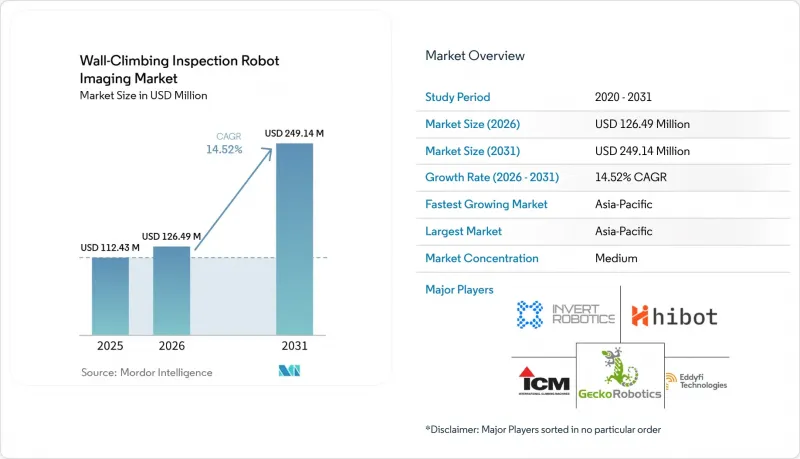
全球壁面攀爬式檢測機器人成像市場趨勢及洞察。
關鍵基礎設施惡化並檢查積壓
維修工作的延誤導致發電廠、煉油廠、橋樑和海上碼頭的檢查進度緩慢。美國土木工程師學會 (ASCE) 在 2025 年評估報告中指出,美國基礎設施資金缺口將超過 2.6 兆美元。這項資金缺口凸顯了業主在確定維護工作的優先順序之前,需要掌握清晰的設施狀況資料。攀爬式檢查機器人的影像採集市場正受益於履帶式機器人,這類機器人無需建造大規模鷹架即可檢查儲槽、碼頭和煙囪。 HausBots、EDF 和 ACS-Solutions 於 2025 年完成了對一座 200 公尺高混凝土煙囪的機器人超音波層析成像測試。此次演示證實了機器人檢查在高層水泥建築物中的效用,並為實施更頻繁的檢查計劃提供了切實的依據。
遵守高空作業安全標準,並透過繩索作業降低風險。
高空作業仍然是傳統檢測計畫中的一大限制。美國職業安全與健康管理局 (OSHA) 的防墜落需求日益嚴格,因此,在檢測工作中管理風險暴露至關重要。機器人作業可以減少工人在高空或難以到達的位置作業的需求。 2025 年,HausBots 使用其 HB3 履帶式機器人對 Cemex 公司 70 公尺高的迴轉窯進行了超音波檢測,整個檢測過程中無需任何工人在高空作業。這使得評估標準從單純的設備成本轉移到風險管理和現場作業規劃。由於營運商必須記錄受監管資產的安全檢測方法,因此,用於攀爬牆壁的檢測機器人的影像擷取市場具有巨大的成長空間。
系統成本高且需要專門的整合服務。
包括履帶式硬體、感測器、軟體、培訓和整合成本在內,先進的多模態系統通常售價在 15 萬美元到 50 萬美元以上。這筆初始投資可能超出小規模檢測公司的採購能力,並可能導致核准流程冗長,尤其是在對價格敏感的應用領域。此外,如何找到負責人豐富的非破壞性檢測 (NDT) 和整合負責人也是一大挑戰。對於希望嘗試機器人檢測方法的企業而言,服務和租賃模式可以降低初始資本負擔。因此,牆面攀爬式偵測機器人的影像擷取市場很可能首先由能夠承擔整合成本的大規模所有者和服務供應商推動擴張。
細分市場分析
頻譜/高光譜遙測成像技術預計到2031年將以18.12%的複合年成長率成長。該技術能夠進行超越標準目視檢測的材料級表面分析。一項2025年的研究發現,高光譜遙測成像技術能夠在移動機器人應用中辨識像素級的材料成分。這項技術有助於識別腐蝕、塗層劣化和水分入侵的化學性質。
2025年,RGB/可見光成像在牆體攀爬檢測機器人成像市場中佔據38.81%的佔有率。由於其與現有相機系統的兼容性以及對成熟缺陷檢測模型的支持,該技術仍被廣泛應用。一項2026年的研究報告顯示,安裝在負壓式牆體攀爬機器人上的即時分割網路對裂縫寬度的相對誤差為0.53%。熱成像/紅外線成像對於檢測隔熱材料下的腐蝕和表面以下的分層仍然至關重要。 3D/立體成像支援缺陷形狀測量,用於產生檢測報告。其他成像技術,包括雷達和聲學技術,適用於牆體攀爬檢測機器人成像市場中需要更詳細評估的鋼筋混凝土結構應用。
區域分析
預計到2025年,亞太地區將佔據壁面攀爬式檢測機器人成像市場31.23%的佔有率,並在2031年之前以15.34%的複合年成長率成長。中國儲存槽數量的成長、日本橋樑檢測需求的增加、印度的維修工程以及韓國的造船投資,都推動了全部區域多元化的需求。日本的NETIS系統允許註冊系統滿足政府資助計畫的規範要求。 Didon Robotics公司開發了一種配備電磁永磁體的攀爬式四足機器人,並已與韓國兩家造船廠和歐洲一家客戶簽訂了供貨契約,預計到2025年12月交付。國內供應商也正訂單在印度和中東的石油天然氣產業取得檢測合約。
北美和歐洲是高價值需求中心,這得益於成熟的無損檢測 (NDT) 服務、高密度的工業資產以及對檢測的迫切需求。在美國,高空作業安全法規、橋樑檢測框架以及對老舊基礎設施的投資正在推動市場需求。 2026 年 3 月,美國海軍授予 Gecko Robotics 一份為期五年的無限期交付/無限期數量 (IDIQ) 契約,用於提供檢測和維護規劃服務,初始契約金額為 5400 萬美元,最高可達 7100 萬美元。歐洲的需求包括與煙囪、冷卻塔和海上結構相關的應用。 Hausbots 公司報告稱,隨著其在日本、新加坡和韓國拓展銷售網路,2025 年銷售額成長了 300%,新契約超過 200 萬美元。
儘管中東、非洲和南美洲的需求量仍然相對較小,但它們蘊藏著一定的長期機會。阿布達比國家石油公司(ADNOC)與Gecko Robotics公司簽訂的2025年合約包括機器人部署和阿拉伯聯合大公國技術人員培訓。巴西的近海油田以及奈及利亞老化的管道和儲罐基礎設施,為降低初始部署成本的服務模式提供了潛在的應用場景。在這些地區,如果供應商能夠展示切實有效的現場成果和合理的定價,用於攀爬式檢測機器人的影像擷取市場可望擴大。
其他好處:
- Excel格式的市場預測(ME)表
- 3個月的分析師支持
目錄
第1章:引言
- 研究假設和市場定義
- 調查範圍
第2章:調查方法
第3章執行摘要
第4章 市場狀況
- 市場概覽
- 市場促進因素
- 關鍵基礎設施惡化和檢查延誤
- 遵守高空作業安全標準,並透過繩索作業降低風險。
- 對數位資產進行完整且可重現記錄的需求
- 多模態無損檢測(NDT)成像有效載荷的擴展
- 危險檢驗工作勞動力短缺
- 利用斷層掃描技術檢驗機器人煙囪和粗糙混凝土表面。
- 市場限制因素
- 系統成本高且需要專門的整合服務。
- 表面狀況和黏合劑可靠性的限制
- 缺陷分類的責任和第三方檢驗要求
- 資產擁有者之間以及無損檢測 (NDT) 工作流程中資料標準不一致。
- 宏觀經濟因素對市場的影響
- 產業供應鏈分析
- 監理情勢
- 技術展望
- 波特五力分析
第5章 市場規模與成長預測
- 透過成像技術
- RGB/可見光成像
- 熱成像/紅外線成像
- 3D/立體成像
- 頻譜/高光譜影像
- 其他成像技術
- 透過成像系統
- 相機硬體
- 熱像儀
- 3D成像系統
- 照明/光學配件
- 影像處理和人工智慧視覺軟體
- 透過使用
- 表面缺陷和裂紋的檢測
- 腐蝕檢測與測繪
- 焊接檢驗
- 塗層/油漆檢驗
- 結構狀況評估
- 其他用途
- 按最終用戶行業分類
- 石油和天然氣
- 發電和公共產業
- 基礎設施和建築
- 海洋/近海
- 風力
- 製造業
- 其他終端用戶產業
- 按地區
- 北美洲
- 美國
- 加拿大
- 墨西哥
- 南美洲
- 巴西
- 阿根廷
- 其他南美國家
- 歐洲
- 德國
- 英國
- 法國
- 義大利
- 西班牙
- 其他歐洲國家
- 亞太地區
- 中國
- 日本
- 印度
- 韓國
- 其他亞太國家
- 中東和非洲
- 中東
- 沙烏地阿拉伯
- 阿拉伯聯合大公國
- 土耳其
- 其他中東國家
- 非洲
- 南非
- 奈及利亞
- 其他非洲國家
- 中東
- 北美洲
第6章 競爭情勢
- 市場集中度
- 策略趨勢
- 市佔率分析
- 公司簡介
- Gecko Robotics, Inc.
- HiBot Corporation
- Invert Robotics Group Limited
- International Climbing Machines, Inc.
- Eddyfi Technologies Inc.
- HausBots Ltd
- Waygate Technologies GmbH
- GE Vernova Inc.
- ANYbotics AG
- Boston Dynamics, Inc.
- Deep Trekker Inc.
- CUES, Inc.
- Rausch GmbH
- Minicam Limited
- Inspector Systems GmbH
- Kummert GmbH
- NDT Global GmbH and Co. KG
- MFE Inspection Solutions, LLC
- Nexxis
- SuperDroid Robots, Inc.
第7章 市場機會與未來展望
According to Mordor Intelligence, the wall-climbing inspection robot imaging market size is projected to be USD 112.43 million in 2025, USD 126.49 million in 2026, and reach USD 249.14 million by 2031, growing at a CAGR of 14.52% from 2026 to 2031.
Global Wall-Climbing Inspection Robot Imaging Market Trends and Insights
Aging Critical Infrastructure and Inspection Backlogs
Deferred maintenance has created inspection backlogs across power plants, refineries, bridges, and marine terminals. The American Society of Civil Engineers reported more than USD 2.6 trillion in U.S. infrastructure funding gaps in its 2025 assessment. These gaps underscore the need for clear condition data before owners can prioritize maintenance work. The wall-climbing inspection robot imaging market benefits when crawlers can inspect tanks, piers, and chimney stacks without extended scaffold work. HausBots, EDF, and ACS-Solutions completed robotic ultrasonic tomography trials on a 200 m concrete chimney during 2025. The demonstration supported the use of robotic surveys for tall concrete structures and added practical evidence for higher-frequency inspection programs.
Height-Safety Compliance and Rope-Access Risk Reduction
Working at height remains a major constraint in conventional inspection planning. OSHA fall-protection requirements increase the need to control exposure during inspection work. Robotic access can reduce the need for personnel to work on elevated or difficult surfaces. HausBots used its HB3 crawler for an ultrasonic inspection of a 70 m Cemex rotary kiln in 2025 without personnel working at height during the survey. This changes the evaluation from equipment cost alone to risk management and site access planning. The wall-climbing inspection robot imaging market can gain where operators must document safe inspection methods across regulated assets.
High System Cost and Specialist Integration Requirements
Advanced multimodal systems commonly cost from USD 150,000 to more than USD 500,000 when crawler hardware, sensors, software, training, and integration are included. The upfront cost can exceed the procurement capacity of smaller inspection companies. It also creates a longer approval process in price-sensitive applications. The availability of experienced NDT and integration personnel adds to the challenge. Service and rental models can reduce the initial capital burden for operators that want to test robotic methods. The wall-climbing inspection robot imaging market may therefore expand first through larger owners and service providers that can absorb integration costs.
Other drivers and restraints analyzed in the detailed report include:
- Demand for Repeatable Digital Asset-Integrity Records
- Expansion of Multimodal NDT Imaging Payloads
- Surface-Condition and Adhesion Reliability Limits
For complete list of drivers and restraints, kindly check the Table Of Contents.
Segment Analysis
Multispectral/Hyperspectral Imaging is forecast to grow at an 18.12% CAGR through 2031. This category supports material-level surface analysis beyond standard visual inspection. A 2025 review found that hyperspectral imaging can distinguish material composition at the pixel level in mobile robot applications. This capability can help identify corrosion chemistry, coating degradation, and moisture ingress.
RGB/Visible-Light Imaging accounted for 38.81% of the wall-climbing inspection robot imaging market size in 2025. It remains widely used because it fits established camera systems and supports mature defect-detection models. A 2026 study reported a crack-width relative error of 0.53% for an onboard real-time segmentation network on a negative-pressure wall-climbing robot. Thermal/Infrared Imaging remains important for corrosion under insulation and subsurface delamination. 3D/Stereo Imaging supports defect geometry measurement for inspection reports. Other imaging technologies, including radar and acoustic approaches, remain suited to reinforced concrete cases that require deeper assessment in the wall-climbing inspection robot imaging market.
Complete Report Scope:
- By Imaging Technology
- RGB / Visible-Light Imaging
- Thermal / Infrared Imaging
- 3D / Stereo Imaging
- Multispectral / Hyperspectral Imaging
- Other Imaging Technologies
- By Imaging Systems
- Camera Hardware
- Thermal Cameras
- 3D Imaging Systems
- Lighting / Optical Accessories
- Imaging Processing and AI Vision Software
- By Application
- Surface Defect and Crack Detection
- Corrosion Detection and Mapping
- Weld Inspection
- Coating / Paint Inspection
- Structural Condition Assessment
- Other Applications
- By End-User Industry
- Oil and Gas
- Power Generation and Utilities
- Infrastructure and Construction
- Marine and Offshore
- Wind Energy
- Manufacturing
- Other End-User Industries
- By Geography
- North America
- United States
- Canada
- Mexico
- South America
- Brazil
- Argentina
- Rest of South America
- Europe
- Germany
- United Kingdom
- France
- Italy
- Spain
- Rest of Europe
- Asia-Pacific
- China
- Japan
- India
- South Korea
- Rest of Asia-Pacific
- Middle East and Africa
- Middle East
- Saudi Arabia
- United Arab Emirates
- Turkey
- Rest of the Middle East
- Africa
- South Africa
- Nigeria
- Rest of Africa
- Middle East
- North America
Geography Analysis
Asia-Pacific held 31.23% of the wall-climbing inspection robot imaging market share in 2025 and is forecast to grow at a 15.34% CAGR through 2031. China's storage tank base, Japan's bridge inspection requirements, India's rehabilitation activity, and South Korea's shipbuilding investment support varied demand across the region. Japan's NETIS framework can make registered systems eligible for government-funded project specifications. Didon Robotics developed an electromagnetic permanent-magnet climbing quadruped and had supply agreements with 2 Korean shipyards and 1 European customer by December 2025. Domestic suppliers are also pursuing inspection work in Indian and Middle Eastern oil and gas applications.
North America and Europe are high-value demand centers due to mature NDT services, industrial asset density, and inspection requirements. Height-safety rules, bridge inspection frameworks, and investment in aging infrastructure support U.S. demandThe. The U.S. Navy awarded Gecko Robotics a five-year IDIQ contract in March 2026, with an initial value of USD 54 million and a ceiling of USD 71 million, for inspection and maintenance-planning activities. European demand includes applications involving chimneys, cooling towers, and offshore structures. HausBots reported 300% turnover growth in 2025 and more than USD 2 million in new deals while expanding distribution in Japan, Singapore, and South Korea.
The Middle East, Africa, and South America remain smaller demand pools with specific long-term opportunities. ADNOC's 2025 agreements with Gecko Robotics included the deployment of robotics and Emirati technician training. Brazil's offshore fields and Nigeria's aging pipeline and tank infrastructure offer potential applications as service models that reduce first-deployment costs. The wall-climbing inspection robot imaging market can expand in these regions as providers demonstrate reliable field outcomes and workable service pricing.
- Gecko Robotics, Inc.
- HiBot Corporation
- Invert Robotics Group Limited
- International Climbing Machines, Inc.
- Eddyfi Technologies Inc.
- HausBots Ltd
- Waygate Technologies GmbH
- GE Vernova Inc.
- ANYbotics AG
- Boston Dynamics, Inc.
- Deep Trekker Inc.
- CUES, Inc.
- Rausch GmbH
- Minicam Limited
- Inspector Systems GmbH
- Kummert GmbH
- NDT Global GmbH and Co. KG
- MFE Inspection Solutions, LLC
- Nexxis
- SuperDroid Robots, Inc.
Additional Benefits:
- The market estimate (ME) sheet in Excel format
- 3 months of analyst support
TABLE OF CONTENTS
1 INTRODUCTION
- 1.1 Study Assumptions and Market Definition
- 1.2 Scope of the Study
2 RESEARCH METHODOLOGY
3 EXECUTIVE SUMMARY
4 MARKET LANDSCAPE
- 4.1 Market Overview
- 4.2 Market Drivers
- 4.2.1 Aging Critical Infrastructure and Inspection Backlogs
- 4.2.2 Height-Safety Compliance and Rope-Access Risk Reduction
- 4.2.3 Demand for Repeatable Digital Asset-Integrity Records
- 4.2.4 Expansion of Multimodal NDT Imaging Payloads
- 4.2.5 Workforce Constraints in Hazardous Inspection Trades
- 4.2.6 Robotic Chimney and Rough-Concrete Tomography Validation
- 4.3 Market Restraints
- 4.3.1 High System Cost and Specialist Integration Requirements
- 4.3.2 Surface-Condition and Adhesion Reliability Limits
- 4.3.3 Defect-Classification Liability and Third-Party Validation Requirements
- 4.3.4 Inconsistent Data Standards Across Asset Owners and NDT Workflows
- 4.4 Impact of Macroeconomic Factors on the Market
- 4.5 Industry Supply Chain Analysis
- 4.6 Regulatory Landscape
- 4.7 Technological Outlook
- 4.8 Porter's Five Forces Analysis
- 4.8.1 Bargaining Power of Suppliers
- 4.8.2 Bargaining Power of Buyers
- 4.8.3 Threat of New Entrants
- 4.8.4 Threat of Substitutes
- 4.8.5 Intensity of Competitive Rivalry
5 MARKET SIZE AND GROWTH FORECASTS (VALUE)
- 5.1 By Imaging Technology
- 5.1.1 RGB / Visible-Light Imaging
- 5.1.2 Thermal / Infrared Imaging
- 5.1.3 3D / Stereo Imaging
- 5.1.4 Multispectral / Hyperspectral Imaging
- 5.1.5 Other Imaging Technologies
- 5.2 By Imaging Systems
- 5.2.1 Camera Hardware
- 5.2.2 Thermal Cameras
- 5.2.3 3D Imaging Systems
- 5.2.4 Lighting / Optical Accessories
- 5.2.5 Imaging Processing and AI Vision Software
- 5.3 By Application
- 5.3.1 Surface Defect and Crack Detection
- 5.3.2 Corrosion Detection and Mapping
- 5.3.3 Weld Inspection
- 5.3.4 Coating / Paint Inspection
- 5.3.5 Structural Condition Assessment
- 5.3.6 Other Applications
- 5.4 By End-User Industry
- 5.4.1 Oil and Gas
- 5.4.2 Power Generation and Utilities
- 5.4.3 Infrastructure and Construction
- 5.4.4 Marine and Offshore
- 5.4.5 Wind Energy
- 5.4.6 Manufacturing
- 5.4.7 Other End-User Industries
- 5.5 By Geography
- 5.5.1 North America
- 5.5.1.1 United States
- 5.5.1.2 Canada
- 5.5.1.3 Mexico
- 5.5.2 South America
- 5.5.2.1 Brazil
- 5.5.2.2 Argentina
- 5.5.2.3 Rest of South America
- 5.5.3 Europe
- 5.5.3.1 Germany
- 5.5.3.2 United Kingdom
- 5.5.3.3 France
- 5.5.3.4 Italy
- 5.5.3.5 Spain
- 5.5.3.6 Rest of Europe
- 5.5.4 Asia-Pacific
- 5.5.4.1 China
- 5.5.4.2 Japan
- 5.5.4.3 India
- 5.5.4.4 South Korea
- 5.5.4.5 Rest of Asia-Pacific
- 5.5.5 Middle East and Africa
- 5.5.5.1 Middle East
- 5.5.5.1.1 Saudi Arabia
- 5.5.5.1.2 United Arab Emirates
- 5.5.5.1.3 Turkey
- 5.5.5.1.4 Rest of the Middle East
- 5.5.5.2 Africa
- 5.5.5.2.1 South Africa
- 5.5.5.2.2 Nigeria
- 5.5.5.2.3 Rest of Africa
- 5.5.5.1 Middle East
- 5.5.1 North America
6 COMPETITIVE LANDSCAPE
- 6.1 Market Concentration
- 6.2 Strategic Moves
- 6.3 Market Share Analysis
- 6.4 Company Profiles (includes Global Level Overview, Market Level Overview, Core Segments, Financials as available, Strategic Information, Market Rank/Share, Products and Services, Recent Developments)
- 6.4.1 Gecko Robotics, Inc.
- 6.4.2 HiBot Corporation
- 6.4.3 Invert Robotics Group Limited
- 6.4.4 International Climbing Machines, Inc.
- 6.4.5 Eddyfi Technologies Inc.
- 6.4.6 HausBots Ltd
- 6.4.7 Waygate Technologies GmbH
- 6.4.8 GE Vernova Inc.
- 6.4.9 ANYbotics AG
- 6.4.10 Boston Dynamics, Inc.
- 6.4.11 Deep Trekker Inc.
- 6.4.12 CUES, Inc.
- 6.4.13 Rausch GmbH
- 6.4.14 Minicam Limited
- 6.4.15 Inspector Systems GmbH
- 6.4.16 Kummert GmbH
- 6.4.17 NDT Global GmbH and Co. KG
- 6.4.18 MFE Inspection Solutions, LLC
- 6.4.19 Nexxis
- 6.4.20 SuperDroid Robots, Inc.
7 MARKET OPPORTUNITIES AND FUTURE OUTLOOK
- 7.1 White-Space and Unmet-Need Assessment

 單人機器人全測站儀市場:全球市場預測,2026-2032年智慧煤礦用輪式地下巡檢機器人市場:全球市場預測(2026-2032年)聲納管道檢測設備市場:全球市場預測,2026-2032年海洋維護機器人市場:全球市場預測,2026-2032年自動攀牆機器人市場:全球市場預測,2026-2032年隧道偵測設備市場:全球市場預測,2026-2032年複合材料檢測機器人市場:全球市場預測,2026-2032年鐵路車輛底盤偵測機器人市場:全球市場預測,2026-2032年
 2026 年至 2035 年檢測機器人的市場機會、成長要素、產業趨勢和預測。檢測機器人市場-全球市場預測(2026-2032年)