


 |
市場調查報告書
商品編碼
2155290
飛行時間工業相機:市場佔有率分析、行業趨勢和統計數據以及成長預測(2026-2031 年)Time-of-Flight Industrial Camera - Market Share Analysis, Industry Trends & Statistics, Growth Forecasts (2026 - 2031) |
||||||

※ 本網頁內容可能與最新版本有所差異。詳細情況請與我們聯繫。
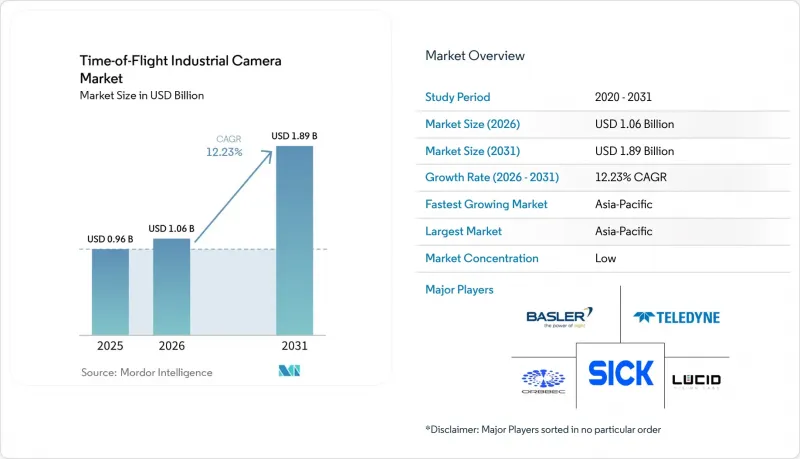
根據 Mordor Intelligence 預測,飛行時間 (ToF) 工業相機的市場規模預計將從 2025 年的 9.6 億美元成長到 2026 年的 10.6 億美元,到 2031 年達到 18.9 億美元,2026 年至 2031 年的年複合成長率(CAGR)為 12.3%。
全球飛行時間工業相機市場趨勢與洞察
倉庫自動化與自主移動機器人的擴展
倉庫自動化是推動飛行時間(ToF)工業相機市場需求的主要因素。自主移動機器人需要可靠的深度資訊來實現避障、路徑規劃以及在工作人員周圍移動。 ToF相機非常適合近距離感知,因為它們能夠快速產生3D佔用資料。這種功能在倉庫中尤其重要,因為倉庫中不同通道、裝卸區和儲存區的照明條件各不相同。隨著機器人數量的增加,可能需要額外的深度感知硬體,而相機需求與設備部署密切相關。因此,隨著物流運營商在大規模機器人集群中實現感知硬體的標準化,飛行時間工業相機市場將從中受益。
工業4.0的引進與機器視覺的現代化
隨著老舊的2D檢測系統逐漸退出市場,製造商正在升級其檢測流程。從2D偵測轉向深度感知偵測通常不僅僅是更換攝影機那麼簡單,它往往會徹底改變整個工作流程。生產線可能需要同時配備攝影機、照明設備、處理能力和軟體許可。因此,採購決策遠不止選擇硬體那麼簡單。成熟的供應商正透過將飛行時間(ToF)感測技術與軟體開發工具包(SDK)和整合生態系統結合來滿足這些需求。隨著現代化改造計劃將機器視覺定位為“互聯生產系統”,飛行時間(ToF)工業相機的市場正在不斷擴大。
高整合度和校驗成本
建造一套功能完善的機器視覺系統,需要的不僅僅是安裝一台深度相機。整合商必須將相機與機器人的座標系對齊,並根據光線和反射表面進行調整。他們還必須考慮因運作條件變化而導致的深度校準漂移。這些要求可能會延長小規模製造工廠的實施週期。在棕地工廠中,如果需要為現有輸送機或貨架客製化介面,則可能需要額外的機械和軟體工作。在飛行時間 (ToF) 工業相機市場,預先校準相機和相機內建的深度處理功能可以減輕這些負擔。
細分市場分析
截至2025年,獨立式工業飛行時間(ToF)相機佔據了ToF工業相機市場48.62%的佔有率。系統整合商傾向於模組化設計,這種設計允許使用者根據自身需求選擇相機硬體、照明設備、計算單元和軟體。這種方法為使用者在確定技術要求後提供了柔軟性,也使整合商能夠根據特定的工作距離和物體類型自訂系統。嵌入式ToF模組則滿足了緊湊型機器人應用中的不同需求。它們可以整合到協作機器人的末端執行器、腕戴式感測設備以及自動導引運輸車(AGV)的感測器叢集中。這些應用對空間、重量和功耗都有嚴格的限制。 ToF工業相機市場將繼續依賴模組化和嵌入式硬體方案。
預計從2026年到2031年,ToF相機系統和捆綁式視覺解決方案的複合年成長率將達到14.36%。中型製造商通常優先考慮快速部署,而非單一組件的柔軟性。捆綁式系統可以透過預先定義的介面提供校準後的深度、置信度和亮度數據,從而減少安裝過程中所需的決策次數。 IDS Imaging於2026年8月開始量產其「Nion 3D ToF相機」。本產品結合了安森美半導體的Hyperlux ID AF0130感測器、片上處理功能和IP67防護等級的機殼。它提供120萬像素的深度解析度,幀率為30 fps,工作範圍為0.3至7.5米。
預計到2025年,間接飛行時間(iToF)技術將佔銷售額的61.47%。其應用主要集中在室內移動機器人、揀貨箱和物流平台等領域。 iToF系統利用連續波相位測量產生高密度深度圖。目前的相機工作距離足以滿足近距離工業搬運任務的需求。SONY的DepthSense和英飛凌的REAL3感測器系列均支援此類應用。它們的運作特性非常適合可控光照的室內環境。 iToF飛行時間工業相機市場持續受益於其與現有工業設計的廣泛相容性。
預計從2026年到2031年,直接飛行時間(ToF)技術將以14.82%的複合年成長率成長。單光子雪崩二極體(SPAD)陣列可測量短雷射脈衝發射的光子的到達時間。這種方法適用於遠距離和高環境光環境。意法半導體(STMicroelectronics)於2026年7月開始量產VL53L9。此模組提供2268個解析度區域,幀速率為100幀/秒,感測範圍為5公分至9公尺。它可為機器人和工業自動化領域的邊緣處理提供輸出。 SPAD陣列設計的研究也著重於減少晶片面積和降低功耗。
區域分析
預計到2025年,亞太地區將佔據飛行時間(ToF)工業相機市場41.58%的佔有率,並將以14.28%的複合年成長率成長至2031年。在中國,電子、電動車電池和半導體工廠的蓬勃發展推動了市場需求。在這些領域,深度感知技術被應用於自動導引車、偵測和物流系統。日本則透過精密儀器和整合機器視覺平台為市場做出貢獻。韓國的半導體和顯示器產業也需要先進的檢測製程。印度則透過電子製造、半導體業務和行動裝置組裝推動市場需求。區域供應商正在同一價值鏈中建立相機、感測器、軟體和機器人技術。歌爾科技為物流、電子商務、食品和消費化工產業的堆疊和拆垛提供全堆疊式3D ToF解決方案。
北美是飛行時間(ToF)工業相機市場第二大地區。製造業的新投資正在推動自動化和機器視覺設備的採購。物流和電履約公司正在將深度感知技術應用於自主移動機器人(AMR)導航和小包裹測量。這些買家可以在單一設施內部署多個系統。在歐洲,德國汽車和機械製造商的需求旺盛。協作機器人環境中的安全要求也推動了對認證系統的需求。 GigE Vision 3.0 新增了對 RoCEv2 的支持,從而能夠在多攝影機環境中實現低延遲影像傳輸。
南美洲仍處於新興市場階段,巴西和阿根廷是主要的需求中心。汽車組裝和國內電商物流是其最顯著的應用領域。由於工廠數位化進程不均衡以及整合能力有限,其普及速度可能較為緩慢。在中東,阿拉伯聯合大公國和沙烏地阿拉伯正在建造智慧倉庫基礎設施。這些投資正推動自主物料輸送及相關感知硬體的發展。非洲仍處於應用初期,南非和埃及是相對活躍的工業中心。由於價格敏感,低成本的立體視覺和2D視覺解決方案在許多非洲應用領域更受歡迎。
其他好處:
- Excel格式的市場預測(ME)表
- 3個月的分析師支持
目錄
第1章:引言
- 研究假設和市場定義
- 調查範圍
第2章:調查方法
第3章執行摘要
第4章 市場狀況
- 市場概覽
- 市場促進因素
- 倉庫自動化與自主機器人的擴展
- 工業4.0的引進與機器視覺的現代化
- 對即時3D檢測和尺寸測量的需求
- 工業相機邊緣人工智慧處理技術的發展
- 戶外機器人對感測能力的需求日益成長。
- GigE Vision、GenICam 和 ROS 整合的標準化
- 市場限制因素
- 高整合和調整成本
- 環境光和多路徑干擾造成的限制
- 低成本立體光學和結構光學系統替代技術的可用性。
- 高密度多攝影機部署中的干擾和人眼安全限制
- 宏觀經濟因素對市場的影響
- 產業供應鏈分析
- 科技趨勢
- 監理情勢
- 波特五力分析
第5章 市場規模與成長預測
- 依產品類型
- 獨立式工業ToF相機
- 嵌入式ToF相機模組
- ToF相機系統與配套視覺解決方案
- 透過技術
- 直接飛行時間 (dToF)
- 間接飛行時間 (iToF)
- 混合飛行時間
- 透過使用
- 機器人引導與揀選
- 自主移動機器人的導航與避障
- 物流中的尺寸測量、稱重和掃描。
- 檢驗、測量、品管
- 人機安全與監控
- 庫存、填充水準和容量的測量
- 其他用途
- 按最終用戶行業分類
- 車
- 電子和半導體
- 食品/飲料/消費品
- 物流、倉儲業與電子商務
- 金屬、機械和一般製造業
- 醫療和生命科學設施
- 其他終端用戶產業
- 按地區
- 北美洲
- 美國
- 加拿大
- 墨西哥
- 南美洲
- 巴西
- 阿根廷
- 其他南美國家
- 歐洲
- 德國
- 英國
- 法國
- 義大利
- 西班牙
- 其他歐洲國家
- 亞太地區
- 中國
- 日本
- 印度
- 韓國
- 其他亞太國家
- 中東
- 阿拉伯聯合大公國
- 沙烏地阿拉伯
- 其他中東國家
- 非洲
- 南非
- 埃及
- 其他非洲國家
- 北美洲
第6章 競爭情勢
- 市場集中度
- 策略趨勢
- 市佔率分析
- 公司簡介
- Basler AG
- LUCID Vision Labs, Inc.
- Orbbec Inc.
- Pmdtechnologies gmbh
- IFM Electronic GmbH
- Teledyne Vision Solutions
- IDS Imaging Development Systems GmbH
- Allied Vision Technologies GmbH
- SICK AG
- Baumer Holding AG
- Cognex Corporation
- KEYENCE CORPORATION
- Hikrobot Co., Ltd.
- Mech-Mind Robotics Technologies Co., Ltd.
- Semiconductor Components Industries, LLC
- Photoneo sro
- STMicroelectronics
- ESPROS Photonics Corporation
- Domi Sensor Technology Co., Ltd.
- Goertek Microelectronics Inc.
- TOPPAN INC.
- BECOM Systems GmbH
- MESA Imaging AG
- Nerian Vision GmbH
第7章 市場機會與未來展望
According to Mordor Intelligence, the time-of-flight industrial camera market size is projected to expand from USD 0.96 billion in 2025 to USD 1.06 billion in 2026, and to USD 1.89 billion by 2031, registering a CAGR of 12.23% between 2026 and 2031.
Global Time-of-Flight Industrial Camera Market Trends and Insights
Expansion of Warehouse Automation and Autonomous Mobile Robots
Warehouse automation is a central driver of demand for the Time-of-flight industrial camera market. Autonomous mobile robots need reliable depth information for obstacle avoidance, path planning, and movement around workers. ToF cameras are well-suited to close-range sensing because they rapidly generate three-dimensional occupancy data. This capability is useful in warehouses where lighting varies across aisles, loading areas, and storage zones. Each fleet expansion may require additional depth-sensing hardware, linking camera demand to equipment deployment. The Time-of-flight industrial camera market, therefore, benefits when logistics operators standardize perception hardware across larger robot fleets.
Industry 4.0 Adoption and Machine Vision Modernization
Manufacturers are updating inspection processes as older two-dimensional systems reach replacement cycles. A move from 2D inspection to depth-aware inspection often changes the workflow rather than simply replacing a camera. Production lines may require cameras, illumination, processing capacity, and software licenses simultaneously. This makes the purchase decision broader than a hardware selection. Established vendors are responding by pairing ToF sensing with software development kits and integration ecosystems. The Time-of-flight industrial camera market gains when modernization programs treat machine vision as a connected production system.
High Integration and Calibration Cost
A working machine-vision system requires more than installing a depth camera. Integrators must align the camera with robot coordinates and tune it for lighting and reflective surfaces. They must also account for drift in depth calibration as operating conditions change. These requirements can extend implementation timelines in smaller manufacturing sites. Brownfield facilities can face added mechanical and software work when existing conveyors and racking need custom interfaces. Pre-calibrated cameras and on-camera depth processing can reduce this burden for the Time-of-flight industrial camera market.
Other drivers and restraints analyzed in the detailed report include:
- Demand for Real-Time 3D Inspection and Dimensioning
- Growth of Edge AI Processing in Industrial Cameras
- Ambient-Light and Multipath-Interference Limits
For complete list of drivers and restraints, kindly check the Table Of Contents.
Segment Analysis
Standalone industrial ToF cameras held 48.62% of the Time-of-flight industrial camera market share in 2025. System integrators have favored modular designs that let them select camera hardware, illumination, computing, and software separately. This approach gives users flexibility when they have established technical preferences. It also lets an integrator tune the system for a specific working distance or object type. Embedded ToF modules serve a different need in compact robot applications. They fit collaborative robot end effectors, wrist-mounted perception equipment, and automated guided vehicle sensor clusters. These uses have strict limits on space, weight, and power. The Time-of-flight industrial camera market continues to depend on both modular and embedded hardware choices.
ToF camera systems and bundled vision solutions are projected to expand at a 14.36% CAGR from 2026 to 2031. Mid-sized manufacturers often place more value on commissioning speed than on the flexibility of separate components. Bundled systems can deliver calibrated depth, confidence, and intensity data through a defined interface. This reduces the number of decisions required during installation. IDS Imaging placed its Nion 3D ToF camera into series production in August 2026. The product combines an onsemi Hyperlux ID AF0130 sensor with on-chip processing and an IP67 housing. It provides 1.2 MP depth resolution at 30 fps and operates across a 0.3 to 7.5 meter range.
Indirect ToF commanded 61.47% of revenue in 2025. Its installed base reflects its use in indoor mobile robotics, bin picking, and logistics platforms. iToF systems use continuous-wave phase measurement to create dense depth maps. Current cameras cover working distances that suit close-range industrial handling tasks. Sony DepthSense and Infineon REAL3 sensor families support this type of deployment. Their operating profile is aligned with indoor environments where lighting can be controlled. The Time-of-flight industrial camera market size for iToF remains supported by broad compatibility with existing industrial designs.
Direct ToF is projected to expand at a 14.82% CAGR from 2026 to 2031. SPAD arrays measure the arrival time of photons from short laser pulses. This approach is relevant for long-range and high-ambient-light tasks. STMicroelectronics began mass production of the VL53L9 in July 2026. The module offers 2,268 resolution zones at 100 fps across a 5-centimeter to 9-meter sensing range. It produces output intended for edge processing in robotics and industrial automation. Research on SPAD array design also focuses on reducing die area and power requirements.
Complete Report Scope:
- By Product Type
- Standalone Industrial ToF Cameras
- Embedded ToF Camera Modules
- ToF Camera Systems and Bundled Vision Solutions
- By Technology
- Direct ToF (dToF)
- Indirect ToF (iToF)
- Hybrid ToF
- By Application
- Robotic Guidance and Bin Picking
- Autonomous Mobile Robot Navigation and Obstacle Avoidance
- Logistics Dimensioning, Weighing, and Scanning
- Inspection, Measurement, and Quality Control
- Human-Robot Safety and Monitoring
- Inventory, Fill-Level, and Volume Measurement
- Other Applications
- By End-User Industry
- Automotive
- Electronics and Semiconductor
- Food, Beverage, and Consumer Goods
- Logistics, Warehousing, and E-Commerce
- Metals, Machinery, and General Manufacturing
- Healthcare and Life Sciences Facilities
- Other End-User Industries
- By Geography
- North America
- United States
- Canada
- Mexico
- South America
- Brazil
- Argentina
- Rest of South America
- Europe
- Germany
- United Kingdom
- France
- Italy
- Spain
- Rest of Europe
- Asia-Pacific
- China
- Japan
- India
- South Korea
- Rest of Asia-Pacific
- Middle East
- United Arab Emirates
- Saudi Arabia
- Rest of Middle East
- Africa
- South Africa
- Egypt
- Rest of Africa
- North America
Geography Analysis
Asia-Pacific held 41.58% of the Time-of-flight industrial camera market share in 2025 and is projected to expand at a 14.28% CAGR through 2031. China supports demand through electronics, electric vehicle battery, and semiconductor factory activity. Depth sensing is used in automated handling, inspection, and intralogistics systems in these settings. Japan contributes through precision equipment and its machine-vision integration base. South Korean semiconductor and display operations also require demanding inspection processes. India is driving demand through electronics manufacturing, semiconductor activity, and mobile device assembly. Regional suppliers are building camera, sensor, software, and robotics capabilities within the same value chain. Goertek Microelectronics offers full-stack 3D ToF solutions for palletizing and depalletizing in logistics, e-commerce, food, and daily-chemicals applications.
North America is the second-largest region in the Time-of-flight industrial camera market. New manufacturing investment is supporting purchases of automation and machine-vision equipment. Logistics providers and e-commerce fulfillment operators deploy depth sensing for AMR navigation and parcel measurement. These buyers can install multiple systems within a single facility. Europe draws demand from German automotive and machinery producers. Safety requirements for collaborative robot environments also support demand for certified systems. GigE Vision 3.0 added RoCEv2 support for lower-latency image transfer in multi-camera environments.
South America remains an emerging area, with Brazil and Argentina as key demand locations. Automotive assembly and domestic e-commerce logistics create the clearest application base. Uneven factory digitalization and limited integration capacity can slow adoption. The Middle East is adding smart warehouse infrastructure in the United Arab Emirates and Saudi Arabia. These investments support autonomous material handling and related perception hardware. Africa is still in the early stages of adoption, with South Africa and Egypt as more active industrial hubs. Price sensitivity in many African applications favors lower-cost stereo and two-dimensional alternatives.
- Basler AG
- LUCID Vision Labs, Inc.
- Orbbec Inc.
- Pmdtechnologies gmbh
- IFM Electronic GmbH
- Teledyne Vision Solutions
- IDS Imaging Development Systems GmbH
- Allied Vision Technologies GmbH
- SICK AG
- Baumer Holding AG
- Cognex Corporation
- KEYENCE CORPORATION
- Hikrobot Co., Ltd.
- Mech-Mind Robotics Technologies Co., Ltd.
- Semiconductor Components Industries, LLC
- Photoneo s. r. o.
- STMicroelectronics
- ESPROS Photonics Corporation
- Domi Sensor Technology Co., Ltd.
- Goertek Microelectronics Inc.
- TOPPAN INC.
- BECOM Systems GmbH
- MESA Imaging AG
- Nerian Vision GmbH
Additional Benefits:
- The market estimate (ME) sheet in Excel format
- 3 months of analyst support
TABLE OF CONTENTS
1 INTRODUCTION
- 1.1 Study Assumptions and Market Definition
- 1.2 Scope of the Study
2 RESEARCH METHODOLOGY
3 EXECUTIVE SUMMARY
4 MARKET LANDSCAPE
- 4.1 Market Overview
- 4.2 Market Drivers
- 4.2.1 Expansion of Warehouse Automation and Autonomous Mobile Robots
- 4.2.2 Industry 4.0 Adoption and Machine-Vision Modernization
- 4.2.3 Demand for Real-Time 3D Inspection and Dimensioning
- 4.2.4 Growth of Edge AI Processing in Industrial Cameras
- 4.2.5 Rising Need for Outdoor-Capable Robot Perception
- 4.2.6 Standardization of GigE Vision, GenICam, and ROS Integration
- 4.3 Market Restraints
- 4.3.1 High Integration and Calibration Cost
- 4.3.2 Ambient-Light and Multipath-Interference Limits
- 4.3.3 Availability of Lower-Cost Stereo and Structured-Light Alternatives
- 4.3.4 Interference and Eye-Safety Constraints in Dense Multi-Camera Deployments
- 4.4 Impact of Macroeconomic Factors on the Market
- 4.5 Industry Supply-Chain Analysis
- 4.6 Technology Outlook
- 4.7 Regulatory Landscape
- 4.8 Porter's Five Forces Analysis
- 4.8.1 Threat of New Entrants
- 4.8.2 Bargaining Power of Suppliers
- 4.8.3 Bargaining Power of Buyers
- 4.8.4 Threat of Substitutes
- 4.8.5 Intensity of Competitive Rivalry
5 MARKET SIZE AND GROWTH FORECASTS (VALUE)
- 5.1 By Product Type
- 5.1.1 Standalone Industrial ToF Cameras
- 5.1.2 Embedded ToF Camera Modules
- 5.1.3 ToF Camera Systems and Bundled Vision Solutions
- 5.2 By Technology
- 5.2.1 Direct ToF (dToF)
- 5.2.2 Indirect ToF (iToF)
- 5.2.3 Hybrid ToF
- 5.3 By Application
- 5.3.1 Robotic Guidance and Bin Picking
- 5.3.2 Autonomous Mobile Robot Navigation and Obstacle Avoidance
- 5.3.3 Logistics Dimensioning, Weighing, and Scanning
- 5.3.4 Inspection, Measurement, and Quality Control
- 5.3.5 Human-Robot Safety and Monitoring
- 5.3.6 Inventory, Fill-Level, and Volume Measurement
- 5.3.7 Other Applications
- 5.4 By End-User Industry
- 5.4.1 Automotive
- 5.4.2 Electronics and Semiconductor
- 5.4.3 Food, Beverage, and Consumer Goods
- 5.4.4 Logistics, Warehousing, and E-Commerce
- 5.4.5 Metals, Machinery, and General Manufacturing
- 5.4.6 Healthcare and Life Sciences Facilities
- 5.4.7 Other End-User Industries
- 5.5 By Geography
- 5.5.1 North America
- 5.5.1.1 United States
- 5.5.1.2 Canada
- 5.5.1.3 Mexico
- 5.5.2 South America
- 5.5.2.1 Brazil
- 5.5.2.2 Argentina
- 5.5.2.3 Rest of South America
- 5.5.3 Europe
- 5.5.3.1 Germany
- 5.5.3.2 United Kingdom
- 5.5.3.3 France
- 5.5.3.4 Italy
- 5.5.3.5 Spain
- 5.5.3.6 Rest of Europe
- 5.5.4 Asia-Pacific
- 5.5.4.1 China
- 5.5.4.2 Japan
- 5.5.4.3 India
- 5.5.4.4 South Korea
- 5.5.4.5 Rest of Asia-Pacific
- 5.5.5 Middle East
- 5.5.5.1 United Arab Emirates
- 5.5.5.2 Saudi Arabia
- 5.5.5.3 Rest of Middle East
- 5.5.6 Africa
- 5.5.6.1 South Africa
- 5.5.6.2 Egypt
- 5.5.6.3 Rest of Africa
- 5.5.1 North America
6 COMPETITIVE LANDSCAPE
- 6.1 Market Concentration
- 6.2 Strategic Moves
- 6.3 Market Share Analysis
- 6.4 Company Profiles (includes Global Level Overview, Market Level Overview, Core Segments, Financials as available, Strategic Information, Market Rank/Share, Products and Services, Recent Developments)
- 6.4.1 Basler AG
- 6.4.2 LUCID Vision Labs, Inc.
- 6.4.3 Orbbec Inc.
- 6.4.4 Pmdtechnologies gmbh
- 6.4.5 IFM Electronic GmbH
- 6.4.6 Teledyne Vision Solutions
- 6.4.7 IDS Imaging Development Systems GmbH
- 6.4.8 Allied Vision Technologies GmbH
- 6.4.9 SICK AG
- 6.4.10 Baumer Holding AG
- 6.4.11 Cognex Corporation
- 6.4.12 KEYENCE CORPORATION
- 6.4.13 Hikrobot Co., Ltd.
- 6.4.14 Mech-Mind Robotics Technologies Co., Ltd.
- 6.4.15 Semiconductor Components Industries, LLC
- 6.4.16 Photoneo s. r. o.
- 6.4.17 STMicroelectronics
- 6.4.18 ESPROS Photonics Corporation
- 6.4.19 Domi Sensor Technology Co., Ltd.
- 6.4.20 Goertek Microelectronics Inc.
- 6.4.21 TOPPAN INC.
- 6.4.22 BECOM Systems GmbH
- 6.4.23 MESA Imaging AG
- 6.4.24 Nerian Vision GmbH
7 MARKET OPPORTUNITIES AND FUTURE OUTLOOK
- 7.1 White-Space and Unmet-Need Assessment

 3D結構光相機市場:全球市場預測,2026-2032年
 3D相機:市佔率分析、產業趨勢與統計、成長預測(2026-2031年)
 結構化光學3D相機市場預測至2034年-按類型、技術、應用和地區分類的全球分析
 3D相機市場分析及預測(至2035年):類型、產品、技術、組件、應用、外形、設備、最終用戶、功能、安裝方式結構光雷射二極體模組市場(按雷射類型、光源、輸出功率、圖案類型、應用、分銷管道和終端用戶行業分類)—全球預測,2026-2032年英格斯相機市場分析及預測(至2035年):依類型、產品類型、服務、技術、組件、應用、最終用戶、功能、安裝類型及模式分類
 2026年全球3D相機市場報告微米級3D工業相機市場:依產品類型、技術、終端用戶產業和應用分類-2026-2032年全球預測結構光雷射市場:按組件類型、波長、輸出功率、應用和最終用戶產業分類 - 全球預測(2026-2032 年)結構光雷射模組市場(依產品類型、應用、最終用戶和通路分類)-2026-2032年全球預測