


 |
市場調查報告書
商品編碼
2119902
3D相機:市佔率分析、產業趨勢與統計、成長預測(2026-2031年)3D Camera - Market Share Analysis, Industry Trends & Statistics, Growth Forecasts (2026 - 2031) |
||||||

※ 本網頁內容可能與最新版本有所差異。詳細情況請與我們聯繫。
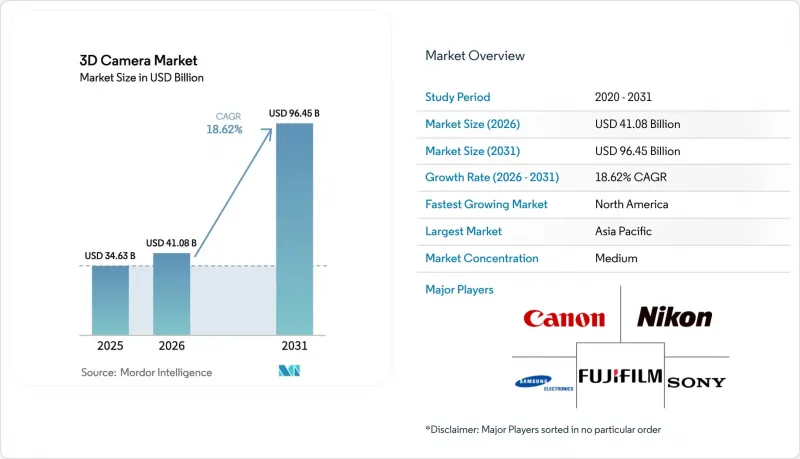
根據 Mordor Intelligence 預測,3D 相機市場規模將從 2025 年的 346.3 億美元成長到 2026 年的 410.8 億美元,然後在 2031 年達到 964.5 億美元,2026 年至 2031 年的複合年成長率為 18.62%。
本報告按技術(飛行時間法、立體視覺等)、類型(目標相機、無目標相機)、解析度(低於 800 萬像素、800 萬至 1,600 萬像素、1,600 萬像素及以上)、介面(千兆乙太網路、CameraLink 等汽車、應用程式/裝置(智慧型手機和平板電腦等)、終端用戶(C)市場預測以美元計價。
全球3D相機市場趨勢與洞察
將基於LiDAR的飛行時間感測器整合到旗艦智慧型手機中
蘋果在 iPhone 12 Pro 中推出 LiDAR 雷射雷達加速了深度感知技術的普及,而 iPhone 15 系列則進一步提升了擴增實境(AR) 任務的能效。三星的系統級晶片 (LSI) 部門目前向多個品牌供應 2 億像素影像感測器,加速了亞洲 OEM 廠商對該技術的採用。深度資料能夠提升自動對焦和人像模式的效能,使計算攝影成為一項關鍵的差異化優勢。供應鏈的重組,即 VCSEL 的供應商從相干公司轉向SONY,凸顯了供應商的不穩定性。在中階智慧型手機市場,散熱限制和組件成本之間的平衡將決定中期的市場滲透率。
汽車製造商強制要求對車內駕駛進行監控
歐洲新車安全評鑑協會(Euro NCAP)的法規強制要求檢測駕駛狀態,迫使汽車製造商安裝3D攝影機來偵測駕駛分心和駕駛能力受損的情況。SONY預測,汽車CMOS影像感測器市場將成長六倍,從2024年的每輛車8個感測器增加到2028年的12個。像Smart Eye和Seeing Machines這樣的利基供應商,將深度資料與人工智慧分析結合,正在形成一個不受經濟週期影響的穩健市場。雖然歐洲在監管合規方面處於領先地位,但美國監管協調的進展也可能提振短期需求。
大眾市場缺乏3D內容標準
由於缺乏統一的歐盟技術協議,創作者不得不針對多種視訊格式進行編碼,這導致製作預算膨脹,並阻礙了對拍攝硬體的投資。此外,對軍民兩用設備的出口限制進一步減緩了開發者之間的知識交流。缺乏統一的測試指標也令買家猶豫不決,拖累了3D相機市場的長期成長前景。
細分市場分析
立體視覺技術憑藉低成本雙鏡頭鑽機的優勢,預計到2025年將佔3D相機市場63.02%的佔有率。此領域尤其適用於專業單眼相機和工業拾取放置機械手臂等偏好被動深度估計的應用。同時,飛行時間(ToF)技術正以21.95%的複合年成長率成長,擴大了智慧型手機和駕駛監控模組等3D相機市場的規模。卓越的低光性能和單鏡頭封裝是推動ToF技術快速普及的關鍵因素。結構光技術對於臉部認證解鎖和牙科掃描仍然至關重要,但新興的混合技術堆疊將ToF與立體影像相結合,以確保冗餘性。
英飛凌和pmdtechnologies等廠商正在展示整合式顯示器的ToF成像器,這些成像器保持了無邊框設計。安森美半導體的間接ToF藍圖將最大測量距離擴展到了工廠車間的距離,從而拓寬了其在工業領域的應用前景。立體成像解決方案由於其低功耗的優勢,在靜態機器人領域仍然很受歡迎,但隨著每個產品週期的更新,其性能差距正在縮小。
預計到2025年,無目標3D相機設計將佔據3D相機市場53.88%的佔有率,複合年成長率(CAGR)將達到18.96%,這主要得益於即插即用技術在消費性電子市場的廣泛應用。取消校準標記簡化了智慧型手機、機器人和智慧家庭設備的部署,從而擴大了3D相機市場的整體規模。同時,基於目標的系統在精密測量領域仍然很受歡迎,因為參考圖案可以確保微米級的精度。
石頭科技的Qrevo Slim機器人採用英飛凌的混合式飛行時間(ToF)成像器,無需環境貼紙即可在家具間的狹窄縫隙中穿梭。工業用戶正在仔細權衡基於目標的相機的高初始精度與標記對準所需的停機時間之間的利弊。人工智慧驅動的自校準技術的進步有望減少這種權衡。
區域分析
到2025年,亞太地區將佔據3D相機市場38.07%的佔有率,這主要得益於中國工廠自動化、日本機器人技術以及韓國行動電話巨頭的崛起。政府激勵措施正在推動該地區感測器製造地的發展,但鍺和鎵的出口限制加劇了價格波動。 Orbbec在中國服務機器人相機市場佔有70%的佔有率,充分體現了該地區在該領域的專業化程度。
北美預計將實現21.28%的複合年成長率,這得益於符合歐洲標準的法規和XR內容工作室的發展。英特爾剝離其RealSense業務,凸顯了其致力於打造專屬市場模式的決心。加拿大正在採礦業應用自動化技術,而墨西哥的汽車出口則配備了駕駛員監視錄影機。
在實力雄厚的汽車一級供應商和工業機械製造商的推動下,歐洲正經歷穩定成長。在中東和非洲,海灣合作理事會(GCC)國家的智慧城市電網正在採用3D視覺技術,重點在於人群分析。同時,在南美洲,資金限制促使人們將重點放在安全和採礦領域的應用。
其他好處:
- Excel格式的市場預測(ME)表
- 3個月的分析師支持
目錄
第1章:引言
- 研究假設和市場定義
- 調查範圍
第2章:調查方法
第3章執行摘要
第4章 市場狀況
- 市場概覽
- 市場促進因素
- 在旗艦智慧型手機中整合基於LiDAR的飛行時間感測器(亞洲)
- 歐洲對汽車製造商車載駕駛員監控的強制性要求
- 智慧製造中對用於品質保證(QA)的3D視覺的需求(中國)
- 面向 XR 頭戴裝置的大量內容創作(美國)
- 海灣國家(海灣合作理事會成員國)智慧城市3D監視錄影機預算
- CMOS深度模組的物料清單成本更低(低於4美元)
- 市場限制因素
- 大眾市場(歐盟)缺乏3D內容標準
- 售價低於 300 美元的智慧型手機有過熱和功耗限制問題
- 中國對光晶片的出口限制
- 因立體視覺重新調整導致的停機(北歐機器人)
- 產業生態系分析
- 技術展望
- 波特五力分析
第5章 市場規模與成長預測
- 透過技術
- 飛行時間法
- 立體視覺
- 結構光
- 混合多感測器
- 按類型
- 目標相機
- 無目標相機
- 通過決議
- 小於 8 兆像素
- 8~16 MP
- 1600萬像素或以上
- 透過介面
- GigE
- CameraLink
- USB 和 CSI
- 其他介面
- 透過應用程式/設備
- 專業相機
- 智慧型手機和平板電腦
- 電腦和筆記型電腦
- AR/ VR頭戴裝置
- 機器人和無人機
- 其他用途和設備
- 按最終用途行業分類
- 家用電子產品
- 車
- 安全監控
- 工業和製造業
- 媒體與娛樂
- 衛生保健
- 航太/國防
- 其他終端用戶產業
- 按地區
- 北美洲
- 美國
- 加拿大
- 墨西哥
- 歐洲
- 德國
- 英國
- 法國
- 北歐的
- 其他歐洲國家
- 南美洲
- 巴西
- 其他南美國家
- 亞太地區
- 中國
- 日本
- 印度
- 東南亞
- 其他亞太國家
- 中東和非洲
- 中東
- 波灣合作理事會(GCC)成員國
- 土耳其
- 其他中東國家
- 非洲
- 南非
- 其他非洲國家
- 中東
- 北美洲
第6章 競爭情勢
- 市場集中度
- 策略趨勢
- 市佔率分析
- 公司簡介
- Sony Corporation
- Canon Inc.
- Panasonic Corporation
- Samsung Electronics Co., Ltd.
- Nikon Corporation
- Fujifilm Holdings Corporation
- LG Electronics Inc.
- Intel Corporation(RealSense)
- Apple Inc.
- Infineon Technologies AG
- STMicroelectronics NV
- pmdtechnologies AG
- Orbbec 3D Technology International, Inc.
- Basler AG
- Cognex Corporation
- OmniVision Technologies Inc.
- Sharp Corporation
- Matterport Inc.
- GoPro Inc.
- Microsoft Corporation
- Qualcomm Technologies Inc.
- Lumentum Holdings Inc.
- ams-OSRAM AG
- Teledyne Technologies Inc.
- Xiaomi Corporation
第7章 市場機會與未來展望
According to Mordor Intelligence, the 3D camera market size is expected to grow from USD 34.63 billion in 2025 to USD 41.08 billion in 2026 and is forecast to reach USD 96.45 billion by 2031 at 18.62% CAGR over 2026-2031.
This report is Segmented by Technology (Time-Of-Flight, Stereo Vision, and More), Type (Target Camera, and Target-Free Camera), Resolution (Less Than 8 MP, 8-16 MP, and Above 16 MP), Interface (GigE, Cameralink, and More), Application/Device (Smartphones and Tablets, and More), End-Use Industry (Automotive, Industrial, and More), and Geography. The Market Forecasts are Provided in Terms of Value (USD).
Global 3D Camera Market Trends and Insights
Integration of LiDAR-based ToF Sensors into Flagship Smartphones
Apple's LiDAR debut on the iPhone 12 Pro catalysed depth-sensing uptake, and the iPhone 15 series refines power efficiency for augmented-reality (AR) tasks. Samsung's System LSI unit now supplies 200-MP image sensors to multiple brands, accelerating Asian OEM adoption. Depth data elevates autofocus and portrait modes, making computational photography a chief differentiator. Supply-chain realignment that shifts VCSEL sourcing from Coherent to Sony underscores vendor volatility. Balancing thermal limits and component costs in sub-premium phones will dictate medium-term penetration.
Automotive OEM Mandates for In-Cabin Driver Monitoring
Euro NCAP rules require driver-state sensing, pushing carmakers to integrate 3D cameras that detect distraction and impairment. Sony forecasts six-fold growth in automotive CMOS imagers, expecting 12 cameras per vehicle by FY 2028 compared with eight in 2024. Niche suppliers such as Smart Eye and Seeing Machines layer AI analytics onto depth input, creating a captive market despite economic cycles. Europe leads compliance, but U.S. regulatory alignment is likely, reinforcing short-term demand.
Lack of Mass-Market 3D Content Standards
Fragmented EU technical protocols force creators to encode multiple volumetric formats, inflating production budgets and stalling investment in capture hardware. Dual-use export rules further slow knowledge exchange among developers. Without unified testing metrics, buyers hesitate, trimming the long-term growth outlook for the 3D camera market.
Other drivers and restraints analyzed in the detailed report include:
- Smart-Manufacturing QA Demand for 3D Vision
- Volumetric Content Production for XR Headsets
- Thermal and Power Limits in Sub-USD 300 Phones
For complete list of drivers and restraints, kindly check the Table Of Contents.
Segment Analysis
Stereo Vision held 63.02% of 3D camera market share in 2025 on the strength of low-cost dual-lens rigs. The segment suits professional DSLRs and industrial pick-and-place arms that prefer passive depth estimation. Time-of-Flight, however, is growing at 21.95% CAGR, enlarging the 3D camera market size for smartphones and driver-monitoring modules. Superior low-light performance and single-lens packaging underpin ToF's rapid uptake. Structured-light remains essential for facial unlock and dental scanning, while emerging hybrid stacks blend ToF with stereo feeds for redundancy.
Manufacturers such as Infineon and pmdtechnologies showcase under-display ToF imagers that preserve bezel-less designs. onsemi's indirect ToF roadmap extends maximum range to factory-floor distances, expanding industrial prospects. Stereo solutions still appeal in static-scene robotics thanks to lower power draw, yet the performance gap narrows each product cycle.
Target-free designs captured 53.88% of 3D camera market share in 2025 and are projected to log a 18.96% CAGR as plug-and-play expectations dominate consumer electronics. Eliminating calibration markers simplifies installation in smartphones, robots and smart-home devices, enlarging overall 3D camera market size. Target-based rigs survive in precision metrology, where reference patterns secure micron-level accuracy.
Roborock's Qrevo Slim robot uses Infineon's hybrid ToF imager to navigate tight furniture clearances without environmental stickers. Industrial adopters weigh the higher upfront accuracy of target-cameras against downtime from marker alignment. Advances in AI-driven self-calibration are set to narrow that trade-off.
Complete Report Scope:
- By Technology
- Time-of-Flight
- Stereo Vision
- Structured Light
- Hybrid Multi-Sensor
- By Type
- Target Camera
- Target-Free Camera
- By Resolution
- Less than 8 MP
- 8 - 16 MP
- Above 16 MP
- By Interface
- GigE
- CameraLink
- USB and CSI
- Other Interfaces
- By Application/Device
- Professional Cameras
- Smartphones and Tablets
- Computers and Laptops
- AR/VR Headsets
- Robotics and Drones
- Other Applications/Devices
- By End-use Industry
- Consumer Electronics
- Automotive
- Security and Surveillance
- Industrial and Manufacturing
- Media and Entertainment
- Healthcare
- Aerospace and Defense
- Other End-use Industry
- By Geography
- North America
- United States
- Canada
- Mexico
- Europe
- Germany
- United Kingdom
- France
- Nordics
- Rest of Europe
- South America
- Brazil
- Rest of South America
- Asia Pacific
- China
- Japan
- India
- South East Asia
- Rest of Asia Pacific
- Middle East and Africa
- Middle East
- Gulf Cooperation Council Countries
- Turkey
- Rest of Middle East
- Africa
- South Africa
- Rest of Africa
- Middle East
- North America
Geography Analysis
Asia-Pacific commanded 38.07% of 3D camera market share in 2025 thanks to China's factory automation, Japan's robotics and Korea's handset giants. Government incentives drive local sensor fabs, though export controls on germanium and gallium raise price volatility. Orbbec's 70% stake in China's service-robot cameras shows the depth of regional specialisation.
North America is set to record 21.28% CAGR, buoyed by Euro-aligned safety mandates and XR content studios. Intel's RealSense spin-off reveals a commitment to dedicated go-to-market models. Canada exploits mining automation, while Mexico's vehicle exports incorporate driver-monitoring cams.
Europe grows steadily on the back of strong automotive tier-ones and industrial machine builders. Middle East & Africa adopt 3D vision in GCC smart-city grids, focusing on crowd analytics, whereas South America leans toward security and mining use cases amid fiscal constraints.
- Sony Corporation
- Canon Inc.
- Panasonic Corporation
- Samsung Electronics Co., Ltd.
- Nikon Corporation
- Fujifilm Holdings Corporation
- LG Electronics Inc.
- Intel Corporation (RealSense)
- Apple Inc.
- Infineon Technologies AG
- STMicroelectronics N.V.
- pmdtechnologies AG
- Orbbec 3D Technology International, Inc.
- Basler AG
- Cognex Corporation
- OmniVision Technologies Inc.
- Sharp Corporation
- Matterport Inc.
- GoPro Inc.
- Microsoft Corporation
- Qualcomm Technologies Inc.
- Lumentum Holdings Inc.
- ams-OSRAM AG
- Teledyne Technologies Inc.
- Xiaomi Corporation
Additional Benefits:
- The market estimate (ME) sheet in Excel format
- 3 months of analyst support
TABLE OF CONTENTS
1 INTRODUCTION
- 1.1 Study Assumptions and Market Definition
- 1.2 Scope of the Study
2 RESEARCH METHODOLOGY
3 EXECUTIVE SUMMARY
4 MARKET LANDSCAPE
- 4.1 Market Overview
- 4.2 Market Drivers
- 4.2.1 Integration of LiDAR-based ToF Sensors into Flagship Smartphones (Asia)
- 4.2.2 Automotive OEM Mandates for In-Cabin Driver Monitoring (Europe)
- 4.2.3 Smart-Manufacturing QA Demand for 3D Vision (China)
- 4.2.4 Volumetric Content Production for XR Headsets (U.S.)
- 4.2.5 Gulf Smart-City Budgets for 3D Surveillance Cameras (Gulf Cooperation Council Countries)
- 4.2.6 Falling BOM Cost of CMOS Depth Modules (Less than USD 4)
- 4.3 Market Restraints
- 4.3.1 Lack of Mass-Market 3D Content Standards (EU)
- 4.3.2 Thermal and Power Limits in Sub-USD 300 Phones
- 4.3.3 Export-Control Curbs on Optical Chips (China)
- 4.3.4 Stereo-Vision Re-Calibration Downtime (Nordic Robots)
- 4.4 Industry Ecosystem Analysis
- 4.5 Technological Outlook
- 4.6 Porter's Five Forces Analysis
- 4.6.1 Bargaining Power of Suppliers
- 4.6.2 Bargaining Power of Buyers
- 4.6.3 Threat of New Entrants
- 4.6.4 Threat of Substitutes
- 4.6.5 Intensity of Rivalry
5 MARKET SIZE AND GROWTH FORECASTS (VALUES)
- 5.1 By Technology
- 5.1.1 Time-of-Flight
- 5.1.2 Stereo Vision
- 5.1.3 Structured Light
- 5.1.4 Hybrid Multi-Sensor
- 5.2 By Type
- 5.2.1 Target Camera
- 5.2.2 Target-Free Camera
- 5.3 By Resolution
- 5.3.1 Less than 8 MP
- 5.3.2 8 - 16 MP
- 5.3.3 Above 16 MP
- 5.4 By Interface
- 5.4.1 GigE
- 5.4.2 CameraLink
- 5.4.3 USB and CSI
- 5.4.4 Other Interfaces
- 5.5 By Application/Device
- 5.5.1 Professional Cameras
- 5.5.2 Smartphones and Tablets
- 5.5.3 Computers and Laptops
- 5.5.4 AR/VR Headsets
- 5.5.5 Robotics and Drones
- 5.5.6 Other Applications/Devices
- 5.6 By End-use Industry
- 5.6.1 Consumer Electronics
- 5.6.2 Automotive
- 5.6.3 Security and Surveillance
- 5.6.4 Industrial and Manufacturing
- 5.6.5 Media and Entertainment
- 5.6.6 Healthcare
- 5.6.7 Aerospace and Defense
- 5.6.8 Other End-use Industry
- 5.7 By Geography
- 5.7.1 North America
- 5.7.1.1 United States
- 5.7.1.2 Canada
- 5.7.1.3 Mexico
- 5.7.2 Europe
- 5.7.2.1 Germany
- 5.7.2.2 United Kingdom
- 5.7.2.3 France
- 5.7.2.4 Nordics
- 5.7.2.5 Rest of Europe
- 5.7.3 South America
- 5.7.3.1 Brazil
- 5.7.3.2 Rest of South America
- 5.7.4 Asia Pacific
- 5.7.4.1 China
- 5.7.4.2 Japan
- 5.7.4.3 India
- 5.7.4.4 South East Asia
- 5.7.4.5 Rest of Asia Pacific
- 5.7.5 Middle East and Africa
- 5.7.5.1 Middle East
- 5.7.5.1.1 Gulf Cooperation Council Countries
- 5.7.5.1.2 Turkey
- 5.7.5.1.3 Rest of Middle East
- 5.7.5.2 Africa
- 5.7.5.2.1 South Africa
- 5.7.5.2.2 Rest of Africa
- 5.7.5.1 Middle East
- 5.7.1 North America
6 COMPETITIVE LANDSCAPE
- 6.1 Market Concentration
- 6.2 Strategic Moves
- 6.3 Market Share Analysis
- 6.4 Company Profiles (includes Global level Overview, Market level overview, Core Segments, Financials as available, Strategic Information, Market Rank/Share, Products and Services, Recent Developments)
- 6.4.1 Sony Corporation
- 6.4.2 Canon Inc.
- 6.4.3 Panasonic Corporation
- 6.4.4 Samsung Electronics Co., Ltd.
- 6.4.5 Nikon Corporation
- 6.4.6 Fujifilm Holdings Corporation
- 6.4.7 LG Electronics Inc.
- 6.4.8 Intel Corporation (RealSense)
- 6.4.9 Apple Inc.
- 6.4.10 Infineon Technologies AG
- 6.4.11 STMicroelectronics N.V.
- 6.4.12 pmdtechnologies AG
- 6.4.13 Orbbec 3D Technology International, Inc.
- 6.4.14 Basler AG
- 6.4.15 Cognex Corporation
- 6.4.16 OmniVision Technologies Inc.
- 6.4.17 Sharp Corporation
- 6.4.18 Matterport Inc.
- 6.4.19 GoPro Inc.
- 6.4.20 Microsoft Corporation
- 6.4.21 Qualcomm Technologies Inc.
- 6.4.22 Lumentum Holdings Inc.
- 6.4.23 ams-OSRAM AG
- 6.4.24 Teledyne Technologies Inc.
- 6.4.25 Xiaomi Corporation
7 MARKET OPPORTUNITIES AND FUTURE OUTLOOK
- 7.1 White-space and Unmet-Need Assessment

 3D結構光相機市場:全球市場預測,2026-2032年
 飛行時間工業相機:市場佔有率分析、行業趨勢和統計數據以及成長預測(2026-2031 年)
 結構化光學3D相機市場預測至2034年-按類型、技術、應用和地區分類的全球分析
 3D相機市場分析及預測(至2035年):類型、產品、技術、組件、應用、外形、設備、最終用戶、功能、安裝方式結構光雷射二極體模組市場(按雷射類型、光源、輸出功率、圖案類型、應用、分銷管道和終端用戶行業分類)—全球預測,2026-2032年英格斯相機市場分析及預測(至2035年):依類型、產品類型、服務、技術、組件、應用、最終用戶、功能、安裝類型及模式分類
 2026年全球3D相機市場報告微米級3D工業相機市場:依產品類型、技術、終端用戶產業和應用分類-2026-2032年全球預測結構光雷射市場:按組件類型、波長、輸出功率、應用和最終用戶產業分類 - 全球預測(2026-2032 年)結構光雷射模組市場(依產品類型、應用、最終用戶和通路分類)-2026-2032年全球預測