


 |
市場調查報告書
商品編碼
2155261
頻譜工業成像系統:市場佔有率分析、產業趨勢與統計及成長預測(2026-2031)Multispectral Industrial Imaging Systems - Market Share Analysis, Industry Trends & Statistics, Growth Forecasts (2026 - 2031) |
||||||

※ 本網頁內容可能與最新版本有所差異。詳細情況請與我們聯繫。
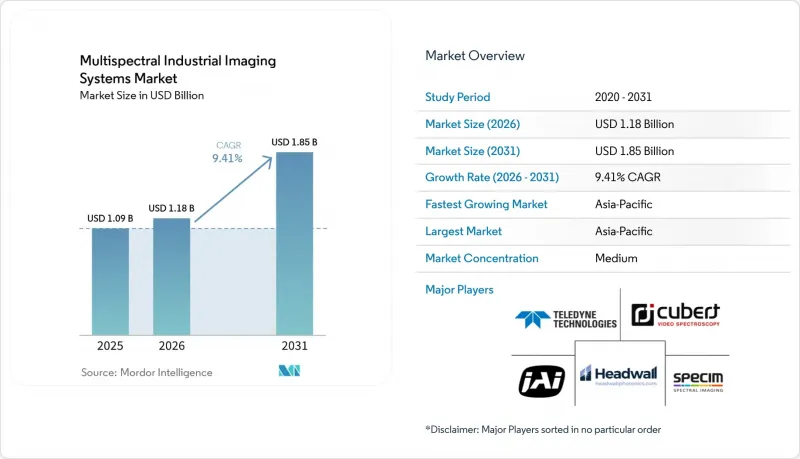
根據 Mordor Intelligence 預測,頻譜工業成像系統的市場規模預計將從 2025 年的 10.9 億美元成長到 2026 年的 11.8 億美元,到 2031 年達到 18.5 億美元,2026 年至 2031 年的複合年成長率為 9.41%。
全球頻譜工業成像系統市場趨勢與洞察
工業品質檢測自動化
自動化檢測正從簡單的合格/不合格缺陷檢查轉向材料分類,以識別化學異常、水分變化和塗層不均勻性。最新的系統可以以超過 2 kHz 的線速率運行,支援高通量生產線上的連續檢測。這種方法使工廠能夠檢測整個生產批次,而無需依賴定期抽樣。這減少了傳統抽樣程序中存在的檢測漏洞,並擴大了頻譜工業成像系統的潛在市場。在 2026 年 CVPR 大會上發布的 UniSpector 展示了利用頻譜對比度進行缺陷識別的能力,無需在不斷變化的工業環境中進行重新培訓。因此,其價值提案正從光學規格轉向在實際生產環境中進行可靠的推論。
人工智慧驅動的頻譜分類
人工智慧驅動的分類技術縮短了開發檢測模型所需的時間,並減少了工廠聘用專職光譜專家的需求。基於物理定律的自監督頻譜變壓器利用未標記的頻譜數據,在單次推理步驟中即可實現量化、評級和異常檢測。這些模型也解決了感測器漂移問題,而感測器漂移歷來會影響分類器部署後的穩定性。Panasonic於2026年8月發布了AG-HSS10軟體,計劃於2026年10月上市。該軟體將頻譜採集和人工智慧學習整合到一個平台中,適用於食品加工、製造和電子組裝等行業。在頻譜工業成像系統市場中,數據品質和在不斷變化的工廠環境中可重複的結果正日益成為重要的競爭因素。
高整合度和校準成本
在頻譜工業成像系統市場,整合和校準仍然是重要的障礙,尤其對於工程能力有限的中小型製造商而言更是如此。頻譜系統需要特定波長的照明、校準面板、溫控機殼以及持續的重新校準。這些要求與傳統的機器視覺系統不同,並且會增加專案的總成本。照明、軟體和分類器訓練的初始成本有時會超過相機硬體的成本。因此,總擁有成本 (TCO) 是頻譜工業成像系統市場採購決策的關鍵因素。提供預訓練庫、承包整合和遠端校準支援的供應商可以減輕小規模工廠的負擔,並促進其採用。
細分市場分析
到2025年,標準線掃描相機將佔據34.60%的市場。這反映了它們在印刷檢測、卷材處理和表面品管等領域的成熟應用。其速度快、整合簡便,使其適用於空間細節比光譜解析度更重要的應用。彩色線掃描系統滿足中型食品分類和紡織品檢測的需求。時延整合線掃描相機支援半導體晶圓偵測和藥品泡殼包裝檢驗。這些相機的多層次電荷累積功能即使在高速輸送機下也能提高訊號雜訊比。預計從2026年到2031年,頻譜和高光譜遙測線掃描相機的複合年成長率將達到10.84%。電池製造商和回收設施需要以簡介式系統無法企及的速度進行化學級材料辨識。
此外,隨著供應商開發針對特定工廠運作的客製化平台,頻譜工業成像系統市場正在不斷發展。 2026年,JAI擴展了其Wave系列產品,在單一InGaAs感測器中實現了可見光和短波紅外線(SWIR)靈敏度,支援面掃描和線掃描配置。此感測器涵蓋400奈米至1700奈米的波長範圍,無需使用雙攝影機進行檢測。 2026年5月,Teledyne DALSA擴展了其AxCIS產品線,推出了多線CMOS接觸式影像感測器,解析度高達1800 dpi,最大掃描長度達1500毫米。設計面向晶圓和電池檢測,單色線掃描速率高達80 kHz。產品開發正從大規模硬體升級轉向能夠減少特定生產作業整合工作的架構。
區域分析
預計到2025年,亞太地區將佔據37.42%的市場佔有率,並在2026年至2031年間以11.18%的複合年成長率成長,使其成為重要的區域中心和成長最快的地區。中國的半導體自給自足計畫正在推動對先進封裝檢測技術的投資。韓國電池超級工廠的擴建進一步增加了對電極和電池品質檢測系統的需求。日本的精密製造地也正在推動頻譜偵測技術在嚴苛的生產環境中的應用。 2026年,Panasonic發布了AG-HSV10M高光譜遙測相機和AG-HSS10檢測軟體。該系統主要面向食品加工和電子組裝。這些因素正在擴大頻譜工業成像系統在亞太地區的部署範圍。
在北美和歐洲,頻譜工業影像系統市場的需求趨勢有所不同。北美市場的需求主要與製藥業的良好生產規範 (GMP) 檢查、食品加工現代化以及美國電池工廠的建設有關。在新工廠中,線上光譜檢測可以在試運行實施,而不是在建成後作為附加功能。在歐洲,該技術的應用主要集中在工業自動化和回收業。德國在精密製造業中扮演著重要角色,而斯堪地那維亞則聚集了多家高光譜遙測相機公司,包括 Specim、HySpex 和 Norsk Elektro Optikk。 2025 年 11 月,Headwall Photonics 收購了 inno-spec GmbH,整合了其線上分選技術和推掃式光學技術。此舉擴大了該公司在歐洲的工業產品線。
在南美洲、中東和非洲,光譜分析技術的發展速度因地區而異。在巴西和阿根廷,頻譜已被用於出口水果加工、穀物污染檢測和農藥殘留篩檢。這些應用與出口目的地的合規要求密切相關。在智利和南非,正在試行使用輸送機礦石品位分級系統。一項於2024年獲得的美國專利描述了一種利用安裝在挖土機上的成像設備進行成分分析的頻譜和高光譜遙測技術。在中東,應用案例主要集中在利用中波紅外線(MWIR)和長波紅外線(LWIR)系統對石油化工和油田進行品質監測。在非洲,相關活動集中在礦區,與傳統採樣方法相比,對基岩進行表徵可以提高品位控制的精確度。
其他好處:
- Excel格式的市場預測(ME)表
- 3個月的分析師支持
目錄
第1章:引言
- 研究假設和市場定義
- 調查範圍
第2章:調查方法
第3章執行摘要
第4章 市場狀況
- 市場概覽
- 市場促進因素
- 工業品質檢測自動化
- 人工智慧驅動的頻譜分類
- 小型簡介感測器的普及
- 食品安全和原料分類需求
- 半導體和電池製造中的檢測
- 頻譜感測器成本更低
- 市場限制因素
- 高昂的整合成本和調整成本
- 工業頻譜庫短缺
- 資料處理和儲存中的瓶頸
- 互通性和標準化之間的差距
- 宏觀經濟因素對市場的影響
- 產業價值鏈分析
- 監理情勢
- 技術展望
- 波特五力分析
第5章 市場規模與成長預測
- 相機架構
- 標準線掃描相機
- 色線掃描相機
- 時延積分(TDI)線掃描相機
- 頻譜和高光譜遙測線掃描相機
- 按頻譜範圍
- 可見光範圍
- 可見光+近紅外線(VIS-NIR)
- 短波紅外線(SWIR)
- 中波紅外線(MWIR)
- 長波紅外線(LWIR)
- 最終用戶
- 製造和工業設備
- 食品/飲料/農業
- 電子元件、半導體、電池
- 汽車和運輸業
- 製藥和生命科學
- 回收、採礦和材料
- 紡織品和紙張
- 研究與發展機構
- 其他終端用戶產業
- 按地區
- 北美洲
- 美國
- 加拿大
- 墨西哥
- 南美洲
- 巴西
- 阿根廷
- 智利
- 其他南美國家
- 歐洲
- 德國
- 英國
- 法國
- 義大利
- 西班牙
- 其他歐洲國家
- 亞太地區
- 中國
- 日本
- 印度
- 韓國
- 澳洲
- 其他亞太國家
- 中東
- 阿拉伯聯合大公國
- 沙烏地阿拉伯
- 卡達
- 其他中東國家
- 非洲
- 南非
- 埃及
- 奈及利亞
- 其他非洲國家
- 北美洲
第6章 競爭情勢
- 市場集中度
- 策略趨勢
- 市佔率分析
- 公司簡介
- JAI A/S
- Teledyne DALSA, Inc.
- Specim, Spectral Imaging Ltd.
- Headwall Photonics, Inc.
- Cubert GmbH
- BaySpec, Inc.
- Resonon, Inc.
- Surface Optics Corporation
- Spectral Devices Inc.
- Photon etc. Inc.
- XIMEA GmbH
- Photonfocus AG
- Torrent Photonics, Inc.
- SILIOS Technologies SAS
- EVK DI Kerschhaggl GmbH
- Telops Inc.
- Diaspective Vision GmbH
- Raptor Photonics Limited
- SWIR Vision Systems, Inc.
- HinaLea Imaging Corporation
- HySpex AS
- Norsk Elektro Optikk AS
第7章 市場機會與未來展望
According to Mordor Intelligence, the multispectral industrial imaging systems market size is projected to expand from USD 1.09 billion in 2025 to USD 1.18 billion in 2026, and to USD 1.85 billion by 2031, registering a CAGR of 9.41% from 2026 to 2031.
Global Multispectral Industrial Imaging Systems Market Trends and Insights
Industrial Quality Inspection Automation
Automated inspection is moving from pass-or-fail defect checks to material classification that identifies chemical anomalies, moisture variation, and coating inconsistencies. Modern systems can operate at line rates above 2 kHz, which supports continuous checks on high-throughput production lines. The approach allows factories to inspect the full output instead of relying on samples taken at intervals. This reduces the gaps left by traditional spot-check procedures and broadens potential deployments for the multispectral industrial imaging systems market. UniSpector, presented at CVPR 2026, demonstrated spectral-contrastive defect localization without retraining across changing industrial settings. The value proposition is therefore shifting toward reliable inference in real production conditions, not only optical specifications.
AI-Enabled Spectral Classification
AI-based classification can shorten the time needed to develop inspection models and reduce the need for facilities to employ dedicated spectroscopists. Physics-guided, self-supervised spectral transformers leverage unlabeled spectral data to enable quantification, grading, and anomaly detection in a single inference step. These models also address sensor drift, which has historically made classifiers less stable after deployment. Panasonic announced its AG-HSS10 software in August 2026, with commercial availability planned for October 2026. The software integrates spectral acquisition and AI learning into a single platform for food processing, manufacturing, and electronics assembly. Data quality and repeatable results under changing factory conditions are becoming more important competitive factors in the multispectral industrial imaging systems market.
High Integration and Calibration Costs
Integration and calibration remain major barriers in the multispectral industrial imaging systems market, particularly for small- and mid-sized manufacturers with limited engineering capacity. Spectral systems need wavelength-specific lighting, calibration panels, temperature-controlled housings, and ongoing recalibration. These requirements differ from those of conventional machine-vision installations and can increase the overall project cost. Initial work on illumination, software, and classifier training can cost more than the camera hardware. This makes total ownership cost a central purchasing issue in the multispectral industrial imaging systems market. Suppliers that provide trained libraries, turnkey integration, and remote calibration support can reduce the burden on smaller factories and improve adoption.
Other drivers and restraints analyzed in the detailed report include:
- Semiconductor and Battery Manufacturing Inspection
- Food Safety and Material Sorting Requirements
- Data Processing and Storage Bottlenecks
For complete list of drivers and restraints, kindly check the Table Of Contents.
Segment Analysis
Standard line-scan cameras held 34.60% share in 2025, reflecting their established use in print inspection, web processing, and surface-quality control. Their speed and simpler integration suit applications where spatial detail matters more than spectral resolution. Color line-scan systems serve mid-range food-sorting and textile-inspection needs. Time-delay integration line-scan cameras support semiconductor wafer inspection and pharmaceutical blister-pack verification. Their multi-stage charge accumulation improves signal-to-noise performance at fast conveyor speeds. Multispectral and hyperspectral line-scan cameras are projected to grow at a 10.84% CAGR from 2026 to 2031. Battery manufacturers and recycling facilities require chemical-level material differentiation at speeds that snapshot systems cannot maintain.
The multispectral industrial imaging systems market is also evolving as suppliers develop platforms tailored to specific factory tasks. JAI expanded its Wave Series in 2026 to include visible and SWIR sensitivity in a single InGaAs sensor across area-scan and line-scan configurations. The 400 nm to 1,700 nm range can remove the need for two-camera inspection arrangements. Teledyne DALSA expanded AxCIS in May 2026 with multiline CMOS contact image sensors at 1,800 dpi and scan lengths up to 1,500 mm. This design targeted wafer and battery inspection with monochrome line rates up to 80 kHz. Product development is moving away from broad hardware upgrades and toward architectures that reduce integration work for defined production tasks.
Complete Report Scope:
- By Camera Architecture
- Standard Line-Scan Cameras
- Color Line-Scan Cameras
- Time-Delay Integration (TDI) Line-Scan Cameras
- Multispectral and Hyperspectral Line-Scan Cameras
- By Spectral Range
- Visible
- Visible + Near-Infrared (VIS-NIR)
- Short-Wave Infrared (SWIR)
- Mid-Wave Infrared (MWIR)
- Long-Wave Infrared (LWIR)
- By End User
- Manufacturing and Industrial Equipment
- Food, Beverage, and Agriculture
- Electronics, Semiconductor, and Battery
- Automotive and Transportation
- Pharmaceutical and Life Sciences
- Recycling, Mining, and Materials
- Textile and Paper
- Research and Development Organizations
- Other End-user Industries
- By Geography
- North America
- United States
- Canada
- Mexico
- South America
- Brazil
- Argentina
- Chile
- Rest of South America
- Europe
- Germany
- United Kingdom
- France
- Italy
- Spain
- Rest of Europe
- Asia-Pacific
- China
- Japan
- India
- South Korea
- Australia
- Rest of Asia-Pacific
- Middle East
- United Arab Emirates
- Saudi Arabia
- Qatar
- Rest of Middle East
- Africa
- South Africa
- Egypt
- Nigeria
- Rest of Africa
- North America
Geography Analysis
Asia-Pacific held 37.42% share in 2025 and is projected to grow at a 11.18% CAGR from 2026 to 2031, making it the leading regional base and the fastest-growing geography. China's semiconductor self-sufficiency program supports investment in advanced packaging inspection. South Korea's battery gigafactory expansion adds demand for electrode and cell-quality systems. Japan's precision manufacturing base also supports the use of spectral inspection in demanding production environments. Panasonic announced the AG-HSV10M hyperspectral camera and the AG-HSS10 inspection software in 2026. The system targets food processing and electronics assembly. These factors support a large installed base of multispectral industrial imaging systems in Asia-Pacific.
North America and Europe have distinct demand profiles within the multispectral industrial imaging systems market. In the multispectral industrial imaging systems market, North American demand is linked to pharmaceutical good manufacturing practice inspections, food-processing modernization, and battery factory construction in the United States. New facilities can incorporate inline spectral inspection during commissioning instead of adding it after construction. European deployment is concentrated in industrial automation and recycling. Germany is important in precision manufacturing, while Scandinavia hosts several hyperspectral-camera companies, including Specim, HySpex, and Norsk Elektro Optikk. Headwall Photonics acquired inno-spec GmbH in November 2025, combining inline sorting experience with pushbroom optics. This move added scale to its European industrial offering.
South America, the Middle East, and Africa are developing at different rates. Brazil and Argentina are applying spectral inspection to export-oriented fruit processing, grain contamination checks, and pesticide-residue screening. These uses are linked to compliance requirements in export destinations. Chile and South Africa are piloting conveyor-based systems for ore-grade classification. A 2024 U.S. patent described multispectral and hyperspectral methods for compositional analysis through shovel-mounted imaging. Middle East installations center on petrochemical and oil-field quality monitoring using MWIR and LWIR systems. African activity is concentrated in mining locations, where rock-face characterization can improve grade control compared with conventional sampling.
- JAI A/S
- Teledyne DALSA, Inc.
- Specim, Spectral Imaging Ltd.
- Headwall Photonics, Inc.
- Cubert GmbH
- BaySpec, Inc.
- Resonon, Inc.
- Surface Optics Corporation
- Spectral Devices Inc.
- Photon etc. Inc.
- XIMEA GmbH
- Photonfocus AG
- Torrent Photonics, Inc.
- SILIOS Technologies S.A.S.
- EVK DI Kerschhaggl GmbH
- Telops Inc.
- Diaspective Vision GmbH
- Raptor Photonics Limited
- SWIR Vision Systems, Inc.
- HinaLea Imaging Corporation
- HySpex AS
- Norsk Elektro Optikk AS
Additional Benefits:
- The market estimate (ME) sheet in Excel format
- 3 months of analyst support
TABLE OF CONTENTS
1 INTRODUCTION
- 1.1 Study Assumptions and Market Definition
- 1.2 Scope of the Study
2 RESEARCH METHODOLOGY
3 EXECUTIVE SUMMARY
4 MARKET LANDSCAPE
- 4.1 Market Overview
- 4.2 Market Drivers
- 4.2.1 Industrial Quality Inspection Automation
- 4.2.2 AI-Enabled Spectral Classification
- 4.2.3 Compact Snapshot Sensor Adoption
- 4.2.4 Food Safety and Material Sorting Requirements
- 4.2.5 Semiconductor and Battery Manufacturing Inspection
- 4.2.6 Spectral Sensor Cost Declines
- 4.3 Market Restraints
- 4.3.1 High Integration and Calibration Costs
- 4.3.2 Limited Industrial Spectral Libraries
- 4.3.3 Data Processing and Storage Bottlenecks
- 4.3.4 Interoperability and Standards Gaps
- 4.4 Impact of Macroeconomic Factors on the Market
- 4.5 Industry Value Chain Analysis
- 4.6 Regulatory Landscape
- 4.7 Technological Outlook
- 4.8 Porter's Five Forces Analysis
- 4.8.1 Threat of New Entrants
- 4.8.2 Bargaining Power of Suppliers
- 4.8.3 Bargaining Power of Buyers
- 4.8.4 Threat of Substitutes
- 4.8.5 Competitive Rivalry
5 MARKET SIZE AND GROWTH FORECASTS (VALUE)
- 5.1 By Camera Architecture
- 5.1.1 Standard Line-Scan Cameras
- 5.1.2 Color Line-Scan Cameras
- 5.1.3 Time-Delay Integration (TDI) Line-Scan Cameras
- 5.1.4 Multispectral and Hyperspectral Line-Scan Cameras
- 5.2 By Spectral Range
- 5.2.1 Visible
- 5.2.2 Visible + Near-Infrared (VIS-NIR)
- 5.2.3 Short-Wave Infrared (SWIR)
- 5.2.4 Mid-Wave Infrared (MWIR)
- 5.2.5 Long-Wave Infrared (LWIR)
- 5.3 By End User
- 5.3.1 Manufacturing and Industrial Equipment
- 5.3.2 Food, Beverage, and Agriculture
- 5.3.3 Electronics, Semiconductor, and Battery
- 5.3.4 Automotive and Transportation
- 5.3.5 Pharmaceutical and Life Sciences
- 5.3.6 Recycling, Mining, and Materials
- 5.3.7 Textile and Paper
- 5.3.8 Research and Development Organizations
- 5.3.9 Other End-user Industries
- 5.4 By Geography
- 5.4.1 North America
- 5.4.1.1 United States
- 5.4.1.2 Canada
- 5.4.1.3 Mexico
- 5.4.2 South America
- 5.4.2.1 Brazil
- 5.4.2.2 Argentina
- 5.4.2.3 Chile
- 5.4.2.4 Rest of South America
- 5.4.3 Europe
- 5.4.3.1 Germany
- 5.4.3.2 United Kingdom
- 5.4.3.3 France
- 5.4.3.4 Italy
- 5.4.3.5 Spain
- 5.4.3.6 Rest of Europe
- 5.4.4 Asia-Pacific
- 5.4.4.1 China
- 5.4.4.2 Japan
- 5.4.4.3 India
- 5.4.4.4 South Korea
- 5.4.4.5 Australia
- 5.4.4.6 Rest of Asia-Pacific
- 5.4.5 Middle East
- 5.4.5.1 United Arab Emirates
- 5.4.5.2 Saudi Arabia
- 5.4.5.3 Qatar
- 5.4.5.4 Rest of Middle East
- 5.4.6 Africa
- 5.4.6.1 South Africa
- 5.4.6.2 Egypt
- 5.4.6.3 Nigeria
- 5.4.6.4 Rest of Africa
- 5.4.1 North America
6 COMPETITIVE LANDSCAPE
- 6.1 Market Concentration
- 6.2 Strategic Moves
- 6.3 Market Share Analysis
- 6.4 Company Profiles (includes Global Level Overview, Market Level Overview, Core Segments, Financials as available, Strategic Information, Market Rank/Share, Products and Services, Recent Developments)
- 6.4.1 JAI A/S
- 6.4.2 Teledyne DALSA, Inc.
- 6.4.3 Specim, Spectral Imaging Ltd.
- 6.4.4 Headwall Photonics, Inc.
- 6.4.5 Cubert GmbH
- 6.4.6 BaySpec, Inc.
- 6.4.7 Resonon, Inc.
- 6.4.8 Surface Optics Corporation
- 6.4.9 Spectral Devices Inc.
- 6.4.10 Photon etc. Inc.
- 6.4.11 XIMEA GmbH
- 6.4.12 Photonfocus AG
- 6.4.13 Torrent Photonics, Inc.
- 6.4.14 SILIOS Technologies S.A.S.
- 6.4.15 EVK DI Kerschhaggl GmbH
- 6.4.16 Telops Inc.
- 6.4.17 Diaspective Vision GmbH
- 6.4.18 Raptor Photonics Limited
- 6.4.19 SWIR Vision Systems, Inc.
- 6.4.20 HinaLea Imaging Corporation
- 6.4.21 HySpex AS
- 6.4.22 Norsk Elektro Optikk AS
7 MARKET OPPORTUNITIES AND FUTURE OUTLOOK
- 7.1 White-Space and Unmet-Need Assessment

 無人機搭載高光譜遙測相機市場:全球市場預測,2026-2032年
 2026-2034年全球醫用高光譜影像系統市場規模、佔有率、趨勢及成長分析報告
 多波長雷射雷達系統:市場佔有率分析、行業趨勢和統計數據、成長預測(2026-2031 年)
 高光譜影像系統市場規模、佔有率、趨勢和預測:按產品類型、應用、技術和地區分類,2026-2034年
 2034年醫用高光譜影像市場預測-按產品、技術、應用、最終用戶和地區分類的全球分析
 2026年全球頻譜成像市場報告
 高光譜影像市場:按類型、應用、最終用戶和地區分類全球高光譜影像系統市場規模、佔有率、趨勢和成長分析報告(2026-2034)農業高光譜影像市場:按平台、感測器、應用和最終用戶分類-2026-2032年全球市場預測2026年全球高光譜影像系統市場報告