


 |
市場調查報告書
商品編碼
2155259
美國電動車數控車床中心:市場佔有率分析、產業趨勢與統計、成長預測(2026-2031)United States Electric Vehicle CNC Turning Centers - Market Share Analysis, Industry Trends & Statistics, Growth Forecasts (2026 - 2031) |
||||||

※ 本網頁內容可能與最新版本有所差異。詳細情況請與我們聯繫。
據 Mordor Intelligence 稱,美國電動車用CNC車床市場預計在 2025 年達到 2.4 億美元,從 2026 年的 2.68 億美元成長到 2031 年的 4.41 億美元,2026 年至 2031 年的複合年成長率為 10.5%。
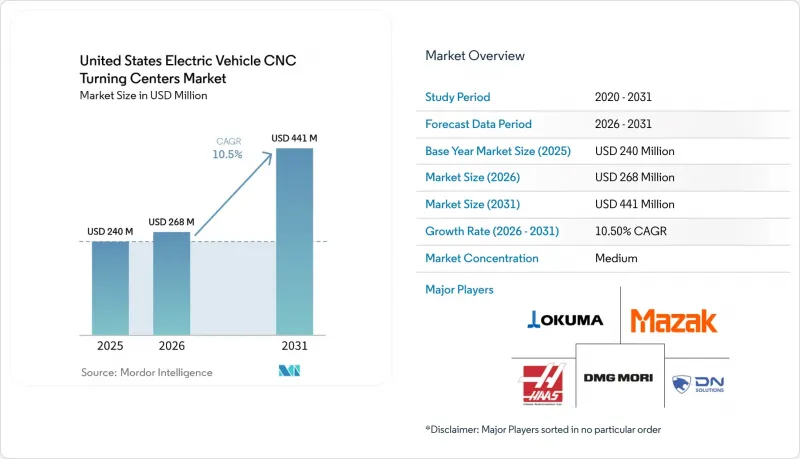
美國電動車用CNC車床市場趨勢及洞察。
國內電動車製造業的擴張正在推動對高精度車床中心的需求。
大規模電動車工廠專案推動了對高精度車削中心的需求。這是因為轉速超過18,000轉/分的馬達軸心需要符合ISO 1940 G1.0動態平衡標準的公差。為了滿足這樣的公差要求,需要具備亞微米級熱補償能力的高精度平台。根據美國環保基金會(EDF)預測,2024年中期,美國電動車製造領域的累積投資預計將達到1,990億美元,到2027年,國內產能將達到每年580萬輛。 2026年4月,Rivian宣布已獲得美國能源部擔保的45億美元貸款,用於在喬治亞建造一座工廠。該廠計畫年產30萬輛,並計畫於2028年投產。這項消息意味著在工廠正式投產前,未來幾年都需要購買相關設備。 2025年10月,博格華納決定投資7,490萬美元在亨德森縣興建一座工廠,在其新的OEM業務基地附近增加精密加工能力。新廠的建設計畫要求供應商根據車型發布調整其加工能力,而不是在車輛產量增加後再添置設備。這種時間安排使得在設備選用階段更加重視溫度控制、重複性和自動化操作。因此,美國電動車CNC車床市場的需求主要來自OEM工廠及其周邊供應商網路。
電動動力傳動系統部件產量的增加提高了對精密加工的要求。
電池工廠的建設催生了對能夠在單一工件夾持循環中同時進行車削和銑削的製作流程的需求。 2026年7月,現代汽車和SK-ON在喬治亞巴託縣投資50億美元興建了一座電池工廠,年產能達35吉瓦時。該工廠滿足了對電池外殼介面、端子組件和模組外殼組件精密加工的需求。Panasonic能源在堪薩斯州德索托設計了一座年產能32吉瓦時的工廠,該工廠需要加工壓延輥和狹縫式塗佈頭組件。這些組件的同心度公差要求達到幾微米,超出了標準車床的加工能力。在美國電動車數控車削中心市場,「電池系統組件」領域在2031年之前實現了12.4%的最高複合年成長率。該領域的加工目標包括外殼、端子、介面和接頭等,這些都需要精確的尺寸控制。這些生產要求促使人們傾向於選擇能夠整合多種加工流程而無需在不同機器之間移動部件的設備。隨著電池生產的擴大,對零件和生產設備的供應商提出了越來越類似的規格要求。
高昂的實施成本和生命週期成本阻礙了中小企業 (SME) 的採用。
高階多功能車床和銑床,以及瑞士型CNC工具機,對於中小製造商而言,都需要大量的初始投資。配備機器人自動化、進程內測量和五軸銑床主軸箱的車床中心,其資本支出就超過50萬美元。對於資金有限的二級製造商和精密契約製造製造商來說,這筆支出無疑是一筆沉重的負擔。根據聯準會(FRB)的工業生產數據,2025年的製造業運轉率將接近其長期平均水準。因此,許多工廠面臨的壓力並非來自設備短缺,而是來自產能利用率不足。此外,刀具補充、CAM軟體許可費用和預防性維護費用也會降低單件獲利能力,除非產量足以支撐固定成本的攤銷。對於那些需要在獲得電動車(EV)相關持續訂單之前具備先進能力的公司而言,這種財務挑戰尤其突出。雖然租賃和結構化融資可以減輕初始負擔,但營運和維護成本仍然存在。這項限制影響了中小型供應商滿足 OEM 認證要求的速度。
細分市場分析
到2025年,臥式CNC車床將佔據美國電動車CNC車床市場42.1%的佔有率,成為最大的產品類別。這些車床支援電動汽車馬達和電力驅動橋所用軸和殼體的批量生產。成熟的刀俱生態系統使製造商能夠實施大規模標準化流程。操作人員的易聘用也促進了新型車床生產線的整體普及。機器人工件上下料功能的整合使這些系統適用於自動化生產單元。立式CNC車床滿足了碟式和短卡盤零件(例如轉子端板和線控刹車殼體)的加工需求。瑞士型數控車床則支援小直徑工件(例如感測器軸、連接器引腳和緊固件毛坯)的加工。電動車電子元件的整合持續推動了對這些高精度、小直徑應用的需求。
在美國電動車CNC車床市場,多功能車銑複合機床的成長率最高,預計到2031年複合年成長率將達到12.3%。製造商利用這些系統來整合流程、減少在製品數量並控制累積公差。 DMG MORI計劃於2025年9月發布其第二代NLX 2500|1250,該工具機定位於電動車、航空航太和半導體產業的加工應用。其12,000轉/分的BMT(塊狀機械加工)能力和數位孿生整合體現了對多功能加工的需求。 IATF 16949認證要求供應商記錄跨多個加工特徵的製程能力。此記錄可在單次裝夾循環內完成,從而減少了工序間的處理。因此,對於既追求高產量又希望實現穩定製程控制的供應商而言,此類工具機是理想之選。
其他好處:
- Excel格式的市場預測(ME)表
- 3個月的分析師支持
目錄
第1章:引言
- 研究假設和市場定義
- 調查範圍
第2章:調查方法
第3章執行摘要
- 市場概況(2025 年與 2031 年比較)
- 各細分市場的主要發現
- 投資重點領域與未開發領域
第4章 市場狀況
- 市場概覽
- 數控車床在電動車製造價值鏈中的作用
- 從內燃機零件加工到電動車專用加工需求的演變
- 市場促進因素
- 國內電動車產量的擴大正在推動對高精度車床中心的需求。
- 汽車供應鏈回流正在加速對CNC設備的投資。
- 電動驅動系統零件產量的增加推高了對精密加工的需求。
- 工業4.0的引進正在提升整個電動車工廠的智慧數控加工能力。
- 對多功能數控工具機的需求不斷成長,提高了生產效率。
- 聯邦政府對製造業的激勵措施正在推動工具機的先進現代化。
- 市場限制因素
- 高昂的實施成本和生命週期成本阻礙了中小企業採用此技術。
- 熟練機械師長期短缺限制了CNC工具機的運轉率。
- 電動車生產計畫的波動為未來的資本投資帶來了不確定性。
- 高階CNC工具機和關鍵零件的交貨週期越來越長。
- 市場機遇
- 電動車輕量化材料的需求催生了對先進車削技術的需求。
- 人工智慧驅動的自適應加工將進一步提高生產效率。
- 電池超級工廠的擴建為精密加工創造了新的需求。
- 電動車售後零件製造為CNC工具機產業創造了長期成長潛力。
- 電動車製造價值鏈分析
- 原物料供應商
- 工具機製造商
- 電動汽車零件製造商
- 電動汽車製造商
- 製造流程分析
- 根據生產量選擇機器
- 原型製作和批量生產的要求
- 貿易趨勢和關稅影響分析
- 工具機的主要進出口路線
- 區域採購來源的變化和本地化趨勢
- 監理情勢
- 電動車生產的製造獎勵
- 在地採購要求
- 智慧製造政策
- 關於工具機能源效率的法規
- 科技趨勢
- 多功能車銑中心
- 人工智慧驅動的工具磨損監測
- 數位孿生整合
- 機器人自動化
- 人工智慧和數位化製造對CNC車床加工的影響
- 地緣政治對工具機供應鏈的影響
第5章 市場規模及成長預測(價值單位:美元)
- 按機器類型
- 臥式CNC車床
- 立式CNC車床
- 多功能車銑中心
- 瑞士型CNC車床
- 其他
- 按組件和應用程式
- 電動機零件
- 電力驅動橋和變速器部件
- 電池系統組件
- 其他
- 最終用戶
- 電動車製造商的製造工廠
- 一級汽車零件供應商
- 二級零件製造商
- 精密契約製造
第6章 競爭情勢
- Market Structure
- Strategic Developments(2022-2026)
- New Product Launches
- Automation Partnerships
- EV Manufacturing Projects
- Capacity Expansion
- Acquisitions
- Digital Manufacturing Collaborations
- 市佔率分析
- 公司簡介
- Haas Automation, Inc.
- Hardinge Inc.
- DN Solutions Co., Ltd.
- Mazak Corporation
- Okuma Corporation
- DMG MORI Co., Ltd.
- Doosan Machine Tools America
- INDEX Corporation
- EMAG LLC
- Tsugami America Inc.
- Citizen Machinery America Inc.
- Star CNC Machine Tool Corp.
- Nakamura-Tome Precision Industry Co., Ltd.
- Muratec USA, Inc.
- Hwacheon Machinery America, Inc.
- SMEC America Corporation
- Tornos Technologies US Corporation
- Big Kaiser Precision Tooling Inc.
- Hexagon Manufacturing Intelligence, Inc.
- GF Machining Solutions LLC
第7章 市場機會與未來展望
According to Mordor Intelligence, the United States electric vehicle CNC turning centers market size was valued at USD 240 million in 2025 and is estimated to grow from USD 268 million in 2026 to USD 441 million by 2031, at a CAGR of 10.5% from 2026 to 2031.
United States Electric Vehicle CNC Turning Centers Market Trends and Insights
Domestic EV Manufacturing Expansion Fuels Demand for High-Precision Turning Centers
Large EV plant projects drove demand for precision turning centers because motor shafts operating above 18,000 RPM required ISO 1940 G1.0 dynamic balancing tolerances. Such tolerances required precision platforms with sub-micron thermal compensation. The Environmental Defense Fund reported USD 199 billion in cumulative EV manufacturing investment in the United States by mid-2024 and projected domestic capacity of 5.8 million vehicles annually by 2027. Rivian announced a USD 4.5 billion Department of Energy-backed loan in April 2026 for its Georgia facility, which targeted 300,000 vehicles annually and a 2028 production start. The announcement created a multiyear procurement requirement before the factory began vehicle production. BorgWarner selected Henderson County for a USD 74.9 million facility in October 2025, adding precision machining capacity near new OEM operations. New plant programs required suppliers to align machining capacity with model launches rather than add equipment after vehicle output rose. This timing placed attention on thermal control, repeatability, and automated handling at the equipment selection stage. The United States electric vehicle CNC turning centers market consequently drew demand from OEM plants and their adjacent supplier networks.
Rising Production of Electric Powertrain Components Boosts Precision Machining Requirements
Battery plant construction created demand for machining operations that combined turning and milling in a single workholding cycle. Hyundai and SK On opened a USD 5 billion battery plant in Bartow County, Georgia, in July 2026, with an annual capacity of 35 GWh. The facility supported precision machining demand for cell casing interfaces, terminal components, and module housing features. Panasonic Energy designed its De Soto, Kansas facility for 32 GWh of annual production, which required machining of calender rollers and slot-die coating head components. These components required concentricity tolerances of a few microns, exceeding standard lathe capability. Battery System Components recorded the highest application CAGR at 12.4% through 2031 in the United States electric vehicle CNC turning centers market. The work involved housings, terminals, interfaces, and fittings that needed consistent dimensional control. These production requirements favored equipment that combined several processes without moving a component between separate machines. As cell production expanded, the same specifications extended through suppliers that made parts and production equipment.
High Acquisition and Lifecycle Costs Limit SME Adoption
Premium multi-tasking turn-mill centers and Swiss-type CNC machines required substantial upfront investment from smaller manufacturers. A fully configured turning center with robotic automation, in-process gauging, and a 5-axis milling headstock required capital outlays above USD 500,000 per unit. This level of expenditure strained Tier-2 and precision contract manufacturers with limited balance sheets. Federal Reserve industrial production data showed manufacturing capacity utilization near long-run averages in 2025. Many shops, therefore, faced pressure from under-utilization rather than a simple shortage of equipment. Tooling replenishment, CAM software licenses, and preventive maintenance also reduced the per-part economics unless production volume supported broad fixed-cost amortization. The financial challenge was most pronounced for firms that needed advanced features before securing recurring EV orders. Leasing and structured financing could reduce the initial burden, but did not remove operating and maintenance expenses. This restraint affected the pace at which smaller suppliers could respond to OEM qualification requirements.
Other drivers and restraints analyzed in the detailed report include:
- Reshoring of Automotive Supply Chains Accelerates CNC Equipment Investments
- Industry 4.0 Adoption Enhances Smart CNC Machining Across EV Factories
- Persistent Skilled Machinist Shortages Constrain CNC Utilization
For complete list of drivers and restraints, kindly check the Table Of Contents.
Segment Analysis
Horizontal CNC Turning Centers accounted for 42.1% of the United States electric vehicle CNC turning centers market share in 2025, making them the largest category in the market. They supported high-volume production of shafts and housings used in EV motors and e-axles. Their established tooling ecosystems helped manufacturers deploy standard processes at scale. Broad operator availability also supported their use across new turning lines. Robotic part-loading integration made these systems suitable for automated production cells. Vertical CNC Turning Centers served disc-type and short-chuck machining needs, including rotor end-plates and brake-by-wire housings. Swiss-Type CNC Turning Centers supported the machining of small-diameter workpieces for sensor shafts, connector pins, and fastener blanks. EV electronics integration maintained demand for these high-precision, small-diameter applications.
Multi-Tasking Turn-Mill Centers recorded the highest projected CAGR at 12.3% through 2031 in the United States electric vehicle CNC turning centers market. Manufacturers used these systems to consolidate operations, reduce work-in-process, and limit cumulative tolerance stack-up. DMG MORI positioned its September 2025 NLX 2500 | 1250 2nd Generation for EV, aircraft, and semiconductor work. Its 12,000 RPM BMT capability and digital twin integration reflected demand for compound machining. IATF 16949 qualification requirements encouraged suppliers to document process capability across multiple machined features. A single-clamping cycle supported this documentation while reducing handling between operations. The category thus served suppliers seeking both throughput and consistent process control.
Complete Report Scope:
- By Machine Type
- Horizontal CNC Turning Centers
- Vertical CNC Turning Centers
- Multi-Tasking Turn-Mill Centers
- Swiss-Type CNC Turning Centers
- Others
- By Component Application
- Electric Motor Components
- E-Axles and Transmission Components
- Battery System Components
- Others
- By End User
- EV OEM Manufacturing Plants
- Tier-1 Automotive Suppliers
- Tier-2 Component Manufacturers
- Precision Contract Manufacturers
List of Companies Covered in this Report:
- Haas Automation, Inc.
- Hardinge Inc.
- DN Solutions Co., Ltd.
- Mazak Corporation
- Okuma Corporation
- DMG MORI Co., Ltd.
- Doosan Machine Tools America
- INDEX Corporation
- EMAG LLC
- Tsugami America Inc.
- Citizen Machinery America Inc.
- Star CNC Machine Tool Corp.
- Nakamura-Tome Precision Industry Co., Ltd.
- Muratec USA, Inc.
- Hwacheon Machinery America, Inc.
- SMEC America Corporation
- Tornos Technologies US Corporation
- Big Kaiser Precision Tooling Inc.
- Hexagon Manufacturing Intelligence, Inc.
- GF Machining Solutions LLC
Additional Benefits:
- The market estimate (ME) sheet in Excel format
- 3 months of analyst support
TABLE OF CONTENTS
1 Introduction
- 1.1 Study Assumptions and Market Definition
- 1.2 Scope of the Study
2 Research Methodology
3 Executive Summary
- 3.1 Market Snapshot (2025 Vs 2031)
- 3.2 Key Findings by Segment
- 3.3 Investment Hotspots and White Space
4 Market Landscape
- 4.1 Market Overview
- 4.1.1 Role of CNC Turning Centers in the EV Manufacturing Value Chain
- 4.1.2 Evolution from ICE Component Machining to EV-Specific Machining Requirements
- 4.2 Market Drivers
- 4.2.1 Domestic EV Manufacturing Expansion Fuels Demand for High-Precision Turning Centers
- 4.2.2 Reshoring of Automotive Supply Chains Accelerates CNC Equipment Investments
- 4.2.3 Rising Production of Electric Powertrain Components Boosts Precision Machining Requirements
- 4.2.4 Industry 4.0 Adoption Enhances Smart CNC Machining Across EV Factories
- 4.2.5 Growing Demand for Multi-Tasking CNC Machines Improves Production Efficiency
- 4.2.6 Federal Manufacturing Incentives Encourage Advanced Machine Tool Modernization
- 4.3 Market Restraints
- 4.3.1 High Acquisition and Lifecycle Costs Limit SME Adoption
- 4.3.2 Persistent Skilled Machinist Shortages Constrain CNC Utilization
- 4.3.3 Volatility in EV Production Plans Creates Uncertain Capital Spending
- 4.3.4 Long Lead Times for Premium CNC Machines and Critical Components
- 4.4 Market Opportunities
- 4.4.1 Lightweight EV Materials Create Demand for Advanced Turning Technologies
- 4.4.2 AI-Powered Adaptive Machining Opens New Productivity Gains
- 4.4.3 Battery Gigafactory Expansion Generates New Precision Machining Demand
- 4.4.4 Aftermarket Manufacturing of EV Components Creates Long-Term CNC Growth Potential
- 4.5 EV Manufacturing Value Chain Analysis
- 4.5.1 Raw Material Suppliers
- 4.5.2 Machine Tool Manufacturers
- 4.5.3 EV Component Manufacturers
- 4.5.4 EV OEMs
- 4.6 Manufacturing Process Analysis
- 4.6.1 Machine Selection by Production Volume
- 4.6.2 Prototype vs. Mass Production Requirements
- 4.7 Trade Flow and Tariff Impact Analysis
- 4.7.1 Key Machine Tool Export and Import Corridors
- 4.7.2 Regional Sourcing Shifts and Localization Trends
- 4.8 Regulatory Landscape
- 4.8.1 Manufacturing Incentives for EV Production
- 4.8.2 Local Content Requirements
- 4.8.3 Smart Manufacturing Policies
- 4.8.4 Energy Efficiency Regulations for Machine Tools
- 4.9 Technology Landscape
- 4.9.1 Multi-Tasking Turn-Mill Centers
- 4.9.2 AI-Based Tool Wear Monitoring
- 4.9.3 Digital Twin Integration
- 4.9.4 Robot Automation
- 4.10 Impact of AI and Digital Manufacturing on CNC Turning
- 4.11 Geopolitical Impact on Machine Tool Supply Chains
5 Market Size and Growth Forecasts Value (USD)
- 5.1 By Machine Type
- 5.1.1 Horizontal CNC Turning Centers
- 5.1.2 Vertical CNC Turning Centers
- 5.1.3 Multi-Tasking Turn-Mill Centers
- 5.1.4 Swiss-Type CNC Turning Centers
- 5.1.5 Others
- 5.2 By Component Application
- 5.2.1 Electric Motor Components
- 5.2.2 E-Axles and Transmission Components
- 5.2.3 Battery System Components
- 5.2.4 Others
- 5.3 By End User
- 5.3.1 EV OEM Manufacturing Plants
- 5.3.2 Tier-1 Automotive Suppliers
- 5.3.3 Tier-2 Component Manufacturers
- 5.3.4 Precision Contract Manufacturers
6 Competitive Landscape
- 6.1 Market Structure
- 6.2 Strategic Developments (2022-2026)
- 6.2.1 New Product Launches
- 6.2.2 Automation Partnerships
- 6.2.3 EV Manufacturing Projects
- 6.2.4 Capacity Expansion
- 6.2.5 Acquisitions
- 6.2.6 Digital Manufacturing Collaborations
- 6.3 Market Share Analysis
- 6.4 Company Profiles
- 6.4.1 Haas Automation, Inc.
- 6.4.2 Hardinge Inc.
- 6.4.3 DN Solutions Co., Ltd.
- 6.4.4 Mazak Corporation
- 6.4.5 Okuma Corporation
- 6.4.6 DMG MORI Co., Ltd.
- 6.4.7 Doosan Machine Tools America
- 6.4.8 INDEX Corporation
- 6.4.9 EMAG LLC
- 6.4.10 Tsugami America Inc.
- 6.4.11 Citizen Machinery America Inc.
- 6.4.12 Star CNC Machine Tool Corp.
- 6.4.13 Nakamura-Tome Precision Industry Co., Ltd.
- 6.4.14 Muratec USA, Inc.
- 6.4.15 Hwacheon Machinery America, Inc.
- 6.4.16 SMEC America Corporation
- 6.4.17 Tornos Technologies US Corporation
- 6.4.18 Big Kaiser Precision Tooling Inc.
- 6.4.19 Hexagon Manufacturing Intelligence, Inc.
- 6.4.20 GF Machining Solutions LLC
7 Market Opportunities and Future Outlook
- 7.1 White-Space Assessment
- 7.1.1 Emerging EV Manufacturing Hubs
- 7.1.2 Tier-2 Suppliers
- 7.1.3 Precision Machining for Next-Generation E-Mobility
- 7.1.4 AI-Driven Autonomous Machining
- 7.2 Strategic Recommendations


