


 |
市場調查報告書
商品編碼
2155258
中國電動汽車CNC車床中心:市場佔有率分析、產業趨勢與統計及成長預測(2026-2031年)China Electric Vehicle CNC Turning Centers - Market Share Analysis, Industry Trends & Statistics, Growth Forecasts (2026 - 2031) |
||||||

※ 本網頁內容可能與最新版本有所差異。詳細情況請與我們聯繫。
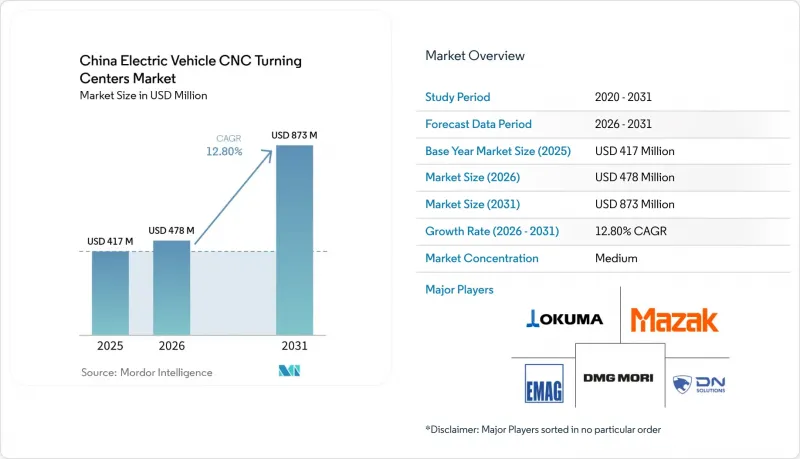
根據 Mordor Intelligence 預測,中國電動車數控車床中心市場規模預計將從 2025 年的 4.17 億美元成長到 2026 年的 4.78 億美元,然後從 2026 年到 2031 年以 12.80% 的複合年成長率,到 2031 年達到 8.31 億美元。
中國電動車用CNC車床市場趨勢及洞察
電動車生產的加速發展正在擴大對精密加工的需求。
預計到2025年,中國新能源汽車產量將達到1,663萬輛,較2024年成長29%。新能源汽車銷售預計到2026年也將達到1,900萬輛。 2026年上半年,新能源汽車總產量達743萬輛,其中6月新能源汽車銷售佔新車總銷量的58.5%。如此龐大的產量帶動了對電機軸、轉子殼體、電驅動橋殼體以及電池托盤結構等需要車削及相關精密加工的零件的持續需求,每次新生產項目啟動時,都會涉及多家零件供應商。需求不僅限於最終組裝階段,因為零件製造商需要在汽車工廠完成生產推出之前提高產能。隨著整車廠商更頻繁地更新車輛架構,中國電動車數控車床市場將從中受益,這要求供應商在保持穩定生產的同時,調整其刀具、程式設計和產能。採購不再僅僅被視為一次性的設備購買,而是成為更廣泛的工廠工程項目的一部分,設備選擇與生產線設計和自動化規劃緊密相連。這種趨勢有利於那些能夠支援跨多個加工單元的規格製定、試運行、製程檢驗、操作人員培訓和生產推出的供應商。
電動車零件製造的在地化正在推動對CNC工具機的投資。
在地化生產馬達總成、整合式電力驅動橋和電池管理外殼的需求,既推動了新建工具機設施的需求,也促進了現有設備的升級改造。中國工業與資訊化部(工信部)發布的《2026-2030年工具機發展規劃》設定了2027年將關鍵功能部件的自主研發率提高到75%以上的目標,並支持聯合研發。這項政策方向凸顯了能夠處理中高階應用的中國設備供應商的優勢,尤其是那些服務團隊能夠與零件製造商緊密合作的供應商。此外,能夠提供標準設備並可根據特定零件組客製化工具機配置的供應商也越來越有價值。在地採購需求也會影響設備選擇,因為供應商需要在OEM供應鏈中爭取優先地位,並證明其符合本地化目標。因此,對於能夠提供可接受的精度、快速的本地服務、針對特定應用的建議以及充足的備件供應的國內製造商而言,中國電動汽車數控車床市場提供了廣闊的准入空間。然而,即使在這種環境下,對海外製造設備的需求也不會消失,尤其是在對複雜加工、控制性能或檢驗仍有較高要求,且買方已建立全球生產標準的情況下。
高昂的資本投資成本和技術限制延緩了設備升級。
能夠滿足電動車公差要求的先進多軸車床價格從80萬元到超過500萬元人民幣(約11.2萬美元至70萬美元)不等。小規模的零件製造商可能需要數年時間才能收回投資,尤其是在訂單隨車型變化而波動,或者產量不足以充分運作新生產單元的情況下。資金籌措通常需要以實體資產作為抵押,這對於固定資產有限的精密加工企業來說十分不利,並且會限制那些希望投資於技術驅動型生產力提升的企業的選擇。從內燃機生產線轉型還需要工件夾具、鋁加工刀具、程序修改、檢測方法修改以及員工培訓,以使其能夠處理不同的零件和材料。除了機器價格之外,這些變更可能會使實際購買成本增加15%至20%,進而可能延長供應商獲得穩定產量所需的時間。經驗豐富的數控編程人員和精密技術人員的短缺進一步限制了供應商將新的生產能力投入穩定生產、檢驗其能力以及響應客戶進度變更的速度。
細分市場分析
2025年,臥式CNC車削中心佔總銷售額的35%。這類工具機廣泛用於棒材和軸類零件的加工,例如轉子軸、馬達主軸和差速器殼體。由於其適用於連續循環生產且設定次數極少,因此在OEM和一級供應商的加工生產線中廣泛應用。此外,隨著工廠對其刀具、控制系統和生產能力進行評估,對現有設備的更新和升級需求也日益成長。垂直數控車削中心則非常適合加工大直徑、低輪廓零件,例如軸承環、馬達端蓋和刹車盤。在水平佈局不適用於排屑和工件搬運的情況下,立式數控車削中心仍扮演重要角色。
預計2026年至2031年間,多功能車銑中心將以16.1%的複合年成長率成長。這些工具機將車削、銑削、鑽孔和螺紋加工整合於一次裝夾中,用於加工複雜的電動汽車車橋零件。這縮短了工具機間的轉移時間,簡化了多面零件的生產。 EMAG在2025年EMO展會上發表了MSC 5 DUO,這是一款緊湊型自動化雙主軸車床系統,專為汽車零件設計。 Okuma於2026年發表了MULTUS U1000和MULTUS U2000,這兩款工具機具備五軸連動加工能力,面積僅8.2平方公尺。中國電動汽車CNC車床產業正朝著這些系統轉型,優先考慮空間利用率、勞動效率和製程的整合。
其他好處:
- Excel格式的市場預測(ME)表
- 3個月的分析師支持
目錄
第1章:引言
- 研究假設和市場定義
- 調查範圍
第2章:調查方法
第3章執行摘要
- 市場概況(2025 年與 2031 年比較)
- 各細分市場的主要發現
- 投資重點領域與未開發領域
第4章 市場狀況
- 市場概覽
- 數控車床在電動車製造價值鏈中的作用
- 從內燃機零件加工到電動車專用加工需求的演變
- 市場促進因素
- 電動車生產的加速發展正在擴大對精密加工的需求。
- 電動車零件製造的在地化正在推動對CNC工具機的投資增加。
- 對電力驅動橋、馬達軸和電池組件的精度要求很高。
- 汽車工廠智慧工廠和工業自動化的擴展。
- 產業政策支持國內CNC工具機產能擴張
- 擴大多軸車床的應用範圍,以提高製造效率
- 市場限制因素
- 先進的CNC車床需要大量的資金投入。
- 依賴進口高階CNC系統和關鍵零件
- 熟練的CNC編程人員和精密加工技術人員短缺
- 來自低成本設備的競爭正在給製造商的利潤率帶來壓力。
- 市場機遇
- 下一代千兆廣播和整合電動車平台正在產生新的處理需求。
- 人工智慧驅動的預測性維護和數位孿生技術在CNC工具機中的應用
- 中國製造的電動車零件出口不斷擴大,帶動了對符合國際標準的機械加工的需求。
- 電動車製造價值鏈分析
- 原物料供應商
- 工具機製造商
- 電動汽車零件製造商
- 電動汽車製造商
- 製造流程分析
- 根據生產量選擇機器
- 原型製作和批量生產的要求
- 貿易趨勢和關稅影響分析
- 工具機的主要進出口路線
- 區域採購來源的變化和本地化趨勢
- 監理情勢
- 電動車生產的製造獎勵
- 在地採購要求
- 智慧製造政策
- 關於工具機能源效率的法規
- 科技趨勢
- 多功能車銑中心
- 人工智慧驅動的工具磨損監測
- 數位孿生整合
- 機器人自動化
- 人工智慧和數位化製造對CNC車床加工的影響
- 地緣政治對市場的影響
第5章 市場規模及成長預測(價值單位:美元)
- 按機器類型
- 臥式CNC車床
- 立式CNC車床
- 多功能車銑複合機
- 瑞士型CNC車床
- 其他
- 按組件和應用程式
- 電動機零件
- 電力驅動橋和變速器部件
- 電池系統組件
- 其他
- 最終用戶
- 電動車製造商的製造工廠
- 一級汽車零件供應商
- 二級零件製造商
- 精密契約製造
第6章 競爭情勢
- Market Structure
- Strategic Developments(2022-2026)
- New Product Launches
- Automation Partnerships
- EV Manufacturing Projects
- Capacity Expansion
- Acquisitions
- Digital Manufacturing Collaborations
- 市佔率分析
- 公司簡介
- Shenyang Machine Tool Co., Ltd.
- Qinchuan Machine Tool & Tool Group Co., Ltd.
- Dalian Machine Tool Group Corporation
- Ningbo Haitian Precision Machinery Co., Ltd.
- Baoji Machine Tool Group Co., Ltd.
- JIER Machine Tool Group Co., Ltd.
- Beijing Jingdiao Group Co., Ltd.
- Qinghai Huading Industrial Co., Ltd.
- Guangdong Create Century Intelligent Equipment Group Corporation Limited
- Genesis Technology Co., Ltd.
- DMG MORI Co., Ltd.
- Mazak Corporation
- Okuma Corporation
- Haas Automation, Inc.
- DN Solutions Co., Ltd.
- INDEX-Werke GmbH & Co. KG Hahn & Tessky
- EMAG GmbH & Co. KG
- Tsugami Corporation
- Citizen Machinery Co., Ltd.
- Star Micronics Co., Ltd.
第7章 市場機會與未來展望
According to Mordor Intelligence, the China electric vehicle CNC turning centers market size is expected to grow from USD 417 million in 2025 to USD 478 million in 2026 and is forecast to reach USD 873 million by 2031 at 12.80% CAGR over 2026-2031.
China Electric Vehicle CNC Turning Centers Market Trends and Insights
Accelerating Electric Vehicle Production Expands Precision Machining Demand
China produced 16.63 million NEVs in 2025, a 29% increase from 2024, and NEV sales are projected to reach 19 million units in 2026. NEV output totaled 7.43 million units in the first half of 2026, while the June penetration rate reached 58.5% of new car sales. This volume creates continuing demand for motor shafts, rotor housings, e-axle casings, and battery tray structures that require turning and related precision machining, with each additional production program drawing on several component suppliers. Demand is not confined to final assembly because component makers must add capacity before vehicle plants can complete their production ramps. The China electric-vehicle CNC turning centers market benefits when OEMs refresh vehicle architectures more frequently, as suppliers must adapt tooling, programming, and production capacity while maintaining stable output. Procurement is increasingly tied to broader plant engineering programs rather than being handled as an isolated machine purchase, bringing machine selection closer to line design and automation planning. That practice favors suppliers that can support specification, commissioning, process validation, operator training, and production ramp-up across several machining cells.
Localization of EV Component Manufacturing Strengthens CNC Machine Investments
Localized production of e-motor assemblies, integrated e-axles, and battery management housings is creating both new-site and upgrade demand for machining equipment. MIIT's 2026-2030 machine tool development plan set a target of more than 75% self-sufficiency in key functional components by 2027 and established support for joint research and development. The policy direction strengthens the case for Chinese equipment suppliers capable of serving mid-range and higher-specification applications, especially when their service teams can work closely with component makers. It also puts greater value on suppliers that can tailor a machine configuration to a specific part family rather than only provide standard equipment. Local procurement requirements can also influence equipment selection, as suppliers seek preferred status within OEM supply chains and need to demonstrate alignment with localization objectives. The China electric vehicle CNC turning centers market, therefore, has room for domestic manufacturers that combine acceptable accuracy with responsive local service, application advice, and spare-parts availability. This environment does not eliminate demand for foreign equipment, especially where complex machining, control performance, or validation requirements remain high, and buyers have established global production standards.
High Capital Costs and Skills Constraints Slow Upgrades
Advanced multi-axis turning centers capable of meeting EV tolerance requirements cost between CNY 800,000 and more than CNY 5 million (USD 112,000 and USD 700,000). Smaller component producers can face multi-year payback periods, particularly when their orders change with vehicle model transitions or when their production volumes are not yet sufficient to keep a new cell fully utilized. Financing often depends on real-asset collateral, which can disadvantage precision machining firms with limited fixed assets and reduce the options available to firms that want to fund technology-led productivity gains. The required conversion from ICE-focused lines also includes workholding, aluminum-capable cutting tools, revised programs, inspection methods, and employee training for different parts and materials. Those changes can add 15% to 20% to the effective acquisition cost beyond the machine price and can lengthen the time before a supplier obtains stable output. A shortage of experienced CNC programmers and precision technicians further limits the speed at which suppliers can bring new capacity into stable production, verify capability, and respond to customer schedule changes.
Other drivers and restraints analyzed in the detailed report include:
- High-Precision Requirements for E-Axles, Motor Shafts, and Battery Components
- Smart Factories and Automation Reshape Equipment Selection
- Imported Control Dependence and Price Competition Constrain Returns
For complete list of drivers and restraints, kindly check the Table Of Contents.
Segment Analysis
Horizontal CNC turning centers accounted for 35% of 2025 revenue. They are widely used for bar-stock and shaft-family parts, including rotor shafts, motor spindles, and differential housings. Their suitability for continuous-cycle production and limited setup changes has supported adoption in OEM and Tier-1 machining lines. The installed base also creates replacement and upgrade demand as plants revise tooling, controls, and capacity. Vertical CNC turning centers are well-suited to larger-diameter, lower-height parts such as bearing rings, motor end plates, and brake rotors. They remain relevant where chip evacuation or workpiece handling makes a horizontal layout less suitable.
Multi-tasking turn-mill centers are forecast to grow at a 16.1% CAGR from 2026 to 2031. The equipment combines turning, milling, drilling, and thread cutting in one setup for complex e-axle components. This reduces transfer time between machines and can simplify the production of multi-face parts. EMAG introduced the MSC 5 DUO at EMO 2025, a compact, automated twin-spindle turning system for automotive components. Okuma introduced the MULTUS U1000 and MULTUS U2000 in 2026, with 5-axis simultaneous machining and an 8.2 m2 footprint. The China electric vehicle CNC turning centers industry is moving toward these systems, in which factories prioritize space utilization, labor efficiency, and process consolidation.
Complete Report Scope:
- By Machine Type
- Horizontal CNC Turning Centers
- Vertical CNC Turning Centers
- Multi-Tasking Turn-Mill Centers
- Swiss-Type CNC Turning Centers
- Others
- By Component Application
- Electric Motor Components
- E-Axles & Transmission Components
- Battery System Components
- Others
- By End User
- EV OEM Manufacturing Plants
- Tier-1 Automotive Suppliers
- Tier-2 Component Manufacturers
- Precision Contract Manufacturers
List of Companies Covered in this Report:
- Shenyang Machine Tool Co., Ltd.
- Qinchuan Machine Tool & Tool Group Co., Ltd.
- Dalian Machine Tool Group Corporation
- Ningbo Haitian Precision Machinery Co., Ltd.
- Baoji Machine Tool Group Co., Ltd.
- JIER Machine Tool Group Co., Ltd.
- Beijing Jingdiao Group Co., Ltd.
- Qinghai Huading Industrial Co., Ltd.
- Guangdong Create Century Intelligent Equipment Group Corporation Limited
- Genesis Technology Co., Ltd.
- DMG MORI Co., Ltd.
- Mazak Corporation
- Okuma Corporation
- Haas Automation, Inc.
- DN Solutions Co., Ltd.
- INDEX-Werke GmbH & Co. KG Hahn & Tessky
- EMAG GmbH & Co. KG
- Tsugami Corporation
- Citizen Machinery Co., Ltd.
- Star Micronics Co., Ltd.
Additional Benefits:
- The market estimate (ME) sheet in Excel format
- 3 months of analyst support
TABLE OF CONTENTS
1 Introduction
- 1.1 Study Assumptions & Market Definition
- 1.2 Scope of the Study
2 Research Methodology
3 Executive Summary
- 3.1 Market Snapshot (2025 vs. 2031)
- 3.2 Key Findings by Segment
- 3.3 Investment Hotspots & White Space
4 Market Landscape
- 4.1 Market Overview
- 4.1.1 Role of CNC Turning Centers in the EV Manufacturing Value Chain
- 4.1.2 Evolution from ICE Component Machining to EV-Specific Machining Requirements
- 4.2 Market Drivers
- 4.2.1 Accelerating Electric Vehicle Production Expands Precision Machining Demand
- 4.2.2 Localization of EV Component Manufacturing Strengthens CNC Machine Investments
- 4.2.3 High-Precision Requirements for E-Axles, Motor Shafts, and Battery Components
- 4.2.4 Growth of Smart Factories and Industrial Automation in Automotive Plants
- 4.2.5 Expansion of Domestic CNC Machine Tool Capabilities Supported by Industrial Policies
- 4.2.6 Increasing Adoption of Multi-Axis Turning Centers to Improve Manufacturing Productivity
- 4.3 Market Restraints
- 4.3.1 High Capital Investment Required for Advanced CNC Turning Centers
- 4.3.2 Dependence on Imported High-End CNC Controllers and Core Components
- 4.3.3 Shortage of Skilled CNC Programmers and Precision Machining Technicians
- 4.3.4 Price Competition from Low-Cost Equipment Reducing Profit Margins for Manufacturers
- 4.4 Market Opportunities
- 4.4.1 Next-Generation Gigacasting and Integrated EV Platforms Create New Machining Requirements
- 4.4.2 AI-Enabled Predictive Maintenance and Digital Twin Integration in CNC Equipment
- 4.4.3 Growing Export of Chinese EV Components Drives Demand for International-Standard Machining
- 4.5 EV Manufacturing Value Chain Analysis
- 4.5.1 Raw Material Suppliers
- 4.5.2 Machine Tool Manufacturers
- 4.5.3 EV Component Manufacturers
- 4.5.4 EV OEMs
- 4.6 Manufacturing Process Analysis
- 4.6.1 Machine Selection by Production Volume
- 4.6.2 Prototype vs. Mass Production Requirements
- 4.7 Trade Flow & Tariff Impact Analysis
- 4.7.1 Key Machine Tool Export & Import Corridors
- 4.7.2 Regional Sourcing Shifts & Localization Trends
- 4.8 Regulatory Landscape
- 4.8.1 Manufacturing Incentives for EV Production
- 4.8.2 Local Content Requirements
- 4.8.3 Smart Manufacturing Policies
- 4.8.4 Energy Efficiency Regulations for Machine Tools
- 4.9 Technology Landscape
- 4.9.1 Multi-Tasking Turn-Mill Centers
- 4.9.2 AI-Based Tool Wear Monitoring
- 4.9.3 Digital Twin Integration
- 4.9.4 Robot Automation
- 4.10 Impact of AI & Digital Manufacturing on CNC Turning
- 4.11 Geopolitical Impact on Market
5 Market Size & Growth Forecasts Value (USD)
- 5.1 By Machine Type
- 5.1.1 Horizontal CNC Turning Centers
- 5.1.2 Vertical CNC Turning Centers
- 5.1.3 Multi-Tasking Turn-Mill Centers
- 5.1.4 Swiss-Type CNC Turning Centers
- 5.1.5 Others
- 5.2 By Component Application
- 5.2.1 Electric Motor Components
- 5.2.2 E-Axles & Transmission Components
- 5.2.3 Battery System Components
- 5.2.4 Others
- 5.3 By End User
- 5.3.1 EV OEM Manufacturing Plants
- 5.3.2 Tier-1 Automotive Suppliers
- 5.3.3 Tier-2 Component Manufacturers
- 5.3.4 Precision Contract Manufacturers
6 Competitive Landscape
- 6.1 Market Structure
- 6.2 Strategic Developments (2022-2026)
- 6.2.1 New Product Launches
- 6.2.2 Automation Partnerships
- 6.2.3 EV Manufacturing Projects
- 6.2.4 Capacity Expansion
- 6.2.5 Acquisitions
- 6.2.6 Digital Manufacturing Collaborations
- 6.3 Market Share Analysis
- 6.4 Company Profiles
- 6.4.1 Shenyang Machine Tool Co., Ltd.
- 6.4.2 Qinchuan Machine Tool & Tool Group Co., Ltd.
- 6.4.3 Dalian Machine Tool Group Corporation
- 6.4.4 Ningbo Haitian Precision Machinery Co., Ltd.
- 6.4.5 Baoji Machine Tool Group Co., Ltd.
- 6.4.6 JIER Machine Tool Group Co., Ltd.
- 6.4.7 Beijing Jingdiao Group Co., Ltd.
- 6.4.8 Qinghai Huading Industrial Co., Ltd.
- 6.4.9 Guangdong Create Century Intelligent Equipment Group Corporation Limited
- 6.4.10 Genesis Technology Co., Ltd.
- 6.4.11 DMG MORI Co., Ltd.
- 6.4.12 Mazak Corporation
- 6.4.13 Okuma Corporation
- 6.4.14 Haas Automation, Inc.
- 6.4.15 DN Solutions Co., Ltd.
- 6.4.16 INDEX-Werke GmbH & Co. KG Hahn & Tessky
- 6.4.17 EMAG GmbH & Co. KG
- 6.4.18 Tsugami Corporation
- 6.4.19 Citizen Machinery Co., Ltd.
- 6.4.20 Star Micronics Co., Ltd.
7 Market Opportunities & Future Outlook
- 7.1 White-Space Assessment
- 7.1.1 Emerging EV Manufacturing Hubs
- 7.1.2 Tier-2 Suppliers
- 7.1.3 Precision Machining for Next-Generation E-Mobility
- 7.1.4 AI-Driven Autonomous Machining
- 7.2 Strategic Recommendations


