


 |
市場調查報告書
商品編碼
2155232
大型太陽能發電廠:市場佔有率分析、行業趨勢和統計數據以及成長預測(2026-2031 年)Utility-Scale Solar Power Plant - Market Share Analysis, Industry Trends & Statistics, Growth Forecasts (2026 - 2031) |
||||||

※ 本網頁內容可能與最新版本有所差異。詳細情況請與我們聯繫。
根據 Mordor Intelligence 的數據,以裝置容量計算,公用事業規模太陽能發電廠的市場規模預計將在 2025 年達到 1.26兆瓦,2026 年達到 1.56兆瓦,到 2031 年達到 3.92兆瓦,從 2026 年到 2031 年的複合年成長率為 20312%。
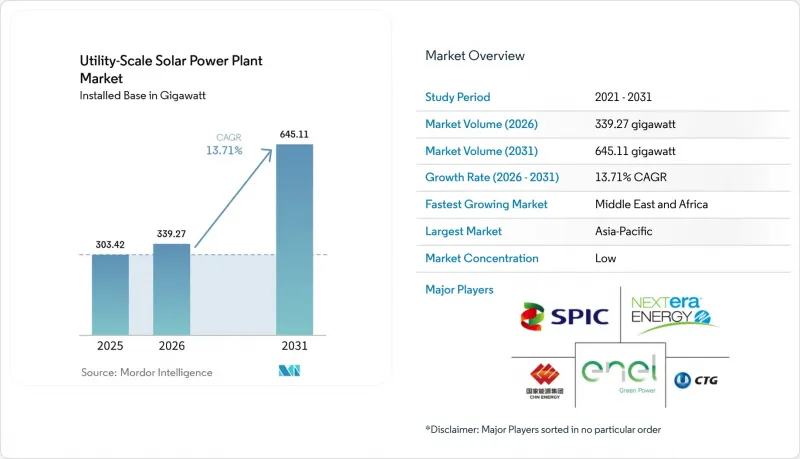
全球公用事業規模太陽能發電廠市場趨勢及洞察
公用事業規模的太陽能發電相對於石化燃料發電的成本競爭力。
在許多市場,太陽能仍然是一種低成本的新型電力源,因此公用事業規模太陽能發電廠的市場持續成長。根據國際再生能源總署(IRENA)的報告,2025年投入運作的公用事業規模可再生能源專案中,超過90%的專案發電成本將低於各市場中最便宜的新建石化燃料發電專案。 IRENA估計,2025年全球公用事業規模太陽能發電的平均成本為44美元/兆瓦時。這種成本環境使得開發標準從單純地在白天盡可能多地發電,轉變為能夠在電網需要時供電,這使得太陽能發電設備、儲能系統、電網限制和客戶需求之間的相互作用在專案經濟性中變得越來越重要。因此,開發商正在尋求能夠評估儲能系統實施和穩定供電能力的合約。公共太陽能研究計畫也持續支持進一步降低成本和技術進步。
企業購電協議 (PPA) 和超大規模資料中心業者的電力採購
企業購電協議 (PPA) 正在為公用事業規模的太陽能發電市場創造更清晰的需求基礎。資料中心需要大量電力,通常需要在建設開始前簽訂長期供電合約。這些合約不僅能改善開發商的收入前景,還有助於獲得企劃案融資。這是因為貸款人和投資者更重視已知的客戶、清晰的合約條款和更可預測的付款流程,而不是在資產運作週期內依賴不確定的批發市場價格。這種資金籌措模式對於需要電網升級或儲能設施的太陽能發電工程尤其重要。 2026 年 2 月,Google和道達爾能源公司 (TotalEnergies) 為位於德克薩斯州的一個資料中心簽訂了兩份總裝置容量總合1 吉瓦的長期太陽能發電合約。隨著企業買家接受更長的合約期限並直接參與專案實施,公用事業規模的太陽能發電市場將從中受益。
電網連接排隊和輸電瓶頸
在北美和歐洲部分地區,併網是公用事業規模太陽能發電市場面臨的主要限制因素。根據勞倫斯柏克萊國家實驗室的記錄,截至2024年底,美國已有超過10,300個項目申請併網,總裝置容量達1400吉瓦。 2000年至2007年間,計畫從申請到商業營運的平均時間不到兩年,但2018年至2024年間,這一時間已延長至四年以上。長期的調查和不確定的電網維修成本增加了前期建設資金需求,並導致開發預算長期佔用。因此,即使在電網維修的成本和時間確定後,專案發起人也很難判斷候選地點是否能帶來足夠的價值。在這種情況下,能夠承受漫長核准期的開發商更具優勢。同行評審的研究表明,美國併網申請等待名單上的項目最終有80%會撤回申請。
細分市場分析
到2025年,光電發電將佔公用事業規模太陽能電站市場的97.2%,預計到2031年將以14.7%的複合年成長率成長。這一地位反映了組件成本的下降、成熟的設計和建造能力,以及能夠支援跨多個國家大規模採購項目的供應鏈。開發商在取得土地、併網、設備和購電協議後,即可快速安裝太陽能發電設施。因此,對於希望在特定規劃期內增加發電能力的電力公司而言,這項技術非常有用;當需求預測表明在引入其他大型電站之前需要大量新增發電能力時,光伏發電也成為負責人的切實可行的選擇。中國沙漠和戈壁沙漠的計畫為集中式太陽能發電的發展奠定了至關重要的基礎,展現了土地規劃如何支持超大規模計畫。
此外,太陽能開發商正面臨更複雜的採購環境。貿易法規和所有權要求可能會改變符合專案資格的組件供應商名單,影響設備訂單的時間安排,並導致受監管產品的成本波動,所有這些都要求專案開發商、供應商、投資者和電力購買者之間加強合作。雙面、TOPCon 和背接觸式電池產品可以提高可用土地的發電量,使開發商能夠更有效地利用不同光照水平的場地。以資料中心和政府買家為導向的專案可能需要符合「外國關注企業 (FEOC)」規定的供應鏈,這進一步凸顯了透明採購和可靠交付計畫的重要性。聚光型太陽熱能發電(CSP) 目前仍是小規模技術,但透過利用熱能儲存技術,可以在日落後繼續發電,而無需依賴單獨的電池系統。截至 2026 年中,中國的 CSP運作裝置容量為 2.1 吉瓦,另有 26 個項目正在建設中,裝置容量為 3.2 吉瓦。而 IRENA 報告稱,2025 年 CSP 的成本為 115 美元/兆瓦時。
區域分析
到2025年,亞太地區將佔全球裝置容量的68.4%,並繼續保持公用事業規模太陽能市場最大的區域中心地位。中國、印度、日本、韓國和澳洲都擁有大規模的電力系統和活躍的太陽能開發項目,但各國的競標規則、電網規劃、國內製造政策和項目核准程序各不相同。到2025年,全球太陽能裝置容量將超過3太瓦(TW),近40個國家將首次實現1吉瓦(GW)以上的裝置容量。這表明太陽能的普及正在向傳統市場以外的地區擴展。中國仍佔據中心地位,其廣闊的面積、強大的國內製造能力和政府支持的發展使其能夠承接大型計畫。同時,印度正透過集中開發區和競爭性採購流程,擴大其在亞太地區安裝公用事業規模項目的能力,從而形成一個龐大的競標項目儲備和一個快速成長的本地供應鏈,為設備採購和建設活動提供支持。
預計到2031年,中東和非洲地區的複合年成長率將達到15.2%,成為公用事業規模太陽能發電市場各地區中成長率最高的地區。沙烏地阿拉伯的可再生能源計畫正在創造對大型計畫的多年需求,而海灣國家則透過國有電力公司、政府採購和充足的陽光資源來支持規模化發展。非洲市場正從小規模專案儲備轉向更廣泛的公用事業規模活動,但資金籌措條件、電網、開發商能力以及電力購買者的信用狀況因國家而異。因此,專案的成功往往取決於精心設計的合約、具有本地經驗的開發合作夥伴以及在商業運營開始前對所需電網基礎設施的實際評估。為了抓住這一機遇,那些能夠將專案開發、資金籌措、施工管理、與當地相關人員的合作以及長期營運相結合的公司,而非僅依賴單一的開發能力,將更具優勢。隨著各國擴大太陽能發電部署,力求更精準地控制電網供電時間,並應對白天發電量過剩帶來的收益風險,儲能的重要性只會與日俱增。這是因為太陽能發電設施可以將至少一部分發電量轉移到夜間,從而更好地滿足夜間用電需求,改善合約條款,並減輕批發電價低迷時期帶來的影響。
在北美和歐洲,成熟的電力系統對公用事業規模的太陽能發電市場提出了更嚴格的營運限制。根據美國能源資訊署(EIA)預測,2026年,美國計畫新增公用事業規模的太陽能發電裝置容量為43.4吉瓦,其中德克薩斯州佔40%。資料中心的需求也支撐著長期上網電價補貼協議的可行性。即使開發商已經獲得了潛在買家、設備和建設資金,併網調查、電網升級和聯邦土地使用許可等程序仍可能延誤北美項目的進度。雖然歐洲市場對太陽能發電的政策支持仍在繼續,但隨著白天供應超過需求可能壓低批發價格,從而降低市場交易的盈利能力,合約、儲能和需求柔軟性的重要性日益凸顯。在南美洲,儘管巴西和智利擁有豐富的太陽能資源,但輸電能力限制和各國特有的政策風險可能會限制專案進度,迫使開發商採取針對特定位置的電網和上網電價補貼策略。
其他好處:
- Excel格式的市場預測(ME)表
- 3個月的分析師支持
目錄
第1章:引言
- 研究假設和市場定義
- 調查範圍
第2章:調查方法
第3章執行摘要
第4章 市場狀況
- 市場概覽
- 市場促進因素
- 大規模太陽能發電相對於石化燃料發電的成本競爭力。
- 透過公司間購電協議 (PPA) 和超大規模資料中心業者進行電力採購
- 「太陽能+儲能」可實現穩定的可再生能源供給能力。
- 可再生能源目標與能源安全政策
- 獎勵到期前的安全港計畫儲備
- 太陽能發電、綠色氫能和工業負載協同部署
- 市場限制因素
- 電網連接等待名單和輸電瓶頸
- 授權、土地使用和社區同意方面的延誤
- 關於貿易限制和從外國公司採購的規定
- 日間發電量削減、負電價、利潤蠶食
- 供應鏈分析
- 波特五力分析
- 科技趨勢
- 監理情勢
- 投資分析
第5章 市場規模與成長預測
- 透過技術
- 太陽能發電(PV)
- 聚光型太陽熱能發電(CSP)
- 按地區
- 北美洲
- 美國
- 加拿大
- 墨西哥
- 歐洲
- 德國
- 法國
- 義大利
- 西班牙
- 英國
- 波蘭
- 俄羅斯
- 其他歐洲國家
- 亞太地區
- 中國
- 印度
- 日本
- 韓國
- 澳洲
- 印尼
- 越南
- 泰國
- 其他亞太國家
- 南美洲
- 巴西
- 阿根廷
- 智利
- 其他南美國家
- 中東和非洲
- 沙烏地阿拉伯
- 阿拉伯聯合大公國
- 埃及
- 南非
- 摩洛哥
- 其他中東和非洲國家
- 北美洲
第6章 競爭情勢
- 市場集中度
- 策略趨勢
- 市佔率分析
- 公司簡介
- ACWA Power
- Adani Green Energy Limited
- Brookfield Renewable Partners LP
- Canadian Solar Inc.
- China Three Gorges Renewables(Group)Co., Ltd.
- CHN Energy Investment Group Co., Ltd.
- EDF Renewables
- Enel Green Power SpA
- ENGIE
- First Solar, Inc.
- Iberdrola, SA
- JinkoSolar Holding Co., Ltd.
- Lightsource bp
- Masdar
- NextEra Energy, Inc.
- Repsol, SA
- RWE Renewables Europe and Australia GmbH
- State Power Investment Corporation Limited
- TotalEnergies SE
- Trina Solar Co., Ltd.
第7章 市場機會與未來展望
According to Mordor Intelligence, the Utility-Scale solar power plant market size in terms of installed base is projected to be 1.26 Terawatt in 2025, 1.56 Terawatt in 2026, and reach 3.92 Terawatt by 2031, growing at a CAGR of 20.24% from 2026 to 2031.
Global Utility-Scale Solar Power Plant Market Trends and Insights
Utility-Scale Solar Cost Competitiveness Against Fossil Generation
Utility-scale solar power plant market growth continues because solar remains a low-cost source of new electricity in many markets. IRENA reported that more than 90% of utility-scale renewable projects commissioned in 2025 generated power below the cost of the cheapest new fossil fuel alternative in their markets. IRENA placed the global average utility-scale solar PV cost at USD 44/MWh in 2025. This cost position shifts development decisions toward the ability to deliver electricity when the system needs it, rather than simply producing the largest possible volume during daylight hours, and it makes the interaction between solar assets, storage systems, grid constraints, and customer demand increasingly important to project economics. Developers are therefore adding storage and seeking contracts that recognize dependable delivery. Public solar research programs also continue to support further cost reductions and technology improvement.
Corporate PPAs and Hyperscaler Electricity Procurement
Corporate power purchase agreements are creating a clearer demand base for the utility-scale solar power plant market. Data centers need large volumes of electricity and often need long-term supply agreements before construction can proceed. These contracts improve revenue visibility for developers and can help attract project financing, because lenders and investors can assess a known customer, a defined contract term, and a more predictable stream of payments instead of relying on uncertain wholesale market prices throughout the operating life of an asset. The financing model is especially important for solar projects that require transmission upgrades or storage assets. Google and TotalEnergies signed 2 long-term solar agreements totaling 1 GW for Texas data centers in February 2026. The utility-scale solar power plant market benefits when corporate buyers accept longer terms and more direct involvement in project delivery.
Grid Interconnection Queues and Transmission Bottlenecks
Grid access is a major constraint on the utility-scale solar power plant market in North America and parts of Europe. Lawrence Berkeley National Laboratory recorded more than 10,300 U.S. projects seeking interconnection at the end of 2024, representing 1,400 GW of generation capacity. The median time from application to commercial operation had increased from under 2 years for the 2000 to 2007 cohort to more than 4 years for the 2018 to 2024 cohort. Long studies and uncertain upgrade costs increase the capital needed before construction, tying up development budgets for longer periods and making it harder for project sponsors to decide whether a prospective site can deliver enough value after the cost and timing of network upgrades are known. They favor developers that can carry projects through extended approval periods. A peer-reviewed study found that 80% of projects entering U.S. interconnection queues ultimately withdraw.
Other drivers and restraints analyzed in the detailed report include:
- Solar-Plus-Storage for Firm Renewable Capacity
- Renewable-Energy Targets and Energy-Security Policies
- Permitting, Land-Use, and Community-Consent Delays
For complete list of drivers and restraints, kindly check the Table Of Contents.
Segment Analysis
Solar PV accounted for 97.2% of the utility-scale solar power plant market size in 2025 and is projected to expand at a 14.7% CAGR through 2031. Its position reflects lower module costs, established engineering and construction capability, and a supply chain that can support large procurement programs across many countries. Developers can install PV rapidly after they secure land, grid access, equipment, and a power purchase agreement, which makes the technology useful for utilities seeking capacity additions within a defined planning period and gives planners a practical option when demand forecasts indicate the need for material new generation before alternative large power assets can be delivered. China's desert and Gobi projects provide a substantial base for centralized solar PV development and show how land planning can support projects at a very large scale.
PV developers are also responding to a more complex procurement environment, because trade rules and ownership requirements can change the list of module suppliers that qualify for a project, affect the timing of equipment orders, alter the cost of compliant products, and require closer coordination between project developers, suppliers, investors, and offtake counterparties. Bifacial, TOPCon, and back-contact cell products can improve output from available land, which helps developers make better use of sites with different levels of solar irradiation. Projects serving data centers or government-linked buyers may require supply chains that meet Foreign Entity of Concern rules, increasing the value of transparent sourcing and dependable delivery schedules. Concentrated solar power remains a smaller technology, but thermal storage can support generation after sunset without relying on standalone battery systems. China had 2.1 GW of operational CSP capacity by mid-2026 and 3.2 GW under construction across 26 additional projects, while IRENA reported a CSP cost of USD 115/MWh in 2025.
Complete Report Scope:
- By Technology
- Solar Photovoltaic (PV)
- Concentrated Solar Power (CSP)
- By Geography
- North America
- United States
- Canada
- Mexico
- Europe
- Germany
- France
- Italy
- Spain
- United Kingdom
- Poland
- Russia
- Rest of Europe
- Asia-Pacific
- China
- India
- Japan
- South Korea
- Australia
- Indonesia
- Vietnam
- Thailand
- Rest of Asia-Pacific
- South America
- Brazil
- Argentina
- Chile
- Rest of South America
- Middle East and Africa
- Saudi Arabia
- United Arab Emirates
- Egypt
- South Africa
- Morocco
- Rest of Middle East and Africa
- North America
Geography Analysis
Asia-Pacific accounted for 68.4% of installed capacity in 2025 and remains the largest regional base for the utility-scale solar power plant market. China, India, Japan, South Korea, and Australia combine large electricity systems with active solar development, although their auction rules, grid planning, domestic manufacturing policies, and project approval procedures differ. Global PV capacity passed 3 TW in 2025, and nearly 40 countries installed at least 1 GW for the first time, showing that solar deployment is broadening beyond its longest-established markets. China remains central because large land areas, domestic manufacturing, and state-backed development can support very large projects, while India adds a major auction-driven pipeline and a growing local supply base that supports equipment procurement and construction activity, broadening the region's ability to deploy utility projects through both centralized development zones and competitive procurement processes.
The Middle East and Africa is projected to record a 15.2% CAGR through 2031, the fastest regional rate in the utility-scale solar power plant market. Saudi Arabia's renewable plans create a multi-year requirement for large projects, and state utility offtake, government procurement, and high-irradiance land support scale in the Gulf. African markets are moving from smaller project pipelines toward broader utility activity, although financing terms, transmission networks, developer capability, and the credit quality of electricity buyers vary considerably across countries, meaning that project success often depends on careful contract design, development partners with local experience, and realistic assessment of the grid work needed before commercial operations begin. The opportunity favors companies that combine project development, financing, construction management, local stakeholder engagement, and long-term operations rather than relying on a single development capability. Storage is likely to become more relevant as countries add large solar volumes, seek greater control over when power reaches the grid, and respond to the revenue risk created when daytime generation is plentiful, because solar assets that can shift at least part of their output can better match evening demand, improve their contractual offer, and reduce exposure to periods of weak wholesale pricing.
North America and Europe face mature power systems and a more demanding set of execution constraints within the utility-scale solar power plant market. The U.S. Energy Information Administration reported 43.4 GW of planned utility-scale solar additions in the United States for 2026, with Texas representing 40% of planned capacity and data center demand reinforcing the case for long-term offtake agreements. Interconnection studies, transmission upgrades, and federal land approvals can delay North American projects even after developers secure prospective buyers, equipment, and construction funding. European markets retain policy support for solar, yet merchant revenue can weaken when daytime supply exceeds demand and pushes down wholesale prices, increasing the importance of contracts, storage, and flexible demand. South America offers high solar resource in Brazil and Chile, while transmission limits and country-specific policy risks can restrain project timing and require developers to adopt location-specific grid and offtake strategies.
- ACWA Power
- Adani Green Energy Limited
- Brookfield Renewable Partners L.P.
- Canadian Solar Inc.
- China Three Gorges Renewables (Group) Co., Ltd.
- CHN Energy Investment Group Co., Ltd.
- EDF Renewables
- Enel Green Power S.p.A.
- ENGIE
- First Solar, Inc.
- Iberdrola, S.A.
- JinkoSolar Holding Co., Ltd.
- Lightsource bp
- Masdar
- NextEra Energy, Inc.
- Repsol, S.A.
- RWE Renewables Europe and Australia GmbH
- State Power Investment Corporation Limited
- TotalEnergies SE
- Trina Solar Co., Ltd.
Additional Benefits:
- The market estimate (ME) sheet in Excel format
- 3 months of analyst support
TABLE OF CONTENTS
1 INTRODUCTION
- 1.1 Study Assumptions and Market Definition
- 1.2 Scope of the Study
2 RESEARCH METHODOLOGY
3 EXECUTIVE SUMMARY
4 MARKET LANDSCAPE
- 4.1 Market Overview
- 4.2 Market Drivers
- 4.2.1 Utility-Scale Solar Cost Competitiveness Against Fossil Generation
- 4.2.2 Corporate PPAs and Hyperscaler Electricity Procurement
- 4.2.3 Solar-Plus-Storage for Firm Renewable Capacity
- 4.2.4 Renewable-Energy Targets and Energy-Security Policies
- 4.2.5 Safe-Harbored Project Pipelines Before Incentive Deadlines
- 4.2.6 Co-Located Solar, Green Hydrogen, and Industrial Loads
- 4.3 Market Restraints
- 4.3.1 Grid Interconnection Queues and Transmission Bottlenecks
- 4.3.2 Permitting, Land-Use, and Community-Consent Delays
- 4.3.3 Trade Restrictions and Foreign-Entity Sourcing Rules
- 4.3.4 Midday Curtailment, Negative Pricing, and Revenue Cannibalization
- 4.4 Supply-Chain Analysis
- 4.5 Porter's Five Forces Analysis
- 4.5.1 Bargaining Power of Suppliers
- 4.5.2 Bargaining Power of Buyers
- 4.5.3 Threat of New Entrants
- 4.5.4 Threat of Substitutes
- 4.5.5 Competitive Rivalry
- 4.6 Technology Outlook
- 4.7 Regulatory Landscape
- 4.8 Investment Analysis
5 MARKET SIZE AND GROWTH FORECASTS
- 5.1 By Technology
- 5.1.1 Solar Photovoltaic (PV)
- 5.1.2 Concentrated Solar Power (CSP)
- 5.2 By Geography
- 5.2.1 North America
- 5.2.1.1 United States
- 5.2.1.2 Canada
- 5.2.1.3 Mexico
- 5.2.2 Europe
- 5.2.2.1 Germany
- 5.2.2.2 France
- 5.2.2.3 Italy
- 5.2.2.4 Spain
- 5.2.2.5 United Kingdom
- 5.2.2.6 Poland
- 5.2.2.7 Russia
- 5.2.2.8 Rest of Europe
- 5.2.3 Asia-Pacific
- 5.2.3.1 China
- 5.2.3.2 India
- 5.2.3.3 Japan
- 5.2.3.4 South Korea
- 5.2.3.5 Australia
- 5.2.3.6 Indonesia
- 5.2.3.7 Vietnam
- 5.2.3.8 Thailand
- 5.2.3.9 Rest of Asia-Pacific
- 5.2.4 South America
- 5.2.4.1 Brazil
- 5.2.4.2 Argentina
- 5.2.4.3 Chile
- 5.2.4.4 Rest of South America
- 5.2.5 Middle East and Africa
- 5.2.5.1 Saudi Arabia
- 5.2.5.2 United Arab Emirates
- 5.2.5.3 Egypt
- 5.2.5.4 South Africa
- 5.2.5.5 Morocco
- 5.2.5.6 Rest of Middle East and Africa
- 5.2.1 North America
6 COMPETITIVE LANDSCAPE
- 6.1 Market Concentration
- 6.2 Strategic Moves
- 6.3 Market Share Analysis
- 6.4 Company Profiles (includes Global Level Overview, Market Level Overview, Core Segments, Financials as available, Strategic Information, Products and Services, Recent Developments)
- 6.4.1 ACWA Power
- 6.4.2 Adani Green Energy Limited
- 6.4.3 Brookfield Renewable Partners L.P.
- 6.4.4 Canadian Solar Inc.
- 6.4.5 China Three Gorges Renewables (Group) Co., Ltd.
- 6.4.6 CHN Energy Investment Group Co., Ltd.
- 6.4.7 EDF Renewables
- 6.4.8 Enel Green Power S.p.A.
- 6.4.9 ENGIE
- 6.4.10 First Solar, Inc.
- 6.4.11 Iberdrola, S.A.
- 6.4.12 JinkoSolar Holding Co., Ltd.
- 6.4.13 Lightsource bp
- 6.4.14 Masdar
- 6.4.15 NextEra Energy, Inc.
- 6.4.16 Repsol, S.A.
- 6.4.17 RWE Renewables Europe and Australia GmbH
- 6.4.18 State Power Investment Corporation Limited
- 6.4.19 TotalEnergies SE
- 6.4.20 Trina Solar Co., Ltd.
7 MARKET OPPORTUNITIES AND FUTURE OUTLOOK
- 7.1 White-Space and Unmet-Need Assessment

 全球公用事業規模太陽能發電市場預測至2034年—按技術、太陽能追蹤系統、專案類型、電站容量和地區分類的分析
 儲能線束市場:全球市場預測,2026-2032年
 2026-2030年全球先進能源市場
 計量後向儲能市場:全球產業分析、市場規模、市場佔有率及按電池類型、系統容量、連接方式、應用、最終用戶、國家和地區分類的預測——2026年至2033年
 先進液化空氣儲能市場分析與預測(至2035年):按類型、產品、技術、組件、應用、製程、最終用戶、功能及安裝類型分類
 公用事業規模太陽能發電市場:策略分析與預測(2026-2031 年)低溫熱能儲存市場:按類型、產品類型、服務、技術、組件、應用、國家和地區分類-全球產業分析、市場規模、市場佔有率及2026年至2033年預測電動車充電市場可再生能源應用:市場規模、佔有率、成長、全球產業分析、區域趨勢及2026-2034年預測
 儲能:市場佔有率分析、產業趨勢與統計、成長預測(2026-2031)
 2026年全球儲能市場報告