


 |
市場調查報告書
商品編碼
2155006
工業視覺系統整合服務:市場佔有率分析、產業趨勢與統計、成長預測(2026-2031)Industrial Vision System Integration Services - Market Share Analysis, Industry Trends & Statistics, Growth Forecasts (2026 - 2031) |
||||||

※ 本網頁內容可能與最新版本有所差異。詳細情況請與我們聯繫。
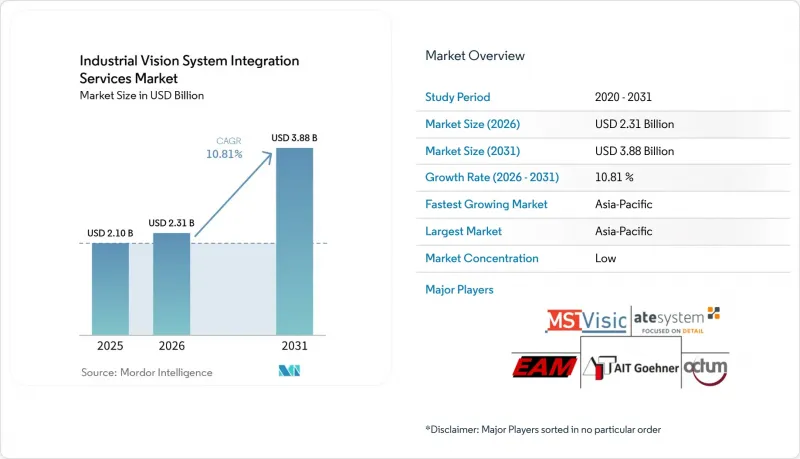
據 Mordor Intelligence 稱,2025 年工業視覺系統整合服務市場價值為 21 億美元,預計到 2031 年將從 2026 年的 23.1 億美元成長至 38.8 億美元,預測期(2026-2031 年)的複合年成長率為 10.81%。
全球工業視覺系統整合服務市場趨勢與洞察
零缺陷製造和自動化品質保證
對於許多一級汽車和航太供應商而言,零缺陷生產已成為一項合約要求。這項要求促使自動化視覺檢測被整合到封閉回路型品質系統的核心設計中。 2026 年的一項系統性綜述發現,即使在振動、灰塵和光照不均等不斷變化的生產條件下,利用深度學習的機器視覺也能辨識物體。而基於規則的系統在運作中,當這些條件改變時,其適應性則較差。由於製造商需要專業知識將檢測數據與生產控制和品質記錄關聯起來,工業視覺系統整合服務市場正從中受益。此外,AIAG 關於測量系統分析的指南也強調了整合商在汽車供應商檢驗人工智慧驅動的品質系統時所扮演的文件編寫角色。即使在初始專案完成後,檢測影像仍然可以作為寶貴的營運資產。當與製造執行系統 (MES) 整合時,影像記錄有助於在缺陷升級為大範圍品質故障之前識別重複出現的缺陷模式。這項要求將工作範圍從簡單的攝影機安裝擴展到持續的資料和製程控制服務。因此,在工業視覺系統整合服務市場,那些能夠在試運行後繼續維護模型、管理影像資料並為品質團隊提供支援的供應商將更具優勢。此外,零缺陷需求意味著專案進度對整體資本投資週期的依賴性降低。雖然供應商可以推遲部分工廠投資,但他們推遲實施支援合約品質績效的管理系統的空間有限。
視覺引導機器人與彈性自動化
視覺引導機器人技術正從大規模生產的汽車產業擴展到產品頻繁變更、產量較低的製造工廠。根據美國自動化協會(AAVI)預測,2025年,北美機器人訂單將達到36,766台,價值22.5億美元。這種環境要求系統即使在零件的方向、訂單位置和表面變化的情況下也能識別它們。由於需要協調相機、機器人控制設備和生產安全系統,工業視覺系統的整合服務市場也從中受益。此外,與固定座標機器人應用相比,3D結構光和深度感測設備需要更精細的設計。視覺與機器人之間的介面通常需要針對每條生產線客製化通訊和行為邏輯。擁有支援多種機器人品牌庫的整合商可以減少重複的工程工作,並縮短專案週期。庫卡(KUKA)正在展示用於機器人系統中2D和3D影像處理的基於人工智慧的視覺工具,這表明自動化領域正在向機器感知方向進行廣泛轉變。工業視覺系統整合服務市場需要能夠確保這些工具在混合生產環境中安全運作的供應商。此外,歐洲安全和人工智慧法規的日益嚴格,也提升了能夠為自主系統編寫清晰技術文件的供應商的價值。
遺留生產資產的整合複雜性很高
與新建生產基地相比,棕地工廠面臨不同的技術和商業性挑戰。過時的可程式邏輯控制器 (PLC)、輸送機系統和人機介面 (HMI) 可能無法使用目前視覺平台所採用的通訊方式。工業視覺系統整合服務市場必須解決介面相容性問題,而這往往在專案早期範圍界定階段被忽略。多供應商生產線可能需要針對來自不同製造商的設備使用不同的驅動程式堆疊和安全性檢查。這些問題可能會增加實施工作量,並降低固定價格合約的利潤率。在設備採購之前進行詳細的通訊映射可以減少未來的中斷。這包括識別整條生產線的控制系統、安全邏輯、可用停機時間和資料介面。工業視覺系統整合服務市場可以透過系統的棕地評估和託管升級服務來解決這些問題。這些服務可以根據產品配置的變化提供定期軟體更新和演算法重新訓練。然而,改裝工作通常需要在計劃的短期停機期內完成,而缺乏應對意外相容性問題的柔軟性仍然是一個重大限制。
細分市場分析
軟體、演算法和控制系統的整合預計將以12.34%的複合年成長率成長至2031年,成為成長最快的服務類別。截至2025年,系統設計和工程已佔工業視覺系統整合服務市場佔有率的25.45%。設計工作仍然至關重要,因為每次部署都需要進行可行性研究、光學元件選擇、照明設計和通訊規劃。這些決策決定了檢測系統能否同時滿足精度和週期時間的要求。對軟體相關工作的需求主要源自於需要使用製造商專有的缺陷模式來訓練模型。
康耐視的「OneVision」環境展示了人工智慧開發部分流程的標準化進程。標準工具簡化了日常設置,但客製化模型仍然需要大量的技術工作。系統安裝和試運行服務與新工廠的運作計劃緊密相關。在受監管的製造業中,當需要可重複的性能證據時,測試、檢驗和校準至關重要。隨著產品和生產條件的變化,模型需要重新訓練,因此維護、支援和升級正成為常規活動。擁有持續軟體收入的供應商可能與主要依賴一次性硬體銷售利潤的供應商採用不同的經營模式。
2025年,新系統整合業務佔總收入的64.78%,這主要得益於北美和亞太地區的工廠建設。預計到2031年,改裝和現代化業務將以12.78%的複合年成長率成長。在新工廠,視覺設備和數據連接可以在生產線設計的早期階段就進行整合,與改造現有設備相比,這在一定程度上降低了整合難度。工業視覺系統整合服務市場(尤其是針對改裝業務的整合服務)的規模,也得益於大量老舊檢測設備即將達到使用壽命。
改裝專案必須考慮通訊介面、安全認證和生產停機時間限制。這些要求意味著更換檢測系統很少是簡單的設備更換。如果事先確定生產線架構和介面,模組化方法可以最大限度地減少安裝期間的營運中斷。在工業視覺系統整合服務市場,擁有在運作中生產線上快速試運行成功經驗的公司具有顯著優勢。此外,每個已完成的棕地專案所累積的營運經驗,新參與企業很難在短時間內複製。能夠仔細界定這些任務範圍的供應商可以維持專案獲利能力,並建立長期的升級合作關係。
區域分析
預計到2025年,亞太地區將佔全球銷售額的37.65%,並將在2031年之前以11.93%的複合年成長率持續成長。在中國,半導體製造、電子產品代工組裝和智慧製造專案支撐了市場需求。印度正日益成為醫藥和汽車零件供應商滿足出口品質要求的重要檢測中心。在馬來西亞檳城工業區,半導體和家用電子電器生產的新工廠正在試運行中。在日本和韓國,精密組裝和先進封裝檢測的需求依然強勁。
北美地區規模排名第二,主要得益於回流投資、食品可追溯性要求以及藥品序列化活動。該地區2025年的機器人訂單將為視覺系統的試運行、維護和支援營運奠定堅實的基礎。 STEMMER IMAGING已於2025年10月完成了第一階段技術向STEMMER IMAGING USA的過渡。在歐洲,互聯工廠系統的AI、網路安全和產品安全要求日益嚴格。德國仍然是汽車、機械和精密製造領域項目的主要來源。
南美洲、中東和非洲地域面積較小,發展之路漫長。在巴西,業務主要集中在汽車製造和食品加工行業,當地供應商在語言和接近性方面具有優勢。在沙烏地阿拉伯和阿拉伯聯合大公國,工業園區的建設和工廠設計優先考慮自動化,推動了市場需求。在南非,汽車組裝和食品加工產業也呈現活躍態勢。在埃及和其他北非國家,製造業多元化有望帶來早期商業機會。工業視覺系統的整合服務市場地理分佈廣泛,但到2031年,這些小規模區域的發展速度將取決於當地的工程能力。
其他好處:
- Excel格式的市場預測(ME)表
- 3個月的分析師支持
目錄
第1章:引言
- 研究假設和市場定義
- 調查範圍
第2章:調查方法
第3章執行摘要
第4章 市場狀況
- 市場概覽
- 市場促進因素
- 零缺陷生產和自動化品質保證
- 視覺引導機器人與彈性自動化
- 利用人工智慧 (AI) 和深度學習進行測試
- 受監管製造業的可追溯性要求
- 半導體、電池和電子設備的微型化
- 公司內部機器視覺工程師短缺
- 市場限制因素
- 跨越傳統生產資產進行高階整合的複雜性。
- 缺乏合格的視覺自動化專家
- 互聯視覺系統中的網路安全與資料管治風險
- 硬體商品化和OEM捆綁式視覺解決方案
- 宏觀經濟因素對市場的影響
- 產業價值鏈分析
- 監理情勢
- 技術展望
- 波特五力分析
第5章 市場規模與成長預測
- 按服務類型
- 系統設計與工程
- 系統安裝和試運行
- 軟體、演算法和控制系統的整合
- 測試、檢驗和校準
- 維護、支援和升級
- 項目類型
- 新系統整合
- 維修和現代化
- 按客戶規模
- 大公司
- 中小企業
- 按最終用戶行業分類
- 汽車與出行
- 電子和半導體
- 食品/飲料
- 藥品和醫療設備
- 包裝
- 工業製造
- 物流和倉儲
- 其他終端用戶產業
- 按地區
- 北美洲
- 美國
- 加拿大
- 墨西哥
- 南美洲
- 巴西
- 阿根廷
- 其他南美國家
- 歐洲
- 德國
- 英國
- 法國
- 義大利
- 西班牙
- 其他歐洲國家
- 亞太地區
- 中國
- 日本
- 印度
- 韓國
- ASEAN
- 其他亞太國家
- 中東
- 沙烏地阿拉伯
- 阿拉伯聯合大公國
- 其他中東國家
- 非洲
- 南非
- 其他非洲國家
- 北美洲
第6章 競爭情勢
- 市場集中度
- 策略趨勢
- 市佔率分析
- 公司簡介
- AIT Goehner GmbH
- Avenir Vision Industrie
- ATEsystem sro
- Automatica y Control Numerico, SL
- Attentra GmbH
- DISYS Srl
- EAM, Inc.
- Eberle Automatische Systeme GmbH & Co. KG
- GEFATEC Sistemas Software e Consultoria Ltda.
- Greatech Integration(M)Sdn. Bhd.
- Integro Technologies, LLC
- JLI vision A/S
- MSTVision GmbH
- OCTUM GmbH
- phil-vision GmbH
- Qualitas Technologies Pvt. Ltd.
- Smart Services VS GmbH
- STEMMER IMAGING AG
- USS Vision, Inc.
- VST Taiwan Co., Ltd.
- Vision and Control Systems, Inc.
第7章 市場機會與未來展望
According to Mordor Intelligence, the industrial vision system integration services market size was valued at USD 2.10 billion in 2025 and is estimated to grow from USD 2.31 billion in 2026 to reach USD 3.88 billion by 2031, at a CAGR of 10.81% during the forecast period (2026-2031).
Global Industrial Vision System Integration Services Market Trends and Insights
Zero-Defect Manufacturing and Automated Quality Assurance
Zero-defect production has become a contractual requirement for many Tier 1 automotive and aerospace suppliers. This requirement places automated visual inspection within the core design of closed-loop quality systems. A 2026 systematic review found that deep-learning machine vision can recognize objects under changing production conditions, including vibration, dust, and uneven lighting. Rule-based systems are less adaptable when those conditions change during high-speed operations. The industrial vision system integration services market benefits because manufacturers need expertise to connect inspection data with production controls and quality records. AIAG guidance on measurement system analysis also gives integrators a documentation role when automotive suppliers validate AI-supported quality systems. Inspection images can become a useful operating asset after the initial project is complete. When linked to manufacturing execution systems, image records can help teams identify repeated defect patterns before they become broader quality failures. That requirement changes the scope of work from a camera installation into a continuing data and process-control service. The industrial vision system integration services market, therefore, favors providers that can maintain models, manage image data, and support quality teams after commissioning. Zero-defect requirements also make project timing less dependent on general equipment spending cycles. Suppliers can postpone some factory investments, but they have less room to postpone controls that support contractual quality performance.
Vision-Guided Robotics and Flexible Automation
Vision-guided robotics is extending beyond high-volume automotive work into manufacturing settings with frequent product changes and lower production volumes. The Association for Advancing Automation reported 36,766 robot orders in North America during 2025, valued at USD 2.25 billion. These environments require a system to locate components despite changing orientation, bin location, or surface variation. The industrial vision system integration services market gains from the additional work needed to connect cameras, robot controls, and production safety systems. 3D structured-light and depth-sensing equipment also require more careful design than fixed-coordinate robotic applications. A vision-to-robot interface often requires customized communication and motion logic for each production line. Integrators with libraries that support several robot brands can reduce repetitive engineering work and improve project delivery speed. KUKA describes AI-based vision tools for 2D and 3D image processing in robotic systems, showing the wider shift toward machine perception in automation. The industrial vision system integration services market has room for providers that can make these tools work safely in mixed production environments. European safety and AI rules also increase the value of suppliers that can prepare clear technical records for autonomous systems.
High Integration Complexity Across Legacy Production Assets
Brownfield factories create different technical and commercial conditions from new production sites. Older programmable logic controllers, conveyor systems, and human-machine interfaces may not use the communication methods expected by current vision platforms. The industrial vision system integration services market must address interface work that may not be visible during early project scoping. Multi-vendor production lines can require separate driver stacks and safety checks for equipment from several manufacturers. These discoveries add labor hours during deployment and can reduce margins on fixed-price contracts. Detailed communication mapping before equipment procurement can help reduce later disruption. The work must identify controls, safety logic, available downtime, and data interfaces across the complete line. The industrial vision system integration services market can respond with structured brownfield assessments and managed upgrade services. Such services can provide regular software updates and algorithm retraining when product mixes change. The restraint remains material because retrofit installations often need to fit into brief planned shutdowns, leaving little flexibility when unexpected compatibility issues appear.
Other drivers and restraints analyzed in the detailed report include:
- Artificial Intelligence and Deep-Learning Inspection
- Traceability Requirements Across Regulated Manufacturing
- Shortage of Qualified Vision and Automation Specialists
For complete list of drivers and restraints, kindly check the Table Of Contents.
Segment Analysis
Software, algorithm, and controls integration is projected to expand at a 12.34% CAGR through 2031, making it the fastest-expanding service type. System design and engineering held 25.45% of the industrial vision system integration services market share in 2025. Design work remains essential because every installation needs a feasibility review, optics selection, lighting design, and communication plan. These decisions determine whether an inspection system can meet both accuracy and cycle-time requirements. Demand for software-related work is supported by the need to train models using a manufacturer's own defect patterns.
Cognex's OneVision environment shows how some parts of AI development are becoming more standardized. Standard tools can simplify routine configuration, but custom models still require significant technical work. System installation and commissioning services remain closely tied to new-factory schedules. Testing, validation, and calibration are important where regulated manufacturing requires repeatable evidence of performance. Maintenance, support, and upgrades are becoming recurring activities because models need retraining after products or production conditions change. Providers with ongoing software revenue may have a different commercial profile from those that rely largely on one-time hardware margins.
New system integration accounted for 64.78% of revenue in 2025, supported by factory construction in North America and Asia-Pacific. Retrofit and modernization is forecast to expand at a 12.78% CAGR through 2031. New sites can incorporate vision equipment and data connections during the initial line design. This reduces some integration barriers compared with modifying established equipment. The industrial vision system integration services market size for retrofit work is supported by legacy inspection equipment that is approaching the end of its useful life.
Retrofit projects must account for communication interfaces, safety approvals, and limited production downtime. These requirements mean that replacing an inspection system is rarely a simple equipment exchange. A modular approach can reduce installation disruption when the line architecture and interfaces have been identified in advance. The industrial vision system integration services market favors firms with a record of rapid commissioning on active production lines. Each completed brownfield project also creates operating knowledge that is difficult for new competitors to reproduce quickly. Providers that scope such work carefully can protect project margins and build longer-term upgrade relationships.
Complete Report Scope:
- By Service Type
- System Design and Engineering
- System Installation and Commissioning
- Software, Algorithm, and Controls Integration
- Testing, Validation, and Calibration
- Maintenance, Support, and Upgrades
- By Project Type
- New System Integration
- Retrofit and Modernization
- By Customer Size
- Large Enterprises
- Small and Medium-Sized Enterprises (SMEs)
- By End-User Industry
- Automotive and Mobility
- Electronics and Semiconductor
- Food and Beverage
- Pharmaceuticals and Medical Devices
- Packaging
- Industrial Manufacturing
- Logistics and Warehousing
- Other End-User Industries
- By Geography
- North America
- United States
- Canada
- Mexico
- South America
- Brazil
- Argentina
- Rest of South America
- Europe
- Germany
- United Kingdom
- France
- Italy
- Spain
- Rest of Europe
- Asia-Pacific
- China
- Japan
- India
- South Korea
- ASEAN
- Rest of Asia-Pacific
- Middle East
- Saudi Arabia
- United Arab Emirates
- Rest of the Middle East
- Africa
- South Africa
- Rest of Africa
- North America
Geography Analysis
Asia-Pacific held 37.65% of revenue in 2025 and is expected to expand at an 11.93% CAGR through 2031. China supports demand through semiconductor fabrication, contract electronics assembly, and intelligent manufacturing programs. India is becoming a more important location for pharmaceutical and automotive supplier inspection projects that support export quality requirements. Malaysia's Penang industrial zones support new-factory commissioning work for semiconductor and consumer electronics production. Japan and South Korea sustain demand for precision assembly and advanced packaging inspection.
North America held the second-largest position, supported by reshoring investment, food traceability requirements, and pharmaceutical serialization activity. The region's 2025 robot orders provide a large base for vision commissioning, maintenance, and support work. STEMMER IMAGING completed the transition of Phase 1 Technology into STEMMER IMAGING USA in October 2025. Europe is shaped by stricter AI, cybersecurity, and product-security requirements for connected factory systems. Germany remains a major source of projects across automotive, machinery, and precision manufacturing.
South America, the Middle East, and Africa represent smaller geographic segments with a longer expansion path. Brazil concentrates work in automotive manufacturing and food processing, where local providers have language and proximity advantages. Saudi Arabia and the United Arab Emirates support demand through industrial-zone development and automation-first factory designs. South Africa has activity in automotive assembly and food processing. Egypt and other North African countries offer earlier-stage opportunities connected to manufacturing diversification. The industrial vision system integration services market has a broad geographic base, but local engineering capacity will affect how rapidly these smaller regions develop through 2031.
- AIT Goehner GmbH
- Avenir Vision Industrie
- ATEsystem s.r.o.
- Automatica y Control Numerico, S.L.
- Attentra GmbH
- DISYS S.r.l.
- EAM, Inc.
- Eberle Automatische Systeme GmbH & Co. KG
- GEFATEC Sistemas Software e Consultoria Ltda.
- Greatech Integration (M) Sdn. Bhd.
- Integro Technologies, LLC
- JLI vision A/S
- MSTVision GmbH
- OCTUM GmbH
- phil-vision GmbH
- Qualitas Technologies Pvt. Ltd.
- Smart Services VS GmbH
- STEMMER IMAGING AG
- USS Vision, Inc.
- VST Taiwan Co., Ltd.
- Vision and Control Systems, Inc.
Additional Benefits:
- The market estimate (ME) sheet in Excel format
- 3 months of analyst support
TABLE OF CONTENTS
1 INTRODUCTION
- 1.1 Study Assumptions and Market Definition
- 1.2 Scope of the Study
2 RESEARCH METHODOLOGY
3 EXECUTIVE SUMMARY
4 MARKET LANDSCAPE
- 4.1 Market Overview
- 4.2 Market Drivers
- 4.2.1 Zero-Defect Manufacturing and Automated Quality Assurance
- 4.2.2 Vision-Guided Robotics and Flexible Automation
- 4.2.3 Artificial Intelligence and Deep-Learning Inspection
- 4.2.4 Traceability Requirements Across Regulated Manufacturing
- 4.2.5 Semiconductor, Battery and Electronics Miniaturization
- 4.2.6 Shortage of In-House Machine Vision Engineering Talent
- 4.3 Market Restraints
- 4.3.1 High Integration Complexity Across Legacy Production Assets
- 4.3.2 Shortage of Qualified Vision and Automation Specialists
- 4.3.3 Cybersecurity and Data-Governance Risks in Connected Vision Systems
- 4.3.4 Hardware Commoditization and OEM-Bundled Vision Solutions
- 4.4 Impact of Macroeconomic Factors on the Market
- 4.5 Industry Value Chain Analysis
- 4.6 Regulatory Landscape
- 4.7 Technological Outlook
- 4.8 Porter's Five Forces Analysis
- 4.8.1 Bargaining Power of Suppliers
- 4.8.2 Bargaining Power of Buyers
- 4.8.3 Threat of New Entrants
- 4.8.4 Threat of Substitute Products
- 4.8.5 Intensity of Competitive Rivalry
5 MARKET SIZE AND GROWTH FORECASTS (VALUE)
- 5.1 By Service Type
- 5.1.1 System Design and Engineering
- 5.1.2 System Installation and Commissioning
- 5.1.3 Software, Algorithm, and Controls Integration
- 5.1.4 Testing, Validation, and Calibration
- 5.1.5 Maintenance, Support, and Upgrades
- 5.2 By Project Type
- 5.2.1 New System Integration
- 5.2.2 Retrofit and Modernization
- 5.3 By Customer Size
- 5.3.1 Large Enterprises
- 5.3.2 Small and Medium-Sized Enterprises (SMEs)
- 5.4 By End-User Industry
- 5.4.1 Automotive and Mobility
- 5.4.2 Electronics and Semiconductor
- 5.4.3 Food and Beverage
- 5.4.4 Pharmaceuticals and Medical Devices
- 5.4.5 Packaging
- 5.4.6 Industrial Manufacturing
- 5.4.7 Logistics and Warehousing
- 5.4.8 Other End-User Industries
- 5.5 By Geography
- 5.5.1 North America
- 5.5.1.1 United States
- 5.5.1.2 Canada
- 5.5.1.3 Mexico
- 5.5.2 South America
- 5.5.2.1 Brazil
- 5.5.2.2 Argentina
- 5.5.2.3 Rest of South America
- 5.5.3 Europe
- 5.5.3.1 Germany
- 5.5.3.2 United Kingdom
- 5.5.3.3 France
- 5.5.3.4 Italy
- 5.5.3.5 Spain
- 5.5.3.6 Rest of Europe
- 5.5.4 Asia-Pacific
- 5.5.4.1 China
- 5.5.4.2 Japan
- 5.5.4.3 India
- 5.5.4.4 South Korea
- 5.5.4.5 ASEAN
- 5.5.4.6 Rest of Asia-Pacific
- 5.5.5 Middle East
- 5.5.5.1 Saudi Arabia
- 5.5.5.2 United Arab Emirates
- 5.5.5.3 Rest of the Middle East
- 5.5.6 Africa
- 5.5.6.1 South Africa
- 5.5.6.2 Rest of Africa
- 5.5.1 North America
6 COMPETITIVE LANDSCAPE
- 6.1 Market Concentration
- 6.2 Strategic Moves
- 6.3 Market Share Analysis
- 6.4 Company Profiles (includes Global Level Overview, Market Level Overview, Core Segments, Financials as available, Strategic Information, Market Rank/Share, Products and Services, Recent Developments)
- 6.4.1 AIT Goehner GmbH
- 6.4.2 Avenir Vision Industrie
- 6.4.3 ATEsystem s.r.o.
- 6.4.4 Automatica y Control Numerico, S.L.
- 6.4.5 Attentra GmbH
- 6.4.6 DISYS S.r.l.
- 6.4.7 EAM, Inc.
- 6.4.8 Eberle Automatische Systeme GmbH & Co. KG
- 6.4.9 GEFATEC Sistemas Software e Consultoria Ltda.
- 6.4.10 Greatech Integration (M) Sdn. Bhd.
- 6.4.11 Integro Technologies, LLC
- 6.4.12 JLI vision A/S
- 6.4.13 MSTVision GmbH
- 6.4.14 OCTUM GmbH
- 6.4.15 phil-vision GmbH
- 6.4.16 Qualitas Technologies Pvt. Ltd.
- 6.4.17 Smart Services VS GmbH
- 6.4.18 STEMMER IMAGING AG
- 6.4.19 USS Vision, Inc.
- 6.4.20 VST Taiwan Co., Ltd.
- 6.4.21 Vision and Control Systems, Inc.
7 MARKET OPPORTUNITIES AND FUTURE OUTLOOK
- 7.1 White-Space and Unmet-Need Assessment

 煤礦車輛管理系統市場:全球市場預測,2026-2032年智慧作物監測市場:全球市場預測,2026-2032年
 2026-2030年全球物聯網(IoT)市場物聯網網路管理市場:全球市場預測,2026-2032年
 鐵路電腦市場規模、佔有率和成長分析:按產品類型、應用、外形規格、最終用戶、銷售管道、部署方式和地區分類-2026-2033年產業預測
 充電管理系統市場規模、佔有率和成長分析:按組件、部署類型、應用、最終用戶和地區分類-2026-2033年產業預測工業系統整合商和工業IoT技術市場 - 全球預測,2026-2032年物聯網解決方案和服務市場:全球預測,2026-2032年
 物聯網 (IoT) 市場預測 2034 年—按組件、部署模式、連接技術、平台、企業規模、最終用戶和地區分類的全球分析
 物聯網虛擬業者:市場佔有率分析、產業趨勢與統計、成長預測(2025-2030 年)