


 |
市場調查報告書
商品編碼
2155003
南美洲接近感測器:市場佔有率分析、產業趨勢與統計及成長預測(2026-2031 年)South America Proximity Sensors - Market Share Analysis, Industry Trends & Statistics, Growth Forecasts (2026 - 2031) |
||||||

※ 本網頁內容可能與最新版本有所差異。詳細情況請與我們聯繫。
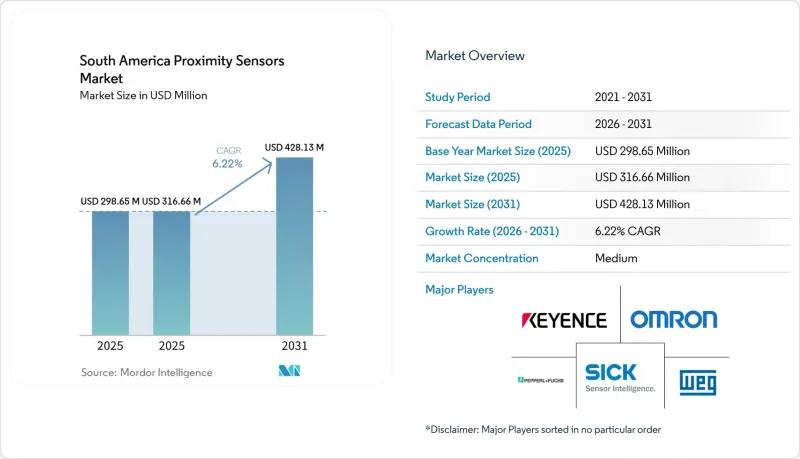
根據 Mordor Intelligence 預測,南美接近感測器市場規模將從 2025 年的 2.9865 億美元成長到 2026 年的 3.1666 億美元,然後在 2031 年達到 4.2813 億美元,2026 年至 2031 年的複合成長率為 6.22%。
南美洲接近感測器市場趨勢與洞察
工業自動化和工業4.0的改裝實施
巴西廣泛採用可透過基礎感測和控制設備進行升級的製造設備。這種情況支撐了工廠增加自動化功能後所產生的升級需求。因此,南美洲接近感測器市場不僅受惠於新建工廠,也受惠於改裝工程。由於許多現有的可程式邏輯控制器 (PLC) 系統使用數位輸入,因此最初的改裝投資可能集中在電感式產品上。這種部署基礎可能會減緩連網感測器介面的廣泛應用,直到工廠也升級其網路基礎設施。即使在最初的現代化改造專案完成後,更換週期也可能繼續。
製造商可以在進行大規模資本投資項目之前,先試行自動化生產單位。此過程支援分階段升級,並滿足後續的感測器更換需求。哥倫比亞政府主導的計畫可以將類似的活動推廣到二級工業區。阿根廷對自動化硬體折舊免稅額方案的調整,將稅收回收期從七年縮短至三年(2024年生效)。這項政策變化有望提高先前因故推遲的工廠升級的經濟可行性。這些因素正在推動南美接近感測器市場出現廣泛但不平衡的現代化進程。
汽車電氣化和先進的組裝自動化
預計到2025年,巴西的汽車產量將達到230萬輛,繼續保持其作為該地區主要製造地的地位。汽車組裝廠需要零件的存在檢測、定位、焊接控制和自動化物料輸送。電動車(EV)的生產在此基礎上增加了電池模組、鋁製結構以及更精密的焊接工序。這就產生了對感測器的需求,其規格與傳統內燃機組裝所使用的感測器有所不同。因此,隨著汽車製造商在當地擴大電動和混合動力汽車的生產,南美洲的接近感測器市場有望受益於工廠設備的升級。此外,隨著新的生產線在當地零件網路中不斷擴展,汽車零件供應商也將需要相容的設備。
與2025年同期相比,2026年前五個月巴西新電動車註冊量顯著成長。比亞迪正在擴建其位於卡馬卡利(Camacali)的工廠,以期在2026年底前提高年產能。該公司還計劃提高在地採購率,這有望吸引更多零件製造企業落腳巴西國內供應鏈。博世正在巴西投資生產電動和混合動力汽車零件。這些投資可能會增加汽車製造廠和供應商對感測設備的需求。未來,本地化生產可望降低對組裝進口的依賴。
自動化初始成本高,投資回收期長
許多中小型製造商在批准自動化單元專案之前,需要仔細審查其總成本。這些成本包括感測器、佈線、可程式邏輯控制器 (PLC)、試運行、軟體和系統整合。這些費用可能超過通常作為投資核准標準的 4-5 年投資回收期。進口成本會進一步推高區域買家的自動化平台價格,這可能導致大型企業(擁有更雄厚的資金籌措能力)集中採用這些平台。因此,南美洲的接近感測器市場面臨中小型買家專案決策延遲的風險。
資金籌措成本會推高購置資本設備的成本。雖然政府貸款專案可以緩解部分資金籌措壓力,但藉貸仍需要有投資回報的保證。本地系統整合商並非總是向潛在客戶量化展示聯網感測器的維護價值。這限制了高階診斷設備的價值認知。扶持計畫可以為正規工業企業提供部分援助,但小規模、非正規的製造商可能仍被排除在這些援助範圍之外。
細分市場分析
2025年,電感式接近感測器在南美洲接近感測器市場佔據38.82%的佔有率。這一市場佔有率反映了其在汽車行業的沖壓、焊接和組裝設備中的長期應用。這些應用需要即使在油霧和冷卻液環境中也能可靠地檢測金屬目標。該地區現有的可程式邏輯控制器(PLC)通常支援NPN或PNP數位輸入。因此,電感式設備可以在現有的佈線和控制系統中運行,使其成為棕地升級的理想選擇。電感式產品在南美洲接近感測器市場的規模得益於其在離散製造設備中的廣泛應用。此外,其成熟的應用也使其成為工廠維護團隊的常用選擇。
預計到2031年,超音波感測器的年複合成長率將達到6.78%。由於其能夠檢測非金屬目標,因此在灌裝、輸送機監控和農業物料處理等領域具有廣泛的應用。在食品飲料行業,當僅靠金屬檢測不足以滿足製程要求時,這些感測器可以發揮作用。遠距離超音波產品也被用於採礦設備,以應對惡劣環境下的檢測任務。 Banner Engineering提供適用於嚴苛清潔環境的IP69K不銹鋼超音波感測器。電容式感測器用於檢測散裝固體和液體的液位,而光電式和磁性產品則滿足特定的定位檢測需求。紅外線和其他技術雖然應用範圍小規模,但它們與電子和穿戴式裝置的組裝密切相關。
到2025年,固定距離感測器將佔產品類型銷售額的61.74%。其低成本和可靠的運作特性使其適用於大量生產環境。固定切換距離感測器常用於汽車車身修理廠、填充生產線和礦物輸送機。在這些場所,產品尺寸通常明確,設備佈局也較為穩定。因此,南美洲整個接近感測器市場對固定距離產品的需求持續強勁。此外,此類別產品也非常適合注重易於更換和既定規格的維護方案。其強勁的銷售動能反映了固定式感測器在全部區域廣泛的應用。
預計到2031年,可變距離感測器的複合年成長率將達到7.02%。在產品種類繁多的食品生產線和處理多個平台的電動車工廠中,無需物理調整即可更改設定的能力至關重要。具備IO-Link參數化功能的產品可在生產線變更期間進行遠端配置。長城汽車計劃在2026年從其位於巴西伊拉塞馬波利斯的工廠銷售8萬輛汽車,該工廠已於4月開始實施三班制生產。產量的提高可能會提升靈活控制配置的價值。供應商可以透過提供特定應用的參數集以及預先認證的感測器型號來獲得競爭優勢。這種方法減少了在變更過程中修改感測器安裝和接線的需要。
到2025年,0-20毫米檢測範圍的感測器將佔總銷售額的45.72%。此範圍廣泛應用於工廠常見任務,例如偵測零件是否存在以及確認行程結束。汽車組裝工裝和食品包裝輸送機通常需要短距離檢測。此外,氣壓也使用該檢測範圍進行重複位置驗證。這些常見應用支撐了南美洲短距離接近感測器市場的規模。該類別受益於其與全部區域大規模生產的設備的相關性。其市場規模反映了現有工業工廠中緊湊型檢測任務的廣泛應用。
預計到2031年,探測範圍超過40毫米的感測器將以6.75%的複合年成長率成長。採礦和散裝物料搬運需要對大型設備和輸送機周圍進行遠距離偵測。自動裝載機和運輸卡車所需的探測架構不能只依賴短距離引導設計。羅米納礦地下裝載機的部署以及克拉貝科礦卡車車隊的建設,都反映了秘魯自動化程度的不斷提高。遠距離探測的需求可能會推動具有強大防護等級的超音波和光電產品的發展。這也可能促使供應商在該地區擴展其符合IP68和IP69K標準的產品線。 20-40毫米的探測範圍在致動器回饋和機器人單元防護應用中仍然發揮著至關重要的作用。
其他好處:
- Excel格式的市場預測(ME)表
- 3個月的分析師支持
目錄
第1章:引言
- 研究假設和市場定義
- 調查範圍
第2章:調查方法
第3章執行摘要
第4章 市場狀況
- 市場概覽
- 市場促進因素
- 透過工業自動化和工業4.0實施改裝
- 汽車電氣化和先進的組裝自動化
- 採礦自動化和自主設備的引入
- 食品、飲料和包裝產業的衛生自動化
- 巴西電力岸上與工業現代化
- 現場感測器組裝和銷售代理主導的供應系統
- 市場限制因素
- 自動化技術初始成本高,投資回收期長。
- 進口依賴性和外匯波動
- 合格的性能驗證和維護技術人員短缺
- 危險和清潔環境的認證前置作業時間
- 宏觀經濟因素對市場的影響
- 產業價值鏈分析
- 監理展望
- 技術展望
- 波特五力分析
- 投資與資金籌措分析
第5章 市場規模與成長預測
- 透過技術
- 歸納法
- 電容式
- 光電
- 磁性(霍爾效應和引線)
- 超音波
- 紅外線和其他技術
- 依產品類型
- 固定距離感測器
- 距離可調式感測器
- 檢測範圍
- 0~20 mm
- 20~40 mm
- 超過 40 毫米
- 住宅/外形規格
- 圓柱形
- 長方形
- 插槽/頻道
- 微型/PCB安裝型
- 環形和對射式
- 透過生產方法
- 數字(NPN/PNP)
- 模擬量(0-10V/4-20mA)
- IO-Link 無線智慧介面
- 按類型進行頻道佈線
- 兩線制交流/直流
- 三線直流
- 四線互補型
- 按最終用戶行業分類
- 航太/國防
- 車
- 工業自動化與機器人技術
- 家用電子電器和穿戴式裝置
- 食品/飲料加工
- 醫療保健和醫療設備
- 建築自動化和智慧基礎設施
- 採礦業、農業和海洋產業
- 國家
- 巴西
- 阿根廷
- 智利
- 哥倫比亞
- 秘魯
- 其他南美國家
第6章 競爭情勢
- 市場集中度
- 策略趨勢
- 市佔率分析
- 公司簡介
- Keyence Corporation
- Omron Corporation
- SICK AG
- Pepperl+Fuchs SE
- WEG SA
- Honeywell International Inc.
- Schneider Electric SE
- Rockwell Automation, Inc.
- ifm electronic GmbH
- Hans Turck GmbH & Co. KG
- Autonics Corporation
- Balluff GmbH
- Banner Engineering Corp.
- Baumer Holding AG
- Leuze electronic GmbH+Co. KG
- Festo SE & Co. KG
- Sensata Technologies Holding plc
- Carlo Gavazzi Holding AG
- Contrinex AG
- Panasonic Holdings Corporation
- Siemens AG
- ABB Ltd
- Emerson Electric Co.
- Rechner Sensors GmbH
- di-soric GmbH & Co. KG
第7章 市場機會與未來展望
According to Mordor Intelligence, the South America proximity sensors market size is expected to grow from USD 298.65 million in 2025 to USD 316.66 million in 2026 and is forecast to reach USD 428.13 million by 2031 at 6.22% CAGR over 2026-2031.
South America Proximity Sensors Market Trends and Insights
Industrial Automation and Industry 4.0 Retrofit Adoption
Brazil has a broad installed base of manufacturing equipment that can be upgraded with basic detection and control devices. These conditions support replacement demand as plants add automated functions. The South America proximity sensors market, therefore, benefits from retrofit projects as well as new factory installations. Inductive products are likely to receive initial retrofit spending because many existing programmable logic controller systems use digital inputs. This installed base can delay wider adoption of connected sensor interfaces until plants also upgrade their network infrastructure. The replacement cycle can continue after initial modernization projects are completed.
Manufacturers can test automated production cells before committing to larger capital projects. That process can support incremental upgrades and later demand for replacement sensors. Government-backed programs in Colombia can extend similar activity into secondary industrial locations. Argentina's depreciation changes for automation hardware shortened the tax recovery period from 7 years to 3 years in 2024. The policy change can improve the financial case for plant upgrades that had been postponed. These factors support a broad but uneven modernization cycle across the South America proximity sensors market.
Automotive Electrification and Advanced Assembly Automation
Brazil produced 2.3 million vehicles in 2025 and remained a major regional manufacturing center. Vehicle assembly plants require part-presence detection, position confirmation, welding controls, and automated material handling. Electric vehicle production adds battery modules, aluminum structures, and more precise welding tasks to those requirements. This creates demand for sensor specifications that differ from conventional combustion-engine assembly lines. The South America proximity sensors market can therefore gain from plant retooling as vehicle makers raise local electric and hybrid production. Automotive suppliers also need compatible devices as new production lines extend through the local parts network.
Brazil's electric vehicle registrations increased significantly during the first five months of 2026 compared with the same period in 2025. BYD is expanding its Camacari facility to increase its annual production capacity by the end of 2026. The company also plans to increase local content, which could attract additional component manufacturing to domestic supply chains. Bosch is investing in Brazil to manufacture electric and hybrid vehicle components. These investments could increase demand for sensing equipment across vehicle manufacturing plants and supplier facilities. Over time, local production could also reduce reliance on fully assembled imported vehicles.
High Upfront Automation Costs and Extended Payback Periods
Many smaller manufacturers must assess the full cost of an automation cell before approving a project. That cost can include sensors, wiring, programmable logic controllers, commissioning, software, and systems integration. These expenses can extend payback beyond the 4-5 year period that often guides investment approval. Import costs can further increase the price of automation platforms for regional buyers. This can concentrate adoption among larger companies with better access to finance. The South America proximity sensors market is consequently exposed to slower project decisions among smaller buyers.
Financing costs can increase the cost of capital equipment purchases. Public credit programs can reduce some funding pressure, but borrowing still requires a credible return from the investment. Local integrators may not always quantify the maintenance value of connected sensors for prospective buyers. This limits the perceived value of premium devices that provide diagnostic information. Support programs can provide partial assistance for formal industrial enterprises. Smaller and informal manufacturers can remain outside their reach.
Other drivers and restraints analyzed in the detailed report include:
- Mining Automation and Autonomous Equipment Deployment
- Food, Beverage, and Packaging Hygienic Automation
- Import Dependence and Foreign-Exchange Volatility
For complete list of drivers and restraints, kindly check the Table Of Contents.
Segment Analysis
Inductive proximity sensors held 38.82% of the South America proximity sensors market share in 2025. Their position reflected long-standing use in automotive stamping, welding, and assembly equipment. These applications require dependable detection of metallic targets under oil mist and coolant exposure. The region's existing programmable logic controller base is commonly configured for NPN or PNP digital inputs. This makes inductive devices practical for brownfield replacements because they can work within existing wiring and controls. The South America proximity sensors market size for inductive products is supported by a large installed base of discrete manufacturing equipment. Their established use also makes them a familiar choice for plant maintenance teams.
Ultrasonic sensors are projected to expand at a 6.78% CAGR through 2031. Their ability to detect non-metallic targets makes them useful in filling, conveyor monitoring, and agricultural material handling. Food and beverage applications can use them where metal-only detection does not meet the process need. Mining equipment can also use longer-range ultrasonic products for detection tasks in rugged areas. Banner Engineering offers stainless-steel IP69K ultrasonic sensors for demanding washdown applications. Capacitive sensors serve bulk solids and liquid-level tasks, while photoelectric and magnetic products address specialized position detection needs. Infrared and other technologies remain smaller categories that are linked to electronics and wearable-device assembly.
Fixed-distance sensors accounted for 61.74% of product-type revenue in 2025. Their lower cost and dependable operating point suit high-volume production environments. Automotive body shops, bottling lines, and mineral conveyors often use fixed switching distances. These facilities usually operate with defined product dimensions and stable equipment layouts. This supports continued demand for fixed-distance products across the South America proximity sensors market. The category also fits maintenance programs that value simple replacement and established specifications. Its strong revenue position reflects the prevalence of fixed-format production across the region.
Adjustable-distance sensors are projected to expand at a 7.02% CAGR through 2031. Mixed-SKU food lines and multi-platform electric-vehicle plants require settings that can change without physical adjustment. Products with IO-Link parameterization can allow remote configuration during line changes. GWM planned 80,000 vehicle sales in Brazil in 2026 from its Iracemapolis operation, which entered 3-shift production in April. Higher production cadence can increase the value of flexible control settings. Vendors can compete by providing application-specific parameter sets with pre-certified sensor models. This approach can reduce the need to change sensor mounting or wiring during retrofits.
The 0-20 mm sensing range category held 45.72% of revenue in 2025. This range serves common factory tasks such as part-presence detection and end-of-stroke confirmation. Automotive assembly jigs and food packaging conveyors commonly require short-distance detection. Pneumatic cylinders also use this range for repeated position confirmation. These familiar applications underpin the South America proximity sensors market size for short-range devices. The category benefits from its relevance to high-volume equipment throughout the region. Its scale reflects the wide use of compact detection tasks in established industrial plants.
Sensors with a range greater than 40 mm are projected to expand at a 6.75% CAGR through 2031. Mining and bulk material handling require longer-range detection around large equipment and conveyors. Autonomous loaders and haul trucks require sensing architectures that cannot rely only on short-range inductive designs. The Romina underground loader deployment and Quellaveco truck fleet demonstrate the wider automation context in Peru. Longer-range demand can favor ultrasonic and photoelectric products with rugged protection ratings. It can also encourage suppliers to expand IP68 and IP69K product portfolios in the region. The 20-40 mm category retains a role in actuator feedback and robot-cell guarding.
Complete Report Scope:
- By Technology
- Inductive
- Capacitive
- Photoelectric
- Magnetic (Hall-Effect and Reed)
- Ultrasonic
- Infrared and Other Technologies
- By Product Type
- Fixed-Distance Sensors
- Adjustable-Distance Sensors
- By Sensing Range
- 0-20 mm
- 20-40 mm
- Greater Than 40 mm
- By Housing / Form Factor
- Cylindrical
- Rectangular
- Slot / Channel
- Miniature / PCB-Mount
- Ring and Through-Beam
- By Output Type
- Digital (NPN / PNP)
- Analog (0-10 V / 4-20 mA)
- IO-Link and Other Smart Interfaces
- By Channel Wiring
- 2-Wire AC/DC
- 3-Wire DC
- 4-Wire Complementary
- By End-User Industry
- Aerospace and Defense
- Automotive
- Industrial Automation and Robotics
- Consumer Electronics and Wearables
- Food and Beverage Processing
- Healthcare and Medical Devices
- Building Automation and Smart Infrastructure
- Mining, Agriculture, and Marine Industries
- By Country
- Brazil
- Argentina
- Chile
- Colombia
- Peru
- Rest of South America
List of Companies Covered in this Report:
- Keyence Corporation
- Omron Corporation
- SICK AG
- Pepperl+Fuchs SE
- WEG S.A.
- Honeywell International Inc.
- Schneider Electric SE
- Rockwell Automation, Inc.
- ifm electronic GmbH
- Hans Turck GmbH & Co. KG
- Autonics Corporation
- Balluff GmbH
- Banner Engineering Corp.
- Baumer Holding AG
- Leuze electronic GmbH + Co. KG
- Festo SE & Co. KG
- Sensata Technologies Holding plc
- Carlo Gavazzi Holding AG
- Contrinex AG
- Panasonic Holdings Corporation
- Siemens AG
- ABB Ltd
- Emerson Electric Co.
- Rechner Sensors GmbH
- di-soric GmbH & Co. KG
Additional Benefits:
- The market estimate (ME) sheet in Excel format
- 3 months of analyst support
TABLE OF CONTENTS
1 INTRODUCTION
- 1.1 Study Assumptions and Market Definition
- 1.2 Scope of the Study
2 RESEARCH METHODOLOGY
3 EXECUTIVE SUMMARY
4 MARKET LANDSCAPE
- 4.1 Market Overview
- 4.2 Market Drivers
- 4.2.1 Industrial Automation and Industry 4.0 Retrofit Adoption
- 4.2.2 Automotive Electrification and Advanced Assembly Automation
- 4.2.3 Mining Automation and Autonomous Equipment Deployment
- 4.2.4 Food, Beverage, and Packaging Hygienic Automation
- 4.2.5 Brazil-Based Powershoring and Industrial Modernization
- 4.2.6 Localized Sensor Assembly and Distributor-Led Availability
- 4.3 Market Restraints
- 4.3.1 High Upfront Automation Costs and Extended Payback Periods
- 4.3.2 Import Dependence and Foreign-Exchange Volatility
- 4.3.3 Shortage of Certified Commissioning and Maintenance Engineers
- 4.3.4 Certification Lead Times for Hazardous and Washdown Environments
- 4.4 Impact of Macroeconomic Factors on the Market
- 4.5 Industry Value Chain Analysis
- 4.6 Regulatory Outlook
- 4.7 Technological Outlook
- 4.8 Porter's Five Forces Analysis
- 4.8.1 Threat of New Entrants
- 4.8.2 Bargaining Power of Buyers
- 4.8.3 Bargaining Power of Suppliers
- 4.8.4 Threat of Substitute Products
- 4.8.5 Intensity of Competitive Rivalry
- 4.9 Investment and Funding Analysis
5 MARKET SIZE AND GROWTH FORECASTS (VALUE)
- 5.1 By Technology
- 5.1.1 Inductive
- 5.1.2 Capacitive
- 5.1.3 Photoelectric
- 5.1.4 Magnetic (Hall-Effect and Reed)
- 5.1.5 Ultrasonic
- 5.1.6 Infrared and Other Technologies
- 5.2 By Product Type
- 5.2.1 Fixed-Distance Sensors
- 5.2.2 Adjustable-Distance Sensors
- 5.3 By Sensing Range
- 5.3.1 0-20 mm
- 5.3.2 20-40 mm
- 5.3.3 Greater Than 40 mm
- 5.4 By Housing / Form Factor
- 5.4.1 Cylindrical
- 5.4.2 Rectangular
- 5.4.3 Slot / Channel
- 5.4.4 Miniature / PCB-Mount
- 5.4.5 Ring and Through-Beam
- 5.5 By Output Type
- 5.5.1 Digital (NPN / PNP)
- 5.5.2 Analog (0-10 V / 4-20 mA)
- 5.5.3 IO-Link and Other Smart Interfaces
- 5.6 By Channel Wiring
- 5.6.1 2-Wire AC/DC
- 5.6.2 3-Wire DC
- 5.6.3 4-Wire Complementary
- 5.7 By End-User Industry
- 5.7.1 Aerospace and Defense
- 5.7.2 Automotive
- 5.7.3 Industrial Automation and Robotics
- 5.7.4 Consumer Electronics and Wearables
- 5.7.5 Food and Beverage Processing
- 5.7.6 Healthcare and Medical Devices
- 5.7.7 Building Automation and Smart Infrastructure
- 5.7.8 Mining, Agriculture, and Marine Industries
- 5.8 By Country
- 5.8.1 Brazil
- 5.8.2 Argentina
- 5.8.3 Chile
- 5.8.4 Colombia
- 5.8.5 Peru
- 5.8.6 Rest of South America
6 COMPETITIVE LANDSCAPE
- 6.1 Market Concentration
- 6.2 Strategic Moves
- 6.3 Market Share Analysis
- 6.4 Company Profiles (includes Global Level Overview, Market Level Overview, Core Segments, Financials as available, Strategic Information, Market Rank/Share, Products and Services, Recent Developments)
- 6.4.1 Keyence Corporation
- 6.4.2 Omron Corporation
- 6.4.3 SICK AG
- 6.4.4 Pepperl+Fuchs SE
- 6.4.5 WEG S.A.
- 6.4.6 Honeywell International Inc.
- 6.4.7 Schneider Electric SE
- 6.4.8 Rockwell Automation, Inc.
- 6.4.9 ifm electronic GmbH
- 6.4.10 Hans Turck GmbH & Co. KG
- 6.4.11 Autonics Corporation
- 6.4.12 Balluff GmbH
- 6.4.13 Banner Engineering Corp.
- 6.4.14 Baumer Holding AG
- 6.4.15 Leuze electronic GmbH + Co. KG
- 6.4.16 Festo SE & Co. KG
- 6.4.17 Sensata Technologies Holding plc
- 6.4.18 Carlo Gavazzi Holding AG
- 6.4.19 Contrinex AG
- 6.4.20 Panasonic Holdings Corporation
- 6.4.21 Siemens AG
- 6.4.22 ABB Ltd
- 6.4.23 Emerson Electric Co.
- 6.4.24 Rechner Sensors GmbH
- 6.4.25 di-soric GmbH & Co. KG
7 MARKET OPPORTUNITIES AND FUTURE OUTLOOK
- 7.1 White-Space and Unmet-Need Assessment

 接近感測器:市場佔有率分析、產業趨勢與統計、成長預測(2026-2031)
 接近感測器市場報告:按技術、檢測範圍、終端用戶產業和地區分類(2026-2034 年)
 鐵接近感測器市場報告:趨勢、預測和競爭分析(至2035年)
 全球接近感測器市場規模、佔有率、趨勢和成長分析報告(2026-2034)
 接近感測器市場規模、佔有率和成長分析:按技術、產品類型和產業預測,2026-2033年
 智慧型手機接近感測器市場規模、佔有率和成長分析:按感測器類型、智慧型手機類別、應用、技術、銷售管道和地區分類 - 2026-2033 年行業預測
 行動電話接近感測器市場規模、佔有率和成長分析:按產品類型、功能、技術類型、最終用戶產業和地區分類 - 2026-2033 年產業預測
 食品業接近接近感測器市場規模、佔有率和成長分析:按感測器類型、應用領域、技術採用狀況、最終用戶、地區和產業預測,2026-2033年
 近發引信感測器市場規模、佔有率和成長分析:按產品類型、技術、應用、最終用戶和地區分類-2026-2033年產業預測全球定位和接近感測器市場規模、佔有率、趨勢和成長分析報告(2026-2034)